Findemails.com Toofr vs Apollo.io: Which Wins in 2026?
Findemails.com (formerly Toofr) is a lean email-lookup tool. Apollo.io is a full sales platform with a 275M-contact database. Here is the honest breakdown of cost, accuracy, and who each one actually fits.
Findemails.com Toofr vs Apollo.io is really one question: do you want a cheap email lookup, or a full sales platform? Findemails.com (formerly Toofr) resolves emails for a list you already have. Apollo.io finds the people too, and charges per seat to do it. Here is how the two compare on cost, accuracy, and fit.
TL;DR
- Findemails.com (formerly Toofr) is a narrow, cheap email-lookup and verification tool. It does one job, charges per credit, and does not try to be your CRM.
- Apollo.io is a full go-to-market platform: a 275M+ contact database, sequencing, dialer, CRM sync, and intent signals. It is priced per seat, which is where the bill grows.
- If you need emails only, Apollo is overkill and Findemails is under-powered on coverage. A dedicated API-first finder usually beats both on cost-per-valid-email.
- Apollo wins on breadth and filtering. Findemails wins on simplicity and no per-seat lock-in. Neither publishes an independently audited accuracy number.
- Verify before you send, whatever the source. Both tools return catch-all and role addresses. Those quietly damage your sender reputation.
Findemails.com Toofr vs Apollo.io: what is each tool?#
Two tools that both put email addresses in your CSV, built on completely different business models.
Findemails.com started life as Toofr, a solo-founder project by Ryan Buckley. It grew into a lightweight email-finding and verification service. It rebranded to Findemails.com but kept the Toofr DNA: guess-and-verify pattern matching, bulk CSV upload, a simple API, and credit-based pricing. There is no sequencer, no dialer, no intent data. You put in a name and a company, you get an email and a confidence score.
Apollo.io is the opposite bet. It bundles a very large contact and company database with sequencing, a power dialer, LinkedIn extension, meeting scheduler, conversation intelligence, and two-way CRM sync. Apollo sells itself as the single system your SDR team lives in. It prices accordingly: per seat, per month, with credit caps on top.
The practical distinction: Findemails is a lookup utility, Apollo is a platform. Compare them head-to-head only if you have not yet picked which of those two you need.
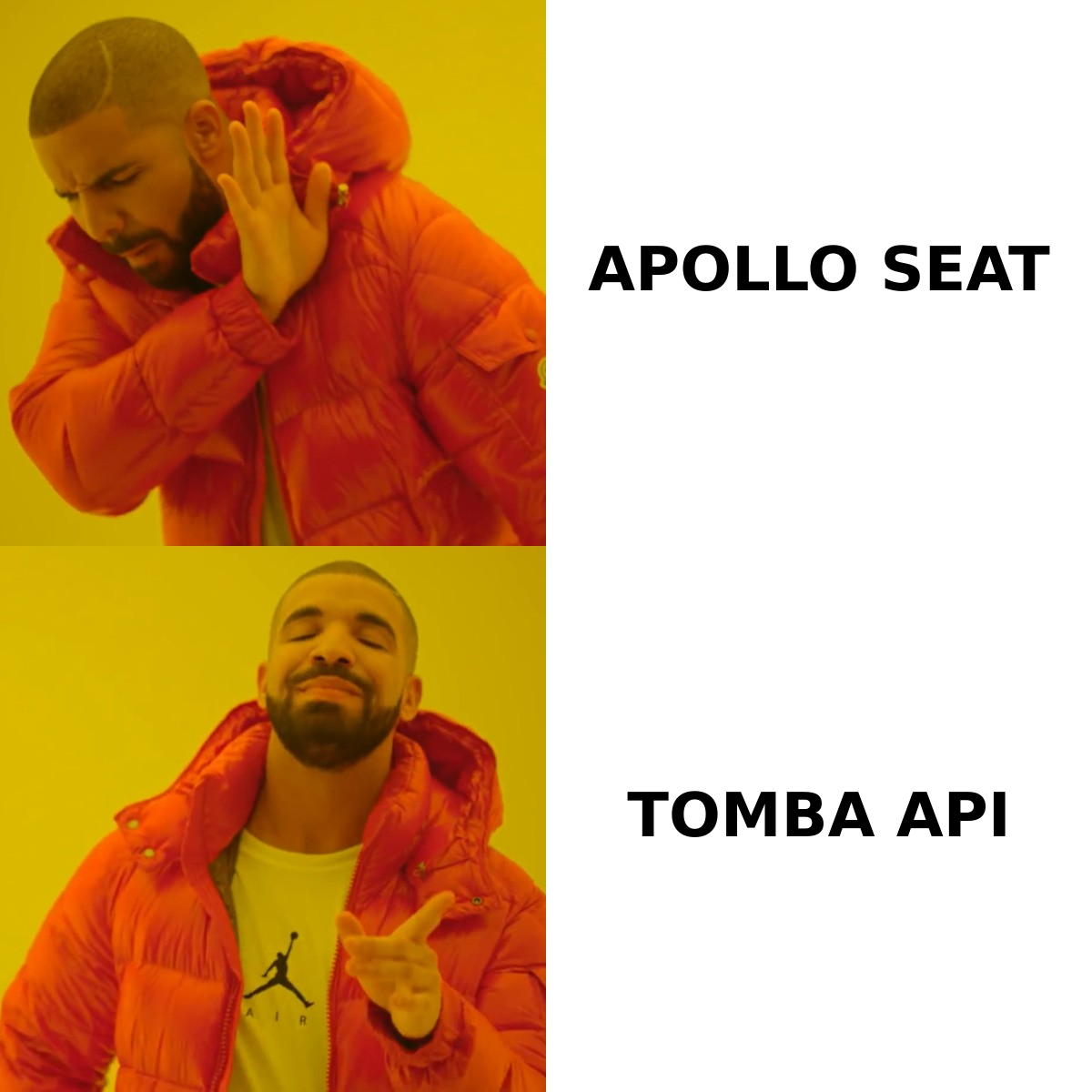
How do Findemails and Apollo.io compare on features and price?#
Here is the side-by-side, with a third column for the API-first approach so you can see where a dedicated finder lands.
| Attribute | Findemails.com (Toofr) | Apollo.io | Tomba |
|---|---|---|---|
| Core model | Credit-based email lookup | Per-seat GTM platform | Credit-based finder + verifier API |
| Entry price | ~$29/mo starter tier | Free tier, paid from ~$49/user/mo | Free (25 searches/mo), Starter $49/mo |
| Mid tier | ~$99/mo | ~$79–99/user/mo (Professional) | Growth $99/mo |
| Contact database | No standing database | 275M+ contacts, 73M+ companies | 500M+ indexed professional records |
| Email verification | Included | Included, limited on lower tiers | Dedicated verifier + catch-all handling |
| Sequencing / dialer | No | Yes (dialer on higher tiers) | No — integrates with your sender |
| Chrome extension | Limited | Yes, strong LinkedIn support | Yes |
| API access | Yes | Yes, gated by plan | Yes, on every paid plan |
| Bulk CSV enrichment | Yes | Yes, credit-capped | Yes |
| Per-seat cost | None — team shares credits | Yes — the main cost driver | None |
| Best fit | Solo founders, small lists | 5+ rep outbound teams | Devs, agencies, high-volume enrichment |
Two things jump out.
First, Apollo's price is per user. A three-person team on Professional is not $99/mo — it is roughly $300/mo before annual discounts. Findemails and credit-based tools charge for the work, not the headcount. If you have four people who each need occasional lookups, that difference compounds fast.
Second, Findemails has no standing database. It resolves emails on demand using pattern inference plus verification. That is genuinely fine for "I have 300 names and companies, get me the emails." It is useless for "show me every VP of Engineering at Series B fintechs in Berlin." That is a database query, and only Apollo (or a similar data provider) answers it.
Which one finds more valid emails?#
Neither vendor publishes an audited hit rate, so treat every marketing number with suspicion — including the ones on this blog.
What holds up across independent testing patterns:
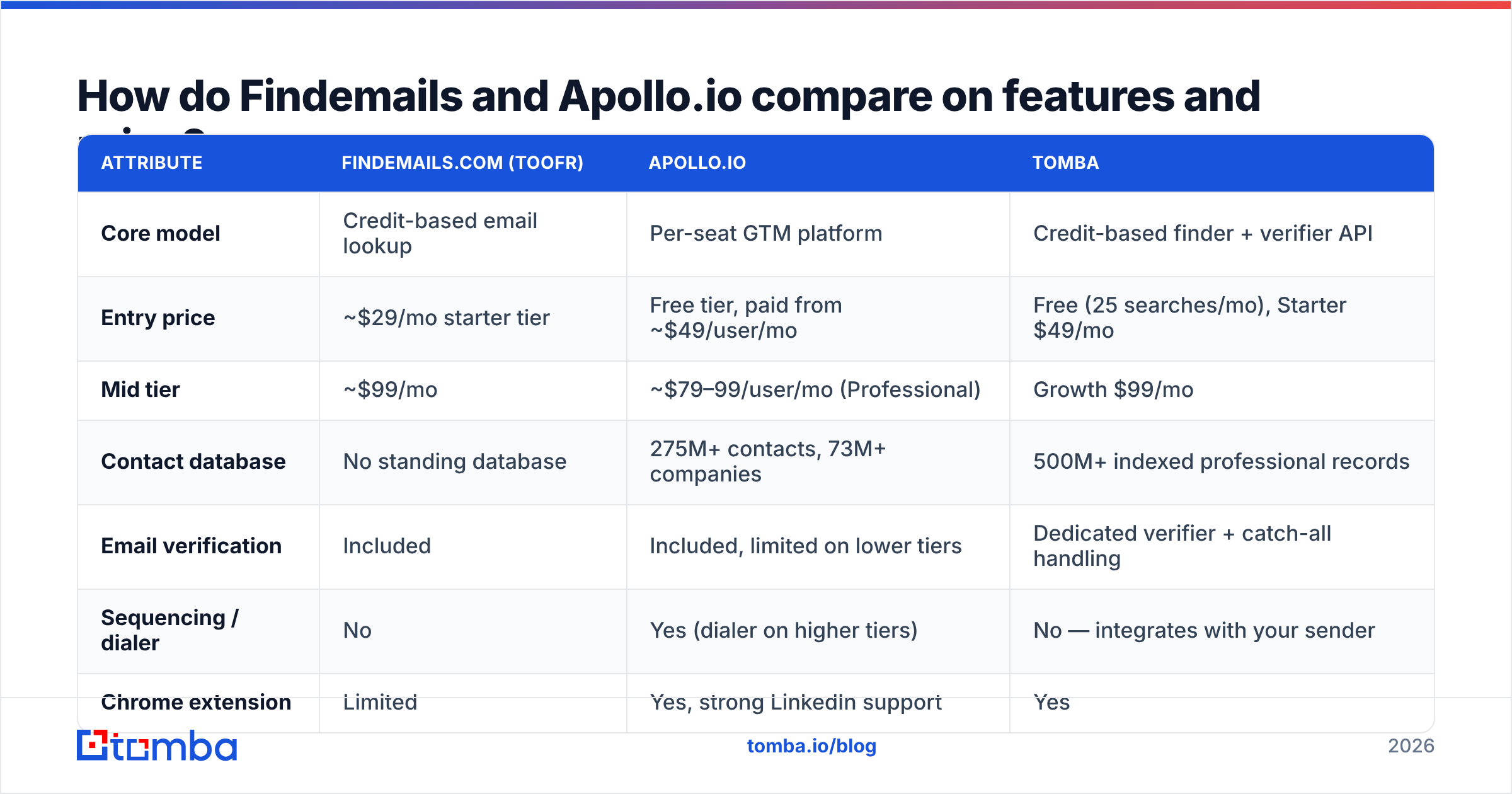
- Apollo has better coverage on well-known companies. Its database is scraped, contributed, and licensed at scale. For a Fortune 5000 target list, you will get a high match rate quickly.
- Apollo's freshness varies sharply by segment. Contributed data ages. Titles and companies that changed 8–14 months ago are a common source of bounces, especially in tech where tenure is short.
- Findemails leans on pattern inference. If a domain uses a consistent format (first.last@, f.last@), it performs well. On domains with mixed or irregular formats, hit rate drops off a cliff.
- Catch-all domains break both. Roughly 15–25% of B2B domains accept all mail at the SMTP layer. A "valid" result there means little on its own. You need a dedicated catch-all verifier to score deliverability separately.
- Role addresses inflate hit rates. info@, sales@, and support@ count as "found" in most vendor stats and are close to worthless for personalized outbound.

The practical implication: your bounce rate is a function of your verification step, not your finder. Run every list through an email verifier before it touches your sending domain. A 4% bounce rate on a new domain gets you throttled by Google and Microsoft within two weeks. The Postmaster Tools guidance on sender requirements is the primary source.
Screenshot placeholder: Apollo.io search filter panel showing job title + headcount + technology filters, next to the Findemails bulk CSV upload screen — the visual gap between "query a database" and "resolve a list" is the whole comparison in one image.
Is Apollo.io worth the per-seat price?#
Yes, if you use more than the database. No, if you only use the database.
Apollo makes economic sense when a rep genuinely lives in it — building lists, sequencing, dialing, logging activity, and syncing to your CRM without leaving the tab. At that point you replace three tools. $99/user/mo is fair next to Outreach or Salesloft, which usually cost more.
Apollo stops making sense in three specific situations:
- You already own a sequencer. If you run Instantly, Smartlead, or Lemlist for sending, Apollo's sequencing is redundant. You are paying platform prices for a data feature. An Instantly alternative analysis usually reaches the same conclusion from the other direction.
- Only one or two people need data. Ops or growth pulls the lists, reps just send. Per-seat pricing punishes that structure — you either over-license or fight over one login.
- You need programmatic enrichment. You may be feeding an internal app, a data warehouse, or an AI agent. That calls for a clean email finder API with predictable per-call pricing, not a UI-first platform where API access sits behind a plan tier.
There is also export and credit friction to price in. Apollo's lower tiers cap exports and gate some fields. Teams often discover mid-quarter that the credit allowance does not match how fast they build lists. Read the credit terms before you commit annually.
Is Findemails.com too basic for a real sales team?#
For a team of five actively prospecting, probably yes — but "basic" is a feature for the right buyer.
Findemails' strengths are real:
- No per-seat tax. Credits are credits. Share them.
- Genuinely simple. Upload CSV, download CSV. No onboarding call, no admin console, no seat management.
- Cheap at the entry point. For a founder validating a market with 500 prospects, it is hard to overspend.
- A working API for basic automation without enterprise procurement.
Its limits are equally real:
- No search-by-criteria. You must already know who you want. That rules out top-of-funnel discovery entirely.
- Thin enrichment. You get an email, not a phone number, seniority, tech stack, or headcount. If you need B2B phone numbers or firmographics, that is a second vendor.
- Small-vendor risk. Fewer engineers means slower response to Gmail and Outlook policy changes, and less aggressive re-crawling of stale records.
- Limited integrations. No deep HubSpot or Salesforce object mapping compared to what Apollo ships.
If your list-building process is "export from LinkedIn Sales Navigator, then find the emails," Findemails covers step two adequately. If discovery itself is the bottleneck, it does not help you.
What are the alternatives to both?#
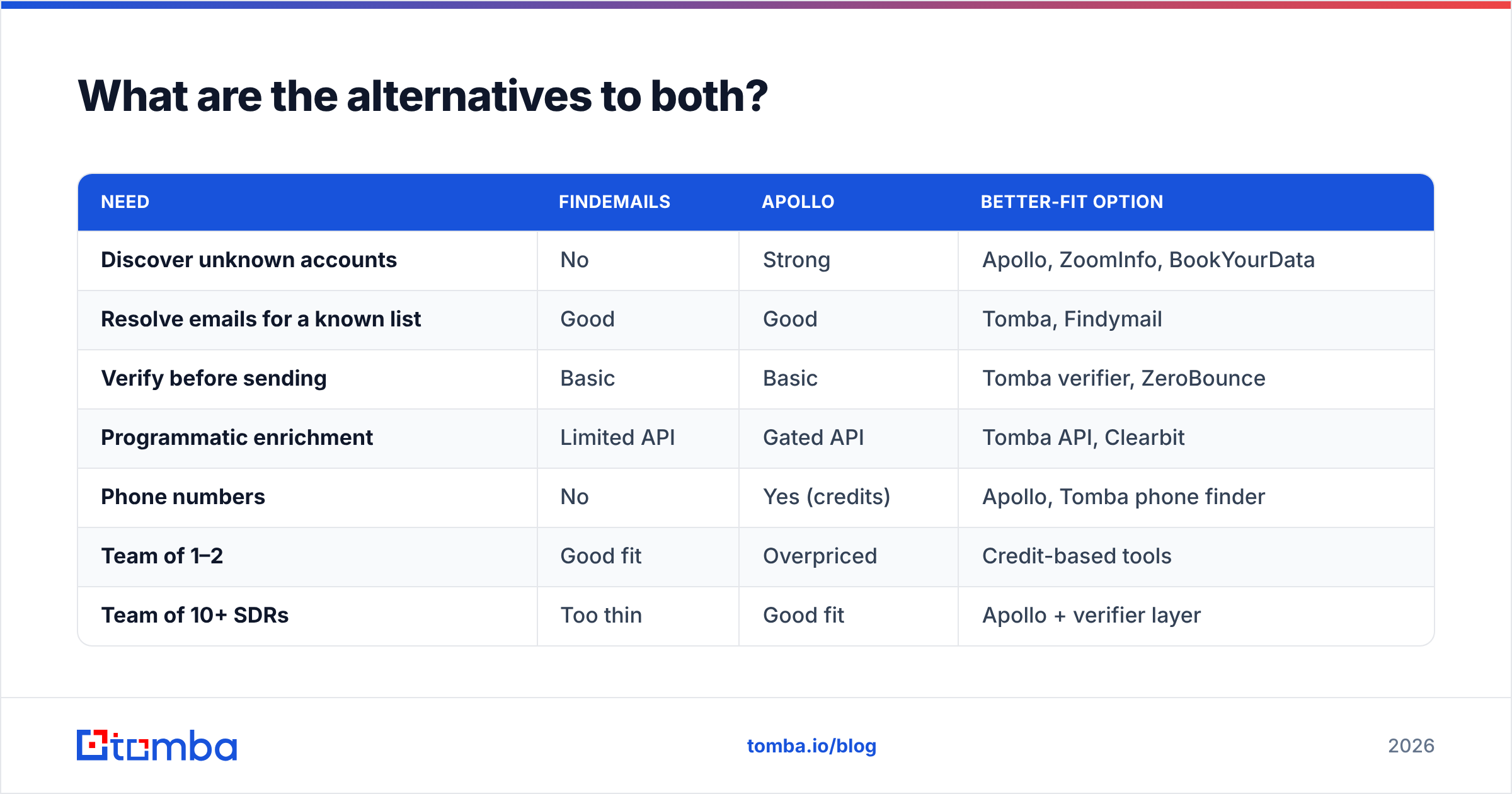
The versus framing hides a third option. Most teams end up with both parts: a database for discovery, plus a dedicated finder-verifier for accuracy and API work.
| Need | Findemails | Apollo | Better-fit option |
|---|---|---|---|
| Discover unknown accounts | No | Strong | Apollo, ZoomInfo, BookYourData |
| Resolve emails for a known list | Good | Good | Tomba, Findymail |
| Verify before sending | Basic | Basic | Tomba verifier, ZeroBounce |
| Programmatic enrichment | Limited API | Gated API | Tomba API, Clearbit |
| Phone numbers | No | Yes (credits) | Apollo, Tomba phone finder |
| Team of 1–2 | Good fit | Overpriced | Credit-based tools |
| Team of 10+ SDRs | Too thin | Good fit | Apollo + verifier layer |
BookYourData is worth a mention for teams that want pre-built, filterable lists. It sells pay-as-you-go rather than by subscription. That is a different purchase shape from both tools here, and a fair option when you need volume without a platform commitment.
Tomba sits deliberately in the middle. It is a Findymail alternative-class finder with a B2B database behind it. It adds a separate verification layer, including catch-all scoring. Pricing is flat credits with no per-seat charge: Free (25 searches/mo), Starter $49/mo, Growth $99/mo, Pro $249/mo. Full Tomba pricing is public — no quote required.

The honest recommendation, by shape of team:
- Solo founder, <1,000 prospects/mo: Findemails or a free finder tier. Do not buy a platform.
- Two-person growth team, no sequencer yet: Apollo's lower tier is defensible — you get discovery and sending in one bill.
- Team with an existing sender (Instantly/Smartlead): Skip Apollo's platform tax. Buy a finder + verifier and pipe it in.
- Engineering-led or agency, high volume: API-first. Per-seat pricing is structurally wrong for your usage pattern.
- Enterprise with ABM motion: Apollo or a heavier data vendor, plus an independent verification layer you control.
Findemails.com Toofr vs Apollo.io: how should you test them?#
Do not trust any comparison post, including this one. Run the same 100-row test list through each tool and score it yourself.
- Build a controlled sample. 100 contacts you can independently confirm — past customers, conference attendees, people who have emailed you. You need ground truth.
- Run all candidates on the identical list. Same names, same domains, same day.
- Score four metrics, not one: match rate, verified-valid rate, role-address share, and actual bounce rate after a real send.
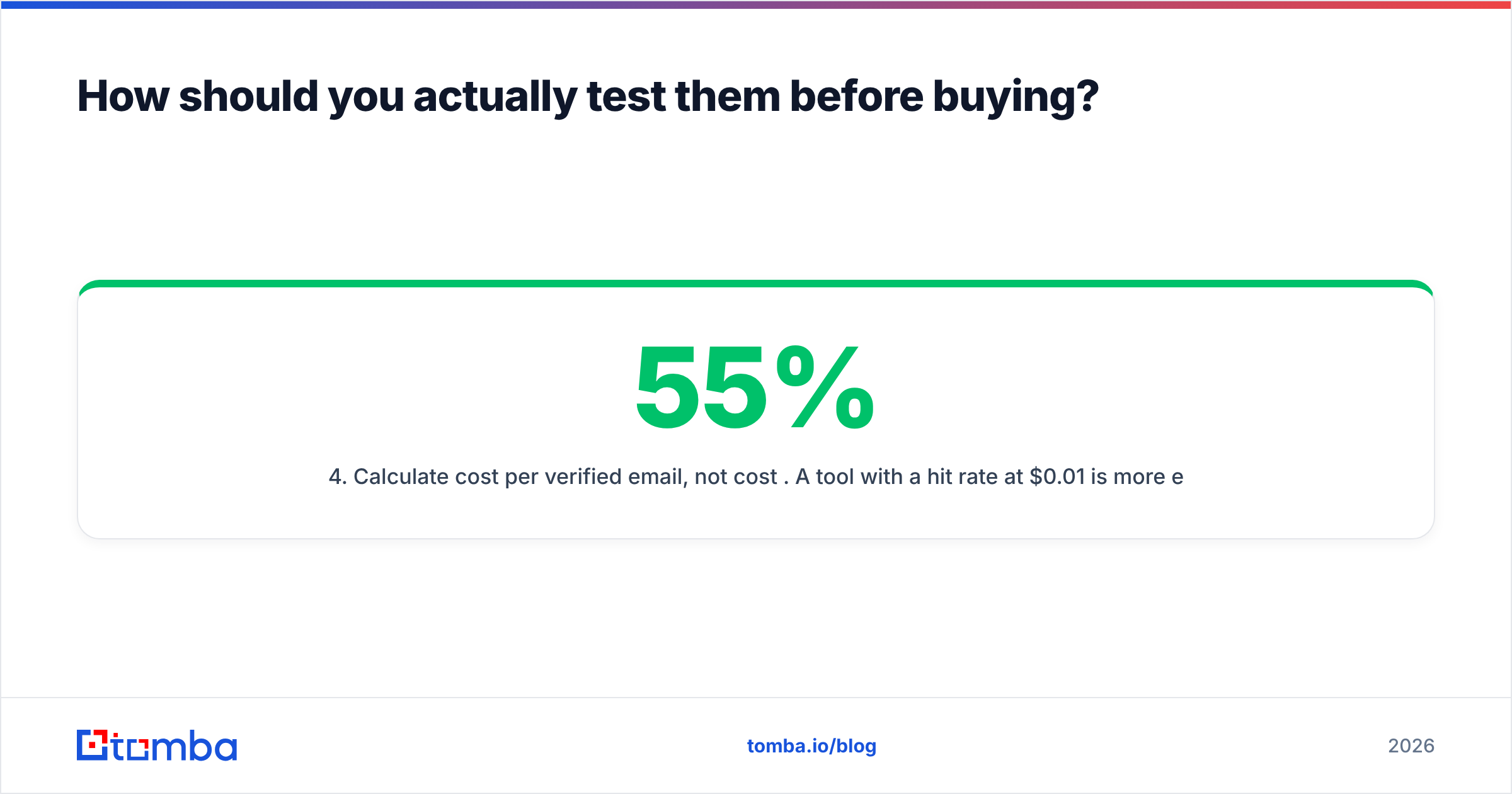
- Calculate cost per verified email, not cost per credit. A tool with a 55% hit rate at $0.01 is more expensive than one with 85% at $0.014.
- Test the catch-all handling explicitly. Include five known catch-all domains and see whether each tool flags them honestly or returns a false "valid."
- Check the export path. Can you get clean CSV out on your plan tier, or is that gated?
That test takes an afternoon. It will save you a year on the wrong annual contract. If you want to shortcut the tooling side, a free email checker lets you spot-check results from any vendor first.
One last note on deliverability. Whichever tool wins your test, your sender reputation depends on list hygiene more than list source. Clean data from a mediocre finder beats dirty data from a great one. Vendor ratings on G2 also help you spot support and billing complaints that never show up in feature tables.
The verdict#
Apollo.io wins if you need discovery plus execution in one system and have the seats to justify it. Findemails.com wins if you need cheap, simple email resolution for a list you already have. They are not really competitors. They answer different questions. Most buyers choose wrong because they compare price tags instead of jobs.
So the Findemails.com Toofr vs Apollo.io answer depends on your job, not on their pricing pages. If that job is "turn names and domains into verified, sendable addresses at predictable cost," neither is the best buy. Start with the Tomba Email Finder: 25 free searches a month, no card, no seat minimums. Its verification layer flags catch-alls instead of pretending they are valid. Run it against the same 100-row test list you use for Apollo and Findemails, then let cost-per-verified-email decide.
Related guides#
Ready to find emails that actually work?
Join 150,000+ professionals who stopped guessing and started sending. Free credits on signup — no credit card required.
Get the Tomba newsletter
Practical outbound tactics and product updates — once every two weeks.
About the author