Finder.io vs HitHorizons: Which B2B Data Tool Wins in 2026
One tool hands you work emails, the other hands you 100M+ registry-verified European company records. Here is where Finder.io and HitHorizons actually overlap, where they don't, and which one belongs in your 2026 stack.
Finder.io vs HitHorizons is a strange matchup. One tool finds work emails. The other maps European company registries. Here is what each one does, what it costs, and which one your team actually needs.
TL;DR
- They are not real competitors. Finder.io finds contacts. It is the email module inside the 500apps suite. HitHorizons searches company data pulled from European business registers. Buy one as a swap for the other and you end up with two half-solutions.
- Pick Finder.io if your bottleneck is "I know the account, I need the person's email."
- Pick HitHorizons if your bottleneck is "I need every EU company in this NACE code, revenue band, and country." It will not hand you named contacts with verified emails.
- Most outbound teams in 2026 need both layers. Registry data builds the target list. A dedicated email finder covers the last mile.
- The cost models differ sharply. Finder.io rides along inside a low-cost suite plan. HitHorizons sells profiles and exports, with a free search tier that is genuinely useful for one-off research.
What is Finder.io and what does it actually do?#
Finder.io is the email-finding module inside 500apps, a bundled suite that packages dozens of business apps under one subscription. Its job is narrow and useful. Give it a domain, or a person plus a company, and it returns a probable work email. You usually get a confidence score, a bulk mode, and a Chrome extension.
The bundle is the real pitch. You are not buying an email finder. You are buying a suite where the finder is one tile, next to CRM, helpdesk, and marketing apps. For a five-person startup that wants one invoice, that is genuinely attractive.
It also explains the most common complaint about suite products on G2 and similar review sites. Depth suffers when one vendor maintains fifty apps. Data freshness, verification quality, and support response times are where suites tend to trail specialists.
What Finder.io does not do: it will not tell you that a German GmbH filed €4.2M in revenue last year. It will not show you that a company in Prague owns three subsidiaries in Slovakia. It has no view into registry filings.
What is HitHorizons and who is it for?#
HitHorizons is a different animal. It is a company search engine covering tens of millions of businesses across Europe. The data comes from official business registers and statistical offices, not scraped web signals. You search by country, industry code (NACE), revenue band, employee count, or company name. Back comes a structured profile: legal name, registration ID, address, industry code, size estimate, and corporate hierarchy.
That registry foundation is the whole value proposition. Sooner or later, someone in compliance, finance, or RevOps asks where a company record came from. Registry-sourced data answers that question. Scraped data cannot. It is also why HitHorizons is popular with market researchers, credit and risk teams, and M&A analysts — not just salespeople.
The tradeoff is just as clear. Registry data describes entities, not people. You will not find "Head of Procurement, maria.novak@..." there. You get the company, its identifiers, and its shape. Turning that into a contactable pipeline takes a second tool.

Finder.io vs HitHorizons: how they compare head to head#
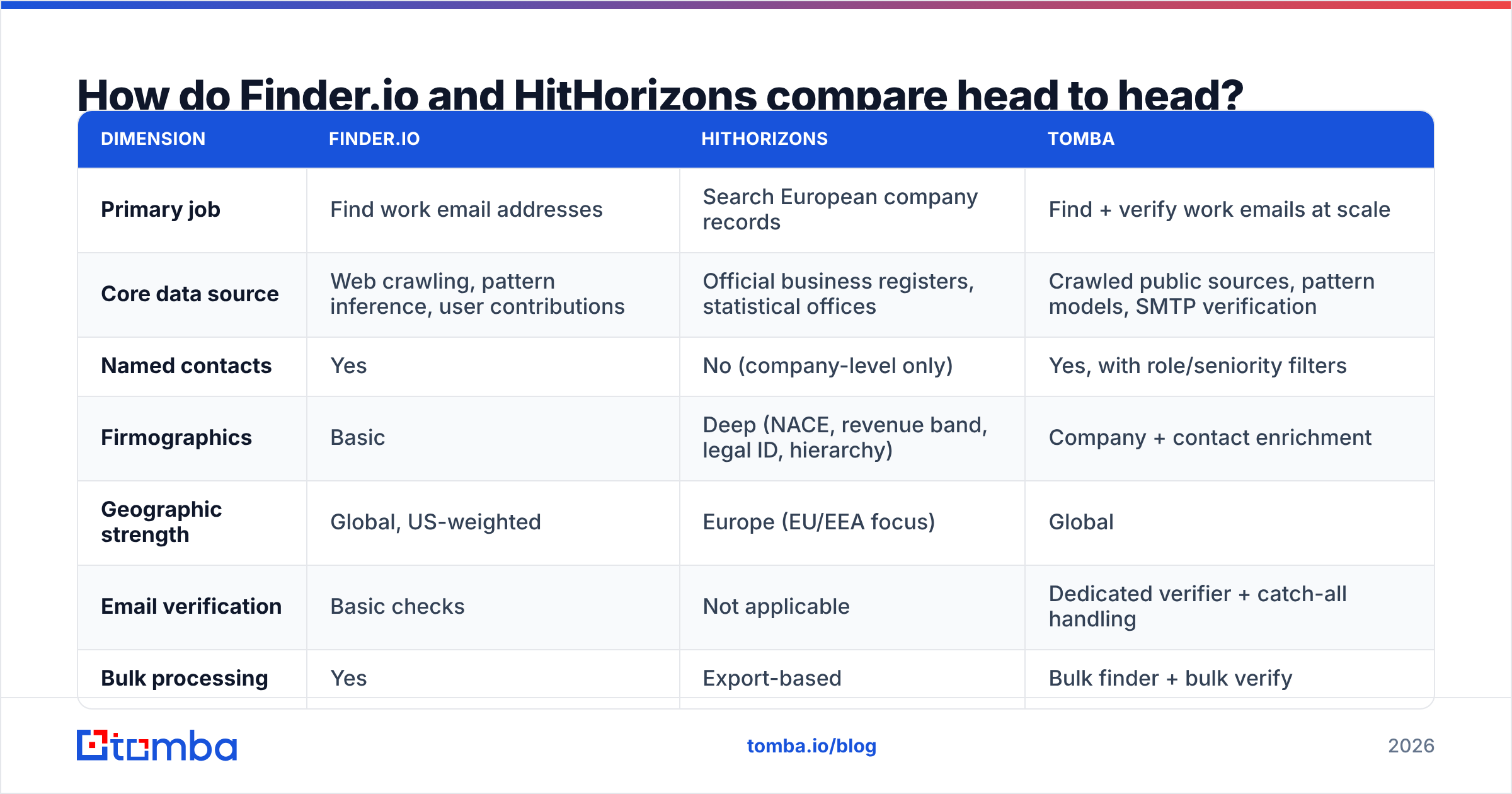
| Dimension | Finder.io | HitHorizons | Tomba |
|---|---|---|---|
| Primary job | Find work email addresses | Search European company records | Find + verify work emails at scale |
| Core data source | Web crawling, pattern inference, user contributions | Official business registers, statistical offices | Crawled public sources, pattern models, SMTP verification |
| Named contacts | Yes | No (company-level only) | Yes, with role/seniority filters |
| Firmographics | Basic | Deep (NACE, revenue band, legal ID, hierarchy) | Company + contact enrichment |
| Geographic strength | Global, US-weighted | Europe (EU/EEA focus) | Global |
| Email verification | Basic checks | Not applicable | Dedicated verifier + catch-all handling |
| Bulk processing | Yes | Export-based | Bulk finder + bulk verify |
| API | Yes | Yes | Yes, documented REST API |
| Free tier | Limited, inside suite trial | Free search with limited detail | 25 searches/mo |
| Entry paid price | Bundled in 500apps subscription | Credit/export based, quote-driven for volume | $49/mo Starter |
| Best for | SMB teams wanting one bundled suite | EU market mapping, risk, research | Outbound teams that need deliverable contacts |
Read that table once and the point jumps out. The two products barely overlap in a single column. Their only shared ground is "B2B data" — which is like calling a fuel pump and a road atlas both "driving tools."
Which one fits your use case?#
Rather than crown a winner, match the tool to the job you are actually hiring it for.
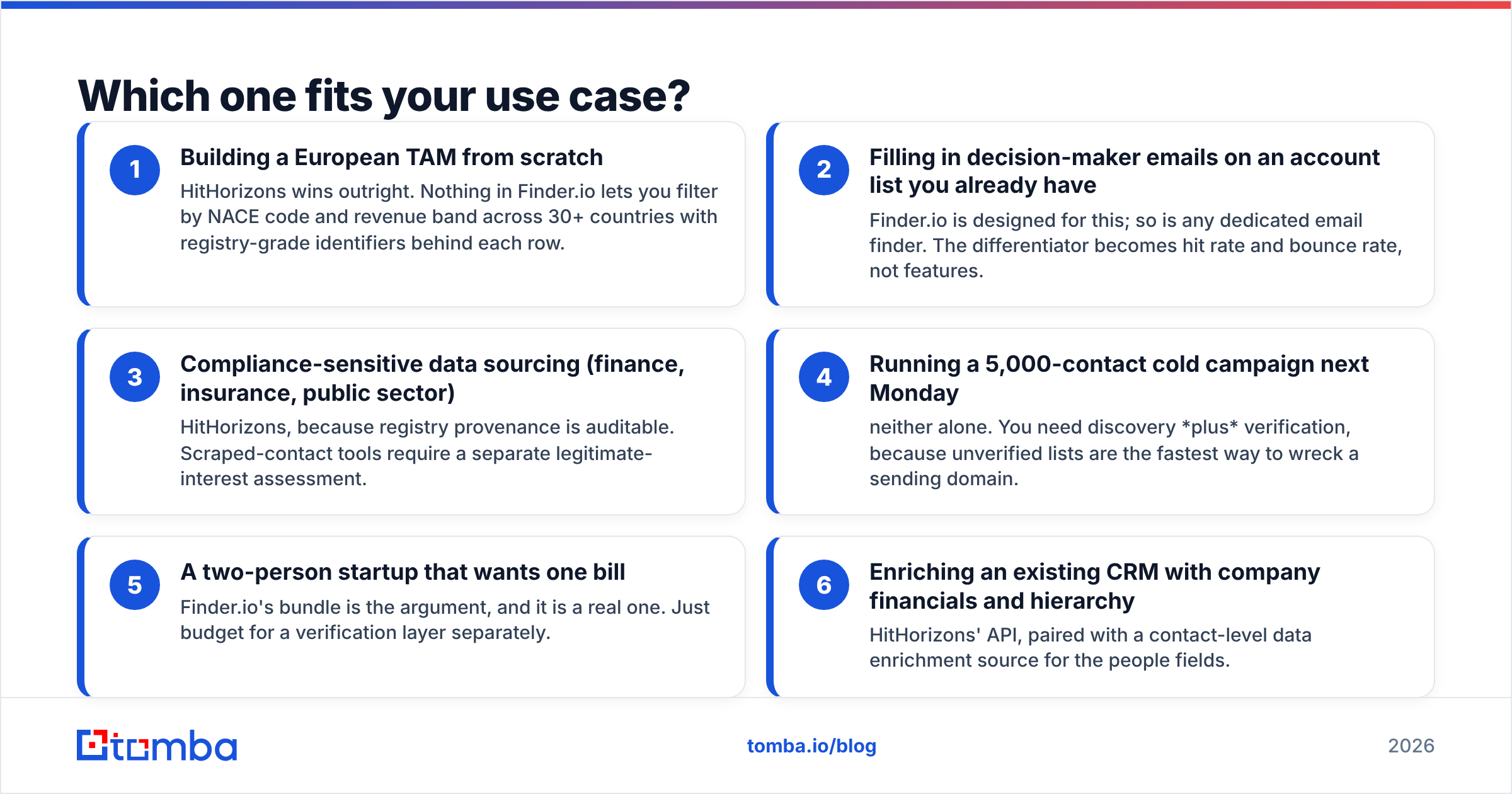
- Building a European TAM from scratch — HitHorizons wins outright. Finder.io cannot filter by NACE code and revenue band across 30+ countries with registry-grade IDs behind each row.
- Filling in decision-maker emails on an account list you already have — Finder.io is built for this, and so is any dedicated email finder. The differentiator is hit rate and bounce rate, not features.
- Compliance-sensitive data sourcing (finance, insurance, public sector) — HitHorizons, because registry provenance is auditable. Scraped-contact tools need a separate legitimate-interest assessment.
The next three cases are where teams most often buy the wrong tool.
- Running a 5,000-contact cold campaign next Monday — neither one alone. You need discovery plus verification. Unverified lists are the fastest way to wreck a sending domain.
- A two-person startup that wants one bill — Finder.io's bundle is the argument, and it is a real one. Just budget for a verification layer separately.
- Enriching a CRM with company financials and hierarchy — HitHorizons' API, paired with a contact-level data enrichment source for the people fields.
Is Finder.io accurate enough for cold outreach?#
This is where suite tools get uncomfortable. Email accuracy is not a static feature. It decays. Company sites change, people leave, patterns shift from first.last@ to flast@, and catch-all domains hide the truth. Keeping a finder accurate takes constant re-crawling, pattern retraining, and live SMTP verification. That is a full-time product, not a tile in a fifty-app suite.
So treat any confidence score — Finder.io's included — as a starting hypothesis, not a green light. The workflow that survives contact with reality looks like this:
- Find the address (finder tool).
- Verify it independently with a real email verifier, not the finder's own optimistic score.
- Handle catch-all domains explicitly rather than lumping them in as "valid."
- Suppress anything that bounced, unsubscribed, or went cold in the last 90 days.
Skip step two and you will learn about email deliverability the expensive way. A 6–8% bounce rate on a fresh domain is enough for mailbox providers to start filtering you. Recovering sender reputation then takes weeks of throttled sending you cannot afford mid-quarter.

What does each one cost in 2026?#
Pricing is the least comparable part of this comparison. The two vendors sell in different units.
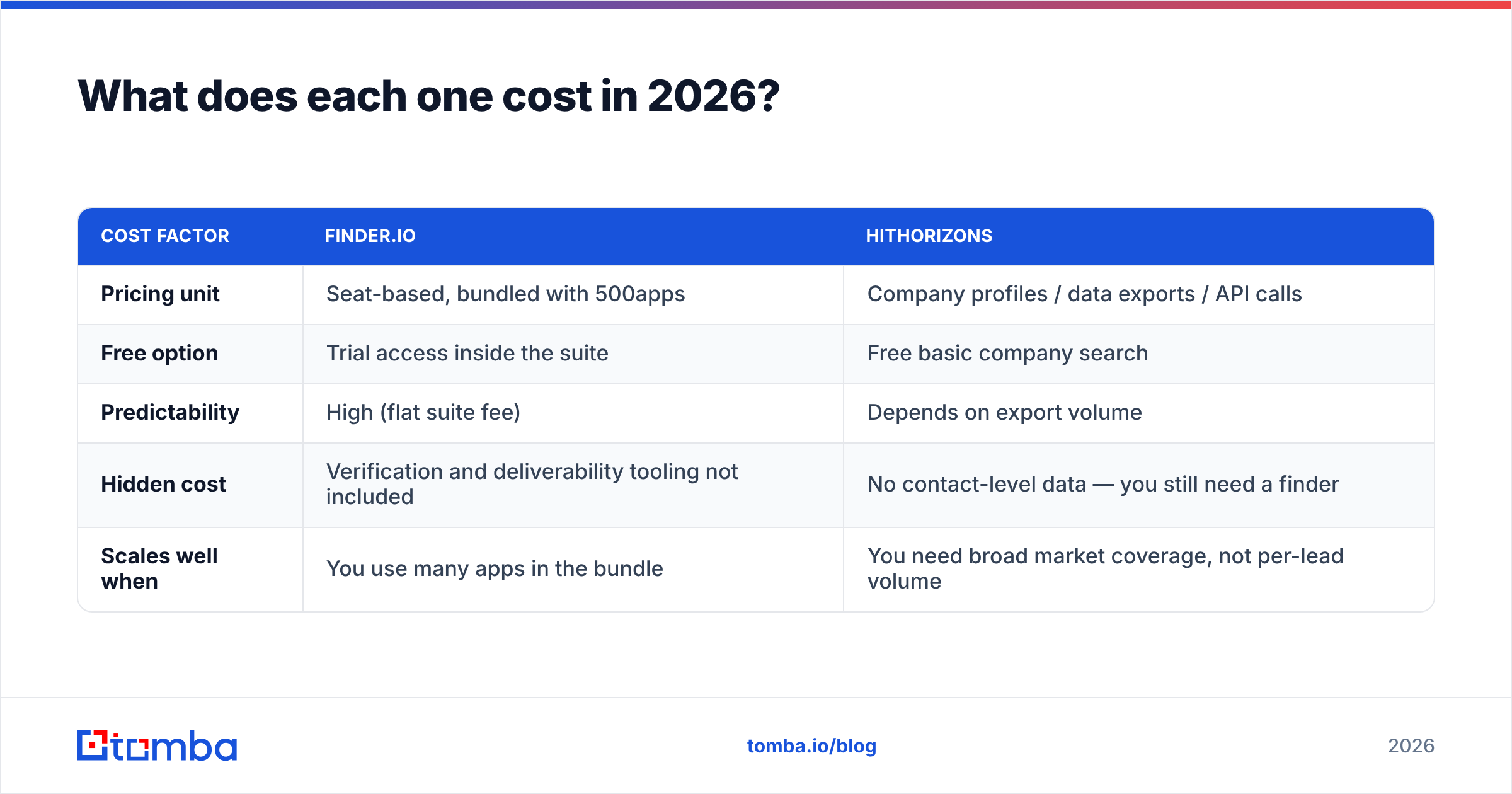
| Cost factor | Finder.io | HitHorizons |
|---|---|---|
| Pricing unit | Seat-based, bundled with 500apps | Company profiles / data exports / API calls |
| Free option | Trial access inside the suite | Free basic company search |
| Predictability | High (flat suite fee) | Depends on export volume |
| Hidden cost | Verification and deliverability tooling not included | No contact-level data — you still need a finder |
| Scales well when | You use many apps in the bundle | You need broad market coverage, not per-lead volume |
The honest read: Finder.io looks cheap because the finder is a rounding error inside a bundle you may never fully use. HitHorizons looks expensive per record. Then you price what registry-grade company data would cost to assemble yourself, and it starts to look like a bargain for serious European market analysis.
Want a like-for-like number to anchor against? A specialist finder like Tomba runs a free tier at 25 searches a month, then $49/mo Starter, $99/mo Growth, and $249/mo Pro. The verifier, domain search, and API are included rather than sold as add-ons. Full Tomba pricing is public, which is its own useful filter. Quote-only pricing usually means the number moves depending on how badly they want your logo.
Can you use both together?#
Yes. For European outbound it is arguably the correct architecture. The pattern looks like this:
Layer 1 — Market definition. HitHorizons, or an equivalent registry-backed source, answers "which companies match my ICP?" Filter by country, NACE code, revenue band, and employee count. Export the entity list with registration IDs and domains.
Layer 2 — Contact discovery. Feed those domains into an email finder to surface named people by role and seniority. This is where a bulk email finder earns its keep. You are processing thousands of domains, not typing them one at a time.
Layer 3 — Verification and hygiene. Every discovered address goes through verification before it touches a sending tool. Flag catch-all domains separately, then decide whether to risk them or route them to LinkedIn instead.
Layer 4 — Enrichment and routing. Push the finished records into your CRM with firmographics from Layer 1 attached. Reps then see revenue band and legal entity next to the contact, instead of a bare email.
Two failure modes kill this pipeline. The first is skipping Layer 3, covered above. The second is letting Layers 1 and 2 drift out of sync. Registry data updates on filing cycles, sometimes annually, while contact data changes weekly. Re-verify contacts far more often than you re-pull firmographics.
What are the main alternatives to both?#
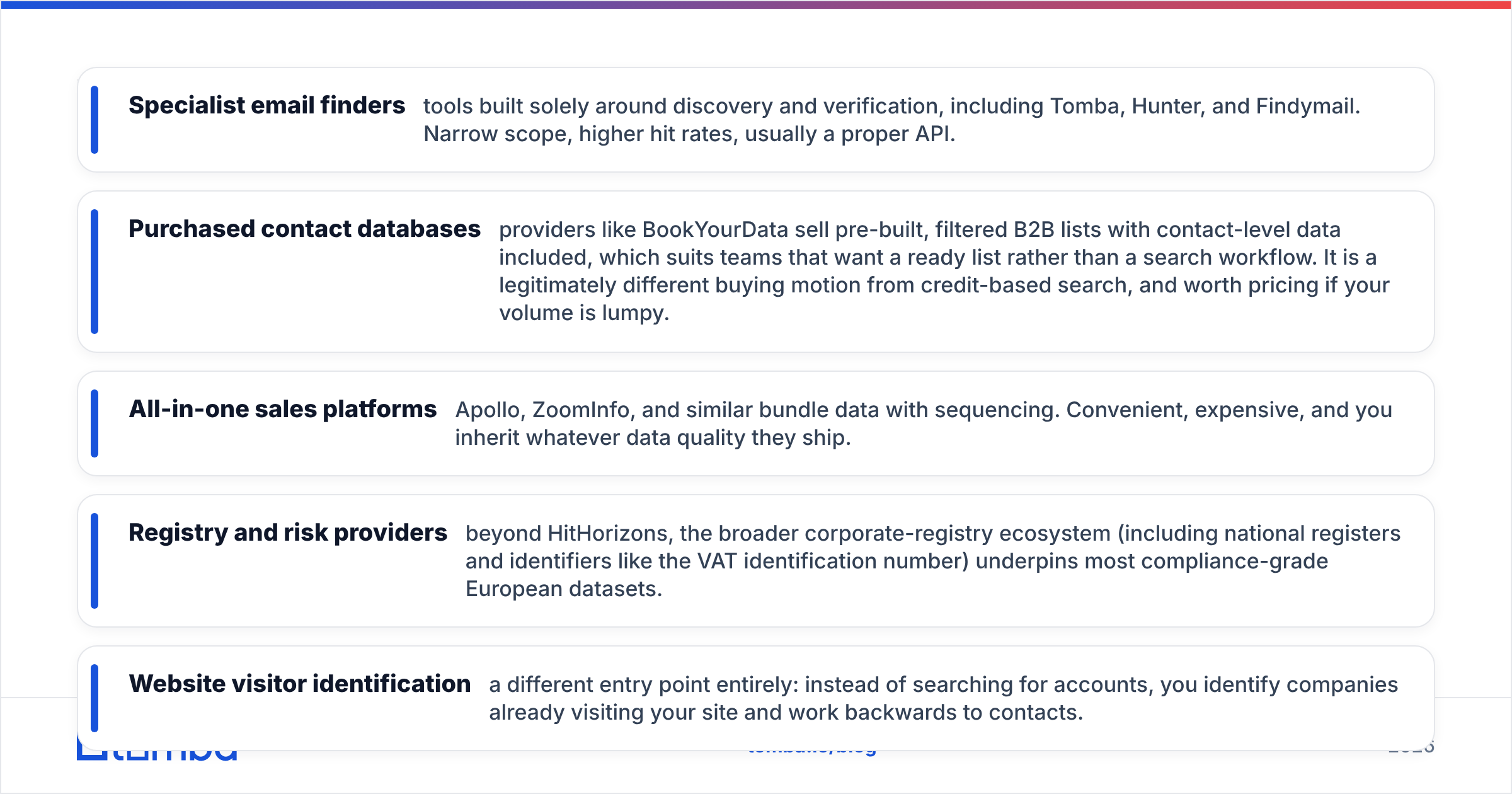
If neither tool fits cleanly, the field around them is crowded but differentiated:
- Specialist email finders — tools built solely around discovery and verification, including Tomba, Hunter, and Findymail. Narrow scope, higher hit rates, proper APIs.
- Purchased contact databases — providers like BookYourData sell pre-built, filtered B2B lists with contact-level data included. That suits teams who want a ready list rather than a search workflow.
- All-in-one sales platforms — Apollo, ZoomInfo, and similar bundle data with sequencing. Convenient, expensive, and you inherit whatever data quality they ship.
Two more angles are worth a look:
- Registry and risk providers — beyond HitHorizons, national registers and identifiers like the VAT identification number underpin most compliance-grade European datasets.
- Website visitor identification — a different entry point entirely. You identify companies already visiting your site, then work backwards to contacts.
Finder.io vs HitHorizons: so which should you actually buy?#
The choice comes down to one question. Are you missing companies, or missing people?
Buy HitHorizons if your primary question is which companies, you sell into Europe, and provenance matters to whoever signs off on data. It is the stronger product at what it does, and nothing in Finder.io competes with it.
Buy Finder.io if you already live inside the 500apps ecosystem and email finding is a secondary need. The bundle economics are real when you use the other apps.
Buy neither as your only tool if outbound email is how you generate pipeline. Your two hard requirements are hit rate and bounce rate. Both come from a specialist that owns discovery and verification end to end, with a documented API so nobody is pasting CSVs at 11pm.
That last profile is the one Tomba is built for. Start with the Tomba Email Finder on the free tier — 25 searches a month, no card. Run it against twenty domains where you already know the answers. Compare the hit rate against your current tool, push the winners through verification, and let the bounce rate settle the argument instead of a comparison table.
Related guides#
Ready to find emails that actually work?
Join 150,000+ professionals who stopped guessing and started sending. Free credits on signup — no credit card required.
Get the Tomba newsletter
Practical outbound tactics and product updates — once every two weeks.
About the author