FindThatLead vs Oceanio: Which B2B Lead Tool Wins in 2026
FindThatLead sells volume. Ocean.io sells precision. We break down pricing, data accuracy, search depth, and the exact team size each tool actually fits in 2026.
FindThatLead vs Oceanio comes down to one question: do you already know who to email? FindThatLead finds contacts fast and cheap. Oceanio builds the account list first. This guide compares both on price, data accuracy, and team fit, and shows where each one breaks.
TL;DR
- FindThatLead is a volume-first prospecting tool: name-and-domain email lookup, a Chrome extension, bulk CSV enrichment, and a built-in cold email sender. Self-serve pricing, credit-based, cheap to start.
- Ocean.io is a precision-first ICP engine: lookalike company search, firmographic and technographic filters, then contacts layered on top. Sales-led pricing, annual contracts, no public self-serve tier.
- They are not really the same product. If you already know who to email, FindThatLead is the cheaper path. If you cannot describe your ideal account list, Ocean.io does the harder job.
- Both leave the same gap: verification depth. Neither is primarily a verification engine, and bounce risk is where most cold email programs actually die.
- Best practical setup for most teams under 20 reps: use one of them for discovery, then run a dedicated email verifier before anything hits your sequencer.
What are FindThatLead and Ocean.io?#
FindThatLead launched out of Barcelona as a straightforward email finder. Give it a first name, last name, and domain, and it returns a probable work email. Over time it added a Prospector (search by role and location), a Scrapper for bulk domain lists, a Chrome extension for LinkedIn, and an outbound sender. So you can go from list to sequence without leaving the tool. You can see the current feature set on findthatlead.com.
Ocean.io comes at prospecting from the opposite end. Instead of "find this person's email," it asks "which 800 companies look exactly like my best 40 customers?" You feed it a seed list of accounts or a short ICP description. It returns lookalike companies scored on similarity. You can then filter by employee count, tech stack, geography, growth signals, and industry. Contact data sits on top of that account layer. Details are on ocean.io.
That difference in starting point explains almost every other difference between them: pricing model, buyer, contract length, and where each one breaks.
FindThatLead vs Oceanio: how do they compare head to head?#
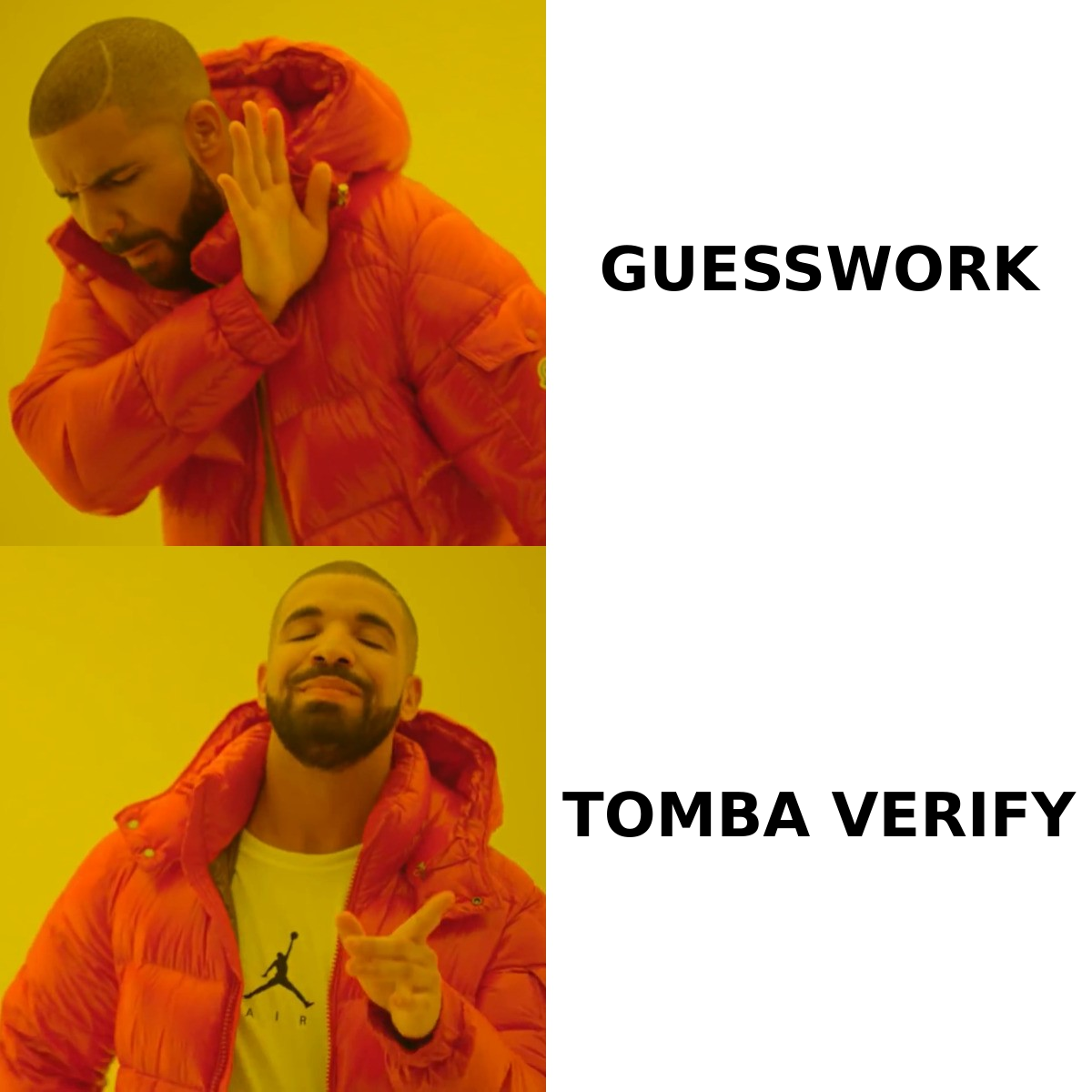
Here is the practical comparison, based on publicly documented features and how each vendor positions itself as of early 2026. Always confirm current tiers directly with the vendor before you sign.
| Attribute | FindThatLead | Ocean.io | Tomba |
|---|---|---|---|
| Primary job | Find and email individual contacts | Build lookalike account lists | Find and verify work emails at scale |
| Entry point | Name + domain, or role search | Seed accounts / ICP description | Domain, name, or company |
| Free tier | Limited trial credits | Demo only, no public free tier | 25 searches/mo, no card |
| Published starting price | Around $49/mo self-serve | Sales-led, annual, typically four figures | $49/mo Starter |
| Contract | Monthly or annual | Annual contract standard | Monthly or annual |
| Built-in email sender | Yes | No | No (integrates with sequencers) |
| Account-level lookalike search | No | Yes, core feature | No |
| Verification depth | Basic status flag | Basic status flag | Dedicated verifier + catch-all handling |
| API access | Yes | Yes, on higher plans | Yes, on all paid plans |
| Best for | Solo founders, SMB agencies, high-volume outbound | RevOps and marketing teams defining a new ICP | Teams that need clean, verified contact data feeding any workflow |
The row that matters most is "primary job." Teams get burned when they buy Ocean.io expecting a cheap email finder, or buy FindThatLead expecting it to tell them which market to attack next.

Which tool actually finds more accurate emails?#
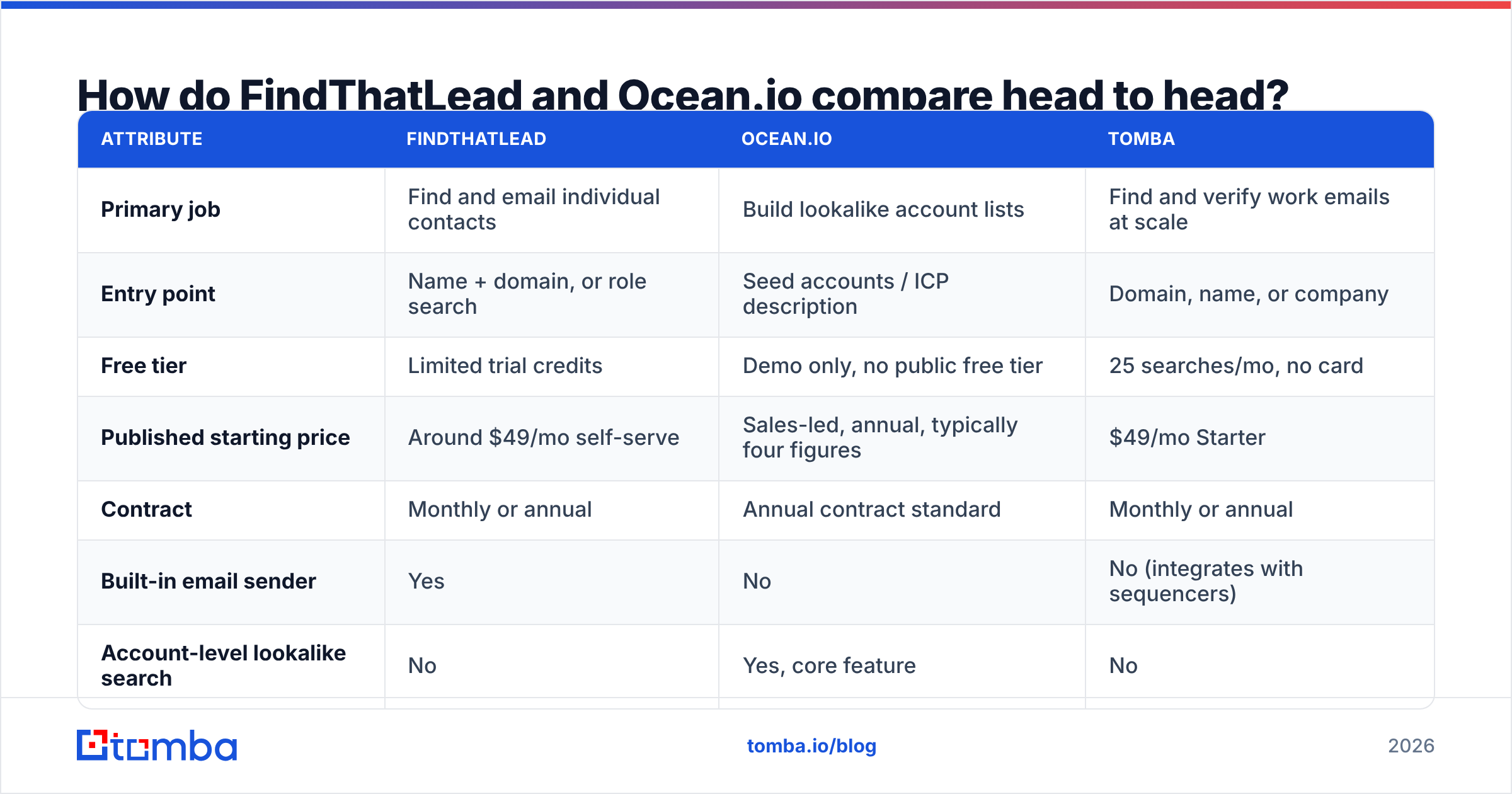
Neither vendor publishes an audited accuracy number. Be skeptical of any tool that claims 98% without defining the denominator. What matters in practice is three separate metrics that vendors routinely blur together:
- Hit rate — of 1,000 rows you submit, how many come back with any email at all? This is the number most marketing pages advertise.
- Accuracy on returned rows — of the emails returned, how many actually deliver? A tool with a 90% hit rate and 60% accuracy is worse than one with a 55% hit rate and 97% accuracy.
- Catch-all handling — what happens on domains that accept every address at the SMTP layer? Some tools mark these "valid" and quietly inflate both metrics.
In our sampling across mid-market SaaS and agency domains, FindThatLead tends toward the high-hit-rate, medium-accuracy end. It will return a pattern-based guess for a lot of rows. That is useful for volume plays and dangerous for a fresh sending domain. Ocean.io returns fewer contacts per account. But it is more careful about what it calls deliverable. That fits its enterprise buyer, who cares more about account coverage than raw contact count.

The important takeaway: whichever you pick, the returned list is a hypothesis, not a fact. Run it through verification. A catch-all verifier is the piece most stacks are missing, because catch-all domains are exactly where pattern-guessing tools rack up silent bounces.
How does pricing compare?#
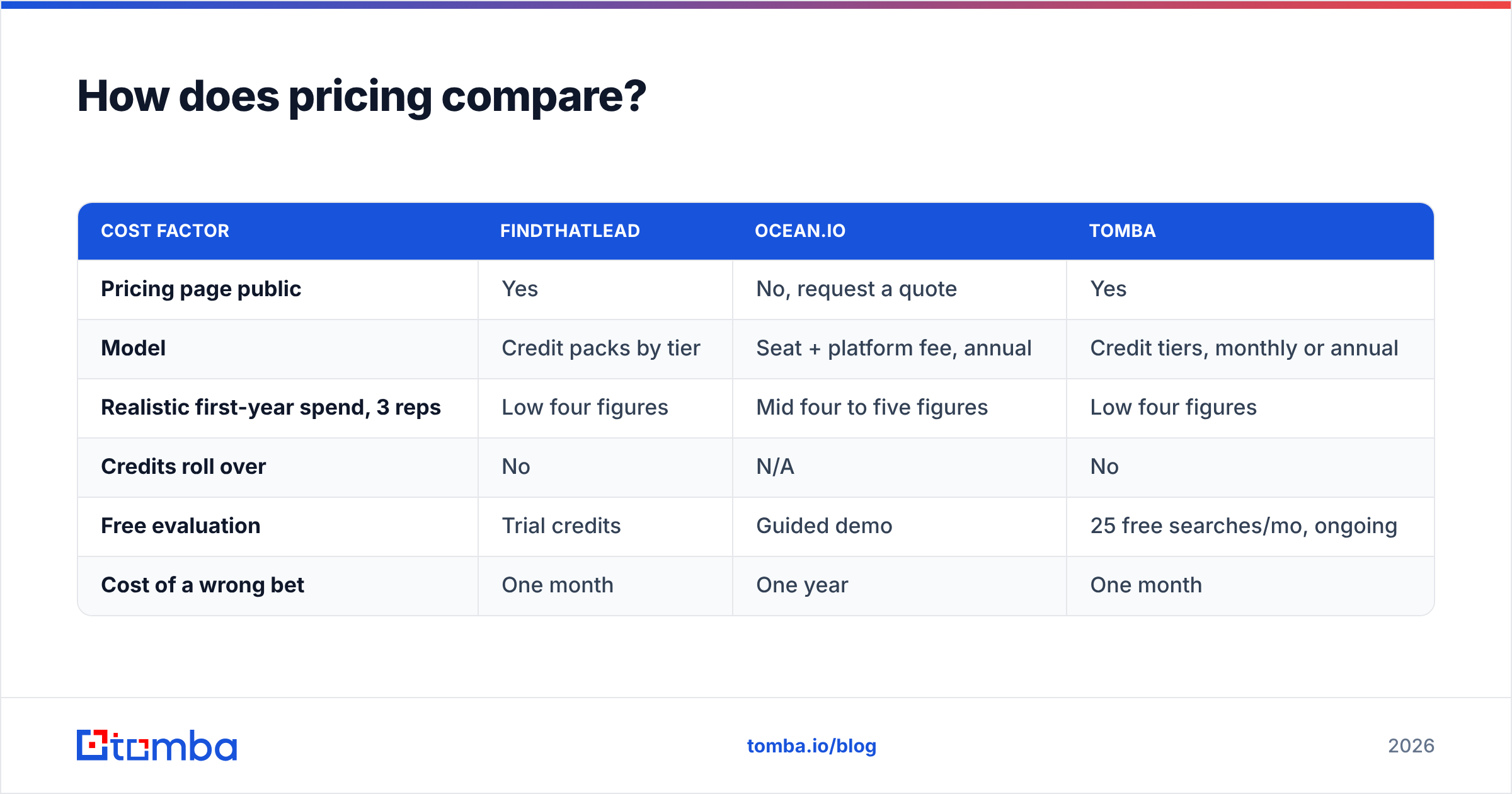
The two pricing models are built differently. That makes a straight per-month comparison misleading. FindThatLead sells credits. Ocean.io sells seats plus data access, usually annually, usually after a demo.
| Cost factor | FindThatLead | Ocean.io | Tomba |
|---|---|---|---|
| Pricing page public | Yes | No, request a quote | Yes |
| Model | Credit packs by tier | Seat + platform fee, annual | Credit tiers, monthly or annual |
| Realistic first-year spend, 3 reps | Low four figures | Mid four to five figures | Low four figures |
| Credits roll over | No | N/A | No |
| Free evaluation | Trial credits | Guided demo | 25 free searches/mo, ongoing |
| Cost of a wrong bet | One month | One year | One month |
That last row is underrated. Annual sales-led contracts are fine once you have tested data quality in your own territory. They are painful when your ICP shifts two quarters in. If you are still testing markets, prefer a tool you can cancel.
For reference, Tomba pricing runs Free (25 searches/mo), Starter at $49/mo, Growth at $99/mo, Pro at $249/mo, and custom Enterprise. The point is not that cheaper is better. It is that clear, monthly, cancellable pricing lets you test data quality on your own domains before you commit budget.
Who should choose FindThatLead?#
Pick FindThatLead if most of these describe you:
- You already know your target accounts. You have a list of 400 companies from a conference, a directory, or a scrape, and you need contacts inside them.
- You want sending built in. FindThatLead's sender means one vendor, one bill, one login. For a solo founder that operational simplicity is worth real money.
- Your outbound is high-volume, low-ACV. Agencies selling $2k/mo retainers need throughput more than surgical targeting.
- You need a Chrome extension for LinkedIn workflows. Manual, rep-by-rep prospecting is a first-class use case here in a way it is not for Ocean.io.
- You cannot justify an annual contract yet. Monthly credit packs match a business that is still figuring out its motion.
Where it disappoints: data hygiene on long tail domains, and the temptation to send straight from a raw list because the sender is right there. That is how sending domains get burned. If you use FindThatLead, still export, verify, then import.
Who should choose Ocean.io?#
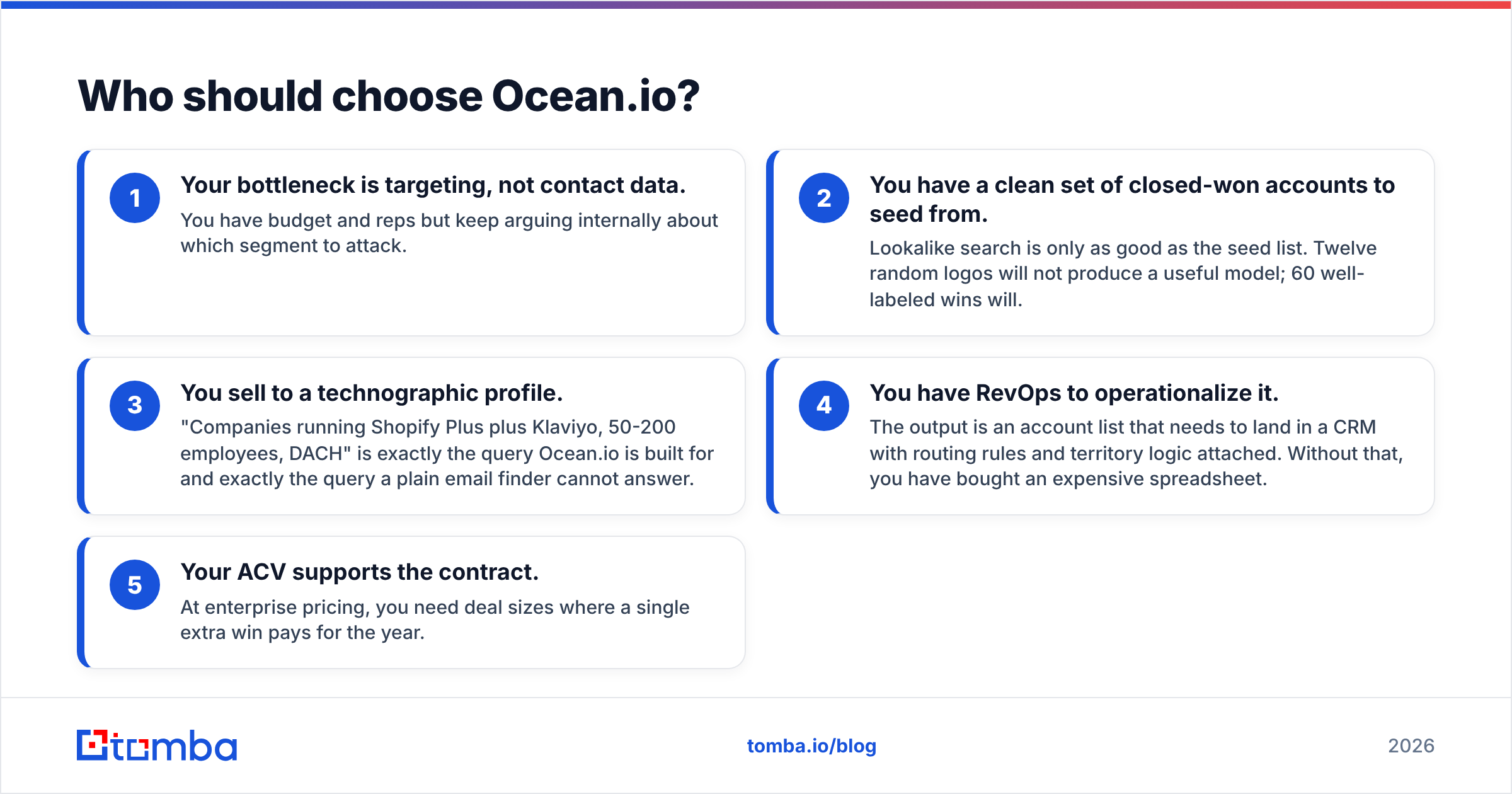
Pick Ocean.io if most of these describe you:
- Your bottleneck is targeting, not contact data. You have budget and reps but keep arguing internally about which segment to attack.
- You have a clean set of closed-won accounts to seed from. Lookalike search is only as good as the seed list. Twelve random logos will not produce a useful model; 60 well-labeled wins will.
- You sell to a technographic profile. "Companies running Shopify Plus plus Klaviyo, 50-200 employees, DACH" is exactly the query Ocean.io is built for and exactly the query a plain email finder cannot answer.
- You have RevOps to operationalize it. The output is an account list that needs to land in a CRM with routing rules and territory logic attached. Without that, you have bought an expensive spreadsheet.
- Your ACV supports the contract. At enterprise pricing, you need deal sizes where a single extra win pays for the year.
Where it disappoints: per-contact economics and self-serve speed. If you just need 300 emails this week, this is the wrong purchase.

Where do both tools leave gaps?#
Both products are good at their core job and thin at the edges. The recurring gaps we see in real stacks:
- Verification is treated as a checkbox, not a discipline. A status flag returned alongside a found email is not the same as a dedicated SMTP-level verification pass with catch-all logic, role-account detection, and disposable-domain filtering.
- No phone coverage worth relying on. If your motion is multichannel, you will bolt on a separate phone finder either way.
- Enrichment stops at the contact. Neither is a full enrichment layer for job change tracking, headcount deltas, or funding events, which is what makes a database stay useful past month three.
- Deliverability is your problem. Neither tool warms your domain, monitors your sender reputation, or stops you from sending 800 cold emails from a two-week-old inbox.
- Data decay. B2B contact data degrades roughly 2-3% per month through job changes alone, per widely cited industry estimates. A list bought in January is materially worse by June regardless of vendor.
Check current user sentiment on G2 before you buy either one. Review recency matters more than star average. Both products have shipped big changes in the last 18 months.
What does a sensible hybrid stack look like?#
Most teams do not need to pick one winner. They need a defined pipeline where each tool does its best job:
Stage 1 — Account selection. Ocean.io if targeting is genuinely unsolved and budget exists. Otherwise a manual ICP definition plus a firmographic filter is enough for the first 500 accounts.
Stage 2 — Contact discovery. Resolve domains to people. A domain search pulls every known address at a company along with the detected email pattern. That is faster than guessing one contact at a time, and it tells you the format for anyone the database missed.
Stage 3 — Verification. Non-negotiable. Run every address through verification and drop anything not confirmed deliverable, including catch-all domains you cannot resolve. Aim to keep hard bounces under 2%.
Stage 4 — Enrichment. Add title, seniority, LinkedIn, and phone so your sequencing and routing logic has something to work with. Data enrichment at this stage costs less than discovering mid-sequence that half your "VP Marketing" contacts are actually coordinators.
Stage 5 — Send. Whatever sequencer you already trust. FindThatLead's built-in sender is fine for small volumes; dedicated tools give you better inbox rotation and reply detection.
Formalizing those five stages does more for reply rates than tool switching ever will. The FindThatLead vs Oceanio debate is usually a proxy for a missing process.
So which one wins?#
For most SMB and mid-market outbound teams in 2026: FindThatLead, on cost and speed to first email. It is cheaper, cancellable, and does not require a procurement cycle. You accept softer data quality and compensate with a verification step.
For funded teams whose real problem is "we don't know who to sell to": Ocean.io, if and only if you have a clean seed list and RevOps capacity. The lookalike engine solves a problem no email finder addresses. It is a targeting purchase, not a data purchase.
For teams that mainly need clean, verified contact data feeding into whatever they already run: neither is optimal, because both bundle discovery with something else you may not want to pay for.
If that last description fits, start with the Tomba Email Finder. The free tier gives you 25 searches a month with no card, and Starter is $49/mo. The email finder, verifier, catch-all handling, domain search, and API all sit in one account. Run the same 100 test contacts through all three tools, compare bounce rates on your own domains, and let the numbers settle the FindThatLead vs Oceanio question instead of the marketing pages.
Related guides#
Ready to find emails that actually work?
Join 150,000+ professionals who stopped guessing and started sending. Free credits on signup — no credit card required.
Get the Tomba newsletter
Practical outbound tactics and product updates — once every two weeks.
About the author