FindThatLead vs RocketReach (2026): Which Tool Actually Wins?
FindThatLead and RocketReach both promise verified B2B contacts, but they solve different problems. Here's the honest breakdown of accuracy, pricing, credits, and which one fits your outbound motion in 2026.
TL;DR
- FindThatLead is a low-cost prospecting suite built around domain and name-based email search, with a bundled cold-email sender. Strongest for solo founders and small teams who want find-and-send in one tab.
- RocketReach is a people-search database with roughly 700M profiles and strong phone-number coverage. Strongest when you already know who you want and need direct dials plus personal emails.
- Neither tool is a clear winner on accuracy. Independent user reviews on G2 and Capterra put both in the 60–85% valid-email range depending on region and company size — you still need a verification layer.
- Pricing diverges hard at scale: RocketReach charges per lookup with tight annual-only discounts, while FindThatLead bundles credits with sending. Cost per verified email is the number that matters, not sticker price.
- If you want a single API that finds, verifies, and enriches without a sender bundled in, a dedicated tool like Tomba (free tier, then $49/mo) is usually cheaper per usable contact than either.
What are FindThatLead and RocketReach?#
They're both B2B contact-data tools, but they were built from opposite directions.
FindThatLead started as a domain-search tool in Spain and grew into a small prospecting suite: search by domain, search by name plus company, scrape LinkedIn lists via a Chrome extension, then push those contacts into its built-in cold-email sender ("Scrab.in" and its campaign module). The pitch is that a two-person startup can run an entire outbound motion inside one subscription.
RocketReach came from the people-search side. It indexes public profiles — LinkedIn, company sites, press mentions, filings — and lets you look up a specific person to get their work email, personal email, and phone. It advertises coverage of roughly 700 million professionals and 60 million companies. The pitch is reach: if a human exists in a professional context, RocketReach probably has a row for them.
That origin difference explains almost every practical trade-off between them.
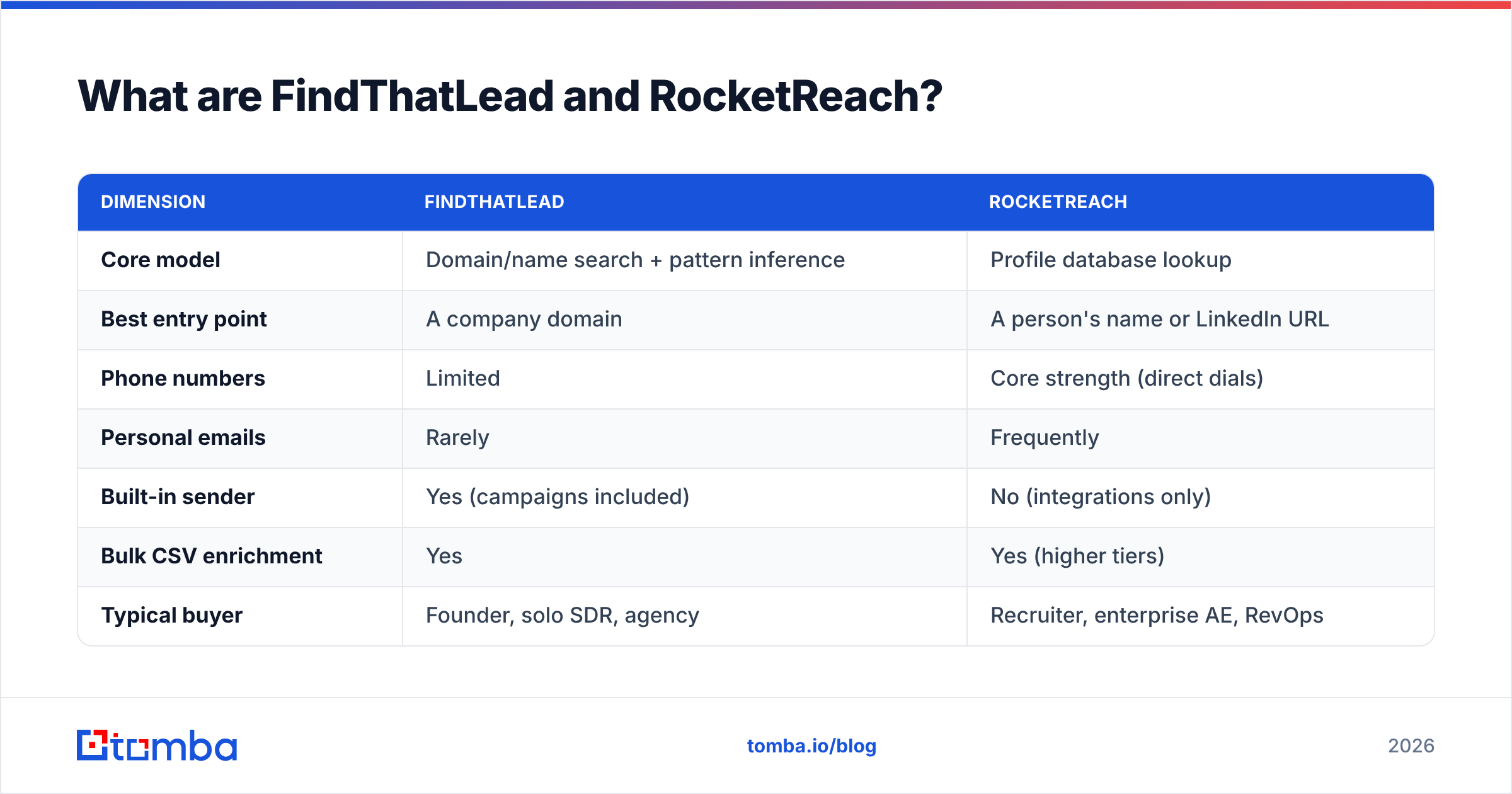
| Dimension | FindThatLead | RocketReach |
|---|---|---|
| Core model | Domain/name search + pattern inference | Profile database lookup |
| Best entry point | A company domain | A person's name or LinkedIn URL |
| Phone numbers | Limited | Core strength (direct dials) |
| Personal emails | Rarely | Frequently |
| Built-in sender | Yes (campaigns included) | No (integrations only) |
| Bulk CSV enrichment | Yes | Yes (higher tiers) |
| Typical buyer | Founder, solo SDR, agency | Recruiter, enterprise AE, RevOps |
Which one finds more valid emails?#
Neither, consistently — and that's the honest answer most comparison posts refuse to give.
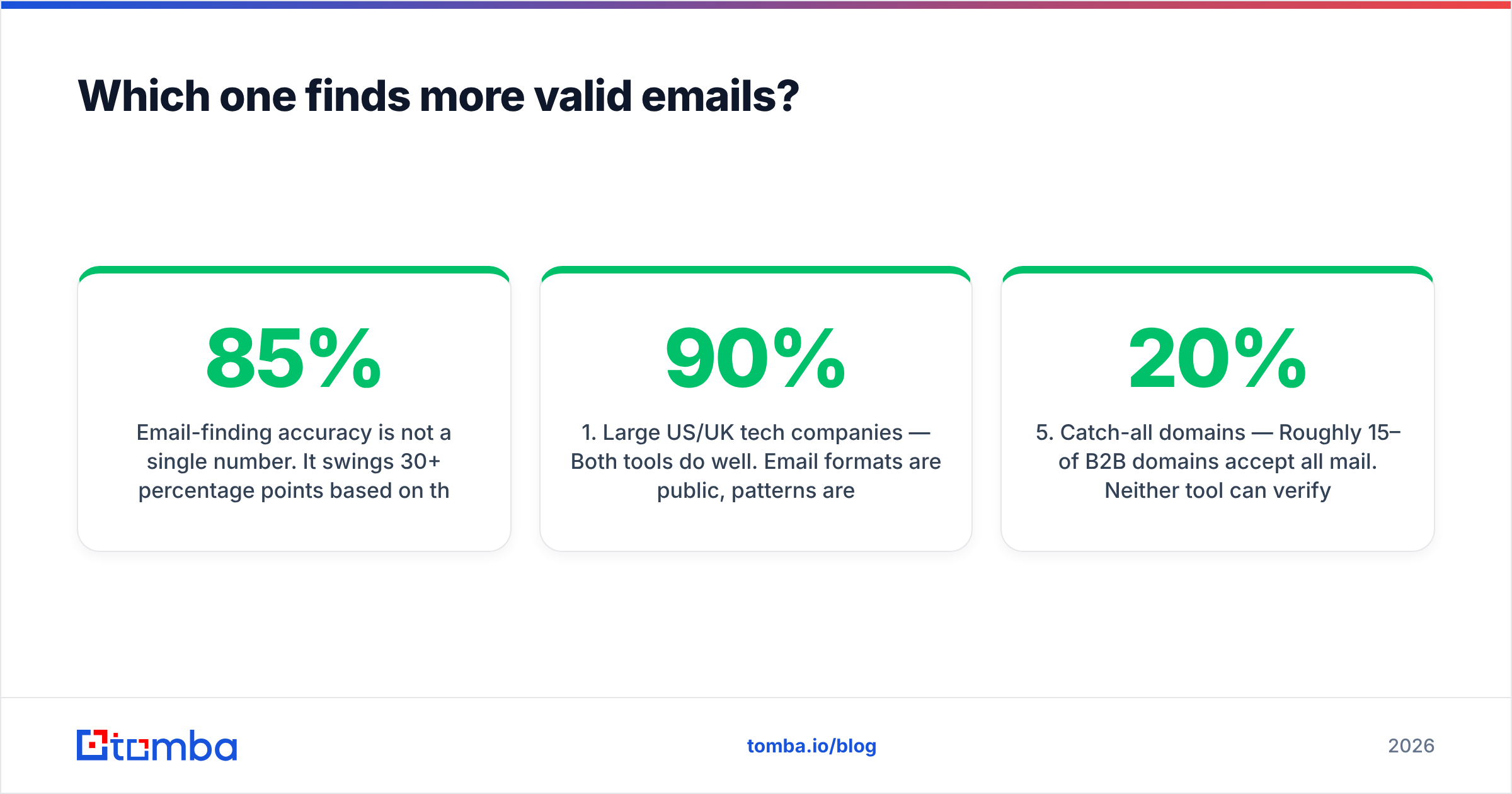
Email-finding accuracy is not a single number. It swings 30+ percentage points based on three variables: company size, region, and how recently the person changed jobs. A tool that hits 85% on US SaaS companies with 200+ employees can fall to 45% on 12-person agencies in Portugal.
Here's what the pattern looks like in practice:
- Large US/UK tech companies — Both tools do well. Email formats are public, patterns are stable, and SMTP validation is usually possible. Expect 75–90% from either.
- SMBs under 50 employees — FindThatLead's pattern-inference approach often guesses correctly where RocketReach has no profile row at all. But "guessed" isn't "verified."
- Non-English-speaking markets — RocketReach's index skews Anglophone. FindThatLead has better European coverage from its Spanish roots.
- Recently-moved contacts — This is where both degrade hardest. A person who changed jobs eight weeks ago will often return a stale employer email. RocketReach's profile-refresh cadence helps here; FindThatLead's does not.
- Catch-all domains — Roughly 15–20% of B2B domains accept all mail. Neither tool can verify these with SMTP alone, so both return "accept-all" or a confidence score rather than a hard pass. You need a dedicated catch-all verifier to resolve them.

The practical takeaway: run a sample. Take 100 known-good contacts from your own CRM, strip the emails, and feed the names and domains through each tool's free trial. Compare against ground truth. That 30-minute test beats any vendor-published accuracy claim, including the ones in this article.

How do FindThatLead and RocketReach pricing compare?#
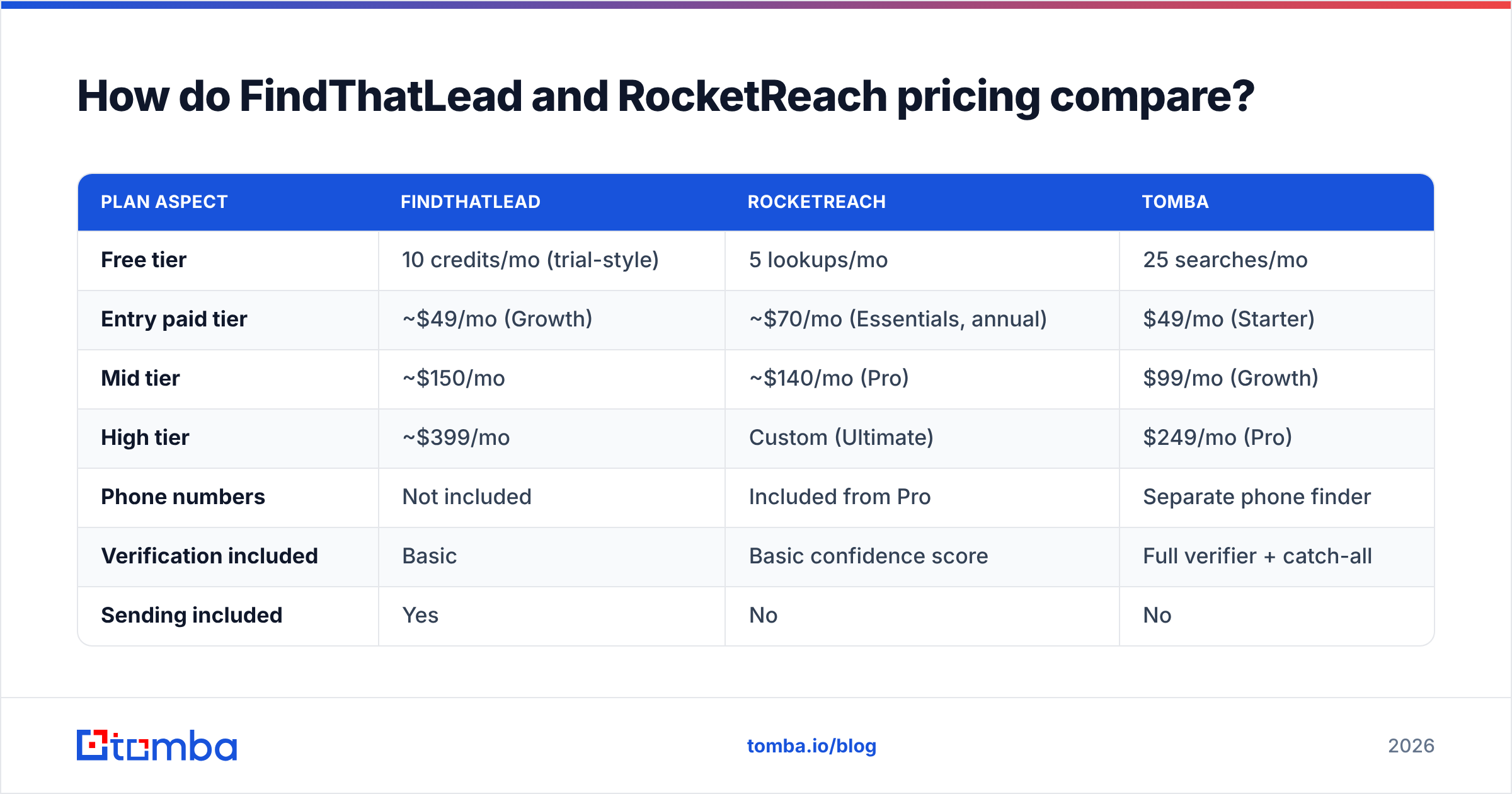
RocketReach is priced per lookup and gates features by tier. FindThatLead bundles credits with sending, which makes the sticker price look lower but muddies the math.
| Plan aspect | FindThatLead | RocketReach | Tomba |
|---|---|---|---|
| Free tier | 10 credits/mo (trial-style) | 5 lookups/mo | 25 searches/mo |
| Entry paid tier | ~$49/mo (Growth) | ~$70/mo (Essentials, annual) | $49/mo (Starter) |
| Mid tier | ~$150/mo | ~$140/mo (Pro) | $99/mo (Growth) |
| High tier | ~$399/mo | Custom (Ultimate) | $249/mo (Pro) |
| Phone numbers | Not included | Included from Pro | Separate phone finder |
| Verification included | Basic | Basic confidence score | Full verifier + catch-all |
| Sending included | Yes | No | No |
| API access | Yes, higher tiers | Yes, higher tiers | All paid tiers |
Two pricing traps to watch:
RocketReach's annual-only discounts. The headline prices on the pricing page are annual-billed. Month-to-month runs meaningfully higher, and the cheapest tier caps at email lookups only — phone numbers require a step up. If you're buying for a three-month pilot, budget the monthly rate, not the advertised one.
FindThatLead's credit consumption. A "credit" is consumed on search attempts, not just successful finds, on some actions. If your list has a lot of thin companies, you can burn through a month's allowance without a proportional number of usable emails. Read the credit terms before committing to an annual plan.
The number to compute is cost per verified email, not cost per credit:
cost per verified email = monthly price / (credits × hit rate × verification pass rate)Plug in a 70% hit rate and an 85% verification pass rate and a $99 plan with 2,000 credits gives you roughly 1,190 usable contacts — about $0.083 each. Do that math for each vendor with your target list, not a generic one.
Is RocketReach better for phone numbers?#
Yes, clearly — and this is the single cleanest differentiator between the two.
RocketReach surfaces direct dials and mobile numbers on a meaningful share of its US profiles. For recruiters and enterprise AEs who need multithreaded outreach, that's the buying reason. FindThatLead does not compete here in any serious way; phone data is not part of its core proposition.
That said, phone-data accuracy across the whole B2B category is worse than email accuracy. Mobile numbers go stale faster than work emails, and there's no equivalent of SMTP validation for phones — you either dial it or you don't know. If dials are core to your motion, budget for a phone validator step regardless of which vendor supplies the raw numbers, and expect to discard 20–35% of records.
Also worth checking before you buy on phone coverage: your compliance posture. Cold-calling rules diverge sharply between the US, EU, and UK, and a database subscription doesn't transfer consent obligations to the vendor. Gartner's coverage of B2B data governance is a reasonable starting point if you need to brief legal.
What about integrations and workflow fit?#
FindThatLead wins on "everything in one place." RocketReach wins on "plugs into the stack you already run."
FindThatLead's integrated model: search, build a list, write a sequence, send — all inside the product. For a founder with no CRM and no sending infrastructure, that's genuinely faster to value. The trade-off is that the sending component is weaker than dedicated tools (Instantly, Smartlead, Lemlist), the deliverability tooling is thin, and you're locked into one vendor's opinion of your entire funnel.
RocketReach's connected model: browser extension, CSV export, Salesforce and HubSpot sync on higher tiers, plus an API. It assumes you already have a CRM and a sequencer and just need contact data flowing into them. That's the right assumption for most teams past ten people.
If you're evaluating a third path, most dedicated finders — including Tomba — sit in the RocketReach camp architecturally: they supply data through an email finder API, browser extension, and CRM integrations rather than trying to own your sending. That separation is usually the more durable choice, because you can swap the data layer without rebuilding your sequences.

Which should you actually pick?#
Match the tool to the shape of your input data. That's the whole decision.
Pick FindThatLead if:
- You start from company domains, not names ("get me everyone at these 300 agencies")
- Your targets skew European or Latin American SMB
- You have no sequencer and want one bundled
- Budget is the hard constraint and you can live with manual cleanup
Pick RocketReach if:
- You start from named people or LinkedIn URLs
- You need direct dials alongside emails
- Your targets are mid-market and enterprise US companies
- You already run a CRM and just need enrichment flowing in
Pick a dedicated finder/verifier (Tomba, Hunter, or similar) if:
- Data quality per dollar is the metric you're optimizing
- You want find + verify + enrich as separate, composable API calls
- You're building programmatic workflows rather than clicking through a UI
- You need catch-all resolution, which most bundled suites punt on
Also worth a look if your ICP is narrow and list-based: BookYourData sells pre-verified, filterable B2B lists on a pay-as-you-go model with a stated accuracy guarantee, which is a different purchase shape entirely — you're buying a finished list rather than a search tool. For some teams that removes the credit-math problem outright.

How do you test either tool before committing?#
Run a controlled bake-off. It takes an afternoon and it will save you a year of a bad annual contract.
- Build a ground-truth set. Pull 100 contacts from your CRM where you know the email is valid because they've replied. Strip the email column. Keep name, company, and domain.
- Run the same 100 through each free tier. FindThatLead and RocketReach both offer small free allowances; supplement with a third option so you have a control.
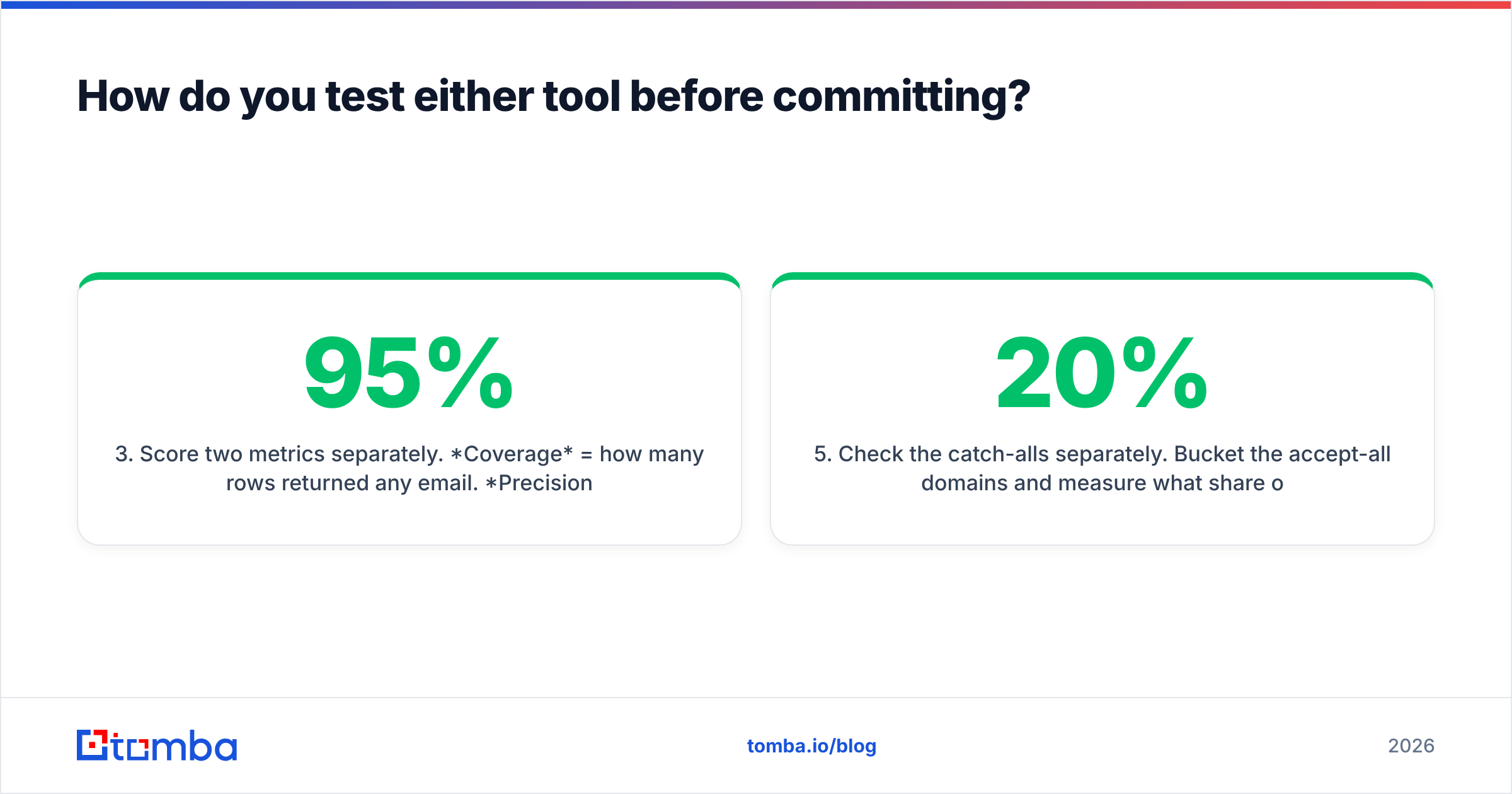
- Score two metrics separately. Coverage = how many rows returned any email. Precision = of those, how many matched ground truth. A tool with 95% coverage and 55% precision is worse than 70/90.
- Verify the winners independently. Push every returned address through a neutral email verifier so you're not grading a vendor with its own confidence score.
- Check the catch-alls separately. Bucket the accept-all domains and measure what share of your list they represent. If it's over 20%, catch-all handling should weigh heavily in your decision.
- Price the winner on cost per verified email, using the formula above, at the volume you'll actually run — not the vendor's example volume.
Reading real user reviews helps calibrate expectations before you start. G2's B2B data category is the least-filtered public source; sort by most recent, and read the two-star reviews first — they tell you where the tool breaks.
What's the verdict for 2026?#
RocketReach is the better database. FindThatLead is the better starter kit. Neither is the better data layer if you're building something that has to scale.
The category has moved. Three years ago, "email finder" meant one thing: guess the pattern, SMTP-ping it, hand you a string. In 2026 the buying criteria have split into coverage, verification depth, catch-all handling, enrichment breadth, and API ergonomics — and most bundled suites are strong on one or two of those while quietly weak on the rest. FindThatLead's weakness is verification depth. RocketReach's is price at volume and non-US coverage.
If your outbound depends on contact data being right, run the bake-off. If it depends on it being right at scale and programmatically, evaluate a purpose-built finder alongside these two rather than assuming a suite covers it.
Ready to benchmark against a dedicated finder? Tomba's Email Finder gives you 25 free searches a month — enough to run the 100-contact bake-off described above without a credit card. Every paid tier from $49/mo includes API access, bulk email finder processing, and full verification with catch-all resolution, so the number you see in your export is the number you can actually send to. Compare the Tomba pricing tiers against your current cost per verified email and see which side the math lands on.
Related guides#
Ready to find emails that actually work?
Join 150,000+ professionals who stopped guessing and started sending. Free credits on signup — no credit card required.
Get the Tomba newsletter
Practical outbound tactics and product updates — once every two weeks.
About the author