FindThatLead vs TrueList: Which Email Tool Wins in 2026?
FindThatLead finds emails. TrueList verifies them. We compare pricing, accuracy, bounce rates, and workflow fit — plus the cheaper stack that replaces both.
TL;DR
- FindThatLead and TrueList are not really competitors. FindThatLead is a prospecting and email-finding tool; TrueList is a bulk email verification service. Comparing them head-to-head only makes sense if you are deciding which problem to solve first.
- If your list is empty, you need a finder. If your list is full of unknowns and your bounce rate is climbing, you need a verifier.
- FindThatLead starts around $49/mo for its Growth plan and bundles a lightweight cold-email sender; TrueList sells credit packs starting near $29 for 5,000 verifications with no monthly commitment.
- Buying both means paying twice for overlapping jobs. Platforms that fold finding and verification into one credit pool — Tomba, Hunter, Findymail — usually cost less per usable contact.
- Our pick: use TrueList if you already own a large legacy list and just need cleanup. Use a combined finder + verifier if you are building lists from scratch this quarter.
What are FindThatLead and TrueList, exactly?#
FindThatLead is a Spanish-built B2B prospecting suite. You give it a domain, a person's name, or a LinkedIn URL, and it returns a work email. Around that core it has stacked a lead search database, a Chrome extension, a basic email-sending sequencer, and a "Prospector" filter that lets you pull lists by country, industry, and job title. It positions itself as an all-in-one for solo founders and small sales teams who do not want a separate finder, database, and sender.
TrueList does one thing. You upload a CSV of email addresses, and it tells you which ones are valid, invalid, risky, or unknown. There is no finder, no database, no sequencer. It runs SMTP checks, syntax validation, disposable-domain detection, role-account flagging, and catch-all identification, then hands back a scored file. Pricing is pay-as-you-go credit packs rather than a subscription, which is the main reason it shows up in shortlists.
So the honest framing of findthatlead vs truelist is not "which is better." It is "which half of the pipeline are you fixing right now?"

Which problem does each tool actually solve?#
Cold outbound has two failure modes, and they look identical from the outside: nobody replies.
The first failure mode is no contacts. You have a target account list, you know the roles you want, and you have no email addresses. That is a finder problem. FindThatLead, Tomba's email finder, Hunter, and Apollo all live here.
The second failure mode is bad contacts. You have 40,000 emails scraped over three years, and when you send to them your bounce rate hits 9% and your domain reputation tanks. That is a verifier problem. TrueList, ZeroBounce, NeverBounce, and Tomba's email verifier live here.
Buying the wrong one is the most common wasted spend in outbound. A verifier cannot invent addresses you never had. A finder without verification hands you plausible-looking guesses that bounce. Most teams need both — the real question is whether you buy them separately.
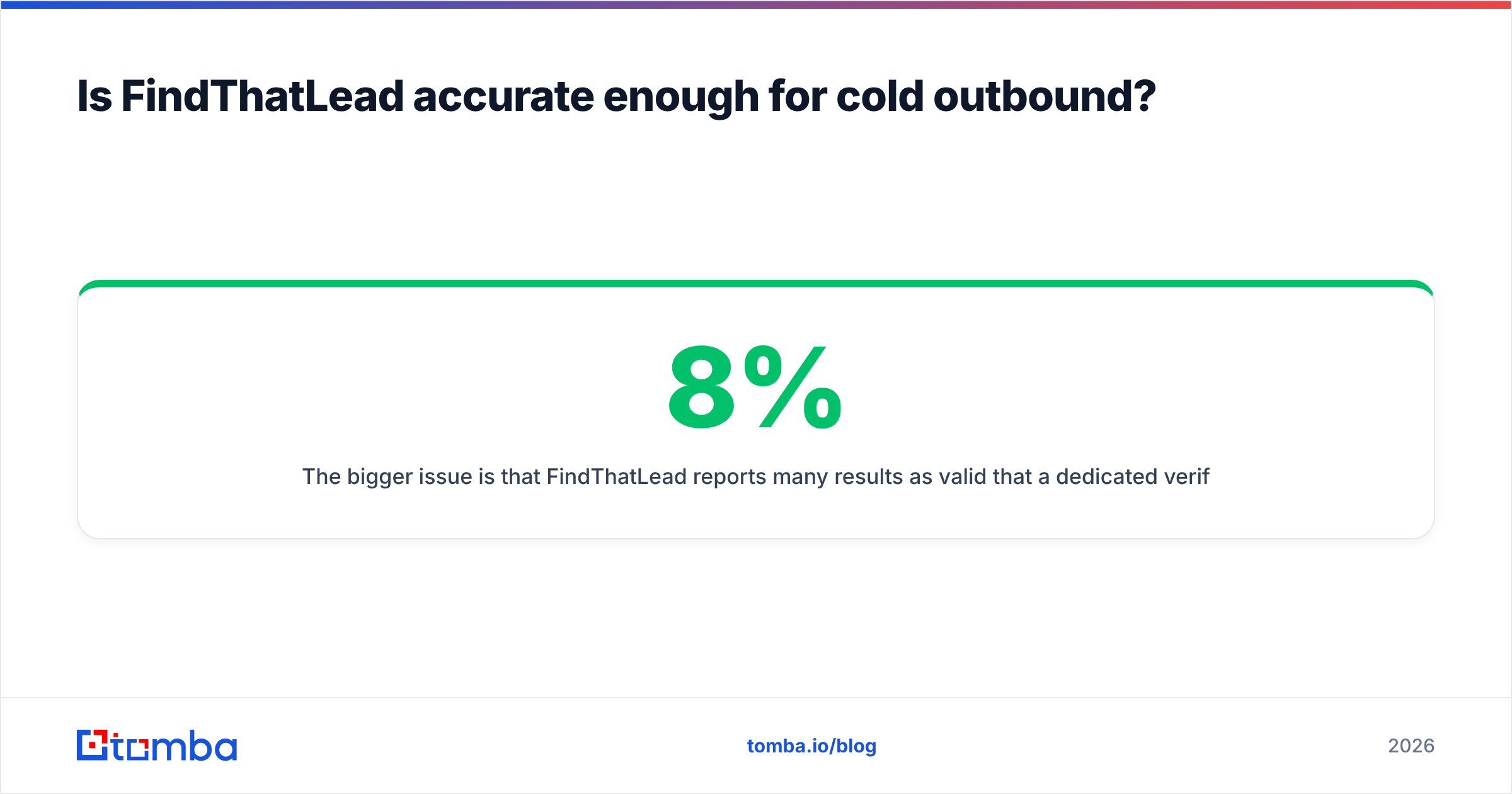
Here is how the two tools map against the pipeline:
| Capability | FindThatLead | TrueList |
|---|---|---|
| Find email by name + domain | Yes | No |
| Bulk domain search | Yes | No |
| Lead database / filters | Yes (Prospector) | No |
| Single email verification | Basic, bundled | Yes, core product |
| Bulk list verification | Limited | Yes, core product |
| Catch-all detection | Weak | Yes |
| Cold email sending | Yes (built-in sender) | No |
| API access | Yes | Yes |
| Chrome extension | Yes | No |
| Pricing model | Monthly subscription | Pay-as-you-go credits |
How do FindThatLead and TrueList compare on price?#
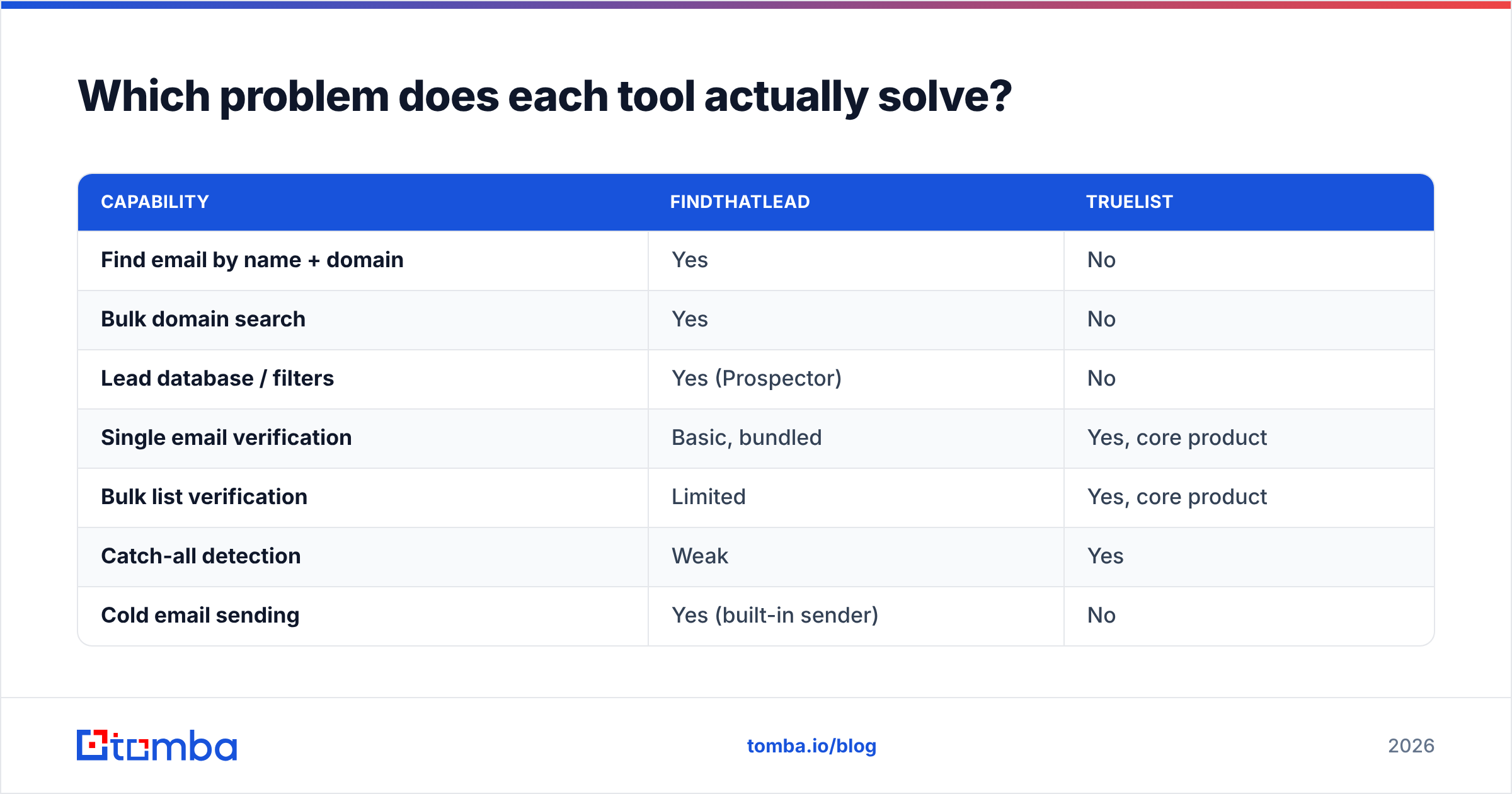
Pricing is where the comparison gets genuinely useful, because the two vendors charge on completely different axes. FindThatLead sells monthly seats with credit allowances. TrueList sells verifications outright — buy 10,000 credits, use them whenever.
| Plan detail | FindThatLead | TrueList | Tomba |
|---|---|---|---|
| Entry paid price | ~$49/mo (Growth) | ~$29 one-time (5k credits) | $49/mo (Starter) |
| Free tier | Limited trial credits | 100 free verifications | 25 searches/mo |
| Credits expire monthly | Yes | No | Yes |
| Finder included | Yes | No | Yes |
| Verifier included | Basic | Yes | Yes |
| Bulk upload | Yes | Yes | Yes |
| API on entry plan | Yes | Yes | Yes |
| Best for | List building | List cleaning | Both in one pool |
Two practical notes. First, TrueList's non-expiring credits are a real advantage if your sending is seasonal — an agency that cleans a client list once a quarter should not be paying a subscription for eleven idle weeks. Second, FindThatLead's monthly credits reset whether you used them or not, which is standard for finders but stings on slow months. Check current Tomba pricing if you want the combined-pool comparison at the same price point.
Is FindThatLead accurate enough for cold outbound?#
FindThatLead's accuracy sits in the acceptable-but-not-leading band. In practical use, pattern-based guessing carries a lot of the weight: it infers first.last@domain.com from a company's observed format, then does a light SMTP check. That works well for mid-size companies with consistent naming and degrades on catch-all domains, on companies using aliasing, and on smaller businesses with irregular formats.
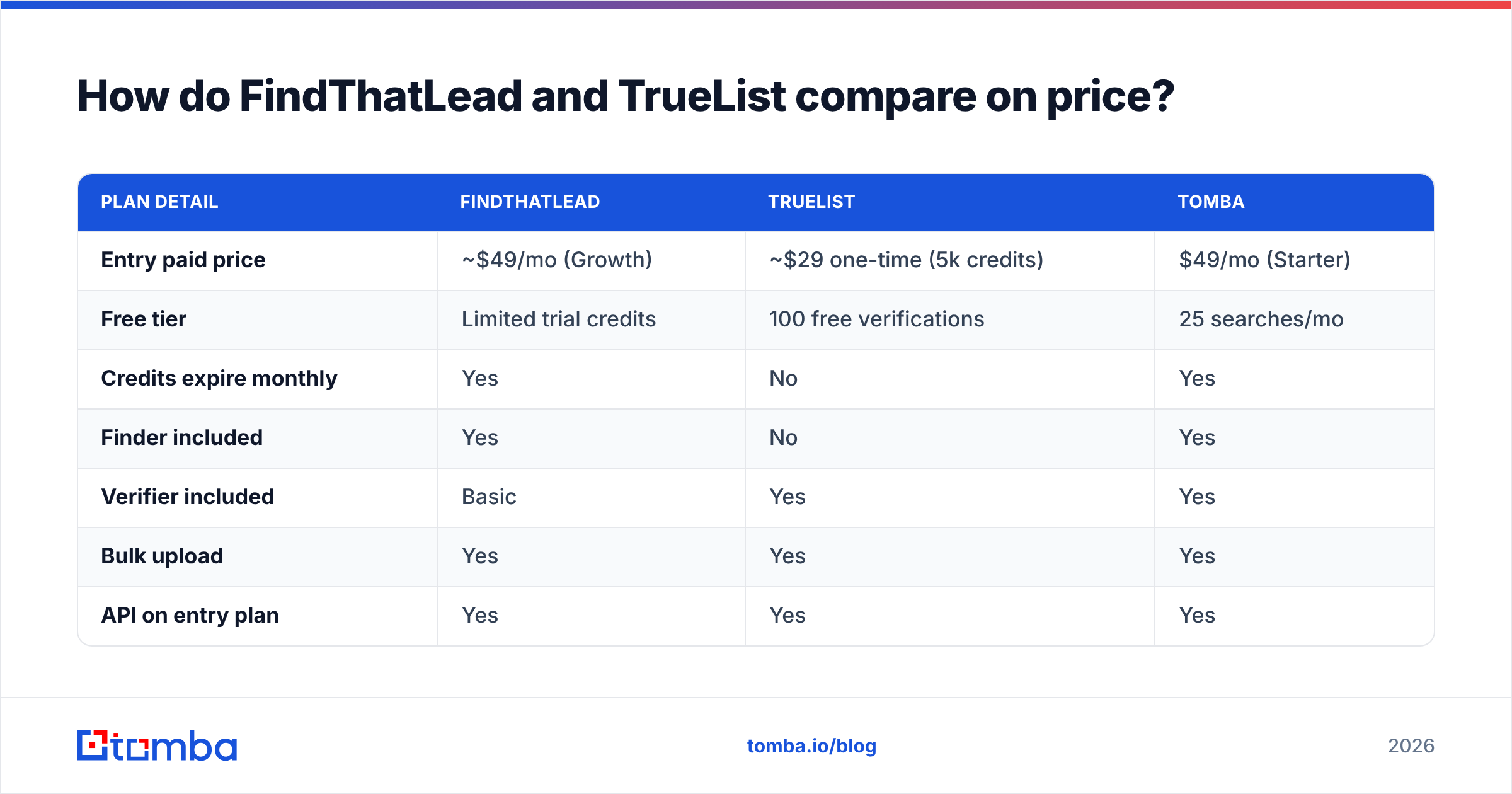
The bigger issue is that FindThatLead reports many results as valid that a dedicated verifier would flag as risky. If you take a FindThatLead export straight to your sequencer without a second pass, expect bounce rates in the 4–8% range on cold lists. Google and Microsoft both tightened bulk-sender requirements, and Google's sender guidelines put the spam-complaint threshold at 0.3% — bounce rates north of 3% will start costing you inbox placement well before you notice reply-rate damage.

This is exactly why the two-tool stack exists. Find with one, verify with another, send only what survives. It works. It also means two vendors, two invoices, two credit systems, and a CSV shuffle between them.
Is TrueList worth it as a standalone verifier?#
Yes, with a caveat about scope.
TrueList does the verification job competently. Its catch-all handling is more honest than most — instead of guessing, it labels catch-all domains as such and lets you decide, which is the correct behavior. Vendors that confidently mark catch-all addresses as "valid" are inflating their own accuracy score at your expense. If you want to go further on those domains specifically, a dedicated catch-all verifier applies additional signals before you decide to send.
The caveat: TrueList is a point solution. If verification is the only gap in your stack — you get contacts from a CRM export, a partner list, an event registration file — then a pay-as-you-go verifier is the cheapest correct answer, and TrueList is a reasonable pick alongside ZeroBounce and Bouncer. Its G2 reviews skew positive on simplicity and support.
But if you are also building lists, you now have two systems. And the moment you have two systems, you are exporting CSVs, re-importing them, losing enrichment fields, and reconciling credit balances across vendors. That overhead is invisible on a spreadsheet and very loud on a Tuesday afternoon.
What does a combined finder + verifier stack look like?#
The alternative is a platform where finding and verifying draw from one credit pool and one API. Every address that comes out of the finder has already been through verification before it reaches your export.
Concretely, a combined workflow looks like this:
- Start from the domain, not the person. Run a domain search on each target account to pull every discoverable address plus the company's dominant email pattern. This is faster than person-by-person lookup and gives you fallback contacts when your primary target leaves.
- Enrich from whatever identifier you already have. LinkedIn URL, a published article byline, or an existing partial record — each maps to a different lookup path rather than forcing you back to manual search.
- Verify inside the same run. Addresses get SMTP-checked and catch-all-flagged before they hit your CSV, so there is no second upload step and no second vendor.
- Push straight into the CRM. A HubSpot integration or the Tomba API moves verified contacts into your pipeline without a manual import, which is where most enrichment fields quietly get dropped.
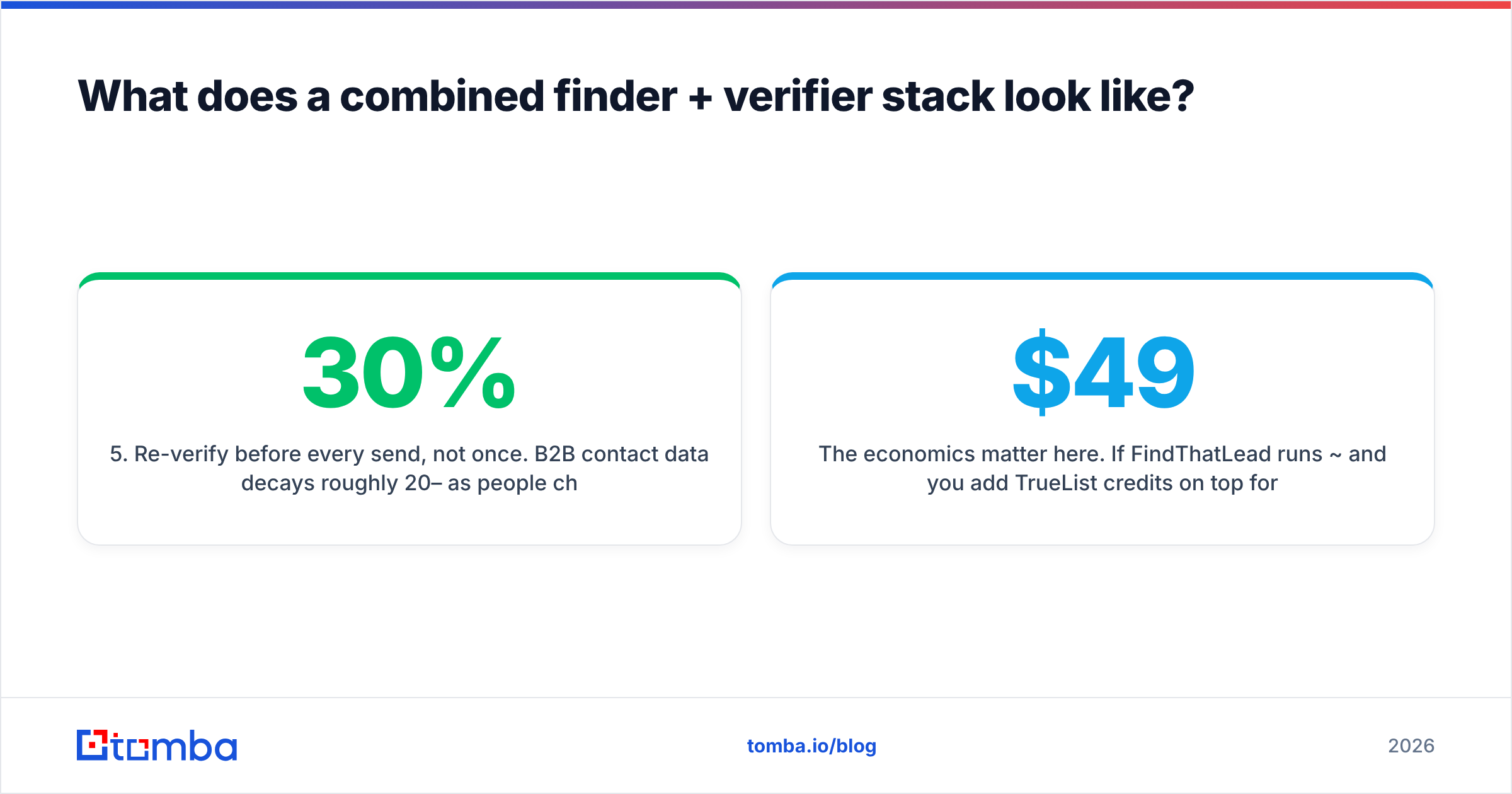
- Re-verify before every send, not once. B2B contact data decays roughly 20–30% per year as people change jobs. A list verified in January is not a verified list in September.

The economics matter here. If FindThatLead runs ~$49/mo and you add TrueList credits on top for cleanup, you are at roughly $75–90/mo for a moderate volume — for two products that each solve half a problem. A single platform at $49/mo covering both is not a marginal saving; it is the same money for a workflow with one fewer failure point.

Which should you choose for your situation?#
Skip the feature matrices for a second and match the tool to your actual state.
Choose TrueList if: you own a large existing list you did not build this year, your bounce rate is above 3%, and you have no immediate need to find new contacts. Non-expiring credits make it cheap to clean once and walk away. Pair it with a free email checker for spot checks between bulk runs.
Choose FindThatLead if: you are a solo founder or two-person team that wants finding and sending in one login, your targets are mid-size companies with predictable email formats, and you can tolerate mid-single-digit bounce rates. The built-in sequencer has genuine value if you would otherwise buy a separate sending tool.
Choose a combined platform if: you are building lists continuously, you care about deliverability enough to measure it, or you want programmatic access rather than CSV round-trips. This is most teams doing outbound seriously in 2026.
Consider a curated database instead if: you would rather buy a pre-verified list than build one. Providers like BookYourData sell verified B2B contacts by filter with bounce guarantees, which suits teams that need volume immediately and do not want to run a discovery workflow at all. It is a different purchase shape — data as inventory rather than data as a service — and for some GTM motions it is the faster path.
What do people get wrong when comparing these tools?#
Three mistakes come up repeatedly.
Mistake one: treating "verified" as binary. A verifier returns categories, not a yes/no. Valid, invalid, risky, catch-all, role-based, and unknown are six different business decisions. Sending to role accounts like info@ is a different risk than sending to a catch-all domain. Tools that collapse this into a single green checkmark are hiding the decision from you.
Mistake two: verifying once and reusing forever. Contact data rots. Gartner research on data decay has long put B2B database degradation in the double digits annually. Treat verification as a step in every campaign, not a one-time purchase.
Mistake three: optimizing cost per credit instead of cost per reply. A finder that is 20% cheaper per lookup but returns 15% more bad addresses costs you more once you account for bounces, reputation damage, and rep time chasing dead contacts. Track cost per verified, deliverable, actually-replied-to contact. It reorders the shortlist immediately.
What about deliverability once the list is clean?#
A clean list is necessary and not sufficient. Verification protects you from hard bounces; it does nothing about authentication, sending volume, or content.
Before your next campaign, confirm three things. Your SPF record, DKIM, and DMARC are configured on the sending domain — Google and Yahoo both require authentication for bulk senders now, and unauthenticated mail is increasingly rejected outright rather than filtered. Your sending volume ramps rather than spikes; a domain that goes from 0 to 500 sends a day looks exactly like a compromised account. And your sender reputation is monitored rather than assumed, using Google Postmaster Tools or an equivalent.
Neither FindThatLead nor TrueList handles any of that. They sit upstream of it. Getting the list right removes the biggest single deliverability variable you control, but it is one variable among several.
The verdict#
If you already have the list, TrueList is a clean, fairly priced way to clean it, and its non-expiring credits suit irregular usage better than any subscription verifier. If you need to build the list, FindThatLead will do it, but the accuracy gap means you will end up buying verification separately anyway — which puts you back at two vendors for one job.
For most teams building outbound lists in 2026, the combined stack wins on both cost and operational simplicity. One credit pool, one API, verification built into discovery rather than bolted on after.
That is the case for starting with the Tomba Email Finder. Find addresses by domain, name, or LinkedIn profile, get them SMTP-verified and catch-all-flagged in the same run, and push them straight into HubSpot, Salesforce, Sheets, or your own stack via API. The free tier gives you 25 searches a month to test the accuracy against your own target accounts before you commit — which is exactly how you should evaluate any tool on this list, including this one.
Related guides#
Ready to find emails that actually work?
Join 150,000+ professionals who stopped guessing and started sending. Free credits on signup — no credit card required.
Get the Tomba newsletter
Practical outbound tactics and product updates — once every two weeks.
About the author