FindThatLead vs Validto 2026: Which Email Tool Wins?
FindThatLead and Validto solve overlapping problems from opposite ends: one is a prospecting suite, the other a verification-first utility. Here is how they compare on accuracy, pricing, bulk limits, and API depth — plus when neither is the right pick.
TL;DR
- FindThatLead is a prospecting suite — lead search, domain scraping, and a built-in cold email sender. You buy it when you want lead sourcing and sending under one login.
- Validto sits at the other end: a lean, verification-first utility. You buy it when your list already exists and you need it cleaned before it torches your domain.
- Neither tool is a drop-in replacement for the other. Comparing them head-to-head only makes sense if you're deciding which problem to solve first — sourcing or hygiene.
- On raw email-finding accuracy across mid-market and enterprise domains, dedicated finders with published verification pipelines (including Tomba) tend to beat suite tools that treat finding as one feature among ten.
- Best-value pick for most 2–20 person outbound teams: a dedicated finder plus a real verifier, which usually lands cheaper than a suite seat and cleaner than a bare validator.
What are FindThatLead and Validto, actually?#
Think of it like buying kitchen equipment. FindThatLead is the all-in-one countertop appliance — it chops, blends, and cooks, and it does none of those things as well as a dedicated tool, but you only need one plug. Validto is a very good knife: single purpose, sharp, cheap, and useless for boiling water.
FindThatLead launched out of Barcelona and has been in the market for roughly a decade. Its pitch is end-to-end: search for leads by role and location, scrape a domain for company contacts, run a Chrome extension over LinkedIn, then push everything into its native "Scrab.in"-adjacent sending flow. The whole point is that you never leave the dashboard.
Validto is positioned as an email validation and deliverability-hygiene tool. Its job is to take a list you already have and tell you which addresses are deliverable, which bounce, which are role-based (info@, sales@), which are disposable, and which sit on catch-all domains where SMTP gives you no honest answer. There's no sequencer, no CRM, no persona search. That's the design, not a gap.
So the honest framing of findthatlead vs validto is not "which is better." It's: which layer of your pipeline is currently leaking?
Which layer of the pipeline are you actually fixing?#
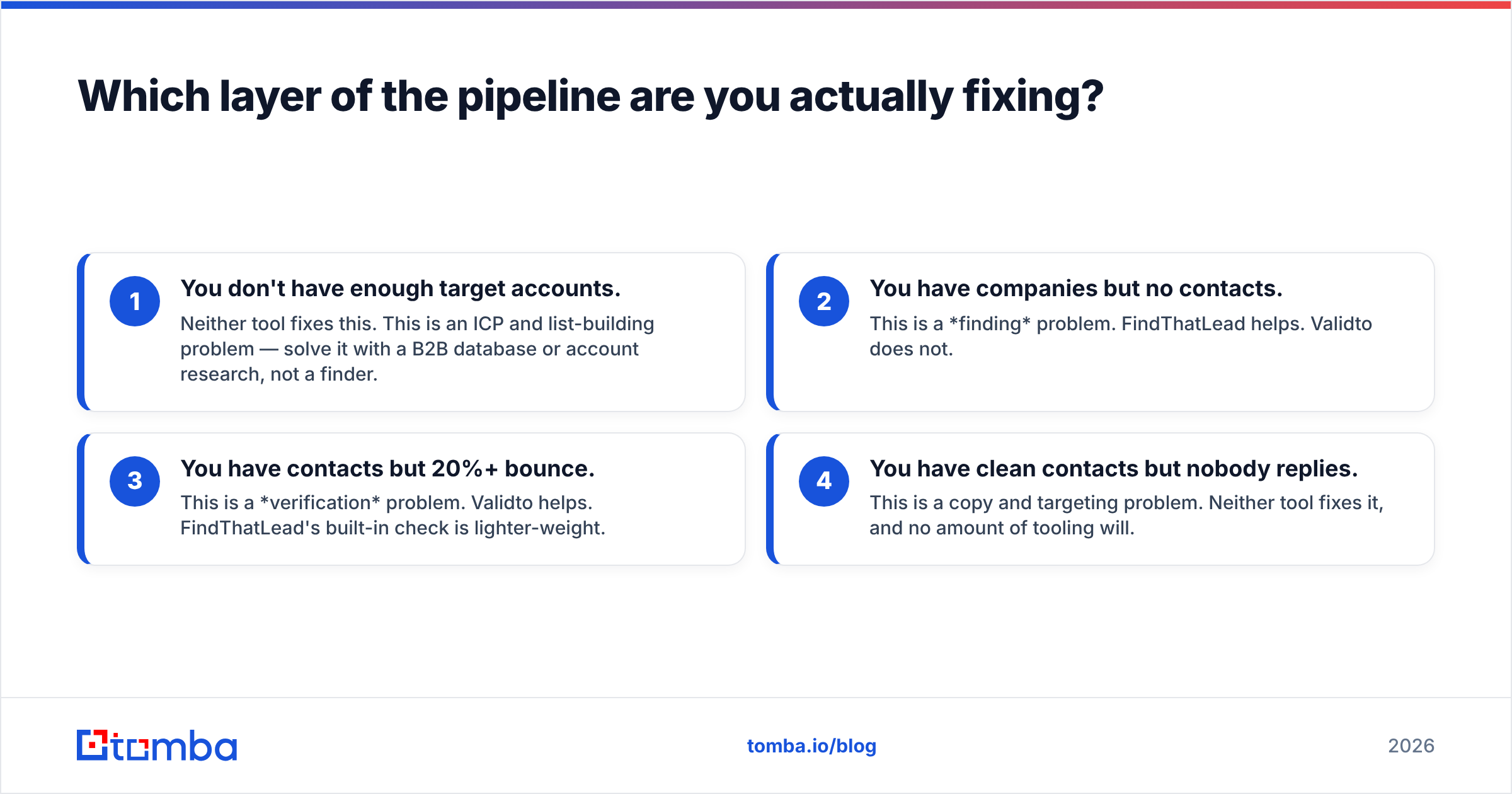
Before you compare feature grids, diagnose the leak. Outbound has four failure points and each one has a different fix:
- You don't have enough target accounts. Neither tool fixes this. This is an ICP and list-building problem — solve it with a B2B database or account research, not a finder.
- You have companies but no contacts. This is a finding problem. FindThatLead helps. Validto does not.
- You have contacts but 20%+ bounce. This is a verification problem. Validto helps. FindThatLead's built-in check is lighter-weight.
- You have clean contacts but nobody replies. This is a copy and targeting problem. Neither tool fixes it, and no amount of tooling will.
Most teams that go shopping for a finder are actually at stage 3. They bought volume, sent it raw, and watched their sender reputation collapse. If that's you, a verification-first tool is the more urgent purchase — but you'll be back for a finder within a quarter.

How do FindThatLead and Validto compare feature by feature?#
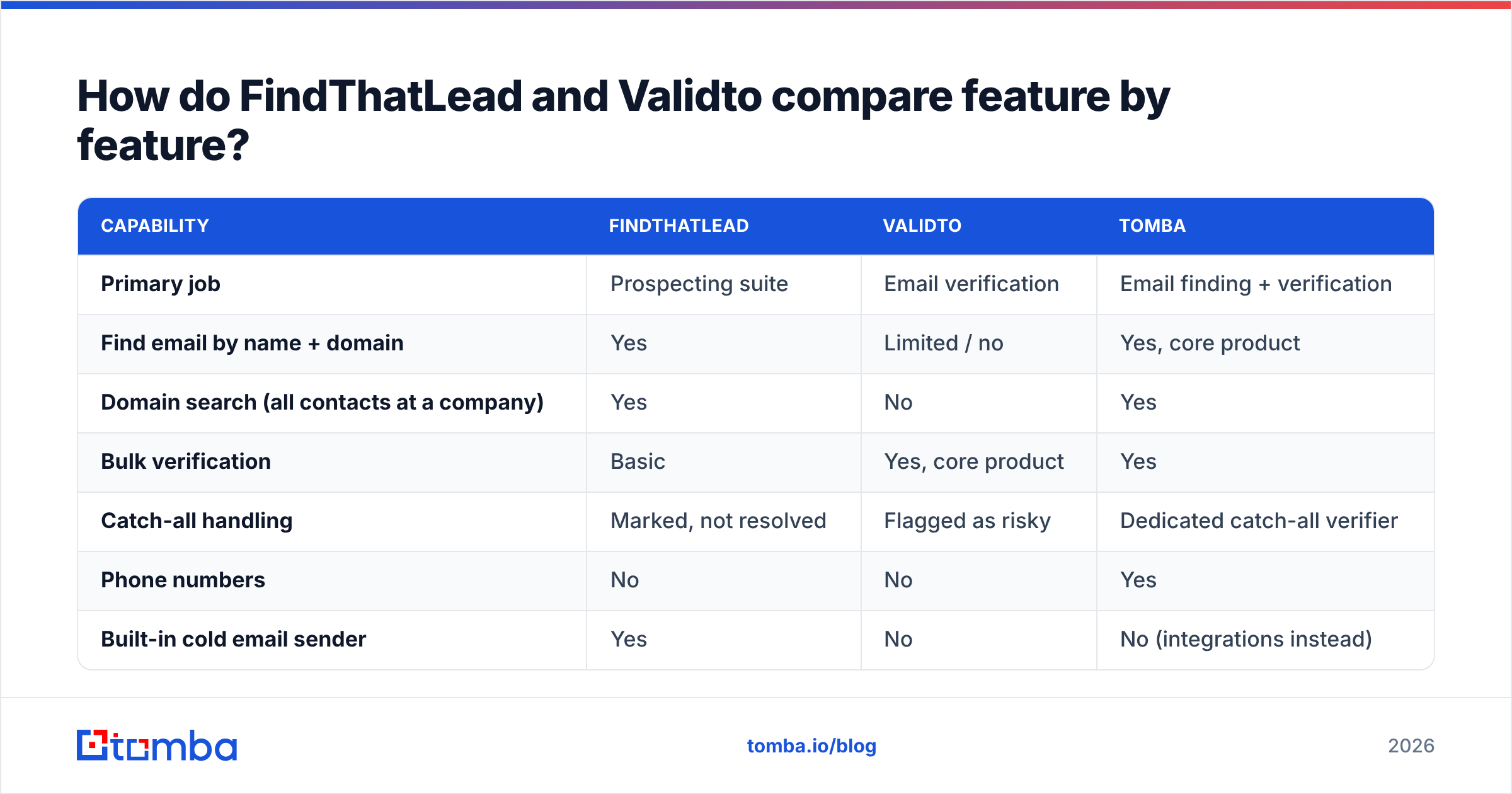
Here's the practical grid. Pricing tiers move, so treat the figures as directional and confirm on each vendor's page before you buy — vendors in this category reprice roughly twice a year.
| Capability | FindThatLead | Validto | Tomba |
|---|---|---|---|
| Primary job | Prospecting suite | Email verification | Email finding + verification |
| Find email by name + domain | Yes | Limited / no | Yes, core product |
| Domain search (all contacts at a company) | Yes | No | Yes |
| Bulk verification | Basic | Yes, core product | Yes |
| Catch-all handling | Marked, not resolved | Flagged as risky | Dedicated catch-all verifier |
| Phone numbers | No | No | Yes |
| Built-in cold email sender | Yes | No | No (integrations instead) |
| Chrome extension | Yes | Varies | Yes |
| Public REST API | Yes | Yes | Yes, documented |
| Free tier | Limited trial credits | Trial credits | 25 searches/mo, no card |
| Entry paid plan | ~$49/mo range | Low-cost, credit-based | $49/mo Starter |
| Best for | Solo founders wanting one login | Cleaning an existing list | Teams that need accuracy at scale |
Two things jump out.
First, the overlap is thinner than the marketing suggests. FindThatLead does verify, and Validto does touch enrichment at the edges, but each is a courtesy feature on the other's home turf. If you buy FindThatLead expecting Validto-grade validation depth, you'll be disappointed. If you buy Validto expecting to source 5,000 net-new contacts, you'll be more disappointed.
Second, "suite" pricing is rarely cheaper. A prospecting suite bundles sending into the seat price. If you already run Instantly, Smartlead, Lemlist, or HubSpot Sequences, you're paying twice for the sender and once for a finder that's weaker than a standalone. That math only works if you genuinely retire your existing sender.
Is FindThatLead accurate enough for cold outbound?#
Accuracy is where suite tools consistently give ground, and it's worth being precise about why rather than just asserting it.
An email finder produces a candidate address one of three ways:
- Pattern inference — it knows
acme.comusesfirst.last@, so it guessesjane.doe@acme.com. - Sourced records — it has actually seen that address in a crawl, a data partnership, or a user contribution.
- Verification — it tests the candidate against the receiving mail server before handing it to you.
Pattern inference is cheap and scales infinitely. It's also where the bounces come from. A tool that leans on inference and skips a hard verification step can report an impressive "found" rate while shipping you 15–25% junk. A tool that verifies aggressively reports a lower found rate and a much lower bounce rate. Those two numbers are in tension, and vendors choose which one to put on the homepage.

The reason this matters more in 2026 than it did in 2021: Google and Microsoft both tightened bulk-sender enforcement, and a sustained bounce rate above roughly 2–3% is now enough to get filtered rather than merely throttled. Volume no longer compensates for accuracy. A list of 500 verified contacts outperforms 3,000 inferred ones, and it does so without costing you the domain.
FindThatLead's finder is competent on SMB domains with predictable patterns. It gets noticeably weaker on enterprise domains that use aliases, on companies with multiple mail domains, and on catch-all configurations — which, at this point, is a large slice of the mid-market. That's not a knock on the product; it's the predictable outcome of splitting engineering across sourcing, scraping, sending, and a browser extension.
Why do catch-all domains break both tools differently?#
Catch-all is where the FindThatLead vs Validto comparison gets genuinely technical, so it's worth a plain explanation.
A catch-all domain is configured to accept mail sent to any address at that domain. asdfgh@catchall-company.com gets a 250 OK just like ceo@catchall-company.com. Standard SMTP verification therefore returns "valid" for both. The protocol simply cannot distinguish them.
Vendors respond in one of three ways:
- Mark as valid. Inflates the accuracy number, ships you bounces. Avoid tools that do this silently.
- Mark as risky and stop. Honest, safe, and useless — you now have a bucket of maybes you paid for and can't send to. This is where most pure validators land, Validto included.
- Resolve it with secondary signals. Cross-reference sourced records, pattern confidence, historical engagement data, and org-level evidence to produce a confidence score instead of a binary flag.
Option 3 is expensive to build and is where dedicated finders earn their price. Tomba splits this into a catch-all finder and a catch-all verifier precisely because the two operations need different logic. If a meaningful share of your ICP sits on catch-all domains — common in agencies, professional services, and anything European mid-market — this single capability will matter more to your reply rate than every other feature on the comparison table combined.
What does each tool actually cost per usable contact?#
Sticker price is the wrong unit. The right unit is cost per contact you can actually email.
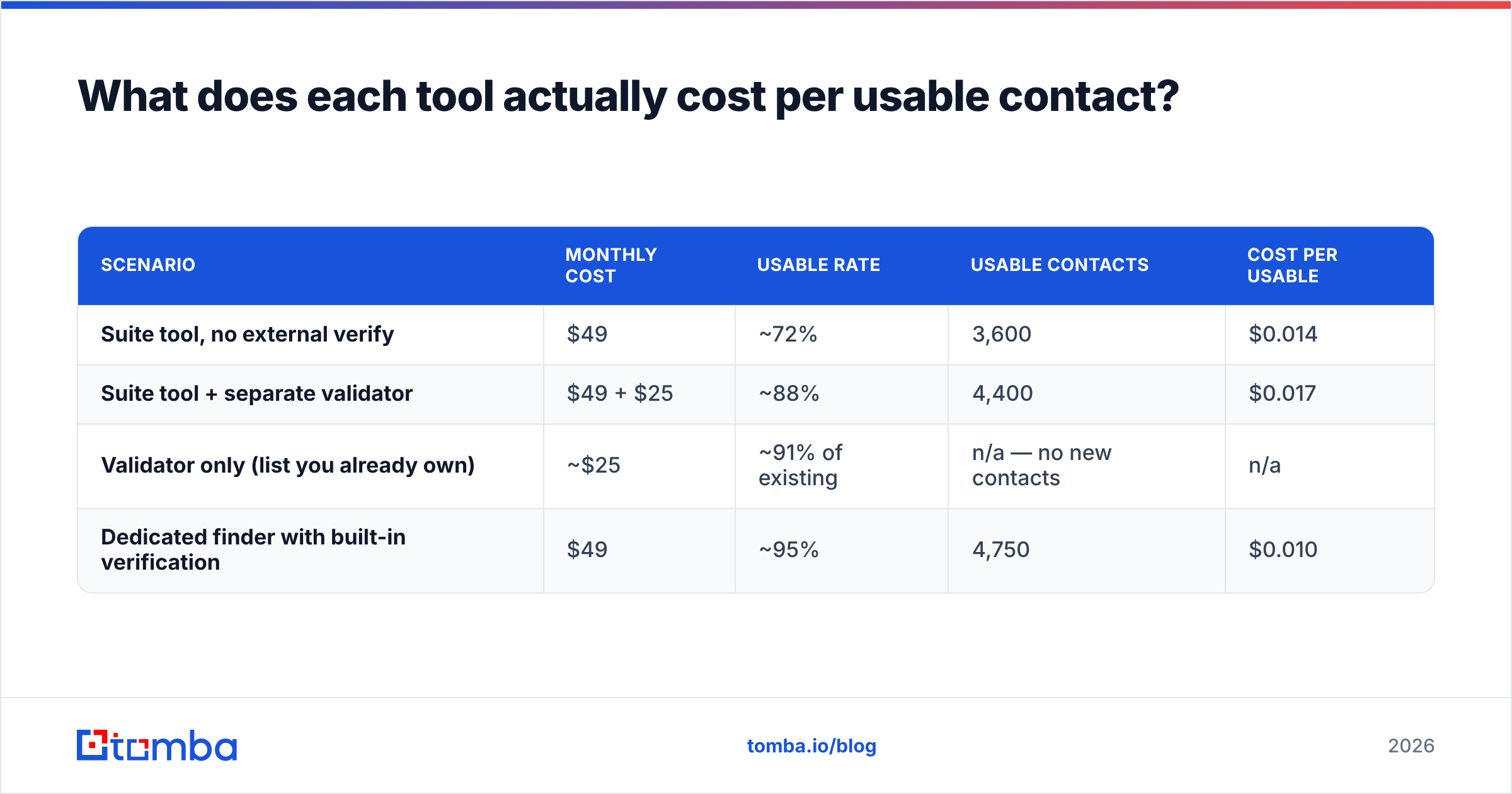
Run the math on a hypothetical 5,000-contact month:
| Scenario | Monthly cost | Usable rate | Usable contacts | Cost per usable |
|---|---|---|---|---|
| Suite tool, no external verify | $49 | ~72% | 3,600 | $0.014 |
| Suite tool + separate validator | $49 + $25 | ~88% | 4,400 | $0.017 |
| Validator only (list you already own) | ~$25 | ~91% of existing | n/a — no new contacts | n/a |
| Dedicated finder with built-in verification | $49 | ~95% | 4,750 | $0.010 |
The usable rates above are illustrative — your numbers will shift with ICP, geography, and how stale your source list is. But the shape holds: stacking a cheap finder on top of a cheap validator often costs more per usable contact than one tool that does both properly, because you're paying for the same record twice and still eating the inference errors.
The other cost nobody lines up is domain risk. One burned sending domain costs you a new domain, three weeks of warmup, and the pipeline gap that follows. Priced against that, the difference between a $25 validator and a proper verification pipeline is rounding error. Run your list through a free email checker before you commit budget if you want a quick read on how dirty it currently is.

When should you pick FindThatLead over Validto?#
Straight answers, no hedging:
Pick FindThatLead if:
- You're a solo founder or a two-person team and consolidating tools has real value.
- You don't yet have a sending platform and want one included.
- Your ICP is SMB with predictable email patterns — agencies, local services, small SaaS.
- You value a single dashboard over best-in-class accuracy, and you accept a higher bounce rate as the trade.
Pick Validto if:
- You already have a list — purchased, scraped, inherited from a previous rep, or exported from a CRM that hasn't been cleaned since 2023.
- Your bounce rate is the fire, not your contact volume.
- You have a finder you're happy with and just need a hygiene layer in front of the sender.
- Budget is tight and you need the cheapest possible path to a sendable list.
Pick neither if:
- You're sending more than a few thousand emails a month and accuracy directly drives revenue.
- A meaningful chunk of your targets sit on catch-all or enterprise domains.
- You need contacts and phone numbers and enrichment in the same workflow — see phone finder and data enrichment for what that stack looks like.
- You need an API you can build on rather than a dashboard you click through.
For that third category, check independent review volume before you decide. G2 is the least-bad public source: filter by company size, ignore the aggregate star rating, and read the two-star reviews specifically. That's where accuracy complaints and support-response problems surface, and it's the fastest way to sanity-check any vendor claim including the ones in this post.
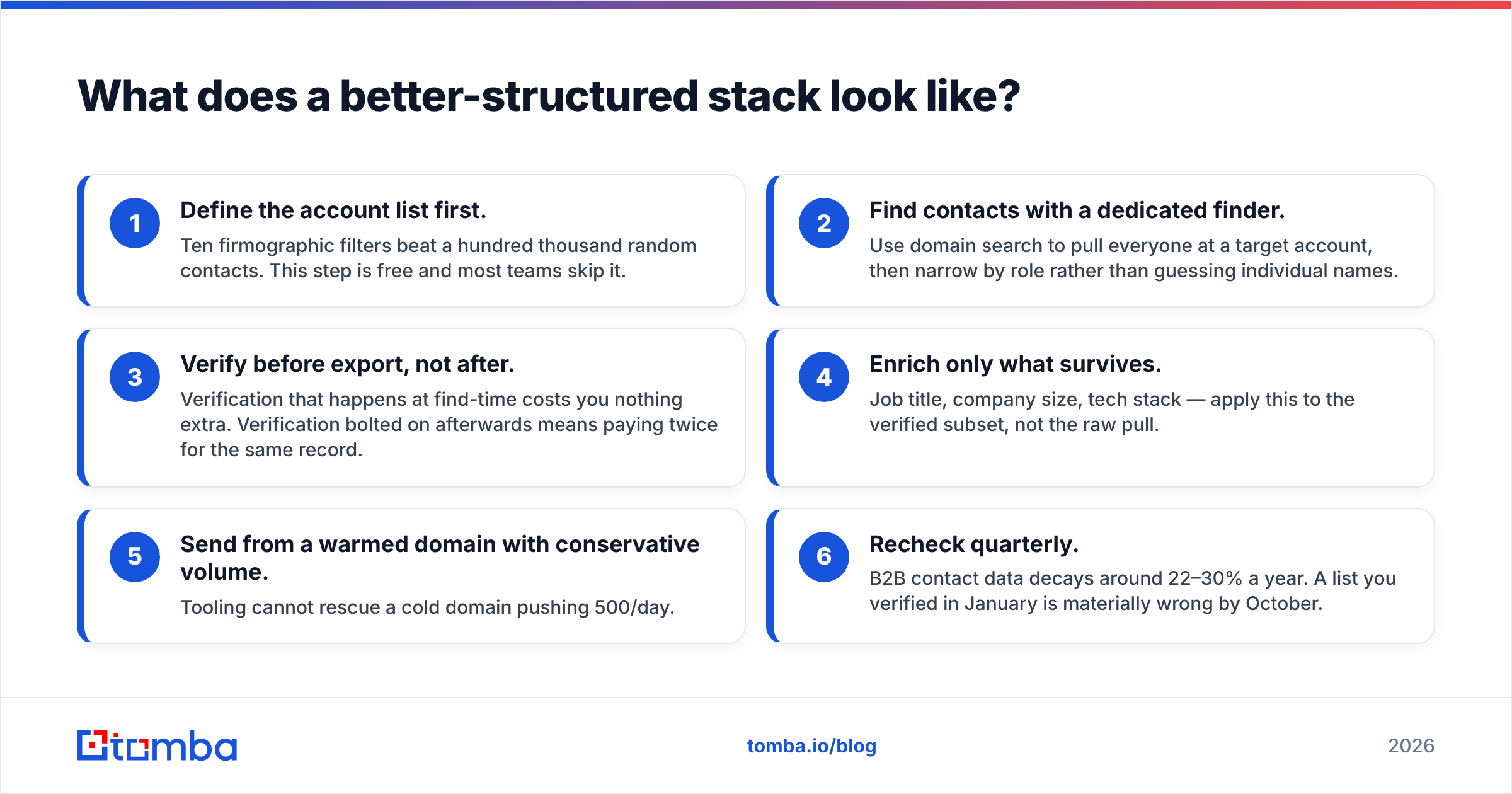
What does a better-structured stack look like?#
If you're building from scratch in 2026, here's the sequence that survives contact with reality:
- Define the account list first. Ten firmographic filters beat a hundred thousand random contacts. This step is free and most teams skip it.
- Find contacts with a dedicated finder. Use domain search to pull everyone at a target account, then narrow by role rather than guessing individual names.
- Verify before export, not after. Verification that happens at find-time costs you nothing extra. Verification bolted on afterwards means paying twice for the same record.
- Enrich only what survives. Job title, company size, tech stack — apply this to the verified subset, not the raw pull.
- Send from a warmed domain with conservative volume. Tooling cannot rescue a cold domain pushing 500/day.
- Recheck quarterly. B2B contact data decays around 22–30% a year. A list you verified in January is materially wrong by October.
Steps 2 and 3 are the ones this comparison is really about. A suite tool gives you a passable version of step 2 and a thin version of step 3. A validator gives you a strong step 3 and none of step 2. If you want both done properly under one line item, you want a purpose-built finder with verification in the pipeline rather than bolted to the end of it.

For teams running outbound programmatically rather than through a UI, the deciding factor is usually API quality — rate limits, response schema stability, and whether bulk jobs are first-class or an afterthought. Compare the Tomba API docs against each vendor's before you commit, and check Tomba pricing against the per-usable-contact math above rather than the headline number.
The verdict#
FindThatLead vs Validto isn't a fair fight because they're not in the same weight class or the same sport. FindThatLead wins if consolidation matters more than precision. Validto wins if your list already exists and is bleeding. Both lose to a dedicated finder if accuracy is what actually drives your number — which, for anyone sending at volume in 2026, it is.
Start with the free tier and test on your own domains before you believe anyone's accuracy chart, including this one. Run 50 known-good contacts through each tool and count the misses. That single hour of testing will tell you more than any comparison post.
Ready to see the difference on your own list? The Tomba Email Finder gives you 25 free searches a month with no card required — enough to benchmark it against whatever you're using now. Verification is built into the pipeline, catch-all domains get resolved instead of shrugged at, and Starter is $49/mo when you're ready to scale. Test it against your hardest 50 accounts and keep whichever tool finds more of them.
Related guides#
Ready to find emails that actually work?
Join 150,000+ professionals who stopped guessing and started sending. Free credits on signup — no credit card required.
Get the Tomba newsletter
Practical outbound tactics and product updates — once every two weeks.
About the author