FindThatLead vs VCbacked: Which Lead Data Tool Wins in 2026?
One tool finds emails at any domain you point it at. The other hands you a curated list of freshly funded startups. Here is how FindThatLead and VCbacked actually differ — and which one belongs in your 2026 outbound stack.
TL;DR
- They are not the same category. FindThatLead is a search-and-verify email finder: you point it at a domain, a name, or a LinkedIn profile and it returns contacts. VCbacked is a curated list product: you buy access to companies that recently raised venture funding, with contacts attached.
- Choose FindThatLead when your target account list already exists and you need addresses for it.
- Choose VCbacked when your ICP is literally "companies with fresh money" and you want the account list handed to you.
- Neither replaces verification. Funded-startup lists go stale fastest of all — the people listed at a Series A company in January may have been backfilled by three new hires in March.
- Most teams end up running a finder plus a trigger source. If you want both in one place, a general-purpose finder with a real API (Tomba starts at $49/mo, with a free 25-search tier) usually costs less than stacking two subscriptions.
What are FindThatLead and VCbacked?#
FindThatLead is a Barcelona-built prospecting suite that has been around since 2015. Its core is an email finder: give it a first name, last name, and company domain, and it returns a best-guess professional address with a confidence score. Around that core it stacks a domain-level "Prospector" search, a Chrome extension for LinkedIn, bulk CSV processing, and a lightweight cold-email sender so you can go from list to sequence without leaving the tab. You can see the current feature set on the FindThatLead site.
VCbacked sits in a different product category entirely: the funding-trigger list. The pitch is that companies which just closed a round are the highest-intent buyers in B2B — they have budget, they are hiring, and they are replacing tooling. Instead of searching for contacts, you buy a maintained list of recently funded companies with decision-maker contacts attached, usually delivered as a downloadable database or a searchable web app.
That difference matters more than any feature-by-feature score. One tool answers "what is this person's email?". The other answers "who should I even be emailing this quarter?" Treating them as substitutes is the single most common mistake in this comparison.
If you want the background on why funding events drive so much outbound spend, venture capital rounds are public, timestamped, and correlated with hiring — which makes them one of the few genuinely reliable buying signals in B2B.
How do FindThatLead and VCbacked compare head to head?#
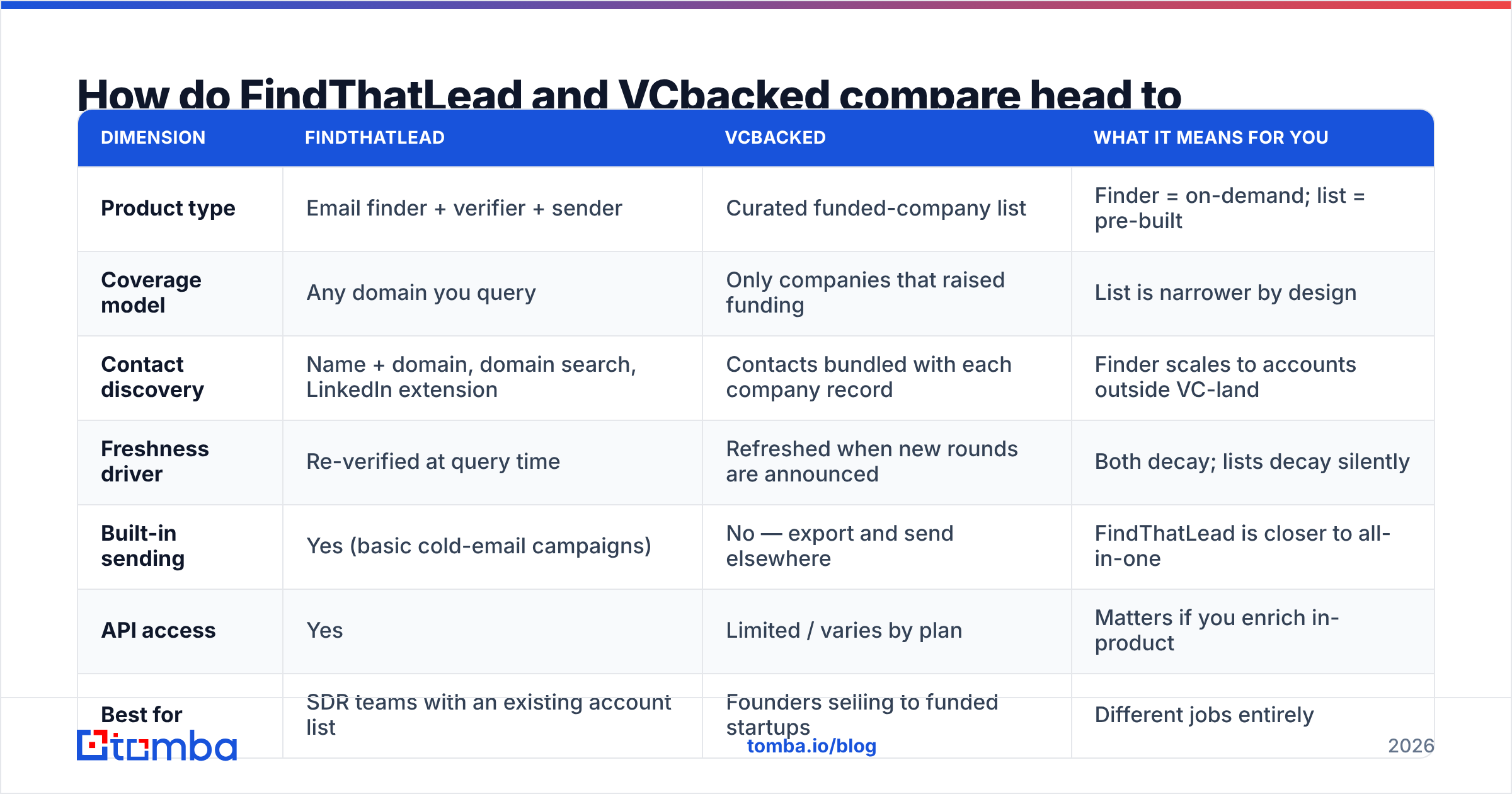
| Dimension | FindThatLead | VCbacked | What it means for you |
|---|---|---|---|
| Product type | Email finder + verifier + sender | Curated funded-company list | Finder = on-demand; list = pre-built |
| Coverage model | Any domain you query | Only companies that raised funding | List is narrower by design |
| Contact discovery | Name + domain, domain search, LinkedIn extension | Contacts bundled with each company record | Finder scales to accounts outside VC-land |
| Freshness driver | Re-verified at query time | Refreshed when new rounds are announced | Both decay; lists decay silently |
| Built-in sending | Yes (basic cold-email campaigns) | No — export and send elsewhere | FindThatLead is closer to all-in-one |
| API access | Yes | Limited / varies by plan | Matters if you enrich in-product |
| Best for | SDR teams with an existing account list | Founders selling to funded startups | Different jobs entirely |
| Typical entry cost | Around $49/mo at the Growth tier | Varies; often sold as database access | Verify current pricing before you commit |
Two honest caveats on that table. First, list prices at both vendors move — treat the numbers as a shape, not a quote, and check the vendor pages before you buy. Second, VCbacked's exact plan structure and refresh cadence are the kind of thing that changes quietly; ask for a sample file and a "last updated" column before you pay for anything.
Which one has more accurate data?#
Wrong question. Ask instead: accurate at what moment?
An email finder like FindThatLead computes an answer when you ask. It looks at known patterns for the domain, cross-references what it has seen in the wild, and often runs an SMTP-level check before returning a result. The answer is as fresh as your query. The failure mode is coverage — small domains, catch-all servers, and privacy-heavy regions produce "not found" or low-confidence guesses.
A funded-startup list like VCbacked was accurate on the day the record was compiled. The failure mode is decay. Post-round companies are the fastest-changing organizations in B2B: they hire aggressively, restructure GTM, and swap the exact contacts you bought. Industry consensus puts B2B contact data decay somewhere around 2–3% per month in normal conditions; at a company that just raised a Series A and tripled headcount, the practical decay on a "Head of Growth" record is worse than that.

So the operating rule is simple, and it applies to both tools:
- Never send to an unverified list, no matter how premium the source. Run every export through an email verifier before it touches your sequencer.
- Treat catch-all domains separately. A huge share of funded startups run catch-all mail servers, which means a naive verifier returns "valid" for addresses that will silently vanish. A dedicated catch-all verifier is the only honest way to score those.
- Re-verify on a schedule, not once. A list you bought in Q1 is a different list by Q3.
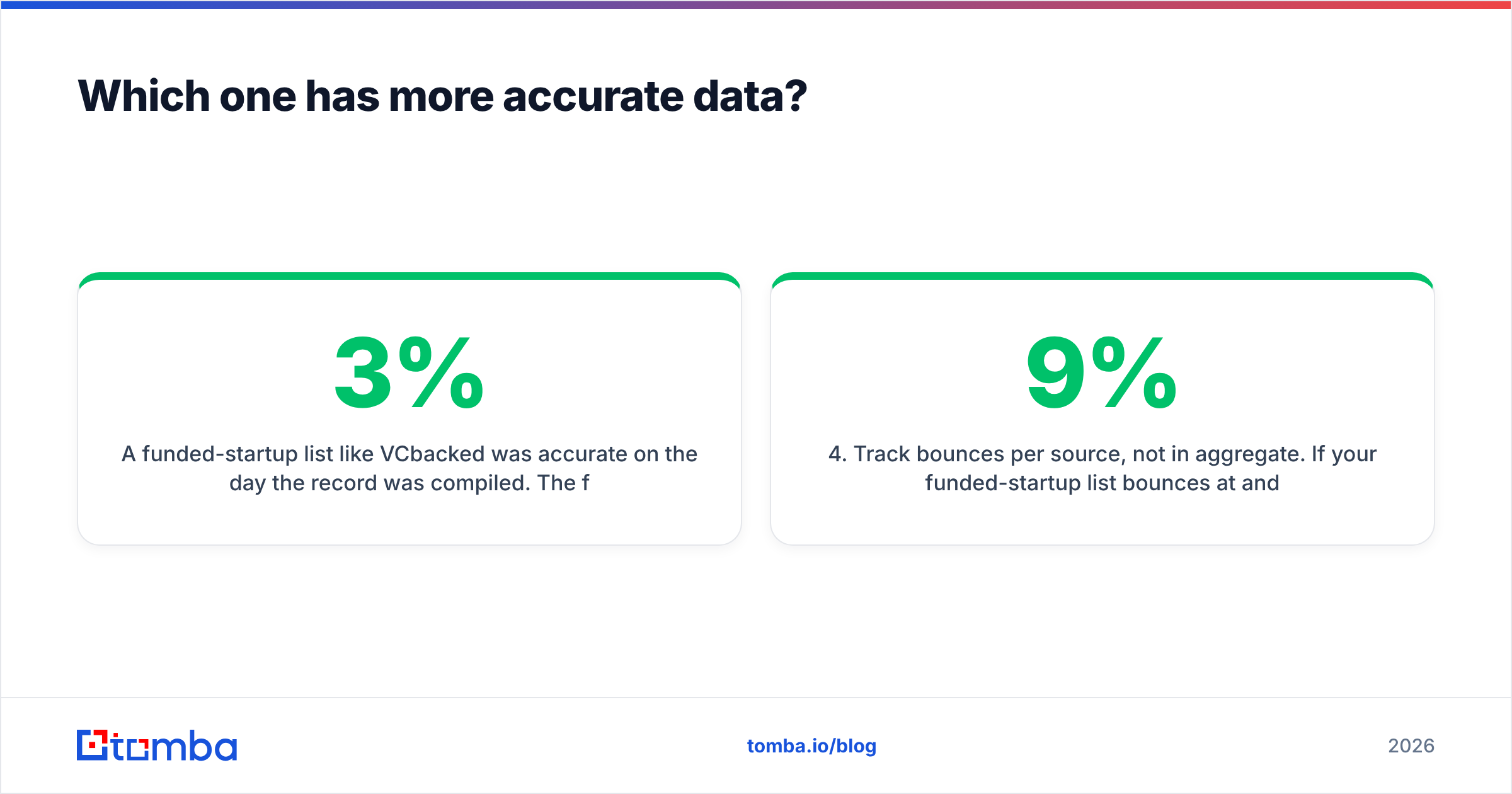
- Track bounces per source, not in aggregate. If your funded-startup list bounces at 9% and your finder output bounces at 2%, you now know where to spend.
Teams that skip step one blame the tool for their bounce rate. It is almost always the sending list, not the finder.
How does pricing compare in 2026?#
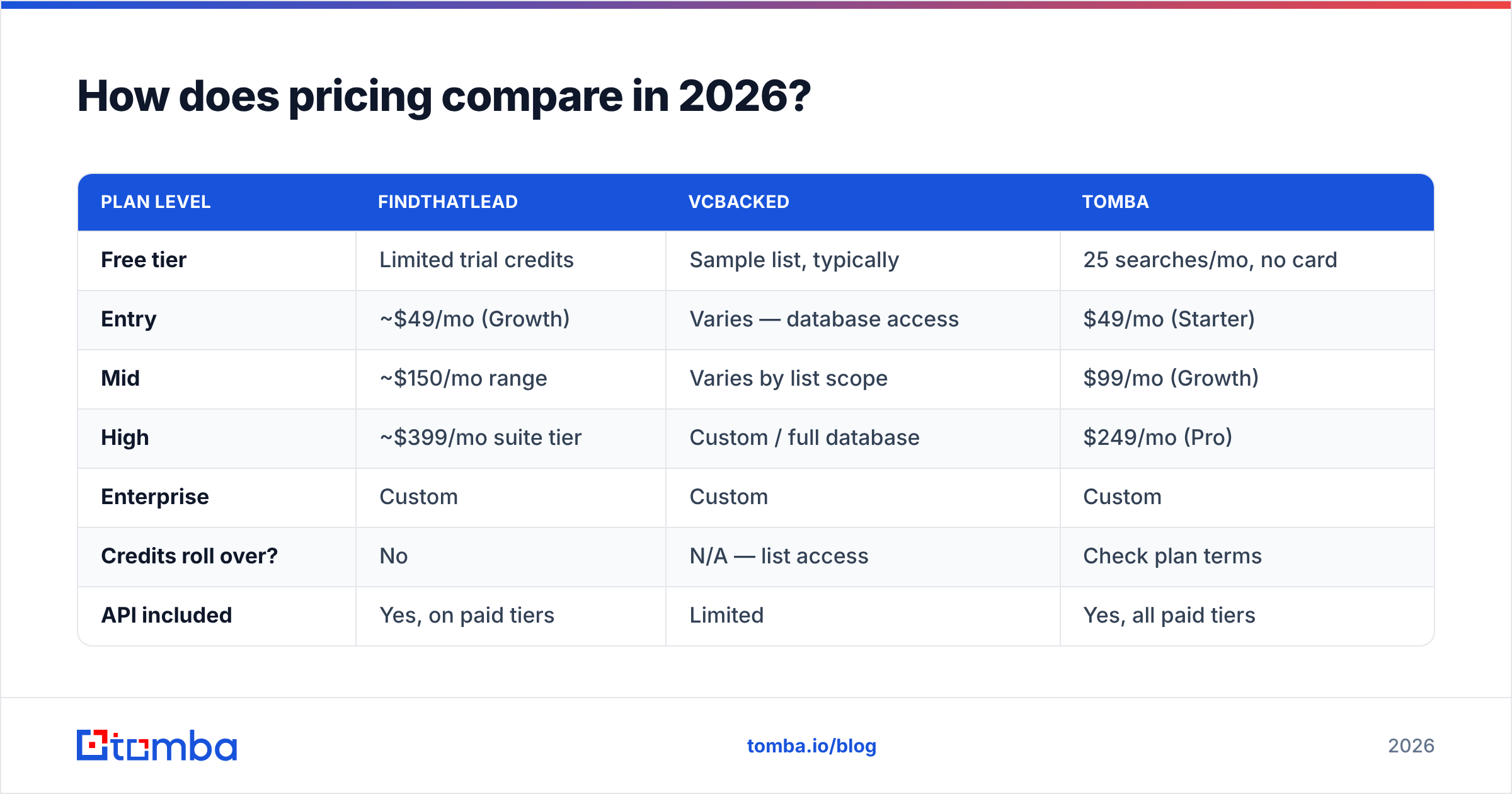
| Plan level | FindThatLead | VCbacked | Tomba |
|---|---|---|---|
| Free tier | Limited trial credits | Sample list, typically | 25 searches/mo, no card |
| Entry | ~$49/mo (Growth) | Varies — database access | $49/mo (Starter) |
| Mid | ~$150/mo range | Varies by list scope | $99/mo (Growth) |
| High | ~$399/mo suite tier | Custom / full database | $249/mo (Pro) |
| Enterprise | Custom | Custom | Custom |
| Credits roll over? | No | N/A — list access | Check plan terms |
| API included | Yes, on paid tiers | Limited | Yes, all paid tiers |
Read that table for structure, not for exact dollars. Both vendors change packaging; VCbacked in particular is priced more like a data product than a SaaS seat, which makes apples-to-apples math awkward. Current Tomba pricing is public and per-plan, so it is the easiest of the three to model against a monthly outbound volume.
The number that actually decides cost-per-meeting is usable contacts per dollar, not credits per dollar. A $49 plan that returns 1,000 verified addresses beats a $49 plan that returns 3,000 addresses of which 40% bounce — the second one also costs you domain reputation, which is not on any pricing page.
Who should pick FindThatLead?#
Pick FindThatLead if you recognise yourself in two or more of these:
- You already know your accounts. You have a list of 500 target companies from a conference, a partner, or your CRM, and you need contacts inside them.
- You want one tool, not three. The built-in sender is basic compared with a dedicated sequencer, but it means a solo founder can go list → email → send without another subscription.
- You prospect on LinkedIn. The Chrome extension pulls contacts while you browse, which is the main daily workflow for a lot of SDRs. If that is your motion, a dedicated LinkedIn finder does the same job and is worth benchmarking side by side.
- Your ICP is not VC-shaped. Agencies, manufacturers, clinics, local services, bootstrapped SaaS — none of these show up on a funding-trigger list, ever.
- You need bulk CSV throughput. Uploading a spreadsheet of names and domains and getting addresses back is the bread-and-butter use case, and FindThatLead handles it competently.
Who should pick VCbacked?#
Pick VCbacked if:
- Your product is bought by newly funded startups. Recruiting, dev agencies, fractional CFOs, GTM tooling, office/perks vendors — funding is a genuine buying trigger for you, not a proxy.
- You value the account list more than the contact. The real product is "which 400 companies raised money last month", curated so you do not have to scrape Crunchbase yourself.
- You want speed over control. No enrichment pipeline to build, no scraping to maintain. Download, filter, send.
- You will still verify. Buy the trigger, verify the contacts yourself. That combination works well; skipping the second half does not.
If your ICP is broader than "recently funded", a trigger list will feel expensive per usable lead very quickly, because you are paying for curation you cannot apply to 90% of your market.
Is there a third option that covers both jobs?#
Yes, and this is where most teams land after a year of stacking tools.
The account-selection problem and the contact-discovery problem are separable. You can source triggers cheaply — funding announcements are public, and so are job postings, tech-stack changes, and site visits. What you cannot fake is a verified address at scale.
That is the gap a general-purpose finder fills. With Tomba you run domain search against any account list you assemble — funded startups included — and get the contact layer without buying a second database. The Tomba API means you can wire funding-trigger sources straight into enrichment rather than exporting CSVs between tools, and data enrichment fills in the role, seniority, and company fields the trigger list left blank.


To be fair to both tools in this comparison: FindThatLead's bundled sender is something Tomba does not try to be, and VCbacked's curation is real work that saves real hours if funded startups are genuinely your market. The argument is not that one tool wins on every axis — it is that most teams over-buy on the data side and under-invest on the verification side.
What does a sane 2026 stack actually look like?#
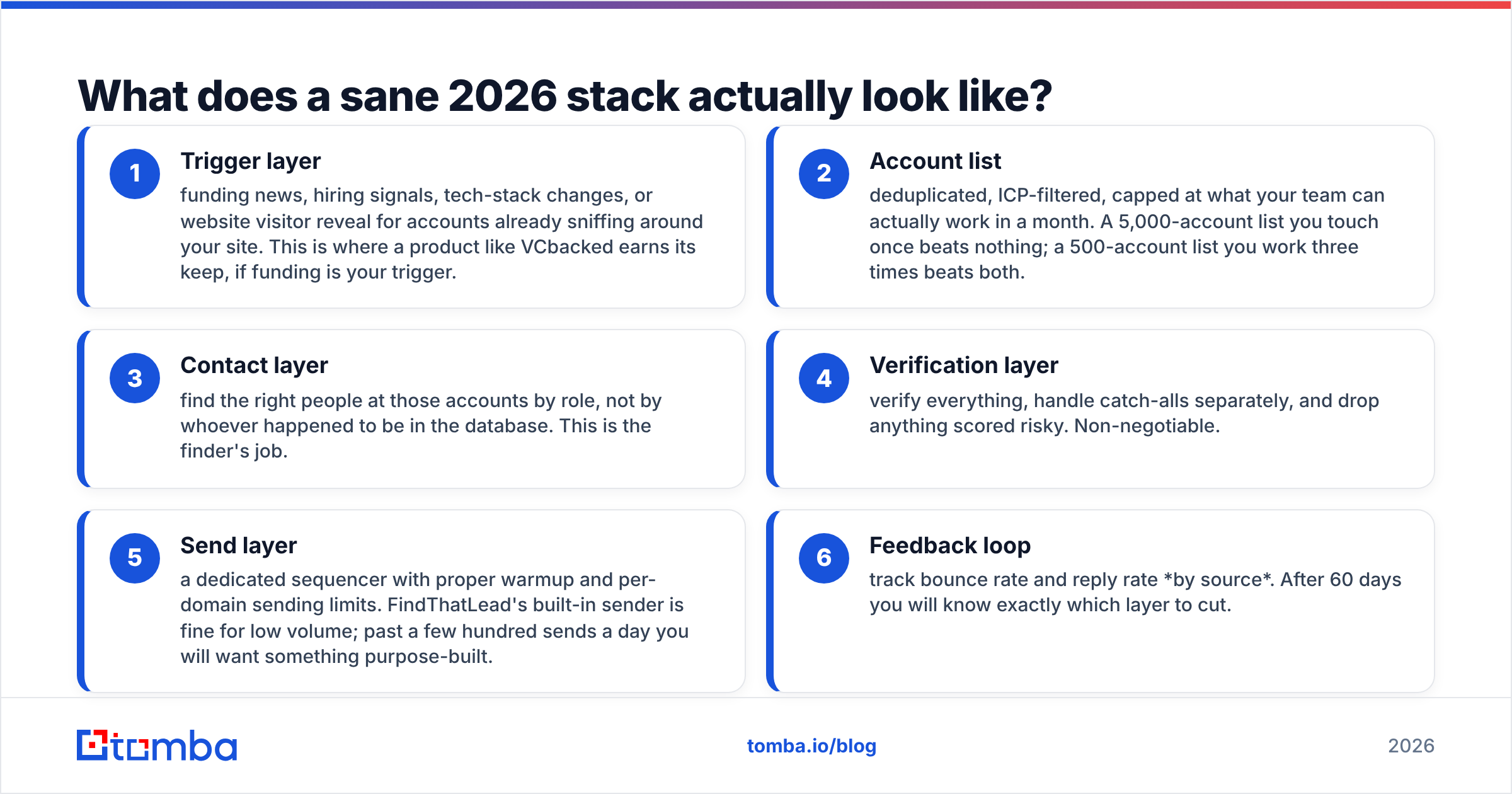
Here is the pattern that keeps showing up in teams with sub-3% bounce rates:
- Trigger layer — funding news, hiring signals, tech-stack changes, or website visitor reveal for accounts already sniffing around your site. This is where a product like VCbacked earns its keep, if funding is your trigger.
- Account list — deduplicated, ICP-filtered, capped at what your team can actually work in a month. A 5,000-account list you touch once beats nothing; a 500-account list you work three times beats both.
- Contact layer — find the right people at those accounts by role, not by whoever happened to be in the database. This is the finder's job.
- Verification layer — verify everything, handle catch-alls separately, and drop anything scored risky. Non-negotiable.
- Send layer — a dedicated sequencer with proper warmup and per-domain sending limits. FindThatLead's built-in sender is fine for low volume; past a few hundred sends a day you will want something purpose-built.
- Feedback loop — track bounce rate and reply rate by source. After 60 days you will know exactly which layer to cut.
The teams that struggle almost always collapsed steps 3 and 4 into one, assumed the vendor verified for them, and found out via a 14% bounce rate three weeks later.
How should you run the evaluation?#
Do not read another comparison post — including this one — as the deciding input. Run the same 50 contacts through both tools and count.
Pick 50 companies you actually want to sell to. For each, name the exact role you would email. Then:
- Ask both tools for that contact. Record hit rate (found vs not found).
- Export both sets and verify them through the same third-party verifier so the scoring is neutral.
- Compute cost per verified contact, not per credit.
- Send to both sets in a controlled test and compare bounce and reply rates.
Fifty rows takes an afternoon and settles the argument permanently. Public review aggregators like G2 are useful for spotting support and billing complaints, but they cannot tell you the hit rate on your ICP — only your own test can.
The verdict#
FindThatLead vs VCbacked comes down to whether you have an account list problem or a contact problem. If you know who to email and just need addresses, FindThatLead is the more flexible buy and works on every domain, not only funded ones. If your entire ICP is companies that just raised, VCbacked hands you a curated starting point that would otherwise cost you hours of manual research per week — and it deserves a look on those terms.
What neither of them removes is the verification step. That is the layer that decides whether your domain still lands in inboxes in six months.
If you want the contact layer to work across your whole market — funded startups, bootstrapped SaaS, and everything that never appears on a VC list — start with the Tomba Email Finder. The free tier gives you 25 searches a month with no card, paid plans start at $49/mo, and every result comes with a confidence score plus catch-all handling so you know what you are sending to before you hit send. Run it against the same 50 companies you test the other two with, and let the bounce rate pick the winner.
Related guides#
Ready to find emails that actually work?
Join 150,000+ professionals who stopped guessing and started sending. Free credits on signup — no credit card required.
Get the Tomba newsletter
Practical outbound tactics and product updates — once every two weeks.
About the author