FindThatLead vs ZoomInfo: Full 2026 Comparison and Verdict
One is a $49/mo prospecting tool built for solo founders. The other is a five-figure enterprise data platform. Here is where each one actually wins, where both waste your money, and which fits your 2026 pipeline.
TL;DR
- FindThatLead is a low-cost, self-serve prospecting tool: email finder, bulk domain search, and a built-in cold email sender. Public plans start around $49/mo. Best for solo founders and small agencies who want to go from list to send inside one tab.
- ZoomInfo is an enterprise sales-intelligence platform: a huge firmographic and contact database, intent signals, org charts, phone/direct-dial coverage, and deep CRM sync. Pricing is quote-only, annual, and typically lands in the five figures per year.
- These are not the same product category. Comparing them on "who finds more emails" misses the point — the real question is whether you're buying contact discovery or a go-to-market data layer.
- Both have the same structural weakness: you pay for volume you may not use, and neither is cheap to run as a pure API-first email lookup.
- If your actual job-to-be-done is "get verified work emails for a defined list of companies, at a predictable price, via API," a focused tool like Tomba Email Finder usually costs less than either and does that one job better.
What are FindThatLead and ZoomInfo, exactly?#
Think of it like buying a vehicle. FindThatLead is a scooter: cheap, immediately useful, gets you across town today, no paperwork. ZoomInfo is a delivery fleet with a dispatcher: enormous capacity, real logistics value, and a contract with a finance team attached.
FindThatLead (findthatlead.com) launched as an email-finding Chrome extension and grew into a lightweight prospecting suite. Its core loop is: search by domain or by name+company, get an email, verify it, drop it into a list, and send a sequence from the built-in "Scrab.in"/campaign tooling. Everything is self-serve. You can sign up and be running a search in under two minutes.
ZoomInfo is a different animal. It maintains one of the largest commercial B2B contact and company databases in the market, enriched by a contributory network, web crawling, and manual research. On top of the raw records it layers intent data (which accounts are researching your category), technographics, org charts, websites-visitor identification, and a workflow engine that pushes segments into Salesforce, HubSpot, and Outreach.
So the honest framing of FindThatLead vs ZoomInfo is not "which finds more emails." It's:
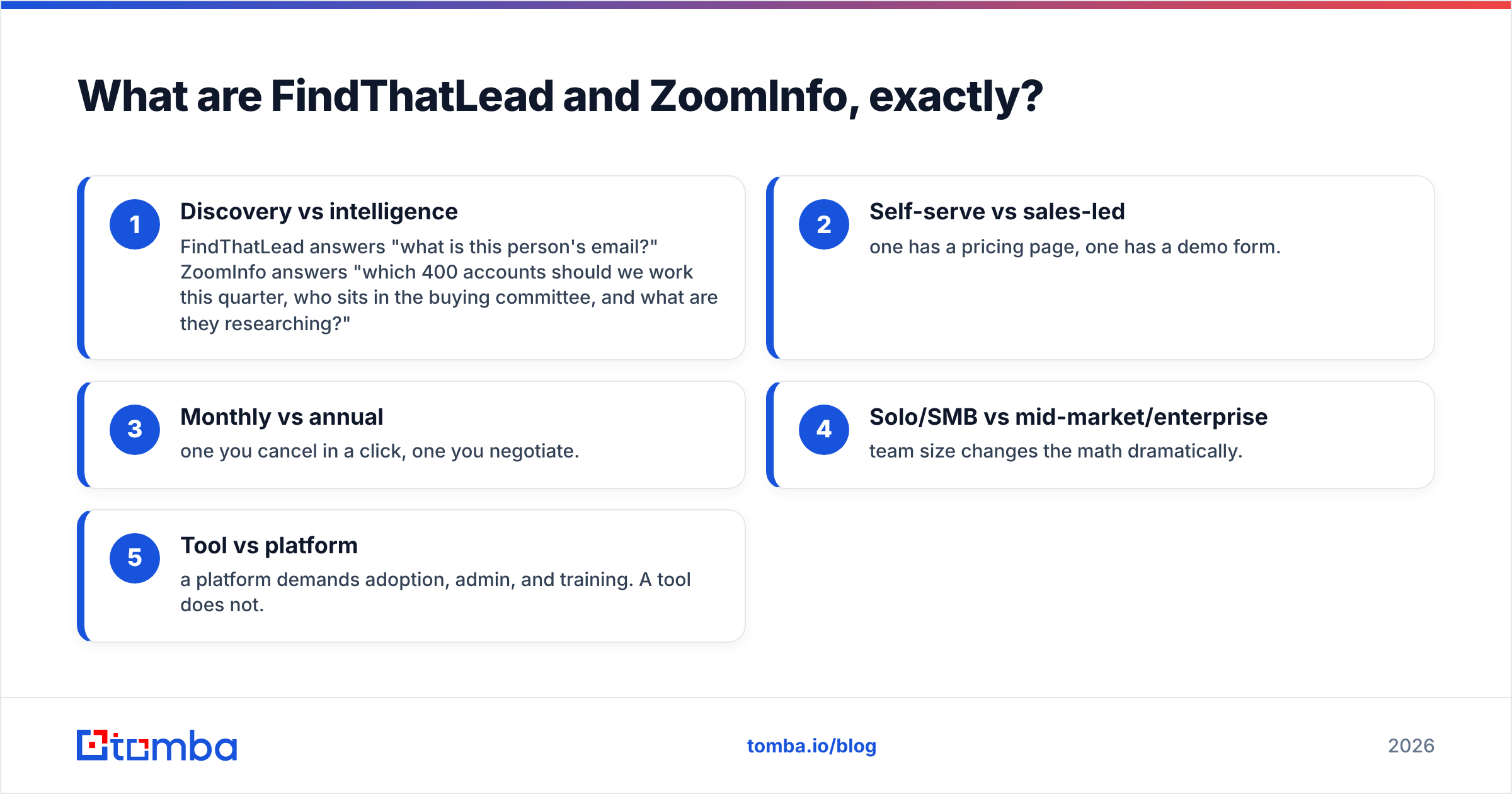
- Discovery vs intelligence — FindThatLead answers "what is this person's email?" ZoomInfo answers "which 400 accounts should we work this quarter, who sits in the buying committee, and what are they researching?"
- Self-serve vs sales-led — one has a pricing page, one has a demo form.
- Monthly vs annual — one you cancel in a click, one you negotiate.
- Solo/SMB vs mid-market/enterprise — team size changes the math dramatically.
- Tool vs platform — a platform demands adoption, admin, and training. A tool does not.

How do FindThatLead and ZoomInfo compare on features and price?#
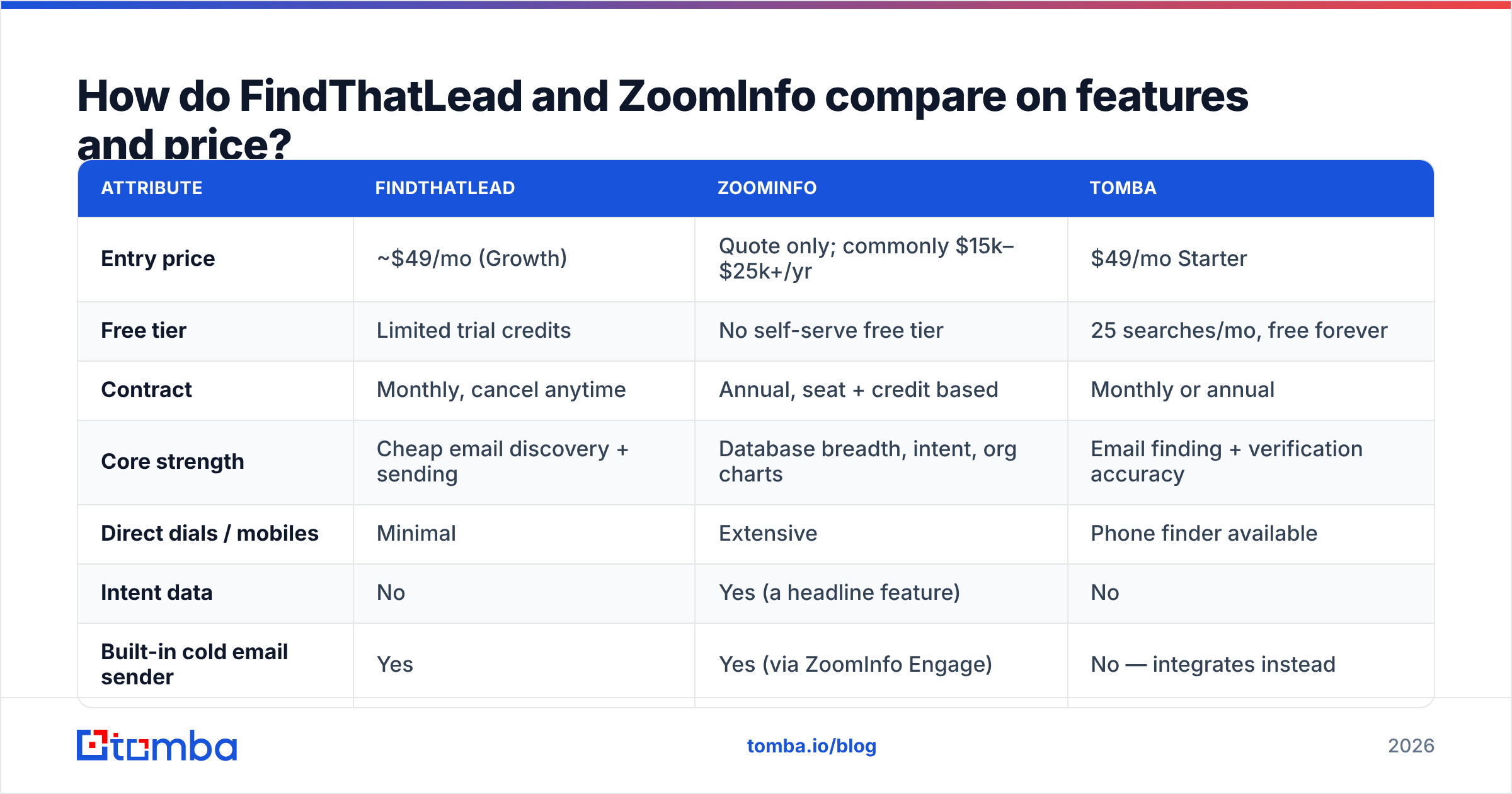
Here is the head-to-head. Treat all pricing as "published or commonly reported at time of writing" — FindThatLead publishes tiers openly, ZoomInfo does not, so its numbers come from public G2/Capterra reviews and buyer reports rather than a rate card.
| Attribute | FindThatLead | ZoomInfo | Tomba |
|---|---|---|---|
| Entry price | ~$49/mo (Growth) | Quote only; commonly $15k–$25k+/yr | $49/mo Starter |
| Free tier | Limited trial credits | No self-serve free tier | 25 searches/mo, free forever |
| Contract | Monthly, cancel anytime | Annual, seat + credit based | Monthly or annual |
| Core strength | Cheap email discovery + sending | Database breadth, intent, org charts | Email finding + verification accuracy |
| Direct dials / mobiles | Minimal | Extensive | Phone finder available |
| Intent data | No | Yes (a headline feature) | No |
| Built-in cold email sender | Yes | Yes (via ZoomInfo Engage) | No — integrates instead |
| Bulk processing | Yes, CSV-based | Yes, plus CRM push | Bulk email finder + API |
| API access | Yes, on higher tiers | Yes, enterprise-priced | Yes, all paid tiers |
| Time to first value | Minutes | Days to weeks (onboarding) | Minutes |
| Best fit | Founders, agencies, SMB | Mid-market and enterprise GTM teams | Devs, SMB, agencies needing verified emails |
Two things jump out of that table.
First, the price gap is not 2x — it's often 20x or more. A single ZoomInfo seat with a reasonable credit allocation frequently costs more per year than five years of a mid-tier self-serve email finder. That gap is defensible if you're using intent, org charts, and CRM automation daily across a team of ten. It is indefensible if two SDRs are logging in to copy email addresses.
Second, FindThatLead's ceiling is real. Its database is far smaller, its phone coverage is thin, and it has nothing resembling intent or account scoring. If your motion depends on knowing which accounts to hit before you know who to email, FindThatLead won't get you there.
Which one has better data accuracy?#
Accuracy is where the marketing pages get slippery, so define terms first.
- Coverage = what percentage of the people you look up exist in the database at all.
- Hit rate = of those, how many return a deliverable email.
- Bounce rate = of the emails returned, how many actually fail on send.
ZoomInfo generally wins on coverage — that's the whole value proposition of a contributory database with tens of millions of profiles. It's also strongest in North America, where its contributory network is densest; coverage thins noticeably in parts of EMEA and APAC, and reviewers on G2 consistently flag stale records for people who changed jobs recently. Big database, big decay surface.
FindThatLead is competitive on hit rate for the specific case it was built for: known domain, known first/last name, standard corporate email pattern. It infers the pattern and validates it. Feed it a Fortune 500 exec with a non-standard alias and it struggles.

The practical takeaway: whichever you pick, verify before you send. No provider — not ZoomInfo, not FindThatLead, not Tomba — should be trusted to hand you a list you fire off unverified. Job changes alone invalidate roughly 2–3% of B2B contact records every month, which compounds fast on a list you bought in January and sent in June. Run every list through an email verifier as a separate step, and treat catch-all domains as their own bucket rather than assuming they're valid.
A tell for evaluating any vendor: ask whether they return a confidence score and the sources behind a record, not just a green checkmark. Tools that expose where the data comes from let you set your own risk threshold. Tools that only say "valid" are asking you to trust a number you can't audit.
When is ZoomInfo actually worth the money?#
Straight answer: when more than five people use it every day and it drives account selection, not just contact lookup.
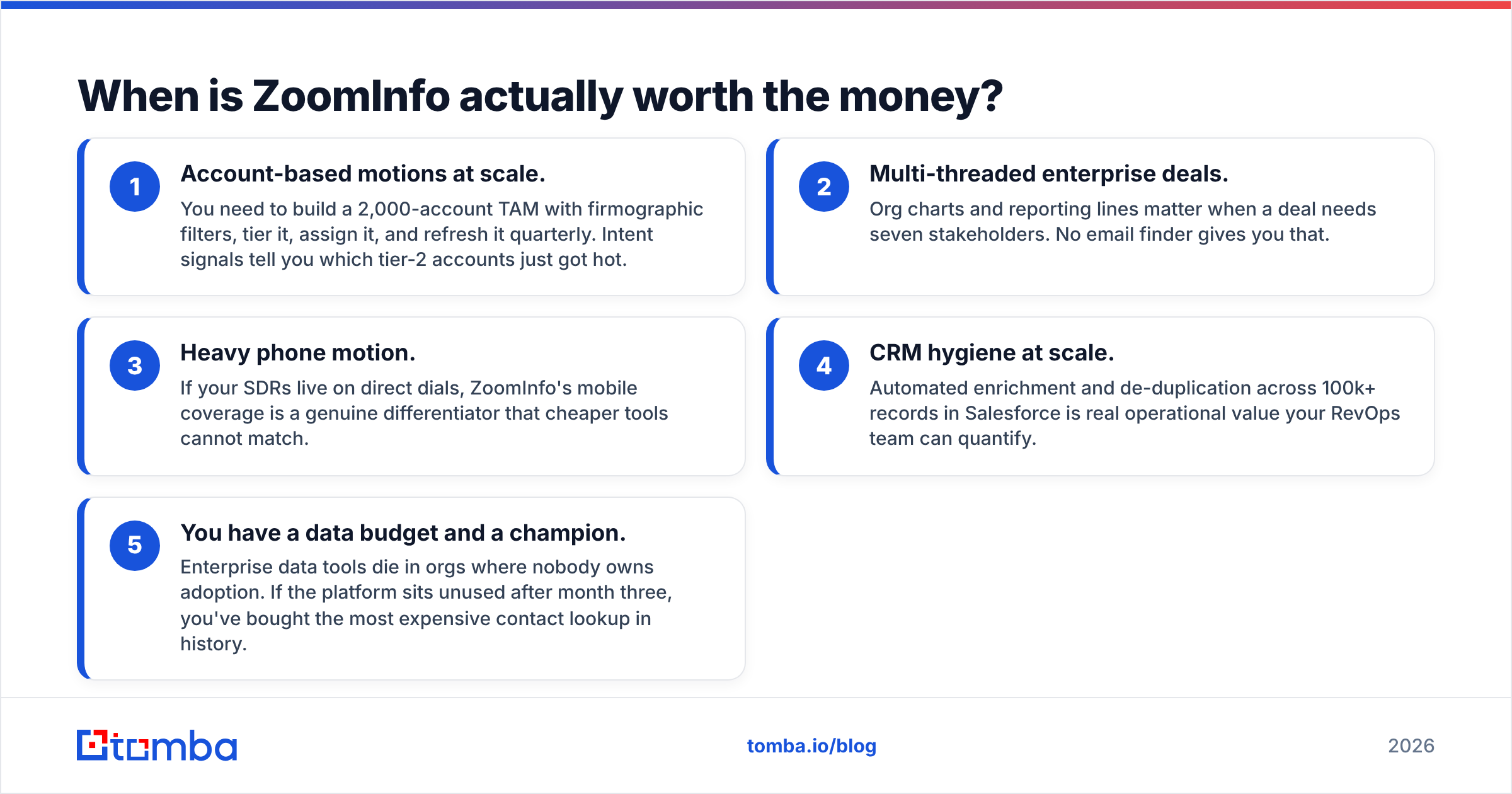
ZoomInfo earns its price in these scenarios:
- Account-based motions at scale. You need to build a 2,000-account TAM with firmographic filters, tier it, assign it, and refresh it quarterly. Intent signals tell you which tier-2 accounts just got hot.
- Multi-threaded enterprise deals. Org charts and reporting lines matter when a deal needs seven stakeholders. No email finder gives you that.
- Heavy phone motion. If your SDRs live on direct dials, ZoomInfo's mobile coverage is a genuine differentiator that cheaper tools cannot match.
- CRM hygiene at scale. Automated enrichment and de-duplication across 100k+ records in Salesforce is real operational value your RevOps team can quantify.
- You have a data budget and a champion. Enterprise data tools die in orgs where nobody owns adoption. If the platform sits unused after month three, you've bought the most expensive contact lookup in history.
If fewer than three of those apply to you, you are probably shopping in the wrong tier. That's not a knock on ZoomInfo — it's a sizing problem, and it's the single most common source of buyer's remorse in this category.
When is FindThatLead the better call?#
FindThatLead wins on speed to value and downside risk.
- You're pre-product-market-fit. You need 200 good emails this week to test a message, not a data governance strategy.
- You're an agency running client campaigns. Per-client volumes are modest, budgets are fixed, and monthly cancellation matters.
- You want find + send in one place. The built-in sender removes a tool from your stack. That's genuinely valuable when you're a team of one.
- Your ICP is SMB with predictable email patterns. Pattern inference works well on companies with one clean domain and standard
first.last@formats.
Where it breaks down: enterprise targets, non-standard domains, phone-heavy motions, and any workflow that needs contact data flowing programmatically into other systems at volume. The API exists but isn't the product's center of gravity.

Is there a better middle option between the two?#
Yes — and it's worth naming the gap honestly, because the FindThatLead-vs-ZoomInfo framing forces a false choice between "cheap and limited" and "powerful and expensive."
A large share of teams evaluating both actually need one narrow thing: verified work emails for companies they already know, delivered reliably, at a price that scales linearly. They already have their account list from a CRM, a conference roster, a funding database, or a scraped directory. They don't need intent data. They don't need a sequencer. They need the contact layer.
That's the middle lane, and it's where a focused provider beats both ends:
- Predictable pricing. Tomba pricing runs Free (25 searches/mo), Starter $49/mo, Growth $99/mo, Pro $249/mo, and Enterprise custom — published, monthly, no quote call.
- API-first. The email finder API is a first-class product, not an upsell gated behind an enterprise tier. So are the CLI, MCP server, and spreadsheet add-ins.
- Verification built in, not bolted on. Finding and verifying live in the same workflow, including catch-all handling — the case that silently wrecks bounce rates.
- Domain-first discovery. Domain search returns every discoverable address at a company with its pattern and confidence, which is exactly how most list-building actually starts.
- No adoption tax. Nothing to roll out, no seat minimums, no annual lock-in to justify in a QBR.

The honest limit: if you genuinely need intent data, org charts, and mobile numbers at enterprise scale, a focused email finder is not a ZoomInfo replacement, and anyone telling you otherwise is selling. Buy the platform. Just make sure you need the platform.
How should you actually decide?#
Run this in order. It takes an afternoon and saves a year of regret.
- Write down your job-to-be-done in one sentence. If it contains "find emails for a list I already have," stop — you don't need a platform.
- Count daily active users. Under five, enterprise seat pricing rarely pencils out.
- Test on your real ICP, not a demo list. Pull 100 target contacts you already know the answers for. Run them through each tool. Measure hit rate and bounce rate yourself. Vendor-published accuracy numbers are marketing; your list is truth.
- Price it per usable contact, not per month. Divide annual cost by verified, deliverable contacts you'll actually use. That number is the only one worth comparing across tiers.
- Check the exit. Can you export your data? Is the contract monthly? What happens to your enriched records if you leave? Annual data contracts with poor export terms are how teams get stuck.
- Pilot the cheapest viable option first. Upgrading is easy. Unwinding a five-figure annual commitment in month four is not.
Most teams that run this honestly discover their real requirement was contact discovery plus verification — and that they were about to buy a go-to-market intelligence platform to solve it.
The verdict#
ZoomInfo if you're a mid-market or enterprise GTM team where intent data, org charts, direct dials, and CRM enrichment drive revenue across many seats — and you have someone who will own adoption.
FindThatLead if you're a founder, solo marketer, or small agency who wants find-and-send in one cheap monthly tool and can live with narrower coverage.
Neither, if what you actually need is a reliable, API-accessible contact layer — because you'd be overpaying at one end and under-served at the other.
If that last line describes you, start with the free tier of Tomba Email Finder. Twenty-five searches a month costs nothing, the API works on every paid plan starting at $49/mo, and you can benchmark it against your own target list in an hour instead of sitting through a discovery call. Bring your own account list, measure the hit rate yourself, and let the numbers pick the tool.
Related guides#
Ready to find emails that actually work?
Join 150,000+ professionals who stopped guessing and started sending. Free credits on signup — no credit card required.
Get the Tomba newsletter
Practical outbound tactics and product updates — once every two weeks.
About the author