Findymail vs GrowMeOrganic: Which Prospecting Tool Wins?
Findymail sells accuracy and clean exports. GrowMeOrganic sells an all-in-one prospecting suite with sending built in. Here's how they compare on data quality, credit math, and real cost per verified lead in 2026.
Findymail vs GrowMeOrganic comes down to one question. Do you want clean email data, or a whole outbound stack on one bill? Here is how the two compare on data quality, credit math, and real cost per lead.
TL;DR
- Findymail is a focused email finder and verifier. It sells one thing: clean B2B emails that land. You don't burn credits on results it can't verify.
- GrowMeOrganic is an all-in-one suite. You get a contact database, LinkedIn extraction, drip campaigns, and email sending on a single bill.
- Already running Instantly, Smartlead, or Lemlist? Findymail slots in as the data layer. No sending stack at all? GrowMeOrganic replaces three tools at once.
- Cost per verified lead beats headline price. A $49 plan with 40% dead rows costs more than a $99 plan with 95% good ones.
- Neither tool wins on every axis. Buy the one whose weak spot you can live with. Better still, keep finding and sending as separate parts you can swap.
What are Findymail and GrowMeOrganic?#
They solve the same problem from opposite ends.
Findymail is a B2B email finder built on one promise: bounce rates under 5%. Feed it a name plus a domain, a LinkedIn profile, or a Sales Navigator list. It returns work emails it has checked. You are not billed for emails it could not confirm. Everything after that step — sequencing, inbox rotation, reporting — is someone else's job. See findymail.com for the current feature set.
GrowMeOrganic is a prospecting platform that bundles more layers. You get a contact database, a Chrome extension for LinkedIn and Sales Navigator, email finding, and email checks. A drip sender comes with it, and higher tiers add unlimited sending. Details at growmeorganic.com.
The split in one line. Findymail is a part. GrowMeOrganic is a suite. Parts are easy to swap when they slip. Suites cost less to buy and take less time to set up.
Who each one is for. Findymail suits an agency or sales team that already sends and is tired of scrubbing bounces. GrowMeOrganic suits a founder or small team with no stack yet. You can be live this week without stitching four tools together.
Where they overlap. Both pull from LinkedIn. Both claim to verify. Both sell credits. That overlap is where the real choice sits.

Findymail vs GrowMeOrganic: how do they compare at a glance?#
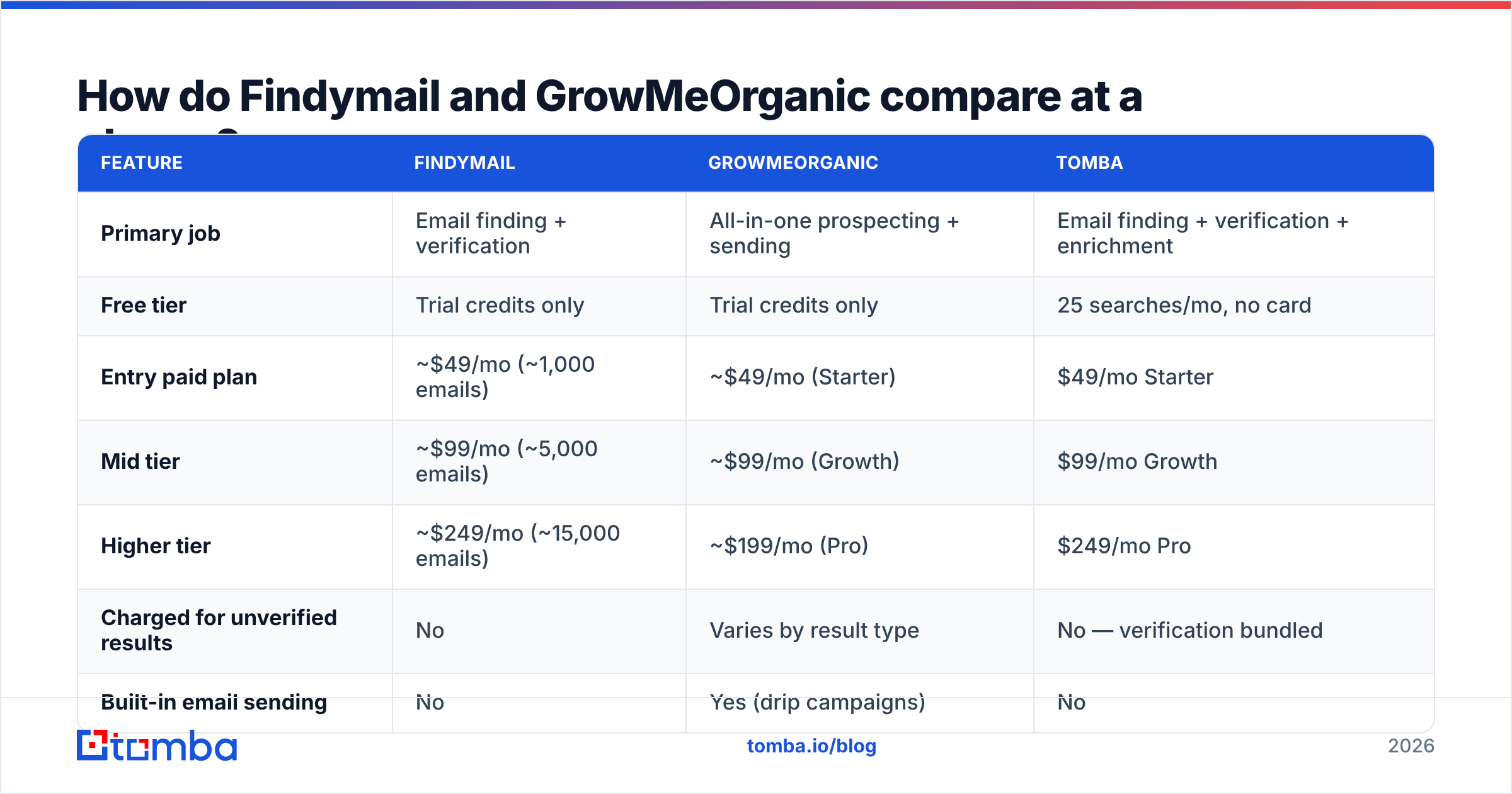
Prices below are the public plans at the time of writing. Both vendors move their tiers often. Check the pricing pages before you buy, and use the annual rate if you sign for a year.
| Feature | Findymail | GrowMeOrganic | Tomba |
|---|---|---|---|
| Primary job | Email finding + verification | All-in-one prospecting + sending | Email finding + verification + enrichment |
| Free tier | Trial credits only | Trial credits only | 25 searches/mo, no card |
| Entry paid plan | ~$49/mo (~1,000 emails) | ~$49/mo (Starter) | $49/mo Starter |
| Mid tier | ~$99/mo (~5,000 emails) | ~$99/mo (Growth) | $99/mo Growth |
| Higher tier | ~$249/mo (~15,000 emails) | ~$199/mo (Pro) | $249/mo Pro |
| Charged for unverified results | No | Varies by result type | No — verification bundled |
| Built-in email sending | No | Yes (drip campaigns) | No |
| LinkedIn / Sales Navigator export | Yes | Yes | Yes, via LinkedIn finder |
| Bulk CSV enrichment | Yes | Yes | Yes |
| Public API | Yes | Limited | Yes, full REST API |
| Catch-all handling | Filtered out | Often returned as valid | Dedicated catch-all verifier |
| Best for | Teams with an existing sender | Teams with no stack yet | Teams that want data as infrastructure |
The table hides one thing. GrowMeOrganic's price includes the sender. Compare it against Findymail alone and you price a bundle against a part. Add a $37–$97/mo sending tool to the Findymail column first. Then decide which one is cheaper.
Which one finds more valid emails?#
Accuracy is where these tools split. It is also the only number that survives a real campaign.
Findymail's pitch is unusually specific. It filters catch-all domains instead of passing them off as "valid." It won't bill you when a search comes back unproven. That policy is a proxy for confidence. Vendors paid per attempt have no reason to be strict. Vendors paid per verified result do.
GrowMeOrganic's edge is reach. Its database and extension span a wide range of company sizes and regions. On lists where a pure finder returns blanks, that means more hits. The trade is spread. A wider net catches more rows, including ones a strict checker would drop.

Test three things before you trust any accuracy claim:
- Run the same 200-row list through both. Same companies, same job levels, same regions. Match rate means nothing without bounce rate next to it.
- Watch what happens to catch-all domains. A tool that marks every catch-all "valid" inflates its match rate and hands you the bounce risk. Run the survivors through a catch-all verifier first.
- Look at role addresses.
info@,sales@, andcontact@pad a match rate. They rarely reach a buyer.
Want an outside read instead of vendor copy? Both tools have plenty of reviews on G2. Filter to firms your size. Match rates swing a lot between small-business lists and enterprise lists.
What does each actually cost per verified lead?#
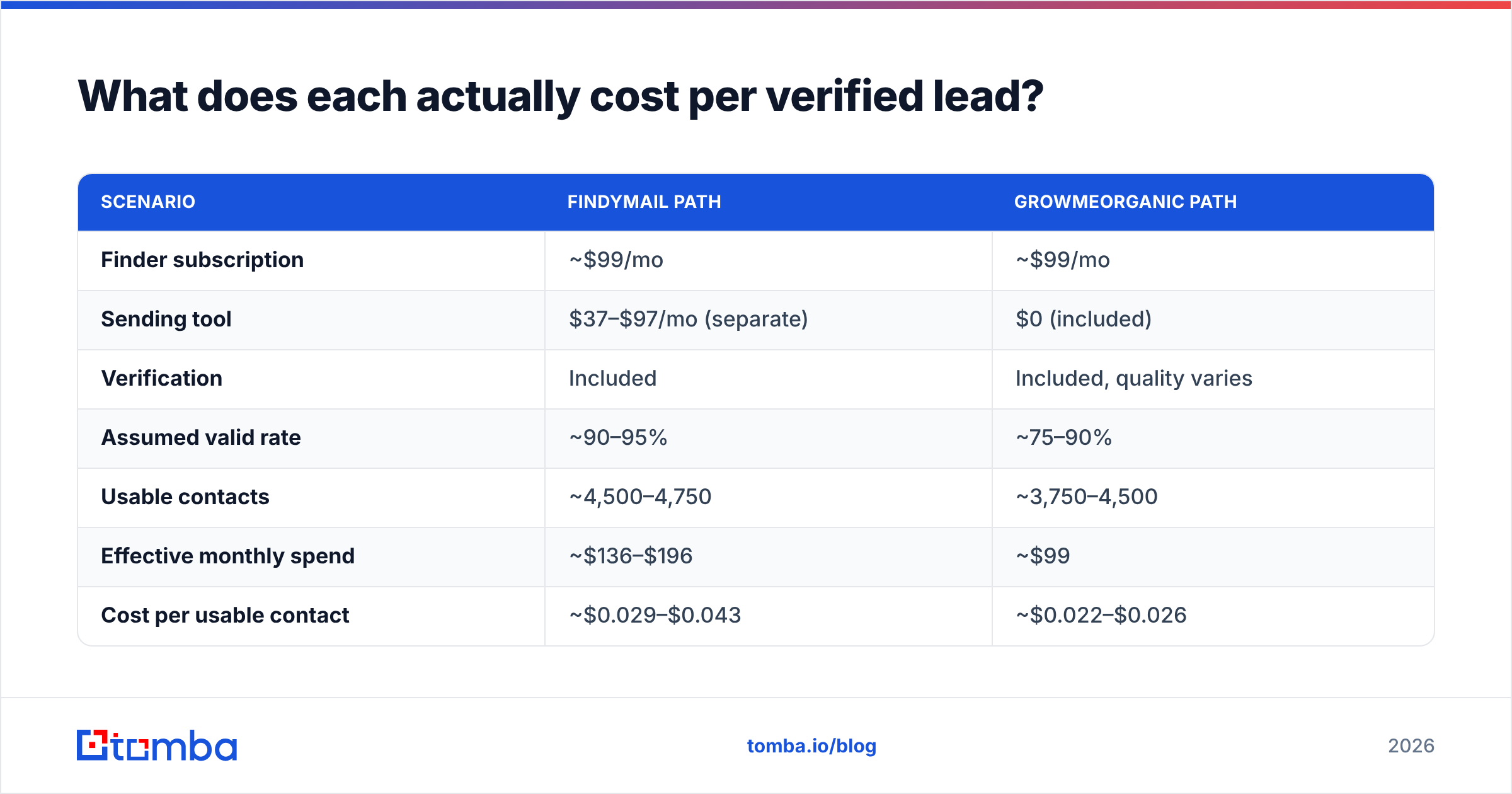
Headline price is the wrong unit. Cost per usable contact is the right one. Here is the math on a 5,000-contact month.
| Scenario | Findymail path | GrowMeOrganic path |
|---|---|---|
| Finder subscription | ~$99/mo | ~$99/mo |
| Sending tool | $37–$97/mo (separate) | $0 (included) |
| Verification | Included | Included, quality varies |
| Assumed valid rate | ~90–95% | ~75–90% |
| Usable contacts | ~4,500–4,750 | ~3,750–4,500 |
| Effective monthly spend | ~$136–$196 | ~$99 |
| Cost per usable contact | ~$0.029–$0.043 | ~$0.022–$0.026 |
Run that table with your own numbers. The valid rate is the figure that swings everything. Ten points of deliverable rate move cost per lead more than $50 of plan price. Bounces also cost more than money. A spike above 3–5% dents sender reputation across every domain you send from. That bill lands weeks later.

The honest summary: GrowMeOrganic usually wins on raw dollars, because the sender is free. Findymail usually wins on list hygiene. Which one is "cheaper" depends on your bottleneck — budget or bounces.
Which is better for LinkedIn and Sales Navigator prospecting?#
Both ship Chrome extensions. Both export a Sales Navigator search to CSV with emails attached. The differences sit in the details.
Findymail treats Sales Navigator exports as a core workflow. Point it at a saved search. It pulls the profiles and returns checked emails, and misses are free. The output lands clean enough to push straight into a sequencer.
GrowMeOrganic covers LinkedIn plus a wider set of sources: company sites, its own database, and local business scraping on some plans. Does your ICP include local services or non-tech firms? Then that reach is a real edge, because LinkedIn coverage there is thin.
One warning on LinkedIn scraping. Every extension that automates LinkedIn puts your account at risk, whatever the vendor. Keep volume low. Never run two extensions on one profile at once. Never point a scraper at the account you send connection requests from. Want the extraction off your own profile? A server-side LinkedIn finder turns profile URLs into emails with no browser extension in the loop.
Which is better if you also need to send the emails?#
GrowMeOrganic, if bundled sending is the point. There is not much to argue about.
It ships drip campaigns, follow-ups, and unlimited sending on higher tiers. For a solo founder or a pair, that is a real win: one login, one invoice, one support queue.
But bundled senders have a ceiling. Know where it sits before you hit it:
- Inbox rotation and warmup. Instantly and Smartlead have spent years on rotation logic, warmup pools, and reputation alerts. A bundled sender tends to be a generation behind. Model your ramp with a warmup calculator first. "Unlimited sending" rarely means what it says.
- Deliverability tools. Check for SPF/DKIM/DMARC reports, spam-score previews, and per-domain reputation. Without them you fly blind. Run your domain through an SPF checker and a spam checker on the side.
- Lock-in. When the sender slips, you can't swap it without losing your data source too. That is the hidden cost of a suite. It is also the best case for keeping finding and sending apart.
"Unlimited sending" deserves a translation. It means the vendor won't cap you. It does not mean Google and Microsoft won't. Mailbox providers throttle on your reputation, not on your plan. Email deliverability is always decided by the receiving side.
Where does each tool fall short?#
Neither is a bad product. Each one serves some buyers badly.
Findymail's weak spots:
- No sending, no CRM, no sequencing. You buy one layer and pay for the rest elsewhere.
- Coverage leans toward firms with a real web and LinkedIn presence. Tiny local businesses come back blank more often.
- Credits are the unit, so one big list can eat a month's allowance fast.
GrowMeOrganic's weak spots:
- Checks are bundled, not specialist, so more borderline addresses reach your export. Plan a second pass.
- The sender is fine, not best in class. Heavy senders outgrow it.
- API access is thinner than a data-first vendor's. That matters if you want to enrich inside your own app.
Shared weak spot. Both leave you with one vendor for data quality. Teams that send at scale end up adding a second source and a neutral checking pass. No single provider covers every region and company size well.
Which should you choose in 2026?#
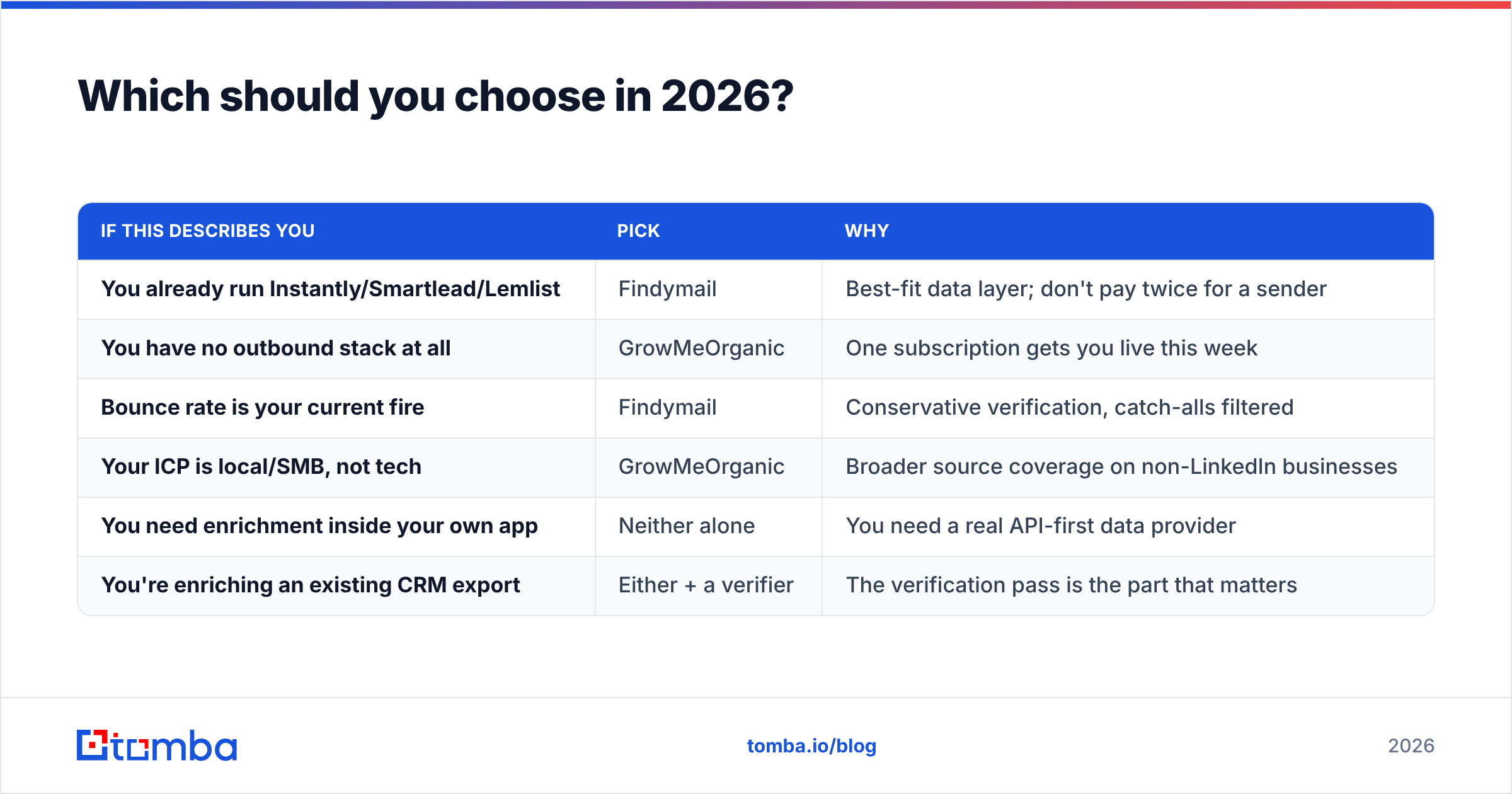
| If this describes you | Pick | Why |
|---|---|---|
| You already run Instantly/Smartlead/Lemlist | Findymail | Best-fit data layer; don't pay twice for a sender |
| You have no outbound stack at all | GrowMeOrganic | One subscription gets you live this week |
| Bounce rate is your current fire | Findymail | Conservative verification, catch-alls filtered |
| Your ICP is local/SMB, not tech | GrowMeOrganic | Broader source coverage on non-LinkedIn businesses |
| You need enrichment inside your own app | Neither alone | You need a real API-first data provider |
| You're enriching an existing CRM export | Either + a verifier | The verification pass is the part that matters |
The Findymail vs GrowMeOrganic call comes down to one thing. Are you buying a tool or plumbing? Tools get swapped every 18 months as prices and quality shift. Plumbing — an API you call from your own code — outlives those cycles, because you own the way it plugs in.
Where does Tomba fit in this comparison?#
Tomba sits on the data side of that line. One trade is worth naming up front: Tomba does not send email. If bundled sequencing is your must-have, GrowMeOrganic covers ground Tomba doesn't.
What Tomba does cover is the whole data layer, as an API you call. The email finder resolves a name plus a domain, or a LinkedIn profile. Domain search maps every contact at a company. The email verifier runs a fresh check on any list, including lists your current vendor built. A catch-all verifier, phone finder, and data enrichment sit alongside. All of it is reachable through the Tomba API, a CLI, an MCP server, and add-ins for Sheets, Excel, and Airtable.
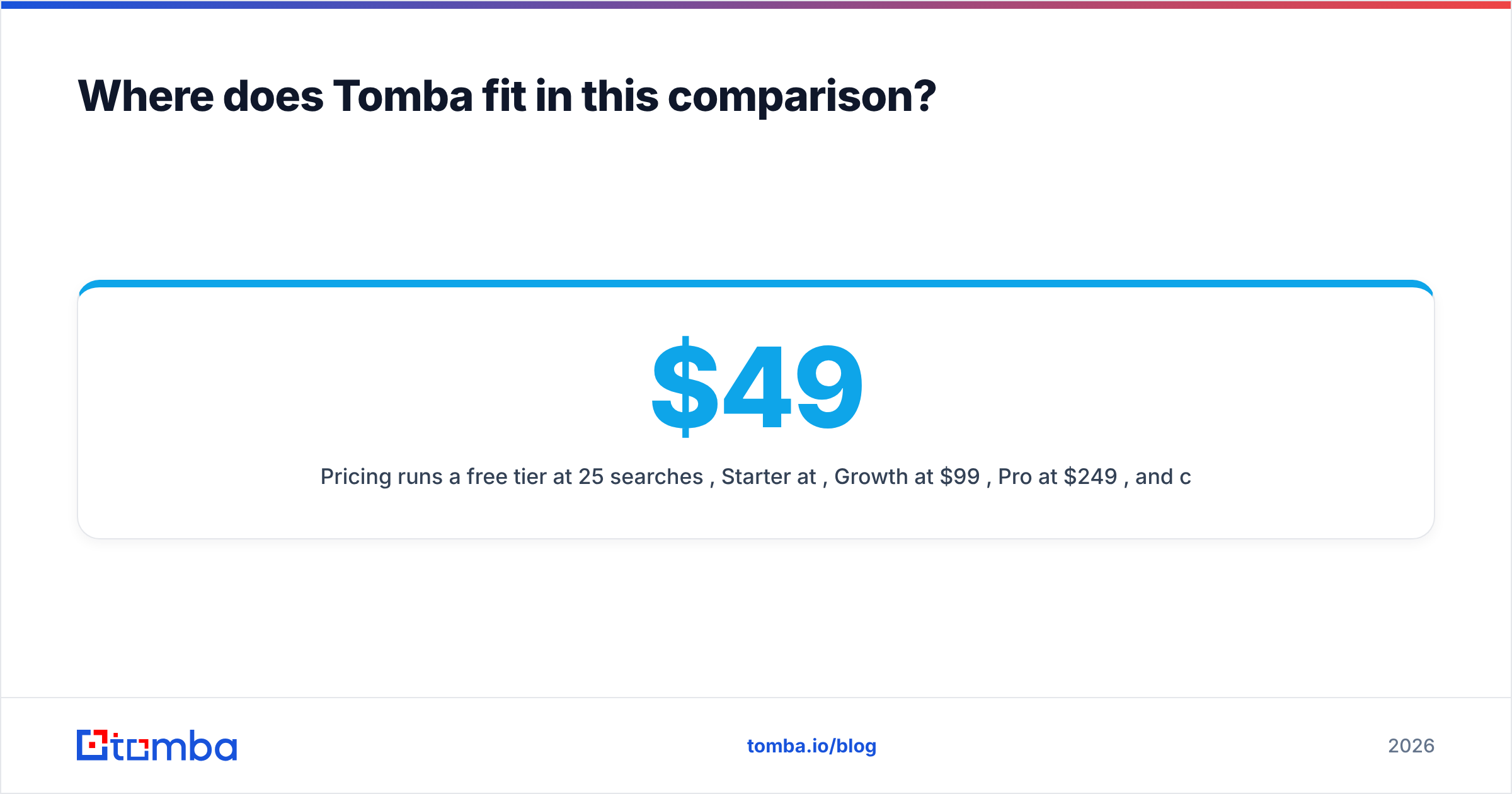
Pricing starts free at 25 searches a month. Paid plans run $49, $99, and $249 a month, with custom Enterprise on top. The Tomba pricing page has the full breakdown. Those tiers line up with both tools above, so a side-by-side trial is easy: one list, three vendors, compare match rate and bounce rate.
One habit is worth copying whichever finder you buy. Use one vendor to find and a different one to verify. Vendors grade their own output kindly. An outside check costs a fraction of a bounce-driven reputation repair. It is the cheapest insurance in outbound.
How should you run the test?#
Don't decide from a comparison post, this one included. Run the bake-off.
- Build one 200-row control list. Real ICP, mixed company sizes, at least two regions.
- Run it through every candidate. Same rows, same day. Log match rate, credits spent, and time to result.
- Check every output with a neutral third tool. Most teams skip this step. It is the one that gives you the answer.
- Send to a small slice. 50 addresses per vendor, same copy, same domain. Measure bounces, not opens.
- Work out cost per reply. Not per email found. That number ties your data spend to pipeline.
Most teams find the winner is not the tool with the best match rate. It is the one whose verified rows survive a real inbox.
Start with the data layer. If your outbound bounces, the sequencer is not the problem. The list is. Run a free trial of the Tomba Email Finder on 25 contacts. Push the results through the verifier. Compare the deliverable rate against whatever you use now. If Findymail or GrowMeOrganic wins on your list, you have evidence instead of a sales claim. If Tomba wins, you have a data layer you can call from your own code for as long as you need it.
Related guides#
Ready to find emails that actually work?
Join 150,000+ professionals who stopped guessing and started sending. Free credits on signup — no credit card required.
Get the Tomba newsletter
Practical outbound tactics and product updates — once every two weeks.
About the author