Findymail vs Influno (2026): Which Tool Actually Wins?
Findymail sells accuracy. Influno sells an all-in-one outbound stack. They are not the same product, and picking the wrong one costs you either bounces or a bloated bill. Here is the honest breakdown.
TL;DR
- Findymail is a data tool. Its job is to turn a name, domain, or LinkedIn profile into a deliverable email address, with a bounce guarantee attached. It does not send your campaigns.
- Influno is a sending tool. Its job is to run multi-inbox cold email sequences with warmup, rotation, and reply detection. Its data layer is a convenience, not its core competency.
- Comparing them head-to-head is slightly unfair — most teams that evaluate both end up buying a finder and a sender, not one or the other.
- Cost is where the decision actually gets made. Findymail's per-credit pricing climbs fast at volume; Influno's seat-and-inbox model punishes small teams less but caps your data quality.
- If you only need the data layer, a finder with a free tier and a real API — like Tomba Email Finder at $49/mo — usually beats paying finder prices inside a sending suite.
What are Findymail and Influno, actually?#
Start here, because half the confusion in the "findymail vs influno" search is a category error.
Findymail is a B2B email finder and verifier built around one promise: the addresses it returns will not bounce. It exports from LinkedIn and Sales Navigator, enriches lists in bulk, verifies at the SMTP layer, and pushes results into your CRM or sequencer through native integrations and an API. It became popular with agencies precisely because it refused to sell you a giant static database and instead charged for verified, freshly-found contacts.
Influno sits one layer downstream. It is a cold outreach platform: connect unlimited sending accounts, warm them up, build sequences, rotate inboxes, detect replies, and report on the pipeline. Contact sourcing exists inside the product, but it is there so you don't leave the tab — not because it is the best data on the market.
The everyday analogy: Findymail is the water utility, Influno is the plumbing in your house. Buying pipes doesn't get you water, and buying water doesn't get it to the tap.
That distinction drives every trade-off below.

How do Findymail and Influno compare head-to-head?#
Here is the honest side-by-side. Pricing reflects publicly listed plans at the time of writing — both vendors change tiers, so verify on their pages before you sign anything.
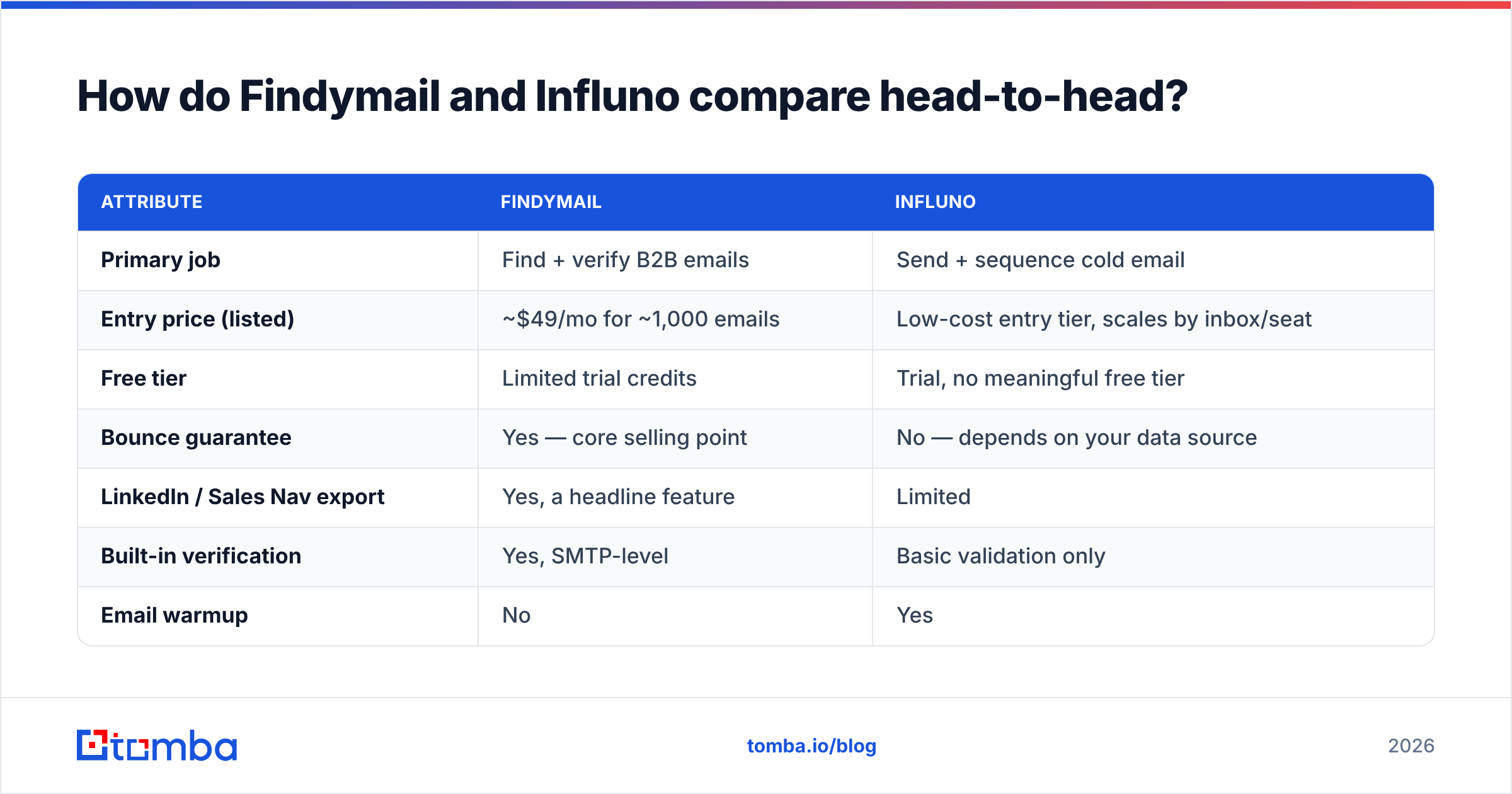
| Attribute | Findymail | Influno |
|---|---|---|
| Primary job | Find + verify B2B emails | Send + sequence cold email |
| Entry price (listed) | ~$49/mo for ~1,000 emails | Low-cost entry tier, scales by inbox/seat |
| Free tier | Limited trial credits | Trial, no meaningful free tier |
| Bounce guarantee | Yes — core selling point | No — depends on your data source |
| LinkedIn / Sales Nav export | Yes, a headline feature | Limited |
| Built-in verification | Yes, SMTP-level | Basic validation only |
| Email warmup | No | Yes |
| Multi-inbox rotation | No | Yes |
| Sequences + reply detection | No | Yes |
| API for developers | Yes | Limited |
| Best fit | Agencies, RevOps, list builders | Founders and SDRs running campaigns |
Read that table twice. There is exactly one row where they genuinely overlap — "find contacts" — and even there they are solving different-sized problems. Findymail is trying to beat the industry's bounce rate. Influno is trying to keep you from opening a second tab.

Where finder-first tools sit against all-in-one suites on the data dimension.
Which one actually finds more valid emails?#
Findymail, and it isn't especially close — but the reason matters more than the verdict.
A dedicated finder runs a waterfall: pattern inference from known company formats, source crawling, third-party enrichment, then SMTP verification before it charges you a credit. That last step is why Findymail can offer a bounce guarantee and Influno cannot. When a sending platform bundles "find emails," it is usually reselling a single enrichment provider with a thin validation pass on top.
What that means for your numbers:
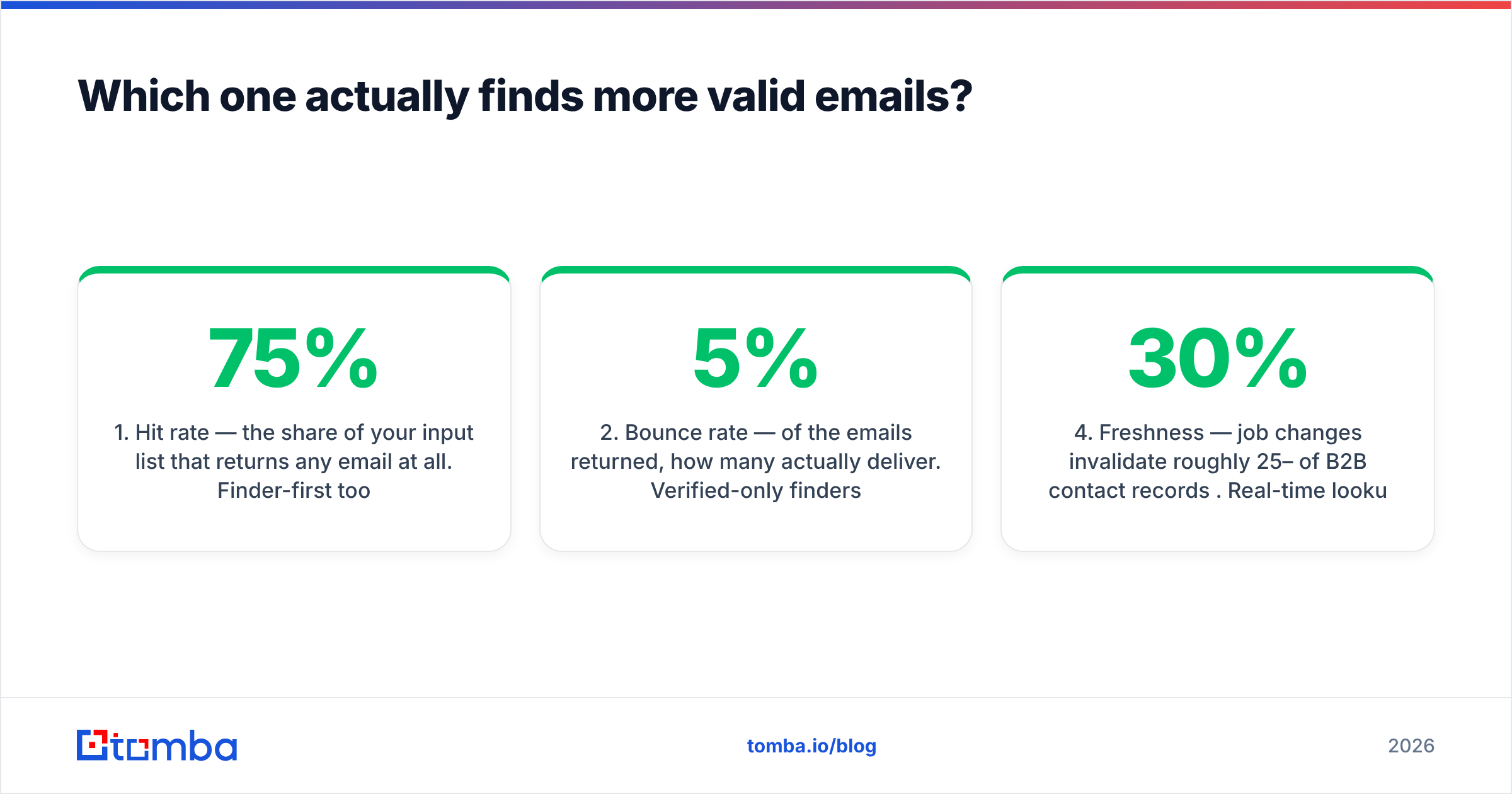
- Hit rate — the share of your input list that returns any email at all. Finder-first tools typically land 55–75% on clean B2B domains; bundled finders inside sending suites run lower, often 35–55%, because they query fewer sources.
- Bounce rate — of the emails returned, how many actually deliver. Verified-only finders keep this under 3–5%. Unverified bundled data routinely doubles that, and Google and Microsoft both treat sustained hard bounces as a spam signal.
- Catch-all handling — the quiet killer. Domains that accept everything can't be verified by SMTP alone. Tools that silently mark catch-alls as "valid" inflate their own hit rate and destroy your sender reputation. A proper catch-all verifier scores them separately instead of guessing.
- Freshness — job changes invalidate roughly 25–30% of B2B contact records per year. Real-time lookups beat static database dumps on this every time.

If you're comparing vendors yourself, don't trust anyone's marketing page — including this one. Take 200 contacts you already have verified emails for, run them through each tool blind, and measure hit rate and bounce rate against your known-good set. A weekend of work saves a year of a wrong subscription. Independent review aggregation on G2 is a useful sanity check on the marketing claims, but it is no substitute for your own test list.
What does each one cost once you scale?#
This is where most teams get surprised.
Findymail's model is credits. That is clean and honest at small volume — you pay for what you find. It gets expensive fast when you're building lists of 20,000+ contacts a month, because credits scale linearly while your budget doesn't. Agencies routinely report that the finder line item becomes their second-largest tool cost after the sending platform itself.
Influno's model leans on seats and connected inboxes. If you're a two-person team running six inboxes, that's cheap. If you're a 15-rep org with 90 inboxes, the math flips and the bundled data quality is still the weak link.
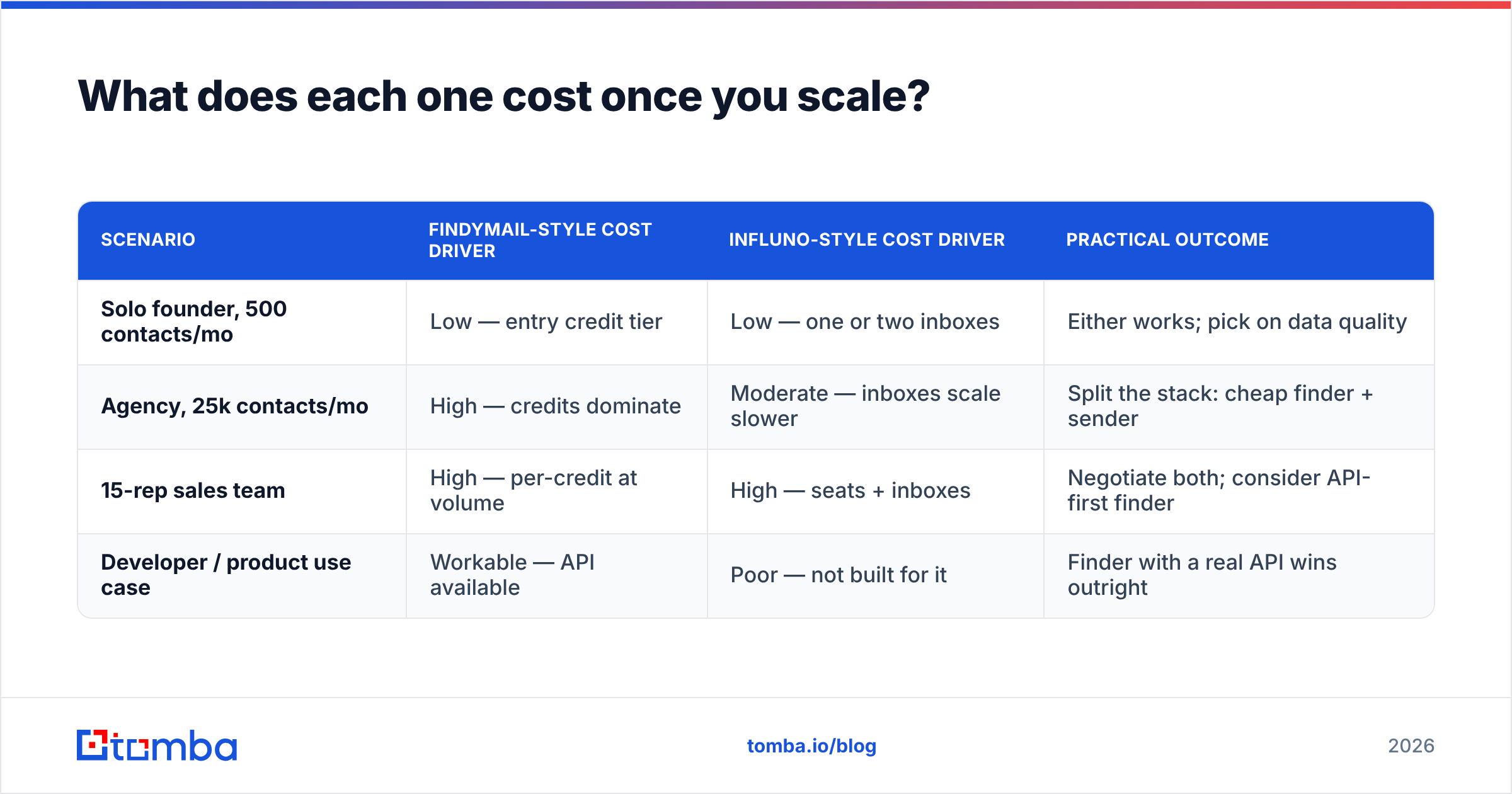
| Scenario | Findymail-style cost driver | Influno-style cost driver | Practical outcome |
|---|---|---|---|
| Solo founder, 500 contacts/mo | Low — entry credit tier | Low — one or two inboxes | Either works; pick on data quality |
| Agency, 25k contacts/mo | High — credits dominate | Moderate — inboxes scale slower | Split the stack: cheap finder + sender |
| 15-rep sales team | High — per-credit at volume | High — seats + inboxes | Negotiate both; consider API-first finder |
| Developer / product use case | Workable — API available | Poor — not built for it | Finder with a real API wins outright |
The third column is the one people miss. Neither tool is "cheaper" in the abstract. Findymail gets expensive on volume of contacts; Influno gets expensive on number of humans and inboxes. Model your actual next twelve months before you commit annually.
Is Influno's all-in-one approach worth it?#
Sometimes — and the honest answer depends on how much your team values one login over best-in-class components.
The case for all-in-one:
- Fewer integrations to maintain. Every Zapier hop between a finder, a verifier, and a sender is a place where records go missing at 2am.
- One vendor relationship. Procurement teams and solo founders both like this for opposite reasons.
- Faster time to first campaign. You can go from empty account to sending in an afternoon.
- Consolidated reporting. Reply rates tied to source data without a spreadsheet in between.
The case against:
- The weakest module sets your ceiling. Bad data at the top of the funnel cannot be fixed by great sequencing at the bottom.
- Switching cost compounds. When the data layer disappoints you in month eight, you're re-platforming your sequences too.
- Bundled credits are rarely a bargain. Compare the per-contact cost of the bundled finder against a standalone one; it's usually higher, not lower.
- API gaps. All-in-one suites optimize for their UI, not for your engineering team.
Most mature outbound teams end up with the split stack: a dedicated finder feeding a dedicated sender. It's more setup, and it's also why Findymail alternative searches spike whenever credit prices move.
What about deliverability and verification?#
Influno wins this dimension outright, because it's the only one of the two that touches your sending infrastructure at all.
Warmup, inbox rotation, throttling, and reply detection are real deliverability levers. Findymail doesn't compete here and doesn't claim to. If your inboxes are cold and your domain has no sending history, no amount of accurate data will save your open rates.
But deliverability starts before the send button. The order of operations that actually works:
- Authenticate the domain first. SPF, DKIM, and DMARC before a single campaign. Run a quick SPF checker if you inherited a domain and aren't sure what's configured.
- Verify every address before it enters the sequencer. A standalone email verifier pass costs a fraction of a cent per record and prevents the bounces that trigger throttling.
- Warm up gradually. Whatever platform you send from, ramp volume over weeks, not days.
- Segment catch-all domains. Send to them last, in small batches, with a separate risk tolerance.
- Monitor and prune. Any address that hard-bounces once never gets another send.
Steps 2 and 4 are data problems. Steps 1, 3, and 5 are sending problems. Findymail owns the first set; Influno owns the second. That's the whole comparison in five lines.
Which one should you pick?#
Pick by the bottleneck you actually have, not by feature count.
- Choose Findymail if your lists are the problem. You have a sequencer you like, your inboxes are warm, and your bounce rate is embarrassing. Buy accuracy.
- Choose Influno if your data is fine but your sending is chaos — spreadsheets, manual follow-ups, one overloaded inbox. Buy infrastructure.
- Choose both if you're running outbound at agency scale and can justify two line items. This is what most serious teams do.
- Choose neither if you're pre-product-market-fit and sending under 300 emails a month. A free finder tier plus your existing inbox is enough until it isn't.
- Choose an API-first finder if you're embedding lookups into a product, a CRM automation, or an internal tool. Neither of these is built for that job as well as a developer-focused email finder API.
One more filter: how much of your prospecting starts on LinkedIn? If the answer is "almost all of it," a tool with strong profile-to-email resolution — via a LinkedIn finder or Sales Navigator export — matters more than anything else on the list.
Where does Tomba fit in this comparison?#
Tomba competes with the Findymail half of this matchup, not the Influno half. We don't send your campaigns and don't pretend to.
What that focus buys you:
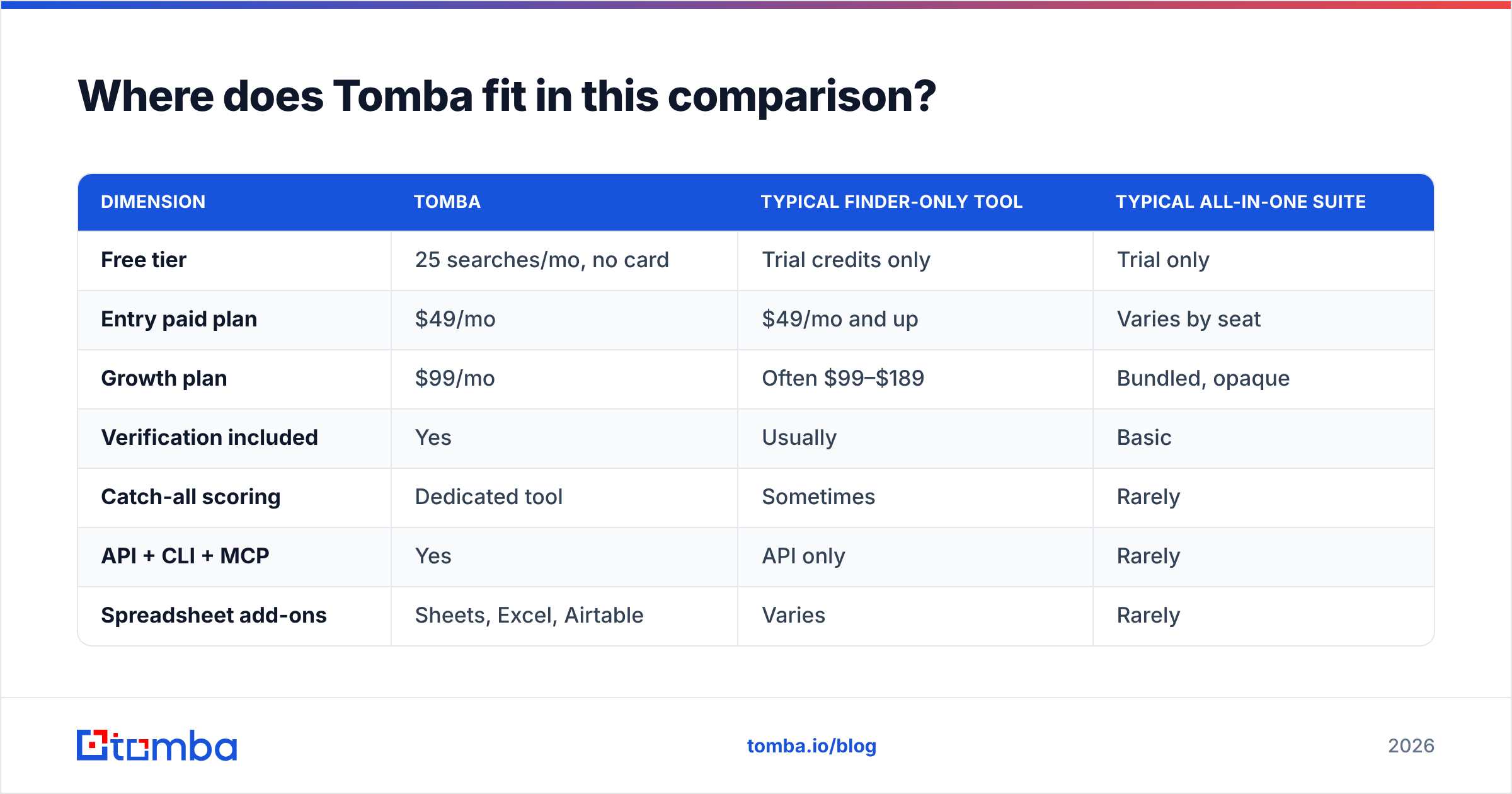
| Dimension | Tomba | Typical finder-only tool | Typical all-in-one suite |
|---|---|---|---|
| Free tier | 25 searches/mo, no card | Trial credits only | Trial only |
| Entry paid plan | $49/mo | $49/mo and up | Varies by seat |
| Growth plan | $99/mo | Often $99–$189 | Bundled, opaque |
| Verification included | Yes | Usually | Basic |
| Catch-all scoring | Dedicated tool | Sometimes | Rarely |
| API + CLI + MCP | Yes | API only | Rarely |
| Spreadsheet add-ons | Sheets, Excel, Airtable | Varies | Rarely |
The practical shape of a split stack: find and verify with a data tool, push into your sequencer through integrations or a Google Sheets hand-off, and let the sending platform do what it's good at. You keep the ability to swap either half without rebuilding the other.
Full Tomba pricing runs Free (25 searches/mo), Starter $49/mo, Growth $99/mo, Pro $249/mo, and Enterprise on request. If you're evaluating against Findymail's credit tiers, the meaningful comparison is cost per verified contact at your real monthly volume — not headline plan price.
The verdict#
There is no single winner in findymail vs influno, because they aren't playing the same game. Findymail is the better answer if your problem is "my emails bounce." Influno is the better answer if your problem is "my outreach doesn't run itself." Buying the wrong one means paying for a solution to a problem you don't have.
Before you commit to either, run the blind test: 200 known contacts, both tools, measure hit rate and bounce rate yourself. Vendors' accuracy claims are marketing; your list is evidence.
If it's the data layer you need fixed, start free. Tomba Email Finder gives you 25 searches a month with no card, verification built in, and an API, CLI, and spreadsheet add-ons when you outgrow the UI. Test it against your own list, compare cost per verified contact at your real volume, and let the numbers pick the winner instead of the pricing page.
Related guides#
Ready to find emails that actually work?
Join 150,000+ professionals who stopped guessing and started sending. Free credits on signup — no credit card required.
Get the Tomba newsletter
Practical outbound tactics and product updates — once every two weeks.
About the author