Findymail vs Lead411 (2026): Pricing, Data, and Accuracy
Findymail is a bounce-guarded email finder. Lead411 is a full contact database with intent data and direct dials. Here is how their pricing, export caps, and accuracy actually compare in 2026.
TL;DR
- Findymail is a finder, Lead411 is a database. Findymail takes a name or a list you already built and returns a verified email. Lead411 sells you the list itself, plus direct dials and intent signals.
- Pricing models are not comparable line-for-line. Findymail bills per credit with published plans starting around $49/mo. Lead411 bills per seat (roughly $99/user/mo on annual billing) and caps monthly exports, so "unlimited" is not unlimited.
- Findymail wins on bounce rate for cold email; Lead411 wins on breadth of firmographic and intent data, and it is the only one of the two with meaningful phone coverage.
- Export caps are the hidden cost of Lead411. If you need 5,000+ contacts a month, the per-seat model gets expensive fast.
- Neither is the cheapest way to get verified B2B emails at volume — credit-based finders like Tomba start at $49/mo with a free tier and no seat minimum.
What Are Findymail and Lead411, Really?#
They solve different halves of the same problem, and most comparison posts blur that.
Findymail (findymail.com) is a purpose-built email finder aimed at cold outbound teams. You feed it a LinkedIn Sales Navigator search, an Apollo list, a CSV of names and domains, or a single prospect, and it returns a deliverable email. Its whole marketing position is the bounce guarantee: emails it returns are verified before delivery, and it does not charge you for credits it cannot resolve. It plugs directly into Lemlist, Instantly, Smartlead, HubSpot, and Zapier so found contacts drop straight into a sequence.
Lead411 (lead411.com) is a sales intelligence platform in the ZoomInfo / Apollo lineage. You search a database of company and contact records by title, industry, headcount, revenue, tech stack, and growth signals, then export the contacts you want. It carries verified emails, direct-dial mobile numbers, Bombora-powered intent data, and trigger alerts like funding rounds and hiring spikes.
The practical difference: with Findymail, you must already know who you want to reach. With Lead411, discovering who to reach is the product.
How Do Findymail and Lead411 Compare on Pricing?#
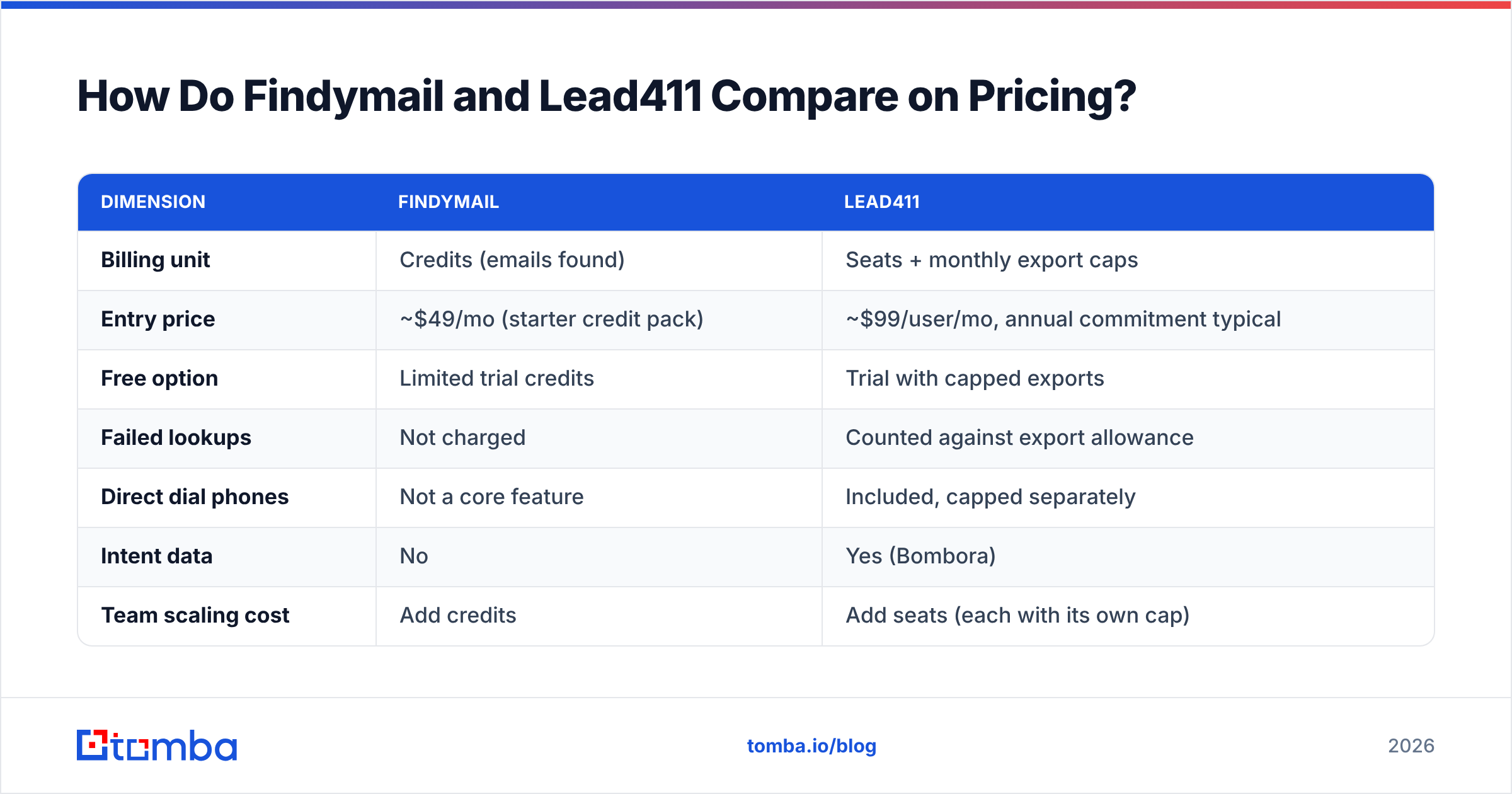
This is where most buyers get burned, because the two vendors price on different units.
| Dimension | Findymail | Lead411 |
|---|---|---|
| Billing unit | Credits (emails found) | Seats + monthly export caps |
| Entry price | ~$49/mo (starter credit pack) | ~$99/user/mo, annual commitment typical |
| Free option | Limited trial credits | Trial with capped exports |
| Failed lookups | Not charged | Counted against export allowance |
| Direct dial phones | Not a core feature | Included, capped separately |
| Intent data | No | Yes (Bombora) |
| Team scaling cost | Add credits | Add seats (each with its own cap) |
| Contract | Monthly available | Annual pushed heavily |
Two things matter more than the headline numbers.
First, Lead411's "unlimited" tiers are export-capped. The Basic Plus Unlimited plan advertises unlimited viewing but caps how many contacts you can actually export per month per seat. If your SDR team needs 3,000 exports a month, you are buying seats you do not need just to raise the ceiling. Read the fine print on the Lead411 pricing page before you sign, and confirm the current cap in writing.
Second, Findymail's credit model punishes low match rates — except it doesn't. Because failed lookups are not charged, the effective cost per delivered email stays close to the sticker price. On a 1,000-credit plan with a 65% match rate, you pay for roughly 650 emails, not 1,000. That is a genuinely better deal than tools that bill on attempts.
Where does this leave you if you want both discovery and low-cost finding? Credit-based platforms that bundle finding, verification, and enrichment under one balance tend to beat both. Tomba pricing runs Free (25 searches/mo), Starter $49/mo, Growth $99/mo, and Pro $249/mo, with no per-seat minimum — your whole team draws from one credit pool instead of paying for empty seats.
Which Tool Has Better Data Accuracy?#
Accuracy splits into two questions that vendors deliberately conflate: match rate (what percentage of your list gets an email at all) and bounce rate (what percentage of returned emails actually deliver).

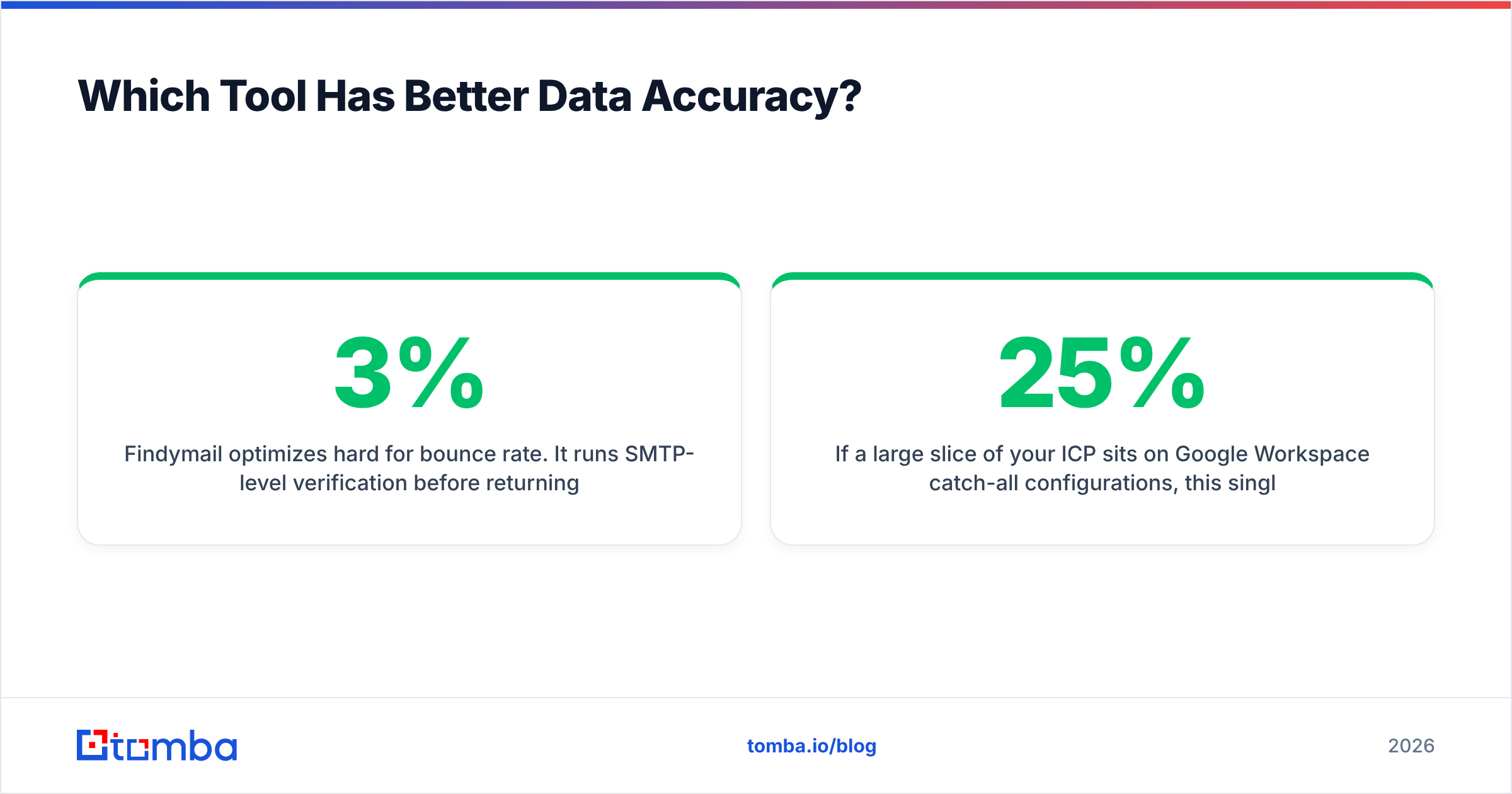
Findymail optimizes hard for bounce rate. It runs SMTP-level verification before returning a result and withholds anything it cannot confirm. The trade-off is a lower raw match rate — you get fewer emails, but the ones you get are safe to send. For cold email at scale, that is the right trade. A 3% bounce rate on a 5,000-send campaign is a domain reputation problem; a 55% match rate is just a smaller campaign.
Lead411 stores pre-verified records in its database and re-verifies on a rolling schedule. Because records are cached rather than resolved live, freshness varies by segment. Enterprise and mid-market records in North America hold up well. Long-tail SMB, non-US, and recently-changed-jobs contacts decay faster. Reviewers on G2 consistently praise Lead411's direct dials and flag the same weak spots on email freshness for smaller companies.
Practical rule regardless of which you pick: run every list through an independent email verifier before it hits your sequencer. Vendor-side verification and sequencer-side verification catch different failure modes, and the second pass costs a fraction of a damaged sending domain.
The catch-all problem nobody prices in#
Roughly a fifth of B2B domains are catch-all — the mail server accepts everything at SMTP time and silently drops invalid addresses later. Neither Findymail nor Lead411 gives you a clean answer here:
- Findymail tends to suppress catch-all results rather than return uncertain data, which protects your bounce rate but shrinks your list.
- Lead411 returns them flagged, leaving the risk call to you.
- Dedicated catch-all tooling resolves a meaningful share of them using pattern confidence plus historical engagement — see how a catch-all verifier scores these domains instead of guessing.
- Your sequencer will happily send to all of them and let your reputation absorb the damage.
If a large slice of your ICP sits on Google Workspace catch-all configurations, this single issue can swing your usable list size by 15–25%.
Is Findymail or Lead411 Better for Cold Outbound?#
Depends entirely on whether your list-building happens inside or outside the tool.
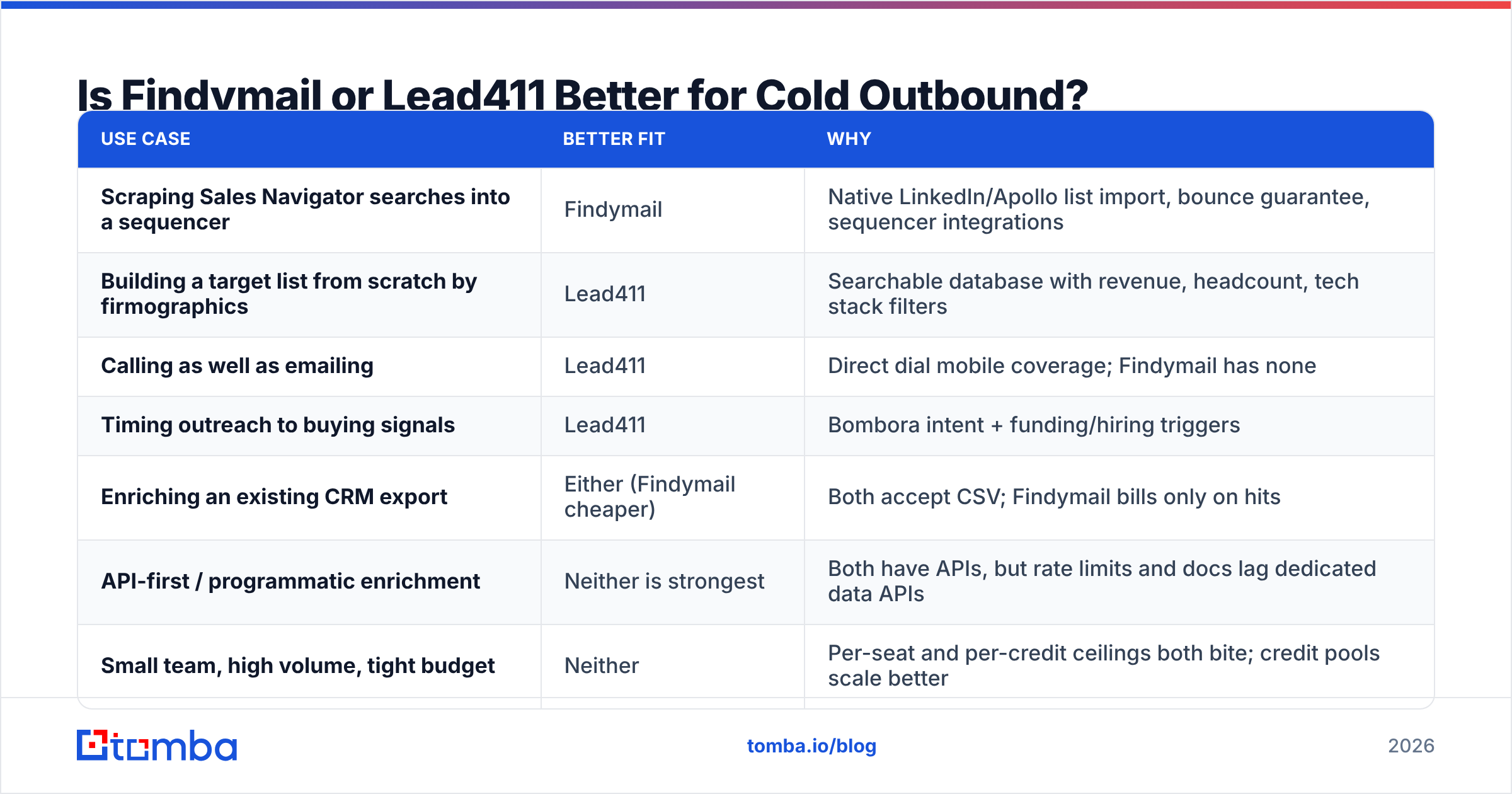
| Use case | Better fit | Why |
|---|---|---|
| Scraping Sales Navigator searches into a sequencer | Findymail | Native LinkedIn/Apollo list import, bounce guarantee, sequencer integrations |
| Building a target list from scratch by firmographics | Lead411 | Searchable database with revenue, headcount, tech stack filters |
| Calling as well as emailing | Lead411 | Direct dial mobile coverage; Findymail has none |
| Timing outreach to buying signals | Lead411 | Bombora intent + funding/hiring triggers |
| Enriching an existing CRM export | Either (Findymail cheaper) | Both accept CSV; Findymail bills only on hits |
| API-first / programmatic enrichment | Neither is strongest | Both have APIs, but rate limits and docs lag dedicated data APIs |
| Small team, high volume, tight budget | Neither | Per-seat and per-credit ceilings both bite; credit pools scale better |
The honest summary: Findymail is a sharper tool with a narrower job. If you already run a list-building motion — LinkedIn scraping, event attendee lists, conference exhibitor pages, G2 category pages — Findymail turns that raw list into sendable contacts with minimal bounce risk, and does it for less than a Lead411 seat.
Lead411 replaces your list-building motion. If you have no reliable source of target accounts, or if your reps live on the phone as much as in the inbox, the database plus direct dials plus intent bundle justifies the seat cost. Buying Findymail in that situation just gives you a very good tool with nothing to point it at.

What About Coverage Outside North America?#
Both tools skew North American, but unevenly.
Lead411's core strength is US company data — revenue estimates, employee counts, and org charts are notably better for US mid-market than for European or APAC accounts. If your ICP is German Mittelstand manufacturers or Japanese SaaS companies, expect thin records and stale titles.
Findymail is less geo-dependent because it resolves emails live from the domain rather than reading from a fixed database. It performs closer to its North American numbers on EU and LATAM domains, though GDPR-driven data minimization on some corporate mail servers reduces what SMTP checks can confirm.
If international coverage is a hard requirement, test both on a 200-row sample of your actual ICP before you commit. Do not accept a vendor's global match-rate claim — run domain search style tests against 20 real target domains in each region and count what comes back with a verified status.
How Do Both Compare to the Broader Market?#
Neither Findymail nor Lead411 exists in a vacuum, and the category has shifted since 2024.
The old split was "cheap finder vs expensive database." That has collapsed. Modern credit-based platforms now bundle finding, verification, enrichment, phone lookup, and CRM sync at price points that undercut per-seat databases. Meanwhile, the databases have added live-verification layers to defend their bounce numbers.
What actually differentiates tools in 2026:
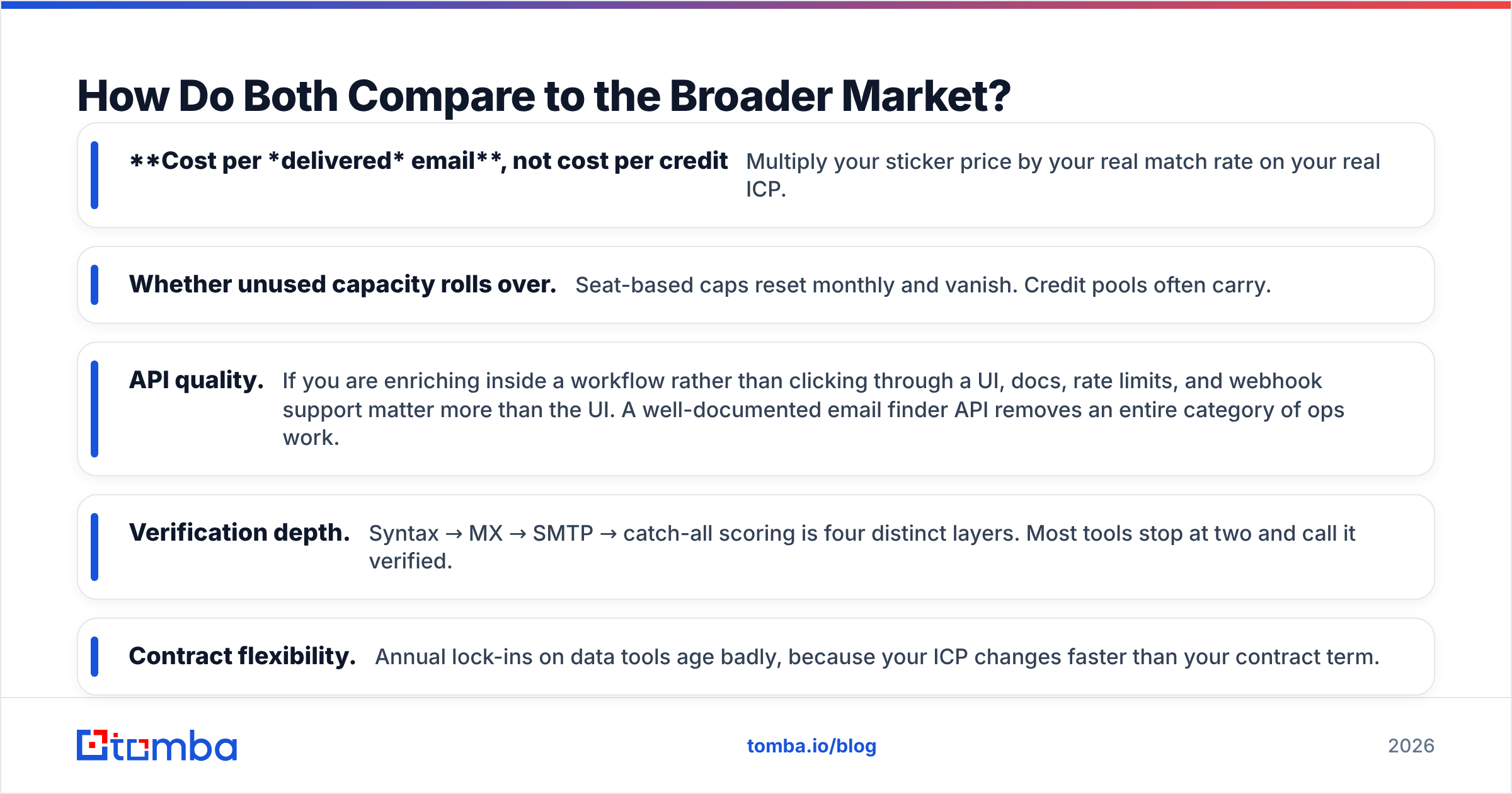
- Cost per delivered email, not cost per credit. Multiply your sticker price by your real match rate on your real ICP.
- Whether unused capacity rolls over. Seat-based caps reset monthly and vanish. Credit pools often carry.
- API quality. If you are enriching inside a workflow rather than clicking through a UI, docs, rate limits, and webhook support matter more than the UI. A well-documented email finder API removes an entire category of ops work.
- Verification depth. Syntax → MX → SMTP → catch-all scoring is four distinct layers. Most tools stop at two and call it verified.
- Contract flexibility. Annual lock-ins on data tools age badly, because your ICP changes faster than your contract term.
Independent buyer reviews on Capterra and G2 are worth twenty minutes here — filter to reviewers at your company size, not the aggregate score. A tool rated 4.6 by 500-person enterprises tells you nothing about a five-person outbound team's experience with the same product.
Which Should You Pick?#
Decide with three questions, in this order.
1. Do you already have a list-building source? If yes — Sales Navigator, scraped directories, event lists, inbound signups needing enrichment — you need a finder, not a database. Findymail fits, and so do cheaper credit-based finders.
2. Do your reps call? If direct dials are part of the motion, Lead411 has the clear edge over Findymail, which does not compete on phone data at all. Compare it against dedicated tools like a phone finder before assuming a full seat license is the only path to dials.
3. How many contacts per month, and across how many people? Under 1,000 contacts on one or two users: Findymail's credit packs are the cheaper answer. Over 5,000 contacts across a team: model the seat math on Lead411 carefully — you will likely find you are buying seats for cap headroom, not for users, and at that point a pooled-credit platform wins on pure arithmetic.
A fourth consideration that decides more deals than it should: how fast can you get data out and into your stack? If your workflow lives in a spreadsheet, a native Google Sheets add-on beats a CSV export cycle every time. If it lives in a CRM, check the depth of the HubSpot integration or Salesforce sync — field-level mapping and dedupe behavior matter more than the logo on the integrations page.
Try a Cheaper Path Before You Commit to a Seat#
Run the same 100-contact test list through Findymail, Lead411, and one credit-based alternative, then compare cost per verified, delivered email. Most teams are surprised by how little the expensive option wins by.
If your bottleneck is turning known companies and people into verified, sendable addresses — not discovering who to target — start with the Tomba Email Finder. The free tier gives you 25 searches a month to benchmark against your current tool with zero commitment, Starter runs $49/mo, and every plan includes verification, domain search, and data enrichment from the same credit pool — no seats, no export caps, no annual lock-in to regret in month four.
Related guides#
Ready to find emails that actually work?
Join 150,000+ professionals who stopped guessing and started sending. Free credits on signup — no credit card required.
Get the Tomba newsletter
Practical outbound tactics and product updates — once every two weeks.
About the author