Findymail vs OutboundView (2026): Software or Agency?
Findymail sells verified contact data by the credit. OutboundView sells booked meetings by the month. Here is the honest cost, control, and ROI comparison before you sign either one.
TL;DR
- Findymail is software: you buy verified B2B email credits and run outbound yourself. OutboundView is a service: you buy an outsourced SDR team that runs outbound for you.
- Comparing them on "accuracy" misses the point. The real question is whether you're buying data or buying labor.
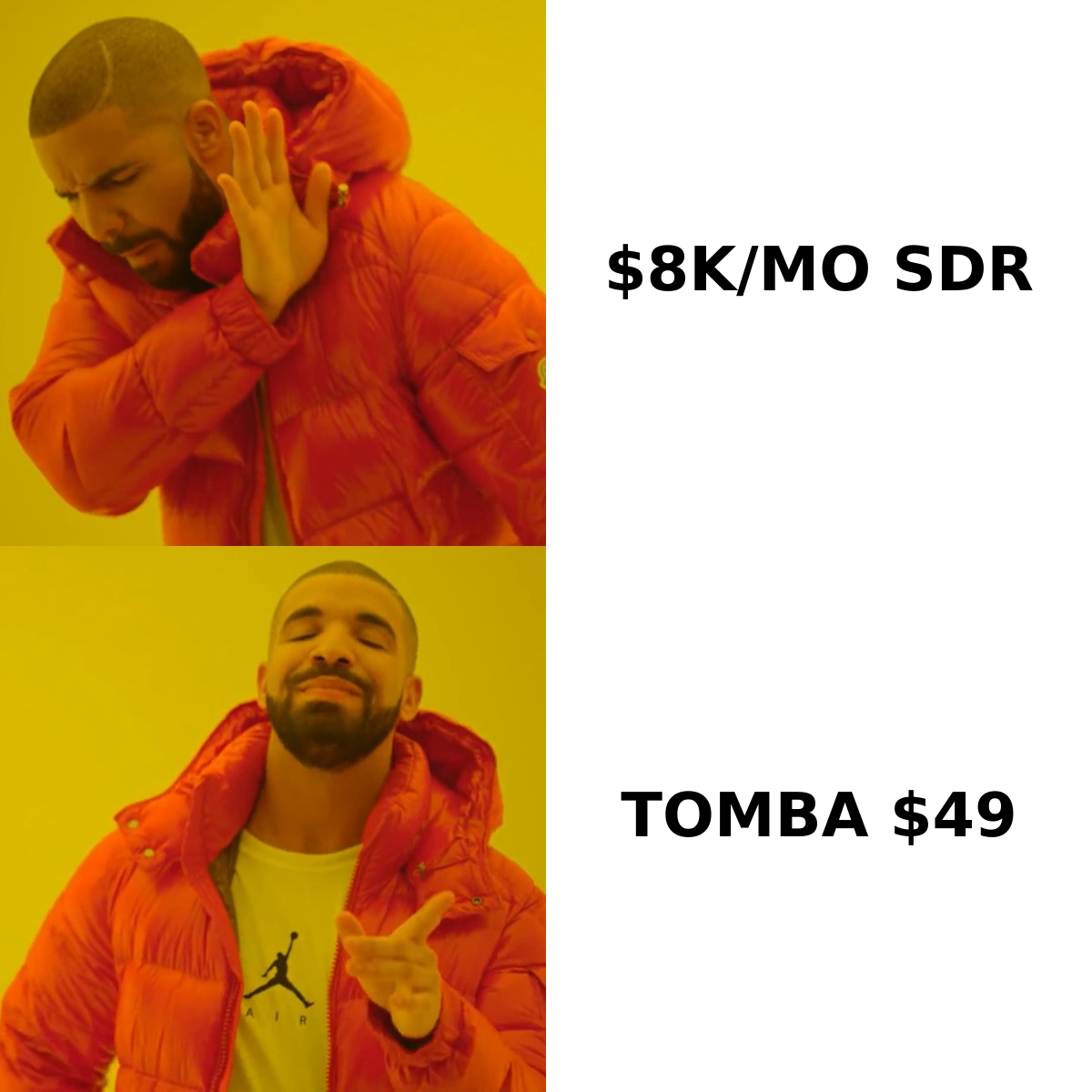
- Findymail-class tooling costs roughly $50–$250/month. Agency retainers like OutboundView's typically start in the low thousands per month and climb with headcount and channels.
- If you already have a founder or AE who can write and send, buy data. If you have budget but no bandwidth and no playbook, buy the service — and expect a 3–6 month ramp before you judge it.
- The cheapest test that de-risks both paths: run 500 verified contacts through a manual sequence yourself first. If the offer converts, an agency scales it. If it doesn't, an agency just burns list faster.
What are Findymail and OutboundView, exactly?#
They are not competitors in the normal sense, which is why most "Findymail vs OutboundView" searches end in confusion.
Findymail is a B2B email-finding and verification tool. You give it a name and a company (or a LinkedIn Sales Navigator export), and it returns a work email it claims is deliverable. Its pitch, per findymail.com, is verified-only output — it filters aggressively so you're not paying for guesses that bounce. It sells credits, has a Chrome extension, an API, and CSV enrichment. It does not write your emails, does not send them, and does not book meetings.
OutboundView is an outbound sales agency. Per outboundview.com, it provides appointment setting, outsourced SDR resources, and inside-sales consulting for B2B companies. You pay a monthly retainer; they build the list, write the sequences, send the emails, make the calls, handle replies, and hand you calendar invites. Their output is meetings, not rows in a spreadsheet.
So the honest framing is: Findymail replaces a data vendor. OutboundView replaces a hire. Comparing their prices side by side without adjusting for that is how teams end up disappointed by both.
How do Findymail and OutboundView compare head-to-head?#
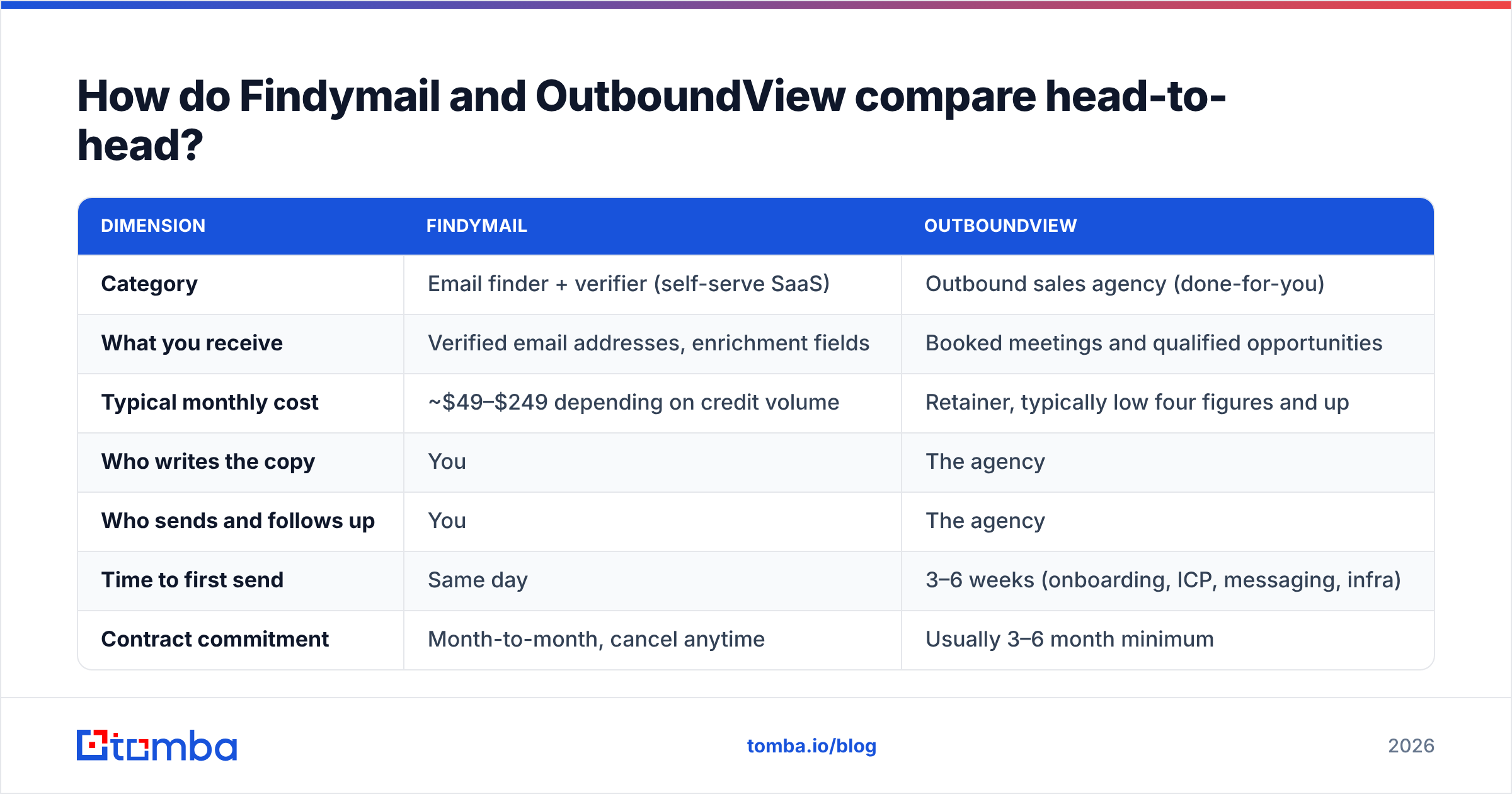
| Dimension | Findymail | OutboundView |
|---|---|---|
| Category | Email finder + verifier (self-serve SaaS) | Outbound sales agency (done-for-you) |
| What you receive | Verified email addresses, enrichment fields | Booked meetings and qualified opportunities |
| Typical monthly cost | ~$49–$249 depending on credit volume | Retainer, typically low four figures and up |
| Who writes the copy | You | The agency |
| Who sends and follows up | You | The agency |
| Time to first send | Same day | 3–6 weeks (onboarding, ICP, messaging, infra) |
| Contract commitment | Month-to-month, cancel anytime | Usually 3–6 month minimum |
| Data ownership | You own every record you pull | Varies by contract — ask before signing |
| Scales by | Buying more credits | Buying more SDR hours |
| Best for | Founders, growth teams, agencies with an operator | Funded teams with budget but no outbound bandwidth |
Read that table twice. The two rows that decide most deals are time to first send and contract commitment. A tool gets you sending this afternoon with a credit card. An agency gets you sending in a month with a signed agreement — but the sending is somebody else's problem after that.
What does each actually cost in year one?#
Sticker price lies in both directions. Here's a fairer model for a team targeting 5,000 prospects in a year.
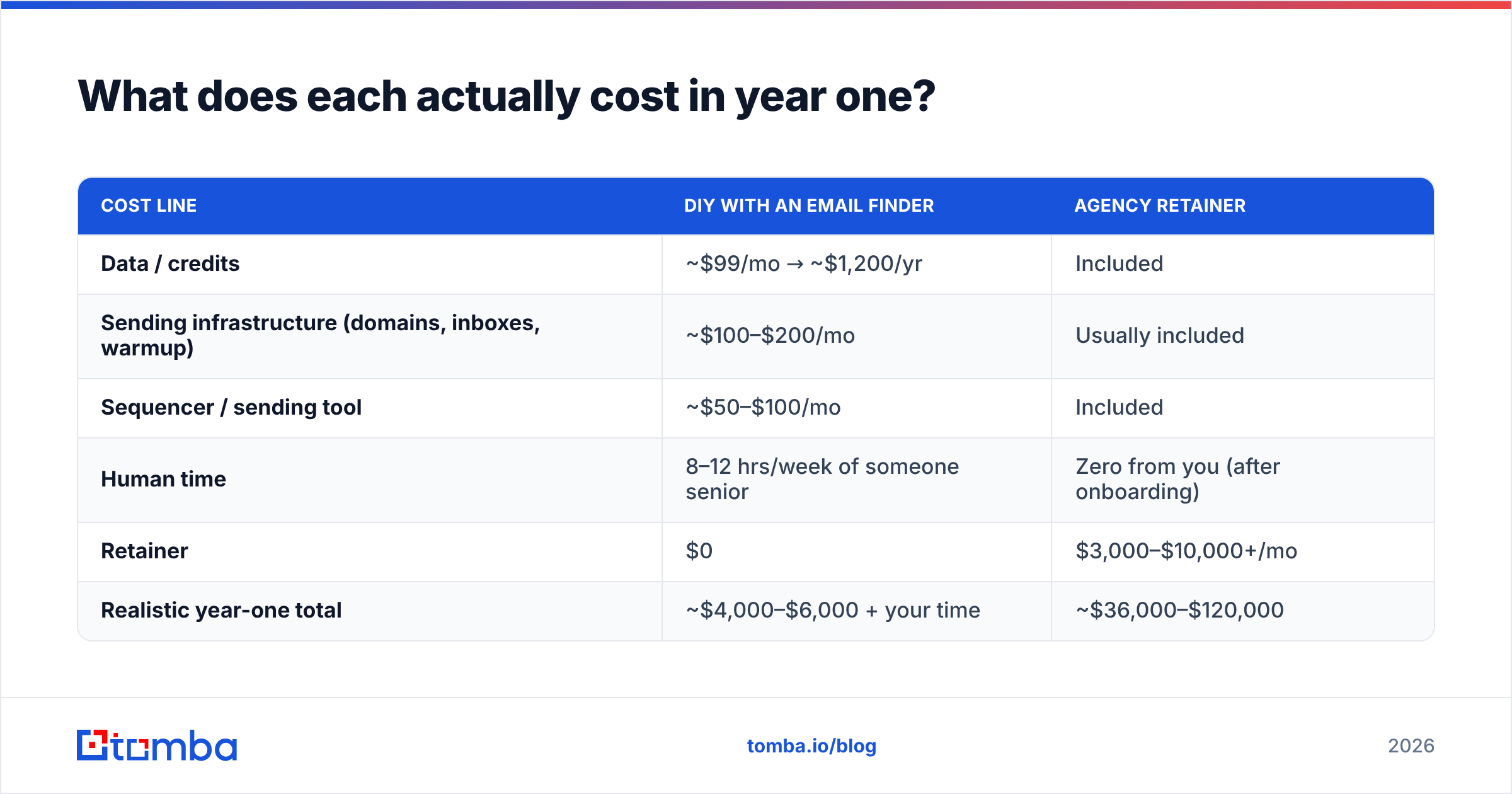
| Cost line | DIY with an email finder | Agency retainer |
|---|---|---|
| Data / credits | ~$99/mo → ~$1,200/yr | Included |
| Sending infrastructure (domains, inboxes, warmup) | ~$100–$200/mo | Usually included |
| Sequencer / sending tool | ~$50–$100/mo | Included |
| Human time | 8–12 hrs/week of someone senior | Zero from you (after onboarding) |
| Retainer | $0 | $3,000–$10,000+/mo |
| Realistic year-one total | ~$4,000–$6,000 + your time | ~$36,000–$120,000 |
The DIY column looks like an obvious win until you price the human time honestly. Ten hours a week of a founder or a $120k AE is not free — it's roughly $30,000–$60,000 of loaded cost. Once you do that math, the gap narrows considerably, and the decision stops being about price.
It becomes about who is better at outbound: your team, or theirs?
If your founder has closed the last 40 deals and knows exactly why people buy, nobody at any agency will out-message them. If your team has never run a cold campaign and your ICP is fuzzy, an experienced agency's first month of messaging will beat your sixth.
Which option fits your team right now?#
Run yourself through these five checks. They predict outcomes better than any feature grid.
- Do you have a repeatable, proven message? If at least five customers have bought for the same stated reason, you have something to scale — either path works. If not, don't hand a fuzzy pitch to an agency and expect them to find product-market fit for you. Buy data, test manually, and find the message yourself.
- Do you have someone who will own the inbox daily? Outbound dies in the reply queue. If nobody can answer within four business hours, a self-serve tool becomes shelfware and the agency's meetings go unattended anyway.
- Is your ACV above $15,000? Below that, agency retainers rarely pencil out — you need too many meetings to cover the cost. Low-ACV, high-volume motions almost always favor tooling plus automation.
- How niche is your ICP? For a list of 400 hospital CFOs in three states, precision beats volume, and hand-built lists from a domain search plus manual research will outperform a generic agency database. For a 60,000-account TAM, volume infrastructure wins and the agency's machinery earns its keep.
- Can you tolerate a six-month feedback loop? Agency contracts usually need two quarters before the data is meaningful. If your runway or your board can't wait that long, start with the tool.
Where does Findymail fall short?#
Being fair to a tool means naming its ceiling.
It's one layer of the stack, not the stack. You still need domains, warmed inboxes, a sequencer, a spam-safe copy process, and a CRM. Findymail solves the "what's their email" problem, which is maybe 20% of the work of running outbound. Teams that expect a finder to fix a pipeline problem are solving the wrong bottleneck.
Credit models punish exploration. When every failed lookup feels like spending, people under-prospect. Watch how a vendor handles unfound contacts and catch-all domains — that policy determines your effective cost per usable contact far more than the headline price does. Run a catch-all verification pass on anything ambiguous before you count it as a real lead.
Verified doesn't mean right. An address can be deliverable and still belong to a person who left the company eight months ago, or who has zero authority over your purchase. Deliverability and relevance are separate problems, and no finder solves the second one.
No strategic layer. The tool won't tell you your ICP is too broad, your subject lines are corporate mush, or that you're pitching a director-level pain to a VP. An agency will — that's a real part of what you're paying them for.
Where does OutboundView fall short?#
Ramp time is real and it's expensive. The first 30–45 days go to onboarding, ICP workshops, messaging drafts, and domain warmup. You're paying full retainer for a period where nothing lands in your calendar. Budget for it emotionally as well as financially.
Meeting quality varies with incentives. Any agency compensated on meetings booked has structural pressure to book meetings. Define "qualified" in the contract — title, company size, expressed pain, budget authority — and require a no-show and disqualification report. Vague definitions produce vague pipeline.
Your brand is being sent from someone else's keyboard. Review the sequences. Insist on approving copy. A tone-deaf email from an outsourced SDR still lands in your prospect's inbox with your logo on it, and you can't unsend a bad first impression to a strategic account.
Institutional knowledge walks out. After 12 months with a tool-plus-in-house approach, your team knows which segments respond, which subject lines work, and which objections recur. After 12 months with an agency, that knowledge often lives in their Slack, not yours. Ask explicitly for list ownership, sequence exports, and reply data on exit.

Can you run the agency playbook in-house?#
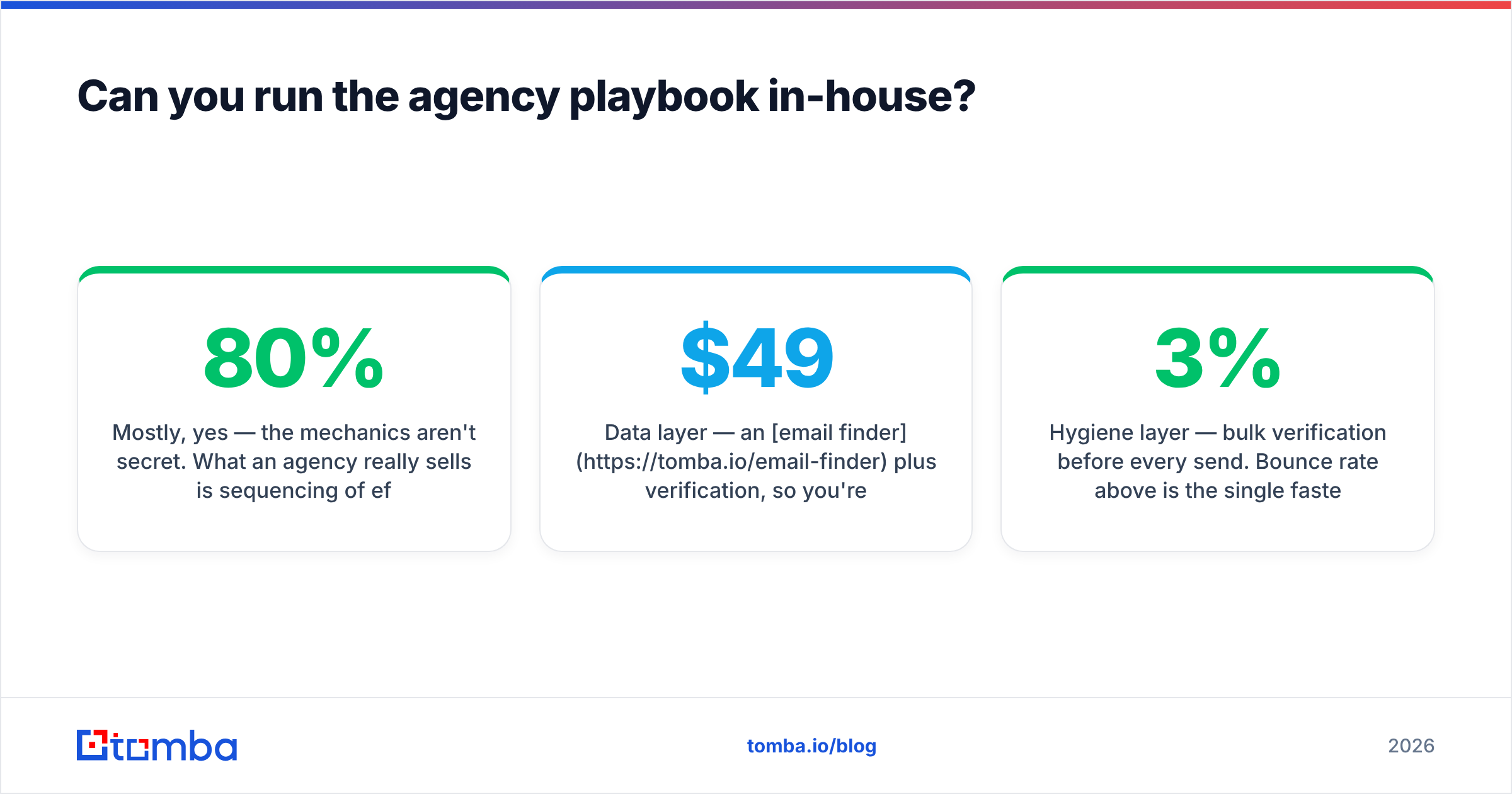
Mostly, yes — the mechanics aren't secret. What an agency really sells is sequencing of effort, not proprietary magic. Here's the stack that replicates roughly 80% of it:
- Data layer — an email finder plus verification, so you're building lists on demand instead of licensing a stale database. Tomba's free tier gives you 25 searches per month; paid plans start at $49/mo (Starter), $99/mo (Growth), and $249/mo (Pro), with full Tomba pricing published rather than quoted on a call.
- Hygiene layer — bulk verification before every send. Bounce rate above 3% is the single fastest way to torch a sending domain, and it's entirely preventable with an email verifier step in the workflow.
- Infrastructure layer — separate sending domains, SPF/DKIM/DMARC configured correctly, and 3–4 weeks of warmup per inbox. Google and Microsoft both publish sender requirements; Google's Postmaster guidelines are the authoritative reference, not a blog rumor.
- Message layer — one offer, one segment, one hypothesis per campaign. Agencies win here mostly through discipline, not talent. Most in-house teams test six variables at once and learn nothing.
- Automation layer — pipe enrichment into your CRM automatically via the Tomba API or a HubSpot/Salesforce integration, so nobody is copy-pasting rows at 11pm.
- Review layer — a weekly 30-minute meeting on reply rate, positive-reply rate, and meetings held. Not opens. Never opens.
Assemble those and your cost structure looks like the DIY column above — with the ramp risk on your shoulders instead of a vendor's.
Which should you pick?#
Pick a data tool if: your ACV is under $15,000, you have an operator who can own sends, you need to start this week, or you're still finding the message. Also pick it if you plan to hire an agency later — arriving with proven copy and a clean list makes any agency engagement dramatically more effective and shortens their ramp.
Pick an agency like OutboundView if: your ACV justifies a five-figure quarterly spend, your team is genuinely at capacity, your motion needs phone plus email (agencies still beat software at coordinated calling), and you can commit two quarters before judging results. Check independent reviews on G2 before signing, and talk to two current clients in your industry — not the two the agency hand-picks.
Pick both if: you're scaling. The mature setup is an agency handling volume outbound on tier-two and tier-three accounts while your in-house team runs precision outbound on tier-one accounts with hand-built lists. Same funnel, different tools, different levels of care.
The one choice that reliably fails is buying an agency to compensate for a positioning problem. No amount of outsourced sending fixes an offer nobody wants, and you'll spend $40,000 finding that out.
What's the fastest way to test the DIY path this week?#
Build a 300-contact list against one tight segment. Verify every address. Write three emails yourself — problem, proof, ask. Send 30 a day for two weeks and count positive replies, not opens.
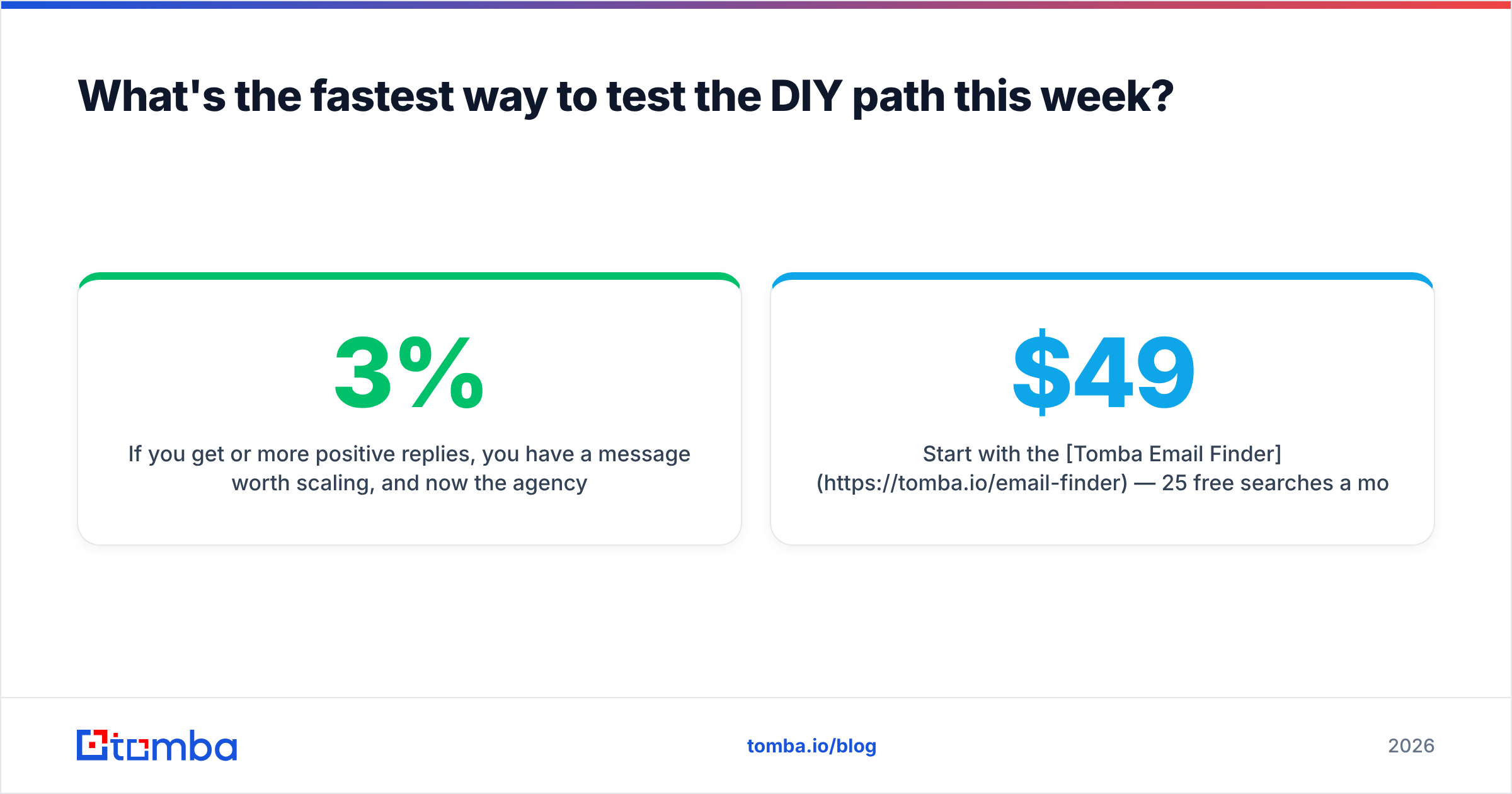
If you get 3% or more positive replies, you have a message worth scaling, and now the agency conversation is about capacity rather than hope. If you get under 1%, no vendor on earth will save the campaign, and you've learned it for the price of a month's subscription instead of a quarter's retainer.
Start with the Tomba Email Finder — 25 free searches a month, no card required, so you can build and verify that first test list today. If it works, plans scale from $49/mo, and the same data flows through the API into whatever sequencer or CRM you already run. Prove the message first. Then decide who should scale it.
Related guides#
Ready to find emails that actually work?
Join 150,000+ professionals who stopped guessing and started sending. Free credits on signup — no credit card required.
Get the Tomba newsletter
Practical outbound tactics and product updates — once every two weeks.
About the author