Findymail vs Pubrio (2026): Which B2B Data Tool Wins?
Findymail is a verification-first email finder. Pubrio is an AI prospecting suite with intent data. We compare pricing, accuracy, credit models, and which one actually fits your outbound stack in 2026.

Findymail vs Pubrio comes down to one question. Do you need cleaner emails, or better accounts? Findymail cleans. Pubrio finds. Every other difference follows from that split.
TL;DR
- Findymail is a narrow email finder built for cold-email teams. It bills only for verified results. It exports from Sales Navigator and Apollo. Entry price is about $49/mo.
- Pubrio is a wider AI GTM suite: contact data, intent signals, technographics, and an AI research layer. It is closer to an all-in-one than to a pure finder.
- If your problem is bounce rate, Findymail wins. If your problem is finding accounts worth emailing, Pubrio wins.
- Both meter credits in different ways. That is where budgets burn. Findymail's verified-only billing is honest and easy to forecast. Pubrio's pooled credits are denser and harder to predict.
- A third option beats both on cost per verified contact. If you just need email and phone data through an API, Tomba starts free with 25 searches a month and scales to $49/mo. The verifier is a separate product, so you never pay twice for one record.
Findymail vs Pubrio: what each tool actually does#
They solve different halves of the same problem. That is why most head-to-head reviews get this wrong.
Findymail grew out of one pain point. Cold email tools returned addresses that bounced, and you paid for them anyway. So its pitch is verification first. Every email it returns has been checked. Credits burn only on a confirmed result. Three workflows cover most of the work: single lookups, bulk CSV enrichment, and Sales Navigator list exports. The API is thin but steady, and it feeds sequencers like Instantly, Lemlist, and Smartlead.
Pubrio sits one layer up the stack. It is an AI prospecting platform. You get a contact and company database, buying-intent signals, technographic filters, and an AI agent that researches accounts and drafts outreach angles. You search for companies that fit a profile, add intent, then pull contacts. Email finding is a feature inside it, not the product itself.
That one difference drives everything below: price, accuracy, and who should buy which.
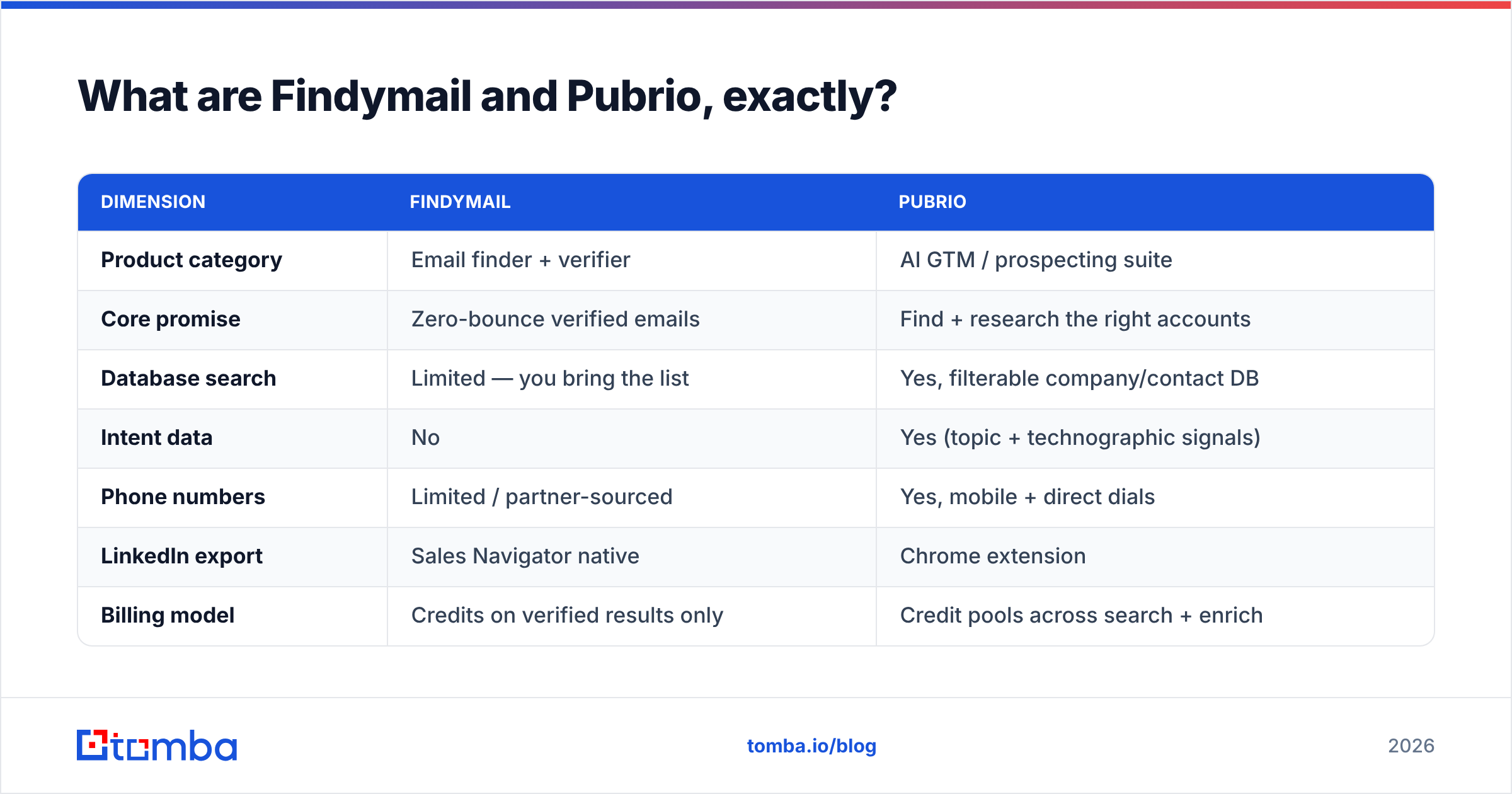
| Dimension | Findymail | Pubrio |
|---|---|---|
| Product category | Email finder + verifier | AI GTM / prospecting suite |
| Core promise | Zero-bounce verified emails | Find + research the right accounts |
| Database search | Limited — you bring the list | Yes, filterable company/contact DB |
| Intent data | No | Yes (topic + technographic signals) |
| Phone numbers | Limited / partner-sourced | Yes, mobile + direct dials |
| LinkedIn export | Sales Navigator native | Chrome extension |
| Billing model | Credits on verified results only | Credit pools across search + enrich |
| Entry price (approx.) | ~$49/mo | ~$49–$99/mo tier-dependent |
| Best for | Cold email operators, agencies | SDR teams doing account research |
| Weak spot | No account discovery | Verification depth varies by record |

Which one has better email accuracy?#
Findymail wins if accuracy means "how many of the emails I got actually land." Pubrio wins if it means "how much of my market can I reach at all."
Those are two different metrics. Vendors trade on the confusion.
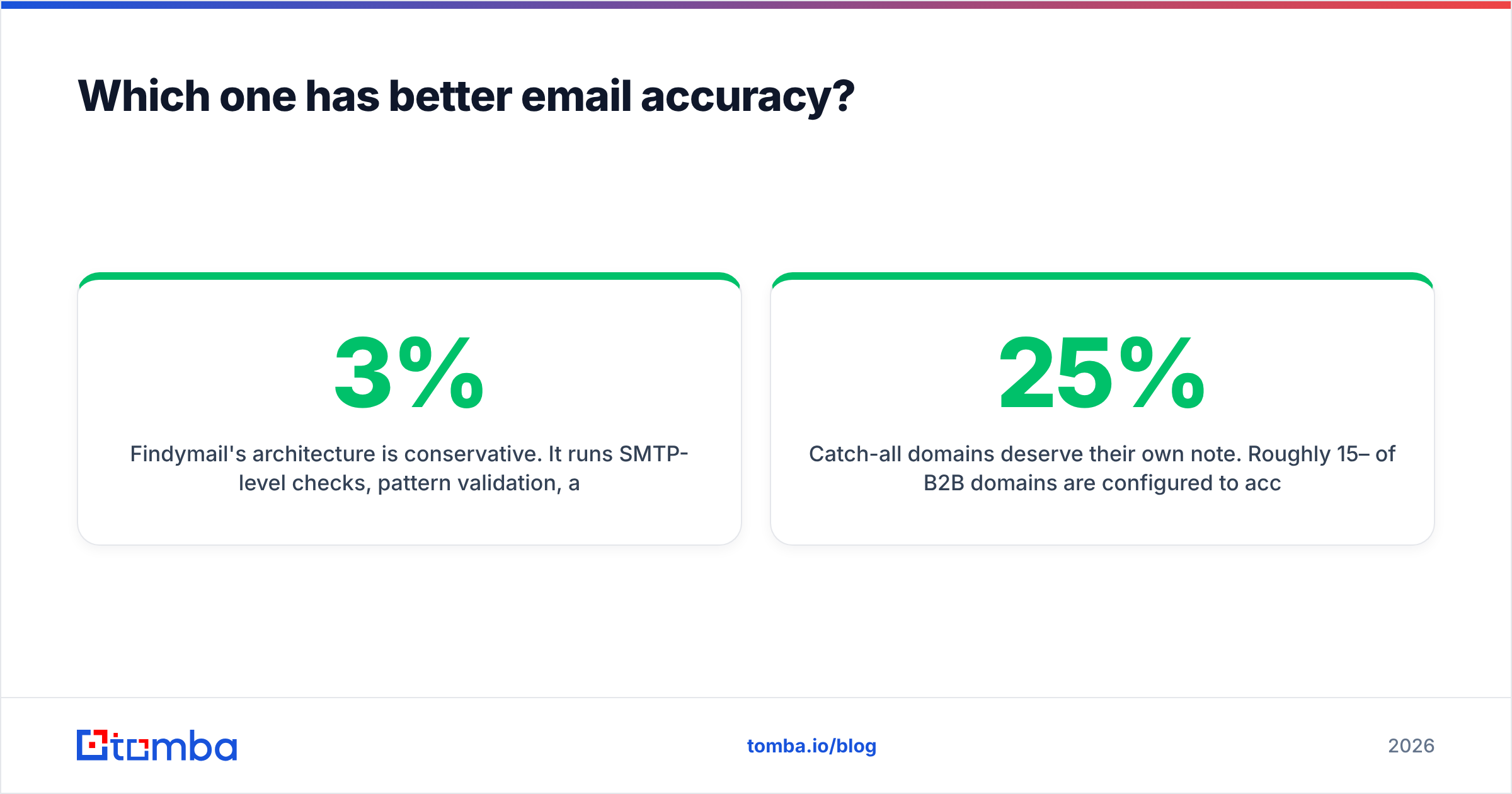
Findymail plays it safe. It runs SMTP checks, pattern validation, and MX checks before it hands you a result. If it cannot confirm the address, it returns nothing. Operators report bounce rates of 1–3% on Findymail lists. That sits well under the 5% line where most sequencers start to throttle you. The caution has a price, and the price is coverage. Ask for 1,000 mid-market SaaS contacts and you may get 600–750 back. The missing 250 were not wrong. They were unverifiable, and most were catch-all domains it refused to guess on.
Pubrio covers more ground because its database is bigger. You get a fuller list back. But that list mixes contributed data with pattern guesses, and those records age fast. Run high-volume outbound with no second check and you will feel it in reply rates before your bounce dashboard catches up.
The fix is the same for both tools. Never treat one vendor's own check as your only gate. Run a second email verification pass before you load a list. It costs a fraction of a send credit. It protects the thing that really matters: your sender reputation.
Catch-all domains need their own note. Roughly 15–25% of B2B domains accept all inbound mail. That makes SMTP checks useless, because the server says yes to everything. Findymail usually declines these. Pubrio often returns them with no label. Say a big slice of your ICP runs catch-all, which is common in enterprise and in EU-hosted setups. Then you need a dedicated catch-all verifier no matter which platform you pick. Without one, you are flying blind on a quarter of your list.
How to test accuracy yourself in 30 minutes#
- Build a 100-row control list from one vertical you know well. Use real companies, real names, and a mix of company sizes.
- Run it through both tools on trial credits. Record found, not found, and any confidence label.
- Check 20 random hits by hand against the company site, LinkedIn, or a press mention.
- Load the rest into a verifier you did not buy the finder from. You want an outside opinion.
- Send a small, warm test from a throwaway domain. Count hard bounces after 48 hours.
- Work out cost per delivered contact, not cost per credit. That is the only number a CFO will accept.
Most teams skip step 6. They buy the tool with the prettiest per-credit price instead of the cheapest working contact.
How do Findymail and Pubrio compare on pricing?#
Findymail is easier to forecast. Pubrio can cost less per action, but it is harder to predict.
Findymail's model is plain on purpose. You buy monthly credits. Credits burn only when a verified email comes back. Failed lookups are free. Unused credits usually do not roll over for long. So your real cost is the plan price divided by delivered contacts. You can budget against that number.
Pubrio pools credits across actions. A company search, a contact reveal, an enrichment call, and an intent pull may all draw from the same bucket, or from separate ones, depending on your tier. When a tool bundles search, enrichment, and AI research, people explore. Exploring burns credits. Teams that use Pubrio well set hard weekly caps.
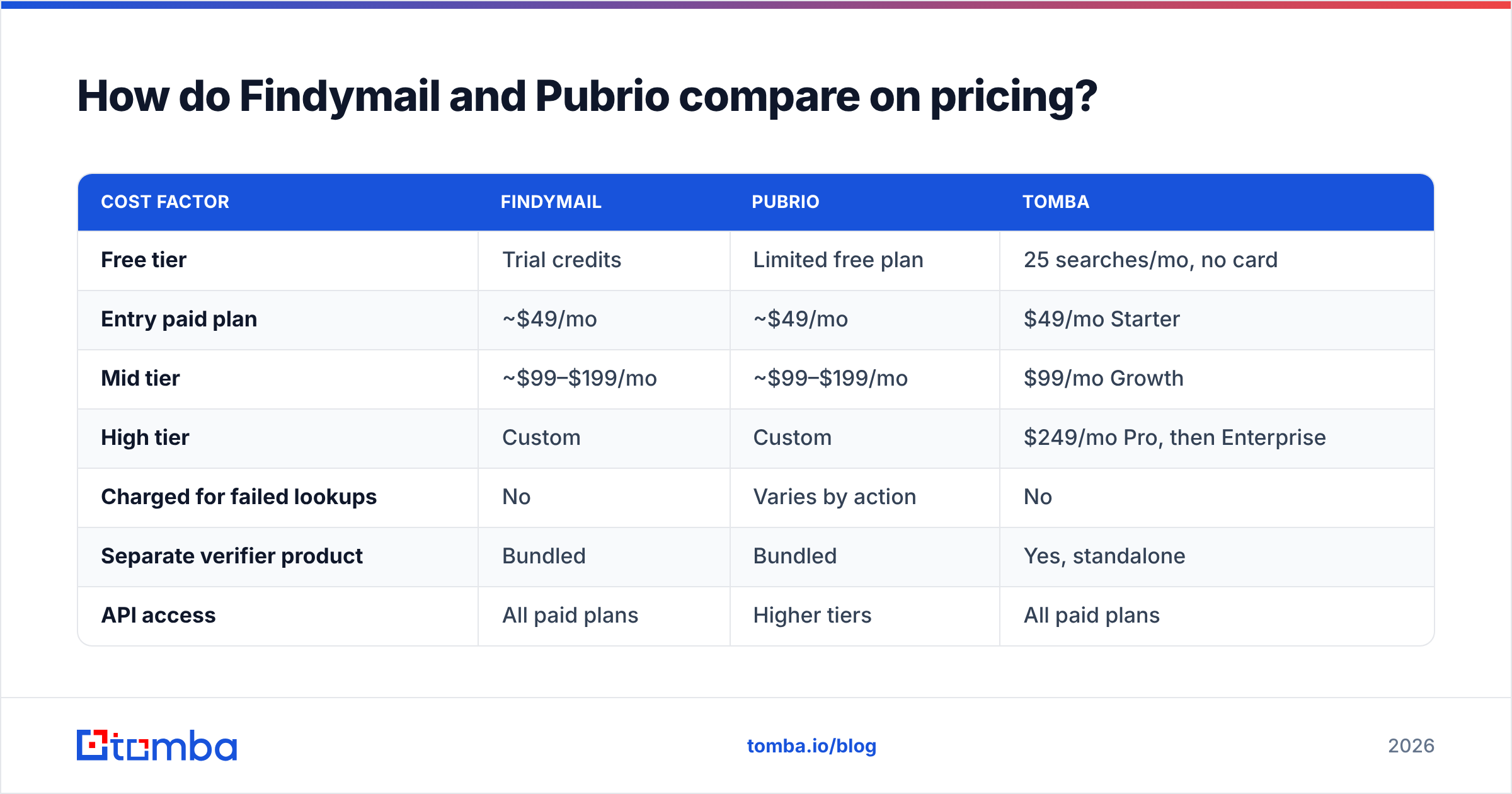
| Cost factor | Findymail | Pubrio | Tomba |
|---|---|---|---|
| Free tier | Trial credits | Limited free plan | 25 searches/mo, no card |
| Entry paid plan | ~$49/mo | ~$49/mo | $49/mo Starter |
| Mid tier | ~$99–$199/mo | ~$99–$199/mo | $99/mo Growth |
| High tier | Custom | Custom | $249/mo Pro, then Enterprise |
| Charged for failed lookups | No | Varies by action | No |
| Separate verifier product | Bundled | Bundled | Yes, standalone |
| API access | All paid plans | Higher tiers | All paid plans |
| Bulk CSV | Yes | Yes | Yes |
| Phone data | Limited | Yes | Yes, separate module |
Two budget rules apply to both. First, ignore the headline credit count. Work out the delivered-contact cost instead. A 10,000-credit plan at a 60% hit rate is a 6,000-contact plan. Second, watch annual lock-in. Both vendors discount annual prepay hard. That is fine if your motion is stable. It is expensive if you are still testing ICPs. Want a simple reference point with no pooled-credit math? Tomba pricing lists flat plan limits and bills the verifier on its own.
Which tool fits which team?#
Match the tool to your real bottleneck, not to the feature list.
- Cold email agencies with many client domains. Findymail. Bounce control is existential here. One client's bad list can burn a shared IP neighborhood. You already know the accounts. You need clean addresses.
- SDR teams that do not yet know who to target. Pubrio. Intent filters and technographics earn their keep when your ICP is fuzzy and you must cut 2,000 accounts down to 200.
- RevOps building an enrichment pipeline. Neither one alone. You want an API-first provider with predictable per-call billing that feeds your CRM on a schedule. Look at Tomba API or a similar option, then add intent data separately if you need it.
Two more cases sit at the edges of this matchup.
- Founders doing sub-500-contact outbound. Start free. A free tier plus manual research beats a $99/mo plan you open twice a month. Tomba's free tier and a Chrome extension will carry a founder-led motion for months.
- Enterprise with a compliance review. Ask both vendors for data-sourcing documentation before you sign. GDPR posture varies a lot across B2B data vendors, and procurement will ask. Read what each one says at findymail.com and pubrio.com. Then check peer reviews on G2.

What do these tools not tell you?#
Three things tend to surprise buyers after the trial ends.
Coverage drops outside North America. Both platforms are strongest on US and UK data. If your ICP skews DACH, Nordics, Japan, or LATAM, expect hit rates to fall 20–40 points. Test on your own geography. A sample list of US SaaS companies makes every vendor look great.
Rollover rules matter more than credit counts. A plan with 20,000 credits that expire each month is worse than 8,000 that roll for a year, if your outbound runs in campaigns rather than year-round. Ask before you buy, and get the answer in writing.
"Verified" is not a standard. Each vendor defines it in-house. For one, it means the SMTP handshake worked. For another, the pattern matched a known company format with 90%+ confidence. For a third, a human contributed the record in the last two years. So when two tools disagree about one address, neither is lying. They are using different words. That is why an outside check is not redundancy. It is arbitration. Keeping your own list of confirmed company email patterns also helps you sanity-check what a vendor returns.
Deliverability is not only a data problem. Even a perfect list bounces if your SPF, DKIM, and DMARC records are wrong, or if your domain is cold. Neither tool fixes your infrastructure. The bulk-sender rules from Google and Yahoo, set out in Google's sender guidelines, apply no matter where your addresses came from. Fix authentication first. Blame the data second.
Is there a better alternative to both?#
Often, yes. If your real need is verified email and phone data through an API at a steady price, price a third option before you commit.
Here is the gap in this matchup. Findymail is narrow by design. Pubrio is broad by design. A large group of buyers wants neither extreme. They want a finder that also verifies, exposes clean endpoints, handles bulk, and does not price like a full GTM platform.
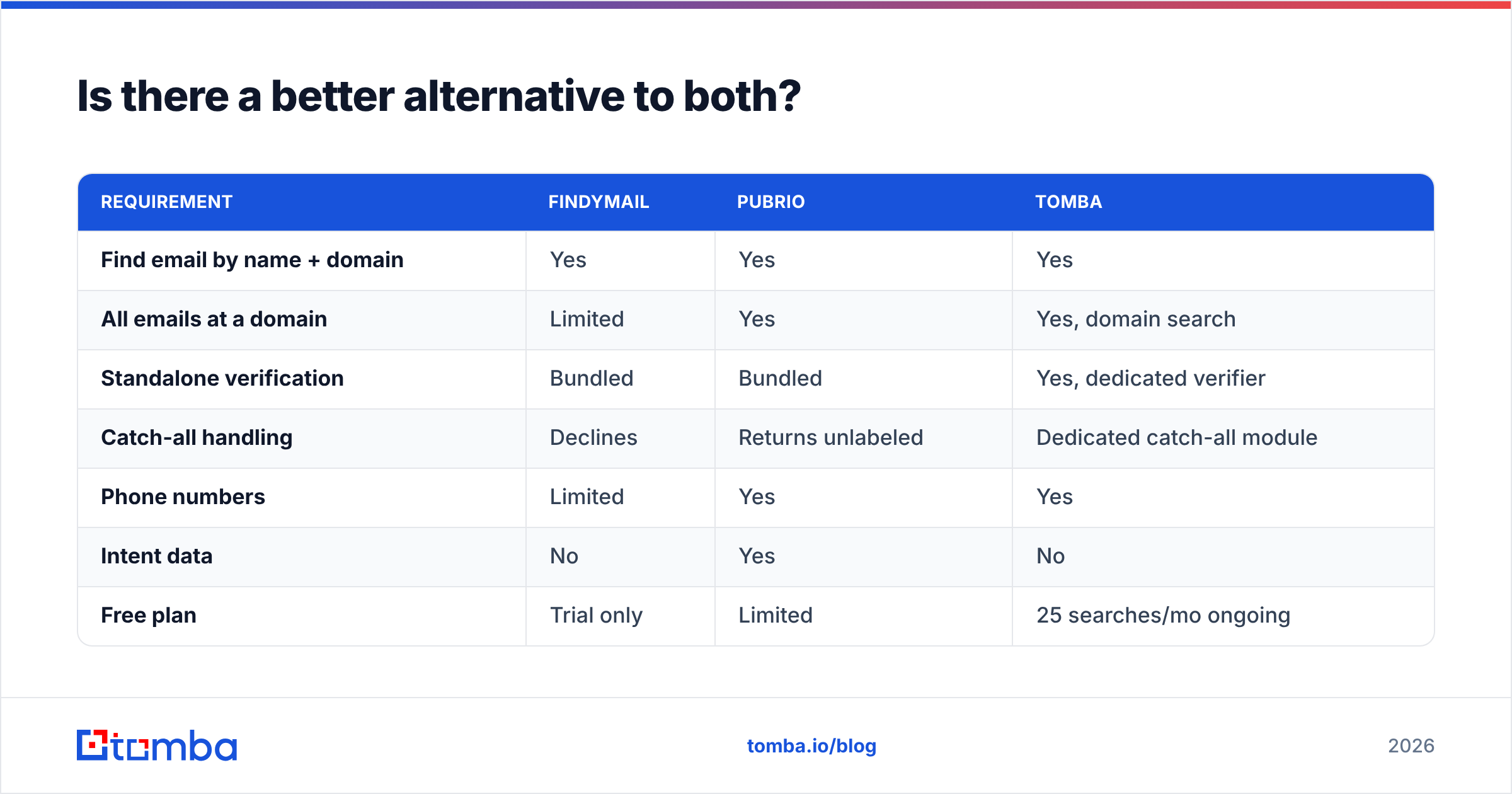
| Requirement | Findymail | Pubrio | Tomba |
|---|---|---|---|
| Find email by name + domain | Yes | Yes | Yes |
| All emails at a domain | Limited | Yes | Yes, domain search |
| Standalone verification | Bundled | Bundled | Yes, dedicated verifier |
| Catch-all handling | Declines | Returns unlabeled | Dedicated catch-all module |
| Phone numbers | Limited | Yes | Yes |
| Intent data | No | Yes | No |
| Free plan | Trial only | Limited | 25 searches/mo ongoing |
| Sheets / Excel add-on | Partial | Partial | Yes, both |
| Developer tooling | REST API | REST API | API, CLI, MCP server |
Tomba is upfront about the trade-off. It does not do intent data or AI account research. If that is your core need, Pubrio is the better fit and you should buy it. What Tomba does is unbundle the parts — email finder, verifier, domain search, catch-all, phone finder, and enrichment. You pay for the parts you use. You do not fund a shared credit pool that covers features you never open. For a team that already runs a sequencer and a CRM, that setup is usually cheaper.
These three are not the only credible options. BookYourData takes a different and valid route: prepaid, pay-as-you-go B2B lists with a bounce guarantee. That suits teams that want one list purchase instead of a subscription. If your buying is episodic rather than continuous, look at that model too. Review sites such as Capterra help you pressure-test vendor claims across all four.
How should you run the decision?#
Run a two-week bake-off with real money on the line. A feature spreadsheet will not settle it.
- Pick the metric first. Cost per delivered, replied-to contact. Not credits. Not hit rate.
- Freeze one ICP segment across all tools: same geography, same company size, same titles.
- Cap the spend at one month of the entry tier per vendor. About $50 each is enough signal.
- Verify on your own. Send every list through the same third-party verifier, so you compare like with like.
- Send from separate subdomains. A bad list from one vendor should not skew your read on another.
- Decide on data and kill fast. If a tool loses on cost per delivered contact by more than 30%, cancel it that week. Sunk-cost drift is how teams end up paying for four overlapping tools.
Teams that run this test honestly usually end up with two tools, not one: a discovery layer to find accounts, and a data layer to reach them cleanly. Findymail and Pubrio each cover one side well. Very few teams need to pay a premium for both sides from one vendor.
The verdict#
The Findymail vs Pubrio call is simple. Findymail wins on data hygiene and predictable billing. Pubrio wins on account discovery and research depth. Pick the one your pipeline is starving for. And if the honest answer is "I just need accurate contact data at a fair price," neither is your cheapest path.
If that sounds like you, start with the Tomba Email Finder. The free tier gives you 25 searches a month with no card. Starter is $49/mo. The verifier, domain search, and phone modules are separate products, so you pay only for what your workflow calls. Run your control list through it next to your Findymail and Pubrio trials. Work out cost per delivered contact for all three, and let the number decide.
Related guides#
Ready to find emails that actually work?
Join 150,000+ professionals who stopped guessing and started sending. Free credits on signup — no credit card required.
Get the Tomba newsletter
Practical outbound tactics and product updates — once every two weeks.
About the author