Findymail vs RocketReach (2026): Which Email Finder Wins?
Findymail is a bounce-obsessed email finder built for outbound. RocketReach is a giant contact database with phones. Here is how they actually compare on accuracy, pricing, and workflow fit in 2026.
TL;DR
- Findymail is a narrow, deliberately opinionated email finder: it optimises for low bounce rates, refuses to sell you unverifiable guesses, and charges only for emails it actually returns. Great for cold email teams running Instantly, Smartlead, or Lemlist.
- RocketReach is a database-first contact platform: ~700M+ profiles, personal emails, and direct dials. Great for recruiters and AE teams that need a phone number as much as an inbox.
- On B2B work email accuracy, the two are closer than the marketing suggests. The real gap is in what happens when the tool is unsure — Findymail returns nothing, RocketReach returns a probability.
- Pricing structures are not comparable line-for-line: Findymail sells credits per workspace, RocketReach sells lookups per seat. A 4-person team changes the math completely.
- If you need both the verified-work-email discipline of Findymail and an API-first, per-workspace price, run a third bid — that is where tools like Tomba's email finder land.
What are Findymail and RocketReach?#
They solve overlapping problems from opposite ends.
Findymail launched as an answer to a single complaint: cold email lists bounce, and bounces burn domains. Its pitch is a bounce guarantee — it verifies before it hands you an address, and if it cannot verify, it does not charge you a credit. The product surface is small on purpose: single lookup, bulk CSV enrichment, a LinkedIn/Sales Navigator scraper, an API, and native pushes into cold email sequencers.
RocketReach is a contact database with a search engine bolted on top. You search people by title, company, location, industry, and skill, then reveal work emails, personal emails, and phone numbers. It has been around far longer, it indexes hundreds of millions of profiles, and it sells heavily to recruiting teams — which explains the emphasis on personal Gmail addresses and mobile numbers that a pure B2B tool would never bother collecting.
The distinction that matters:
- Findymail is a finder. You bring the target (a name + domain, or a LinkedIn URL) and it resolves the address.
- RocketReach is a database. You bring a filter and it returns a list of people you did not know existed.
- Findymail's default answer when unsure is "no result." That protects your sender reputation.
- RocketReach's default answer when unsure is a "likely" address. That protects your coverage number.
- Neither is wrong — they are tuned for different failure costs. A recruiter losing one candidate is cheaper than a cold email team losing a domain.
How do Findymail and RocketReach compare at a glance?#
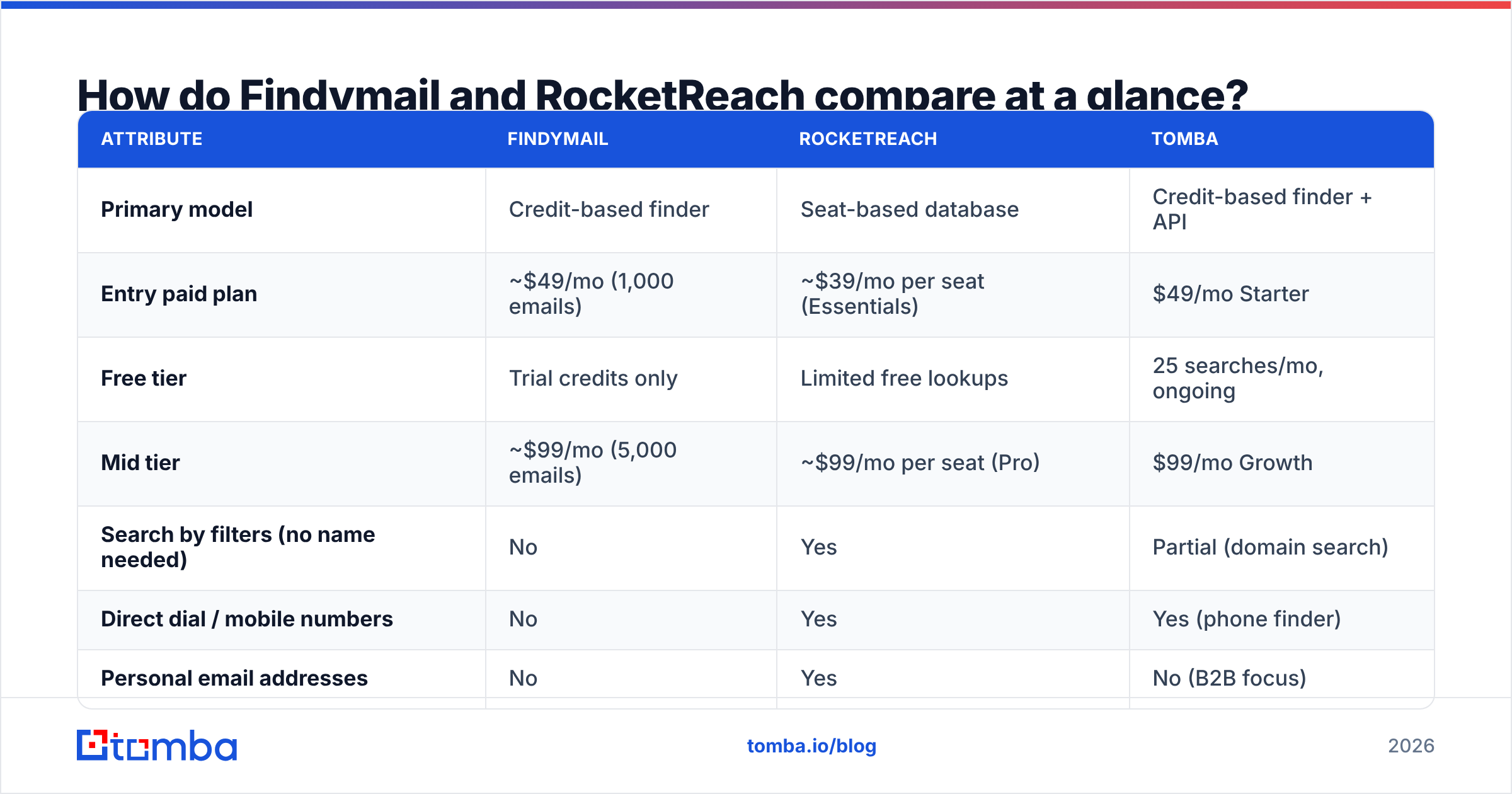
Prices below reflect publicly listed monthly rates at the time of writing and shift with annual discounts and promos — always confirm on the vendor page before you buy.
| Attribute | Findymail | RocketReach | Tomba |
|---|---|---|---|
| Primary model | Credit-based finder | Seat-based database | Credit-based finder + API |
| Entry paid plan | ~$49/mo (1,000 emails) | ~$39/mo per seat (Essentials) | $49/mo Starter |
| Free tier | Trial credits only | Limited free lookups | 25 searches/mo, ongoing |
| Mid tier | ~$99/mo (5,000 emails) | ~$99/mo per seat (Pro) | $99/mo Growth |
| Search by filters (no name needed) | No | Yes | Partial (domain search) |
| Direct dial / mobile numbers | No | Yes | Yes (phone finder) |
| Personal email addresses | No | Yes | No (B2B focus) |
| Bounce/credit policy | No charge for unverified | Charged on reveal | Verification bundled |
| Standalone email verifier | Included | Limited | Full verifier + catch-all |
| API access | Yes, all paid plans | Yes, higher tiers | Yes, all paid plans |
| Best fit | Cold email at volume | Recruiting, multi-channel AE | API-driven enrichment, dev teams |
Two structural things fall out of that table.
First, per-seat versus per-workspace is the biggest hidden cost in this comparison. A three-person SDR pod on RocketReach Pro is roughly $297/mo before anyone runs a bulk job. The same pod on Findymail or on Tomba pricing shares one credit pool. If your team is one growth marketer, RocketReach's entry tier is genuinely cheap. If it is five reps, it is not.
Second, RocketReach's extras are only extras if you use them. Personal emails and mobile numbers are worth real money to a recruiter and worth roughly zero to a B2B SaaS team that only sends to work addresses and would get flagged for calling a personal cell.
Which one finds more valid emails?#
Coverage and accuracy are different numbers, and vendors love to blur them.
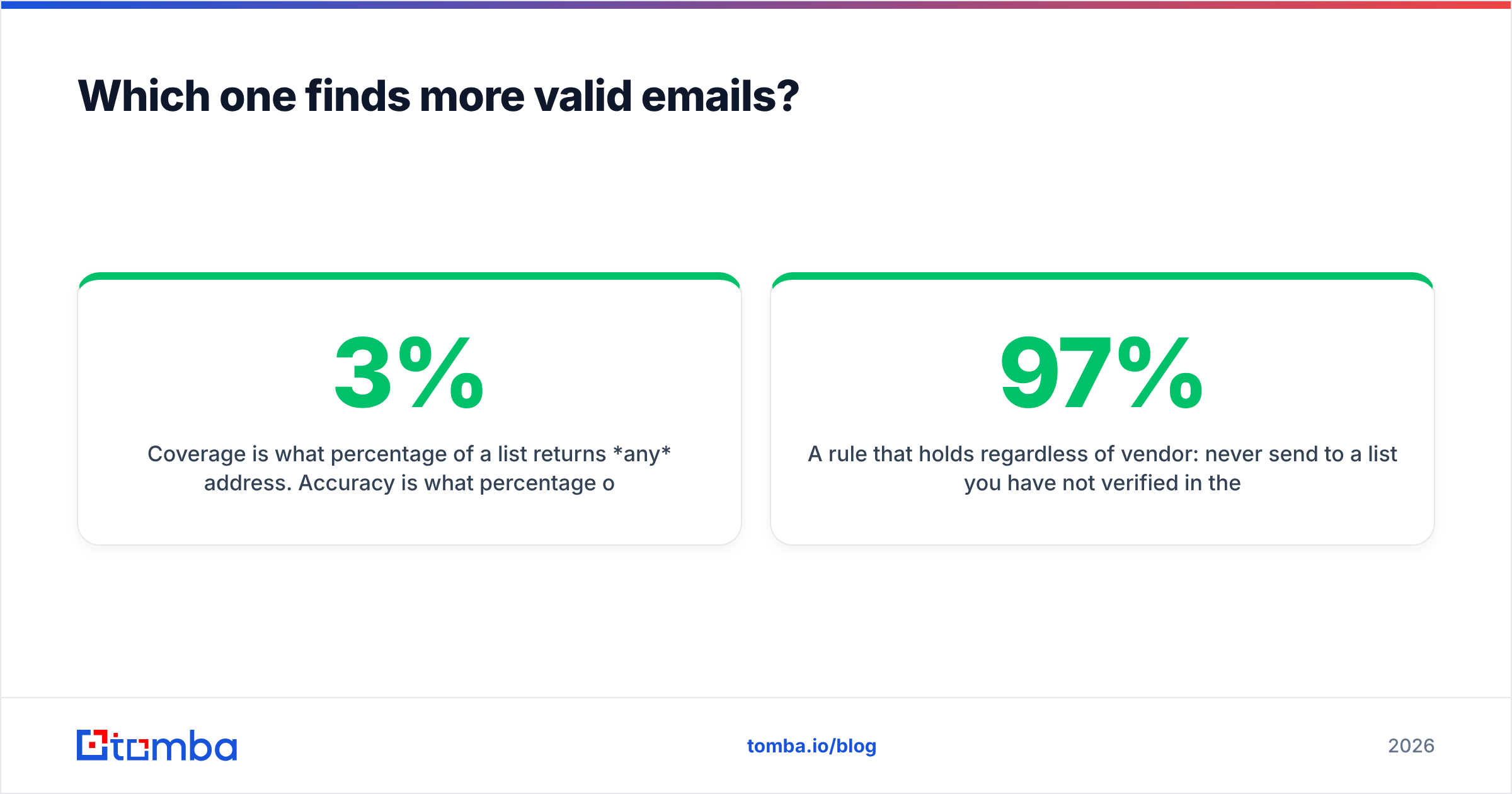
Coverage is what percentage of a list returns any address. Accuracy is what percentage of those addresses actually accept mail. A tool can win coverage and lose you money — every extra guess that bounces pushes your bounce rate toward the 2–3% ceiling that Google and Microsoft use as a spam signal.

In practice, when you run the same 1,000-row list of B2B decision-makers through both:
- Findymail typically returns fewer rows but bounces less. Its refusal to return low-confidence guesses means the delta between "emails found" and "emails that landed" is small. Users on G2 consistently cite bounce rates in the low single digits as the reason they switched.
- RocketReach typically returns more rows, with more variance. You will see addresses tagged by confidence level, and the lower tiers of that scale need a second pass through a verifier before you send anything.
- Catch-all domains are where both tools get soft. A catch-all server accepts everything at SMTP time, so no verifier can prove an address by ping alone. This is where pattern-plus-source evidence matters — and where a dedicated catch-all verifier earns its keep instead of you guessing.
The honest read: if your entire success metric is deliverability, Findymail's conservatism is the right default. If your metric is "did I find a way to reach this person at all," RocketReach's wider net wins — as long as you treat its medium-confidence results as raw material, not as a send-ready list.
A rule that holds regardless of vendor: never send to a list you have not verified in the last 30 days. People change jobs, domains get retired, and a list that was 97% valid in January is not 97% valid in June. Run any exported file through an email verifier before it touches your sequencer, even if the finder claims it already verified.
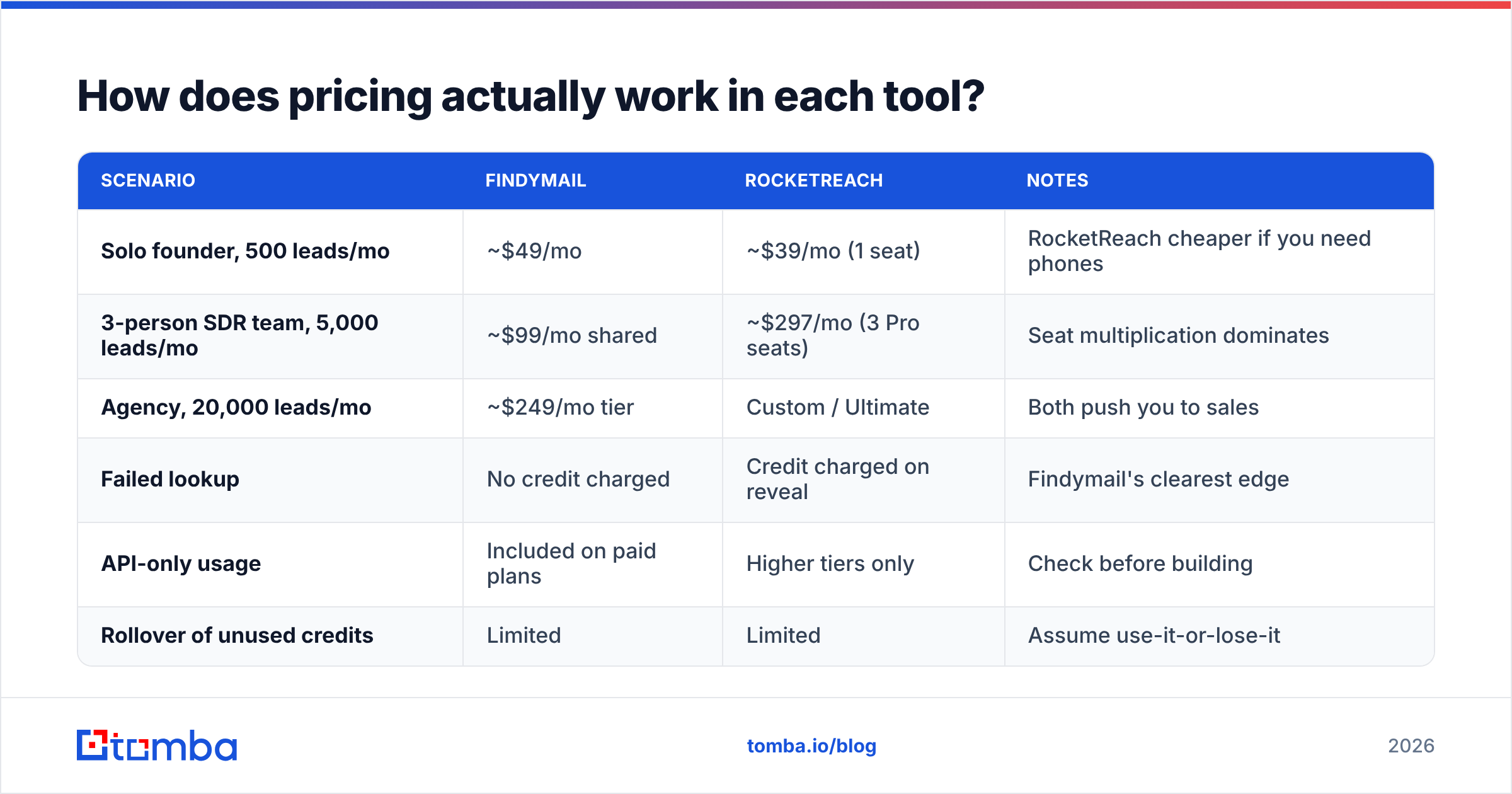
How does pricing actually work in each tool?#
| Scenario | Findymail | RocketReach | Notes |
|---|---|---|---|
| Solo founder, 500 leads/mo | ~$49/mo | ~$39/mo (1 seat) | RocketReach cheaper if you need phones |
| 3-person SDR team, 5,000 leads/mo | ~$99/mo shared | ~$297/mo (3 Pro seats) | Seat multiplication dominates |
| Agency, 20,000 leads/mo | ~$249/mo tier | Custom / Ultimate | Both push you to sales |
| Failed lookup | No credit charged | Credit charged on reveal | Findymail's clearest edge |
| API-only usage | Included on paid plans | Higher tiers only | Check before building |
| Rollover of unused credits | Limited | Limited | Assume use-it-or-lose-it |

The line worth reading twice is the failed-lookup row. If a tool charges you for a miss, your effective cost per usable email is your sticker price divided by your hit rate. At a 60% hit rate, a $99 plan advertising 5,000 lookups is really a $99 plan delivering 3,000 usable contacts — $0.033 each, not $0.020. Findymail's no-charge-on-miss policy removes that penalty. Tomba applies the same logic and bundles verification into the find, so your credit maps to a deliverable address rather than to a query.
Also budget for the second tool you will inevitably buy. Almost nobody runs a single vendor. The common stack is one finder for volume, one verifier for the final gate, and one enrichment source for firmographics — which is why per-workspace data enrichment and bulk email finder jobs matter more than headline credit counts.
Which tool fits which workflow?#
- Cold email at scale (500+ sends/day). Findymail. The bounce discipline is the entire product, and the native pushes to Instantly/Smartlead remove a CSV step. Add a separate verifier as a final gate anyway.
- Recruiting and talent sourcing. RocketReach. Personal emails and mobile numbers are the job. Findymail deliberately does not collect them.
- Multi-channel AE outbound (email + call + LinkedIn). RocketReach, or a finder plus a dedicated phone finder. One tool that returns an email and a dial saves a tab, but check dial accuracy on a sample before committing a year.
- Building product features on top of contact data. Neither by default — check API terms first. If your use case is programmatic (enrich on signup, resolve emails inside your app), you want API access on the entry tier, not gated behind a $249 plan. The Tomba API and Findymail both allow this; RocketReach historically restricts it.
- Territory research and TAM mapping. RocketReach. Findymail cannot answer "show me every VP of Engineering at 200-1,000 person fintechs in Berlin" — it needs you to already have the name.
- One-off list of 200 accounts. Either, on a free or entry tier. Do not sign an annual contract for a project you will finish in a week.

Where does each tool fall short?#
Findymail's limits:
- No search-by-filter. You must supply the person. If your motion starts with "who should I even talk to," it is the wrong tool alone.
- No phone numbers, no personal emails. Single-channel by design.
- Smaller feature surface means fewer integrations than an incumbent — check that your CRM is supported natively before you assume Zapier will cover it.
- Credit consumption on scraping jobs can surprise you if you run large Sales Navigator exports without a cap.
RocketReach's limits:
- Per-seat pricing punishes teams. This is the single most common complaint in review sites, and it does not get better as you grow.
- Confidence-scored results shift the verification burden onto you. Budget for a verifier or accept the bounce risk.
- Data freshness on smaller companies and non-US regions is uneven. Enterprise US contacts are strong; a 30-person agency in Lisbon is a coin flip.
- Personal-email and mobile data raises compliance questions in the EU. If you sell into the EEA, get your GDPR legitimate-interest position documented before you export anything.
What neither does well:
Both are contact-resolution tools, not intent or signal platforms. Neither tells you when to reach out. If timing is your bottleneck rather than contact data, no amount of credits fixes it — you need website visitor reveal, job-change alerts, or a signal layer sitting in front of whichever finder you pick.
Which should you pick in 2026?#
Pick Findymail if you send cold email for a living, your domain reputation is the asset you protect above all else, and you already know who you want to reach. Its narrowness is a feature.
Pick RocketReach if you are sourcing people you cannot name yet, if you need a phone number in the same row as the email, or if you are a solo operator whose per-seat cost never multiplies.
Run a third bid if either of these is true: you are a team of three or more (seat pricing will eat you), or you want API access on an entry-level plan. That is the gap Tomba is built for — per-workspace credits starting at $49/mo Starter, $99/mo Growth, $249/mo Pro, a permanent free tier of 25 searches, and API access on every paid plan rather than only at the top.
The pragmatic answer for most B2B teams is a two-tool stack, not a winner: one source for discovery, one gate for verification. What you should refuse to do is pay per seat for a database you use twice a month, or trust any single tool's word that an address is valid without a second check.
Ready to test the third option? Start with the Tomba Email Finder — run the same 50 contacts you tested in Findymail and RocketReach through the free tier, compare hit rate and bounce rate side by side, and let your own list decide. Twenty-five searches a month costs nothing, and a real bake-off beats any comparison post, including this one.
Related guides#
Ready to find emails that actually work?
Join 150,000+ professionals who stopped guessing and started sending. Free credits on signup — no credit card required.
Get the Tomba newsletter
Practical outbound tactics and product updates — once every two weeks.
About the author