Findymail vs ZoomInfo (2026): Which Data Tool Wins?
Findymail costs under $100/mo and verifies emails on the fly. ZoomInfo starts near $15k/yr and sells intent data. Here's the honest breakdown of which one your team actually needs in 2026.
Findymail vs ZoomInfo is really a choice between two price tags. One runs about $49 a month. The other starts near $15,000 a year. Here is what each tool does, and who should pick which.
TL;DR
- Findymail is a light email finder and verifier for cold outreach teams. Self-serve pricing, no annual lock-in, and verification in every lookup.
- ZoomInfo is a full go-to-market data platform. You get contacts, company data, tech stacks, intent signals, and a CRM-native workflow layer. Contracts usually start near $15,000/year with seat minimums.
- They solve different problems. Findymail answers "what's this person's email?" ZoomInfo answers "which accounts should we work, and are they in-market now?"
- Run a 1-10 person outbound team with a known target list? ZoomInfo is overkill. Need intent data, org charts, and CRM enrichment at scale? Findymail can't get you there.
- A third path exists. Pair a credit-based finder like Tomba or Findymail with a separate intent tool. You pay a fraction of the ZoomInfo ticket.
What is Findymail?#
Findymail is a B2B email-finding tool with a narrow promise. It returns verified emails, not guesses. And it doesn't charge you for the ones that bounce.
The product is deliberately small. You give it a name and a company domain. A LinkedIn URL, a CSV, or a Sales Navigator export works too. It returns an email that already passed verification. There's a Chrome extension, a bulk CSV uploader, a Sales Navigator scraper, and an API. That's most of it.
The design philosophy matters more than the feature list. Findymail sells on a bounce guarantee. If an email it marks valid bounces, you get the credit back. That one policy shapes the whole tool. It returns fewer results than aggressive rivals. But a higher share of what it returns actually lands. For teams whose domain reputation is their livelihood, that trade is usually right.
Pricing sits in self-serve territory. The entry plan runs about $49/month for roughly 1,000 credits. Higher tiers scale into the low hundreds. No sales call, no annual commitment, no seat minimum. You can sign up on a Tuesday and send on a Wednesday.
What Findymail does not do: company research, buying-committee mapping, intent signals, tech-stack filters, org charts, call analysis, or CRM data cleanup. It is a finder, not a platform.
What is ZoomInfo?#
ZoomInfo is the largest commercial B2B data platform on the market, and it behaves like one. The core product is ZoomInfo Sales, formerly SalesOS. It bundles well over 100 million professional profiles with company details, tech stacks, funding events, org charts, and its flagship feature: intent data.
Intent is the part rivals struggle to copy. ZoomInfo watches what people read across a large ad-bid network. It then flags accounts researching topics tied to your product. When it works, your rep calls a company the week they start shopping. Not the month after they signed with someone else.
Around that sits a workflow layer. Copilot ranks accounts and drafts messages. Engage runs sequences. Chorus records calls. Operations cleans up CRM data. Marketing handles ABM ads. You can run a whole GTM motion inside ZoomInfo without another vendor.
The cost of that scope is the cost. ZoomInfo does not publish pricing. Reported contracts on G2 and other review sites cluster around $15,000–$40,000 a year for mid-market teams. Enterprise deals run well into six figures. Contracts are annual, seat-based, and credit-capped. They also auto-renew unless you cancel inside a set window, which is a recurring theme in reviews. Budget for procurement, a security review, and onboarding.
Findymail vs ZoomInfo: how do the two compare?#
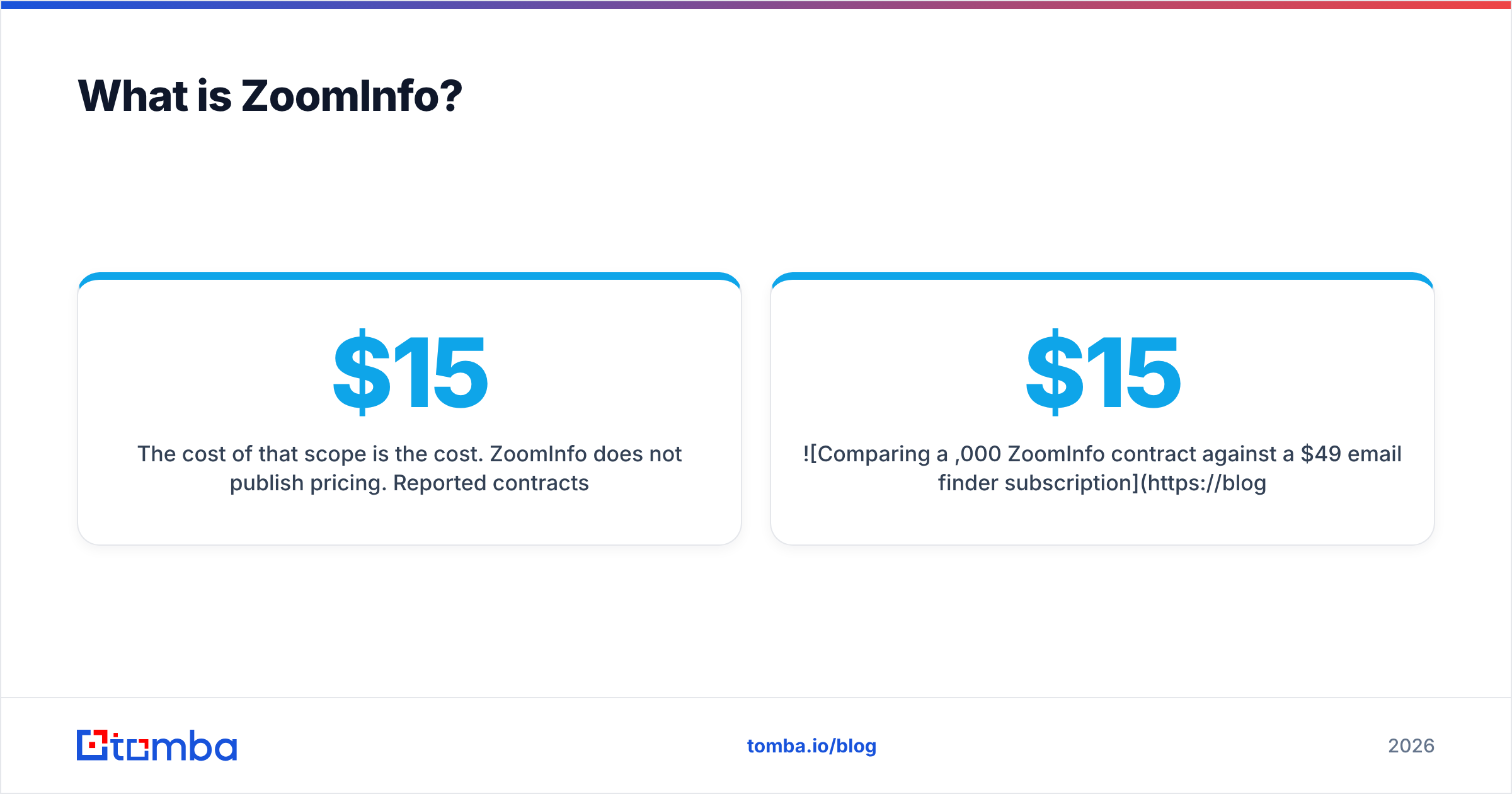
Here's the side-by-side on the details that change a buying decision.
| Attribute | Findymail | ZoomInfo |
|---|---|---|
| Entry price | ~$49/mo self-serve | ~$15,000+/yr, quote-only |
| Contract | Monthly, cancel anytime | Annual, seat minimums, auto-renew |
| Free tier | Limited trial credits | Free "Community" tier (heavily gated) |
| Primary job | Find + verify a known person's email | Discover accounts, contacts, and timing |
| Verification | Built in, bounce guarantee | Bundled, no bounce credit-back policy |
| Direct dials / mobiles | No | Yes, large mobile dataset |
| Intent data | No | Yes — core differentiator |
| Org charts / hierarchy | No | Yes |
| Technographics | No | Yes |
| CRM enrichment | Via Zapier/API only | Native Salesforce + HubSpot sync |
| Sequencing | No | Yes (Engage) |
| Call recording | No | Yes (Chorus) |
| API | Yes, straightforward | Yes, enterprise-gated |
| Time to first send | Same day | 2-6 weeks (procurement + onboarding) |
| Best for | SDR teams, agencies, founders | Enterprise GTM, RevOps, ABM programs |
The table makes the real question obvious. You're not picking between two versions of the same product. You're picking between buying a tool and buying a system.
Which one has better data accuracy?#
Different tools, different failure modes. Treat accuracy claims from both vendors with care.
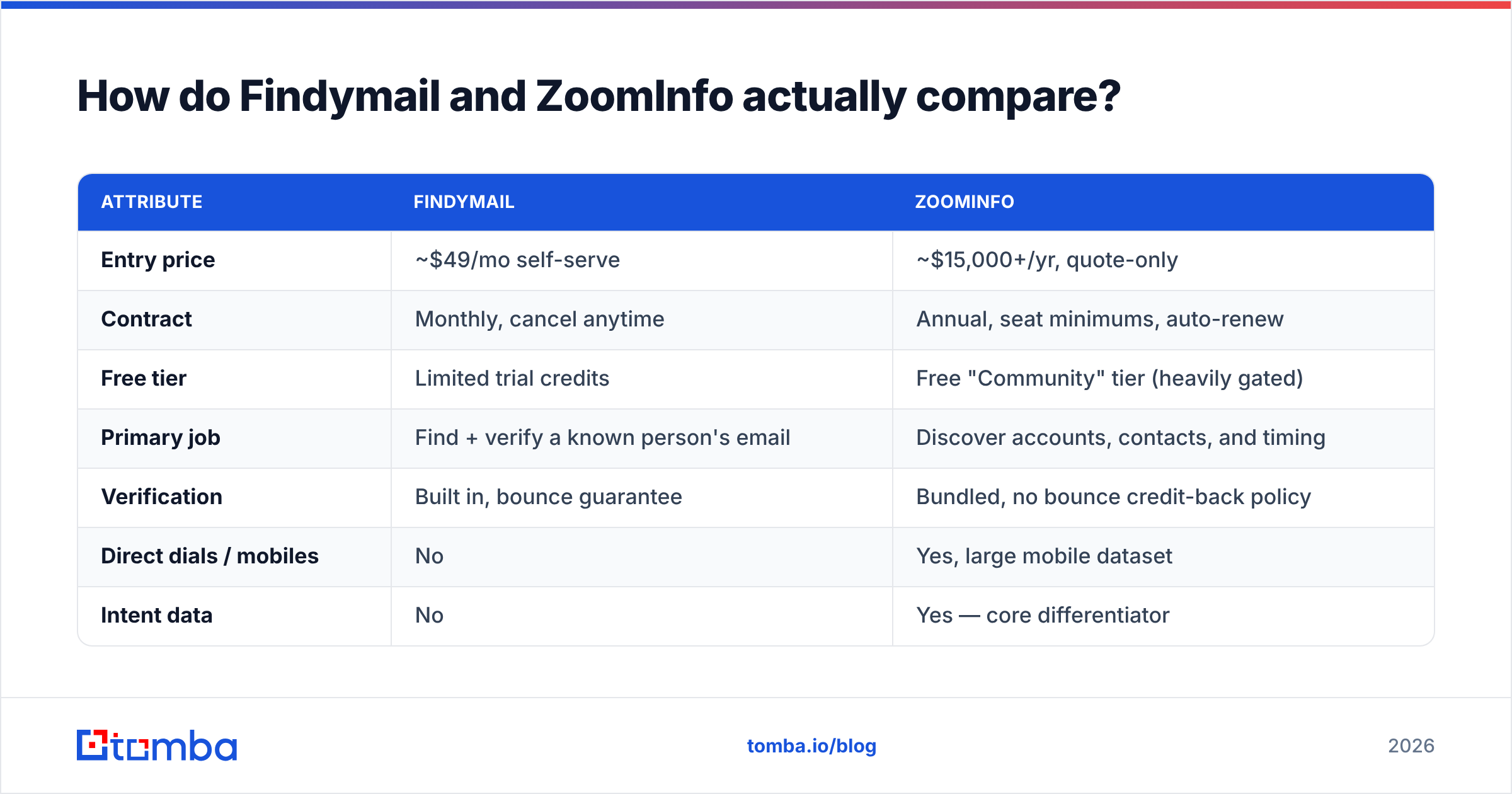
Findymail's edge comes from how it works, not how big it is. It verifies at lookup time and refunds bounced credits. So it has a money reason to say "not found" instead of guessing. In practice, teams report bounce rates of 1-3% on Findymail-sourced lists. The cost is coverage. On small companies, non-US markets, and catch-all domains, it comes back empty more often than a database that guesses.
ZoomInfo's story is about breadth and age. The database is huge. It includes contact types Findymail doesn't touch, such as direct dials, mobile numbers, and seniority data. But a database that big decays. B2B contact data goes stale by roughly 25-30% a year through job changes alone. The most common complaint in ZoomInfo reviews is records for people who left months ago. ZoomInfo does re-verify. At 100M+ records, though, the refresh cycle can't be constant.
Four practical rules, whichever you pick:
- Never send to an unverified list. Pass every source through an independent email verifier first. Two checks cost pennies. A blocked domain costs weeks.
- Treat catch-all domains separately. Roughly 15-20% of B2B domains accept every address. That defeats normal checks. A catch-all verifier uses pattern confidence instead.
- Re-verify anything older than 90 days. A list you pulled last quarter is already 6-8% wrong. That applies to ZoomInfo exports sitting in Salesforce too.
- Sample before you commit. Ask any vendor for 50 records against your ICP. Check them yourself. Vendor accuracy numbers are marketing numbers.
Is ZoomInfo worth the price premium?#
Sometimes. And the deciding factor is almost never data quality.
ZoomInfo earns its price when you need things Findymail can't provide:
- Intent data. Long sales cycle in a crowded category? Knowing who is shopping is worth real money. Nothing under $100/month copies this.
- Buying committee mapping. Enterprise deals need 6-10 stakeholders named. ZoomInfo's org data does that. An email finder does not.
- CRM cleanup at scale. Got 200,000 stale records in Salesforce? ZoomInfo Operations is a real fix for a real problem.
- Phone-heavy motions. ZoomInfo's mobile dataset is a genuine asset for teams that still dial. Findymail has no phone product.
ZoomInfo is a bad buy when:
- Your list is already known. If you can name your 500 target accounts, you need contact data, not a discovery engine. That's a $50/month problem.
- You're under 10 reps. Seat minimums and annual terms punish small teams.
- Your motion is email-only. You'd pay for Chorus, Engage, mobiles, and intent while using maybe 15% of it.
- You can't absorb the renewal risk. Auto-renewal is the top complaint in ZoomInfo reviews. Read the termination window first.
Here's a gut check from HubSpot's sales research. Does the platform cost more than one extra closed deal is worth in year one? Then the burden of proof sits with the platform.
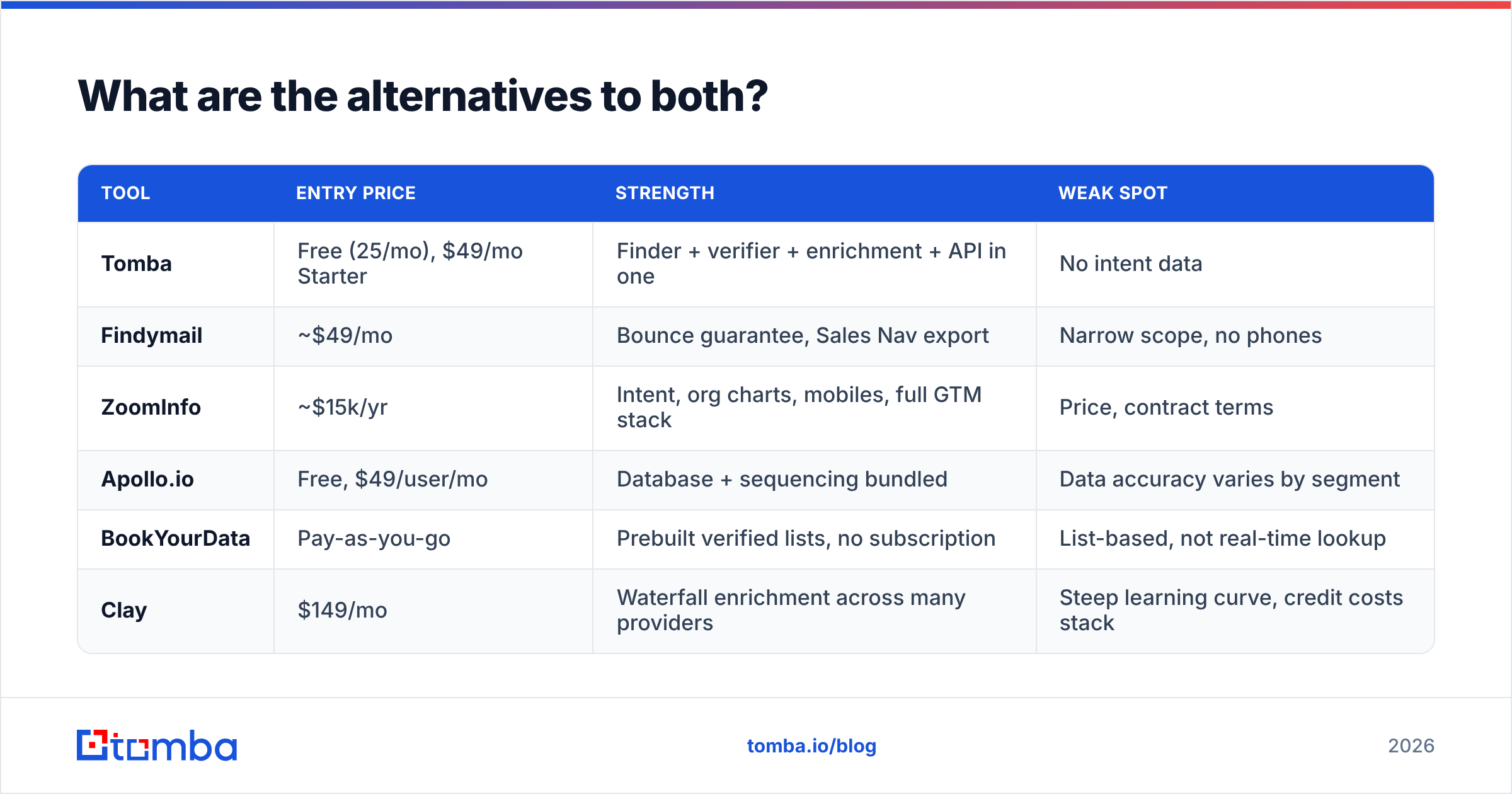
What are the alternatives to both?#
Most teams land somewhere in the middle, and the middle is crowded.
| Tool | Entry price | Strength | Weak spot |
|---|---|---|---|
| Tomba | Free (25/mo), $49/mo Starter | Finder + verifier + enrichment + API in one | No intent data |
| Findymail | ~$49/mo | Bounce guarantee, Sales Nav export | Narrow scope, no phones |
| ZoomInfo | ~$15k/yr | Intent, org charts, mobiles, full GTM stack | Price, contract terms |
| Apollo.io | Free, $49/user/mo | Database + sequencing bundled | Data accuracy varies by segment |
| BookYourData | Pay-as-you-go | Prebuilt verified lists, no subscription | List-based, not real-time lookup |
| Clay | $149/mo | Waterfall enrichment across many providers | Steep learning curve, credit costs stack |
The waterfall approach deserves a mention. Tools like Clay chain data providers together. If provider A misses, it tries B, then C. You pay only for the hit. It's the best coverage you can buy. It also adds build-and-maintain work that most 3-person teams underestimate.
Want breadth without the enterprise ticket? The practical stack is simple. Use a credit-based finder for contact data, a B2B database for list building, and a light intent or website-visitor tool. That combination lands under $300/month. It covers maybe 80% of ZoomInfo, minus the org charts and the mobile dataset.
How should you actually decide?#
The Findymail vs ZoomInfo call comes down to the job, not the feature grid. Run this sequence instead of booking two demos.
- Write down the job. "Find emails for a list I have" and "figure out who to sell to" are different jobs. Only the second needs a platform.
- Count your reps. Under 10, self-serve tooling wins on cost. Over 25, stitching point tools together costs more than a license.
- Test on your ICP, not theirs. Pull 100 contacts from your real target segment. Measure hit rate and bounce rate yourself.
- Price the full year. Include onboarding, seat count, and overage credits. Compare annual totals, not sticker prices.
- Read the exit clause. Find the cancellation window before you find the discount. This is what generates the angriest reviews.
- Check integration depth. "Integrates with Salesforce" can mean a native sync or a Zapier webhook. Check the integrations list.
One more thing teams skip: data compliance. Selling into the EU? Confirm the vendor's GDPR posture before your list touches a sending tool. Both vendors publish documentation. Read it instead of trusting a sales rep's summary.
Findymail vs ZoomInfo: which should you pick in 2026?#
Pick Findymail if you're a founder, agency, or small SDR team. You have a defined target list and an email-first motion. You need your sending domain to stay clean. The bounce guarantee is a real differentiator, and the pricing won't need budget approval.
Pick ZoomInfo if you run enterprise or upper-mid-market GTM. You need intent signals and buying-committee data. You dial as much as you email. You have RevOps capacity to run a platform. Negotiate hard, read the renewal terms, and demand a pilot.
Pick neither if you need broad contact coverage at self-serve pricing. That describes most teams asking this question. A finder with built-in verification, bulk processing, and a clean API covers the daily work. No five-figure commitment, no procurement cycle.
That's the gap Tomba was built for. The Tomba Email Finder returns verified professional emails by name, domain, or company. Verification, catch-all handling, and enrichment sit in the same workflow. It's free for your first 25 searches a month, $49/mo on Starter, and $99/mo on Growth. No annual contract, no seat minimum, no procurement call. Run 100 real prospects through it, then compare the hit rate against whatever quote you're holding.
Related guides#
Ready to find emails that actually work?
Join 150,000+ professionals who stopped guessing and started sending. Free credits on signup — no credit card required.
Get the Tomba newsletter
Practical outbound tactics and product updates — once every two weeks.
About the author