Fintech Go To Market Strategy: The 2026 Operator's Playbook
Most fintech GTM plans die on compliance review, not on positioning. Here's how the teams that actually hit revenue targets in 2026 sequence ICP, channel, pricing, and proof.
TL;DR
- Fintech GTM fails at the sequence, not the strategy. Teams pick a channel before they've defined which regulated buyer can actually sign.
- Your ICP in fintech has three layers: the economic buyer, the compliance blocker, and the integration owner. Miss any one and the deal stalls at 80%.
- PLG works for fintech infrastructure and SMB tools. It rarely works for anything touching balance-sheet risk, KYC/AML, or core banking — those need outbound plus a named-account motion.
- Sales cycles run 3–9 months for mid-market fintech and 9–18 months for bank/enterprise. Model your CAC payback against that, not against a SaaS benchmark.
- The unglamorous edge: accurate contact data on a narrow list beats a broad list every time. 200 verified compliance-officer emails outperform 20,000 scraped ones.
What makes a fintech go to market strategy different from SaaS GTM?#
Three things: regulated buyers, integration weight, and trust-before-transaction.
A standard B2B SaaS deal has one or two decision-makers and a credit card. A fintech deal — payments infrastructure, lending software, treasury tooling, embedded finance, KYC/AML platforms — routinely involves a compliance officer, a CISO, a head of risk, a procurement team, and sometimes an external auditor. None of them can say yes. All of them can say no.
That asymmetry is the whole game. Your GTM plan needs to be built around unblocking rather than persuading.
The second difference is integration weight. Selling a project-management tool means asking for a browser tab. Selling a payments rail or ledger means asking an engineering team to rip out something that currently works and touches money. The switching cost isn't the subscription price — it's six weeks of a senior engineer's time plus the risk of a failed reconciliation.
Third: trust precedes transaction. Buyers evaluate you on SOC 2 status, uptime history, funding stability, and who else in their peer set already uses you — often before they read your feature page. Your GTM assets must front-load proof, not features.
Sorry — that image should read:
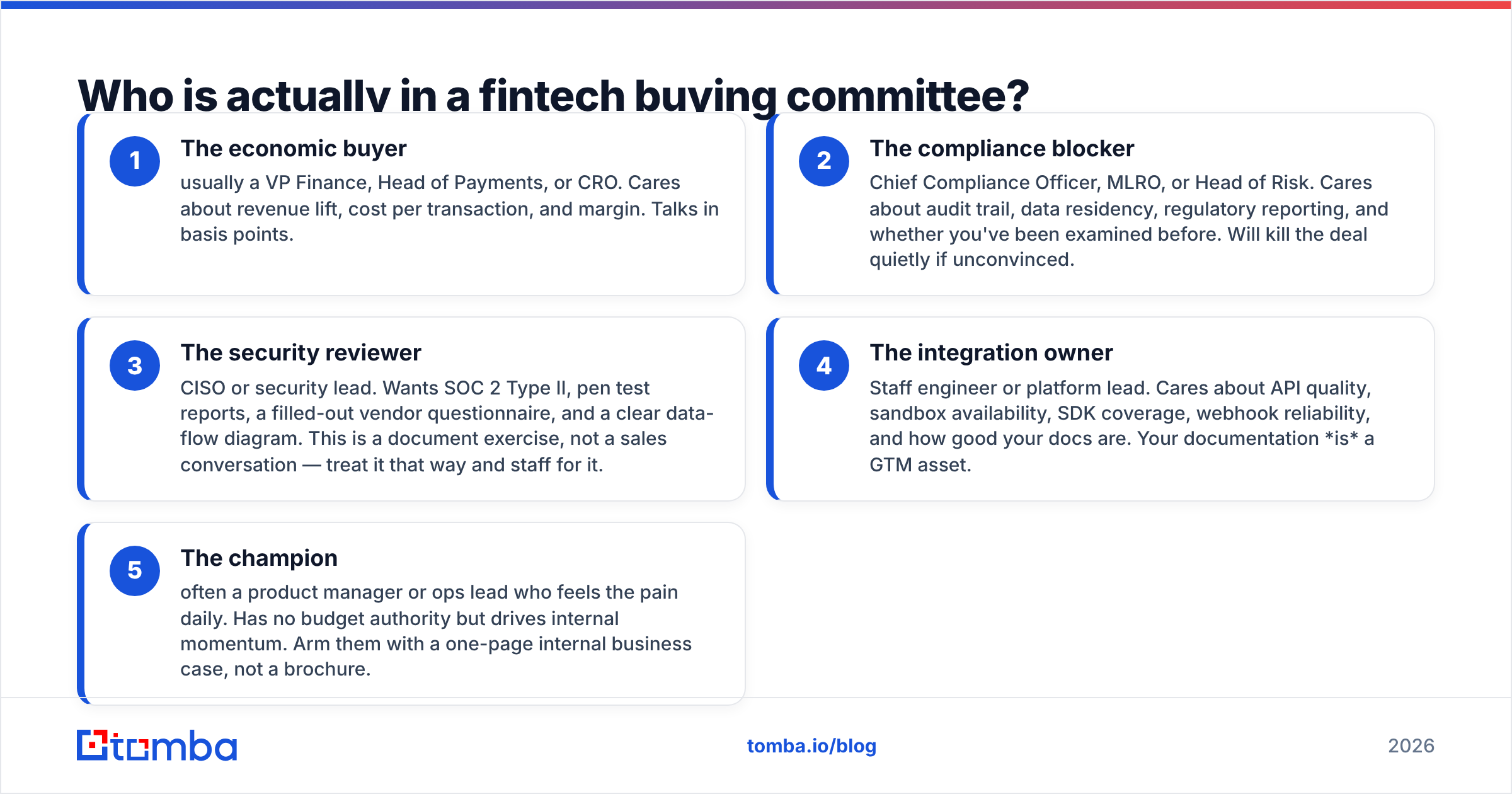
Who is actually in a fintech buying committee?#
Map these five roles before you write a single sequence. Each needs a different first message.
- The economic buyer — usually a VP Finance, Head of Payments, or CRO. Cares about revenue lift, cost per transaction, and margin. Talks in basis points.
- The compliance blocker — Chief Compliance Officer, MLRO, or Head of Risk. Cares about audit trail, data residency, regulatory reporting, and whether you've been examined before. Will kill the deal quietly if unconvinced.
- The security reviewer — CISO or security lead. Wants SOC 2 Type II, pen test reports, a filled-out vendor questionnaire, and a clear data-flow diagram. This is a document exercise, not a sales conversation — treat it that way and staff for it.
- The integration owner — Staff engineer or platform lead. Cares about API quality, sandbox availability, SDK coverage, webhook reliability, and how good your docs are. Your documentation is a GTM asset.
- The champion — often a product manager or ops lead who feels the pain daily. Has no budget authority but drives internal momentum. Arm them with a one-page internal business case, not a brochure.
The practical implication: your outbound list can't be one persona. You need multi-threaded contact data across at least three of these roles inside the same account, which is exactly where most teams' data quality collapses. Building that list is why a domain search approach — pulling every relevant contact at a target company — beats hunting one name at a time.
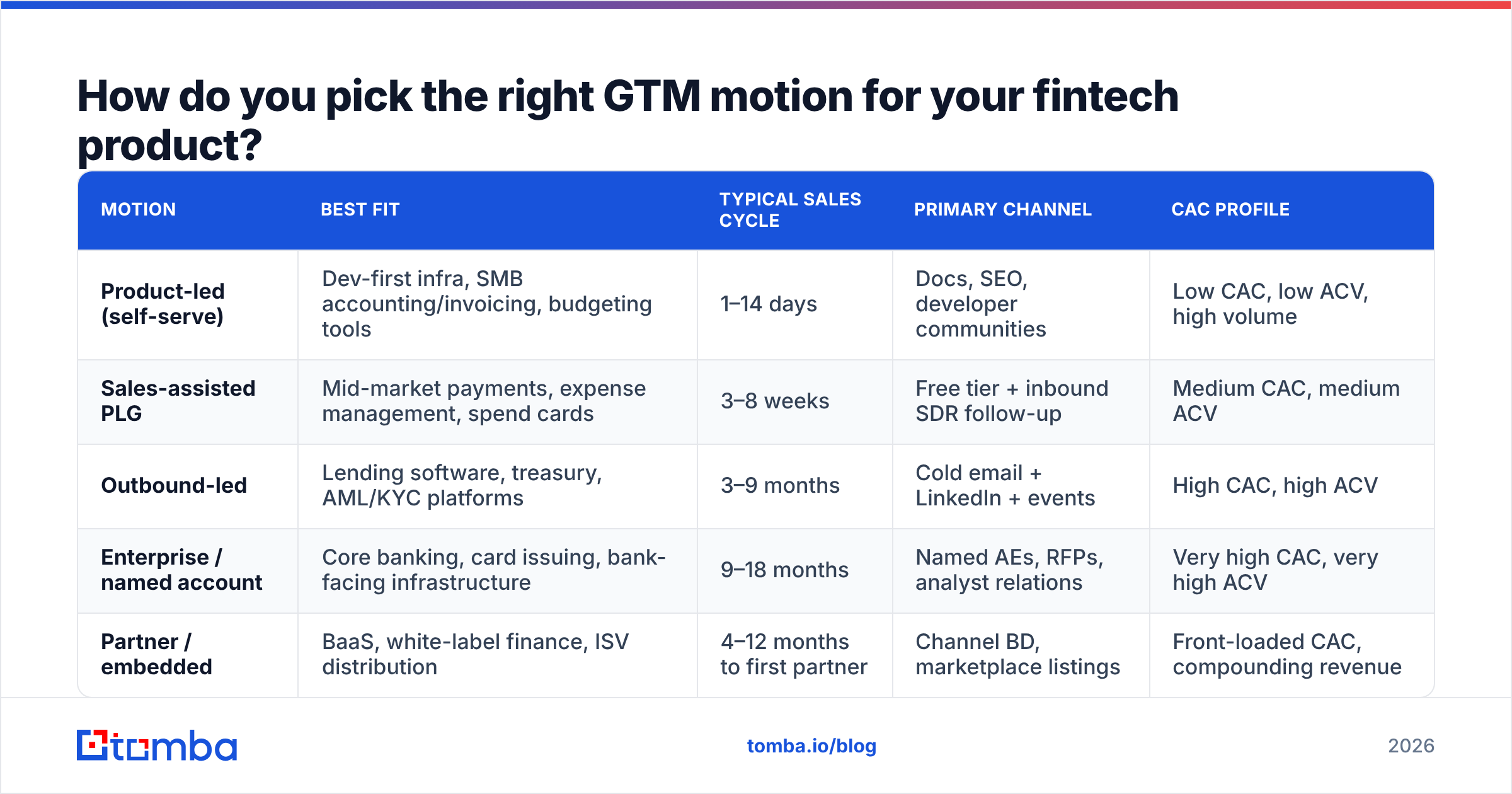
How do you pick the right GTM motion for your fintech product?#
The honest answer: your product's risk surface determines your motion. Not your preference, not your funding stage.
| Motion | Best fit | Typical sales cycle | Primary channel | CAC profile |
|---|---|---|---|---|
| Product-led (self-serve) | Dev-first infra, SMB accounting/invoicing, budgeting tools | 1–14 days | Docs, SEO, developer communities | Low CAC, low ACV, high volume |
| Sales-assisted PLG | Mid-market payments, expense management, spend cards | 3–8 weeks | Free tier + inbound SDR follow-up | Medium CAC, medium ACV |
| Outbound-led | Lending software, treasury, AML/KYC platforms | 3–9 months | Cold email + LinkedIn + events | High CAC, high ACV |
| Enterprise / named account | Core banking, card issuing, bank-facing infrastructure | 9–18 months | Named AEs, RFPs, analyst relations | Very high CAC, very high ACV |
| Partner / embedded | BaaS, white-label finance, ISV distribution | 4–12 months to first partner | Channel BD, marketplace listings | Front-loaded CAC, compounding revenue |
Most fintech companies run two of these simultaneously and pretend they're running one. That's fine — as long as you resource them separately. A PLG funnel and a named-account motion need different metrics, different comp plans, and different content.
The failure pattern: a Series A fintech with a $40k ACV product hires three SDRs, buys a sequencer, and blasts a 50,000-contact list. Three months later, reply rates are 0.4%, the domain is burned, and the compliance officer they needed to reach never saw an email because it went to a role-based inbox that bounced.
What does the GTM sequence look like, quarter by quarter?#
Sequence matters more than any individual tactic. Here's a workable 12-month build for a company moving from founder-led sales to a repeatable motion.
Quarter 1 — Narrow, don't broaden. Pick one segment (e.g., "US-based lenders originating $50M–$500M annually on legacy LOS"). Interview 20 of them. Write down the exact words they use for the problem. Ship a positioning page and one proof asset — a security overview or a compliance FAQ. Close 5–10 design partners at a discount in exchange for logos and references.
Quarter 2 — Instrument and prove. Build the vendor-security packet: SOC 2 report or roadmap, data-flow diagram, subprocessor list, DPA template, uptime page. This packet removes more friction than any sales deck. Simultaneously, stand up a clean outbound motion against 300–500 accounts, multi-threaded. Track meetings-per-100-accounts, not emails-sent.
Quarter 3 — Add a second channel. Whichever channel worked in Q2, add a complementary one. If outbound worked, add partner/marketplace distribution. If inbound worked, add outbound to look-alike accounts. Do not add three channels. Two is the limit for a team under 20 people.
Quarter 4 — Systematize. Write the playbook: ICP definition, qualification criteria, objection library (especially compliance objections), pricing guardrails, and the proof-asset index. Hire against the playbook, not ahead of it.
Why does fintech pricing break so often?#
Because fintech pricing has to survive two audiences at once: the buyer's finance team and your own unit economics.
Four models dominate, each with a specific failure mode:
- Per-transaction / bps. Aligns with customer value, scales with them, and is easy to say yes to. Failure mode: your revenue becomes hostage to their volume, and a bad quarter for them is a bad quarter for you. Also invites basis-point haggling on every renewal.
- Platform fee + usage. The most durable model. Predictable floor, upside from growth. Failure mode: the platform fee scares SMB buyers off before they see value — mitigate with a genuinely useful free or low tier.
- Per-seat. Familiar to procurement, easy to forecast. Failure mode: badly misaligned in fintech, where value often comes from automation that reduces seats. You end up penalizing the outcome you sell.
- Flat enterprise license. Clean for large deals. Failure mode: leaves enormous money on the table when the customer grows 5x, and creates painful renegotiations.
The pattern that works: a low-friction entry point that lets the integration owner prove the API works, then a value-based tier that scales with the metric the economic buyer already tracks. That's why so many infrastructure companies publish transparent pricing — including tools like Tomba pricing with a free tier at 25 searches per month and paid plans from $49/mo, so the evaluator can test before involving procurement. Removing the "book a demo to see pricing" gate is itself a GTM decision.
For a broader view on how pricing interacts with acquisition cost, Gartner's B2B buying research is worth reading — it documents how much of the buying journey now happens before a vendor conversation.
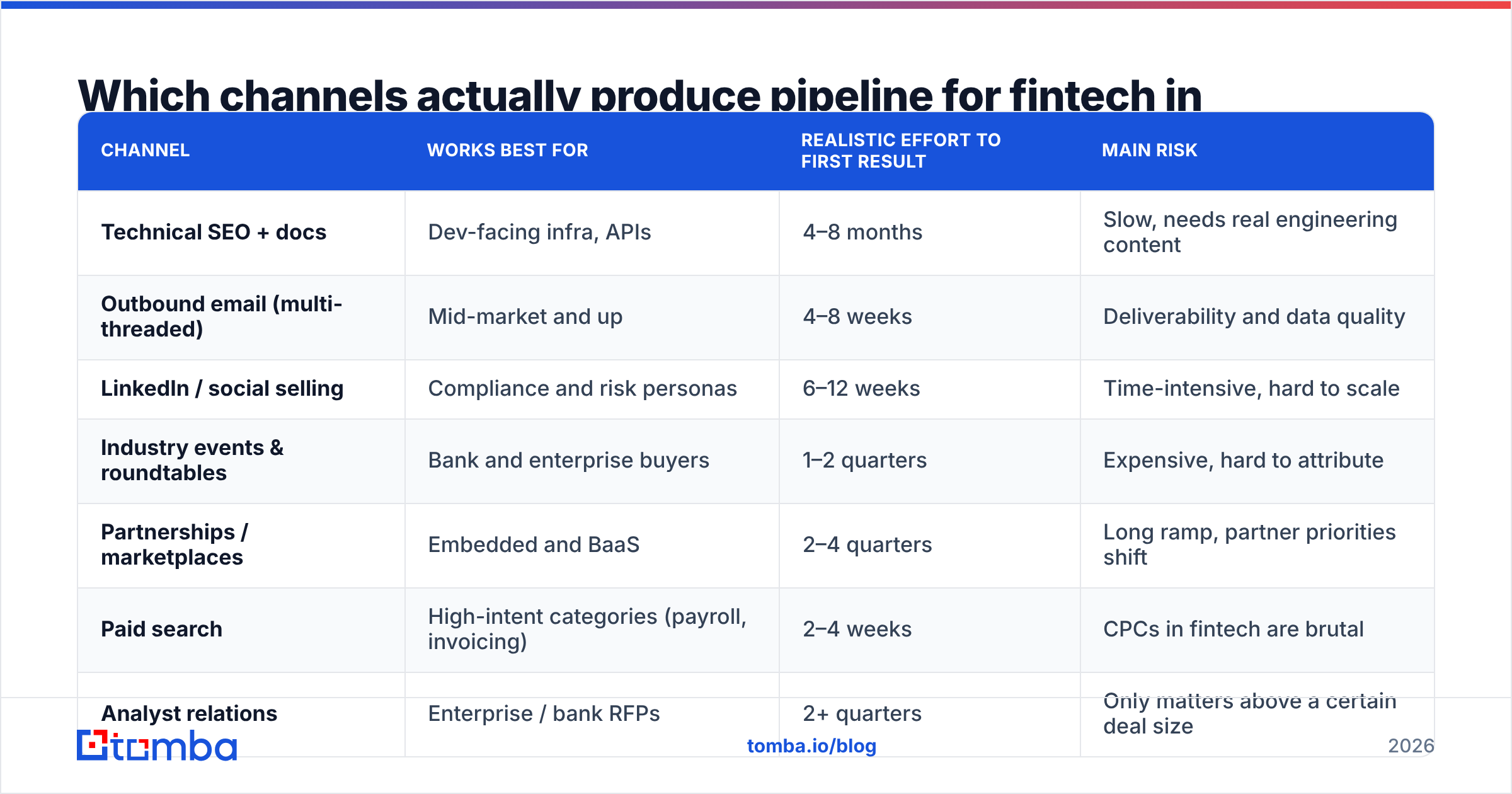
Which channels actually produce pipeline for fintech in 2026?#
Ranked by what we see working, with honest caveats:
| Channel | Works best for | Realistic effort to first result | Main risk |
|---|---|---|---|
| Technical SEO + docs | Dev-facing infra, APIs | 4–8 months | Slow, needs real engineering content |
| Outbound email (multi-threaded) | Mid-market and up | 4–8 weeks | Deliverability and data quality |
| LinkedIn / social selling | Compliance and risk personas | 6–12 weeks | Time-intensive, hard to scale |
| Industry events & roundtables | Bank and enterprise buyers | 1–2 quarters | Expensive, hard to attribute |
| Partnerships / marketplaces | Embedded and BaaS | 2–4 quarters | Long ramp, partner priorities shift |
| Paid search | High-intent categories (payroll, invoicing) | 2–4 weeks | CPCs in fintech are brutal |
| Analyst relations | Enterprise / bank RFPs | 2+ quarters | Only matters above a certain deal size |
Two notes on outbound, because it's where most fintech teams spend money badly.
First, deliverability is a GTM constraint, not an IT detail. If your sending domain is unhealthy, none of your positioning matters because nobody reads it. Warm your domains, keep bounce rates under 2%, authenticate properly, and check your email deliverability fundamentals before you scale volume. A single bad list can cost you a quarter.
Second, list quality beats list size by a wide margin in regulated categories. Compliance officers and heads of risk are not on every database. They change roles frequently. Their email patterns differ from the sales-team pattern at the same company. Running your target list through an email verifier before the first send is the cheapest insurance in your entire GTM budget.

How should you measure a fintech GTM strategy?#
Standard SaaS dashboards mislead in fintech because the cycle length distorts everything. Track these instead:
- Meetings per 100 target accounts — not emails sent, not open rate. This is the only top-of-funnel number that survives contact with reality.
- Compliance-review pass rate — what percentage of deals that reach security review actually clear it, and how long it takes. If this is under 60% or over 45 days, fix your security packet before you hire another AE.
- Multi-threading depth — average number of contacts engaged per open opportunity. Below 3 in fintech, your win rate collapses when your champion leaves.
- Time-to-first-transaction (for usage-based models) — the real activation metric. A signed contract that never processes volume is not revenue.
- CAC payback against actual cycle length — if your cycle is 7 months and you're modeling 12-month payback, you're funding a gap you haven't budgeted for.
- Logo-to-reference ratio — how many customers will take a reference call. In fintech, references close deals that content cannot.
Worth benchmarking your category against peer reviews on G2 — not for vanity, but because your enterprise buyers genuinely check them during vendor shortlisting.
What are the most common fintech GTM mistakes?#
Selling the feature instead of the risk reduction. Your buyer is not excited about your reconciliation engine. They're excited about not explaining a variance to their auditor. Rewrite every headline from that angle.
Hiring AEs before the playbook exists. Founder-led sales isn't a phase to escape — it's the research that produces the playbook. Ship 15–20 closed deals yourself first. You'll learn which objection kills deals and what evidence defuses it.
Treating compliance as sales' problem. Compliance objections are a content problem. Build the security packet, the data-residency FAQ, the subprocessor list, and the DPA template once, then hand them to everyone. The best fintech GTM teams have a dedicated "trust center" page and treat it like a top-three landing page.
Ignoring the integration owner. If your docs are bad, your deal dies in a Slack thread you'll never see. Fund developer documentation as a marketing line item.
Scaling outbound on dirty data. This is the most fixable mistake on the list. Build a narrow account list, find the three relevant roles at each account, verify before sending, and refresh the list quarterly. Tools that combine find email addresses with verification in one pass — and peers like BookYourData, which offers pre-verified B2B lists for teams that prefer buying over building — both solve the same underlying constraint from different angles. Pick whichever matches how your team works.
Chasing enterprise logos too early. A bank pilot can consume two quarters of engineering for $60k and a logo. Sometimes that's the right trade. Usually, at Series A, it isn't. Be honest about which one you're doing.
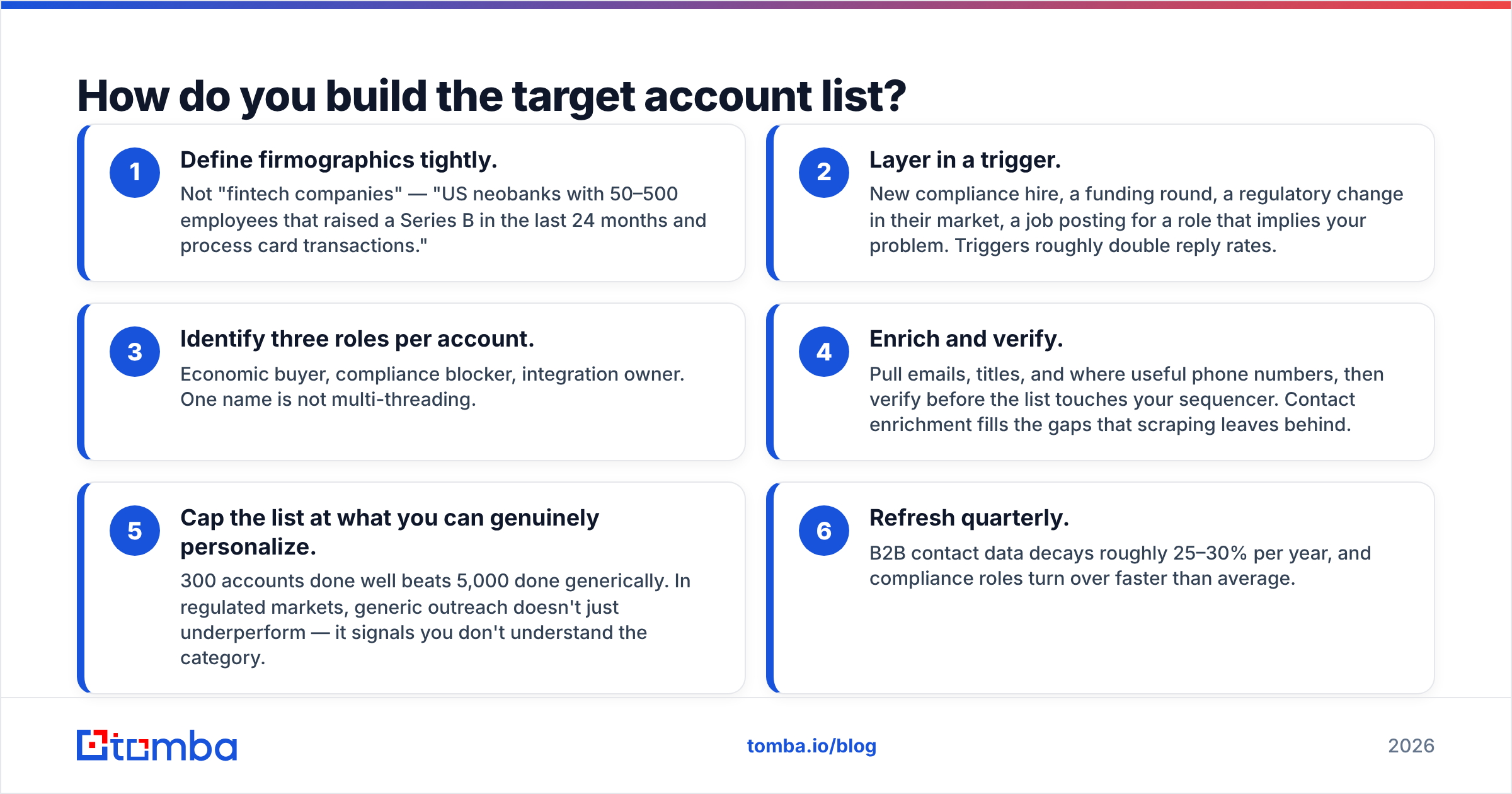
How do you build the target account list?#
Start narrow enough that the list feels uncomfortably small.
- Define firmographics tightly. Not "fintech companies" — "US neobanks with 50–500 employees that raised a Series B in the last 24 months and process card transactions."
- Layer in a trigger. New compliance hire, a funding round, a regulatory change in their market, a job posting for a role that implies your problem. Triggers roughly double reply rates.
- Identify three roles per account. Economic buyer, compliance blocker, integration owner. One name is not multi-threading.
- Enrich and verify. Pull emails, titles, and where useful phone numbers, then verify before the list touches your sequencer. Contact enrichment fills the gaps that scraping leaves behind.
- Cap the list at what you can genuinely personalize. 300 accounts done well beats 5,000 done generically. In regulated markets, generic outreach doesn't just underperform — it signals you don't understand the category.
- Refresh quarterly. B2B contact data decays roughly 25–30% per year, and compliance roles turn over faster than average.
For the operational side of running this in a repeatable way, HubSpot's research on sales prospecting has solid data on cadence and touch counts that generalizes reasonably well to fintech.
Putting it together#
A fintech go to market strategy is mostly a sequencing problem wearing a positioning costume. Narrow the segment until it's specific enough to name individual companies. Map the buying committee's three blockers. Build the proof assets that unblock them. Pick one motion that matches your product's risk surface, add a second only after the first works, and measure against your real cycle length rather than a generic SaaS benchmark.
The part nobody puts in the deck: none of it runs without accurate contact data. Multi-threaded outreach into regulated buying committees requires knowing the actual email of the actual compliance officer at the actual account — not a guess, not a role-based inbox, not a contact who left 14 months ago.
That's the gap Tomba Email Finder closes. Search by domain to pull every relevant contact at a target account, verify before you send so your deliverability survives the quarter, and start on the free tier at 25 searches per month before committing to a paid plan. Build the narrow list properly, and the rest of your GTM strategy finally gets a chance to work.
Related guides#
Ready to find emails that actually work?
Join 150,000+ professionals who stopped guessing and started sending. Free credits on signup — no credit card required.
Get the Tomba newsletter
Practical outbound tactics and product updates — once every two weeks.
About the author