Fintech Lead Generation: The 2026 Playbook That Works
Fintech buyers sit behind compliance reviews, procurement gates, and inboxes filtered to death. Here is how the pipelines that actually close get built in 2026 — channels, data, and the numbers behind each.
TL;DR
- Fintech lead generation fails for a structural reason, not a creative one: your buyer is a risk-averse committee (CFO, Head of Compliance, CISO, VP Engineering) with a 6-11 month cycle and a legal veto on every vendor.
- Channel economics differ wildly. Outbound email to verified, role-matched contacts still returns the lowest cost per qualified meeting in most fintech segments; paid search on "payment orchestration" style terms routinely costs $40-90 per click.
- Data quality is the hinge. Fintech has brutal contact churn — compliance and risk roles turn over fast — so a list bought in Q1 is measurably worse by Q3.
- Compliance-first content (SOC 2 posture, PCI DSS scope reduction, model risk documentation) converts better than generic "grow your revenue" content because it de-risks the internal champion.
- Build the stack around verified contact data, a compliance-aware sequence, and a scoring model that weighs regulatory triggers — not around another sequencing tool.
What is fintech lead generation, and why is it different?#
Fintech lead generation is the process of identifying, contacting, and qualifying buyers at financial-services and financial-infrastructure companies — banks, credit unions, payment processors, lenders, insurers, wealth platforms, crypto custodians, and the vendors selling into them.
Here is the analogy: selling most B2B SaaS is like selling a nice office chair. Someone likes it, expenses it, done. Selling into fintech is like selling a replacement part for a plane mid-flight. The buyer wants it. The buyer also has to prove to a regulator, an auditor, and an internal risk committee that installing it will not bring the plane down.
That difference shows up in four measurable ways:
- Longer cycles. Enterprise fintech deals commonly run 6-11 months from first touch to signature, with security review alone eating 4-8 weeks.
- Bigger committees. Expect 6-10 people involved. Your economic buyer rarely has unilateral authority; compliance and security hold hard vetoes.
- Heavier gatekeeping on contact data. Financial institutions strip staff directories, use catch-all mail servers, and rotate roles frequently. Guessed email patterns fail more often here than in almost any other vertical.
- Regulatory triggers replace "pain points." A new rule, an examination finding, a failed audit, or a partner-bank mandate creates urgency far faster than a feature gap does.
If your playbook does not account for those four, you are running SaaS lead gen with a fintech logo on the deck.
Which channels actually produce fintech pipeline in 2026?#
Different channels solve different parts of the problem. The mistake is treating them as interchangeable and grading them all on the same metric.
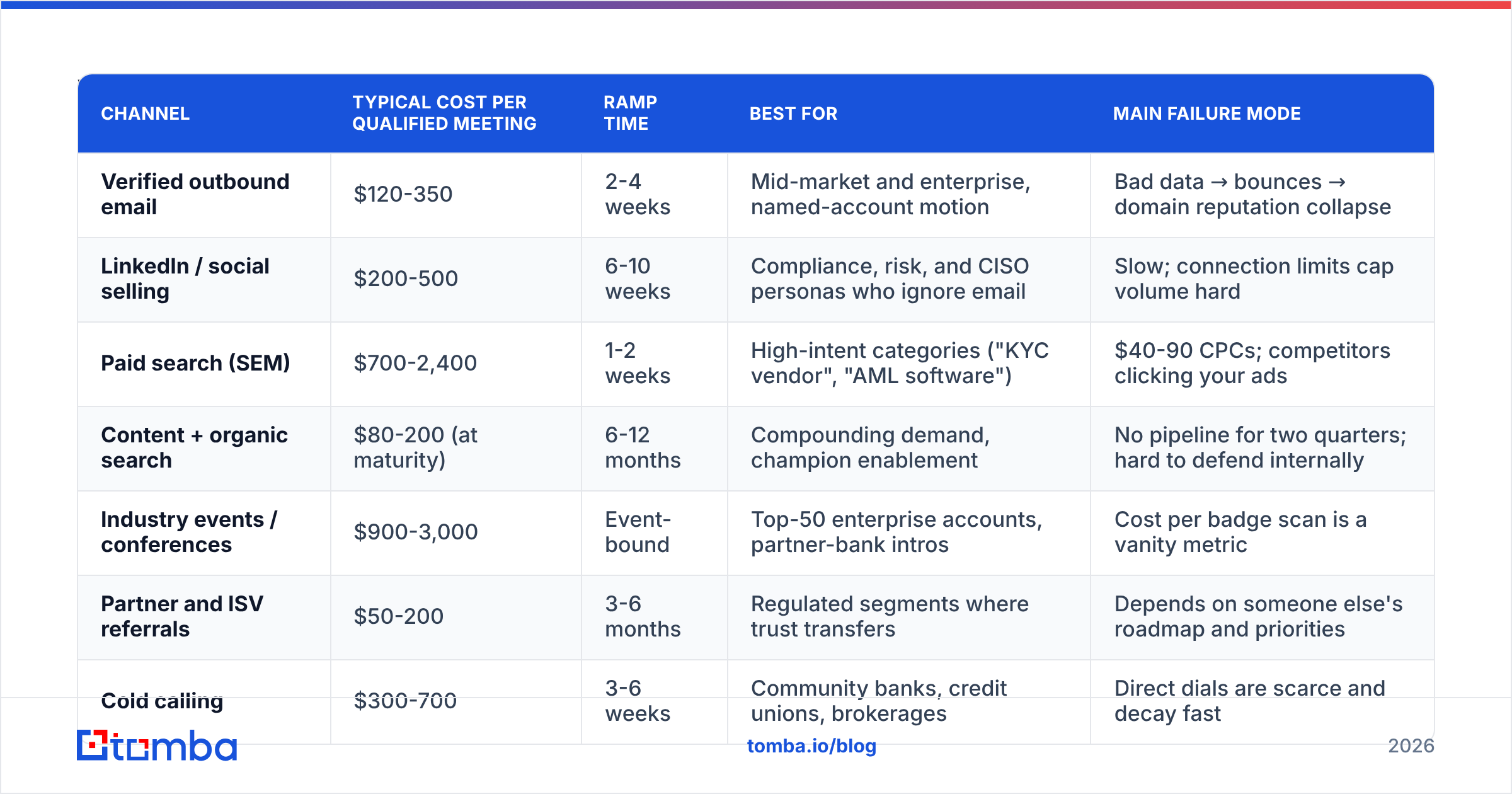
| Channel | Typical cost per qualified meeting | Ramp time | Best for | Main failure mode |
|---|---|---|---|---|
| Verified outbound email | $120-350 | 2-4 weeks | Mid-market and enterprise, named-account motion | Bad data → bounces → domain reputation collapse |
| LinkedIn / social selling | $200-500 | 6-10 weeks | Compliance, risk, and CISO personas who ignore email | Slow; connection limits cap volume hard |
| Paid search (SEM) | $700-2,400 | 1-2 weeks | High-intent categories ("KYC vendor", "AML software") | $40-90 CPCs; competitors clicking your ads |
| Content + organic search | $80-200 (at maturity) | 6-12 months | Compounding demand, champion enablement | No pipeline for two quarters; hard to defend internally |
| Industry events / conferences | $900-3,000 | Event-bound | Top-50 enterprise accounts, partner-bank intros | Cost per badge scan is a vanity metric |
| Partner and ISV referrals | $50-200 | 3-6 months | Regulated segments where trust transfers | Depends on someone else's roadmap and priorities |
| Cold calling | $300-700 | 3-6 weeks | Community banks, credit unions, brokerages | Direct dials are scarce and decay fast |
Two readings of that table matter more than the individual numbers.
First, verified outbound email and partner referrals share the lowest cost per meeting — but for opposite reasons. Outbound is cheap because you control volume. Referrals are cheap because trust is pre-loaded. Run both.
Second, paid search is not a lead gen channel in fintech; it is a capture channel. Someone typing "AML transaction monitoring software" is already in an evaluation you did not start. That is worth paying for, but it will never scale into a pipeline engine at those CPCs. Budget it as demand capture, not demand creation.

Why does contact data break fintech outbound faster than anywhere else?#
Because financial institutions are structurally hostile to the assumptions email-finding shortcuts rely on.
Catch-all servers are everywhere. Large banks and processors configure mail servers to accept everything, so a naive SMTP check returns "valid" for asdfgh@bigbank.com. You send 2,000 emails, get zero bounces, and quietly land 40% of them in a black hole. This is why a real catch-all verifier matters more in fintech than in any other vertical — you need a system that distinguishes "accepted" from "deliverable."
Role churn is fast. Compliance officers, BSA/AML analysts, and risk managers move frequently, often between competing institutions. A contact list built in January has meaningfully decayed by the time you run your Q3 campaign. Treat data freshness as a recurring cost, not a one-time purchase.
Pattern guessing underperforms. Consumer-tech companies mostly use first@domain.com. Financial institutions are older, have merged repeatedly, and carry legacy domains from acquisitions — f.lastname@, firstname.lastname@, flast@, plus subsidiary domains that never got consolidated. An email permutator helps you enumerate candidates, but you still need verification to pick the live one.
Reputation punishes you harder. Recipients at financial institutions report aggressively, and their security teams run inbound filtering that is stricter than the average company's. One bad send list can put your domain in a hole that takes months to climb out of.
The practical response is simple and non-negotiable: verify before you send, re-verify before every major campaign, and never mail a list older than 90 days without a refresh pass. Run your list through an email verifier and drop anything that is not confidently deliverable. A 3% bounce rate is the ceiling; past that, Google and Microsoft start throttling you, and email deliverability becomes the only problem you have.
How do you build a fintech prospect list that holds up?#
Work from firmographics plus regulatory signals. Firmographics alone will hand you a list of banks. Regulatory signals tell you which banks have a reason to answer this quarter.
- Define the regulated segment precisely. "Fintech" is not a segment. "US credit unions with $500M-$5B in assets running Fiserv core" is a segment. Precision here doubles reply rates because it makes personalization mechanical instead of creative.
- Layer a trigger. New charter application, a published enforcement action, a partner-bank change, a new Chief Compliance Officer, a Series B raise, a job posting for a BSA analyst, or a newly announced product launch. Triggers are what convert a cold list into a warm one.
- Map the buying committee before you touch the inbox. Identify the champion (usually an operator: Head of Payments, Director of Compliance Ops), the economic buyer (CFO/COO), and the vetoers (CISO, General Counsel). Sequence the champion first — never open with the vetoer.
- Source contacts by domain, not by name. Start from the institution's domain and pull the roles you need. A domain search returns the live addresses and the dominant email pattern for that org, which is far more reliable than guessing per person.
- Verify and enrich in one pass. Attach title, seniority, department, LinkedIn profile, and a direct dial where possible. Data enrichment at list-build time is cheaper than an SDR discovering mid-sequence that the contact left eight months ago.
- Cap the list and refresh it. 400 well-verified, well-triggered accounts beat 8,000 scraped rows. In fintech, list size is inversely correlated with reply rate almost every time.
For teams doing this at volume, run it through a bulk email finder rather than one lookup at a time, or wire the Tomba API into whatever builds your account lists so enrichment happens at ingest instead of as a manual chore.
What does a compliance-aware outbound sequence look like?#
The core insight: your email is not asking someone to buy. It is asking someone to take a risk on your behalf, internally. Write to reduce that risk.
What underperforms in fintech:
- Generic ROI claims ("increase conversions 40%") — every vendor says this, and compliance does not care about conversions.
- Aggressive urgency and fake scarcity — reads as unserious to a regulated buyer.
- Long feature lists — the champion cannot forward a feature list to their risk committee.
- Name-dropping unnamed "leading banks" — either name them with permission or do not imply them.
What outperforms:
- Regulatory specificity. Reference the actual rule, exam expectation, or standard your product addresses. "PCI DSS 4.0 scope reduction" beats "better payment security."
- Proof artifacts up front. SOC 2 Type II, penetration test summary, data residency, subprocessor list. Offering these in email two removes a month from the cycle.
- Peer-institution framing. "Three credit unions in the $1-3B asset band" is concrete without breaching confidentiality.
- A forwardable asset. A one-page security overview or a model-risk documentation template gives the champion something to hand their committee. That is the actual conversion event.
- Short, plain sentences. Financial-services professionals read a lot of dense prose all day. Do not add to the pile.
A workable five-touch cadence over 18 days: value email → proof artifact → LinkedIn touch → short case reference → break-up with an asset attached. Keep every email under 120 words. Use a spam checker before launch — fintech recipients sit behind stricter filtering than average, and a single trigger word can kill an otherwise good campaign.

How should you score and route fintech leads?#
Standard demographic scoring undervalues the signals that actually predict a fintech close. Add a regulatory dimension.
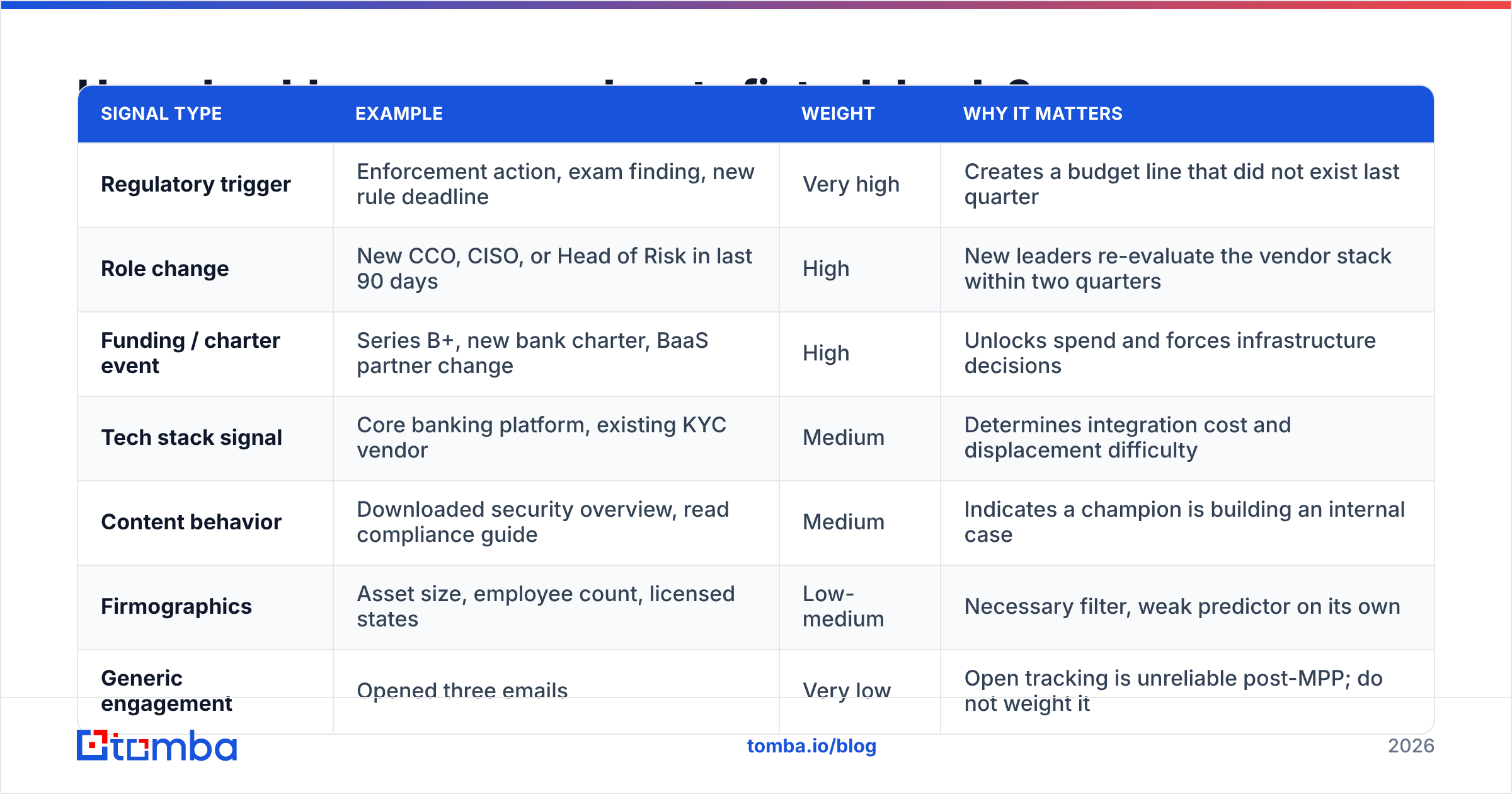
| Signal type | Example | Weight | Why it matters |
|---|---|---|---|
| Regulatory trigger | Enforcement action, exam finding, new rule deadline | Very high | Creates a budget line that did not exist last quarter |
| Role change | New CCO, CISO, or Head of Risk in last 90 days | High | New leaders re-evaluate the vendor stack within two quarters |
| Funding / charter event | Series B+, new bank charter, BaaS partner change | High | Unlocks spend and forces infrastructure decisions |
| Tech stack signal | Core banking platform, existing KYC vendor | Medium | Determines integration cost and displacement difficulty |
| Content behavior | Downloaded security overview, read compliance guide | Medium | Indicates a champion is building an internal case |
| Firmographics | Asset size, employee count, licensed states | Low-medium | Necessary filter, weak predictor on its own |
| Generic engagement | Opened three emails | Very low | Open tracking is unreliable post-MPP; do not weight it |
Two routing rules follow from this:
- Any regulatory trigger goes to a human within 24 hours. These have the shortest half-life of any signal in the vertical.
- Compliance-content readers get nurture, not a call. They are building an internal case. Interrupting with a demo request resets their process. Send them the next artifact instead.
If you are formalizing this, it helps to align on shared definitions of a marketing qualified lead between marketing and sales before you argue about lead quality for the third quarter running.
What should the fintech lead gen stack look like?#
You need four layers. Most teams over-buy layer three and under-buy layer one, which is exactly backwards.
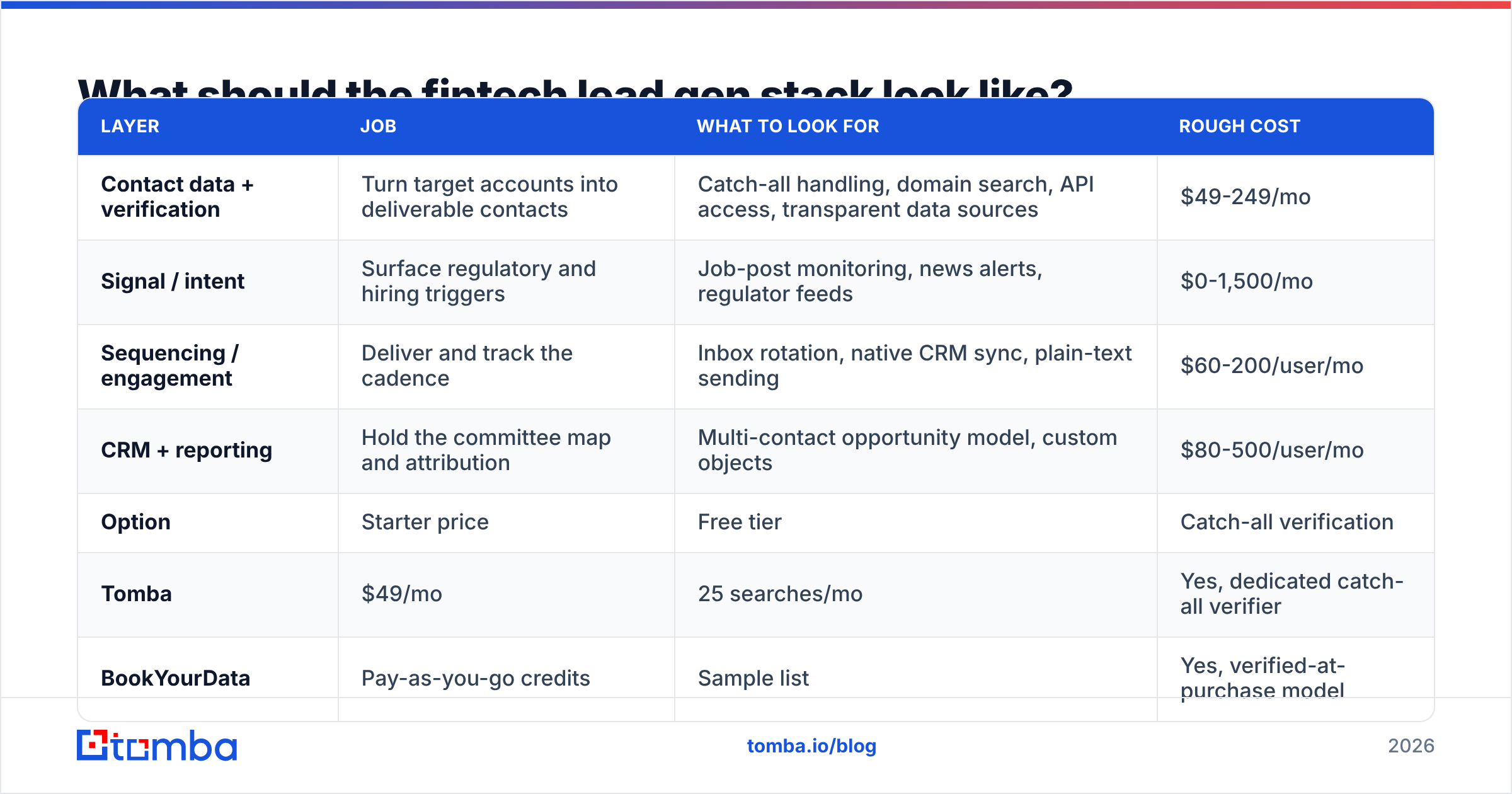
| Layer | Job | What to look for | Rough cost |
|---|---|---|---|
| Contact data + verification | Turn target accounts into deliverable contacts | Catch-all handling, domain search, API access, transparent data sources | $49-249/mo |
| Signal / intent | Surface regulatory and hiring triggers | Job-post monitoring, news alerts, regulator feeds | $0-1,500/mo |
| Sequencing / engagement | Deliver and track the cadence | Inbox rotation, native CRM sync, plain-text sending | $60-200/user/mo |
| CRM + reporting | Hold the committee map and attribution | Multi-contact opportunity model, custom objects | $80-500/user/mo |
On the data layer specifically, the honest comparison across common options:
| Option | Starter price | Free tier | Catch-all verification | Best fit |
|---|---|---|---|---|
| Tomba | $49/mo | 25 searches/mo | Yes, dedicated catch-all verifier | Teams wanting finder + verifier + API in one place |
| BookYourData | Pay-as-you-go credits | Sample list | Yes, verified-at-purchase model | Buyers who prefer owning a downloaded list outright |
| Apollo.io | ~$49/user/mo | Limited credits | Partial | All-in-one prospecting plus sequencing |
| ZoomInfo | Custom (annual) | No | Yes | Large enterprise with budget and procurement patience |
| Manual research | $0 | — | No | Fewer than 30 target accounts |
BookYourData's model — buy a filtered, pre-verified list and own it — genuinely suits teams that want a one-time asset rather than a subscription, and their fintech filtering is solid. Tomba's model suits teams that need continuous, API-driven lookups because their account list changes weekly. Pick based on whether your motion is a one-time build or a constant refresh; both are legitimate. Full Tomba pricing runs Free (25 searches/mo), Starter $49/mo, Growth $99/mo, Pro $249/mo, and Enterprise custom.
Before buying anything, check the vendor's own reviews on G2 or Capterra and read the actual data-sourcing page. In a regulated vertical, "where did this contact data come from" is a question your prospect's legal team may genuinely ask you.
What metrics should you actually hold the team to?#
Drop opens. Apple's Mail Privacy Protection made open rate noise years ago, and it is worse now.
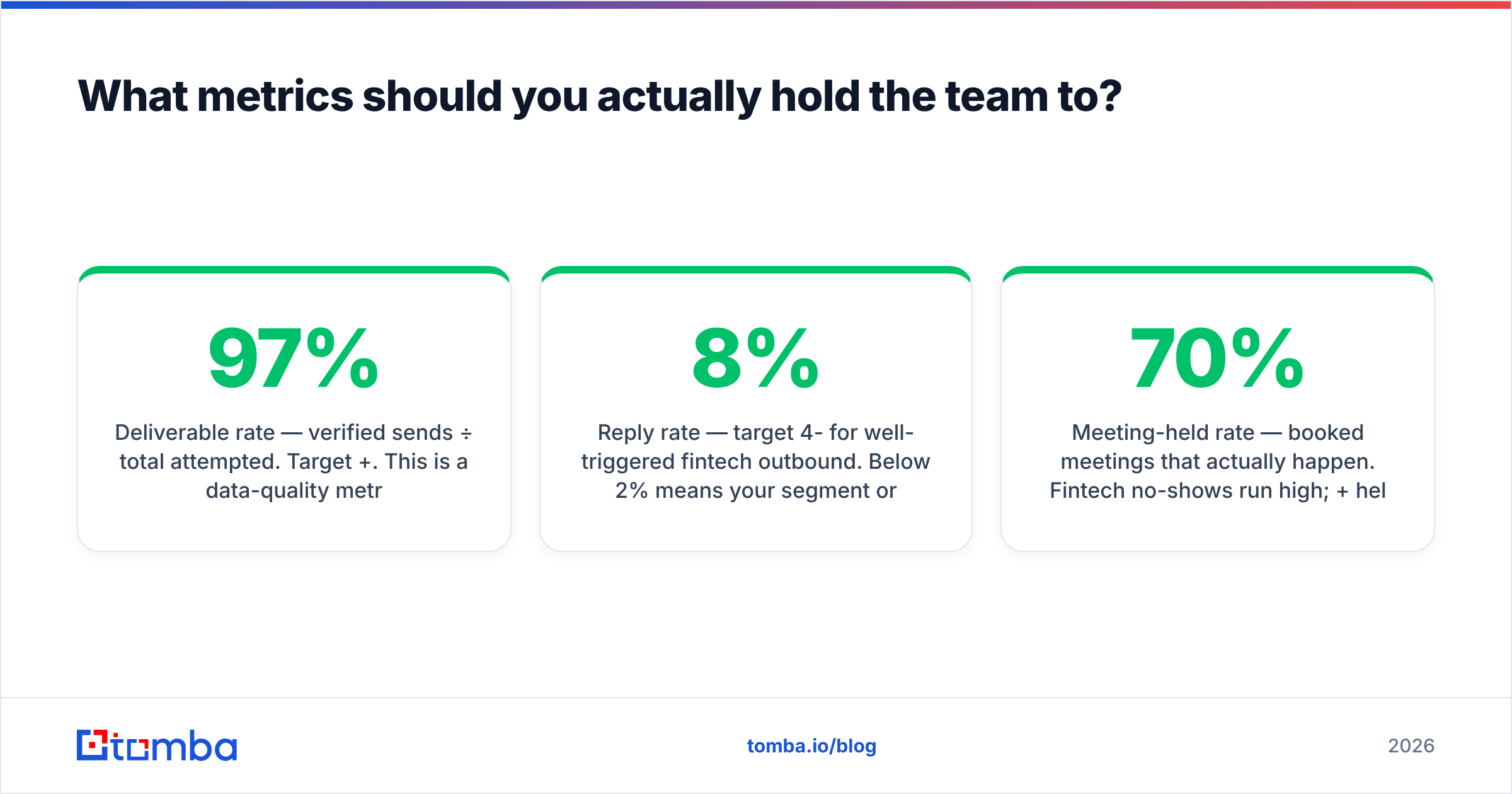
- Deliverable rate — verified sends ÷ total attempted. Target 97%+. This is a data-quality metric, not a sending metric.
- Reply rate — target 4-8% for well-triggered fintech outbound. Below 2% means your segment or trigger is wrong, not your copy.
- Meeting-held rate — booked meetings that actually happen. Fintech no-shows run high; 70%+ held is healthy.
- Security-review entry rate — the percentage of opportunities that reach vendor security review. This is the single most predictive mid-funnel metric in the vertical.
- Cost per qualified meeting — by channel, monthly. This is the number that should drive budget reallocation.
- Cycle length by segment — track community banks separately from enterprise processors. Blending them produces a meaningless average.
Track response rate by segment and trigger type, not just in aggregate. The aggregate number hides the fact that one segment is carrying the whole program.
What is the 90-day plan to get this running?#
Days 1-30 — foundation. Pick two precise segments. Build a 300-400 account target list per segment with mapped committees. Verify every contact. Set up domain authentication properly (SPF, DKIM, DMARC) and warm any new sending domains. Write the two forwardable assets your champion will need.
Days 31-60 — launch and instrument. Run the five-touch cadence on segment one only. Hold volume low — 40-60 contacts per day maximum — while you watch deliverability. Add a LinkedIn touch for compliance and security personas who never answer email. Start publishing the compliance-specific content that will pay off in month seven.
Days 61-90 — read the data and cut. Compare cost per qualified meeting across segments and triggers. Kill the weaker segment without sentiment. Double the volume on the winner. Re-verify the entire list before scaling — this is the step teams skip, and it is the one that protects the domain you just spent three months warming.
The honest expectation: month one produces almost nothing, month two produces a handful of meetings, and month three tells you whether the segment is real. Anyone promising a full pipeline in six weeks in a vertical with a 9-month cycle is selling you something. For a broader view of how buying committees are shifting, Gartner's B2B buying research is worth reading alongside your own funnel data.
Get the data layer right first#
Every other layer of fintech lead generation compounds off contact data. Great copy sent to a decayed list produces bounces. A sharp trigger delivered to a catch-all black hole produces silence. A perfect scoring model applied to unverified rows produces confident nonsense.
Start with the Tomba Email Finder to build verified, role-matched contact lists from your target institution domains — free tier gives you 25 searches a month to test the accuracy on your own accounts before you commit, with Starter at $49/mo when you are ready to scale. Pair it with the catch-all verifier so the banks and processors on your list stop swallowing your sends, and wire the API into your list-building process so enrichment happens automatically instead of on someone's Tuesday afternoon.
Build the list right, and the rest of the playbook actually has something to work with.
Related guides#
Ready to find emails that actually work?
Join 150,000+ professionals who stopped guessing and started sending. Free credits on signup — no credit card required.
Get the Tomba newsletter
Practical outbound tactics and product updates — once every two weeks.
About the author