FinTrx Pricing and Reviews: Pros, Cons and 2026 Costs
FinTrx sells private-wealth data on quote-only annual contracts. Here is what buyers report paying, what reviewers praise and complain about, and when a cheaper prospecting stack does the same job.
FinTrx pricing and reviews are hard to pin down. The vendor quotes every deal in private, and public feedback is thin. This guide pulls together what buyers say they pay, what they praise, and what they wish they had known first.
TL;DR
- FinTrx does not publish pricing. Every deal is a quote-only annual contract, and buyers consistently report five-figure yearly commitments rather than monthly seats.
- The product is a niche private-wealth database — family offices, RIAs, and the people inside them — not a general-purpose B2B contact tool.
- Reviewers praise the depth of family-office coverage and the research team behind it; the recurring complaints are cost, contract rigidity, and contact data that still needs verification before you send.
- If your ICP is wealth management, FinTrx has coverage almost nobody else matches. If your ICP is "any B2B company," you are paying a specialist premium for data you could assemble for a fraction of the cost.
- A practical middle path: keep a firm-level source for targeting, then layer a cheap, high-accuracy email finder for the contact layer.
What is FinTrx, and who actually uses it?#
FinTrx is a private-wealth data platform. Think of it less as a contact database and more as a specialist library: instead of stocking every business in the world, it goes deep on one shelf — family offices, registered investment advisors, wealth managers, and the individual professionals inside those firms.
The typical buyer is an asset manager, alternative-investment sponsor, private-credit fund, fintech vendor, or wealth-tech company selling into the wealth-management channel. Say you raise capital from single-family offices, or you distribute a fund through RIA platforms. FinTrx tells you which firms exist, what they allocate to, who runs them, and how to reach those people. The product pages at fintrx.com frame it as family-office and RIA intelligence. That framing is accurate.
The important consequence for buyers: FinTrx is not a competitor to general prospecting databases. It is a competitor to other financial-data vendors — Preqin, Dakota, PitchBook-adjacent products — and it is priced like one.
How much does FinTrx cost in 2026?#
Short answer: nobody outside a sales call knows the exact number, and that is deliberate. FinTrx publishes no pricing page, no free tier, and no self-serve checkout. You book a demo, describe your team size and use case, and receive a custom annual quote.
Here is what buyers report in FinTrx pricing and reviews threads. Treat these as directional ranges gathered from user reviews and reseller listings, not as an official rate card:
| Pricing dimension | What buyers report |
|---|---|
| Contract length | Annual, paid upfront; multi-year discounts offered |
| Entry point | Low five figures per year for a single-seat, single-module deal |
| Typical team deal | Mid five figures per year once you add seats and modules |
| Free tier | None — demo and sample records only |
| Monthly option | Not standard; annual commitment is the default |
| Overage model | Seat- and module-based rather than per-credit |
| Exports | Often capped or tiered; unlimited export is usually an upsell |
Three cost drivers matter more than the headline number:
- Seats. Pricing scales per user. A four-person fundraising team costs materially more than a solo capital-raiser, and seats are rarely poolable.
- Modules. Family-office data, RIA data, and contact-level detail can be scoped separately. The demo often shows the full product; the quote may not include all of it.
- Export rights. How many records you can pull out and push into your CRM is a negotiable line item. Ask about it explicitly before signing, because a "read-only in the UI" plan is far less useful for outbound.
Compare that to the pricing model most sales teams are used to. Tools like Tomba publish a rate card: free tier at 25 searches per month, $49/mo Starter, $99/mo Growth, $249/mo Pro, custom Enterprise. You can see the full Tomba pricing before you talk to anyone. Neither model is wrong. They serve different buyers. But the gap in evaluation cost is real. One takes ten minutes and a credit card. The other takes a procurement cycle.
FinTrx pricing and reviews: what buyers actually say#
Review volume for FinTrx is thin compared to mainstream sales tools. It is a niche product with a niche buyer, so you will find dozens of reviews rather than thousands. Scan the listings on G2 and Capterra and a consistent pattern shows up.
What reviewers reliably praise:
- Coverage no generalist matches. Single-family offices are famously private. Reviewers who tried to build this list themselves describe FinTrx as the only place the data was already assembled.
- Human research behind the records. Profiles include allocation preferences, AUM bands, and mandate detail that scraping alone does not produce.
- Responsive account teams. Support and onboarding show up in positive reviews more often than in most data-vendor feedback.
- Time saved on list building. Multiple reviews frame the ROI as "weeks of analyst time," which is the honest version of the value argument.
What reviewers reliably complain about:
- Price relative to team size. The most common negative theme. Small teams describe the annual cost as hard to justify against usage.
- Contact-level staleness. Firm data ages slowly; people move constantly. Several reviewers report bounced emails and outdated direct dials on individual contacts.
- Rigid contracts. No month-to-month, limited mid-term downgrade, and renewal conversations that start well before you want them to.
- UI and export friction. Getting data out in the shape your CRM wants takes more clicks than reviewers expect.
None of this is disqualifying. It is the standard shape of a specialist-vendor review profile: the data is the reason to buy, the commercial terms are the reason people churn.
What are the pros and cons of FinTrx?#
Here is the honest ledger, stripped of vendor language.
| FinTrx | |
|---|---|
| Best at | Family office and RIA firm intelligence, allocation context, wealth-channel mapping |
| Weakest at | General B2B coverage outside financial services |
| Data freshness | Strong at firm level, variable at contact level |
| Pricing transparency | None — quote only, annual commitment |
| Time to first value | Days to weeks (demo, contract, onboarding) |
| Fits | Fund managers, wealth-tech vendors, capital raisers targeting RIAs |
| Does not fit | SaaS, agency, e-commerce, or any non-financial ICP |
The pros, expanded:
- It solves a genuinely hard data problem. Family offices do not maintain public directories. Assembling this yourself means reading SEC Form ADV filings, conference attendee lists, and press coverage for months.
- Context, not just contacts. Knowing that a firm allocates to private credit at a specific ticket size changes your first sentence. Generic databases cannot give you that.
- Compliance-friendly sourcing. For regulated buyers, a vendor with a documented research process is easier to get past legal than a scraper.
The cons, expanded:
- You pay specialist rates for the whole stack. If 70% of your outreach is to firms that any database covers, you are overpaying for that 70%.
- Contact data still needs verification. Even excellent firm data does not guarantee a deliverable inbox. Running exports through an email verifier before a campaign is not optional — it is the difference between a healthy sender reputation and a burned domain.
- Annual lock-in punishes experimentation. If you are still testing whether the wealth channel is your market, a year-long commitment is the wrong instrument.
- Seat economics discourage adoption. Teams that ration seats end up with one person doing all the list pulls, which becomes a bottleneck.
Is FinTrx worth it for your team?#
Use these five questions as a gate. If you answer "yes" to four or more, the quote is probably justified.
- Is more than half your pipeline family offices, RIAs, or wealth managers? If not, you are buying a specialist tool for a generalist problem.
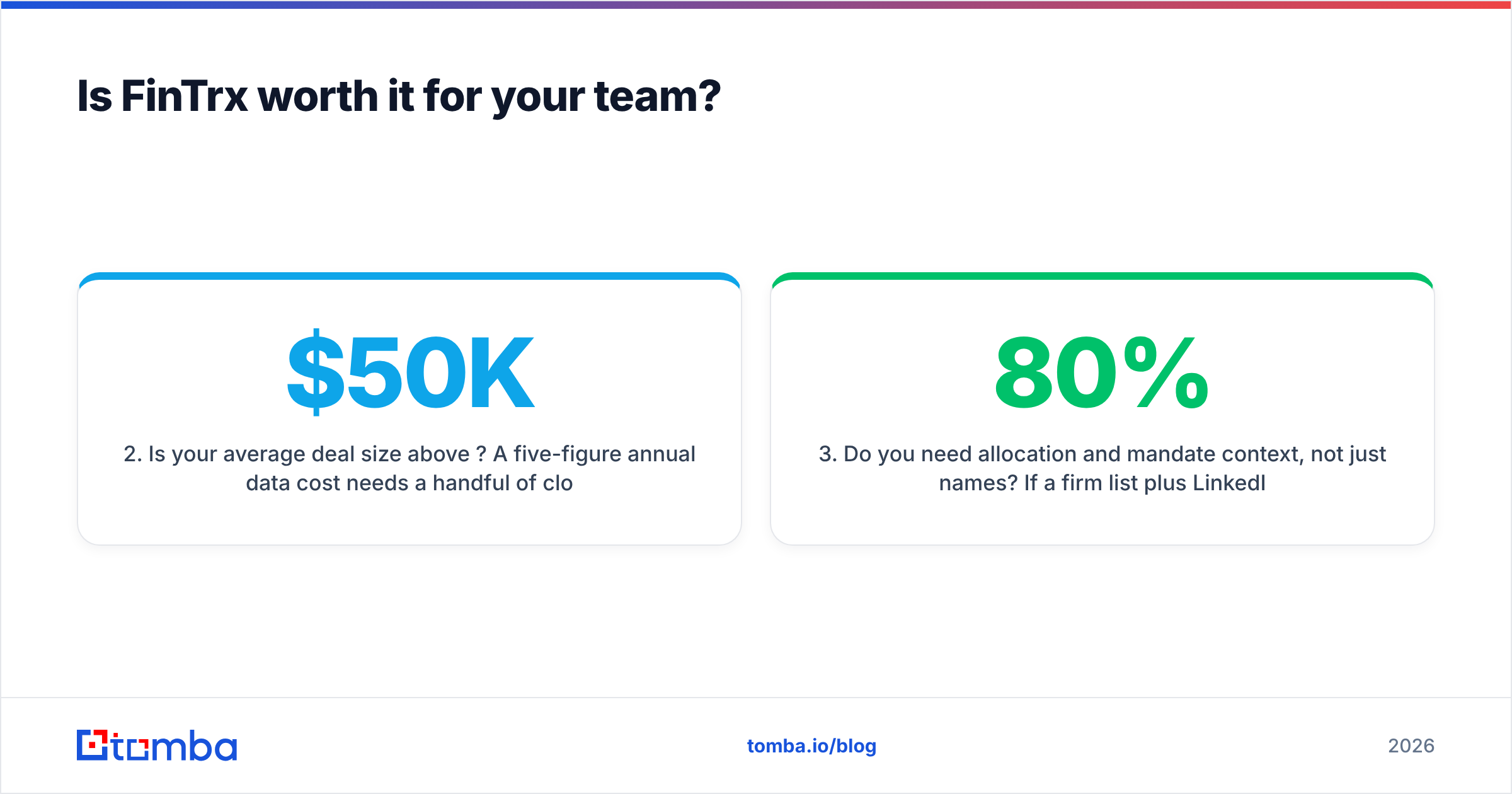
- Is your average deal size above $50K? A five-figure annual data cost needs a handful of closed deals to pay for itself. Small-ticket motions rarely clear that bar.
- Do you need allocation and mandate context, not just names? If a firm list plus LinkedIn gets you 80% there, the premium buys the last 20%.
- Do you have at least two people who will use it weekly? Idle seats are the fastest way to a bad renewal conversation.
- Can you commit for twelve months? If the channel is unproven, run a cheap manual test first and buy the database after you have signal.
If you land on two or fewer, run the alternative stack described below for a quarter, measure reply rates, and revisit.
How does FinTrx compare to the alternatives?#
There is no single drop-in replacement, because FinTrx competes on a dataset rather than a feature set. What exists instead is a set of tools that each cover part of the job.
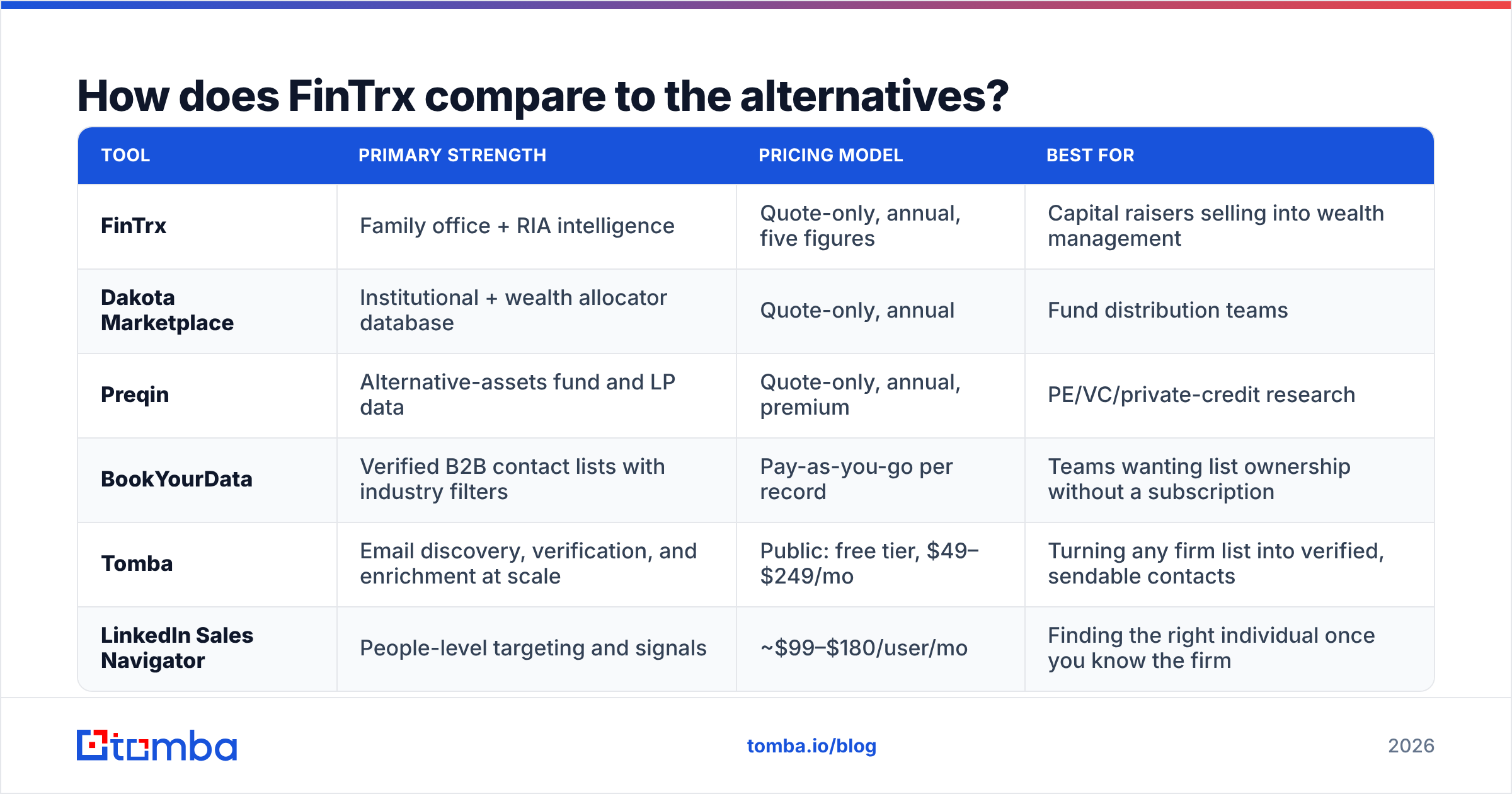
| Tool | Primary strength | Pricing model | Best for |
|---|---|---|---|
| FinTrx | Family office + RIA intelligence | Quote-only, annual, five figures | Capital raisers selling into wealth management |
| Dakota Marketplace | Institutional + wealth allocator database | Quote-only, annual | Fund distribution teams |
| Preqin | Alternative-assets fund and LP data | Quote-only, annual, premium | PE/VC/private-credit research |
| BookYourData | Verified B2B contact lists with industry filters | Pay-as-you-go per record | Teams wanting list ownership without a subscription |
| Tomba | Email discovery, verification, and enrichment at scale | Public: free tier, $49–$249/mo | Turning any firm list into verified, sendable contacts |
| LinkedIn Sales Navigator | People-level targeting and signals | ~$99–$180/user/mo | Finding the right individual once you know the firm |

The comparison that matters is not "FinTrx vs Tomba" — they answer different questions. FinTrx answers which firms and which people. A tool like Tomba answers what is their actual, deliverable email address. Teams that get the best economics usually run both layers deliberately instead of asking one vendor to do everything badly.
How do you build a cheaper stack that covers most of the job?#
If the quote comes back higher than your budget, this is the pragmatic assembly. It will not replicate FinTrx's proprietary allocation research — nothing at this price will. But it covers firm discovery and contact acquisition well enough to validate the channel.
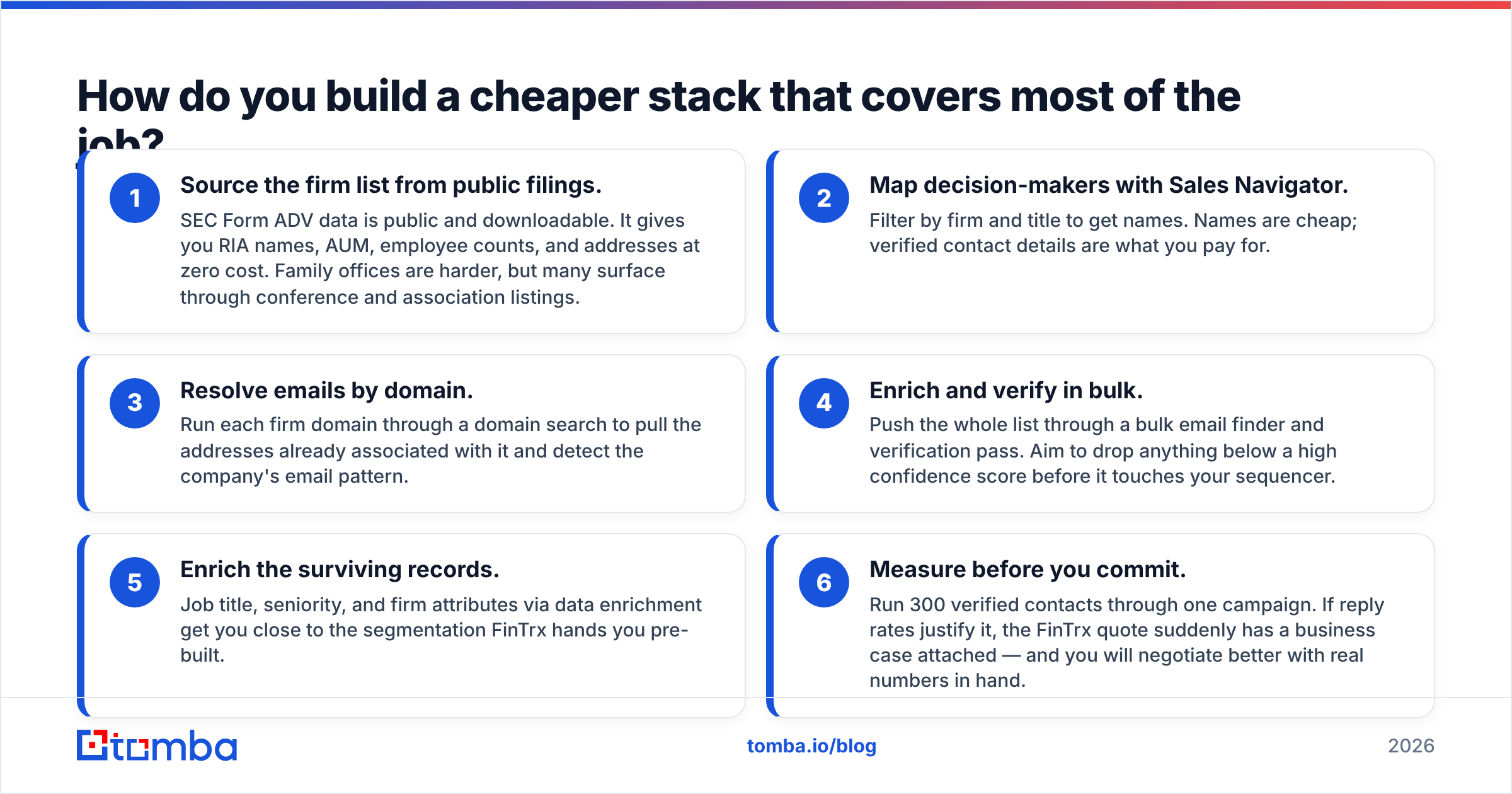
Start by building the firm list:
- Source the firm list from public filings. SEC Form ADV data is public and free to download. It gives you RIA names, AUM, employee counts, and addresses at zero cost. Family offices are harder. Many still surface through conference and association listings.
- Map decision-makers with Sales Navigator. Filter by firm and title to get names. Names are cheap; verified contact details are what you pay for.
- Resolve emails by domain. Run each firm domain through a domain search to pull the addresses already tied to it and detect the company's email pattern.
Then turn that raw list into something you can safely send to:
- Enrich and verify in bulk. Push the whole list through a bulk email finder and a verification pass. Drop anything below a high confidence score before it touches your sequencer.
- Enrich the surviving records. Job title, seniority, and firm attributes via data enrichment get you close to the segmentation FinTrx hands you pre-built.
- Measure before you commit. Run 300 verified contacts through one campaign. If reply rates justify it, the FinTrx quote suddenly has a business case attached — and you will negotiate better with real numbers in hand.
Rough cost of that stack: a Sales Navigator seat plus a $99/mo data plan. Rough cost of FinTrx: an annual commitment an order of magnitude higher. The tradeoff is your analyst time and the absence of proprietary allocation intelligence. For teams testing a channel, that tradeoff is usually correct. For teams whose entire business is the wealth channel, it usually is not.
What should you ask on the FinTrx sales call?#
Go in with these written down:
- What exactly is included at this price, and which modules are excluded?
- How many records can I export per year, and does that reset?
- What is the documented refresh cadence for contact-level data specifically?
- What is your bounce-rate guarantee, if any, on emails and direct dials?
- Can I add seats mid-term, and at what rate? Can I remove them?
- What does renewal pricing look like in year two?
- Can I get a 200-record sample in my target segment before signing?
That last one is the highest-leverage request. Sample records in your niche tell you more than any demo, and you can verify them independently in an afternoon.
The bottom line#
Most FinTrx pricing and reviews questions come down to one thing: how much of your pipeline lives in wealth management. FinTrx is a good product with an expensive, opaque commercial model aimed at a narrow, well-funded audience. If you sell into family offices and RIAs for a living, the annual cost is defensible and the coverage is hard to replicate. If wealth management is one segment among several — or a hypothesis you are still testing — the quote will outrun the value. A public-filings-plus-verification stack gets you most of the way there for a fraction of the spend.
Whichever side you land on, the contact layer is where campaigns actually break. Firm intelligence gets you a target; a deliverable address gets you a conversation. Run your list through the Tomba Email Finder to turn firm names and domains into verified, sendable addresses — start on the free tier at 25 searches a month, and scale to a $49/mo Starter plan only once the channel proves itself.
Related guides#
Ready to find emails that actually work?
Join 150,000+ professionals who stopped guessing and started sending. Free credits on signup — no credit card required.
Get the Tomba newsletter
Practical outbound tactics and product updates — once every two weeks.
About the author