Fintrx vs Generect: Which B2B Data Tool Wins in 2026?
Fintrx sells private-wealth intelligence. Generect sells real-time B2B lead generation. They rarely compete for the same buyer — here's how pricing, coverage, and data freshness actually compare, plus who each one fits.
Fintrx vs Generect is not really a head-to-head fight. One tool maps private wealth. The other builds fresh B2B lead lists on demand. This guide shows which one fits your motion — and when neither does.
TL;DR
- Fintrx is a private-wealth and family-office intelligence platform. Generect is a real-time B2B lead tool that finds emails and phone numbers. They solve different problems. They only look like rivals if you are shopping for contact data in general.
- Pick Fintrx if you sell to RIAs, family offices, private equity, or HNW advisory. The depth on wealth entities is the whole product.
- Pick Generect if you run broad B2B outbound. It builds lists from live queries instead of a static database dump.
- Neither is priced for a small team testing outbound. Fintrx costs five figures a year. Generect is credit-based and mid-market.
- If you just need to find and verify work emails at a set price, a dedicated email finder from $49/mo does that job for far less.
Most "Fintrx vs Generect" searches start the same way. Two tools land in the same spreadsheet during a data-vendor review. Ten minutes into the demos, the mismatch is obvious. This post saves you those ten minutes. It also maps the decision honestly, including the case where neither vendor is the right buy.
What is Fintrx, and who buys it?#
Fintrx is a private-wealth data platform. The database covers registered investment advisors (RIAs), single- and multi-family offices, private-equity and venture firms, and the people inside them — advisors, principals, CIOs, wealth managers. The edge is not record count. It is the entity model. Fintrx maps AUM tiers, investment mandates, asset-class preferences, custodian relationships, and advisor moves between firms.
That matters in a few cases. Maybe you are an asset manager raising capital. Maybe you sell fintech software to wealth-management firms. Maybe your team needs to know which family offices back private credit. A generic B2B database tells you a firm exists and has 40 employees. Fintrx tells you it manages $2.3B, invests in alternatives, and just hired a new head of research.
The trade-off is scope and price. Outside financial services, Fintrx covers almost nothing. You cannot prospect SaaS CTOs or e-commerce ops managers with it. Pricing is annual, seat-based, and usually lands in the low-to-mid five figures per year. The modules you pick drive the final number. There is no real self-serve tier. Check fintrx.com for the current module list. They publish feature detail but quote pricing on request.

What is Generect, and how is it different?#
Generect comes at lead data from the other side. It does not license you a pre-built static database. It builds lists on demand. You define a query — title, location, company size, tech signals, LinkedIn attributes — and it gathers and enriches matching contacts in near-real time. You get work emails, and direct phone numbers on higher tiers.
The pitch is freshness. Static databases decay. B2B contact data goes stale at roughly 22–30% a year as people change jobs. A record licensed in January can be plain wrong by August. Generect narrows the gap between when a record is built and when you email it.
In practice, Generect fits broad B2B outbound. Think agencies running campaigns for many clients. Think sales teams that need a new ICP slice every month. Think RevOps teams piping leads into a sequencer through an API. It is credit-based, mid-market priced, and skips the enterprise procurement cycle Fintrx requires.
Where it falls short: it is not a research tool. You do not browse Generect the way you browse Fintrx or ZoomInfo. You query it. Some teams study an account before they touch it — firm detail, relationship maps, past filings. Generect's flat contact records will not carry that work.
Fintrx vs Generect: how do they compare head-to-head?#
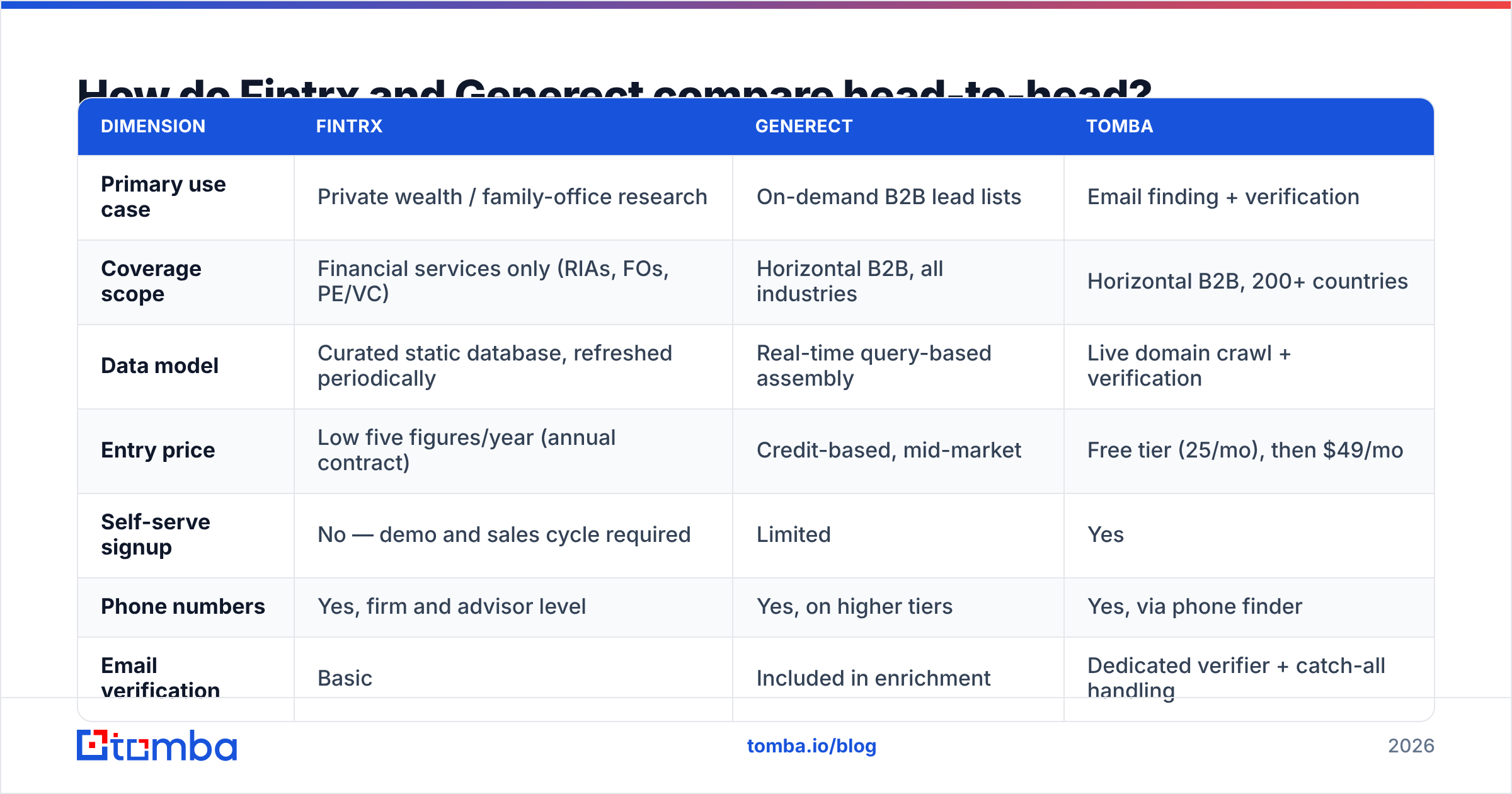
Here is the practical comparison, across the things that actually change a buying decision. Treat pricing as directional. Both vendors quote, and both discount on annual deals.
| Dimension | Fintrx | Generect | Tomba |
|---|---|---|---|
| Primary use case | Private wealth / family-office research | On-demand B2B lead lists | Email finding + verification |
| Coverage scope | Financial services only (RIAs, FOs, PE/VC) | Horizontal B2B, all industries | Horizontal B2B, 200+ countries |
| Data model | Curated static database, refreshed periodically | Real-time query-based assembly | Live domain crawl + verification |
| Entry price | Low five figures/year (annual contract) | Credit-based, mid-market | Free tier (25/mo), then $49/mo |
| Self-serve signup | No — demo and sales cycle required | Limited | Yes |
| Phone numbers | Yes, firm and advisor level | Yes, on higher tiers | Yes, via phone finder |
| Email verification | Basic | Included in enrichment | Dedicated verifier + catch-all handling |
| API access | Enterprise tier | Yes — core to the product | Yes, all paid plans |
| Best for | Asset raisers, wealth-tech vendors | Agencies, horizontal outbound teams | Teams that need accurate emails cheaply |
| Worst for | Anyone outside finance | Deep account research | Wealth-specific firmographics |
The table makes the core point. The "vs" framing is mostly false. Fintrx and Generect overlap on the words "B2B contact data" and almost nowhere else.
Which one fits your go-to-market motion?#
Rather than ranking them, match them to a motion. Here are five common cases and the honest call for each:
Raising capital from family offices and RIAs. Fintrx, clearly. No broad database carries AUM tiers, mandate data, or advisor moves at this depth. The annual cost pays for itself when one allocation lands.
Agency running outbound for 8 clients in unrelated industries. Generect. You need a fresh ICP slice per client per month, sent by API into whatever sequencer that client uses. A static annual license is the wrong shape.
Seed-stage SaaS testing three ICPs before committing. Neither. You need cheap, accurate emails and room to be wrong about your ICP twice. Start with a domain search against a target account list. Then run an email verifier pass before you send.
Enterprise RevOps merging five data vendors. Look at both, but weigh ZoomInfo and Apollo too. The real question is which single vendor covers 80% of your ICP, with specialists filling the gap. Our Apollo alternative breakdown shows how the broad players stack up.
Wealth-tech company selling software to RIAs. Fintrx for the target list, plus a cheap email finder for the contacts Fintrx misses. This pairing is common and works well. Fintrx tells you which firms. A finder tells you how to reach the person you picked.
How accurate is the data from each?#
This is where every vendor review should focus. It is also where marketing pages help least.
Fintrx gets its accuracy from curation. People review the records. Much of the data comes from regulatory filings — Form ADV, 13F, SEC registrations. Those sources are authoritative and update on a known schedule. So firm-level data is reliable. Person-level data is reliable but slow: an advisor who moved last month may still show the old employer until the next filing.
Generect gets its accuracy from recency. Records are built at query time, so the signals are current. But real-time assembly means less human review. Expect more edge-case noise — guessed email patterns that never resolve, phone numbers that ring a switchboard instead of a desk.
Neither replaces verification before you send. Whatever you buy, run the list through an SMTP-level check first. Bounce rates above 3% start to hurt sender reputation. Repairing a burned domain costs far more than verifying a list. Catch-all domains are very common in financial services, where Fintrx operates. They need a dedicated catch-all verifier, because a standard SMTP check returns "accept" for every address on the domain, valid or not.
A reasonable QA process, whichever vendor you pick:
- Sample before you buy. Ask for 100 records in your exact ICP, not a polished demo list. Verify them yourself.
- Measure bounce, not "accuracy." Vendor accuracy claims use vendor math. Your bounce rate is the only number that pays rent.
- Re-verify on a schedule. A list verified in Q1 is not verified in Q3. Quarterly re-runs are the floor.
- Segment catch-alls. Send to them from a second domain until you know how they behave.

What are the alternatives to Fintrx vs Generect?#
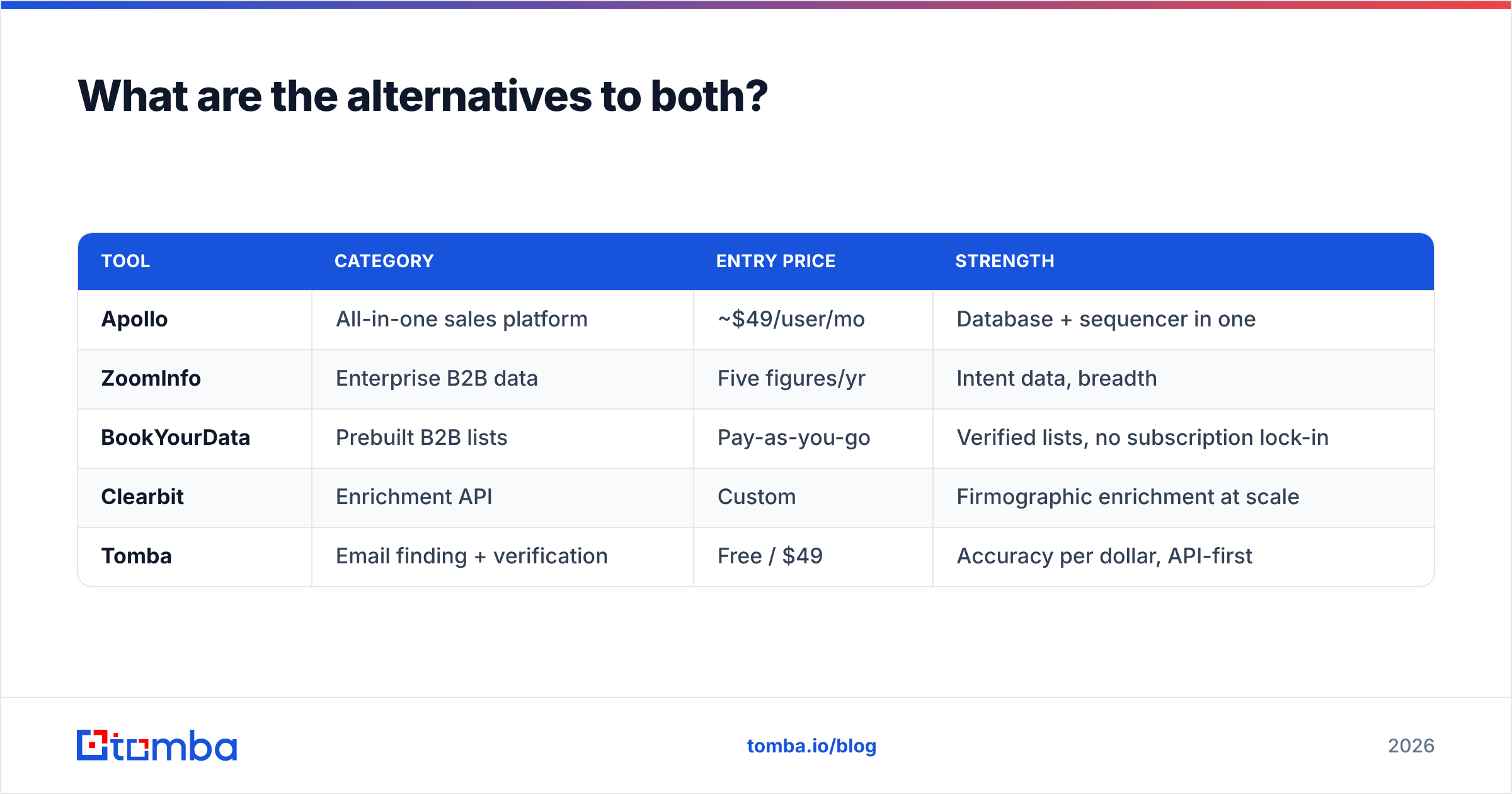
If neither fits, the field is wider than these two names suggest:
| Tool | Category | Entry price | Strength |
|---|---|---|---|
| Apollo | All-in-one sales platform | ~$49/user/mo | Database + sequencer in one |
| ZoomInfo | Enterprise B2B data | Five figures/yr | Intent data, breadth |
| BookYourData | Prebuilt B2B lists | Pay-as-you-go | Verified lists, no subscription lock-in |
| Clearbit | Enrichment API | Custom | Firmographic enrichment at scale |
| Tomba | Email finding + verification | Free / $49 | Accuracy per dollar, API-first |
BookYourData is worth a look if you hate subscriptions. It sells verified, prebuilt lists pay-as-you-go with a bounce guarantee. That sidesteps the annual-contract problem both Fintrx and Generect create. For enrichment-heavy work, our Clearbit alternative comparison covers the API-first options.
Most Fintrx vs Generect evaluations end in a split stack. You keep one specialist source for your core ICP. You add a cheap, accurate finder-and-verifier layer that fills contact gaps and keeps the database clean. That costs less than forcing one vendor to do both jobs badly.
What should you actually budget?#
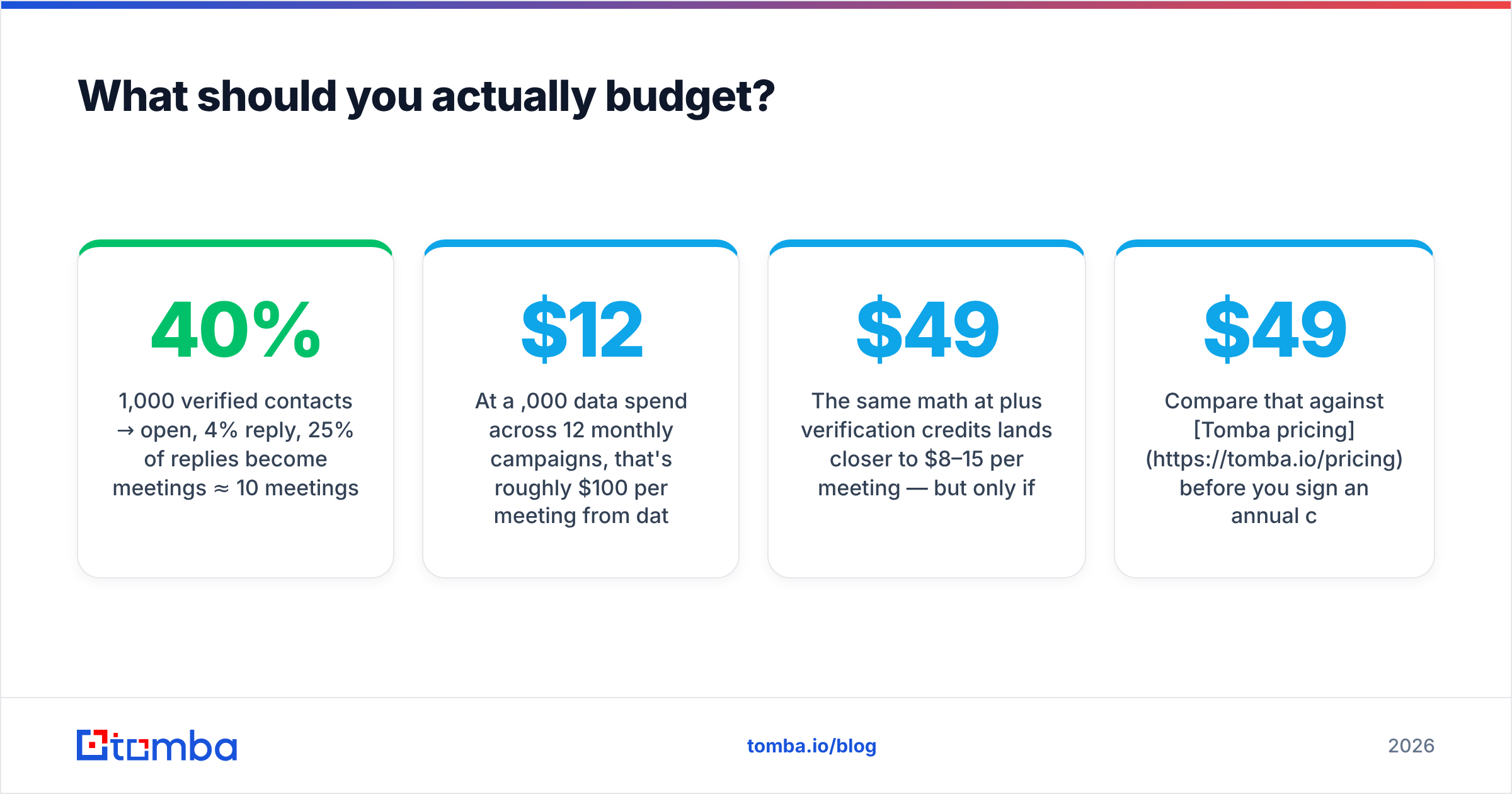
Work backwards from cost per meeting, not cost per record. A rough model:
- 1,000 verified contacts → 40% open, 4% reply, 25% of replies become meetings ≈ 10 meetings.
- Spend $12,000 a year on data across 12 monthly campaigns. That is roughly $100 per meeting from data alone.
- The same math at $49/mo plus verification credits lands closer to $8–15 per meeting. That only holds if your list-building is good, since you do the targeting the pricey vendor would have done.
That gap sums up the whole Fintrx vs Generect comparison. Expensive vendors sell you targeting. Cheap tools sell you reach. Fintrx is the clearest case of paid targeting on the market. If your ICP is family offices, paying for it is rational. If your ICP is "B2B companies with 50–500 employees," you are paying for targeting you could do yourself with a decent filter and a good finder.
Compare that against Tomba pricing before you sign an annual contract. The Free tier gives you 25 searches a month. Starter is $49/mo, Growth $99/mo, and Pro $249/mo. Every plan includes full Tomba API access instead of gating it behind an enterprise tier.
Frequently asked questions#
Is Fintrx worth it for non-financial companies? No. The coverage is financial services only, by design. Outside that field you pay a premium for a database with almost no records that match your ICP.
Does Generect replace a sales engagement platform? No. It sources and enriches leads. You still need a sequencer (Instantly, Smartlead, Reply.io) to send. Its API is built to feed one.
Can I use both together? Yes, and some wealth-tech teams do. They use Fintrx to find targets, then a broad tool for contacts at the vendors and service providers around those firms.
How do I check a company's email format before building a list? Use a company email pattern lookup. Knowing whether a domain uses first.last@ or finitial.last@ saves a lot of bounces.
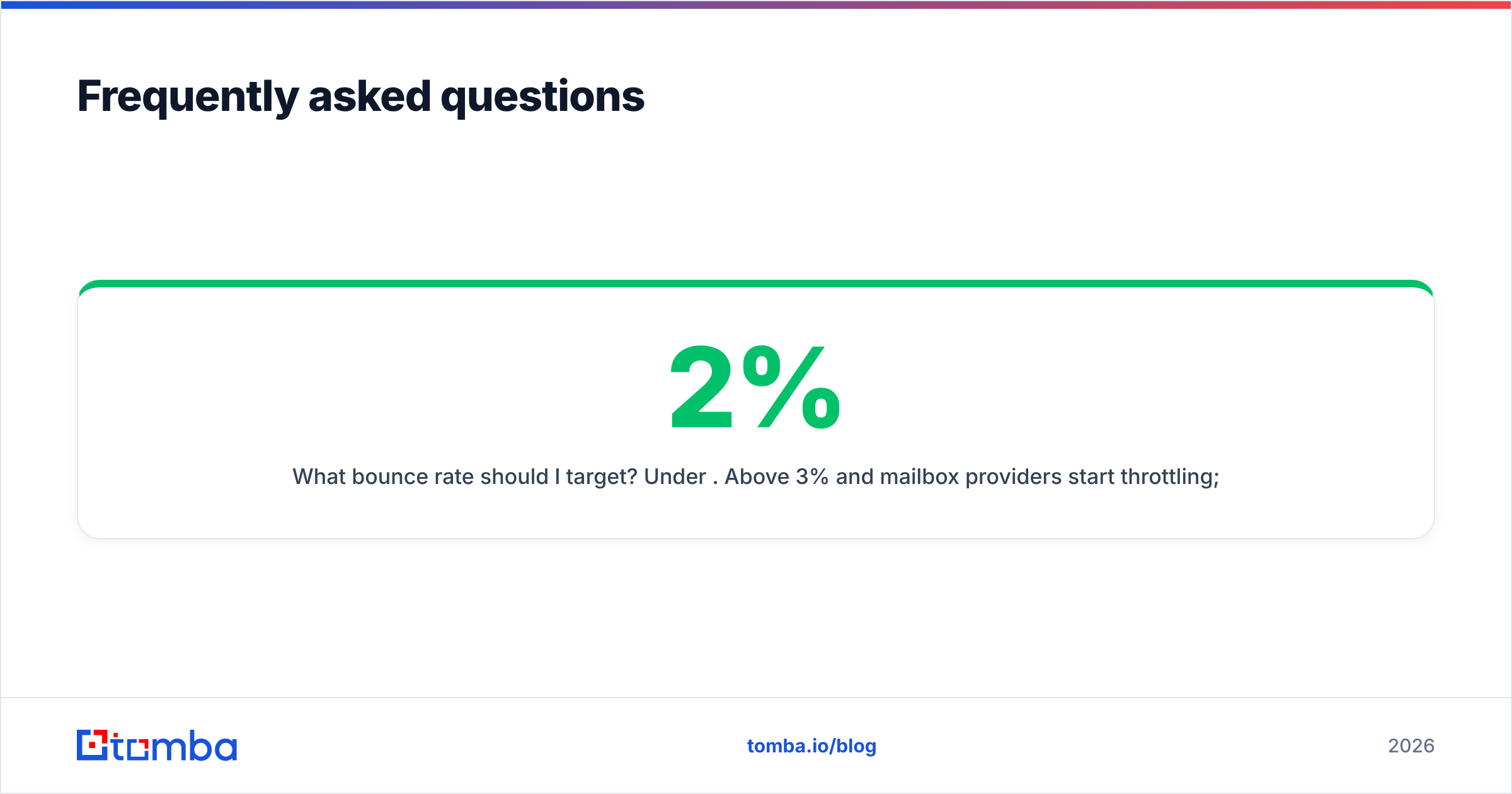
What bounce rate should I target? Under 2%. Above 3%, mailbox providers start to throttle you. Above 5%, you are actively hurting deliverability.
The bottom line on Fintrx vs Generect#
Fintrx and Generect are not real rivals. Fintrx is a vertical intelligence product for people who sell into private wealth. It is very good at that, at a price that only makes sense if wealth is your market. Generect is a broad, API-first lead engine for teams that need fresh lists on demand and no enterprise contract. Choose by motion, not by feature grid.
And if what you really need is a reliable way to find and verify work emails without a five-figure commitment, start with the Tomba Email Finder. The Free tier covers 25 searches a month, so you can test accuracy against your own ICP before paying. Starter is $49/mo. Every plan includes API access, bulk processing, and catch-all handling. Run 100 of your target accounts through it and compare the bounce rate to whatever quote sits in your inbox.
Related guides#
Ready to find emails that actually work?
Join 150,000+ professionals who stopped guessing and started sending. Free credits on signup — no credit card required.
Get the Tomba newsletter
Practical outbound tactics and product updates — once every two weeks.
About the author