FinTRX vs Kaspr in 2026: Wealth Data vs LinkedIn Contacts
FinTRX sells curated private-wealth intelligence. Kaspr pulls phone numbers and emails off LinkedIn profiles. They barely compete — but teams keep comparing them. Here's which one fits your motion, what each costs, and when neither is the right buy.
TL;DR
- FinTRX and Kaspr are not really competitors. FinTRX is a vertical database for the private wealth channel — family offices, RIAs, wirehouse advisors. Kaspr is a horizontal contact-data extension that pulls emails and phone numbers off LinkedIn profiles.
- Pick FinTRX if you sell into wealth management (fund distribution, alternative investments, fintech for advisors) and need firm-level AUM, custodian, and mandate data you cannot get from a generic provider.
- Pick Kaspr if you run high-volume SDR prospecting on LinkedIn and mostly need direct dials plus a work email per profile, fast and per-seat cheap.
- Budget gap is enormous. Kaspr publishes per-seat plans in the tens of euros per month. FinTRX is a quote-based annual license — plan for a real procurement cycle, not a credit card.
- Neither one is a great general-purpose email engine. If your bottleneck is "I have a company list and I need verified work emails at scale," a dedicated email finder plus email verification does that job for a fraction of either price.
What is FinTRX and who actually buys it?#
FinTRX is a private wealth intelligence platform. Instead of trying to cover every B2B contact on earth, it goes deep on one vertical: the money-management channel. That means registered investment advisors (RIAs), family offices, multi-family offices, broker-dealer reps, and the individual advisors inside them.
The data you get is not just "name, title, email." It's channel-specific attributes that only matter if you sell into this world: assets under management, custodian relationships, account minimums, allocation preferences, ADV-derived firm details, advisor movement between firms, and mandate signals. FinTRX markets itself to asset managers, alternative investment sponsors, and fintech vendors whose entire pipeline lives inside the wealth channel.
The typical buyer is a distribution team at an asset manager, a capital-raising team at a private credit or real estate sponsor, or a sales team at a wealthtech vendor. These teams have small TAMs — a few thousand meaningful firms — and high deal values. Paying five figures a year for a curated list of 4,000 family offices is rational when one allocation covers the license fifty times over.
The flip side: if your ICP is "any SaaS company with 50–500 employees," FinTRX is the wrong shape of tool entirely. You'd be paying a premium for depth in a vertical you never sell into.
What is Kaspr and what does it actually do?#
Kaspr is a contact-data tool built around a Chrome extension. You open a LinkedIn profile, a Sales Navigator search, a LinkedIn group, or an event attendee list, and Kaspr surfaces phone numbers and email addresses for those people. It also supports list building, basic LinkedIn automation sequences, and CRM pushes.
Kaspr is a French company acquired by Cognism in 2022, and it inherits that company's compliance posture — GDPR and CCPA alignment, notification workflows, and a European data footprint that matters if your legal team asks hard questions about where contact data came from.
Its reputation is built on two things: direct dials in Europe, where many global databases thin out badly, and a free tier that is actually usable rather than a three-day trial in disguise. Reviews on G2 consistently praise the phone data in EMEA and consistently flag the same two limitations: coverage drops outside Europe, and the credit system for phone numbers runs out faster than you expect on a heavy prospecting week.
Kaspr's operating model is LinkedIn-first. That's a strength when your SDRs already live in Sales Navigator. It's a constraint when you need to work from a company list, a conference exhibitor PDF, or a CRM export where no LinkedIn URL exists yet.

FinTRX vs Kaspr: how do they compare head-to-head?#
Here's the honest side-by-side. Note that the two tools optimize for different failure modes: FinTRX is trying not to miss a $2B family office, Kaspr is trying not to make your SDR wait eight seconds for a phone number.
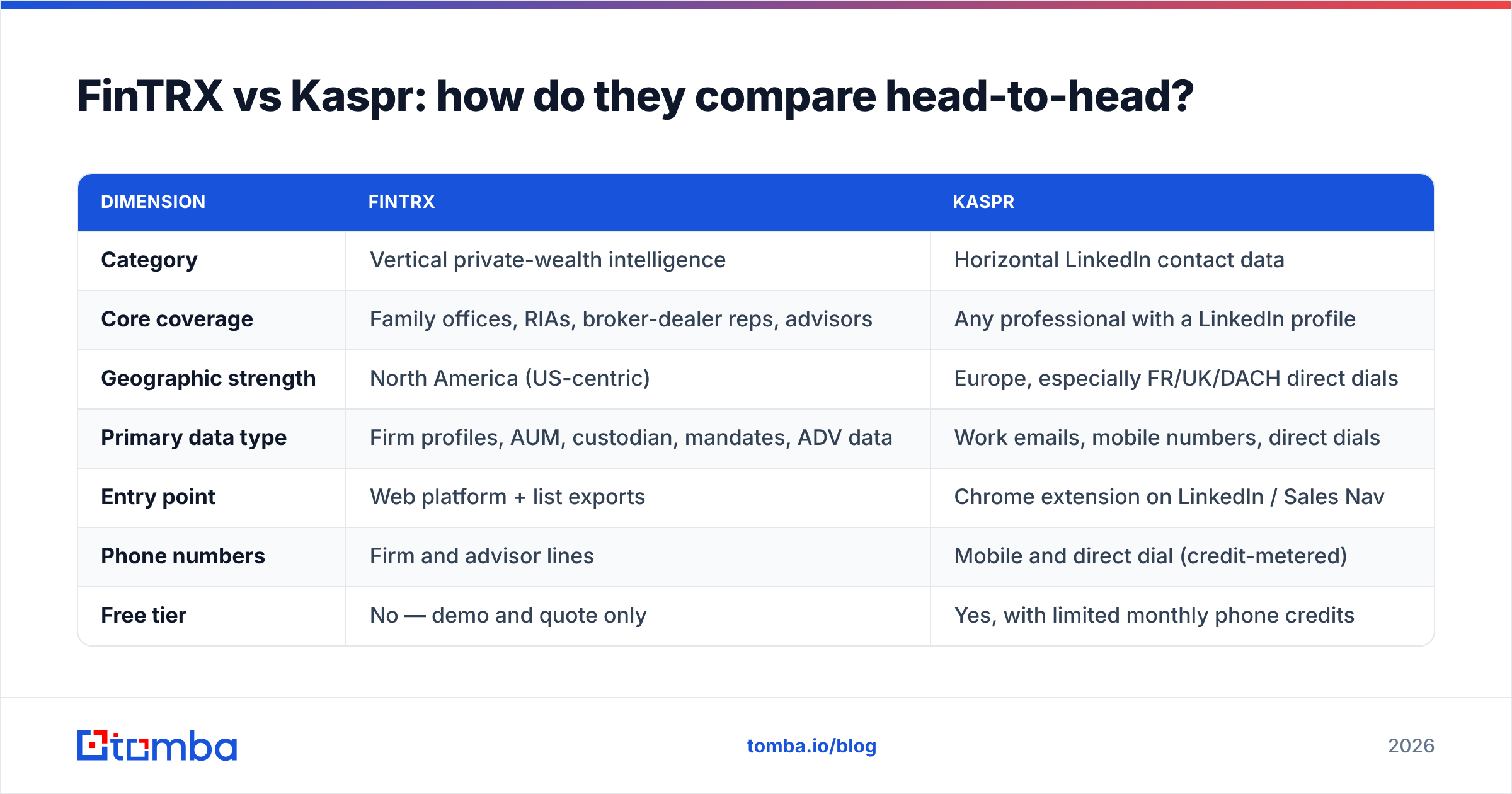
| Dimension | FinTRX | Kaspr |
|---|---|---|
| Category | Vertical private-wealth intelligence | Horizontal LinkedIn contact data |
| Core coverage | Family offices, RIAs, broker-dealer reps, advisors | Any professional with a LinkedIn profile |
| Geographic strength | North America (US-centric) | Europe, especially FR/UK/DACH direct dials |
| Primary data type | Firm profiles, AUM, custodian, mandates, ADV data | Work emails, mobile numbers, direct dials |
| Entry point | Web platform + list exports | Chrome extension on LinkedIn / Sales Nav |
| Phone numbers | Firm and advisor lines | Mobile and direct dial (credit-metered) |
| Free tier | No — demo and quote only | Yes, with limited monthly phone credits |
| Pricing model | Annual license, quote-based, seat-tiered | Published per-user monthly plans |
| Typical annual spend | Five figures | Low four figures for a small team |
| Best fit | Capital raising, fund distribution, wealthtech | SDR teams doing volume outbound in EMEA |
| Worst fit | Generic B2B SaaS prospecting | Vertical research where firm attributes matter |
| Contract friction | Procurement, legal review, annual commit | Self-serve signup, monthly cancel |
Read that table twice and the conclusion becomes obvious: these tools rarely appear on the same shortlist for the same reason. When they do, it's usually because a wealthtech company is deciding whether to buy vertical depth (FinTRX) or contact volume (Kaspr) with the same budget line.
How much do FinTRX and Kaspr cost in 2026?#
Pricing transparency is the single largest practical difference.
Kaspr publishes its plans. There's a free tier with unlimited B2B email lookups and a small allowance of phone credits per month, then paid per-user tiers that climb into the tens of euros per seat monthly, with the higher tiers unlocking bulk enrichment, integrations, and admin controls. Annual billing discounts apply. You can sign up, test on twenty profiles, and know within an hour whether the phone coverage works for your territory. Always confirm current numbers on the vendor's own pricing page — per-seat tools reprice often.
FinTRX does not publish pricing. You book a demo, scope seats and modules, and receive an annual quote. Public discussion and buyer reports put it firmly in the enterprise-data bracket — think five figures per year for a small team, scaling with seats and data access. There is no free tier and no month-to-month escape hatch.
That difference changes who can buy. Kaspr is a card-swipe decision an SDR manager makes on a Tuesday. FinTRX is a budget line approved by a VP of Distribution during annual planning.
Here's how the real cost of ownership breaks down beyond the sticker:
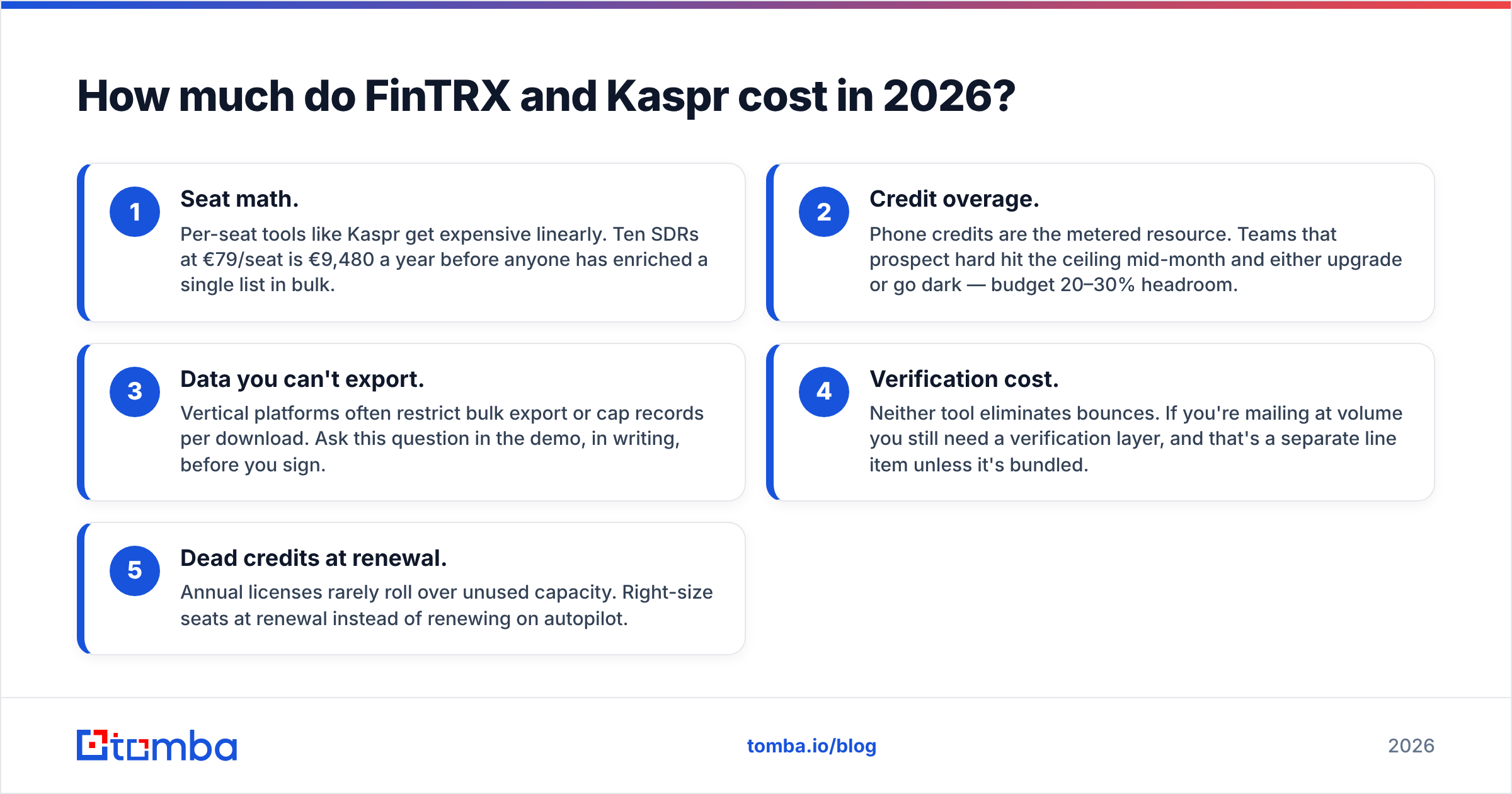
- Seat math. Per-seat tools like Kaspr get expensive linearly. Ten SDRs at €79/seat is €9,480 a year before anyone has enriched a single list in bulk.
- Credit overage. Phone credits are the metered resource. Teams that prospect hard hit the ceiling mid-month and either upgrade or go dark — budget 20–30% headroom.
- Data you can't export. Vertical platforms often restrict bulk export or cap records per download. Ask this question in the demo, in writing, before you sign.
- Verification cost. Neither tool eliminates bounces. If you're mailing at volume you still need a verification layer, and that's a separate line item unless it's bundled.
- Dead credits at renewal. Annual licenses rarely roll over unused capacity. Right-size seats at renewal instead of renewing on autopilot.
Which one gives better data quality?#
Wrong question — better at what.
FinTRX wins decisively on attribute depth inside its vertical. If you need to know which RIAs custody at a specific platform, which family offices have allocated to private credit in the last 18 months, or which advisor just moved from one wirehouse to another, no horizontal provider will match it. That's the entire value proposition, and it's earned through manual research plus regulatory filings, not scraping.
Kaspr wins on contact-level reachability in Europe. A mobile number for a French procurement director is a genuinely hard record to source, and Kaspr's European bias means it holds numbers many US-first databases simply don't have. It's also faster — the record is on screen in the moment the rep decides to reach out, which matters more for conversion than most data teams admit.
Both share the same universal weakness: email records decay. B2B contact data degrades roughly 22–30% per year through job changes, domain migrations, and mailbox retirement. A record that was accurate when it entered the database is a coin flip eighteen months later. That's not a knock on either vendor — it's physics. It's also why running any exported list through an independent email verifier before your first send is non-negotiable, regardless of which platform sourced it.

What are the real limitations of each?#
FinTRX limitations:
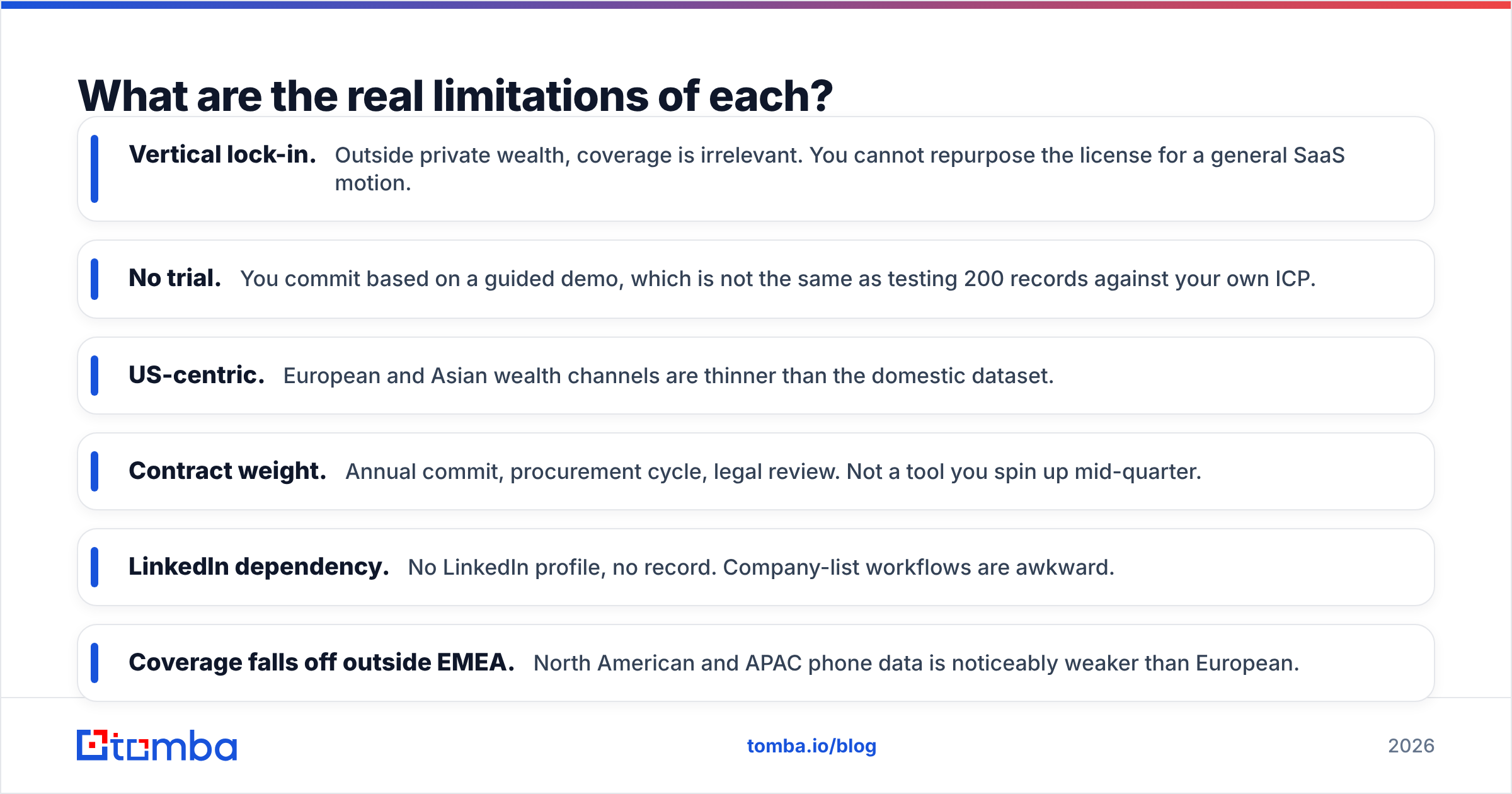
- Vertical lock-in. Outside private wealth, coverage is irrelevant. You cannot repurpose the license for a general SaaS motion.
- No trial. You commit based on a guided demo, which is not the same as testing 200 records against your own ICP.
- US-centric. European and Asian wealth channels are thinner than the domestic dataset.
- Contract weight. Annual commit, procurement cycle, legal review. Not a tool you spin up mid-quarter.
Kaspr limitations:
- LinkedIn dependency. No LinkedIn profile, no record. Company-list workflows are awkward.
- Coverage falls off outside EMEA. North American and APAC phone data is noticeably weaker than European.
- Credit anxiety. Phone credits are the real currency and they deplete faster than teams model.
- Shallow firmographics. You get the person, not a rich picture of the account.
- Per-seat cost scaling. Great for three reps, painful at thirty.
Do you actually need either one?#
Here's the uncomfortable middle case: a lot of teams comparing FinTRX vs Kaspr don't need a vertical wealth database or a LinkedIn extension. They need to turn a list of company domains into verified, deliverable work emails — and everything else is scope creep.
If that describes you, the cheaper path is a purpose-built email infrastructure layer:
- Domain search — feed a domain, get the people and email patterns at that company. Works from a CRM export, a conference exhibitor list, or a scraped directory. No LinkedIn URL required.
- Bulk email finder — process thousands of name-plus-domain rows in one job instead of one profile at a time.
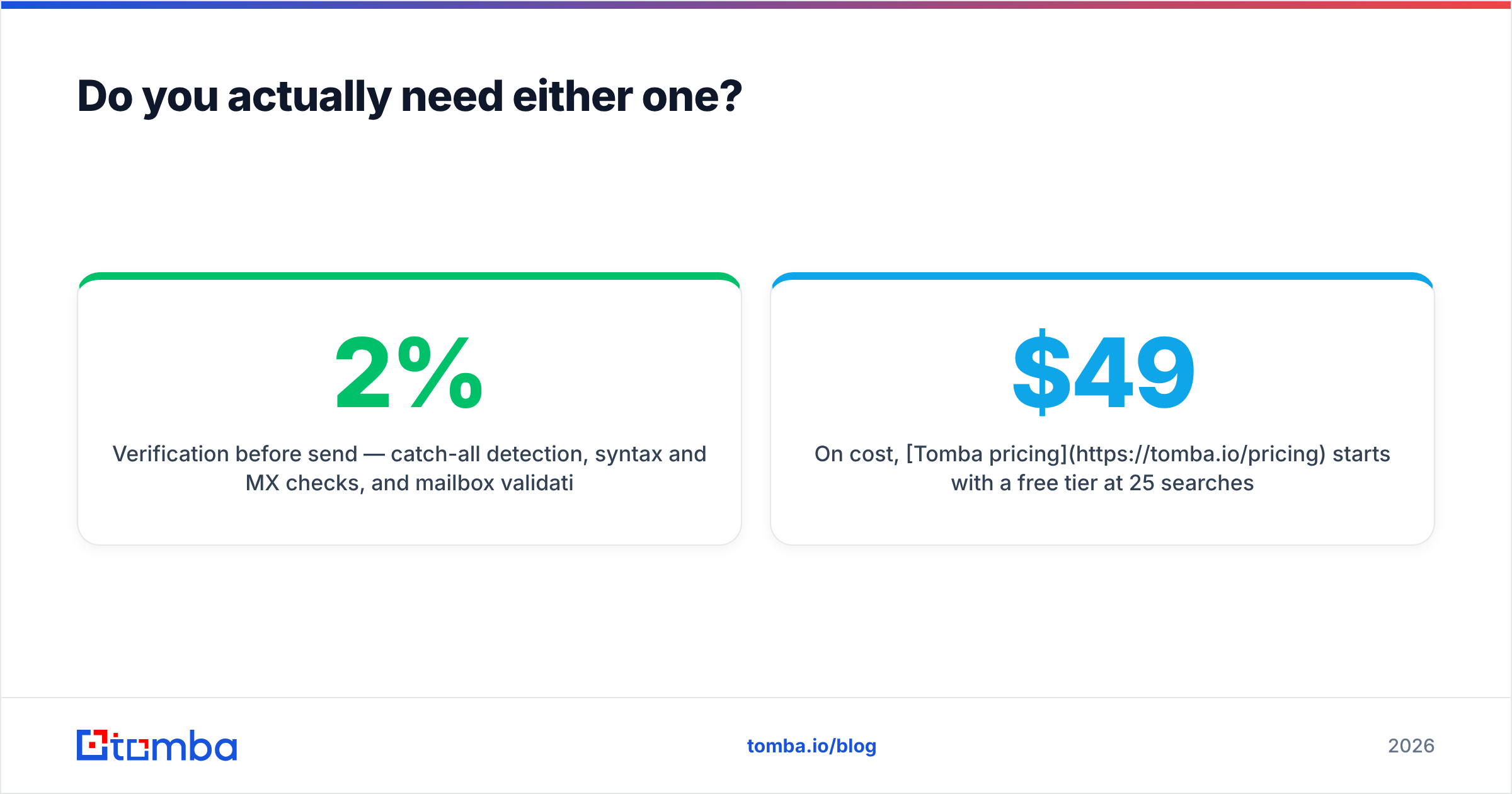
- Verification before send — catch-all detection, syntax and MX checks, and mailbox validation so your bounce rate stays under the 2% threshold that keeps sender reputation intact.
- API-first workflows — the Tomba API means enrichment runs inside your own systems rather than behind a Chrome extension a rep has to remember to click.
On cost, Tomba pricing starts with a free tier at 25 searches per month, then Starter at $49/mo, Growth at $99/mo, and Pro at $249/mo — account-level, not per-seat. For a five-person team, that's the difference between one predictable line item and five multiplying ones.
The honest caveat: Tomba will not tell you which family office allocated to private credit last quarter. That's FinTRX's job and there's no substitute. Nor will it match Kaspr's European mobile numbers if cold calling is your primary channel. Match the tool to the actual constraint.
Which should you choose in 2026?#
Choose FinTRX if your entire revenue motion runs through the wealth channel, your deal sizes justify a five-figure annual data spend, and you need attributes — AUM, custodian, mandate history — that no horizontal provider carries. It's a specialist instrument. It's excellent at the one thing it does.
Choose Kaspr if you're an SDR-led team selling into Europe, your reps live inside Sales Navigator, and phone contact is a core channel. Start on the free tier, run 50 real prospects from your territory, and check the direct-dial hit rate before you buy a single seat. The free plan makes this evaluation nearly costless — take advantage of it.
Choose neither if your bottleneck is simply volume of verified email addresses from a domain list. Buying a vertical intelligence platform to solve an email-finding problem is like buying a Bloomberg terminal to check a stock price.
Most mature teams end up running a two-layer stack anyway: a specialist source for the accounts that matter most, and a cheap, high-throughput data enrichment layer underneath it for everything else. The mistake is paying specialist prices for generalist work.
Ready to stop paying per seat for email addresses? Start with the Tomba Email Finder — free for your first 25 searches, no card required. Feed it a domain or a name-and-company pair, get a verified work email with a confidence score and the sources behind it, and run the whole thing through the API when you're ready to scale. Whatever you decide on FinTRX vs Kaspr, your email layer should be the cheap, reliable part of the stack — not the expensive one.
Related guides#
Ready to find emails that actually work?
Join 150,000+ professionals who stopped guessing and started sending. Free credits on signup — no credit card required.
Get the Tomba newsletter
Practical outbound tactics and product updates — once every two weeks.
About the author