FinTRX vs SalesIntel: Which B2B Data Platform Wins in 2026?
FinTRX owns wealth-management data; SalesIntel owns human-verified B2B contacts. We compare coverage, pricing, verification methods and fit so you know which one your team should actually buy in 2026.
FinTRX vs SalesIntel is a strange matchup. One is a niche wealth-data platform. The other is a broad B2B contact database. Here is how they differ, what they cost, and which one your team should actually buy.
TL;DR
- FinTRX is a vertical database, not a general sales tool. It covers family offices, RIAs, and private wealth firms in depth. If you don't sell to wealth firms, skip it.
- SalesIntel is a broad B2B contact database. People check its contacts, not just bots. It adds tech and intent data on top. Coverage is wide, but US-heavy.
- They rarely compete head-to-head. The real question is simple. Do you need a niche dataset or a general one?
- Both sell annual, seat-based contracts. Expect five figures. Neither one posts public prices.
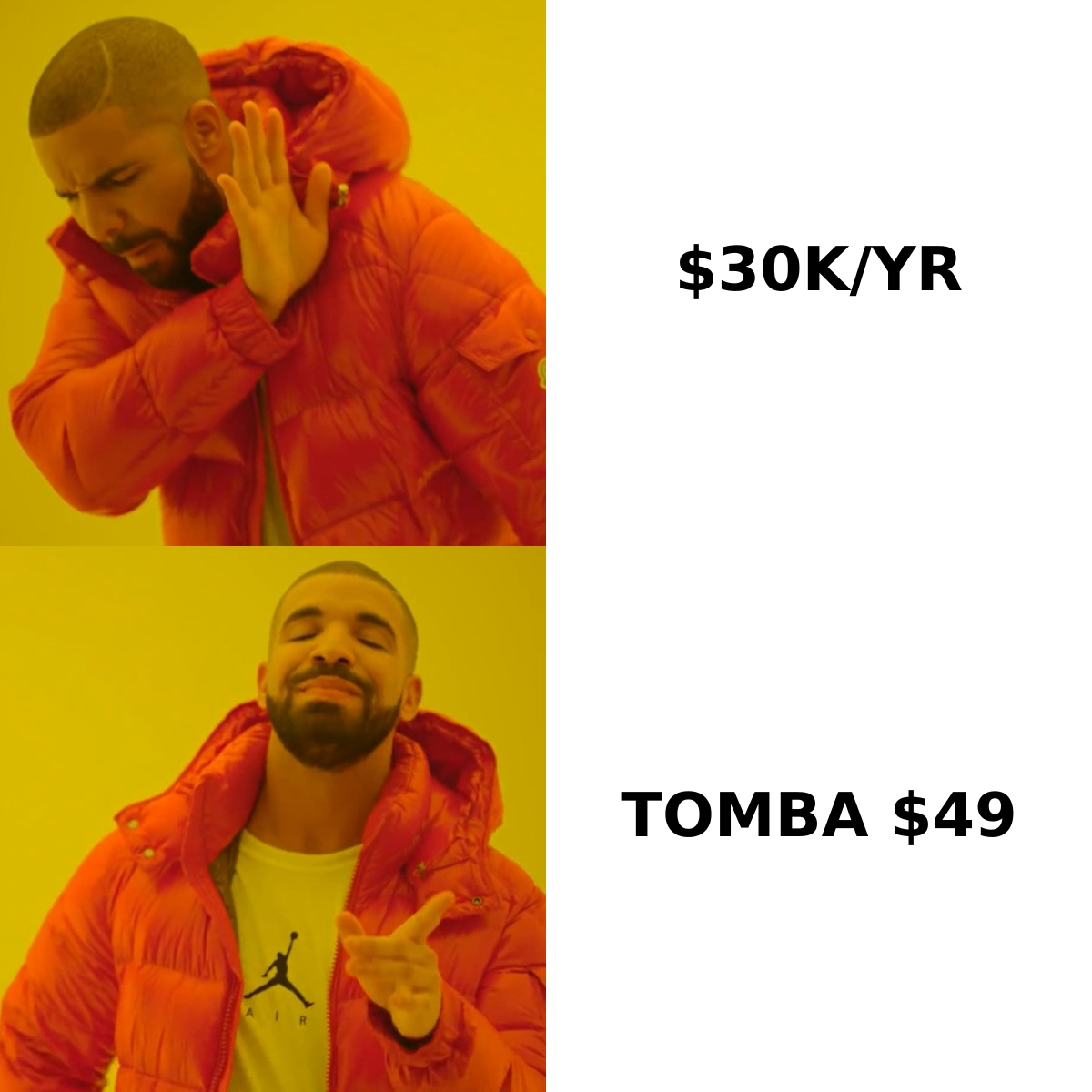
- If you just need work emails, an email finder at $49/mo does that job. No $20K contract needed.
What are FinTRX and SalesIntel, exactly?#
They look similar on a feature list. They solve different problems.
FinTRX (fintrx.com) is a private wealth data platform. It tracks family offices, registered investment advisors (RIAs), broker-dealers, and the people inside them. The contact record is not the main value. The context around it is: AUM bands, custodians, mandates, SEC filing history, and team structure. Asset managers and fintech vendors use it to pick which firms are worth a call. They do that long before anyone looks up an email.
SalesIntel (salesintel.io) is a general B2B contact and company database. Its edge is human checking. A research team re-confirms records on a stated cycle. Crawling is not the only source. The platform also adds technographics, firmographics, and buyer intent signals. Sales teams use it to build territory lists and feed sequencing tools.
Think of it this way. FinTRX is a specialist directory for cardiologists: small, deep, and costly per record. SalesIntel is the phone book for the whole economy: wide, thinner per record, priced by volume.
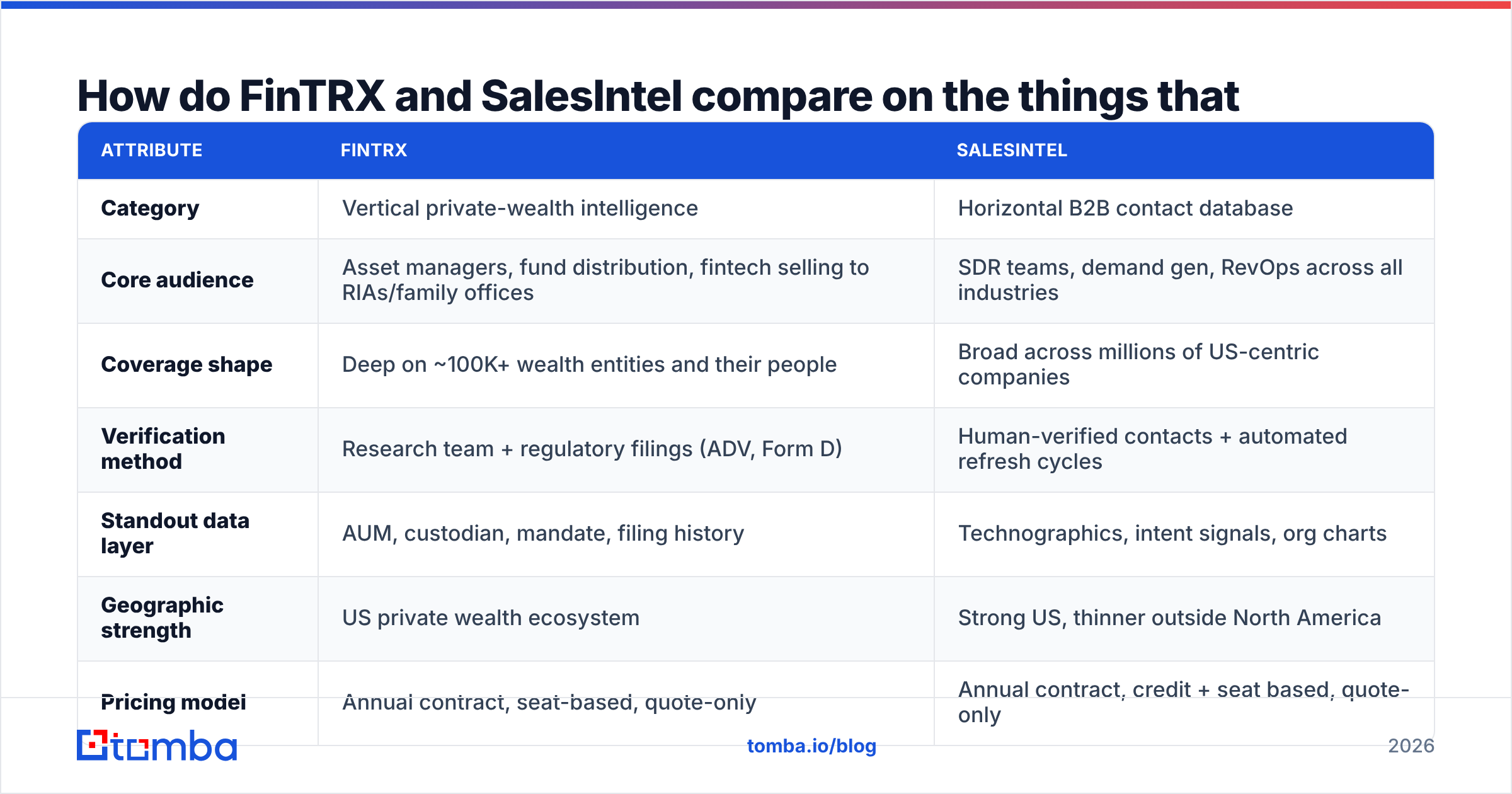
FinTRX vs SalesIntel: how the two compare#
Here is the head-to-head on the traits that change a buying decision.
| Attribute | FinTRX | SalesIntel |
|---|---|---|
| Category | Vertical private-wealth intelligence | Horizontal B2B contact database |
| Core audience | Asset managers, fund distribution, fintech selling to RIAs/family offices | SDR teams, demand gen, RevOps across all industries |
| Coverage shape | Deep on ~100K+ wealth entities and their people | Broad across millions of US-centric companies |
| Verification method | Research team + regulatory filings (ADV, Form D) | Human-verified contacts + automated refresh cycles |
| Standout data layer | AUM, custodian, mandate, filing history | Technographics, intent signals, org charts |
| Geographic strength | US private wealth ecosystem | Strong US, thinner outside North America |
| Pricing model | Annual contract, seat-based, quote-only | Annual contract, credit + seat based, quote-only |
| Typical entry cost | Five figures/year | Five figures/year |
| Free tier | No — demo only | No — demo only |
| Best for | "Which wealth firms should we target?" | "Give me 5,000 verified contacts in this ICP" |
The pattern is clear. FinTRX answers a targeting question. SalesIntel answers a volume question. Many buyers compare the two after one search for "B2B data platform." That is the wrong altitude. Decide the shape of your problem first.
Which one has better data accuracy?#
Accuracy means something different in each product. A single percentage would mislead you.
FinTRX works from a small, regulated pool. RIAs and broker-dealers file with the SEC and FINRA. Those filings are public, structured, and updated on a schedule. Firm-level records stay current because the source is a government database, not a scraped page. Advisor-level detail is softer. Advisors move firms, and personal emails never appear in ADV filings.
SalesIntel works from human labor. Researchers call and confirm records. The company also publishes a re-check cycle for its contacts. Confidence is high on records the team has touched. But coverage and freshness vary sharply by segment. A VP of Engineering at a Fortune 500 gets re-checked far more often than a founder at a 12-person shop in Poland.
Run this test before you sign either contract:
- Pull 200 real accounts from your own pipeline. Do not use the vendor's demo list.
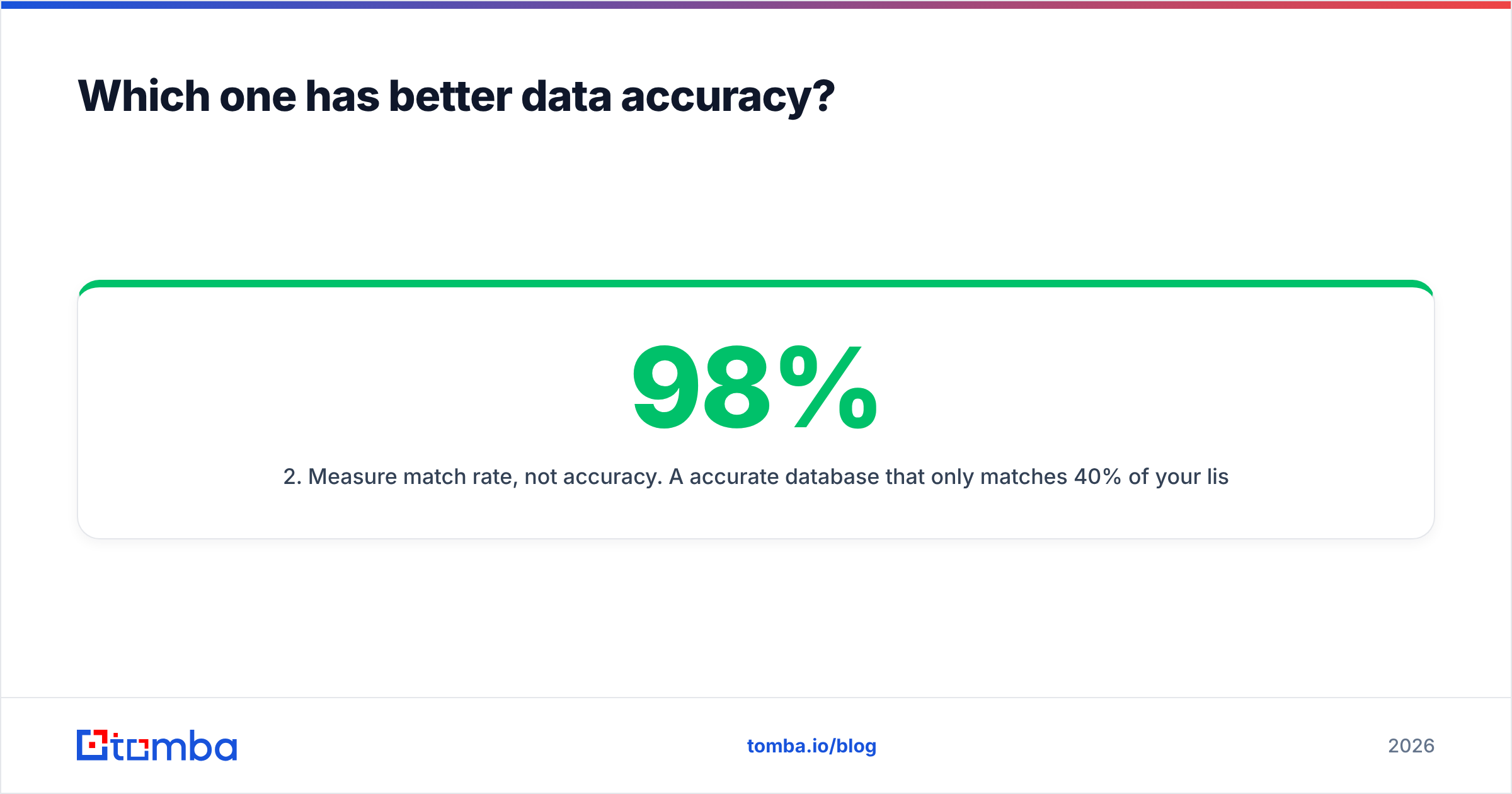
- Measure match rate, not accuracy. A 98% accurate database that matches 40% of your list is worse than an 88% one that matches 85%.
- Check deliverability yourself. Run the export through an independent email verifier. Do not trust the vendor's own status flag.
- Age-test the records. Ask when each contact was last confirmed. Anything over 90 days on a mid-market persona is a coin flip.
- Test the edge of your ICP. Everyone has good data on the obvious accounts.
That last point kills more deals than any price fight. Vendors demo the middle of the market. Your reps work the edges.
What does each platform actually cost?#
Neither one posts a price list. That fact tells you something. Both sell through reps on annual contracts.
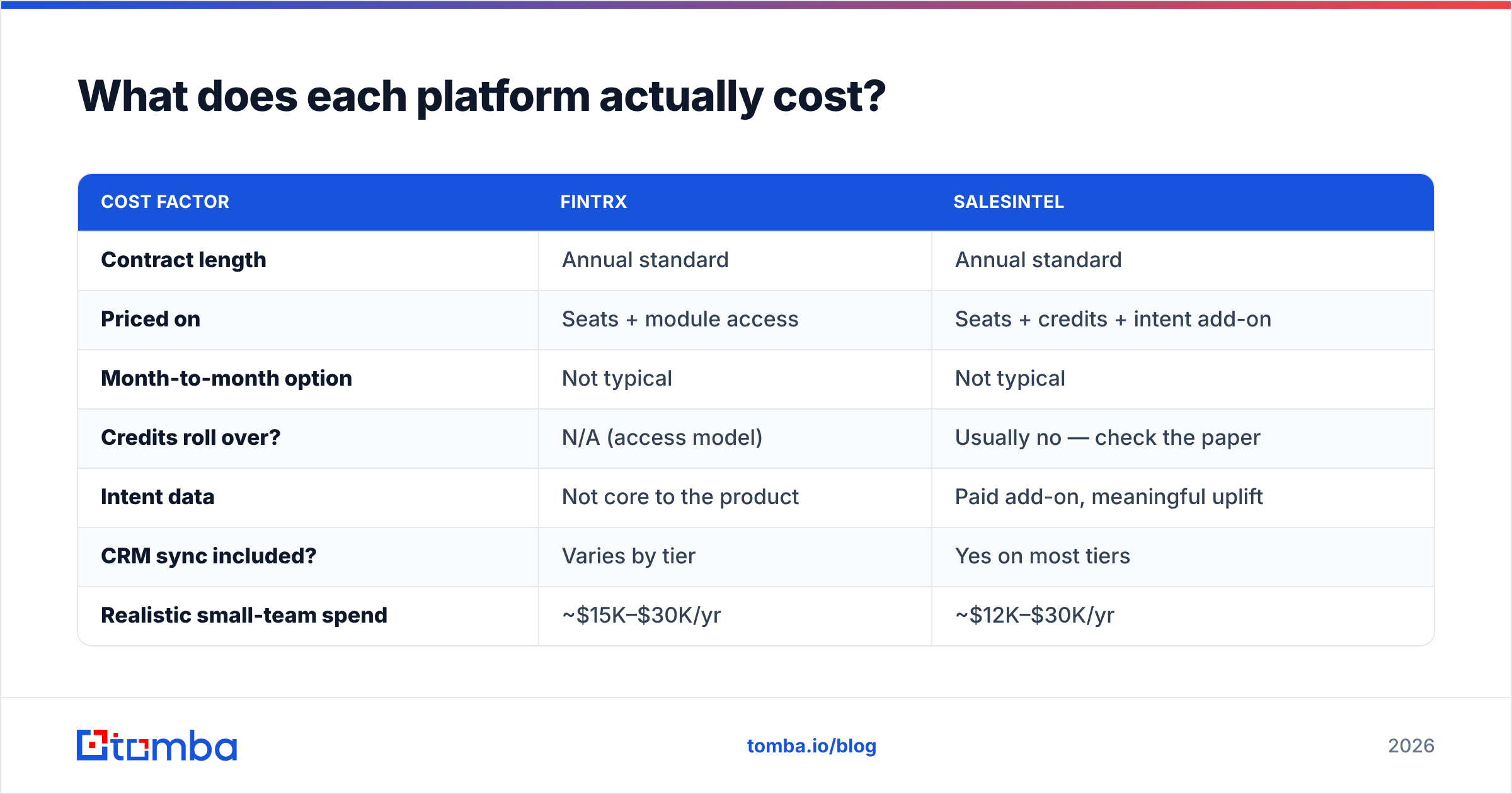
Public figures on review sites like G2 put both in the five-figure range for a small team. Seat count and credit volume drive the number. Here is what to expect.
| Cost factor | FinTRX | SalesIntel |
|---|---|---|
| Contract length | Annual standard | Annual standard |
| Priced on | Seats + module access | Seats + credits + intent add-on |
| Month-to-month option | Not typical | Not typical |
| Credits roll over? | N/A (access model) | Usually no — check the paper |
| Intent data | Not core to the product | Paid add-on, meaningful uplift |
| CRM sync included? | Varies by tier | Yes on most tiers |
| Realistic small-team spend | ~$15K–$30K/yr | ~$12K–$30K/yr |
Two contract terms deserve a lawyer's eye. The first is credit expiration. If unused credits vanish at renewal, your real cost per usable record climbs well past the sticker math. The second is auto-renewal. Notice periods of 30 to 60 days are common here. Miss the window and you have bought another year.
Now compare that to self-serve tools with public prices. Tomba pricing starts free at 25 searches a month. Starter is $49/mo, Growth is $99/mo, and Pro is $249/mo. There is no annual lock-in and no sales call to see a number. This is not a like-for-like swap. Tomba is not a wealth database and does not sell intent data. But it shows what a $25K contract really buys: the dataset and the research team, not the lookup itself.

FinTRX vs SalesIntel: which one fits your team?#
It depends on the question your pipeline cannot answer.
Choose FinTRX if:
- You sell into wealth management. Think fund managers raising from family offices, or vendors selling software to RIAs. The vertical context is the product.
- Targeting is your bottleneck, not volume. You need the 300 firms with the right AUM and mandate. You do not need 30,000 emails.
- Regulatory data drives your qualification. ADV and Form D history show things no general database captures.
Choose SalesIntel if:
- You run volume outbound across many industries and need steady list-building.
- Human-verified phone numbers matter. If your team dials, verified direct dials are worth real money. See also our take on building a B2B phone numbers workflow.
- You want intent signals bundled in instead of buying a second platform.
Choose neither if:
- Your real problem is email discovery. You already know the accounts. You just need working addresses. A domain search plus verification covers that for far less.
- You are pre-product-market-fit. Signing a five-figure data contract before you know your ICP is a costly mistake. Start with usage-based tools. Learn who converts. Then buy the dataset.
What are the alternatives to both?#
The market splits into three layers. Most teams weighing FinTRX vs SalesIntel over-buy, because they treat all three as one purchase.
Layer 1 — Vertical intelligence platforms. FinTRX sits here, next to other industry datasets: healthcare provider directories, construction project trackers, gov-contract intelligence. You buy these when your whole ICP lives in one specialized vertical. Nothing horizontal replaces them.
Layer 2 — Horizontal contact databases. SalesIntel competes here with Apollo, ZoomInfo, Cognism, Lusha, and BookYourData. That last one works differently: pay-as-you-go credits and verify-on-export, instead of annual seat contracts. If you are looking at SalesIntel, price at least two rivals. The quote spread in this layer is huge for similar coverage. Our Apollo alternative breakdown covers the trade-offs.
Layer 3 — Finding and verification utilities. This is where email finders, verifiers, and enrichment APIs sit. They do not tell you who to target. They resolve details for accounts you already picked. The job is narrow, so pricing is public and usage-based.
A good stack pairs one Layer 1 or 2 subscription with a Layer 3 tool. That beats paying premium rates for a database vendor's weak lookup module. Many teams use data enrichment to fill the gaps. Non-US contacts are the usual gap, since both FinTRX and SalesIntel thin out there.
How should you run the evaluation?#
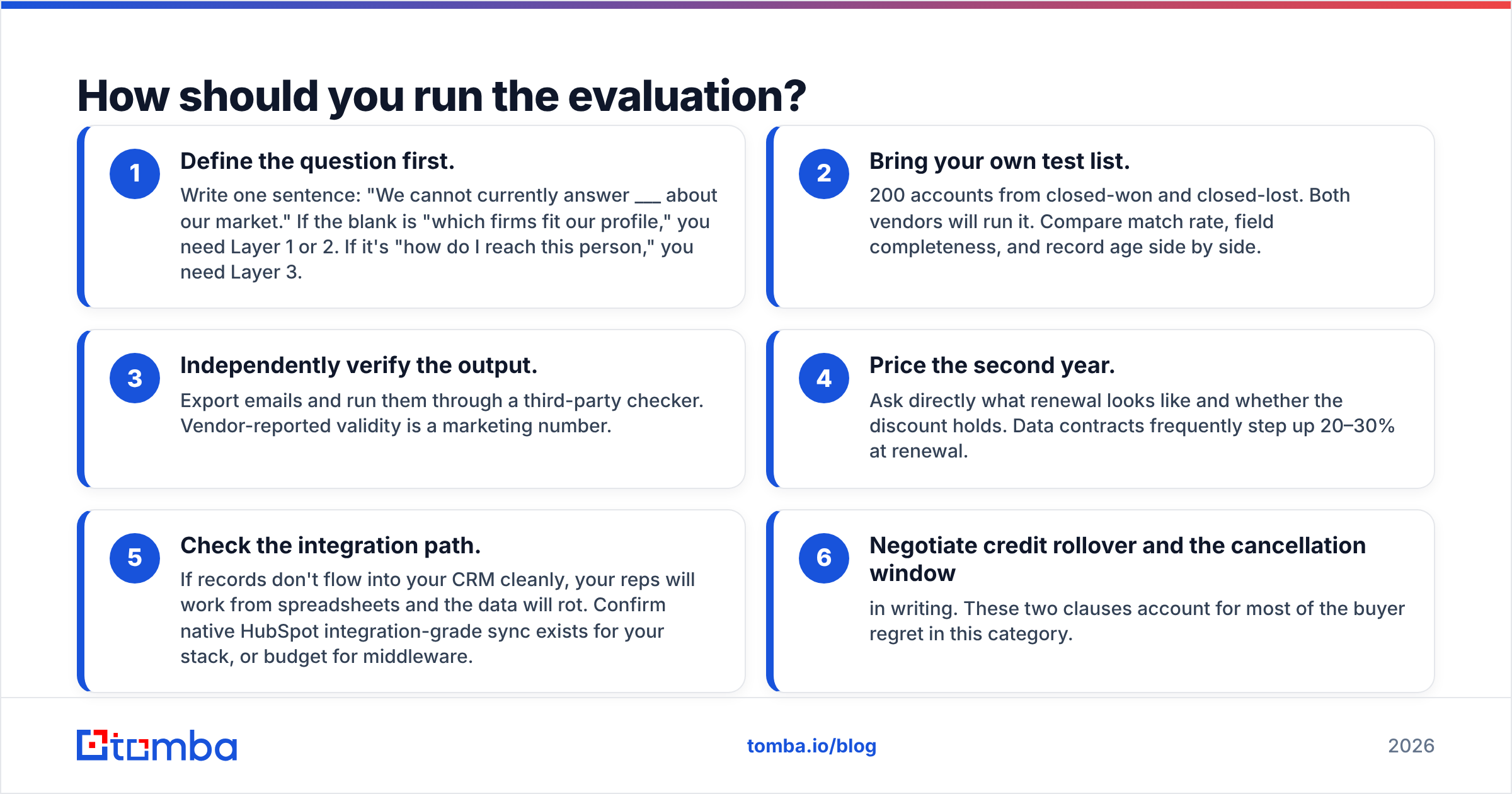
Treat the FinTRX vs SalesIntel decision as a bake-off with a fixed scoring sheet. Do not run a string of demos.
- Define the question first. Write one sentence: "We cannot answer ___ about our market." If the blank is "which firms fit our profile," you need Layer 1 or 2. If it is "how do I reach this person," you need Layer 3.
- Bring your own test list. Use 200 accounts from closed-won and closed-lost deals. Both vendors will run it. Compare match rate, field completeness, and record age.
- Verify the output yourself. Export the emails and run them through a third-party checker. Vendor-reported validity is a marketing number.
- Price the second year. Ask what renewal looks like and whether the discount holds. Data contracts often step up 20–30%.
- Check the integration path. If records do not flow into your CRM cleanly, reps will work from spreadsheets and the data will rot. Confirm you get HubSpot integration-grade sync, or budget for middleware.
- Negotiate credit rollover and the cancellation window in writing. These two clauses cause most of the buyer regret here.
Run this over three weeks, not three months. Data quality decays while you deliberate. Both vendors will re-quote at quarter-end anyway.
The verdict#
There is no universal winner. These tools are not substitutes.
FinTRX wins for anyone selling into private wealth. Horizontal databases do not carry that regulatory depth or firm-level context. Five figures is rational there, because one RIA relationship can be worth millions in AUM flows.
SalesIntel wins for general outbound teams. It suits a US-centric ICP, a dialing motion, and buyers who want intent bundled in. It is a solid pick in a crowded layer, though not the clear leader. Price it against BookYourData, Cognism, and Apollo first. The coverage overlap is real and the quotes vary widely.
One last note on FinTRX vs SalesIntel. Maybe your real blocker is simply getting working addresses for accounts you already know. Then skip both. That is a $49/mo problem, not a $25K/yr one.
Start there: run your target domains through the Tomba Email Finder on the free tier. You get 25 searches a month, no card. Check the match rate against your own list. Then decide whether you need a full data platform at all. If you do, you walk into the vendor call with a baseline to hold them against.
Related guides#
Ready to find emails that actually work?
Join 150,000+ professionals who stopped guessing and started sending. Free credits on signup — no credit card required.
Get the Tomba newsletter
Practical outbound tactics and product updates — once every two weeks.
About the author