FinTRX vs Sparklane: B2B Data Platforms Compared 2026
FinTRX sells depth in private wealth. Sparklane sells AI-scored prospecting signals for European accounts. They barely overlap — here's how to tell which one your pipeline actually needs, and when neither is the right buy.
FinTRX vs Sparklane is a comparison that trips up a lot of buyers. Both are pricey B2B data platforms. Both sell by demo. But they solve different problems, and only one of them may fit yours. Here is the short version.
TL;DR
- FinTRX and Sparklane are not really rivals. FinTRX is a deep database of private wealth firms — family offices, RIAs, and the advisors inside them. Sparklane is a European sales-intelligence tool. It watches company signals and ranks accounts for you.
- Pick FinTRX if you sell to wealth managers in North America. Your whole market is a few tens of thousands of firms, and you need them mapped in detail.
- Pick Sparklane if you sell B2B in France, Benelux, or the wider EU. You get AI-ranked account lists and trigger events, not a static directory.
- Both are quote-only. Both are annual contracts priced per seat. Expect four to five figures a year, not a $49 card charge.
- Need verified contact data for a list you already have? A finder-and-verifier stack costs a fraction of either. It slots in behind both.
What are FinTRX and Sparklane, really?#
Short answer: FinTRX is a map of one industry. Sparklane is a radar for a whole market.
FinTRX built its business around private wealth. It tracks family offices, registered investment advisors, wirehouse teams, broker-dealers, and the people who work there. Records include mandates, AUM bands, custodian ties, and detail pulled from filings. Do you sell alternative investments, fund administration, or fintech into that world? Then FinTRX wants to be your single source of truth.
Sparklane comes from a different tradition. It is a European sales-intelligence platform, French-headquartered and strongest in France and nearby markets. It mixes company data with predictive scoring and buying signals. Hiring surges, funding rounds, exec changes, filings, and news all feed a model. The model ranks which accounts look ready to buy. Then it pushes them into your CRM.
The two tools answer different questions. FinTRX answers "who are all the wealth managers that match this profile, and who works there?" Sparklane answers "out of these hundreds of thousands of companies, which twenty should my reps call this week?"
That gap matters more than any feature scorecard. Buying the wrong category costs far more than picking the second-best tool inside the right one.
FinTRX vs Sparklane: how they compare head to head#
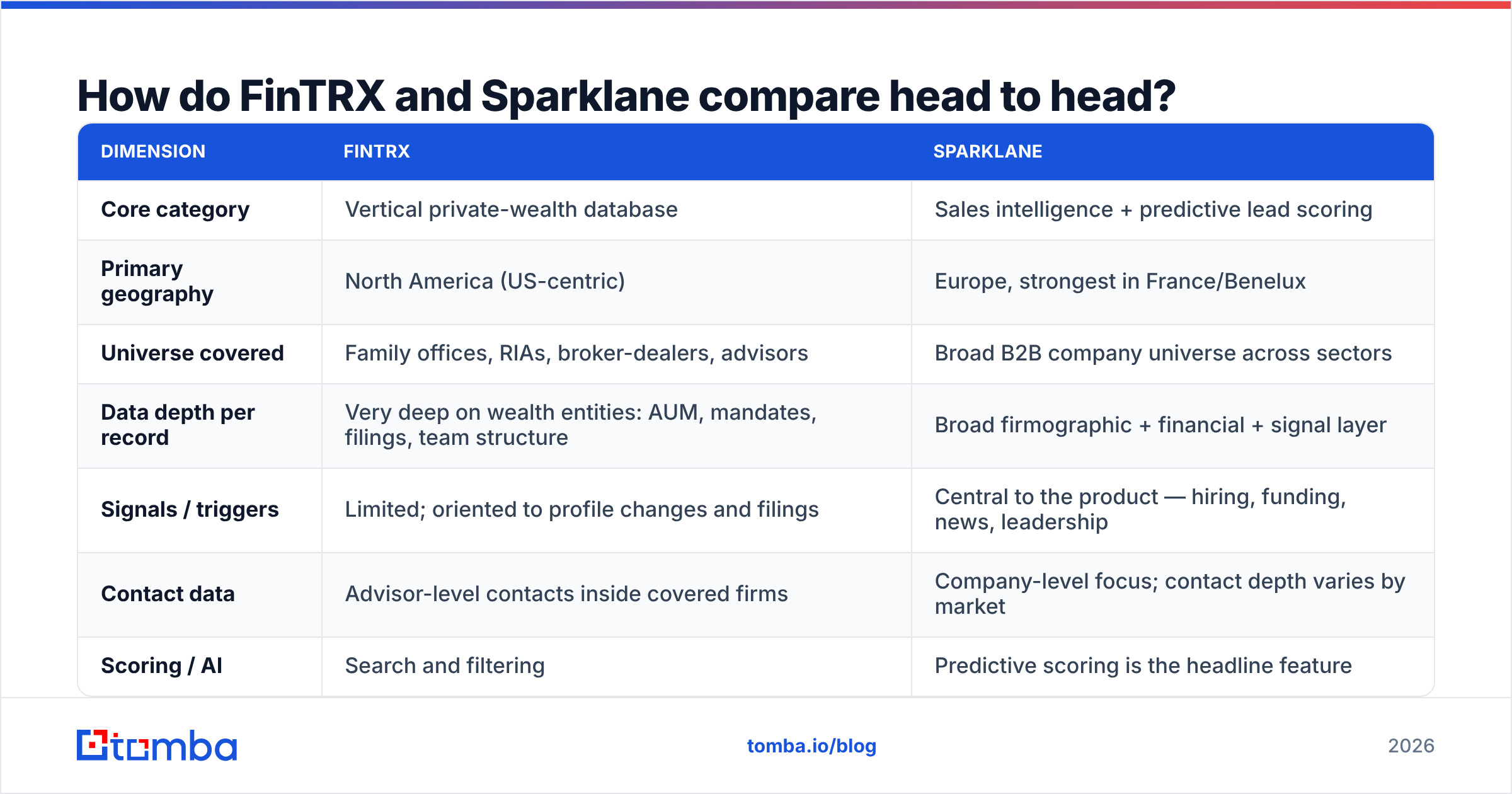
| Dimension | FinTRX | Sparklane |
|---|---|---|
| Core category | Vertical private-wealth database | Sales intelligence + predictive lead scoring |
| Primary geography | North America (US-centric) | Europe, strongest in France/Benelux |
| Universe covered | Family offices, RIAs, broker-dealers, advisors | Broad B2B company universe across sectors |
| Data depth per record | Very deep on wealth entities: AUM, mandates, filings, team structure | Broad firmographic + financial + signal layer |
| Signals / triggers | Limited; oriented to profile changes and filings | Central to the product — hiring, funding, news, leadership |
| Contact data | Advisor-level contacts inside covered firms | Company-level focus; contact depth varies by market |
| Scoring / AI | Search and filtering | Predictive scoring is the headline feature |
| CRM integrations | Salesforce, HubSpot and common CRMs | Salesforce, HubSpot, Pipedrive, Microsoft Dynamics |
| Pricing model | Annual contract, quote-only, seat-based | Annual contract, quote-only, seat-based |
| Free tier | No | No — demo/trial by request |
| Typical buyer | Asset managers, fintechs, fund services selling to wealth | European B2B sales and marketing teams |
Neither vendor publishes a price list. So treat any number you see in a comparison article — including this one — as directional. Both sit in the "book a demo, get a proposal" tier. Both sign annual deals with seat minimums. Check current buyer reviews on G2 before you commit. Contract terms move faster than review sites do.
Which one fits your go-to-market motion?#
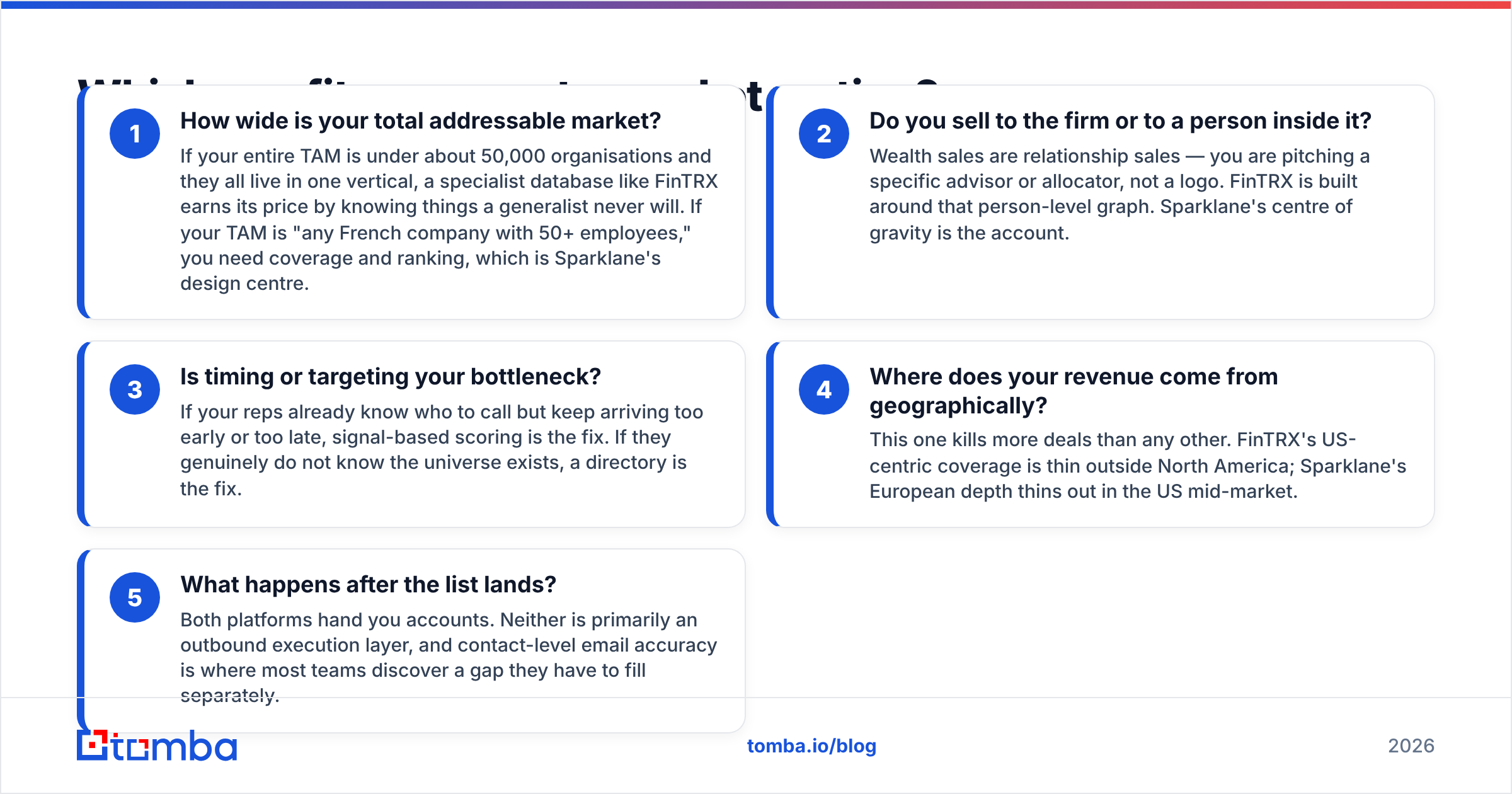
Work through these five questions before you take either demo. They settle the decision faster than a feature matrix.
- How wide is your market? Is your whole market under about 50,000 companies, all in one industry? Then a specialist database like FinTRX earns its price. It knows things a generalist never will. Is your market "any French company with 50+ employees"? Then you need coverage and ranking. That is what Sparklane was built for.
- Do you sell to the firm or to a person inside it? Wealth sales are relationship sales. You pitch a specific advisor or allocator, not a logo. FinTRX is built around that person-level map. Sparklane focuses on the account.
The last three questions are the ones buyers skip. They are also the ones that decide the deal.
- Is timing or targeting your bottleneck? Do your reps know who to call, but keep arriving too early or too late? Then signal-based scoring is the fix. Do they not know the universe exists? Then a directory is the fix.
- Where does your revenue come from? This kills more deals than anything else. FinTRX coverage is thin outside North America. Sparklane's European depth thins out in the US mid-market.
- What happens after the list lands? Both platforms hand you accounts. Neither runs your outbound. Contact-level email accuracy is where most teams find a gap they have to fill on their own.

That fifth point deserves its own section. It is the most common complaint after buying either tool.
Where does contact data fit into either stack?#
Here is the pattern that repeats across almost every rollout. The platform is excellent at naming the 400 accounts that matter. It is only adequate at giving you the working email address of the right person inside them.
That is not a knock on either vendor. Keeping a live, verified contact graph is a different engineering problem. Titles change monthly. People leave. Domains get merged after acquisitions. Catch-all servers make naive checks useless. Vendors that lead in one rarely lead in the other.
In practice, your stack ends up looking like this:
- Layer 1 — universe. FinTRX or Sparklane says who is worth chasing and why.
- Layer 2 — contacts. A dedicated email finder resolves named people at those domains. Domain search pulls the full roster when you have no names yet.
- Layer 3 — hygiene. An email verifier removes anything that would bounce.
- Layer 4 — execution. Your sequencer, dialer, or CRM does the outreach.
Skip layer 3 and your targeting will not save you. A 12% bounce rate on a beautifully scored list still wrecks your sender reputation. Mailbox providers throttle you within weeks.
The cost gap is worth saying plainly. A vertical database or an AI scoring tool is a five-figure yearly commitment. A finder-and-verifier layer starts free. It scales in the tens to low hundreds of dollars a month. Tomba's pricing runs from a free tier at 25 searches a month, then Starter at $49/mo, Growth at $99/mo, and Pro at $249/mo. That is not a swap for either platform. It solves a different layer. But it does mean the contact-quality problem is the cheapest one in your stack to fix properly.
Is FinTRX worth it for non-wealth sellers?#
No. This is the clearest verdict in the comparison.
FinTRX is worth what private wealth is worth to you. The AUM bands, mandate detail, custodian ties, and advisor-team maps are expensive to compile. They are hard to copy. That is why they cost what they cost. Do you sell fund administration software, alternative investments, or wealth-tech? Then the premium is fair. Your whole pipeline lives inside a few thousand firms, and knowing which of them allocates to your asset class beats any volume play.
Sell horizontal SaaS, logistics, or manufacturing services? None of that depth helps you. You would pay for a wealth-industry lens on a market that has nothing to do with wealth. Buy a general B2B data provider instead. Or build the pieces yourself with a B2B database plus data enrichment, and keep the difference.
Is Sparklane worth it outside Europe?#
This one is closer. The scoring method is not tied to a region — signals are signals. The limit is the data supply. Sparklane's best company coverage, filing depth, and news signals are tuned to French and nearby registries, where filings are consistent and machine-readable.
Run the same model over US mid-market firms and the inputs get weaker. Private US financials are simply not published the way French ones are. You still get hiring and funding signals. You lose part of what makes the scoring special.
So: strong buy if your revenue is European and your reps waste time on bad accounts. Weaker case if you are a US team hoping AI will make up for thin inputs. Test it on your own territory, not the demo territory. Ask for 200 accounts from your exact ICP and region. Then check the scores against deals you already won and lost.

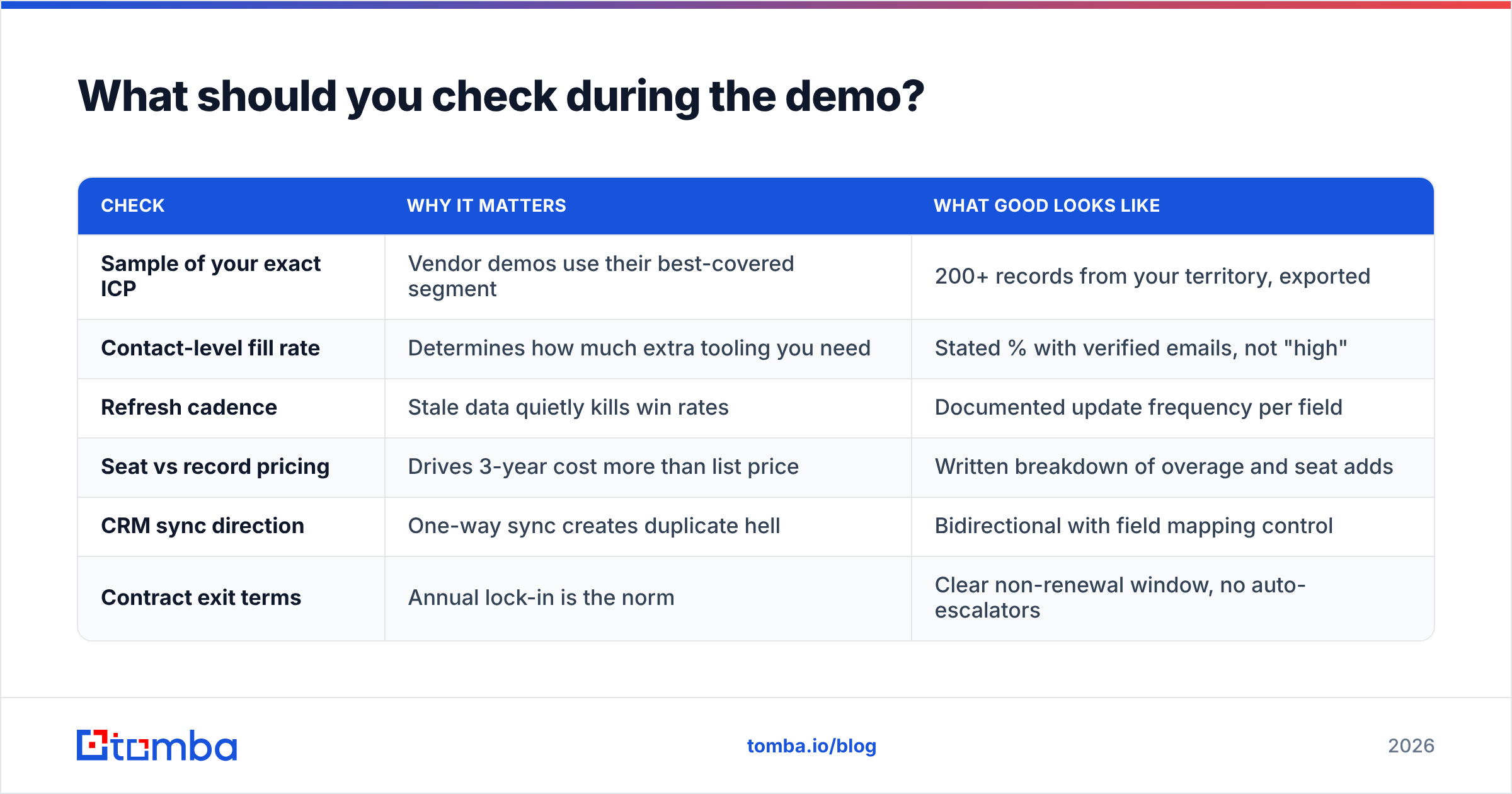
What should you check during the demo?#
Both vendors demo well. Both are quote-only, so the demo is also the negotiation. Bring a checklist.
| Check | Why it matters | What good looks like |
|---|---|---|
| Sample of your exact ICP | Vendor demos use their best-covered segment | 200+ records from your territory, exported |
| Contact-level fill rate | Determines how much extra tooling you need | Stated % with verified emails, not "high" |
| Refresh cadence | Stale data quietly kills win rates | Documented update frequency per field |
| Seat vs record pricing | Drives 3-year cost more than list price | Written breakdown of overage and seat adds |
| CRM sync direction | One-way sync creates duplicate hell | Bidirectional with field mapping control |
| Contract exit terms | Annual lock-in is the norm | Clear non-renewal window, no auto-escalators |
Two more questions vendors rarely volunteer. First: if you churn, what happens to exported data? Do you keep it, and under what licence? Second: how are records counted? "Unlimited search" with capped exports is a very different product.
Also compare adjacent options honestly. Do you just need verified B2B contacts at scale? Providers like BookYourData sell prepaid lists you own outright. That is a different commercial model, and it suits teams who do not want an annual seat commitment. Do you need automation instead? An email finder API will do more for a technical team than any UI-first platform.
So which one wins?#
Neither. FinTRX vs Sparklane was never a fair race, because the two were never in the same category.
Choose FinTRX if private wealth is your market. Nothing generalist matches its depth on family offices and RIAs. The price is rational against a single closed mandate.
Choose Sparklane if you sell B2B in Europe and your problem is priority. The scoring layer earns its keep when reps have more accounts than hours.
Choose neither if you already know your target accounts and just need good contact data. That is the most common case, and the cheapest to fix. Most teams over-buy at the intelligence layer. They under-invest in the accuracy layer that decides whether their emails arrive at all.
Whichever platform you pick, the contact layer underneath decides your reply rate. Run your target domains through Tomba's Email Finder to resolve named contacts. Verify every address before it enters a sequence. Start on the free tier at 25 searches a month and benchmark fill rate against your current provider. It takes an afternoon. It tells you how much of your data problem is targeting and how much is deliverability.
Related guides#
Ready to find emails that actually work?
Join 150,000+ professionals who stopped guessing and started sending. Free credits on signup — no credit card required.
Get the Tomba newsletter
Practical outbound tactics and product updates — once every two weeks.
About the author