Firmographic Data Examples: 12 Fields That Drive B2B Targeting
Industry, headcount, revenue, location, tech stack — see the 12 firmographic data fields that actually change who you target, where each one comes from, and which ones quietly wreck your segments.
TL;DR
- Firmographic data describes the company — industry, headcount, revenue, location, ownership, growth stage — as opposed to the person (demographic) or the behavior (intent).
- The 12 fields below cover about 95% of real B2B segmentation work. Most teams only use three of them well.
- Employee count and revenue are the two most-used and most-wrong fields in commercial databases. Treat every number as a range, never a point value.
- Firmographics decay ~25-30% per year. A list you built in January is measurably worse by June.
- Pair firmographics with a verified contact layer — segmentation is useless if the emails bounce.
What is firmographic data, exactly?#
Firmographic data is demographic data for companies. If demographics tell you a person is 34, lives in Austin, and works in engineering, firmographics tell you their employer is a 220-person Series B fintech headquartered in Austin with $30M in ARR and a Salesforce-based stack.
The term comes from market research and predates modern GTM tooling by decades. The practical definition today: any attribute that describes an organization as an entity, stable enough to filter on, and available before you ever speak to anyone there.
That last clause matters. Firmographics are pre-conversation attributes. You can build an entire target account list from them without a single reply. That's why they sit underneath almost every ICP definition, territory carve-up, lead-scoring model, and pricing tier in B2B.
Three data types get confused constantly:
- Firmographic — company attributes. Industry, headcount, revenue, HQ location, funding stage. "A 500-person logistics company in Rotterdam."
- Technographic — what the company runs. CRM, cloud provider, payment processor, analytics stack. "They run HubSpot and Snowflake."
- Intent / behavioral — what the company is doing right now. Content consumption, job postings, site visits, review-site activity. "Three people from that domain read your pricing page this week."
Firmographics answer should we sell to them. Technographics answer can we integrate. Intent answers should we call today. You need all three, but firmographics are the foundation — get them wrong and the other two are pointed at the wrong companies.

What are the core firmographic data examples?#
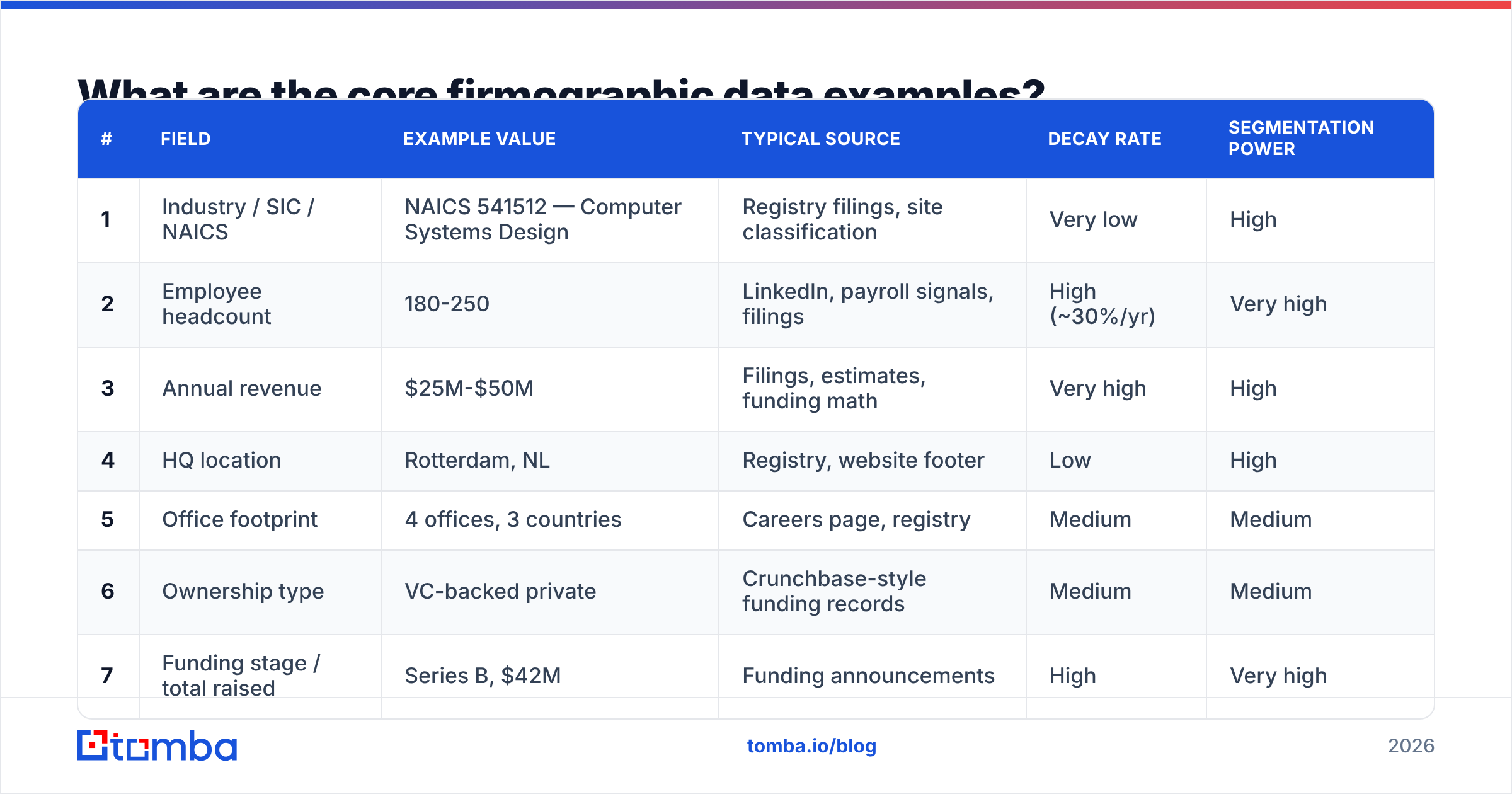
Here are the twelve fields that carry real weight, with where they come from and how badly they rot.
| # | Field | Example value | Typical source | Decay rate | Segmentation power |
|---|---|---|---|---|---|
| 1 | Industry / SIC / NAICS | NAICS 541512 — Computer Systems Design | Registry filings, site classification | Very low | High |
| 2 | Employee headcount | 180-250 | LinkedIn, payroll signals, filings | High (~30%/yr) | Very high |
| 3 | Annual revenue | $25M-$50M | Filings, estimates, funding math | Very high | High |
| 4 | HQ location | Rotterdam, NL | Registry, website footer | Low | High |
| 5 | Office footprint | 4 offices, 3 countries | Careers page, registry | Medium | Medium |
| 6 | Ownership type | VC-backed private | Crunchbase-style funding records | Medium | Medium |
| 7 | Funding stage / total raised | Series B, $42M | Funding announcements | High | Very high |
| 8 | Growth signals | +34% headcount YoY | Headcount deltas, job posts | Very high | Very high |
| 9 | Company age / founded year | 2016 | Registry, domain WHOIS | None | Low |
| 10 | Legal entity structure | GmbH, LLC, PLC | Company registry | Very low | Medium |
| 11 | Domain + email pattern | acme.com — {first}.{last}@ | Domain crawling, verified sends | Low | Operational |
| 12 | Parent / subsidiary structure | Sub of Acme Holdings NV | Filings, ownership graphs | Low | High (enterprise) |
A few of these deserve unpacking, because the naive version of each one will burn you.
Industry looks like the safest field on the list and is the messiest in practice. A company can be legitimately tagged "Software," "FinTech," "Financial Services," and "Payments" simultaneously. Standardized codes (NAICS and its older cousin SIC) exist to fix this, and mostly do — at the cost of granularity. NAICS 541512 lumps a two-person WordPress shop in with a 4,000-person systems integrator. Use codes for compliance and reporting, use vendor taxonomies plus keyword filters for actual targeting.
Employee headcount is the single most-used firmographic field and the most casually mis-stated. Most providers derive it from LinkedIn profile counts, which systematically overstate companies in LinkedIn-heavy markets (US tech) and understate them everywhere else (German Mittelstand, Japanese enterprise, most of the trades). Contractors, part-timers, and offshore teams appear or vanish depending on methodology. Never build a rule on headcount = 200. Build it on headcount between 100 and 400 and accept the fuzz.
Revenue is worse. For private companies it's almost always modeled, not observed — a function of headcount times an industry-specific revenue-per-employee multiplier, sometimes adjusted for funding. That means revenue and headcount aren't two independent signals; in many databases they're the same signal wearing different hats. If your scoring model weights both, you've double-counted one variable.
Funding stage and growth signals are the highest-leverage fields on the list and the ones most teams skip. A Series B company that grew headcount 34% in the last year has budget, urgency, and unsolved process problems. A flat 200-person company that raised nothing in five years has none of those. Same headcount bucket, completely different sales motion.
Where does firmographic data actually come from?#
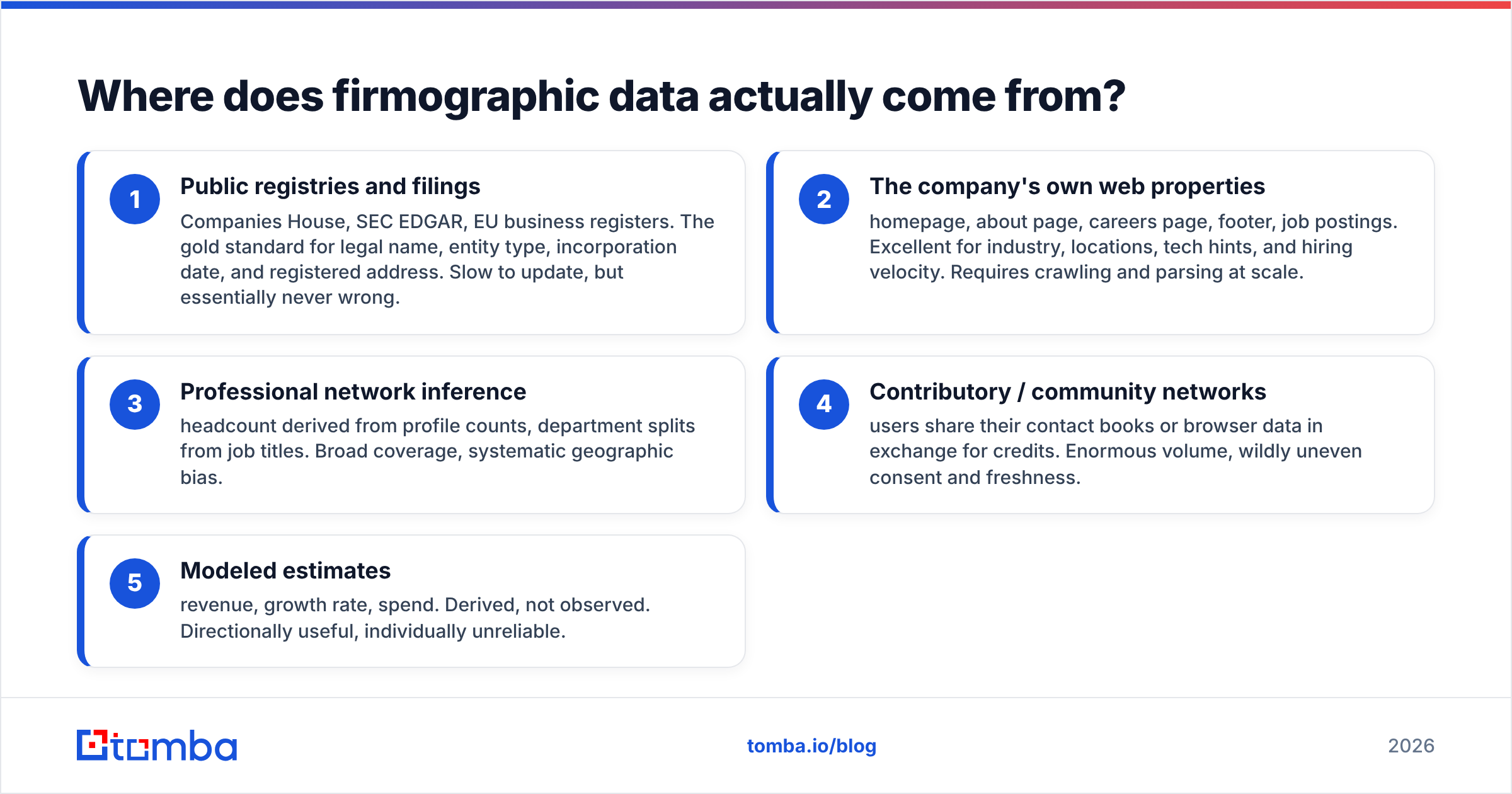
Every firmographic record traces back to one of five origins, and the origin tells you how much to trust it.
- Public registries and filings — Companies House, SEC EDGAR, EU business registers. The gold standard for legal name, entity type, incorporation date, and registered address. Slow to update, but essentially never wrong.
- The company's own web properties — homepage, about page, careers page, footer, job postings. Excellent for industry, locations, tech hints, and hiring velocity. Requires crawling and parsing at scale.
- Professional network inference — headcount derived from profile counts, department splits from job titles. Broad coverage, systematic geographic bias.
- Contributory / community networks — users share their contact books or browser data in exchange for credits. Enormous volume, wildly uneven consent and freshness.
- Modeled estimates — revenue, growth rate, spend. Derived, not observed. Directionally useful, individually unreliable.
Good providers document the mix. Tomba's data sources page explains the crawling and verification approach, and it's worth reading the equivalent page from any vendor you're evaluating — if they don't have one, that's your answer.
The practical takeaway: match your tolerance to the source. Compliance and contracting work needs registry-grade data. Targeting and prioritization can happily run on inferred data with a stated confidence band. Mixing those up — using a modeled revenue figure to set legally binding pricing tiers, say — is how data problems become finance problems.
How do you use firmographic data examples in practice?#
Four workflows account for most of the value.
Building an ICP that isn't a vibe. Export your closed-won accounts. Append firmographics to every one. Then do the boring thing: compare the distribution of your wins against the distribution of your total pipeline. The fields where those distributions diverge sharply are your ICP. If 70% of wins are 100-500 employees but only 30% of pipeline is, headcount is a real qualifier. If wins and pipeline have identical industry mixes, industry isn't predicting anything for you and you should stop filtering on it.
Territory and account assignment. HQ location, entity structure, and parent-subsidiary graphs decide who owns what. The parent-subsidiary field is the one enterprise teams underrate — without it, three reps independently work three subsidiaries of the same holding company and the deal dies in procurement when someone notices three different quotes.
Lead scoring. Firmographics form the "fit" half of a fit-plus-intent model. The classic mistake is over-weighting them — a perfect-fit company that has never heard of you is not a hot lead. HubSpot's guidance on lead scoring treats fit and engagement as separate dimensions for good reason. Keep them separate, then combine at the end.
Message segmentation. A 40-person agency and a 4,000-person bank have nothing in common in what they care about. Headcount plus funding stage is usually enough to justify three or four distinct value propositions. That's a far better use of your time than personalizing the first line of an email while sending the same generic pitch to both.
How do you enrich firmographic data without wrecking your CRM?#
A repeatable sequence, in order:
- Normalize on domain, not company name. "Acme Inc.", "ACME, Incorporated", and "Acme" are three rows and one company.
acme.comis one key. Every enrichment pipeline should resolve to root domain first — that's what domain search is built around. - Enrich company-level fields before contact-level ones. Company records are cheaper, more stable, and let you disqualify entire accounts before you spend credits finding people at them.
- Store confidence and source alongside every value. A revenue figure with no provenance is a rumor. One field for the value, one for where it came from, one for when it was last checked.
- Never overwrite a human-entered value with a machine-inferred one. If a rep talked to the CFO and typed in the real revenue, that beats any model. Enrichment should fill blanks and flag conflicts, not silently replace.
- Then find and verify contacts. Firmographics tell you which accounts to work; you still need people. Run contact enrichment on the accounts that survived filtering, then verify every address with an email verifier before it reaches a sequence.
- Set a refresh cadence per field. Founded year never changes. Headcount should be re-checked quarterly. Funding stage should be event-driven if you can manage it.

Which firmographic data providers should you compare?#
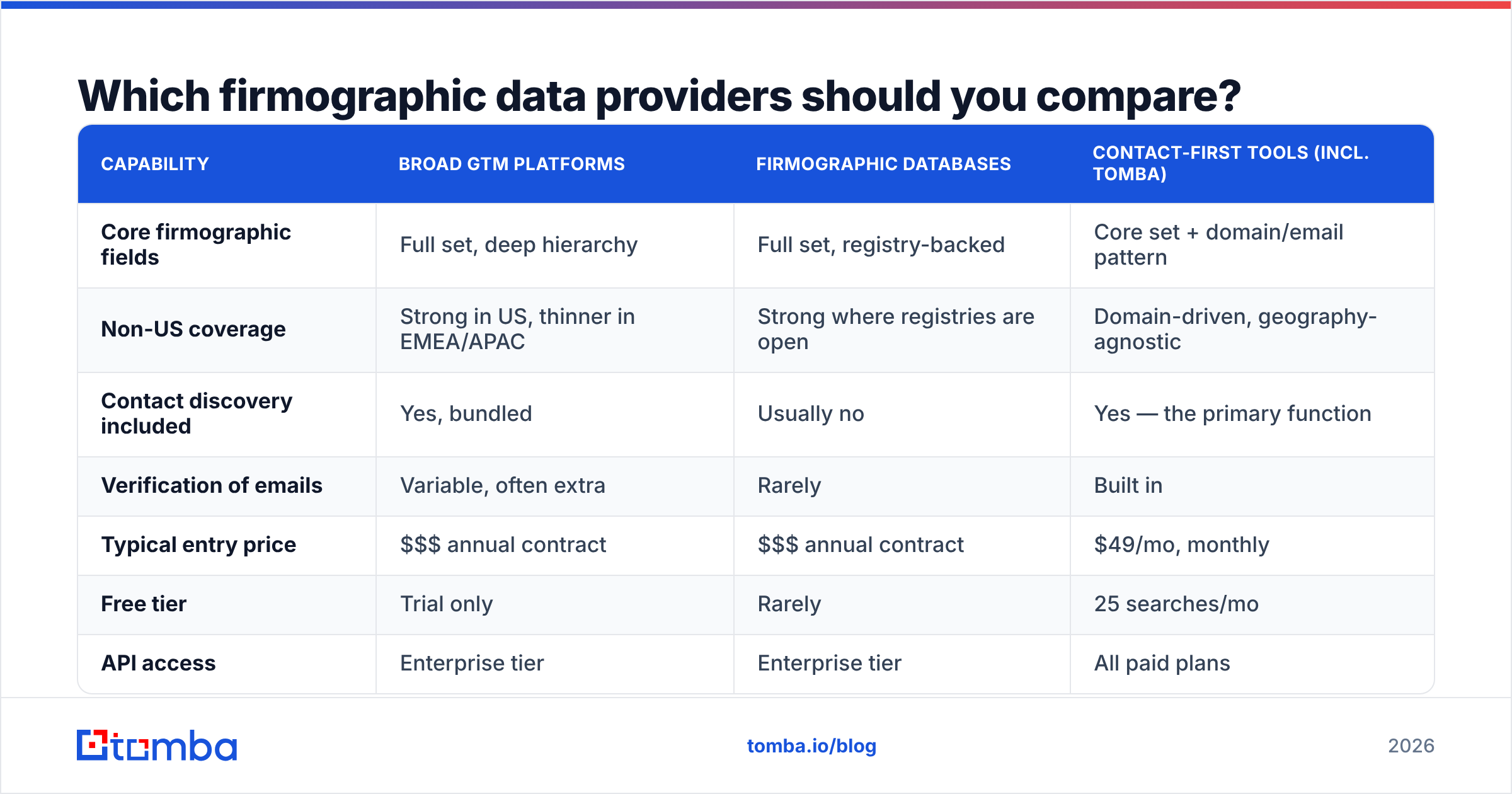
Providers differ less on which fields they carry and more on coverage depth by region, refresh cadence, and how they price the same record twice.
| Capability | Broad GTM platforms | Firmographic databases | Contact-first tools (incl. Tomba) |
|---|---|---|---|
| Core firmographic fields | Full set, deep hierarchy | Full set, registry-backed | Core set + domain/email pattern |
| Non-US coverage | Strong in US, thinner in EMEA/APAC | Strong where registries are open | Domain-driven, geography-agnostic |
| Contact discovery included | Yes, bundled | Usually no | Yes — the primary function |
| Verification of emails | Variable, often extra | Rarely | Built in |
| Typical entry price | $$$ annual contract | $$$ annual contract | $49/mo, monthly |
| Free tier | Trial only | Rarely | 25 searches/mo |
| API access | Enterprise tier | Enterprise tier | All paid plans |
| Best for | Enterprise RevOps | Compliance, risk, finance | Outbound teams and builders |
Two honest notes on this table. First, if you need deep global corporate hierarchies and registry-grade legal entity data — the kind of thing credit and compliance teams live on — a dedicated firmographic database is the right purchase and no email-finder will replace it. Second, if what you actually need is "find the right 2,000 companies and get me verified contacts at them," you're overpaying for hierarchy depth you'll never query.
Vendor-neutral review sites are useful here for coverage complaints specifically — G2's sales intelligence category surfaces the regional gaps that vendor marketing pages never mention. Filter reviews by company size and region closest to your own; a glowing review from a US-only SMB seller tells you nothing about EMEA mid-market coverage.
Providers like BookYourData take a different route — prepaid, pre-built lists with firmographic filters applied up front rather than a live query API. That model works well if you want a bounded one-time purchase rather than an ongoing enrichment pipeline; it's a genuinely different buying motion, not a worse one. Pick based on whether your list-building is a project or a process.
What are the biggest mistakes with firmographic data?#
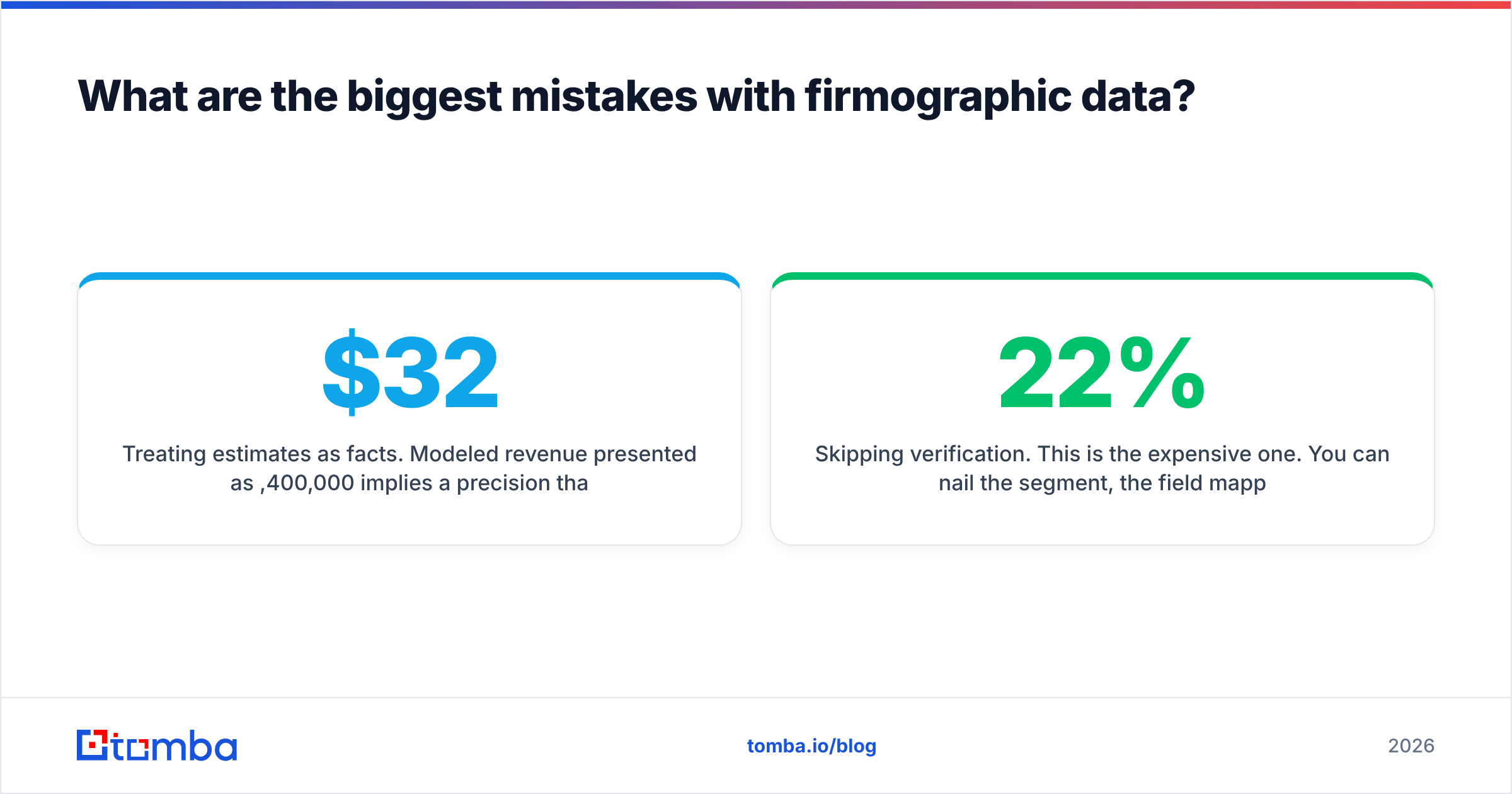
Treating estimates as facts. Modeled revenue presented as $32,400,000 implies a precision that does not exist. The underlying model produced "somewhere in the $25-50M range." Round it, band it, and stop letting false precision into your reports.
Ignoring decay. Firmographics lose roughly a quarter to a third of their accuracy per year. People change jobs, companies get acquired, headcounts swing. A two-year-old enriched list is closer to fiction than data. Re-verify before every major campaign, not after it underperforms.
Over-segmenting. Eleven segments across four industries and three size bands means every segment gets a rushed, mediocre message. Three well-differentiated segments beat eleven neglected ones every time.
Using firmographics alone to time outreach. Fit tells you who. It says nothing about when. A company that has matched your ICP for four years is not more ready today than it was yesterday — you need a behavioral or event trigger for that.
Skipping verification. This is the expensive one. You can nail the segment, the field mapping, and the message, and still hit a 22% bounce rate because nobody checked whether the addresses were live. Bounces damage sender reputation, which suppresses inbox placement for every subsequent campaign, including the ones with good data. Perfect targeting into a burned domain is worth nothing.
Buying hierarchy depth you don't need. Ask concretely: when did you last run a query that required knowing the ultimate parent of a subsidiary? If the answer is never, don't pay for it.
How do you check whether your firmographic data is any good?#
Run this audit quarterly. It takes an afternoon.
- Fill rate by field. What percentage of your accounts have a non-null value for each of the 12 fields? Anything under 60% on a field you filter on means your filter is silently excluding accounts that might qualify.
- Manual spot-check. Pull 50 random accounts. Verify headcount and industry by hand against the company's own site and LinkedIn. Under 80% agreement means recalibrate before you trust any segment built on those fields.
- Staleness distribution. What's the median age of your
last_enriched_attimestamps? If the median is over 12 months, your database is describing a world that no longer exists. - Win-rate by segment. If your "perfect fit" segment doesn't convert measurably better than your "decent fit" segment, your ICP definition is decorative.
- Bounce rate by source. Segment bounce rates by which provider supplied the contact. This surfaces coverage problems faster than any vendor benchmark.
That last check is the one that changes purchasing decisions. Sales intelligence vendors publish accuracy figures they measured themselves; the only number that matters is what bounces on your domains, in your regions, in your industries.
Where do you go from here?#
Firmographic data isn't complicated. It's twelve fields, five sources, and a discipline problem — the teams that win with it are the ones who normalize on domain, band their estimates, refresh on a schedule, and verify before sending. The ones who lose are running a two-year-old export through a shiny new sequencer and blaming the copy.
Start narrow. Pick three fields that genuinely predict your wins, build one clean segment, verify every contact in it, and measure. Then add the fourth field.
When you're ready to turn a firmographic segment into people you can actually reach, the Tomba Email Finder resolves company domains to verified professional email addresses, with domain-level pattern detection and built-in verification so bad addresses never reach your sequencer. The free tier gives you 25 searches a month to test coverage on your own target accounts before committing — and paid plans start at $49/mo with full Tomba API access on every tier. Check the coverage on your ten hardest accounts first. That's the only benchmark that counts.
Related guides#
Ready to find emails that actually work?
Join 150,000+ professionals who stopped guessing and started sending. Free credits on signup — no credit card required.
Get the Tomba newsletter
Practical outbound tactics and product updates — once every two weeks.
About the author