First Party Data Collection: The 2026 B2B Playbook
Third-party cookies are gone and purchased lists decay faster than ever. Here's how B2B teams actually build a first-party data engine in 2026 — sources, stack, costs, and the traps that kill most programs.
TL;DR
- First-party data is anything you collect directly from people who interacted with you — site visitors, form fills, product usage, calls, support tickets, events. You own it, you control consent, and it doesn't expire on a vendor's renewal date.
- Third-party cookie deprecation is only half the story. The bigger driver is that purchased B2B lists decay 22–30% per year, and models trained on them inherit the rot.
- A workable first-party stack has four layers: capture (forms, product events, visitor reveal), identity resolution (stitch anonymous to known), enrichment (fill the gaps), and activation (CRM, ads, sequences).
- Enrichment is not a contradiction. First-party data tells you who showed intent; enrichment tells you how to reach them. The two are complementary, not rival.
- Start with three sources, not twelve. Most programs die from schema sprawl, not from lack of data.
What is first party data collection?#
First-party data collection is the practice of gathering information directly from your own audience, through your own properties, with your own consent record. No intermediary, no broker, no shared cookie pool.
Think of it like the difference between growing vegetables in your garden and buying them at a market stall. The market is faster today. The garden is cheaper, fresher, and still there next season when the stall moves to another street.
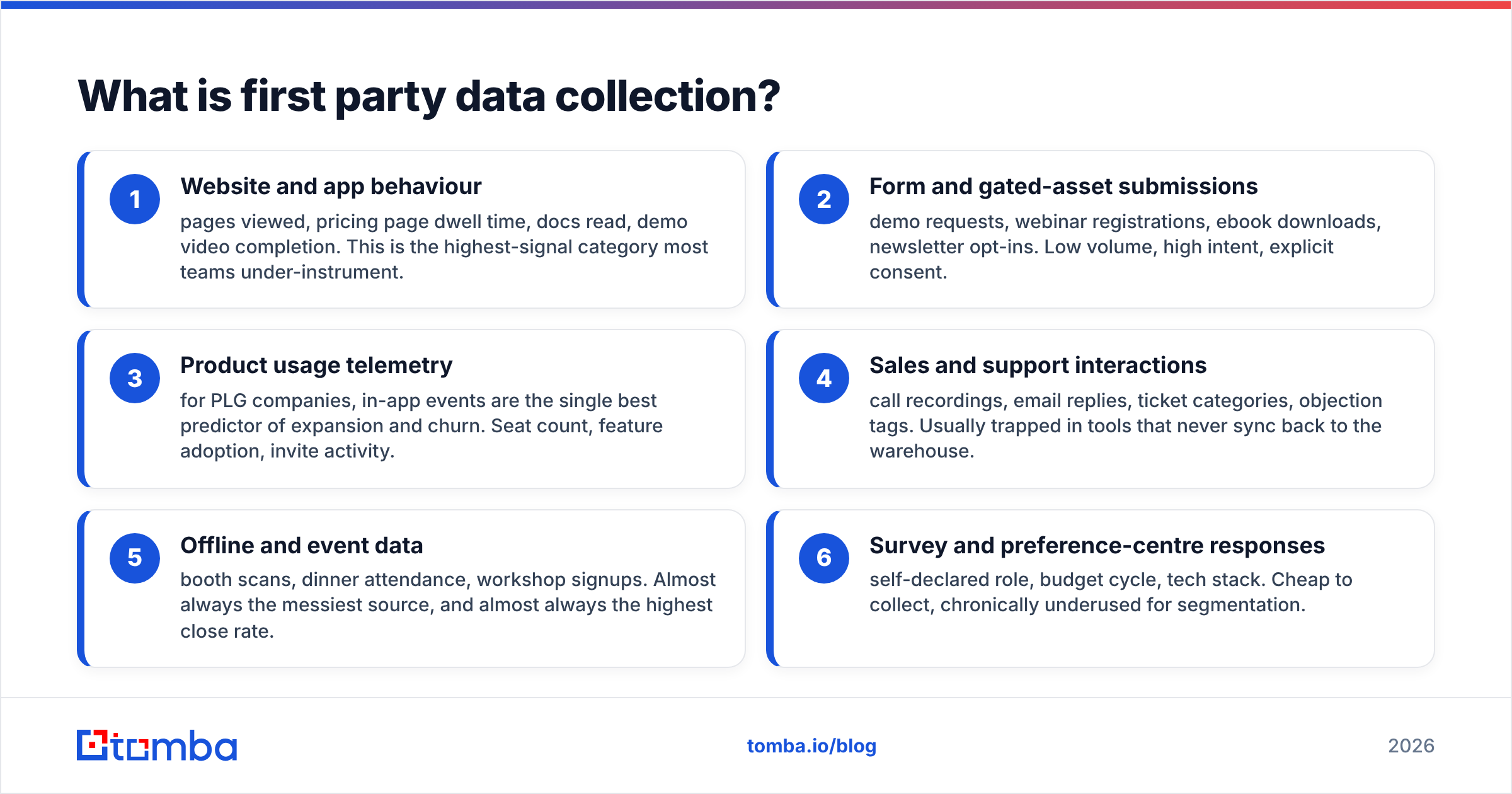
In B2B, first-party data typically includes:
- Website and app behaviour — pages viewed, pricing page dwell time, docs read, demo video completion. This is the highest-signal category most teams under-instrument.
- Form and gated-asset submissions — demo requests, webinar registrations, ebook downloads, newsletter opt-ins. Low volume, high intent, explicit consent.
- Product usage telemetry — for PLG companies, in-app events are the single best predictor of expansion and churn. Seat count, feature adoption, invite activity.
- Sales and support interactions — call recordings, email replies, ticket categories, objection tags. Usually trapped in tools that never sync back to the warehouse.
- Offline and event data — booth scans, dinner attendance, workshop signups. Almost always the messiest source, and almost always the highest close rate.
- Survey and preference-centre responses — self-declared role, budget cycle, tech stack. Cheap to collect, chronically underused for segmentation.
The defining test is simple: if the vendor you bought it from disappeared tomorrow, would you still have it? If no, it isn't first-party.

Why did first party data collection become urgent in 2026?#
Because three deadlines landed at once.
Cookie deprecation finished what it started. Google's long, wobbly retreat from third-party cookies in Chrome, following Safari and Firefox by years, removed the cross-site tracking layer most B2B retargeting quietly depended on. The Chrome Privacy Sandbox documentation is now the reference point for what replaced it, and none of the replacements give you an individual-level identifier.
Regulation stopped being a European problem. GDPR set the template, but state-level US privacy laws now cover a majority of the US population, each with slightly different rules on sale-of-data, opt-out signals, and sensitive categories. Purchased contact lists are the hardest asset to defend in an audit because you cannot produce a consent record you never collected.
Model quality started depending on data provenance. Every AI scoring layer — lead scoring, ICP fit, next-best-action — inherits the biases and staleness of its training input. Feeding a model a two-year-old purchased list produces confident predictions about people who changed jobs eighteen months ago.
The practical consequence: teams that spent 2020–2024 renting audiences are now rebuilding, and the ones who instrumented their own properties early are compounding.
How does first party data compare to second and third party data?#
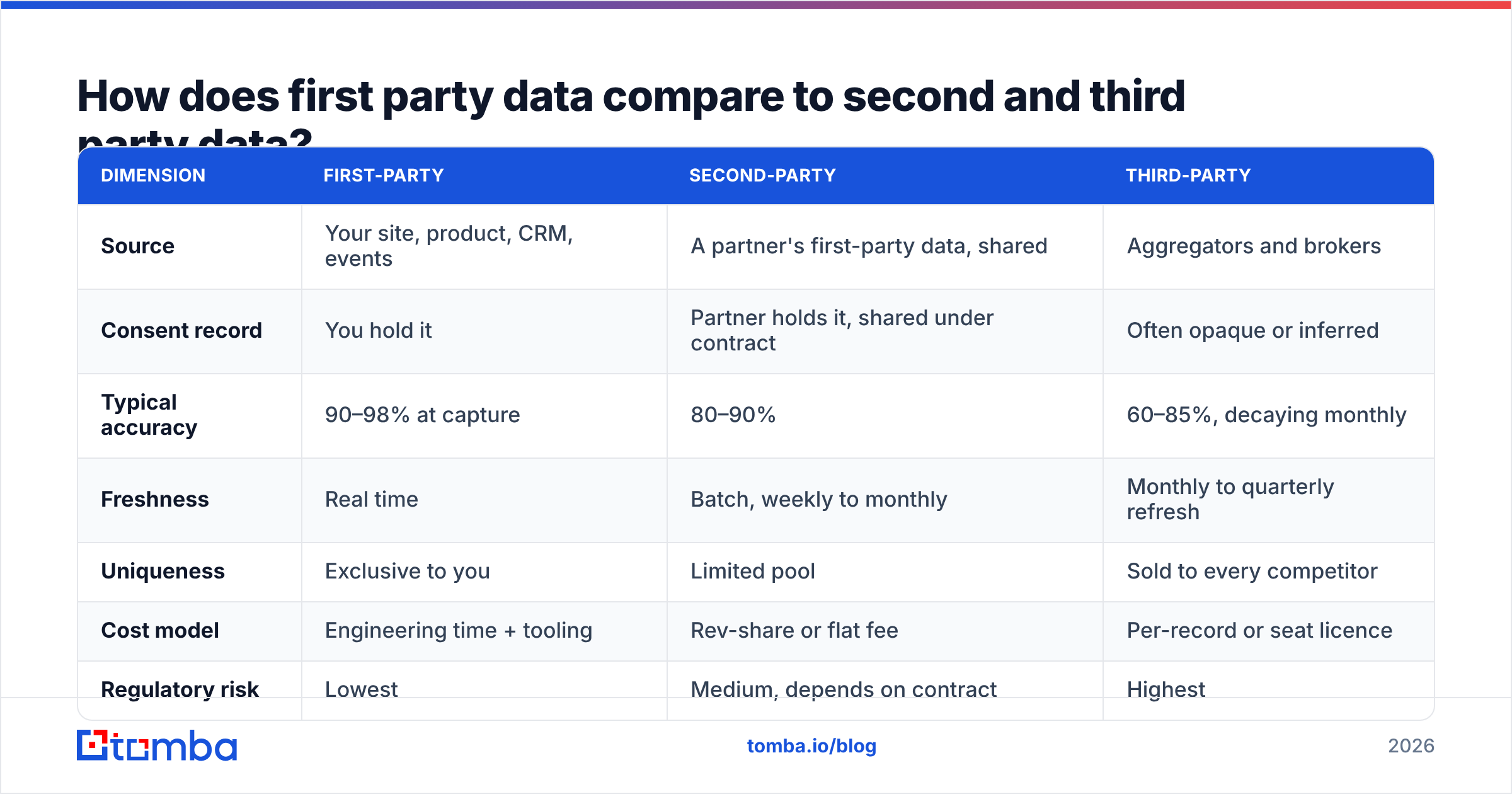
| Dimension | First-party | Second-party | Third-party |
|---|---|---|---|
| Source | Your site, product, CRM, events | A partner's first-party data, shared | Aggregators and brokers |
| Consent record | You hold it | Partner holds it, shared under contract | Often opaque or inferred |
| Typical accuracy | 90–98% at capture | 80–90% | 60–85%, decaying monthly |
| Freshness | Real time | Batch, weekly to monthly | Monthly to quarterly refresh |
| Uniqueness | Exclusive to you | Limited pool | Sold to every competitor |
| Cost model | Engineering time + tooling | Rev-share or flat fee | Per-record or seat licence |
| Regulatory risk | Lowest | Medium, depends on contract | Highest |
| Scale ceiling | Limited to your traffic | Partner's audience size | Effectively unlimited |
| Best for | Scoring, personalisation, retention | Co-marketing, ABM overlap | Cold TAM expansion |
The honest read: first-party data wins on quality and loses on scale. That's not a reason to skip third-party sources — it's a reason to stop treating them as interchangeable. Use third-party data to discover accounts, first-party data to decide what to do with them.
What does a first party data collection stack actually look like?#
Four layers. Skip one and the whole thing leaks.
Layer 1 — Capture. Analytics with server-side tagging, form tooling that writes directly to your warehouse, product event streams, and call/meeting capture. The mistake here is instrumenting pageviews only. Pageviews tell you traffic; events tell you intent. Instrument the pricing page scroll depth, the docs search query, the failed signup.
Layer 2 — Identity resolution. Roughly 95–98% of your B2B traffic is anonymous. Some of it is worth knowing about. Reverse-IP and vendor-graph tooling turns anonymous sessions into account-level signal — this is what website visitor reveal does. It won't give you a named person in most cases, and any vendor promising person-level resolution from IP alone in a GDPR jurisdiction is selling you a liability.
Layer 3 — Enrichment. Your form captured name and work email. Your scoring model wants company size, tech stack, funding stage, and a direct dial. Enrichment fills that gap without asking the prospect eleven questions. Keep form fields to three and let data enrichment do the rest — every removed field measurably lifts conversion.
Layer 4 — Activation. Warehouse to CRM, CRM to sequencer, segments to ad platforms via server-side conversion APIs. If your first-party data lives in a dashboard nobody opens, you built a reporting project, not a revenue system.
Is enrichment still first party data?#
Partly, and the distinction matters for compliance.
The record is yours. The enrichment attributes attached to it came from an external source, and they carry that source's provenance. What makes the combined record defensible is that the relationship — the consent, the interaction, the intent signal — originated with you.
Here's the sequence that works:
- A visitor lands on your pricing page from an organic search and reads for four minutes. First-party behavioural signal, no PII yet.
- They submit a three-field form: name, work email, company. First-party, explicit, consented.
- You enrich that record with firmographics, a job title, a direct dial, and a LinkedIn profile. Third-party attributes on a first-party spine.
- Your scoring model combines the behaviour with the firmographics. The behaviour is what makes the score predictive; the firmographics make it actionable.
Compare that to the reverse — buying 40,000 contacts matching an ICP filter and sequencing them cold. Same enrichment data, zero first-party signal, an order of magnitude worse in reply rate and a materially worse compliance posture.
Where teams get burned is verification. Enriched emails go stale between the vendor's refresh cycle and your send date. Run every enriched address through an email verifier before it enters a sequence, and treat catch-all domains as a separate bucket rather than assuming they're valid. Bounce rate is the fastest way to torch a sending domain you spent months warming.
What are the real costs of building this?#
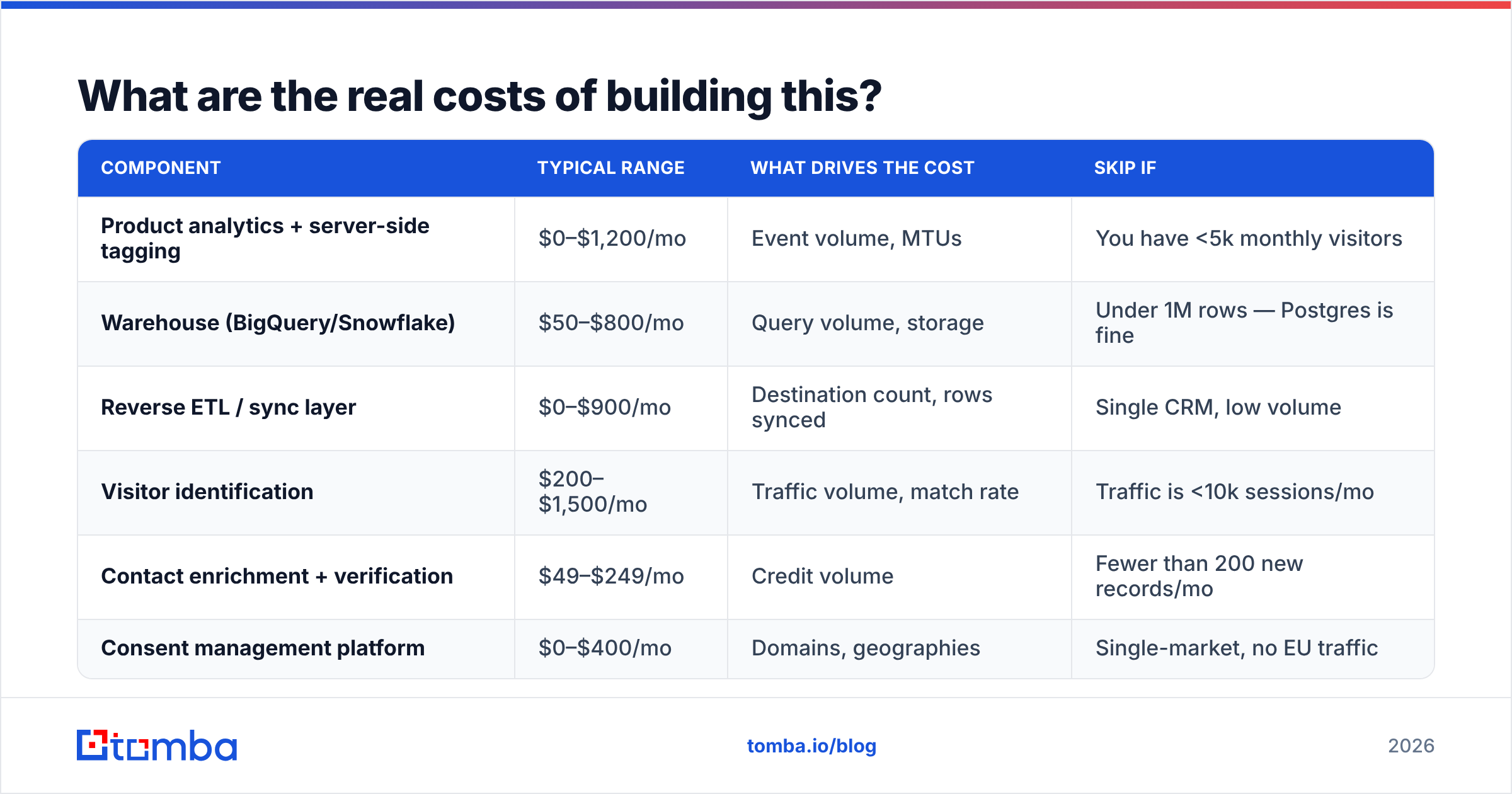
| Component | Typical range | What drives the cost | Skip if |
|---|---|---|---|
| Product analytics + server-side tagging | $0–$1,200/mo | Event volume, MTUs | You have <5k monthly visitors |
| Warehouse (BigQuery/Snowflake) | $50–$800/mo | Query volume, storage | Under 1M rows — Postgres is fine |
| Reverse ETL / sync layer | $0–$900/mo | Destination count, rows synced | Single CRM, low volume |
| Visitor identification | $200–$1,500/mo | Traffic volume, match rate | Traffic is <10k sessions/mo |
| Contact enrichment + verification | $49–$249/mo | Credit volume | Fewer than 200 new records/mo |
| Consent management platform | $0–$400/mo | Domains, geographies | Single-market, no EU traffic |
For reference on the enrichment line, Tomba pricing runs a free tier at 25 searches/month, Starter at $49/mo, Growth at $99/mo, and Pro at $249/mo, with Enterprise custom. Most seed-to-Series-B teams sit on Growth and spend more on the warehouse than on enrichment.
The number people underestimate is engineering time. A functional first-party pipeline is roughly 3–6 weeks of one engineer's attention for the initial build, then ongoing maintenance every time someone changes a form field. Budget for the maintenance, not just the build.

How do you start collecting first party data without a data team?#
Three moves, in order. Resist the urge to do all twelve.
Move 1: Instrument the three pages that predict revenue. Not every page. Pricing, the highest-traffic docs or comparison page, and your demo request page. Track scroll depth, time on page, and exit destination. Within two weeks you'll have a behavioural signal that outperforms most purchased intent data — because it's specific to your product, not a keyword cluster.
Move 2: Cut your forms to three fields and enrich the rest. Every field past three costs you conversions. Ask for work email, name, and one qualifying question that a database genuinely cannot answer — "what are you trying to solve?" beats "company size" every time, because company size is enrichable and intent isn't. HubSpot's own research on form conversion benchmarks has held this line consistently.
Move 3: Close the loop back to the CRM. Signals that don't reach a rep don't produce pipeline. Push the behavioural score into the CRM as a field, set one alert threshold, and let a human decide. Automating the outreach on day one is how you generate a spam complaint before you've validated the signal.
Once those three work, add product telemetry, then event data, then survey. In that order.
What kills first party data programs?#
Five failure modes, all avoidable.
- Schema sprawl. Forty-seven custom properties, none documented, three of them meaning "company size" with different scales. Define your fields before you collect them, and delete anything unused after 90 days.
- Consent theatre. A banner that technically records consent while the tracking script fires before the click. This is the single most common audit finding, and it invalidates everything downstream. The ICO's guidance on cookies and similar technologies is the clearest plain-English reference.
- Collecting without a decision attached. If no one can name the decision a field will change, don't collect it. Storage is cheap; schema confusion is not.
- Treating decay as a one-time problem. Contacts go stale continuously. Set a re-verification cadence — quarterly for active pipeline, biannually for the long tail — rather than a single cleanup project that never repeats.
- Ignoring the anonymous majority. Most teams optimise the 2% who fill a form and completely ignore the 98% who don't. Account-level identification on that traffic is usually the highest-ROI addition to an existing stack.
One more, less obvious: over-indexing on volume. A first-party database of 4,000 genuinely engaged accounts outperforms 400,000 purchased records on every metric that matters — reply rate, meeting rate, close rate, and cost per opportunity. Vendors like BookYourData have built solid businesses on pay-as-you-go verified B2B contacts, and blended approaches work well: use bought data to widen the top of funnel, first-party signal to prioritise who gets a human.
How do you measure whether it's working?#
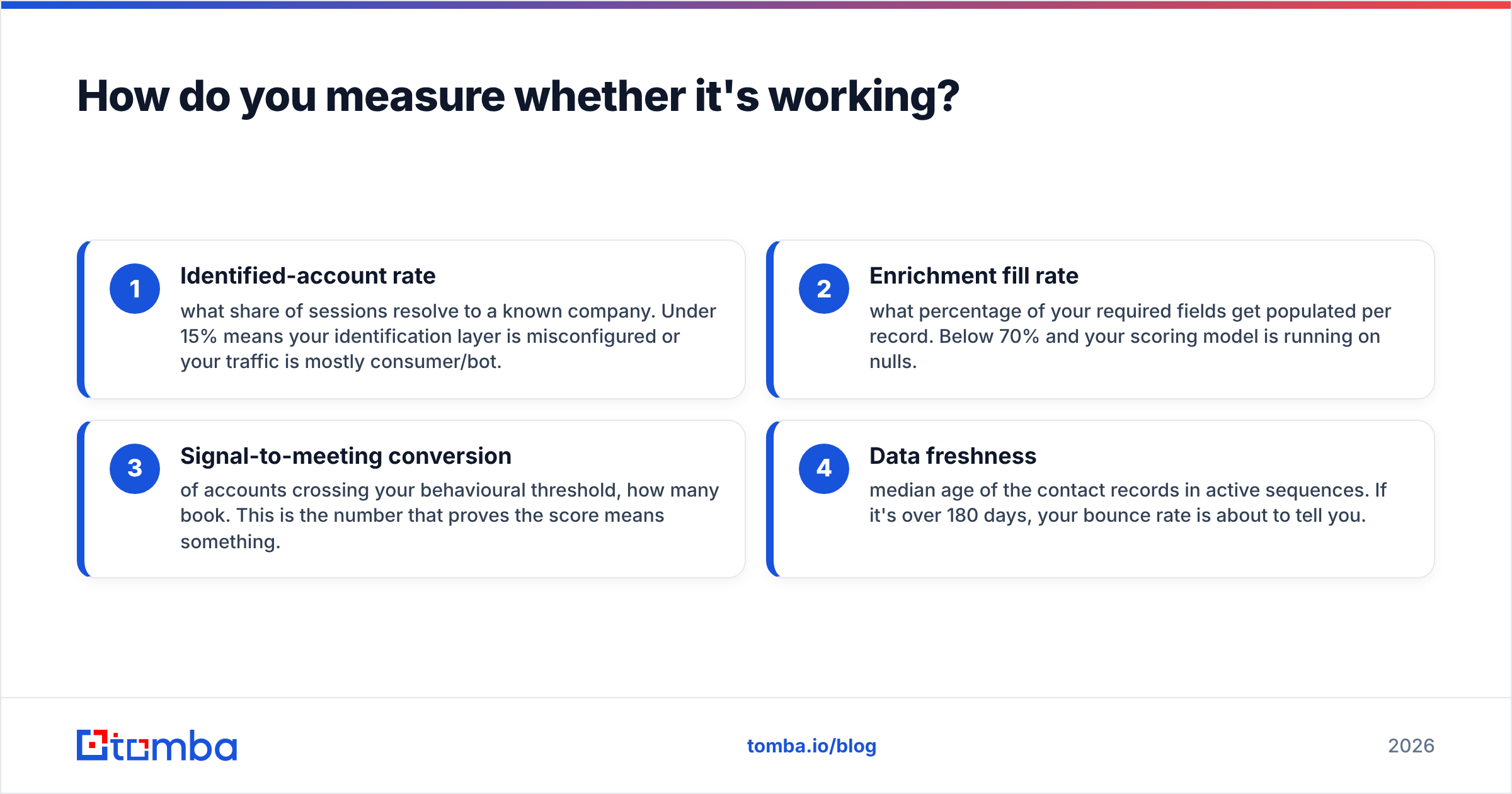
Four metrics, tracked monthly:
- Identified-account rate — what share of sessions resolve to a known company. Under 15% means your identification layer is misconfigured or your traffic is mostly consumer/bot.
- Enrichment fill rate — what percentage of your required fields get populated per record. Below 70% and your scoring model is running on nulls.
- Signal-to-meeting conversion — of accounts crossing your behavioural threshold, how many book. This is the number that proves the score means something.
- Data freshness — median age of the contact records in active sequences. If it's over 180 days, your bounce rate is about to tell you.
Track these against the pre-program baseline. If identified-account rate rises but signal-to-meeting doesn't, your threshold is wrong, not your data.
Where should you start this week?#
Pick the layer that's most broken. For most B2B teams, it's the gap between "we know an account visited" and "we have a person we can actually email." That's a capture-and-enrich problem, and it's the cheapest one to fix.
Start with the Tomba Email Finder to turn identified companies and named contacts into verified, reachable addresses — then push them into your CRM with the behavioural context already attached. The free tier gives you 25 searches a month to validate the workflow before you commit budget, and the Tomba API handles it programmatically once the manual version proves out. Own the relationship first, rent the reach second.
Related guides#
Ready to find emails that actually work?
Join 150,000+ professionals who stopped guessing and started sending. Free credits on signup — no credit card required.
Get the Tomba newsletter
Practical outbound tactics and product updates — once every two weeks.
About the author