First Sales Meeting Tips: A 2026 Playbook That Closes
Most first meetings die from too much pitching and too little prep. Here is a concrete, framework-by-framework playbook for running a first sales meeting that earns a real second one.
TL;DR
- A first sales meeting is not a pitch. Its only job is to earn a specific, calendared second step — everything else is decoration.
- Spend 15–25 minutes on prep per meeting. Below 10 minutes you sound generic; above 40 you are procrastinating.
- Talk-to-listen ratio matters more than your deck. Aim for 40/60 in your favor on listening, and stop talking after every question.
- Pick one qualification framework and run it loosely. MEDDICC, SPIN, and GPCTBA all work; switching between them mid-call does not.
- Close the meeting with a date, a name, and a deliverable. "I'll follow up next week" is how 60% of first meetings quietly die.
What actually happens in a first sales meeting?#
Two conversations run at once. You are trying to learn whether this account has a problem worth solving. The buyer is trying to decide whether you are worth 30 more minutes of their life. Almost every mistake in a first meeting comes from optimizing for the first conversation while ignoring the second.
That framing changes what "success" means. A first meeting where you diagnosed a real pain, disqualified a bad fit, and ended in 18 minutes is a win. A first meeting where you delivered a flawless 40-slide walkthrough and got "this is great, send me some information" is a loss with good manners attached.
The measurable outcome you should track is second-meeting conversion rate — the percentage of first meetings that end with a mutually calendared next step. Most teams sit between 30% and 45%. Teams that treat the first meeting as diagnosis rather than demonstration tend to run 55%+. That single metric predicts your win rate further down the funnel better than almost anything else you can measure at this stage.
How much prep does a first sales meeting really need?#
Fifteen to twenty-five minutes, structured. Not an hour of reading, and not the two minutes you spend skimming a LinkedIn headline in the waiting room.
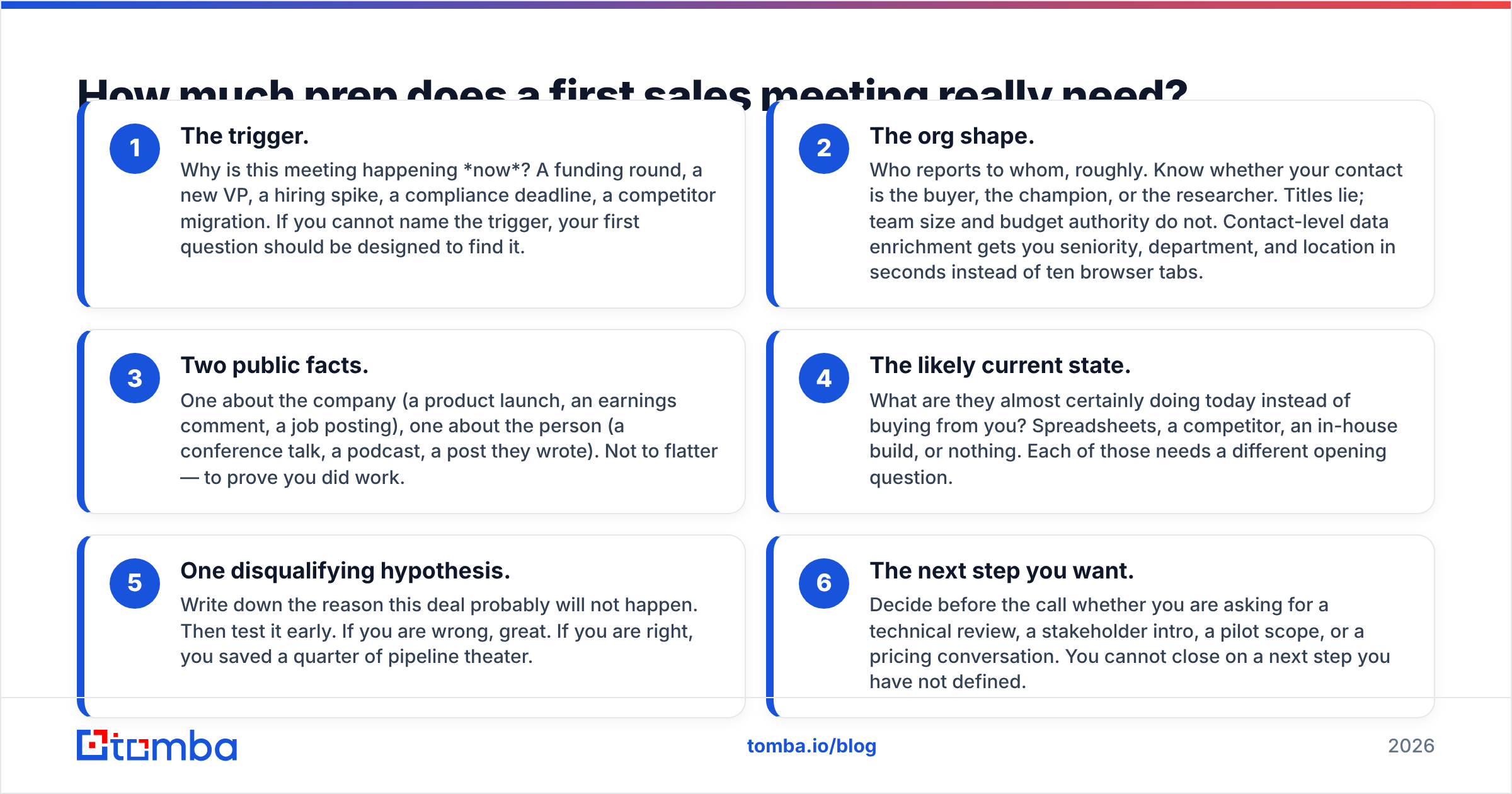
Here is the prep stack that actually changes how the call goes:
- The trigger. Why is this meeting happening now? A funding round, a new VP, a hiring spike, a compliance deadline, a competitor migration. If you cannot name the trigger, your first question should be designed to find it.
- The org shape. Who reports to whom, roughly. Know whether your contact is the buyer, the champion, or the researcher. Titles lie; team size and budget authority do not. Contact-level data enrichment gets you seniority, department, and location in seconds instead of ten browser tabs.
- Two public facts. One about the company (a product launch, an earnings comment, a job posting), one about the person (a conference talk, a podcast, a post they wrote). Not to flatter — to prove you did work.
- The likely current state. What are they almost certainly doing today instead of buying from you? Spreadsheets, a competitor, an in-house build, or nothing. Each of those needs a different opening question.
- One disqualifying hypothesis. Write down the reason this deal probably will not happen. Then test it early. If you are wrong, great. If you are right, you saved a quarter of pipeline theater.
- The next step you want. Decide before the call whether you are asking for a technical review, a stakeholder intro, a pilot scope, or a pricing conversation. You cannot close on a next step you have not defined.
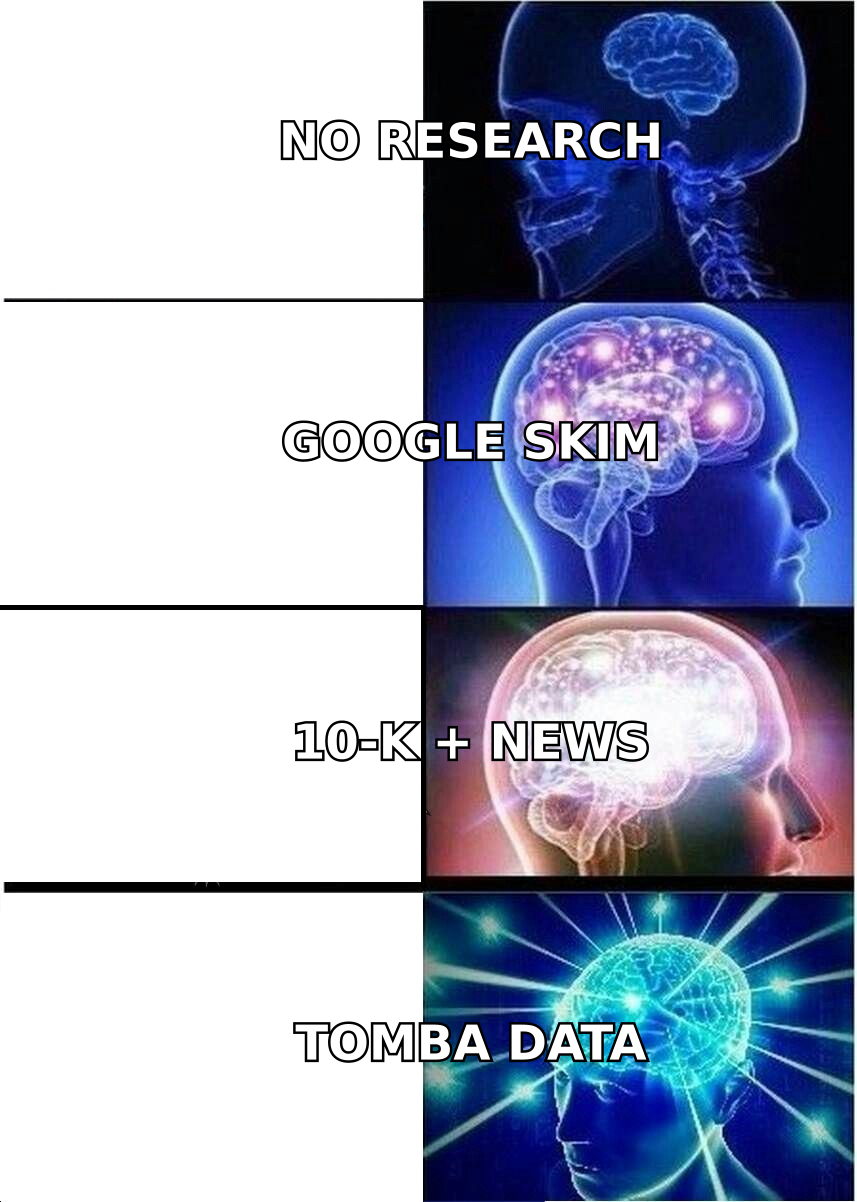
The prep tax is real, which is why it has to be systematized. If you are researching accounts one at a time in a browser, you will skip it under pressure. If contact and company data lands in your CRM automatically — via a HubSpot integration or a scheduled bulk enrichment run — prep becomes reading, not hunting.
What should the first five minutes sound like?#
Short. The opening has three jobs and they take about 90 seconds combined.
Set the frame. "I've got 30 minutes on the calendar. My plan is to spend most of it understanding how you're handling [X] today, then I'll show you the two or three things that are actually relevant. If it's not a fit, I'll say so. Sound reasonable?"
That paragraph does more work than any slide. It tells them you will not monologue, gives them permission to end it, and gets a verbal yes — which meaningfully raises engagement for the rest of the call.
Confirm the time. "Still good for the full 30?" You will occasionally learn they have 15. Better to know at minute one than at minute 22 when you finally get to the good question.
Ask the trigger question. Not "so tell me about your business" — they know you should already know that. Ask something that proves prep and opens a wound: "I saw you posted three SDR roles last month. Is the plan to scale outbound volume, or fix conversion on what you've already got?"
Research from Gong's conversation analytics has consistently shown that successful discovery calls front-load questions and back-load product talk. The pattern is boring and it works.
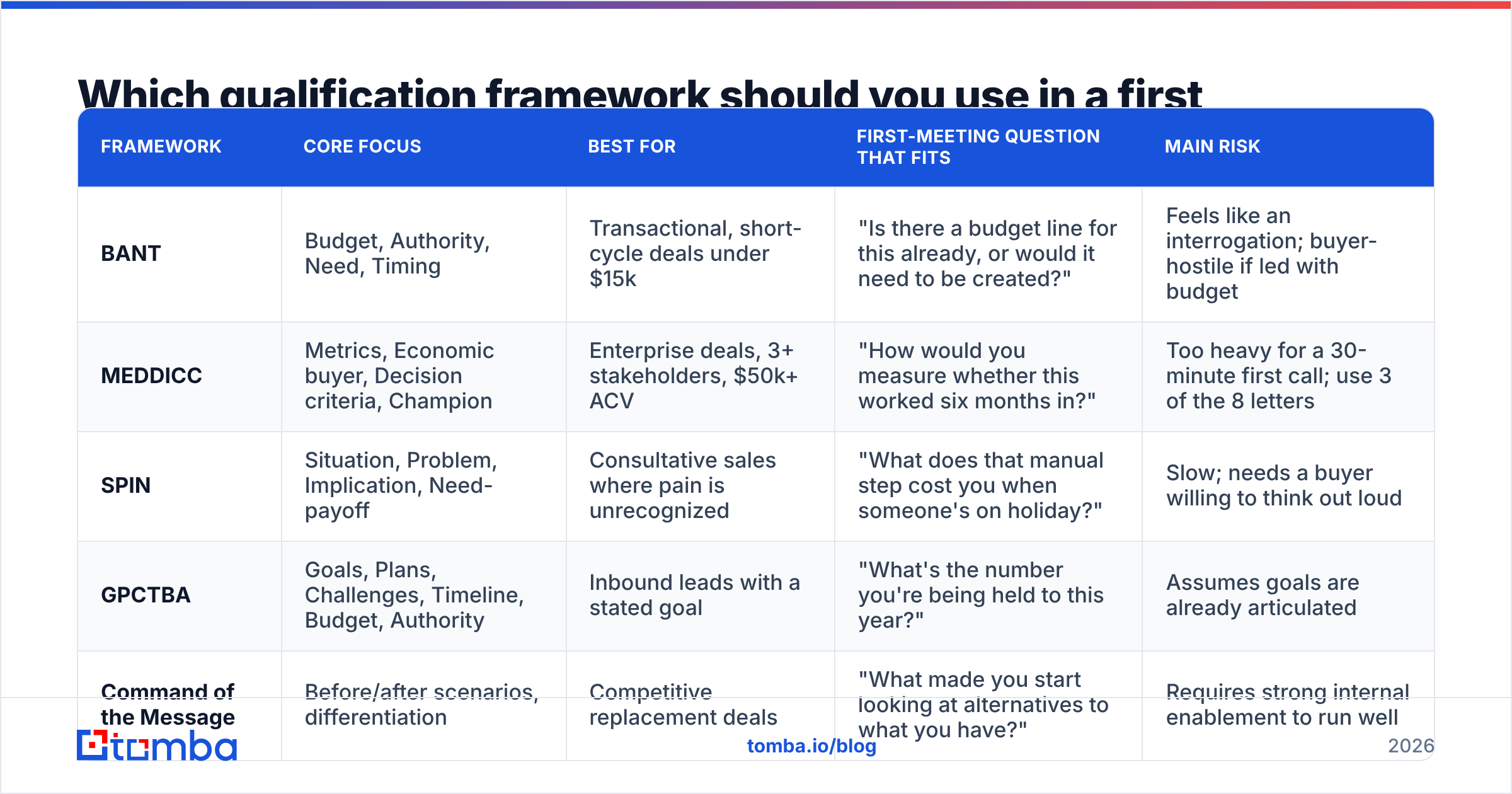
Which qualification framework should you use in a first meeting?#
Pick one and stay in it. The framework is a memory aid, not a script — a buyer can tell when you are working through a checklist, and it makes you sound like a call-center survey.
| Framework | Core focus | Best for | First-meeting question that fits | Main risk |
|---|---|---|---|---|
| BANT | Budget, Authority, Need, Timing | Transactional, short-cycle deals under $15k | "Is there a budget line for this already, or would it need to be created?" | Feels like an interrogation; buyer-hostile if led with budget |
| MEDDICC | Metrics, Economic buyer, Decision criteria, Champion | Enterprise deals, 3+ stakeholders, $50k+ ACV | "How would you measure whether this worked six months in?" | Too heavy for a 30-minute first call; use 3 of the 8 letters |
| SPIN | Situation, Problem, Implication, Need-payoff | Consultative sales where pain is unrecognized | "What does that manual step cost you when someone's on holiday?" | Slow; needs a buyer willing to think out loud |
| GPCTBA | Goals, Plans, Challenges, Timeline, Budget, Authority | Inbound leads with a stated goal | "What's the number you're being held to this year?" | Assumes goals are already articulated |
| Command of the Message | Before/after scenarios, differentiation | Competitive replacement deals | "What made you start looking at alternatives to what you have?" | Requires strong internal enablement to run well |
For a 30-minute first meeting with a mid-market buyer, the pragmatic move is three MEDDICC letters: Metrics, Economic buyer, and Champion. Metrics tell you if the pain is quantified. Economic buyer tells you if you are talking to the right person. Champion tells you whether anyone inside will fight for this when you are not in the room.
How do you run discovery without interrogating?#
Trade information for information. Every two or three questions, give something back — a benchmark, a pattern you have seen, a mistake another customer made. This turns an interview into a conversation and dramatically raises the quality of what you get back.
Three techniques that carry most of the weight:
- The layered why. First answer is the surface. "We're evaluating tools" becomes, after two more questions, "our CRO got burned on data quality last quarter and now every vendor gets a bake-off." That second version is the actual deal.
- The silence. After you ask a real question, stop. Four seconds of quiet is uncomfortable for you and productive for them. Most reps talk over the most valuable pause in the call.
- The negative check. "It sounds like this might not be a priority until Q1 — am I reading that right?" Buyers correct you when you understate their urgency. It is the cheapest way to test timeline honestly.
Also: take notes visibly and say you are doing it. "Give me one second, I'm writing that down" signals that the answer mattered. It also means your follow-up email can quote them, which is the difference between a summary and a mirror.
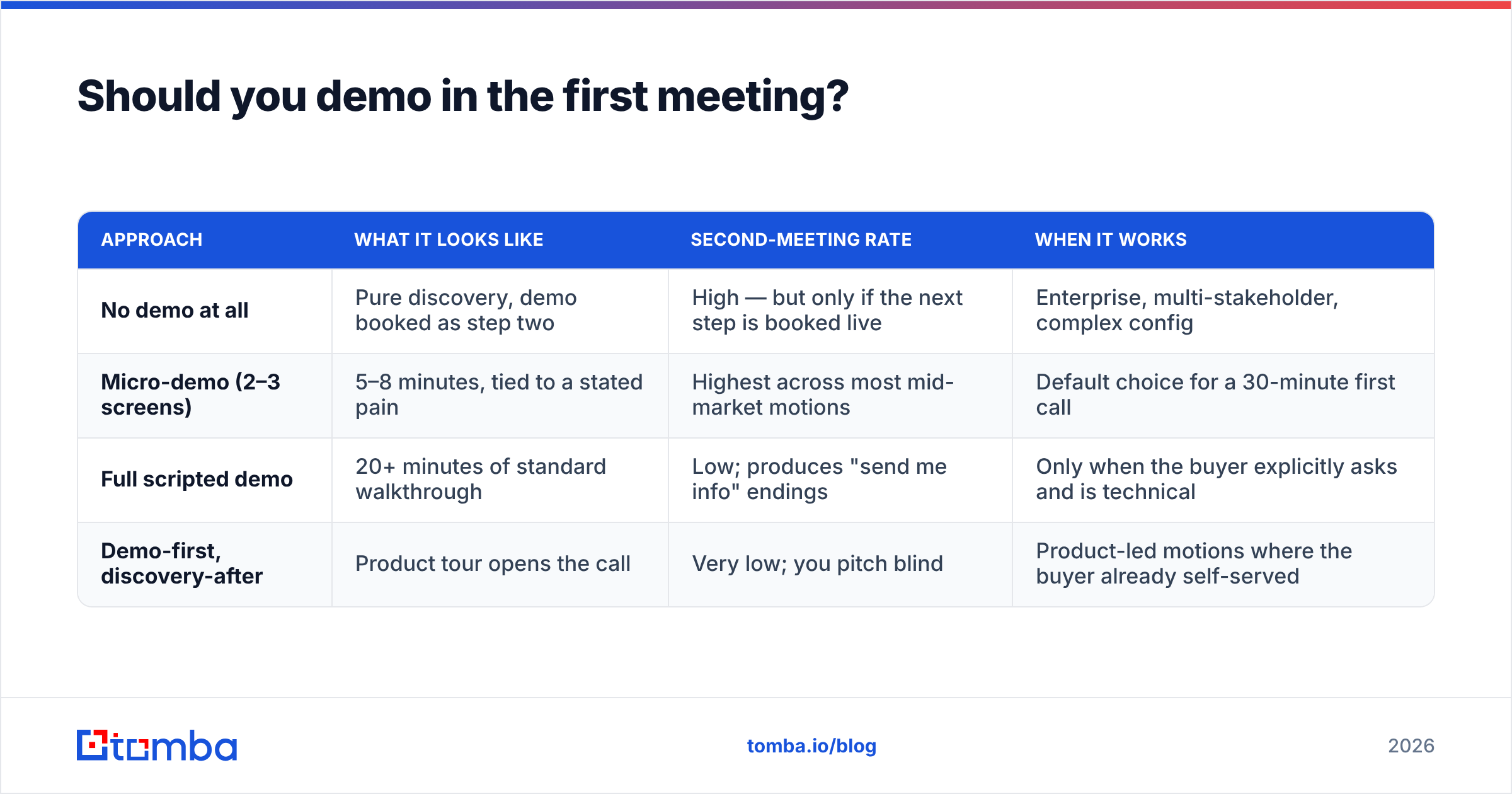
Should you demo in the first meeting?#
Usually not the full thing. Show two or three screens, chosen live, in response to something they said. Nothing else.
| Approach | What it looks like | Second-meeting rate | When it works |
|---|---|---|---|
| No demo at all | Pure discovery, demo booked as step two | High — but only if the next step is booked live | Enterprise, multi-stakeholder, complex config |
| Micro-demo (2–3 screens) | 5–8 minutes, tied to a stated pain | Highest across most mid-market motions | Default choice for a 30-minute first call |
| Full scripted demo | 20+ minutes of standard walkthrough | Low; produces "send me info" endings | Only when the buyer explicitly asks and is technical |
| Demo-first, discovery-after | Product tour opens the call | Very low; you pitch blind | Product-led motions where the buyer already self-served |
The micro-demo works because it converts your claim into evidence at the exact moment they care. The full demo fails because it front-runs the diagnosis: you are answering questions the buyer has not asked yet, and every irrelevant feature is a small withdrawal from their attention.
What does a strong close to a first meeting look like?#
Three sentences, always in this order.
Recap what you heard. "So the situation is: two reps are spending a day a week cleaning lists, your data vendor's accuracy dropped after the last refresh, and you need this sorted before the January push."
Name the gap. "The thing I don't know yet is whether your ops lead needs to sign off on how the data gets in."
Propose the specific next step. "Here's what I'd suggest: 45 minutes next Tuesday or Thursday with you and your ops lead, and I'll come with a sample run against 200 of your actual target accounts. Which day works?"
Notice what that close contains: a date, a person, and a deliverable. Vague closes ("I'll send some materials over") are how good meetings become dead pipeline. If they will not commit to a next step in the room, ask directly why — the answer is usually the real objection, arriving late.
How do you follow up so the second meeting actually happens?#
Send it within two hours, while the meeting is still emotionally recent. The structure that gets replies:
- Subject line that references their words, not yours. "Re: the January list-cleanup problem" beats "Great speaking with you."
- A three-bullet recap using their language, not your product vocabulary.
- One open question you owe them an answer to, or they owe you.
- The calendar link or the accepted invite, already sent separately.
- One asset, maximum. A case study from a similar company. Not a resource library.
If new stakeholders came up during the call, get their contact details before you write the email — that ops lead you need for meeting two is far easier to loop in when you already have their address. A domain search against the company gives you role-filtered contacts in one pass, and running them through an email verifier before you send keeps your sender reputation intact when you introduce yourself cold.
Then set a follow-up cadence and actually run it. HubSpot's sales statistics roundup has long shown that most reps stop after two attempts while most positive responses arrive later. The gap between "sent a recap" and "booked meeting two" is usually three polite touches, not a better email.
What are the most common first sales meeting mistakes?#
- Pitching before diagnosing. If you have not heard a problem stated in their words, you have nothing to pitch to.
- Talking to the wrong person and knowing it. Ask "who else would need to weigh in?" in the first ten minutes, not the last two.
- Confusing interest with intent. "This is really interesting" is not a buying signal. A follow-up question about implementation is.
- Skipping the disqualification. Rejecting a bad fit early buys you time for a good one. Gartner's sales research consistently finds that buyer indecision — not competitor losses — is the largest single source of stalled B2B deals.
- Ending without a next step. The single highest-leverage fix on this list. Book it live, on the call, with the invite sent before you hang up.
- Bad data before the call even starts. Wrong title, wrong company size, wrong contact entirely. Nothing burns credibility in minute one faster than "actually, I don't handle that."
What should you do before your next first meeting?#
Block 20 minutes. Find the trigger, map two stakeholders, write one disqualifying hypothesis, and decide the exact next step you will ask for. That is the whole discipline. Everything else in this post is elaboration on those four items.
The prep only stays consistent if the data is easy to get. If your team is still copy-pasting contacts between LinkedIn, a spreadsheet, and the CRM, use the Tomba Email Finder to pull verified, role-accurate contacts for every account on your calendar — including the second and third stakeholders you will need for meeting two. The free tier covers 25 searches a month if you want to test it against accounts you already know, and paid plans start at $49/mo. Walk into the meeting knowing who you are talking to, and the rest of the playbook gets a lot easier to run.
Related guides#
Ready to find emails that actually work?
Join 150,000+ professionals who stopped guessing and started sending. Free credits on signup — no credit card required.
Get the Tomba newsletter
Practical outbound tactics and product updates — once every two weeks.
About the author