First Touch Attribution: How It Works and When to Use It
First touch attribution gives 100% of the credit to the channel that started the journey. Here is exactly when that is the right call, when it quietly wrecks your budget, and how to fix the data underneath it.
TL;DR
- First touch attribution assigns 100% of the revenue credit to the very first recorded interaction a contact had with your company — the first ad click, the first organic landing page, the first webinar signup.
- It is the correct model when your question is "what should we spend more on to create new demand?" It is the wrong model when your question is "what closed this deal?"
- The model's biggest weakness is not the math. It is the data: dark social, referral loss, cookie expiry, and unmatched anonymous sessions mean your "first touch" is frequently a third touch wearing a disguise.
- Multi-touch models (linear, time decay, W-shaped) are not automatically smarter. They spread credit across the same broken touch data — they just hide the breakage better.
- The practical fix in 2026 is boring: enrich anonymous traffic, resolve contacts to companies, stamp a durable first-touch field on the account record, and stop re-writing it.
What is first touch attribution?#
First touch attribution is a single-touch marketing attribution model that gives all of the credit for a conversion to the first interaction in a buyer's recorded journey. If a prospect clicked a LinkedIn ad in March, read three blog posts in April, attended a webinar in June, and signed a $40,000 contract in August, first touch attribution hands the entire $40,000 to the LinkedIn ad.
That sounds crude, and it is — deliberately. Single-touch models trade precision for interpretability. Every stakeholder in the room understands "this channel started 61 deals last quarter." Nobody argues about the weighting coefficients, because there aren't any.
The model answers exactly one question well: which channels create awareness that eventually turns into pipeline? For a demand-gen team whose job is to fill the top of the funnel, that is not a small question. It is the question.
Where teams get into trouble is applying first touch to problems it was never built for — sales performance, content ROI on late-stage assets, or renewal forecasting. Attribution models are lenses, not verdicts. Use the wrong lens and you will confidently defund the thing that was working.
How does first touch attribution actually work?#
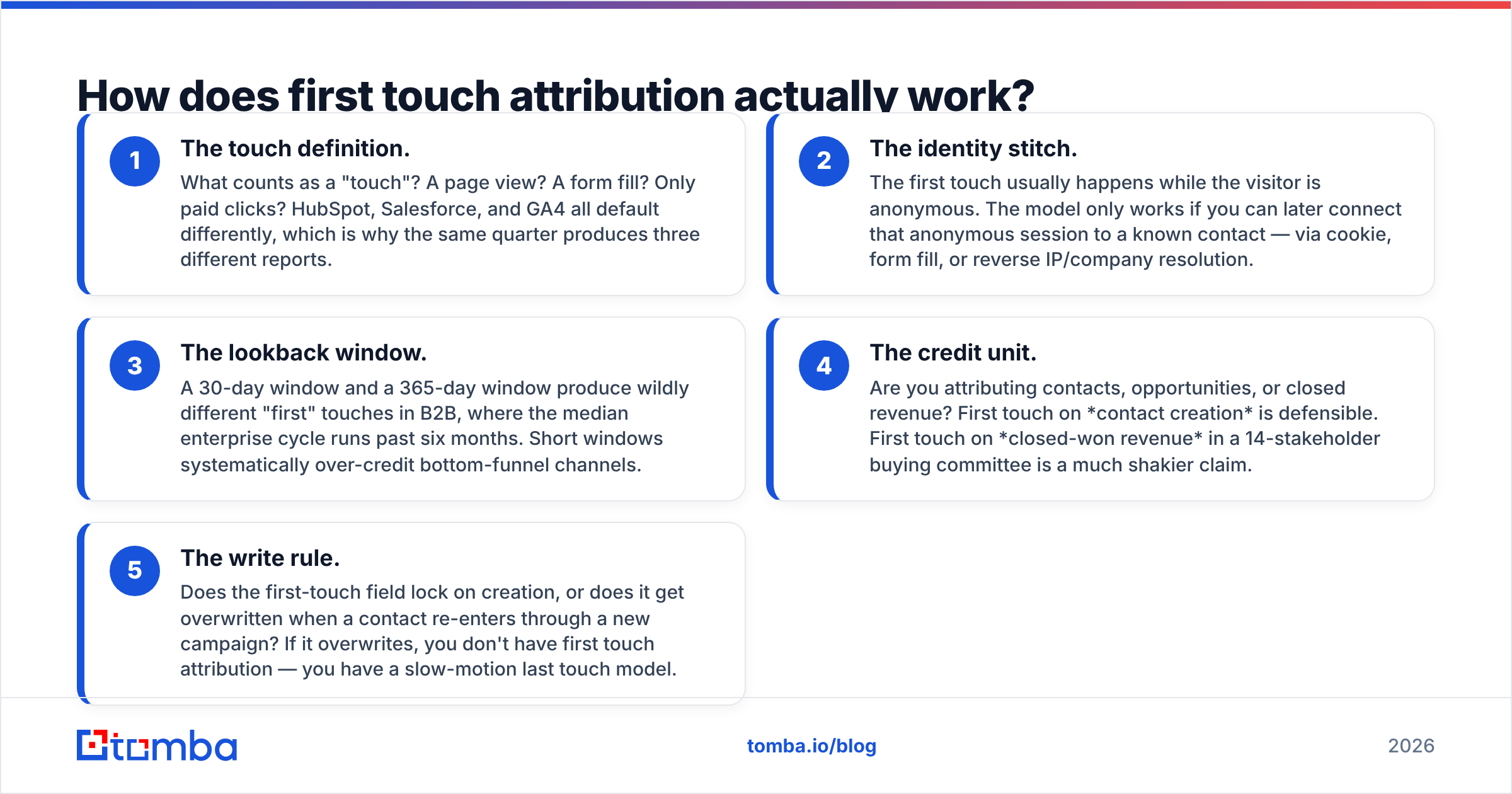
Mechanically, the model has four moving parts. Most attribution disputes trace back to one of these being configured differently than someone assumed.
- The touch definition. What counts as a "touch"? A page view? A form fill? Only paid clicks? HubSpot, Salesforce, and GA4 all default differently, which is why the same quarter produces three different reports.
- The identity stitch. The first touch usually happens while the visitor is anonymous. The model only works if you can later connect that anonymous session to a known contact — via cookie, form fill, or reverse IP/company resolution.
- The lookback window. A 30-day window and a 365-day window produce wildly different "first" touches in B2B, where the median enterprise cycle runs past six months. Short windows systematically over-credit bottom-funnel channels.
- The credit unit. Are you attributing contacts, opportunities, or closed revenue? First touch on contact creation is defensible. First touch on closed-won revenue in a 14-stakeholder buying committee is a much shakier claim.
- The write rule. Does the first-touch field lock on creation, or does it get overwritten when a contact re-enters through a new campaign? If it overwrites, you don't have first touch attribution — you have a slow-motion last touch model.
Get those five settings written down somewhere both marketing and RevOps can see them. Half the "attribution is broken" complaints in B2B are actually "attribution is undocumented" complaints. If your team needs shared definitions, a plain-language B2B glossary beats another 40-slide deck.
First touch vs last touch: which one should you use?#
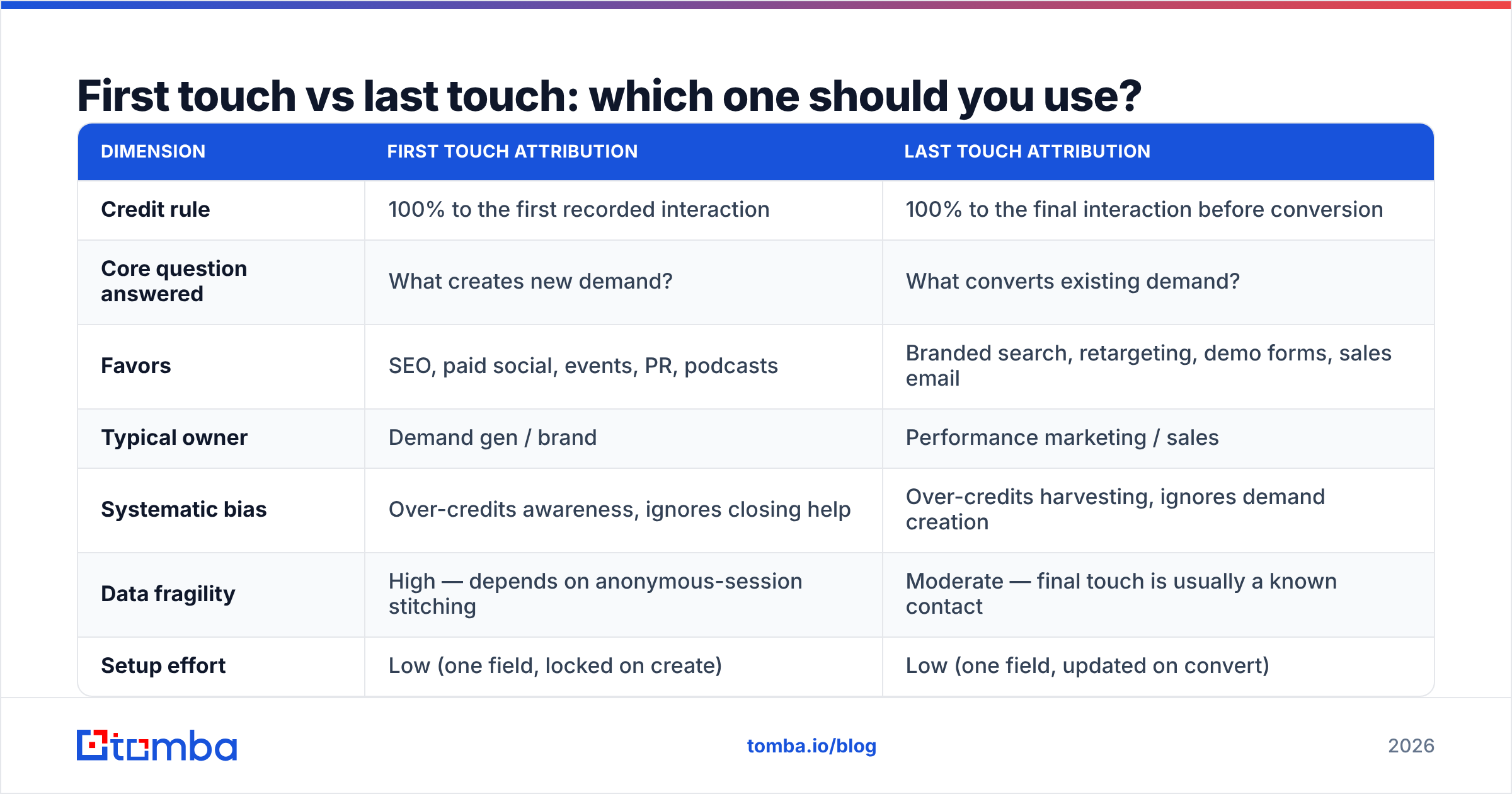
Last touch attribution is first touch's mirror image — all credit to the final interaction before conversion. Both are single-touch, both are "wrong," and both are useful for different budget decisions.
| Dimension | First touch attribution | Last touch attribution |
|---|---|---|
| Credit rule | 100% to the first recorded interaction | 100% to the final interaction before conversion |
| Core question answered | What creates new demand? | What converts existing demand? |
| Favors | SEO, paid social, events, PR, podcasts | Branded search, retargeting, demo forms, sales email |
| Typical owner | Demand gen / brand | Performance marketing / sales |
| Systematic bias | Over-credits awareness, ignores closing help | Over-credits harvesting, ignores demand creation |
| Data fragility | High — depends on anonymous-session stitching | Moderate — final touch is usually a known contact |
| Setup effort | Low (one field, locked on create) | Low (one field, updated on convert) |
| Best for | Channel investment, content strategy, event ROI | Landing page optimization, ad creative tests, CRO |
The honest answer is that mature teams run both, side by side, and treat the gap between them as the interesting signal. If a channel ranks top-three on first touch and bottom-five on last touch, that channel is doing real work that a conversion-optimized dashboard will punish it for. Kill it and your pipeline will thin out two quarters later, long after anyone connects the two events.
G2's attribution software category is full of tools promising to settle this argument with machine learning. They mostly don't. They re-weight the same touch table you already have.
When is first touch attribution the right model?#
Use first touch when the decision on the table is an investment decision, not an optimization decision.
- Long sales cycles. When deals take 6–18 months, the last touch is almost always a sales-triggered event. First touch is the only view that surfaces what started the cycle.
- New market entry. Testing a new vertical, region, or persona? You need to know which entry points work before you care about conversion polish.
- Content and SEO budgeting. Top-of-funnel content rarely wins last touch. First touch is the only model that gives an educational blog post credit for a deal it genuinely started.
- Event and podcast ROI. Field marketing and sponsorships live and die on first touch. Nobody signs a contract from the booth; they sign nine months later after four other touches.
- Brand campaigns. Awareness spend is structurally invisible to last touch. If your CFO wants proof that brand investment produces pipeline, first touch is the least-bad evidence you have.
Skip first touch when you are optimizing a landing page, testing ad creative, comparing sales sequences, or diagnosing why deals stall at proposal stage. Those are conversion problems, and first touch will tell you nothing useful about them.
Where does first touch attribution break down?#
Three failure modes, in order of how much money they waste.
1. The first touch you recorded is not the first touch that happened. This is the big one. Somebody hears about you on a podcast, mentions it in a Slack community, gets a referral from a colleague, then eventually types your brand name into Google. Your CRM records "Organic Search — Branded." Congratulations: you just credited Google for a podcast's work. Dark social is not an edge case in B2B; on some surveys it accounts for the majority of how buyers first hear about vendors, and none of it carries a UTM parameter.
2. Identity resolution fails silently. The anonymous session that produced the real first touch never gets stitched to the contact record. The visitor cleared cookies, switched from mobile to desktop, or arrived through a corporate proxy. The touch isn't wrong — it's simply missing, and the model quietly promotes touch #4 to touch #1.
3. The field gets overwritten. A contact re-enters through a nurture campaign, an integration updates the source field, and eighteen months of demand-gen history is replaced with "Email — Newsletter." This happens constantly and is almost never audited.
None of these are solved by switching to a multi-touch model. Multi-touch models consume the same touch table. If the table is missing the podcast, W-shaped attribution will not hallucinate it back into existence — it will just distribute the error across more channels, which makes it harder to spot.
How does first touch compare to multi-touch models?#
Here is the full landscape, so you can pick deliberately rather than by default.
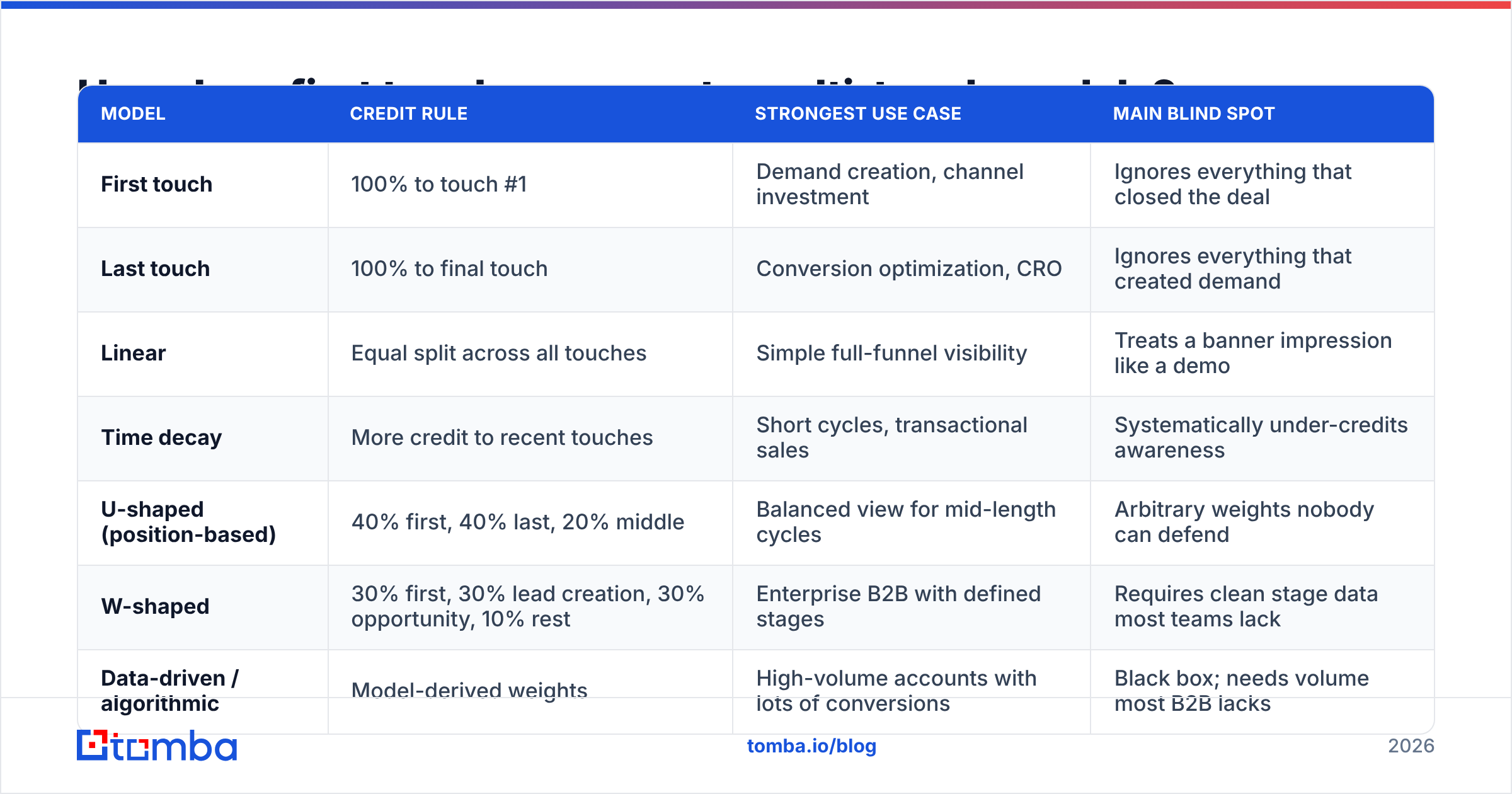
| Model | Credit rule | Strongest use case | Main blind spot |
|---|---|---|---|
| First touch | 100% to touch #1 | Demand creation, channel investment | Ignores everything that closed the deal |
| Last touch | 100% to final touch | Conversion optimization, CRO | Ignores everything that created demand |
| Linear | Equal split across all touches | Simple full-funnel visibility | Treats a banner impression like a demo |
| Time decay | More credit to recent touches | Short cycles, transactional sales | Systematically under-credits awareness |
| U-shaped (position-based) | 40% first, 40% last, 20% middle | Balanced view for mid-length cycles | Arbitrary weights nobody can defend |
| W-shaped | 30% first, 30% lead creation, 30% opportunity, 10% rest | Enterprise B2B with defined stages | Requires clean stage data most teams lack |
| Data-driven / algorithmic | Model-derived weights | High-volume accounts with lots of conversions | Black box; needs volume most B2B lacks |
The pattern: model sophistication scales with data volume, not with company ambition. If you close 40 deals a year, an algorithmic model has nothing to learn from. First touch plus last touch, both audited, will beat it every time. Gartner's marketing research has been making a version of this point for years — the constraint is data quality, not model choice.
How do you improve first touch data quality?#
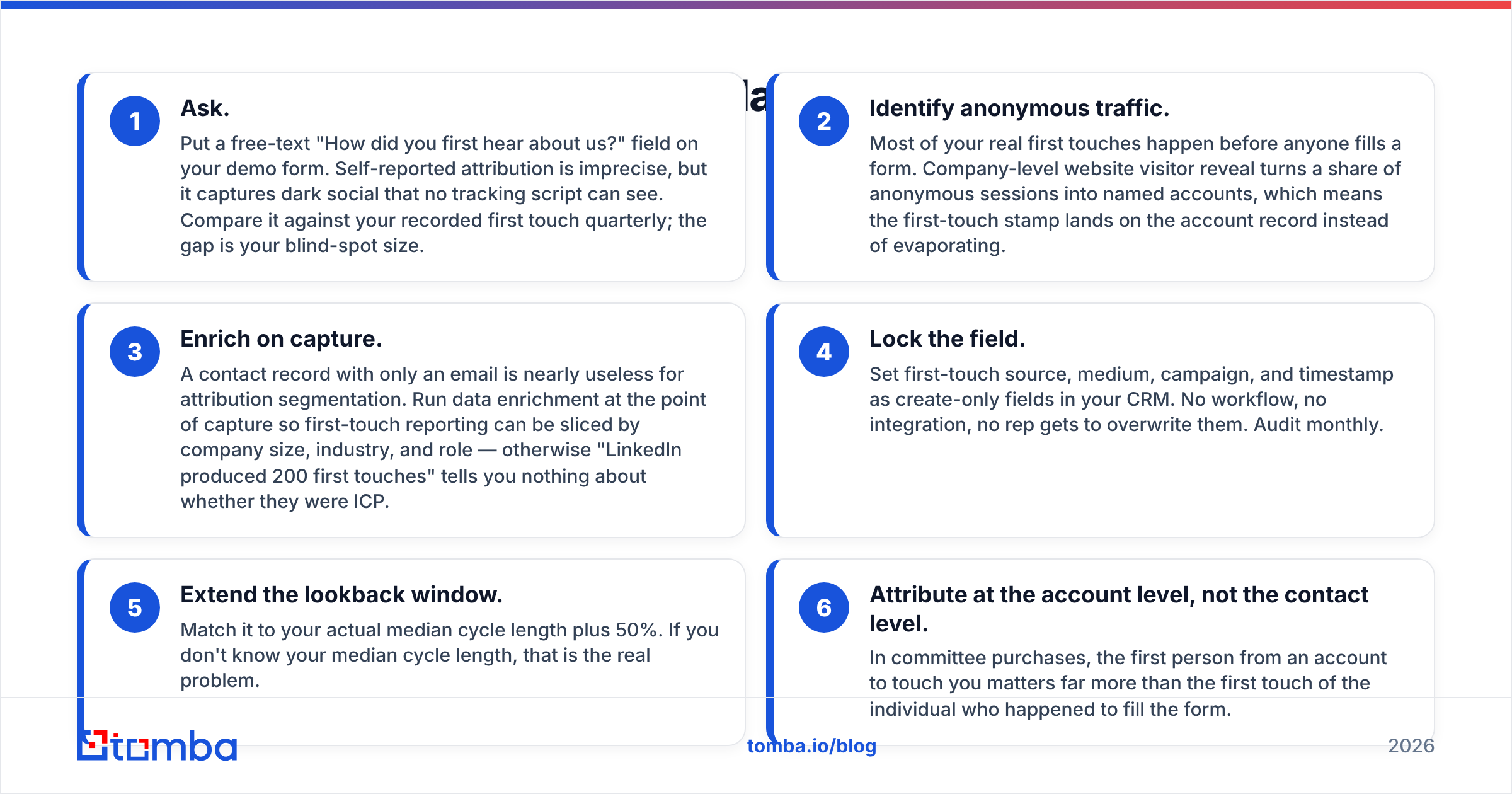
Fix the inputs before you fix the model. In rough order of return on effort:
- Ask. Put a free-text "How did you first hear about us?" field on your demo form. Self-reported attribution is imprecise, but it captures dark social that no tracking script can see. Compare it against your recorded first touch quarterly; the gap is your blind-spot size.
- Identify anonymous traffic. Most of your real first touches happen before anyone fills a form. Company-level website visitor reveal turns a share of anonymous sessions into named accounts, which means the first-touch stamp lands on the account record instead of evaporating.
- Enrich on capture. A contact record with only an email is nearly useless for attribution segmentation. Run data enrichment at the point of capture so first-touch reporting can be sliced by company size, industry, and role — otherwise "LinkedIn produced 200 first touches" tells you nothing about whether they were ICP.
- Lock the field. Set first-touch source, medium, campaign, and timestamp as create-only fields in your CRM. No workflow, no integration, no rep gets to overwrite them. Audit monthly.
- Extend the lookback window. Match it to your actual median cycle length plus 50%. If you don't know your median cycle length, that is the real problem.
- Attribute at the account level, not the contact level. In committee purchases, the first person from an account to touch you matters far more than the first touch of the individual who happened to fill the form.
Steps 2 and 3 are where most teams stall, because they require contact data that the form never collected. Tools like HubSpot's attribution reporting handle the modeling; they do not manufacture the identity data underneath it. That part you have to supply.
What should you report to leadership?#
Report two numbers per channel and one gap.
- First-touch sourced pipeline — dollars of pipeline whose originating touch was this channel.
- Last-touch influenced pipeline — dollars where this channel was the final interaction.
- The delta — channels with high first-touch and low last-touch are demand creators. Channels with the reverse are demand harvesters. You need both, and they should be budgeted differently.
Then add one qualitative line: what percentage of closed-won deals had a self-reported source that disagreed with the recorded first touch. If that number is above 30%, your attribution reporting is directional at best, and you should say so out loud before someone makes a seven-figure decision on it. The broader discipline here belongs to revenue operations — attribution is a RevOps data problem that marketing happens to consume.
For definitions and background on how attribution models developed across the ad industry, the marketing attribution entry on Wikipedia is a reasonable neutral primer.
Is first touch attribution worth it in 2026?#
Yes — as one of two lenses, with honest error bars, on properly stamped data.
First touch attribution is not a truth machine. It is a budgeting heuristic that answers "what starts deals?" better than any alternative of comparable simplicity. Run it alongside last touch, document your five configuration decisions, ask buyers directly, and treat the gap between recorded and self-reported source as a known measurement error rather than a scandal.
The teams that get real value from first touch are not the ones with the most sophisticated model. They are the ones whose contact records are complete enough that the model has something accurate to point at.
Start with the data layer. If your first-touch reporting is thin because half your inbound contacts arrive as an email address and nothing else, fix that first. Tomba's Email Finder and enrichment stack fill in the company, role, and firmographic fields that make attribution reporting sliceable instead of decorative — with a free tier at 25 searches a month, Starter at $49/mo, and Growth at $99/mo. Check the full Tomba pricing and wire it into your CRM before your next attribution review.
Related guides#
Ready to find emails that actually work?
Join 150,000+ professionals who stopped guessing and started sending. Free credits on signup — no credit card required.
Get the Tomba newsletter
Practical outbound tactics and product updates — once every two weeks.
About the author