Firstquadrant Alternatives: 9 Better AI Sales Tools for 2026
FirstQuadrant bundles AI sequencing, data, and inbox management into one price. Here are 9 alternatives that beat it on data accuracy, cost control, or deliverability — with a plain comparison table.
TL;DR
- FirstQuadrant is an AI-first sales platform that bundles prospecting data, sequencing, and inbox handling into one subscription. It works best for small teams who want one tool instead of five.
- The two most common reasons people look for FirstQuadrant alternatives: opaque credit consumption on the AI features, and contact data that needs a second verification pass before it's safe to send to.
- If your bottleneck is data quality, split the stack: a dedicated finder/verifier (Tomba, Findymail, BookYourData) plus a sending tool you already trust.
- If your bottleneck is sending at scale, Instantly or Smartlead will cost less per mailbox than an all-in-one AI platform.
- The cheapest reliable path for most teams under 10 reps: $49–$99/mo on data + $37–$97/mo on sending, not a single $500+ AI SDR seat.
What is FirstQuadrant and who actually uses it?#
FirstQuadrant (firstquadrant.ai) positions itself as an AI sales platform rather than a sequencer with AI bolted on. The pitch is end-to-end: it sources prospects, writes and personalizes the outbound messages, sends them, then reads and routes replies — including drafting responses and booking meetings. The company frames this as "AI-managed sales" where a human supervises rather than operates.
That resonates with a specific buyer: founders and 2–8 person GTM teams who don't have an ops person and don't want to wire together five vendors. If that's you, FirstQuadrant's bundling is genuinely valuable, and you should weigh the alternatives below against the cost of managing more tools.
The buyers who churn out tend to fall into three groups:
- Teams with an existing sequencer. If you already pay for Outreach, Salesloft, or Instantly, you're buying overlapping sending infrastructure and only really want the data and the AI layer.
- Teams sending to hard-to-verify domains. Catch-all-heavy verticals (enterprise IT, finance, healthcare systems) expose weak verification fast. A bundled provider that doesn't tell you how an address was validated is a bounce-rate risk.
- Teams that outgrew the pricing curve. All-in-one AI platforms price on seats and AI actions. Once you're running multiple domains and thousands of sends, unbundled tools get cheaper per contact.

Why do teams look for FirstQuadrant alternatives?#
Three concrete complaints show up repeatedly in reviews on G2 and in founder communities:
Credit opacity. AI actions — research, personalization, reply drafting — consume credits at rates that are hard to forecast before you've run a month. Teams that budget by contact volume get surprised by budget by action volume.
Data you can't audit. When one vendor sources, verifies, and sends, you lose the ability to check work. You don't know whether an address came from an SMTP handshake, a pattern guess, or a stale database record. That matters because email deliverability punishes you for the guesses, not the vendor.
Reply handling that needs supervision anyway. Autonomous reply drafting sounds like it removes work. In practice most teams review every draft for the first several months, which means the labor savings arrive later than the invoice does.
None of that makes FirstQuadrant a bad product. It makes it a product with a narrow ideal customer. The question is whether you're inside that profile.
What are the best FirstQuadrant alternatives in 2026?#
Here's the honest map. I've split by what problem you're actually solving, because "alternative" means different things depending on which part of FirstQuadrant you were using.
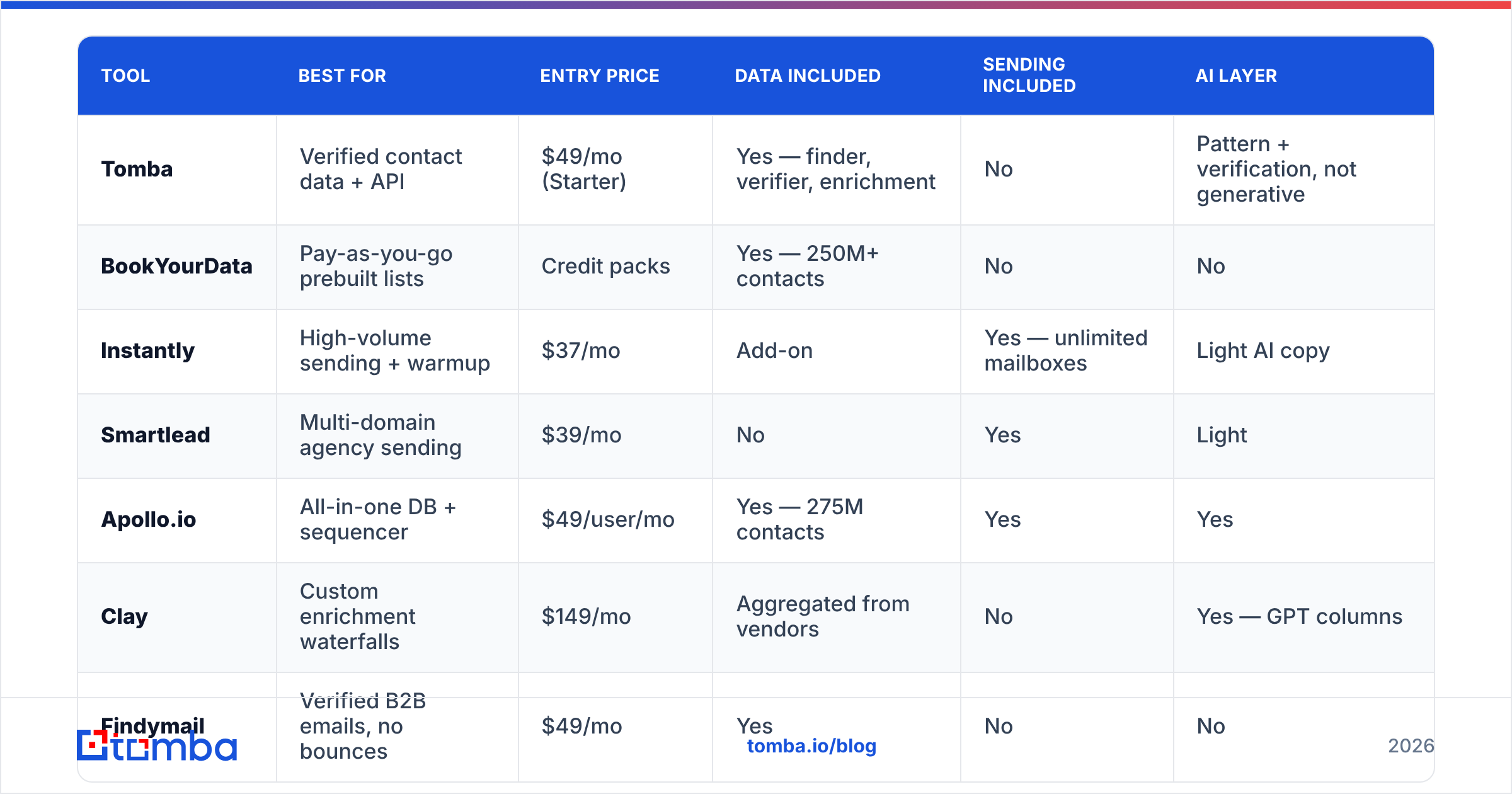
| Tool | Best for | Entry price | Data included | Sending included | AI layer |
|---|---|---|---|---|---|
| Tomba | Verified contact data + API | $49/mo (Starter) | Yes — finder, verifier, enrichment | No | Pattern + verification, not generative |
| BookYourData | Pay-as-you-go prebuilt lists | Credit packs | Yes — 250M+ contacts | No | No |
| Instantly | High-volume sending + warmup | $37/mo | Add-on | Yes — unlimited mailboxes | Light AI copy |
| Smartlead | Multi-domain agency sending | $39/mo | No | Yes | Light |
| Apollo.io | All-in-one DB + sequencer | $49/user/mo | Yes — 275M contacts | Yes | Yes |
| Clay | Custom enrichment waterfalls | $149/mo | Aggregated from vendors | No | Yes — GPT columns |
| Findymail | Verified B2B emails, no bounces | $49/mo | Yes | No | No |
| Lemlist | Multichannel sequences | $69/user/mo | Yes — 450M leads | Yes | Yes |
| Outreach | Enterprise revenue orchestration | Custom (~$100+/user) | Partner-sourced | Yes | Yes |
A few notes on how to read that table. Price alone is misleading — Apollo's $49/user/mo looks identical to Tomba's $49/mo, but one is per-seat and the other is account-wide. If you have four people needing contact lookups, the real gap is $196/mo vs $49/mo.
1. Tomba — when data accuracy is the bottleneck#
Tomba is a dedicated data layer, not a FirstQuadrant clone. You use it to find and verify contacts, then push them into whatever sending tool you already run.
What that buys you: auditability. The email verifier returns a status per address — deliverable, risky, catch-all, undeliverable — rather than a single confidence blob. The catch-all verifier handles the domains that break most tools, and domain search pulls every discoverable address at a company so you can pick the right entry point rather than accepting whoever the AI picked.
Pricing is flat: Free (25 searches/mo), Starter $49/mo, Growth $99/mo, Pro $249/mo, Enterprise custom. Full Tomba pricing is public — no "contact sales" wall on the tiers most teams need.
Where it loses: no sequencer, no inbox management, no AI copywriting. If you wanted FirstQuadrant precisely because it does everything, Tomba solves one third of that. Pair it with Instantly or Smartlead.
2. BookYourData — when you want lists, not a subscription#
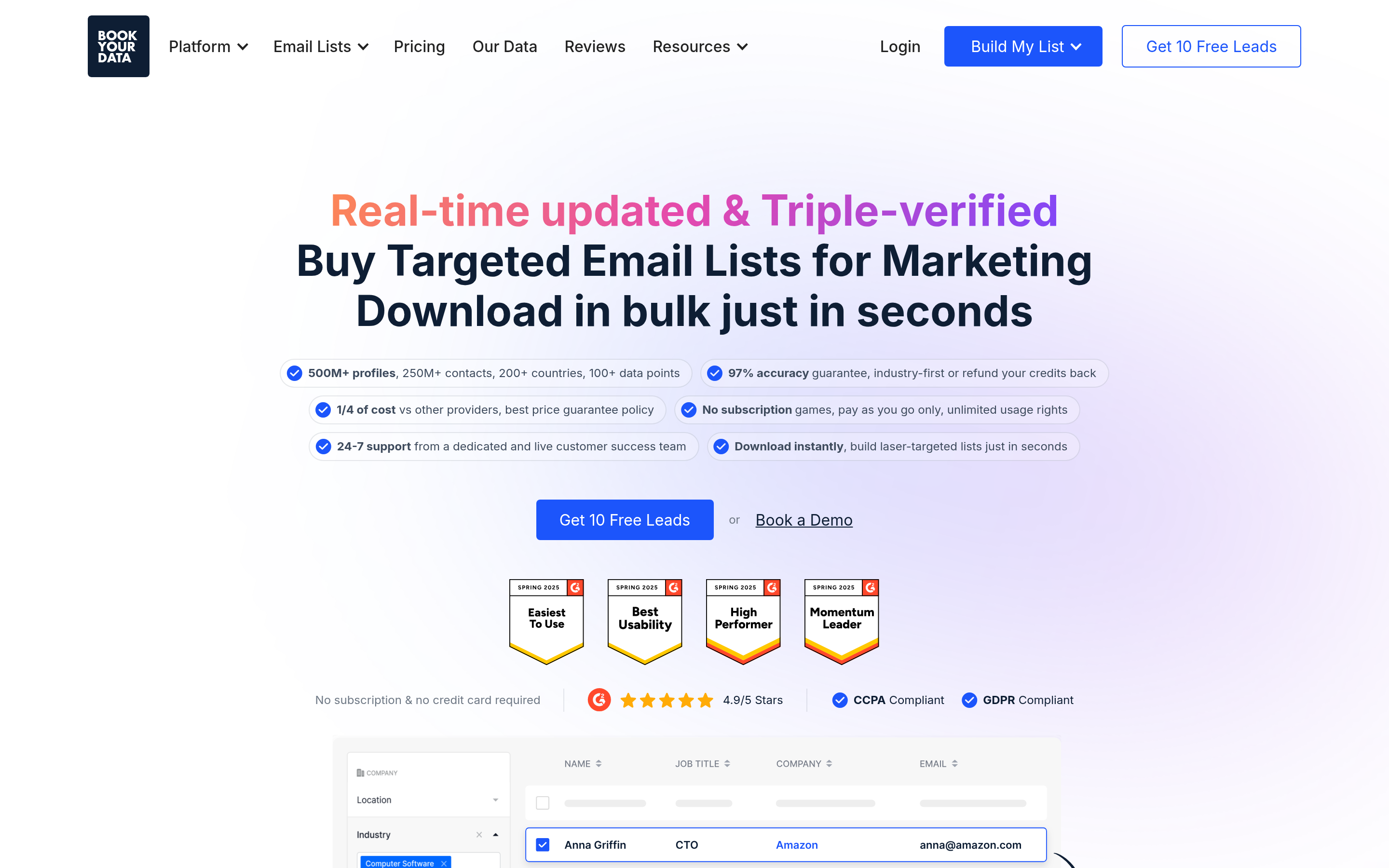
BookYourData sells prebuilt, filtered B2B contact lists on a pay-as-you-go model with a stated accuracy guarantee. It's a genuinely different purchasing motion: you define the ICP filters, see the count, buy the records, and own them. No seat fees, no monthly minimum.
That fits teams running campaign-based outbound — a quarterly push into a new vertical, an event follow-up list, a specific segment test. It's also a clean fit when your sequencer already handles everything else and you just need the input file.
Where it fits less well: continuous, always-on prospecting where you want fresh records daily. Subscription tools update rows in the background; a purchased list is a snapshot.
3. Instantly — when sending volume is the constraint#
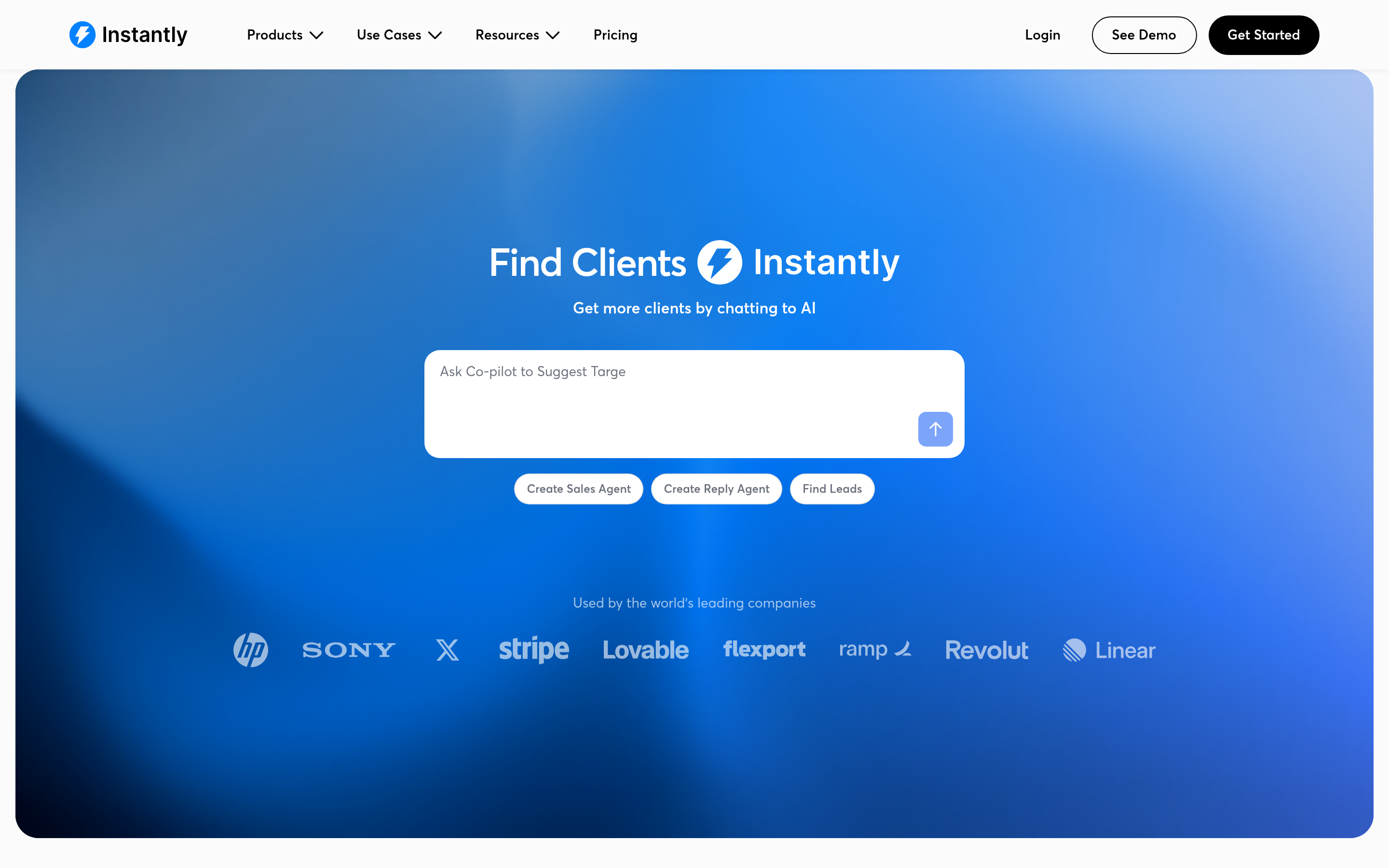
Instantly's core value is unlimited mailbox connections and built-in warmup at a price that doesn't scale with your domain count. If FirstQuadrant's per-seat AI pricing was the problem and you have someone who can write your own copy, this is the cheapest way to keep sending.
Instantly bundles a lead database, but treat it as a starting point rather than the final list. Run addresses through a dedicated verifier before your first send — an Instantly alternative comparison usually comes down to whether you want data and sending from the same vendor.
4. Clay — when your enrichment logic is unusual#
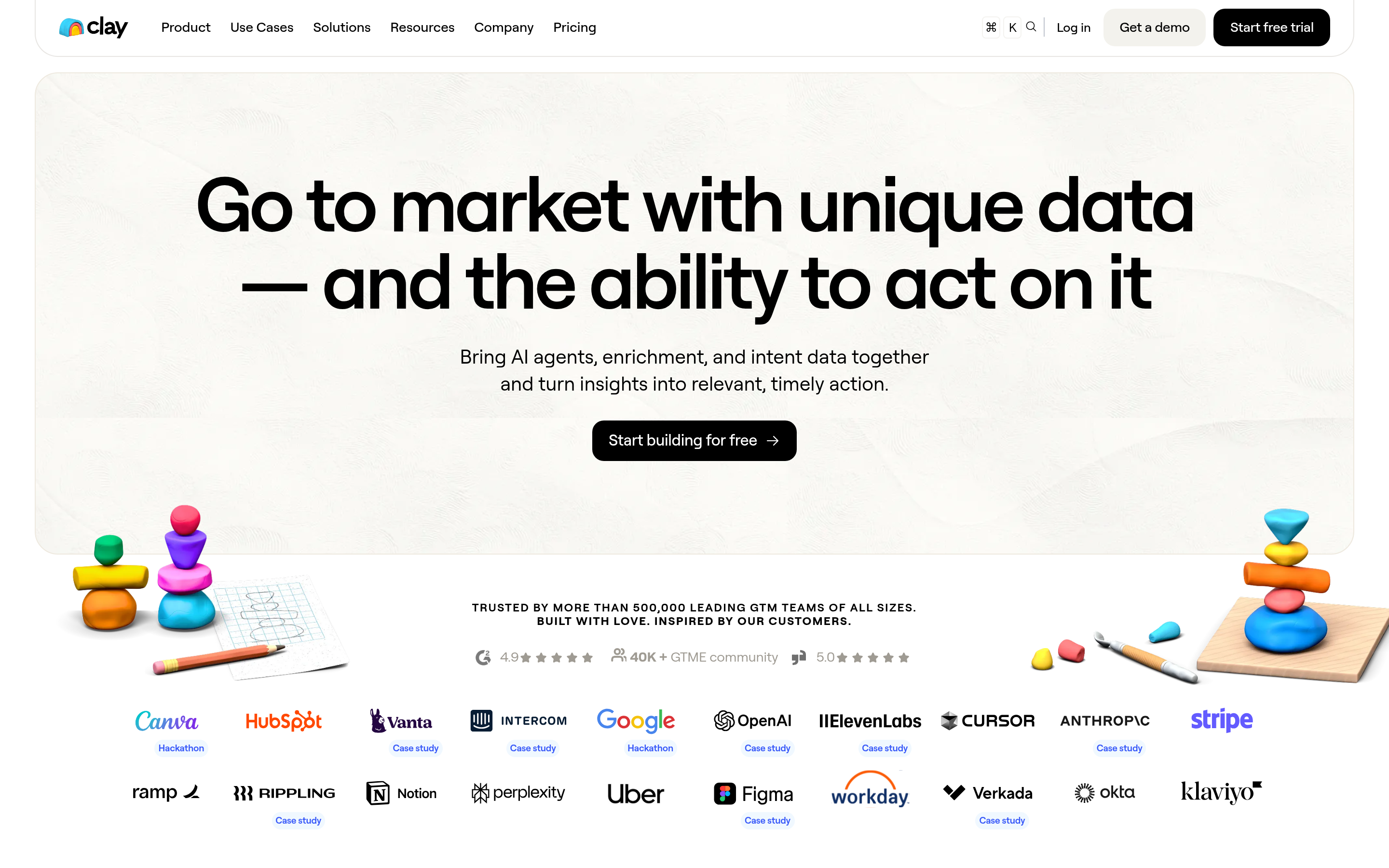
Clay is the opposite philosophy from FirstQuadrant. Instead of one AI making decisions for you, you build the waterfall: try provider A, if null try provider B, run a GPT column to classify the result, branch on the outcome. Extremely powerful, genuinely steep learning curve, and the credit math gets expensive when your table has 50,000 rows.
Pick Clay if you have someone who enjoys building systems. Skip it if your team wants results in week one.
5. Apollo.io — the closest all-in-one substitute#
Apollo comes nearest to a like-for-like swap: large database, sequencer, dialer, and AI assist in a single seat. It's the default answer for teams that want FirstQuadrant's bundling with more market maturity behind it.
The recurring complaint is data freshness on job-change-heavy segments, and per-seat costs that climb once non-sales users need access. If you're evaluating this route, the Apollo alternative breakdown covers where the database actually holds up.

How do you replace FirstQuadrant without breaking your pipeline?#
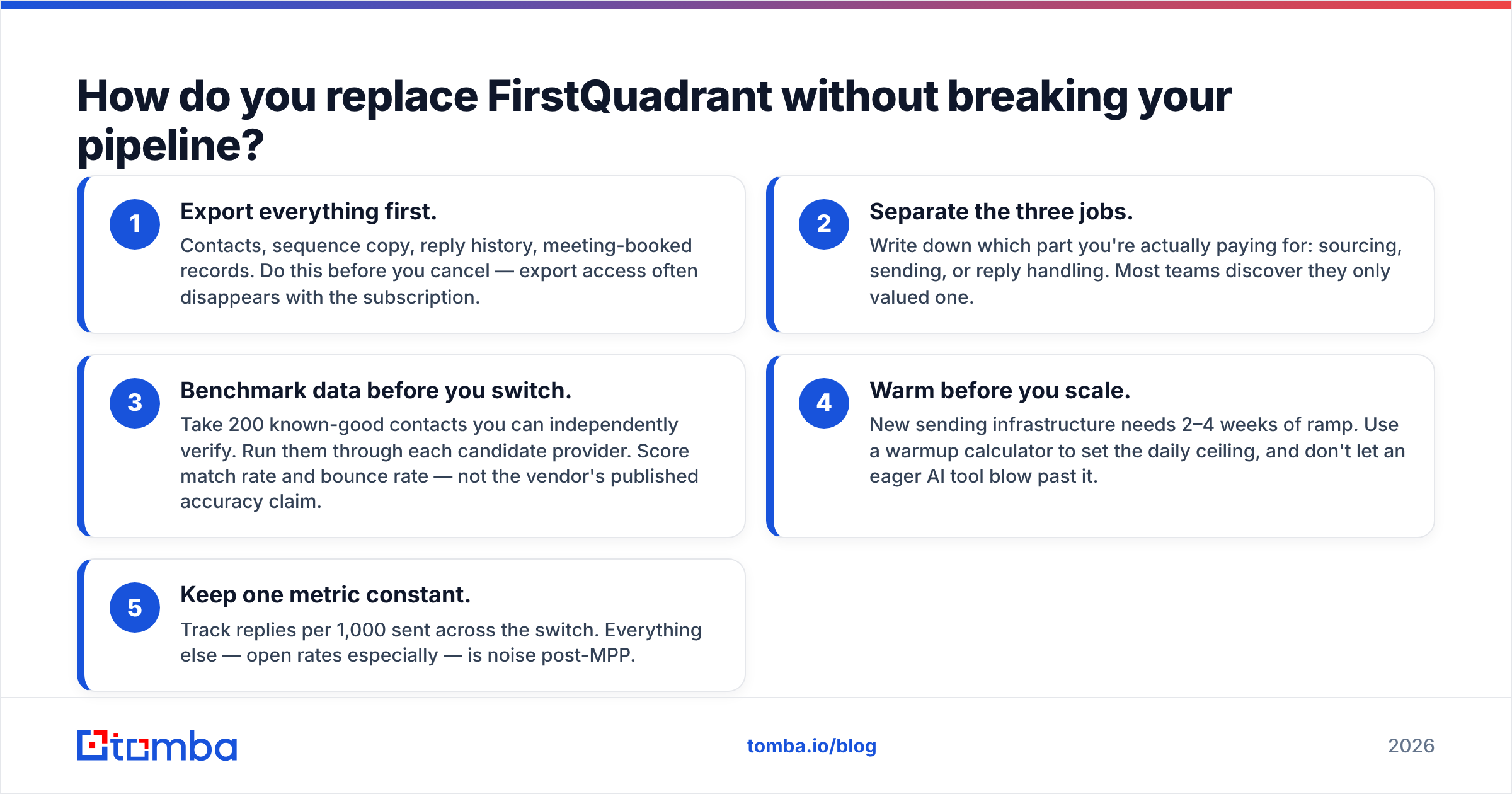
Don't rip and replace mid-quarter. Run this sequence instead:
- Export everything first. Contacts, sequence copy, reply history, meeting-booked records. Do this before you cancel — export access often disappears with the subscription.
- Separate the three jobs. Write down which part you're actually paying for: sourcing, sending, or reply handling. Most teams discover they only valued one.
- Benchmark data before you switch. Take 200 known-good contacts you can independently verify. Run them through each candidate provider. Score match rate and bounce rate — not the vendor's published accuracy claim.
- Warm before you scale. New sending infrastructure needs 2–4 weeks of ramp. Use a warmup calculator to set the daily ceiling, and don't let an eager AI tool blow past it.
- Keep one metric constant. Track replies per 1,000 sent across the switch. Everything else — open rates especially — is noise post-MPP.
Step 3 is where most migrations go wrong. Teams compare pricing pages and skip the bake-off, then discover three weeks in that their new provider's match rate on their specific ICP is 20 points lower than the demo suggested. A 200-contact test costs you an afternoon and settles the argument with data.
Is an AI SDR actually better than a human plus good data?#
Not yet, for most segments, and the honest reason is input quality rather than model quality.
An AI SDR making a bad decision on a bad record produces a confidently personalized email to someone who left the company nine months ago. The model isn't wrong — the row was. Gartner has been consistent that autonomous GTM agents outperform in high-volume, low-complexity motions and underperform in complex or high-ACV sales where a single misfired message burns an account.
The practical implication: fix data before you buy autonomy. A rep with clean, verified contacts and a decent template beats an AI agent working from a stale list, every time. That's why the split-stack recommendation keeps showing up — the data layer is the one you should not economize on.
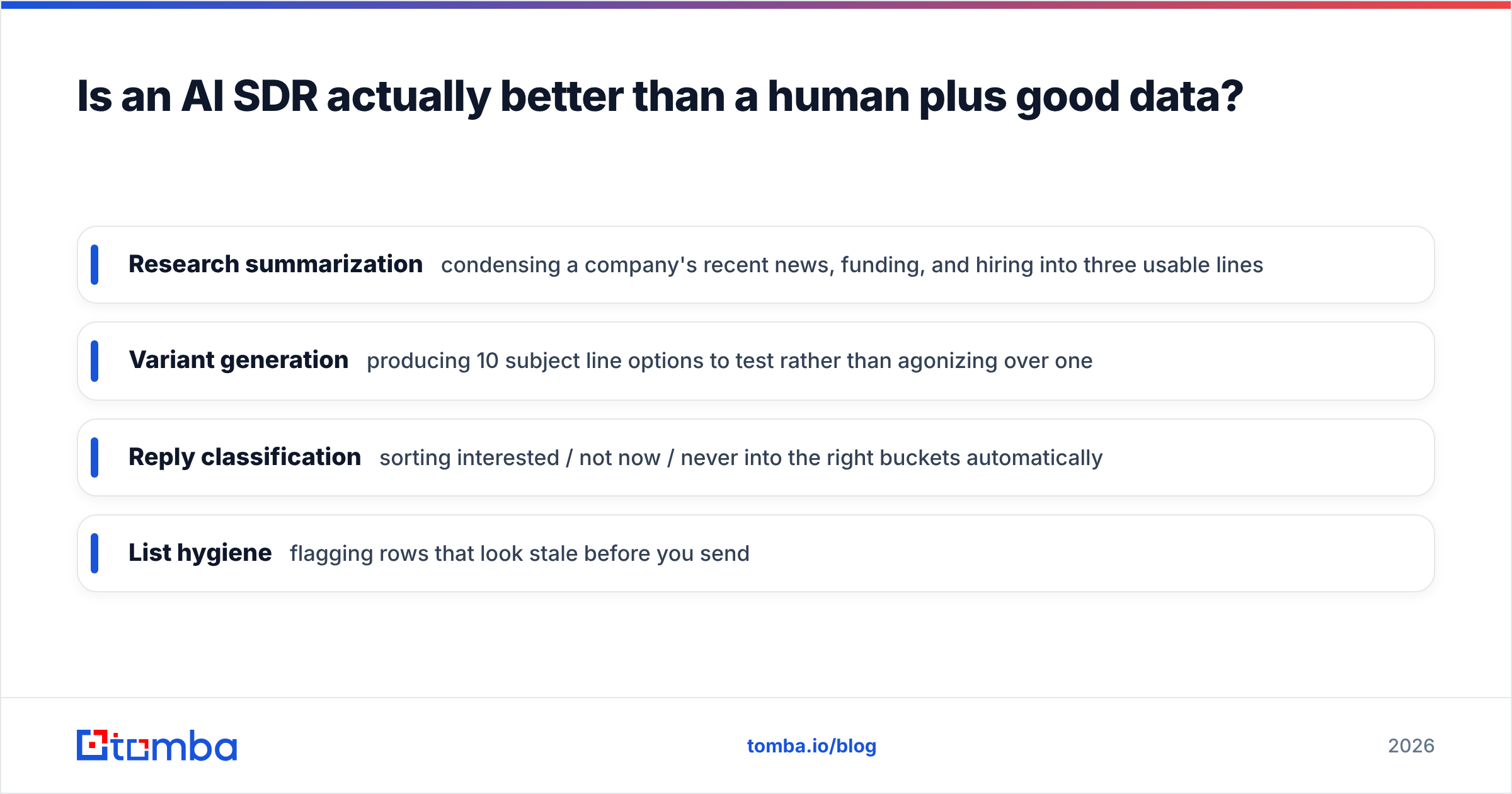
Where AI genuinely earns its cost today:
- Research summarization — condensing a company's recent news, funding, and hiring into three usable lines
- Variant generation — producing 10 subject line options to test rather than agonizing over one
- Reply classification — sorting interested / not now / never into the right buckets automatically
- List hygiene — flagging rows that look stale before you send
Notice none of those require handing over the send decision.
What should you actually buy?#
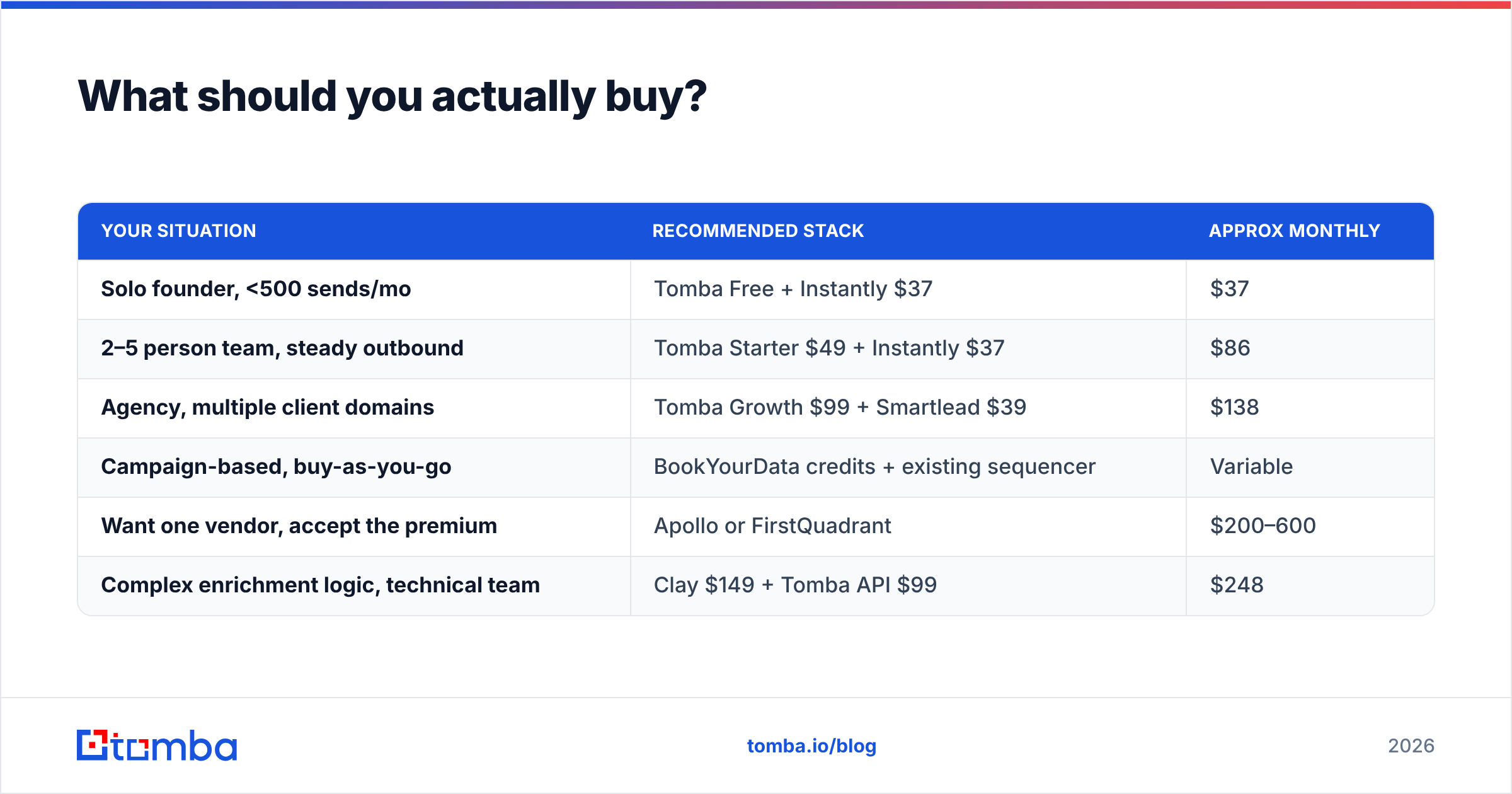
Match the stack to your constraint:
| Your situation | Recommended stack | Approx monthly |
|---|---|---|
| Solo founder, <500 sends/mo | Tomba Free + Instantly $37 | $37 |
| 2–5 person team, steady outbound | Tomba Starter $49 + Instantly $37 | $86 |
| Agency, multiple client domains | Tomba Growth $99 + Smartlead $39 | $138 |
| Campaign-based, buy-as-you-go | BookYourData credits + existing sequencer | Variable |
| Want one vendor, accept the premium | Apollo or FirstQuadrant | $200–600 |
| Complex enrichment logic, technical team | Clay $149 + Tomba API $99 | $248 |
The pattern: unbundling is cheaper and more auditable, bundling is faster to set up. Choose based on whether you have someone who can own the integration — if you're the only technical person and you're also the one selling, pay the bundle premium and move on.
For teams going the unbundled route, the Tomba API handles the piping — find, verify, and enrich inside your own workflow, CRM, or n8n/Make automation, with the same flat pricing as the dashboard. There's also a HubSpot integration if you'd rather the enrichment happen where your reps already live.
What questions should you ask before signing anything?#
Bring these to every demo. The answers separate real infrastructure from a well-designed dashboard:
- How was this address verified? SMTP handshake, pattern inference, or database record? If they can't answer per-contact, you're accepting bounce risk you can't measure.
- What happens to my data if I cancel? Export format, retention window, whether enriched records stay yours.
- How are credits consumed on failed lookups? Some vendors charge for a null result. Over a 50,000-row table that's real money.
- What's the catch-all policy? Ask specifically. Catch-all domains are where accuracy claims quietly break down.
- Is pricing per seat or per account? This single question changes the three-year cost more than anything else on the pricing page.
Get answers in writing before the trial ends, not after.
Where to start#
If you're leaving FirstQuadrant because the data wasn't holding up, start with the data layer and keep whatever sending tool you already trust. Run the Tomba Email Finder against a sample of your ICP on the free tier — 25 searches is enough to compare match rates against your current provider before you spend anything. If the numbers hold, Starter at $49/mo covers most small teams without a per-seat tax, and you can layer sending on top from whichever vendor fits your volume.
Fix the input first. The rest of the stack gets easier once the contacts are real.
Related guides#
Ready to find emails that actually work?
Join 150,000+ professionals who stopped guessing and started sending. Free credits on signup — no credit card required.
Get the Tomba newsletter
Practical outbound tactics and product updates — once every two weeks.
About the author