Floworks AI Pros and Cons: What the Hype Leaves Out (2026)
Floworks sells an AI SDR that researches, writes, and books meetings on its own. Here is an honest breakdown of where that works, where it quietly fails, and what it costs to run it properly in 2026.
Floworks sells an AI SDR that runs outbound on its own. The Floworks AI pros and cons below come from what teams see in month three, not from the demo. Short version: it buys back real hours, and it breaks fast on dirty data.
TL;DR
- Floworks sells an autonomous AI SDR agent that researches accounts, writes personalized outbound, and handles reply triage — it is closer to "hire an agent" than "buy a sequencer."
- The strongest pro is compression: one operator can run the research-plus-write-plus-follow-up loop that used to need two or three junior reps.
- The biggest con is dependency. An AI SDR amplifies whatever contact data you feed it, so bad emails turn into bounces at machine speed.
- Pricing is quote-based and lands well above a $99/mo sequencer. Budget for the platform and a verified data layer — they are separate line items.
- Best fit: teams with a defined ICP, working inboxes, and a clean contact source. Worst fit: teams hoping AI fixes a broken list.
What is Floworks AI, exactly?#
Floworks is an AI sales agent platform. The idea is to hand outbound prospecting to software end to end, not just automate it in pieces. You give the agent an ICP. It researches accounts, drafts messages that reference something real about each prospect, sends them on a schedule, and sorts the replies that come back.
The category is called "AI SDR" or "agentic outbound." Floworks sits in it alongside Artisan, 11x, Regie.ai, and a growing crowd. Read the product framing on the Floworks site, then check user reviews on G2 before you talk to sales. Both beat any vendor deck.
Here is the mental model that helps. A traditional sequencer is a conveyor belt: you load it, it moves things at a fixed speed, and it never decides anything. An AI SDR is closer to a line cook. You give it the menu and the ingredients, and it makes judgment calls about each plate. That is more leverage and more risk, in the same box.
What are the real pros of Floworks AI?#
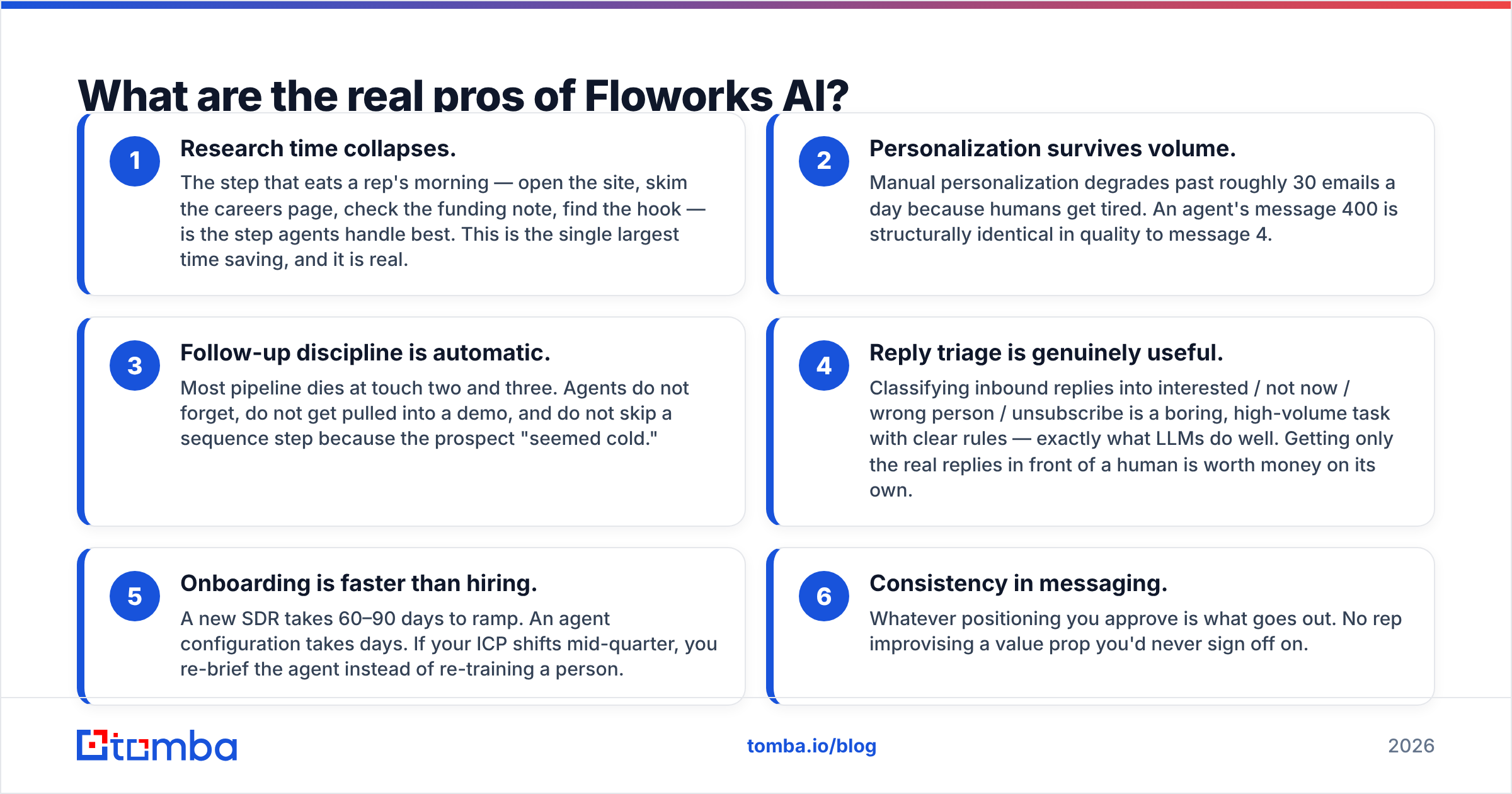
Here is what teams actually report getting out of agentic outbound platforms in this class:
- Research time collapses. The step that eats a rep's morning — open the site, skim the careers page, check the funding note, find the hook — is the step agents handle best. This is the single largest time saving, and it is real.
- Personalization survives volume. Manual personalization degrades past roughly 30 emails a day, because people get tired. An agent's message 400 is as good as message 4.
- Follow-up discipline is automatic. Most pipeline dies at touch two and three. Agents do not forget, do not get pulled into a demo, and do not skip a step because the prospect "seemed cold."
Those three are about speed. The next three are about consistency, and they matter more in month three than in week one.
- Reply triage is genuinely useful. Sorting replies into interested / not now / wrong person / unsubscribe is a boring job with clear rules — exactly what LLMs do well. Getting only the real replies in front of a human is worth money on its own.
- Onboarding is faster than hiring. A new SDR takes 60–90 days to ramp. An agent setup takes days. If your ICP shifts mid-quarter, you re-brief the agent instead of re-training a person.
- Consistency in messaging. Whatever positioning you approve is what goes out. No rep improvising a value prop you would never sign off on.
What are the cons nobody puts in the demo?#
The failure modes are consistent across this whole category, not just Floworks. Any honest list of Floworks AI pros and cons has to start with the data problem.
- Garbage in, garbage at scale. An agent that sends 500 emails a day against a 78%-accurate list produces roughly 110 bounces a day. That is a deliverability incident, not a campaign. Verification is not optional here — it is the load-bearing wall.
- Personalization can be correct and still hollow. "I saw you're hiring three backend engineers" is accurate, and it still says nothing about why the prospect should care. Agents are better at finding facts than at finding relevance.
- You lose the intuition loop. A human SDR who reads 200 replies gets a feel for what is landing, and tells you. An agent gives you metrics, not instincts. Someone still has to read the raw replies every week.
Those are the data and message risks. The rest are commercial and legal.
- Pricing is opaque and quote-based. You will not find a self-serve number that lets you model ROI in a spreadsheet before a sales call. Expect annual commitments.
- Vendor lock-in on your outbound brain. Your ICP definition, your messaging library, your reply-handling rules — that knowledge lives in the platform. Migration is not a CSV export.
- Compliance surface expands. Autonomous sending to EU or UK contacts raises GDPR questions that "the AI decided to" does not answer. Gartner has flagged governance gaps in autonomous GTM agents since the category emerged. Treat that as a procurement checklist item, not FUD.
- Deliverability is still your problem. No agent platform absorbs the cost of a burned domain. That risk stays on your side of the table.
How does Floworks compare to other AI SDR platforms?#
Pricing in this category is quote-driven and moves quarterly, so treat the cost row as a shape, not a quote. The functional differences matter more.
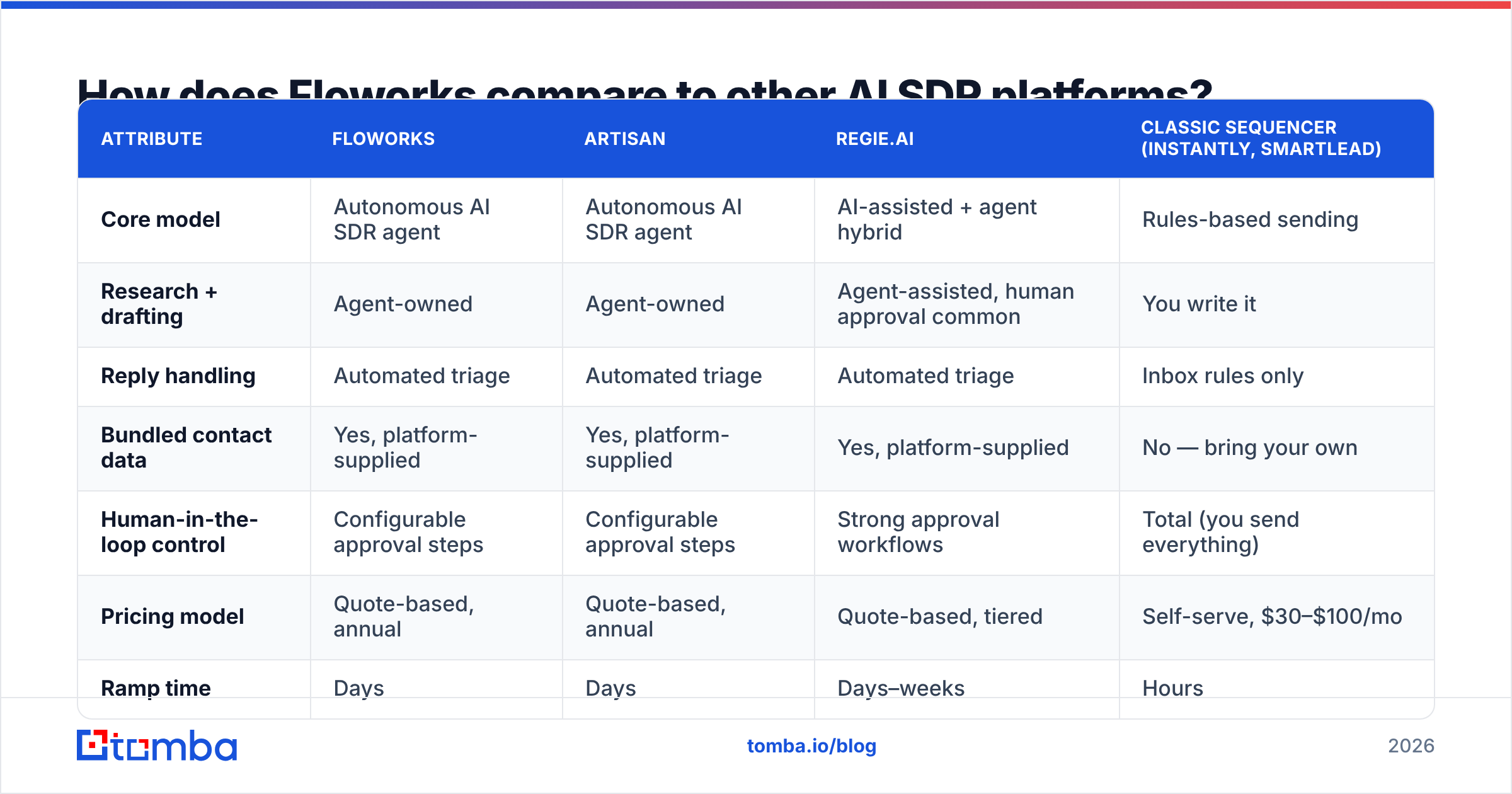
| Attribute | Floworks | Artisan | Regie.ai | Classic sequencer (Instantly, Smartlead) |
|---|---|---|---|---|
| Core model | Autonomous AI SDR agent | Autonomous AI SDR agent | AI-assisted + agent hybrid | Rules-based sending |
| Research + drafting | Agent-owned | Agent-owned | Agent-assisted, human approval common | You write it |
| Reply handling | Automated triage | Automated triage | Automated triage | Inbox rules only |
| Bundled contact data | Yes, platform-supplied | Yes, platform-supplied | Yes, platform-supplied | No — bring your own |
| Human-in-the-loop control | Configurable approval steps | Configurable approval steps | Strong approval workflows | Total (you send everything) |
| Pricing model | Quote-based, annual | Quote-based, annual | Quote-based, tiered | Self-serve, $30–$100/mo |
| Ramp time | Days | Days | Days–weeks | Hours |
| Best for | Lean teams scaling outbound fast | Lean teams scaling outbound fast | Enterprises needing approval gates | Operators who want full control |
The honest read: within the agentic tier, the differences are smaller than the marketing suggests. The bigger fork in the road is agentic platform vs. sequencer plus your own data stack — that decision changes your cost structure by an order of magnitude.
What does an AI SDR actually cost to run properly?#
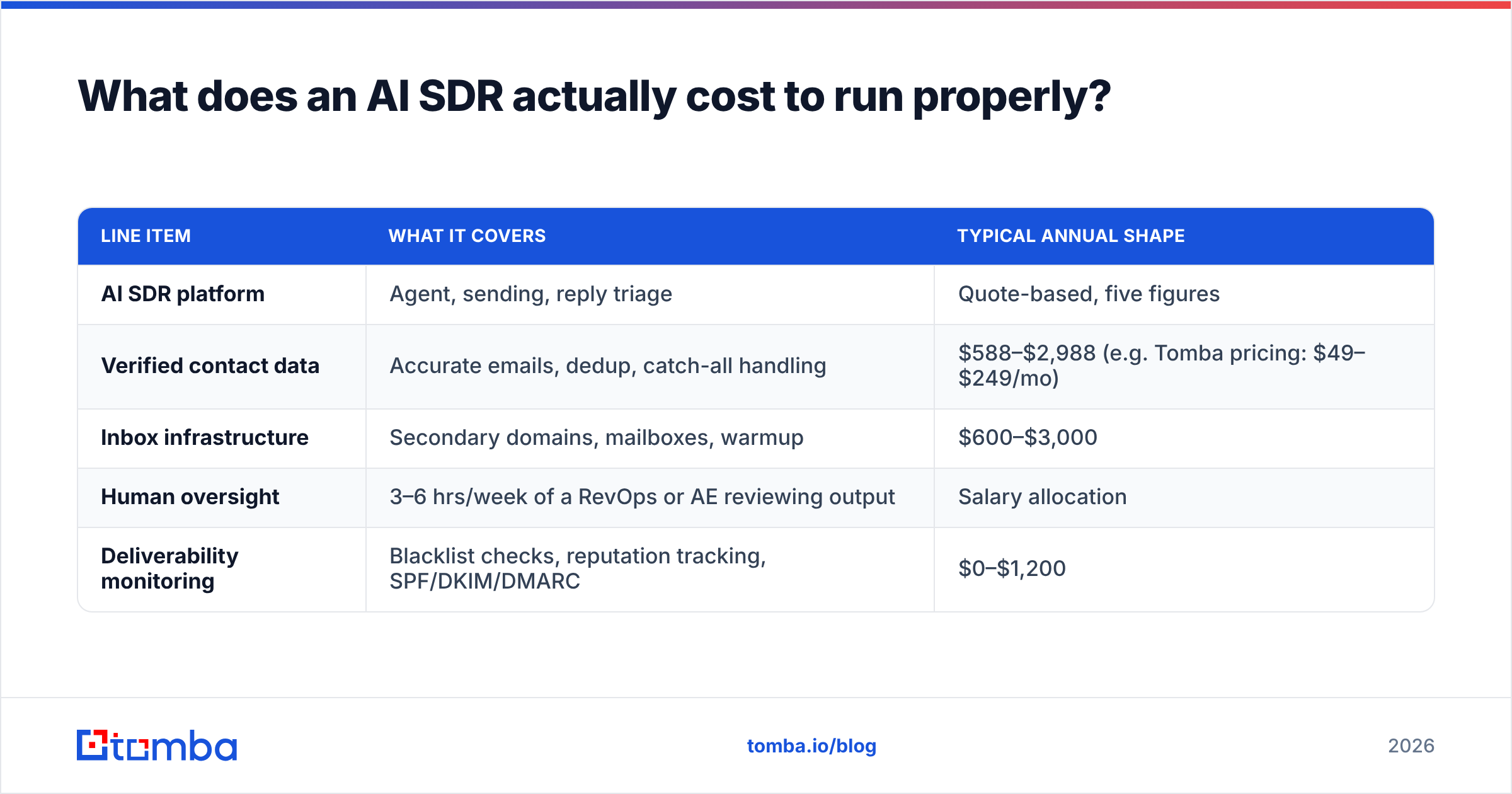
Here is the part that gets skipped. The platform fee is not the total cost of running autonomous outbound.
| Line item | What it covers | Typical annual shape |
|---|---|---|
| AI SDR platform | Agent, sending, reply triage | Quote-based, five figures |
| Verified contact data | Accurate emails, dedup, catch-all handling | $588–$2,988 (e.g. Tomba pricing: $49–$249/mo) |
| Inbox infrastructure | Secondary domains, mailboxes, warmup | $600–$3,000 |
| Human oversight | 3–6 hrs/week of a RevOps or AE reviewing output | Salary allocation |
| Deliverability monitoring | Blacklist checks, reputation tracking, SPF/DKIM/DMARC | $0–$1,200 |
Teams that budget only the first row are the teams that come back in month four saying "AI SDRs don't work." They usually mean "our data layer didn't hold."
If you want to sanity-check your sending setup before any agent touches it, run your domain through a blacklist checker and confirm your SPF record is clean. Five minutes, and it prevents the most expensive failure mode in this whole category.
Does Floworks replace your SDR team?#
No — and any vendor that says otherwise is selling you a headcount argument that won't survive a board meeting.
What it replaces is the mechanical 70% of the SDR role: list building, research, first-draft writing, follow-up scheduling, reply sorting. What it does not replace is the 30% that closes. Someone has to read a lukewarm reply and know whether to push or park it, handle a real objection on a call, and notice that three prospects this week named the same competitor.
The teams getting results run a 1:3 ratio — one experienced human overseeing the output of what used to be three prospecting seats. The rep's job changes from "send 60 emails" to "review what the agent surfaced and take the good conversations." That is a promotion for the rep and a cost saving for you. It is not a layoff plan.
Watch out for the second-order effect too. If agents handle all early prospecting, you have no farm system for training junior reps into AEs. Some teams solve this deliberately. Most discover it 18 months late.
What should you fix before buying any AI SDR?#
Run this checklist before the procurement call, not after.
- Define the ICP tightly enough to write it down. If you cannot describe your buyer in three filter criteria, the agent will spray. Agents inherit vagueness and multiply it.
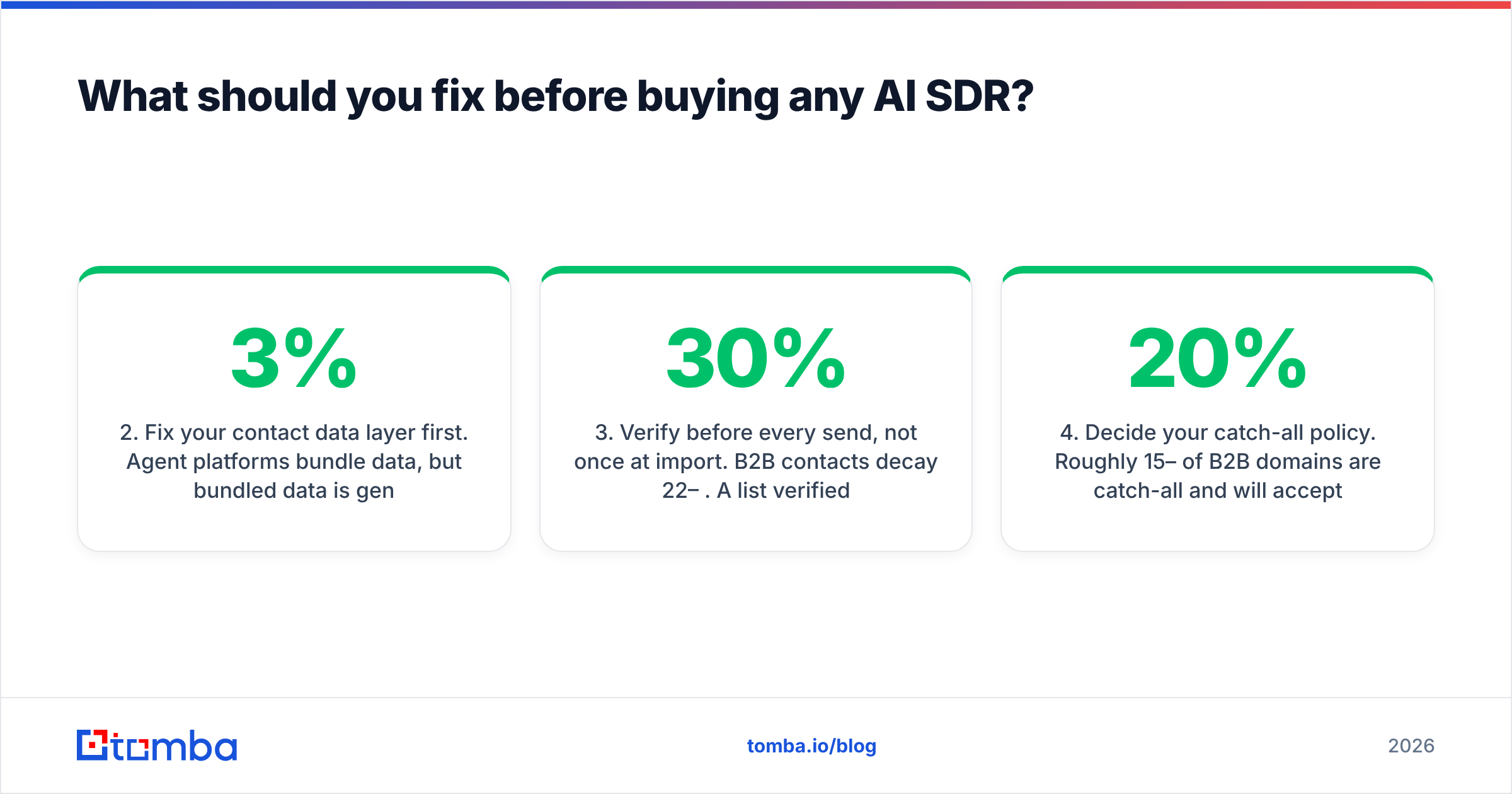
- Fix your contact data layer first. Agent platforms bundle data, but bundled data is generalist data. Most teams end up running a dedicated email finder and pushing verified contacts in, because a bounce rate above 3% degrades the whole domain regardless of who sourced the address.
- Verify before every send, not once at import. B2B contacts decay 22–30% per year. A list verified in January is materially wrong by July. Run a bulk verify pass on any list older than 60 days.
The first three fixes are about data. The last three are about control.
- Decide your catch-all policy. Roughly 15–20% of B2B domains are catch-all and will accept anything at the SMTP layer. Either exclude them or use a catch-all verifier that tests deeper. Letting an agent blast catch-alls unchecked is how bounce rates lie to you for three weeks and then bite.
- Set the approval gate. Full autonomy on day one is a bad idea. Start with human approval on every message, measure quality for two weeks, then loosen.
- Instrument the outcome, not the activity. Meetings booked and pipeline created — not emails sent. Agents make activity metrics meaningless because activity is free now.
How do you evaluate Floworks in a trial?#
Ask for a pilot with a real segment, not a curated one. Then measure four things:
- Bounce rate on agent-sourced contacts. Anything over 3% means you supply the data going forward.
- Reply quality, read manually. Pull 50 raw replies yourself. Are they "not interested" or actual conversations?
- Personalization audit. Take 20 drafted emails and ask: would a human rep have written this? Would a prospect notice a machine wrote it?
- Time to first meeting. From configuration to a booked call on the calendar. Under 21 days is good; over 45 means the ICP or the data is wrong.
Also test the boring stuff. Does it write to your CRM cleanly, and can you export your messaging library if you leave? A platform that makes exit painful is telling you something about its confidence in retention.
Floworks AI pros and cons: is it worth it in 2026?#
The verdict depends entirely on which problem you have.
Buy it if you have product-market fit, a defined ICP, working inbox infrastructure, and a genuine capacity ceiling — you know who to reach and you cannot reach enough of them. That is the case where agentic outbound turns spend into pipeline.
Skip it if your outbound is underperforming because the message is wrong, the ICP is fuzzy, or the list is stale. AI does not diagnose those problems. It executes them faster. A $30/mo sequencer plus three weeks of message testing will teach you more, for less.
The middle path most teams should consider: keep a self-serve sequencer, invest the difference in a verified data layer and contact enrichment, and revisit agents once your baseline reply rate proves the message works. Agents multiply a working system. They cannot create one.
Where does your contact data come from?#
Whatever you decide about Floworks, the data question outlives the tooling decision. Every AI SDR platform — Floworks included — is only as accurate as the email addresses it sends to. Bundled databases are built for breadth, not for your specific niche.
Tomba's email finder and email verifier sit underneath whatever outbound stack you run: find the address, confirm it is deliverable, push it into your agent or sequencer through the Tomba API. The free tier gives you 25 searches a month, so you can test accuracy against your own known-good contacts before you commit. Paid plans start at $49/mo. That is a rounding error next to any AI SDR contract, and the highest-leverage line item in the whole budget. Verify first, automate second.
Related guides#
Ready to find emails that actually work?
Join 150,000+ professionals who stopped guessing and started sending. Free credits on signup — no credit card required.
Get the Tomba newsletter
Practical outbound tactics and product updates — once every two weeks.
About the author