How to Follow Up After a Sales Call: The 2026 Playbook
Most deals die in the 48 hours after the call, not during it. Here's the follow-up cadence, timing data, and templates that actually move deals forward in 2026.
TL;DR
- The follow-up email you send in the first 24 hours does more for the deal than anything you said on the call. Send a recap, not a "great chatting."
- Plan a 5-8 touch sequence across 3-4 weeks. Most reps stop after two touches; most positive replies land after the third.
- Every follow-up must carry new value — a doc, a benchmark, an answer to an objection they raised — or it reads as pressure.
- Multi-thread early. If only one person on the buying committee has your email, you have one point of failure.
- Bad contact data kills more follow-ups than bad copy. Verify addresses before the sequence starts, not after the bounces come back.
Why does the follow up after a sales call matter more than the call itself?#
Because the call is where interest peaks and the follow-up is where it either converts into internal momentum or evaporates.
Think of a discovery call like a good conversation at a conference. You had it, it felt great, and then you both went back to 400 unread emails. The person who sends a short, specific note the next morning — "here's the thing you asked about, here's the two-line summary you can forward to your boss" — is the one who gets remembered. Everyone else becomes a vague memory of "a call I had, sometime."
The mechanics behind this are unglamorous. After your call, your prospect has to sell your solution internally to people who were never on the call. They will do that badly from memory. Your follow-up is the artifact they forward. If it's a paragraph of pleasantries, they have nothing to forward. If it's a crisp recap with the problem stated in their words, the proposed scope, the cost, and the next date, you've just written their internal pitch for them.
Three things determine whether the deal survives the week after the call:
- Speed — a recap within 24 hours, while the conversation is still the freshest thing in their inbox.
- Specificity — their exact words, their exact numbers, their exact objection. Generic recaps signal you weren't listening.
- Persistence — a planned cadence, not a mood-dependent one. Reps who "check in when it feels right" follow up twice and quit.
What should the first follow-up email after a sales call contain?#
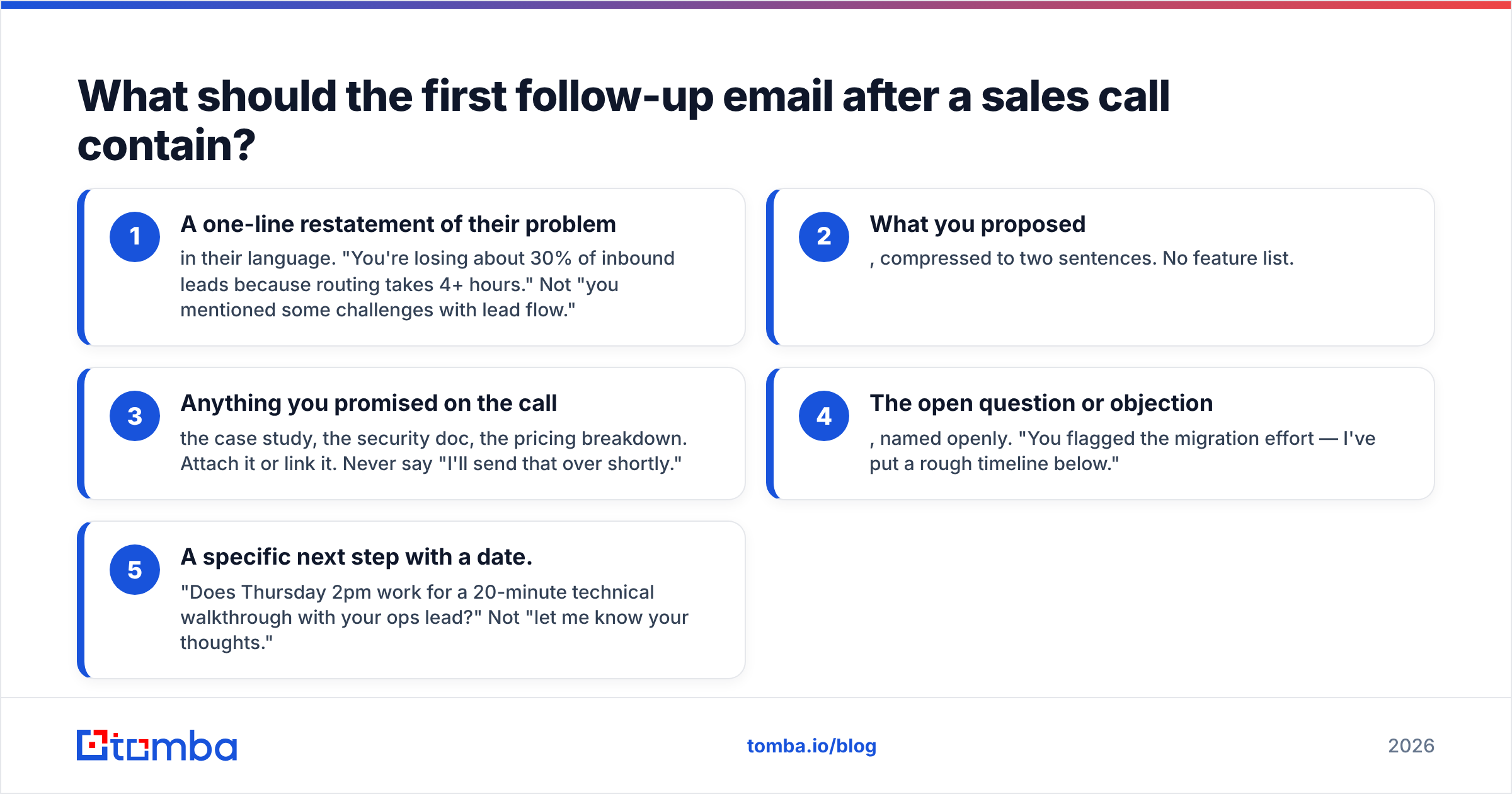
Five parts, in this order, under 200 words total.
- A one-line restatement of their problem in their language. "You're losing about 30% of inbound leads because routing takes 4+ hours." Not "you mentioned some challenges with lead flow."
- What you proposed, compressed to two sentences. No feature list.
- Anything you promised on the call — the case study, the security doc, the pricing breakdown. Attach it or link it. Never say "I'll send that over shortly."
- The open question or objection, named openly. "You flagged the migration effort — I've put a rough timeline below."
- A specific next step with a date. "Does Thursday 2pm work for a 20-minute technical walkthrough with your ops lead?" Not "let me know your thoughts."
The most common failure is #5. "Let me know if you have any questions" transfers all the work to the prospect and gives them a free exit. A dated, small, low-commitment ask gives them something to say yes to.
One structural tip: put the recap in the email body, not in an attachment. Attachments don't get forwarded on mobile, and mobile is where half of your recaps get read.
What does a good follow-up cadence look like?#
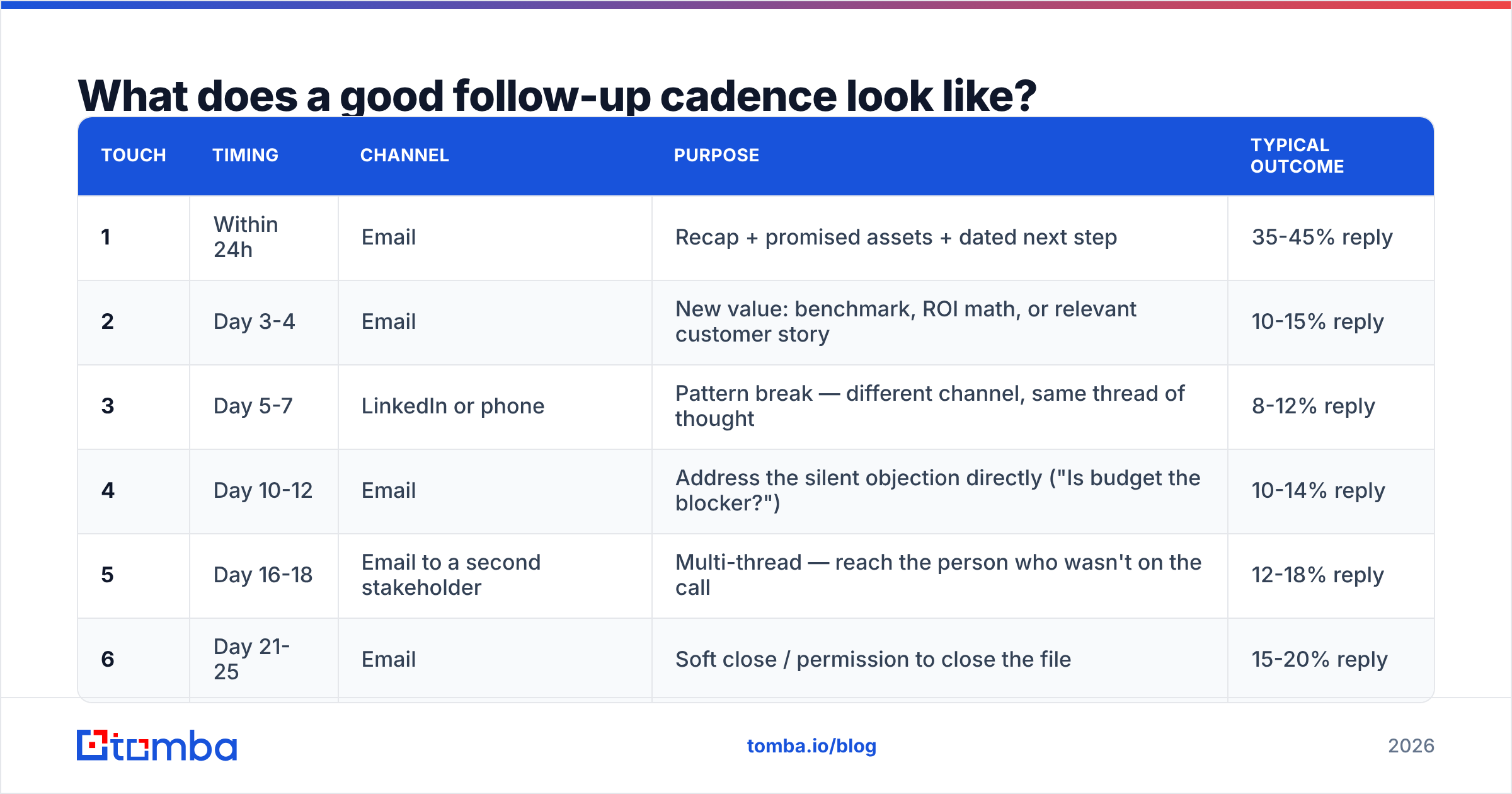
Here's a cadence that works for mid-market B2B deals after a first discovery or demo call. Adjust the spacing for enterprise (slower) or SMB (faster).
| Touch | Timing | Channel | Purpose | Typical outcome |
|---|---|---|---|---|
| 1 | Within 24h | Recap + promised assets + dated next step | 35-45% reply | |
| 2 | Day 3-4 | New value: benchmark, ROI math, or relevant customer story | 10-15% reply | |
| 3 | Day 5-7 | LinkedIn or phone | Pattern break — different channel, same thread of thought | 8-12% reply |
| 4 | Day 10-12 | Address the silent objection directly ("Is budget the blocker?") | 10-14% reply | |
| 5 | Day 16-18 | Email to a second stakeholder | Multi-thread — reach the person who wasn't on the call | 12-18% reply |
| 6 | Day 21-25 | Soft close / permission to close the file | 15-20% reply |
Two things to notice. First, replies do not decay smoothly — touch 6, the "should I close your file?" email, often outperforms touches 2 through 4 because it's the only one that costs the prospect nothing to answer. Second, touch 5 is where most reps have no plan, because they only ever collected one contact.
That last point is a data problem, not a persistence problem. If you finished the call with one email address, your cadence has a single point of failure. Running a domain search on the account before or right after the call gives you the ops lead, the finance approver, and the champion's manager — the people who will actually decide.
The touches that consistently underperform#
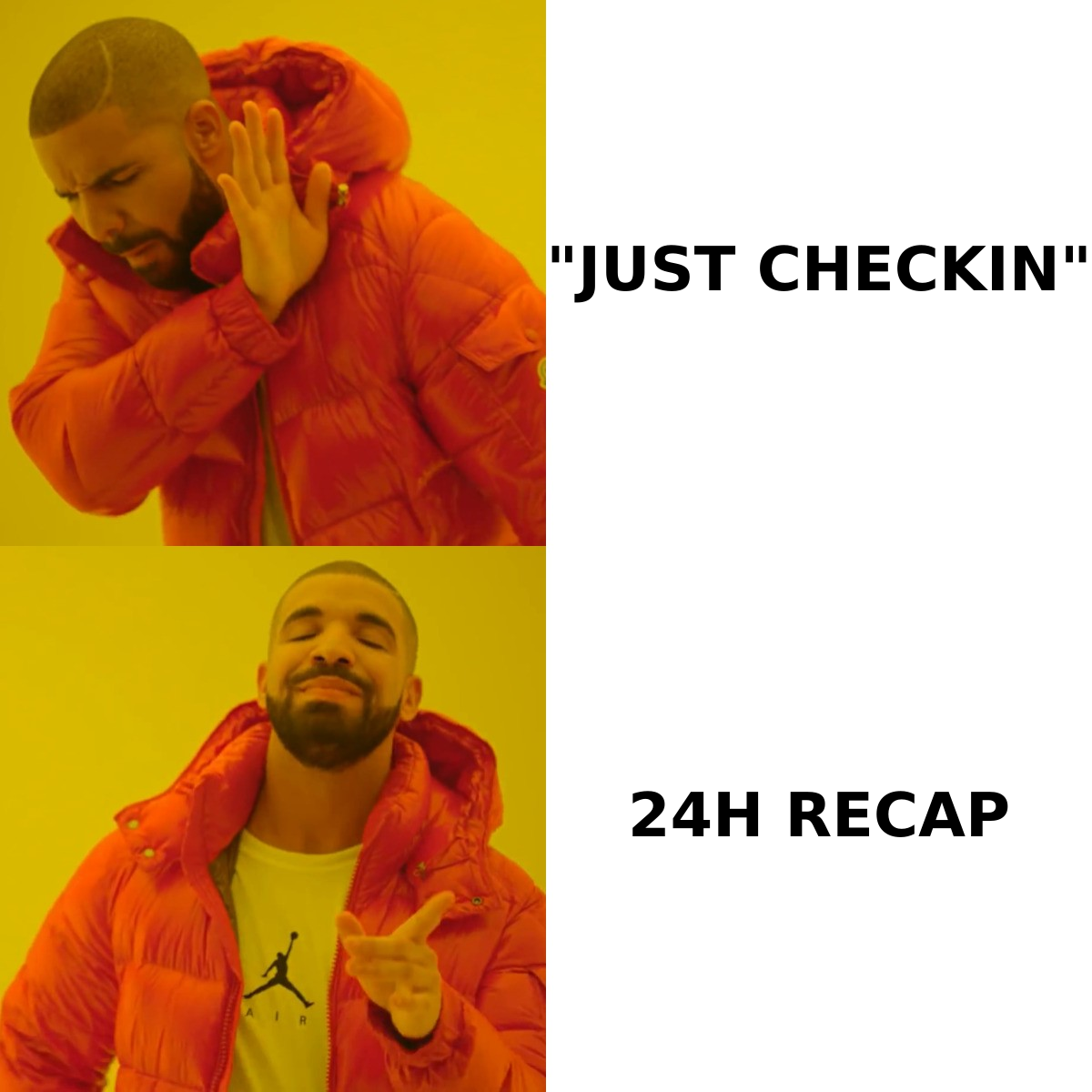
- "Just checking in" — no new information, so no reason to reply.
- "Bumping this to the top of your inbox" — announces that you have nothing to add.
- Same-message resends — reads as automation, and it usually is.
- The five-paragraph value essay — nobody reads a wall on touch 4.
How long should you keep following up before giving up?#
Three to four weeks and five to eight touches for a warm post-call deal, then move them to a long-term nurture list rather than deleting them.
The reason to formally end the sequence is that the "close the file" email is genuinely effective. It's the only message in the sequence that asks for a no, and giving someone permission to say no is the fastest way to find out whether the deal is real. Roughly a fifth of the replies you get in a typical sequence arrive on that final touch, and a meaningful share of them are "no, wait, don't close it — we've just been slammed."
After the sequence ends, the contact belongs in a nurture track: a quarterly touch tied to a real trigger — funding round, new hire in their department, a product release that solves the objection they raised. This is where contact hygiene matters. B2B contact data decays at roughly 25-30% a year as people change jobs, so a nurture list you built in 2026 is meaningfully wrong by 2027 unless you re-verify it. Running that list through an email verifier before each quarterly send protects your sender reputation and keeps your email deliverability from degrading over the exact months your list is sitting idle.
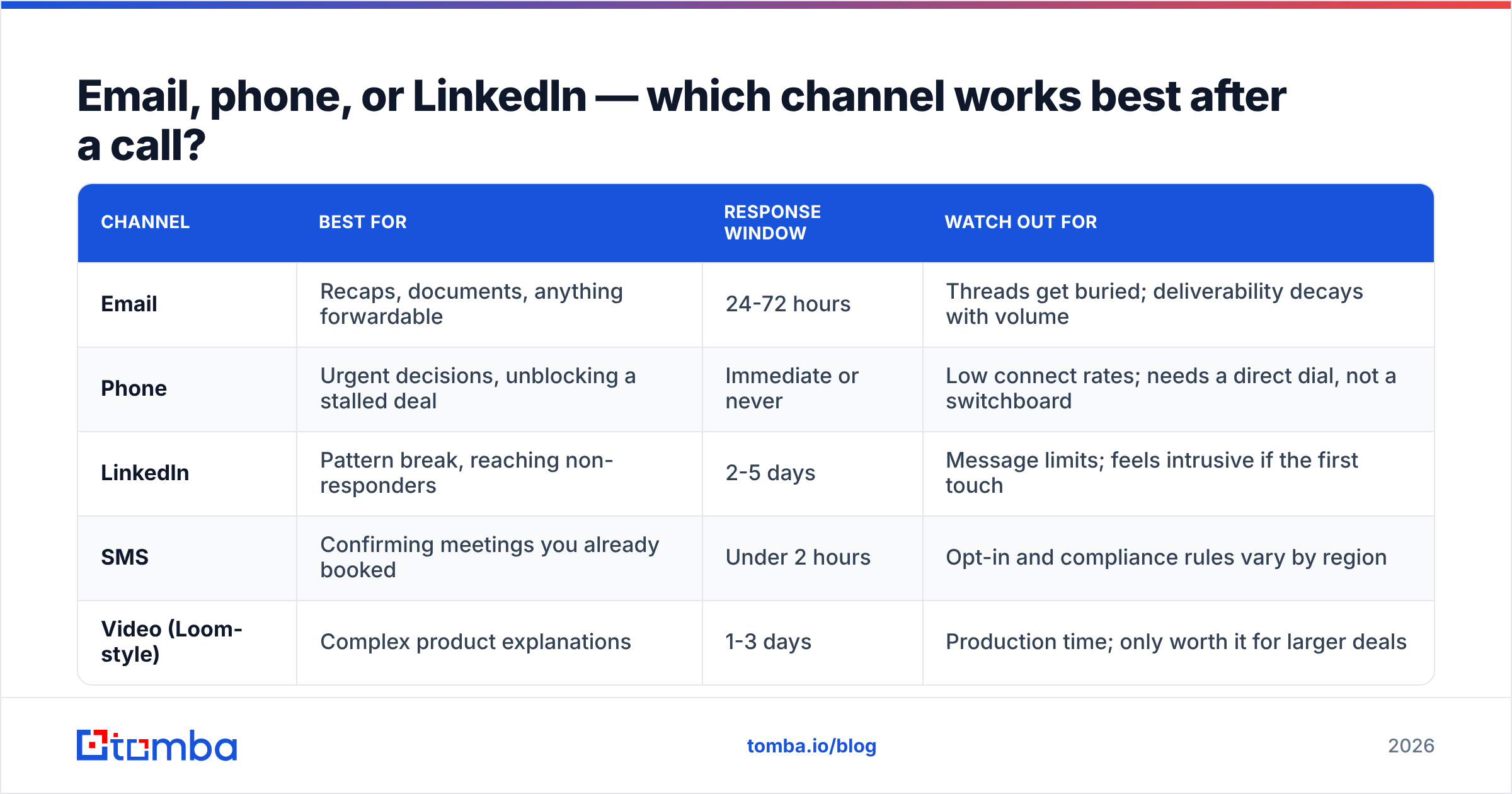
Email, phone, or LinkedIn — which channel works best after a call?#
All three, in rotation. Channel diversity beats channel optimization.
| Channel | Best for | Response window | Watch out for |
|---|---|---|---|
| Recaps, documents, anything forwardable | 24-72 hours | Threads get buried; deliverability decays with volume | |
| Phone | Urgent decisions, unblocking a stalled deal | Immediate or never | Low connect rates; needs a direct dial, not a switchboard |
| Pattern break, reaching non-responders | 2-5 days | Message limits; feels intrusive if the first touch | |
| SMS | Confirming meetings you already booked | Under 2 hours | Opt-in and compliance rules vary by region |
| Video (Loom-style) | Complex product explanations | 1-3 days | Production time; only worth it for larger deals |
The practical rule: email is your default carrier, phone is your escalation, LinkedIn is your pattern break, and SMS only touches deals where you already have an established relationship and explicit permission.
Phone deserves a note. Most reps skip the call-back touch because they don't have a direct number — the CRM has a company switchboard and nothing else. Enriching the account with a phone finder before the sequence starts turns touch 3 from a coin flip into a real conversation. A 90-second call after a demo often resolves an objection that would take four emails and two weeks to surface.
Also worth reading if you're building the sequence yourself: HubSpot's sales follow-up research and G2's category reviews for sales engagement platforms both give you a sanity check on cadence norms before you commit a team to one.
How do you write follow-ups that don't sound like pressure?#
Shift the frame from "chasing you" to "helping you decide." Every message should be defensible if forwarded to your prospect's boss.
Concretely, that means each touch delivers one of four things:
- New information — a benchmark, a comparable customer's outcome, an integration you confirmed after the call.
- Reduced risk — a security doc, a pilot structure, a shorter contract term, a reference call.
- Reduced effort — you wrote the internal business case, you drafted the Slack message they can paste to their team.
- A clean exit — permission to stop, with the door left open.
Notice that none of these mention your enthusiasm, your quarter, or your "wanting to circle back." Those are your problems, not theirs.
A quick before/after. Before: "Hi Sarah, just following up on our call last week to see if you had any thoughts. Let me know!" After: "Sarah — you flagged that migration would take your team two sprints. I checked with our implementation lead: the CSV path takes 3 days and doesn't touch engineering. Worth a 15-minute call with him on Tuesday?"
Same intent. The second one is forwardable, answers a real objection, and asks for something small and dated.
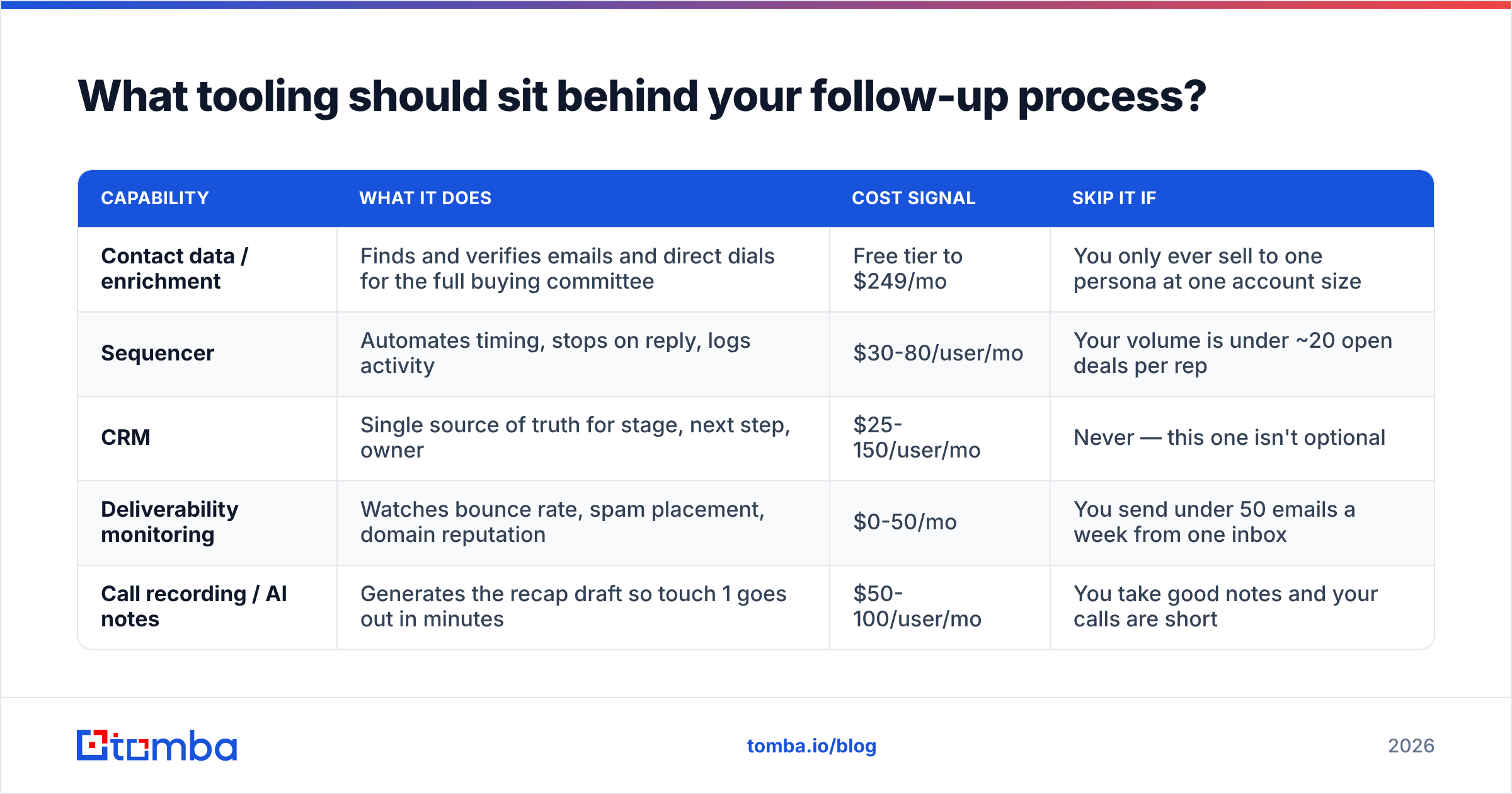
What tooling should sit behind your follow-up process?#
The stack is thinner than vendors suggest. You need four capabilities: accurate contact data, a sequencing tool, CRM logging, and deliverability hygiene. Everything else is optional.
| Capability | What it does | Cost signal | Skip it if |
|---|---|---|---|
| Contact data / enrichment | Finds and verifies emails and direct dials for the full buying committee | Free tier to $249/mo | You only ever sell to one persona at one account size |
| Sequencer | Automates timing, stops on reply, logs activity | $30-80/user/mo | Your volume is under ~20 open deals per rep |
| CRM | Single source of truth for stage, next step, owner | $25-150/user/mo | Never — this one isn't optional |
| Deliverability monitoring | Watches bounce rate, spam placement, domain reputation | $0-50/mo | You send under 50 emails a week from one inbox |
| Call recording / AI notes | Generates the recap draft so touch 1 goes out in minutes | $50-100/user/mo | You take good notes and your calls are short |
On contact data specifically, the market splits into full-suite platforms and focused finders. Suites like Apollo bundle data with sequencing; BookYourData sells verified, pay-as-you-go B2B lists with strong coverage for teams that want to buy contacts outright rather than subscribe to a platform; focused finders like Tomba do discovery and verification well and hand off to whatever sequencer you already use.
Tomba's pricing starts with a free tier at 25 searches per month, then $49/mo Starter, $99/mo Growth, and $249/mo Pro, with Enterprise custom. If you're wiring enrichment into an existing workflow rather than adopting another dashboard, the Tomba API and the HubSpot and Salesforce integrations do the pre-sequence enrichment step without a new tab in anyone's browser.
What are the most common follow-up mistakes?#
- Waiting for the "right moment." There isn't one. The right moment was yesterday, and the second-best is now.
- Sending the recap two days late. Reply rates drop measurably after 48 hours because the mental context is gone.
- Single-threading. One contact, one champion, one job change, and the deal dies with no warning.
- Not logging the next step. If your CRM doesn't have a dated next action on the record, the deal is already stalling and you just can't see it.
- Confusing volume with persistence. Six thoughtful touches beat twenty automated bumps, and they don't torch your domain reputation.
- Ignoring bounces. A hard bounce on touch 2 means the rest of your sequence is shouting into a void — and it's quietly damaging your sender reputation at the same time.
Ready to stop losing deals in the follow-up gap?#
Most of the follow-up advice online is about copy. In practice, the sequences that fail usually fail on data: one contact instead of five, a stale address that bounces on touch 2, no direct dial for the escalation call. Fix the input and the copy has something to work with.
Start by enriching your open post-call deals with the full buying committee. The Tomba Email Finder locates professional email addresses by domain, name, or company, and the free tier gives you 25 searches a month to test it against accounts you already know. Run your next ten stalled deals through it, find the two stakeholders who were never on the call, and send them the recap you should have sent three weeks ago.
Related guides#
Ready to find emails that actually work?
Join 150,000+ professionals who stopped guessing and started sending. Free credits on signup — no credit card required.
Get the Tomba newsletter
Practical outbound tactics and product updates — once every two weeks.
About the author