Follow Up Cadence in 2026: The Sequence That Gets Replies
Most reps quit after two emails. Most replies land on touch four through seven. Here is a day-by-day follow up cadence, channel mix, and timing rules that hold up in 2026.
TL;DR
- A follow up cadence is a pre-planned sequence of touches — email, phone, LinkedIn — spaced over a fixed window, with a defined exit rule. Not "I'll ping them when I remember."
- Most reps stop at two touches. A large share of positive replies arrive on touches three through seven, which means the majority of pipeline is left on the table by people who technically did outreach.
- Eight to twelve touches over 21–28 days is the workable default for mid-market B2B. Enterprise runs longer and slower; SMB runs shorter and faster.
- Channel mix beats channel volume. Three emails, two calls, two LinkedIn touches, and one voicemail outperform eight emails to the same inbox.
- The cadence is worthless if the contact data is wrong. Bounces on touch one kill the whole sequence and your sender reputation with it.
What is a follow up cadence?#
A follow up cadence is the fixed schedule of contact attempts you run against a prospect after the first touch — how many, on which channels, how far apart, and when you stop.
Think of it like watering a plant. One heavy soak on day one then nothing for a month kills it. A small, predictable amount every few days keeps it alive. Your prospects work the same way: attention is not won in a single burst, it is won by showing up consistently enough to catch the week where your problem becomes their priority.
Three components define any cadence:
- Touch count — the total number of contact attempts before you exit the prospect. Eight to twelve for most B2B motions.
- Channel mix — which touches are email, call, voicemail, LinkedIn, or video. Multi-channel cadences consistently beat email-only ones because you catch people where they actually respond.
- Spacing — the gap between touches, usually tightening early (days 1, 3, 5) and widening late (days 12, 18, 26).
- Exit rules — what ends the sequence. A reply, a meeting booked, a hard bounce, an unsubscribe, or the final touch firing with no response.
- Recycle logic — where a non-responder goes next. Most teams drop them into a 90-day nurture rather than deleting them.
The word "cadence" matters. It implies rhythm — predictable, evenly spaced, not frantic. Sending five emails in four days is not a cadence, it is harassment with a spreadsheet.
How many follow-ups should a cadence have?#
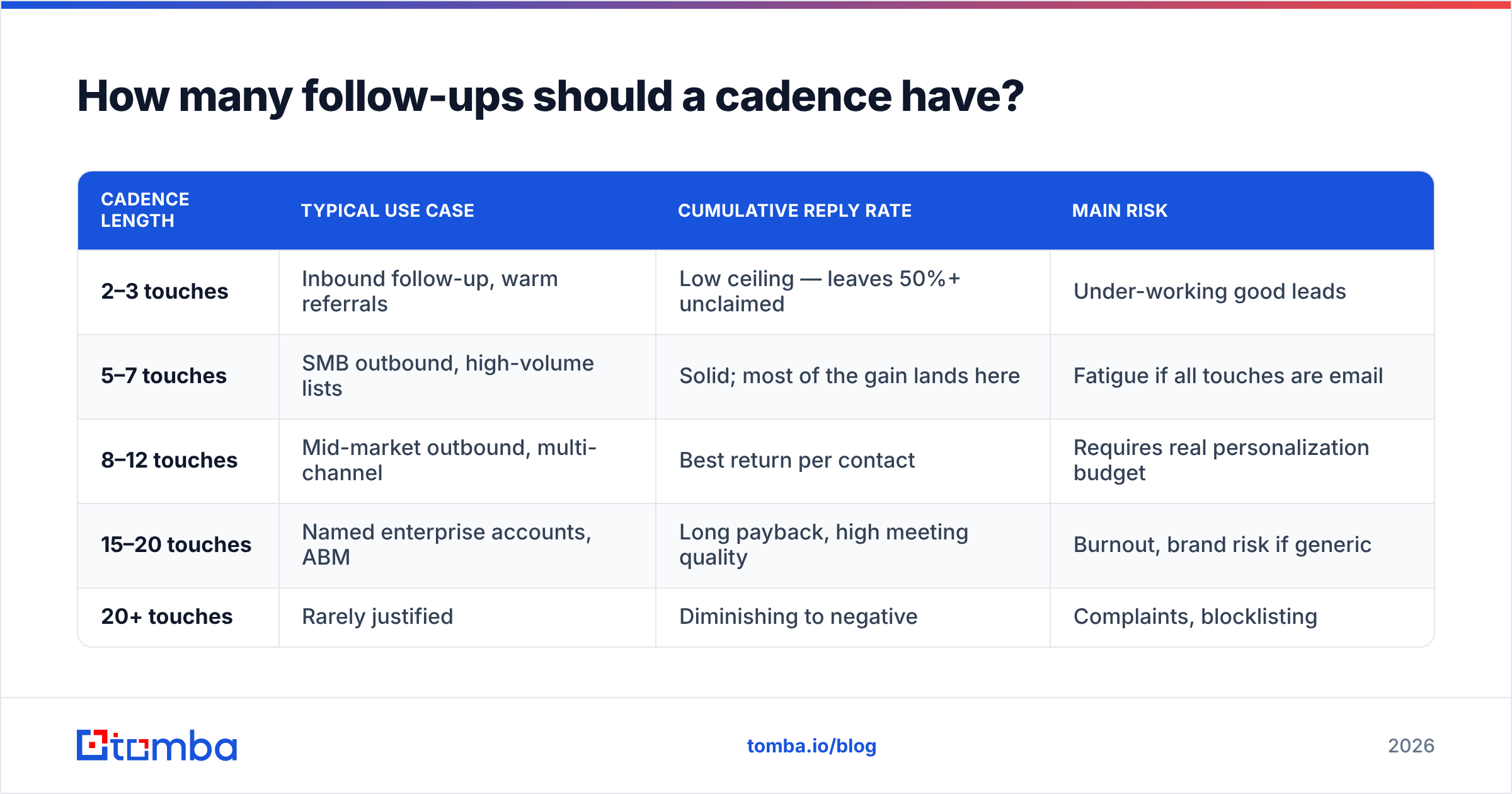
Eight to twelve touches over three to four weeks, for most B2B teams selling a considered purchase.
Here is the uncomfortable arithmetic. If your first email gets a 5% reply rate and each subsequent touch adds 2–4 points of cumulative reply rate, a two-touch sequence captures roughly a third of what a seven-touch sequence captures. The rep who "did outreach" and got nothing usually sent one email and one nudge, then concluded the list was bad.
But more is not linearly better. Past roughly touch twelve, the incremental reply rate collapses while spam complaints and brand damage climb. The curve flattens; the risk does not.
| Cadence length | Typical use case | Cumulative reply rate | Main risk |
|---|---|---|---|
| 2–3 touches | Inbound follow-up, warm referrals | Low ceiling — leaves 50%+ unclaimed | Under-working good leads |
| 5–7 touches | SMB outbound, high-volume lists | Solid; most of the gain lands here | Fatigue if all touches are email |
| 8–12 touches | Mid-market outbound, multi-channel | Best return per contact | Requires real personalization budget |
| 15–20 touches | Named enterprise accounts, ABM | Long payback, high meeting quality | Burnout, brand risk if generic |
| 20+ touches | Rarely justified | Diminishing to negative | Complaints, blocklisting |
The number that matters more than touch count is touches per channel. Twelve emails to one inbox reads as desperation. Twelve touches split across four channels reads as a competent salesperson doing their job.
What does a good follow up cadence look like day by day?#
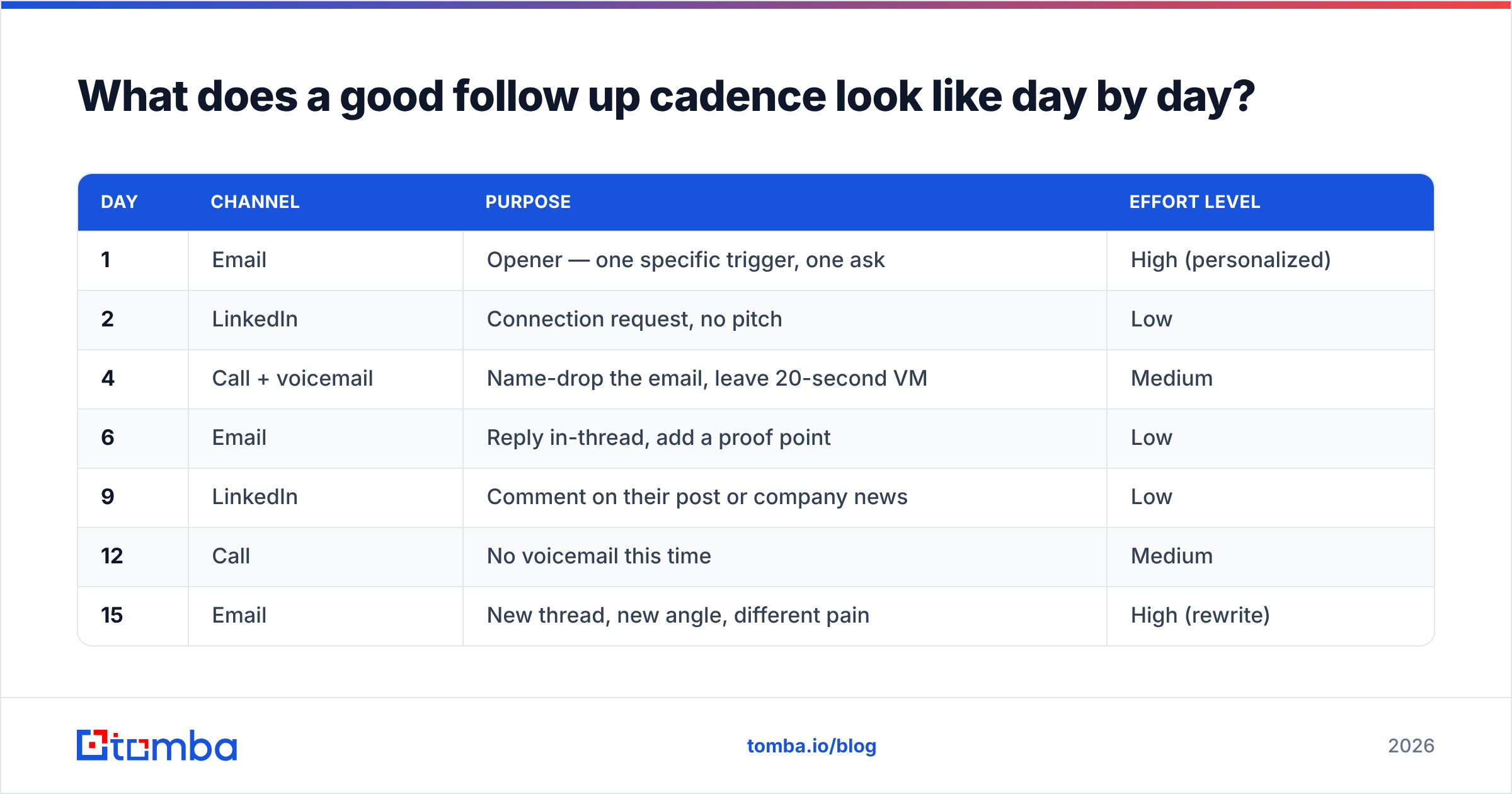
Below is a 26-day, ten-touch mid-market cadence you can copy and adjust. It front-loads effort, gives space in the middle, and exits cleanly.
| Day | Channel | Purpose | Effort level |
|---|---|---|---|
| 1 | Opener — one specific trigger, one ask | High (personalized) | |
| 2 | Connection request, no pitch | Low | |
| 4 | Call + voicemail | Name-drop the email, leave 20-second VM | Medium |
| 6 | Reply in-thread, add a proof point | Low | |
| 9 | Comment on their post or company news | Low | |
| 12 | Call | No voicemail this time | Medium |
| 15 | New thread, new angle, different pain | High (rewrite) | |
| 19 | Call + voicemail | Reference the new angle | Medium |
| 23 | Short value asset — teardown, benchmark, checklist | Medium | |
| 26 | Breakup — permission to close the file | Low |
Notice what is not in there: no "just bumping this to the top of your inbox," no "circling back," no third identical reply to a thread that already died. Every touch either introduces new information or changes channel.
The breakup email on day 26 is the highest-converting message in most cadences, and it works for an unglamorous reason: it removes the obligation to buy and replaces it with a two-second decision. Keep it to three lines. "I'll assume the timing is wrong and close the file — happy to revisit in Q3 if that's better" outperforms anything with the phrase "one last try."
Which channels belong in your follow up cadence?#
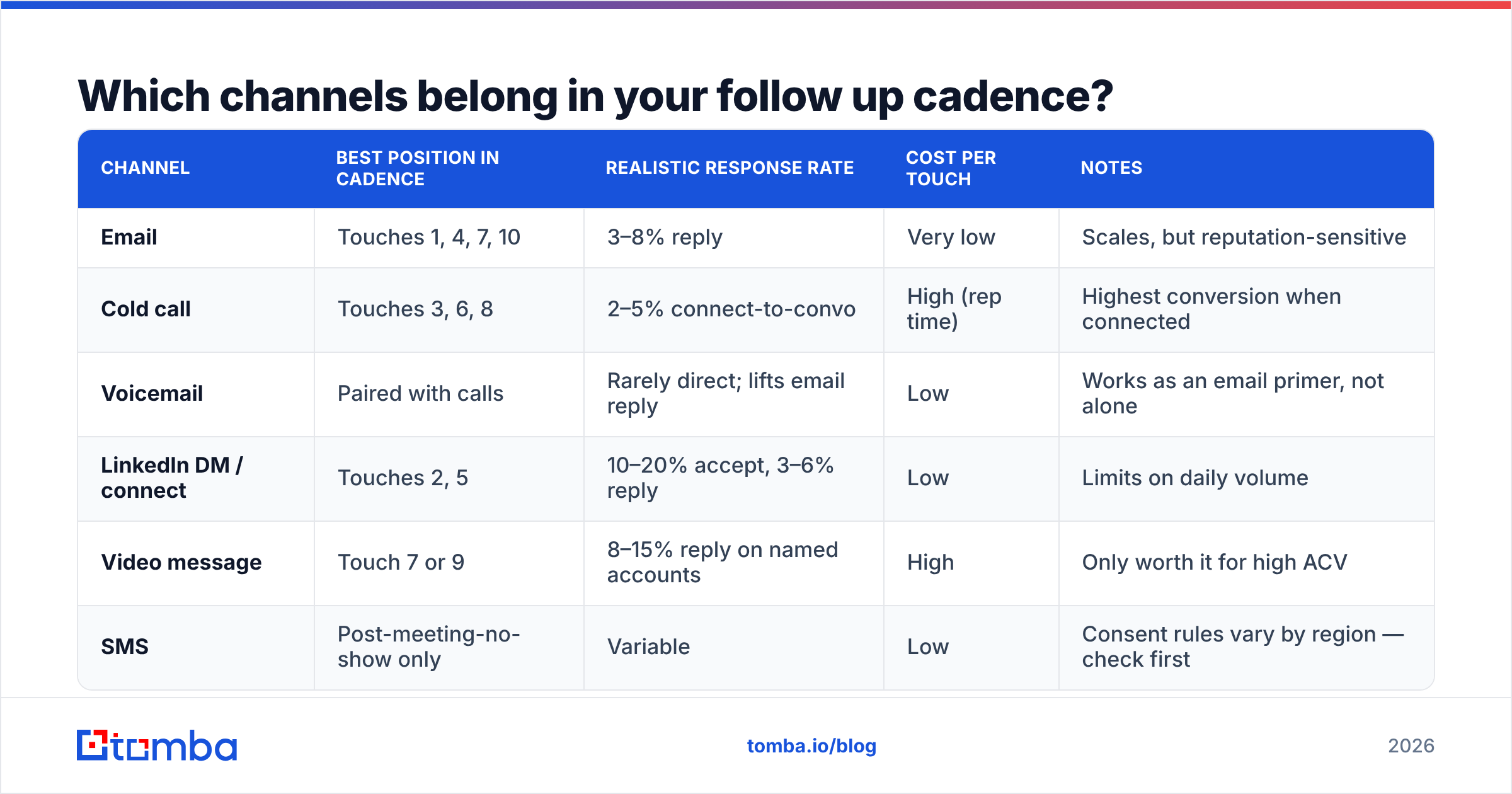
Email carries volume, phone carries conversion, LinkedIn carries credibility. Pick all three.
| Channel | Best position in cadence | Realistic response rate | Cost per touch | Notes |
|---|---|---|---|---|
| Touches 1, 4, 7, 10 | 3–8% reply | Very low | Scales, but reputation-sensitive | |
| Cold call | Touches 3, 6, 8 | 2–5% connect-to-convo | High (rep time) | Highest conversion when connected |
| Voicemail | Paired with calls | Rarely direct; lifts email reply | Low | Works as an email primer, not alone |
| LinkedIn DM / connect | Touches 2, 5 | 10–20% accept, 3–6% reply | Low | Limits on daily volume |
| Video message | Touch 7 or 9 | 8–15% reply on named accounts | High | Only worth it for high ACV |
| SMS | Post-meeting-no-show only | Variable | Low | Consent rules vary by region — check first |
The pattern to steal from teams that run this well: channel-switch after every non-response. If email one lands nothing, do not send email two the next day. Go to LinkedIn or the phone. The prospect who ignores your inbox may pick up at 8:10am. Sales engagement platforms categorized on G2's sales engagement listings are all built around this assumption for a reason.
How long should you wait between follow-ups?#
Start at 2–3 days, widen to 4–5, finish at 6–7. Total window: three to four weeks.
Short early gaps work because your first email is still faintly familiar — the prospect half-remembers seeing your name. Long late gaps work because you are no longer trying to be remembered, you are trying to catch a changed circumstance: a new budget cycle, a departed vendor, a board mandate.
Practical rules that hold up:
- Never follow up the next morning. It reads as automated and it is. Minimum 48 hours.
- Reply in-thread for touches 2–3, start a fresh thread for touch 4+. A dead thread trains the inbox to ignore you; a new subject line resets the read decision.
- Respect the out-of-office. Push the whole cadence forward by the stated return date plus two days. This one change alone lifts reply rates on enterprise sequences.
- Tuesday–Thursday, 7–9am local, is still the least-bad window for cold email, but the effect size is smaller than every blog post claims. Consistency beats timing micro-optimization.
- Cap at one touch per day per prospect, across all channels. An email and a LinkedIn DM in the same hour is one message too many.
The mistake most teams make is treating spacing as a scheduling problem rather than a relevance problem. If you have nothing new to say on day 6, the answer is not to send a shorter version of day 1 — it is to find something new to say. HubSpot's sales resources are a decent free source of angle ideas when you are out of them.
What should each follow-up actually say?#
Each touch should carry one new piece of information. That is the whole rule.
Rotate through these angles across the sequence:
- Trigger — funding round, new hire in a relevant role, product launch, job posting that implies your problem.
- Proof — a named customer in their segment with a specific number, not "we help companies grow."
- Insight — something true about their market they cannot easily get elsewhere. A benchmark, a teardown, a pattern you see across similar accounts.
- Different persona pain — the pain you pitched the VP is not the pain the Director feels. Change the pain, not just the wording.
- Low-friction ask — replace "30 minutes?" with "worth a look, or wrong time?" on touches 6+.
- Permission close — the breakup.
Keep every follow-up under 90 words. The second email should be shorter than the first, the fifth shorter than the second. Length signals effort at touch one and desperation at touch seven.
If you want a starting library rather than a blank page, the cold email templates collection covers the standard angles, and a subject line generator helps when you need a fresh thread for touch four without recycling the same phrasing.
Does the cadence change by segment?#
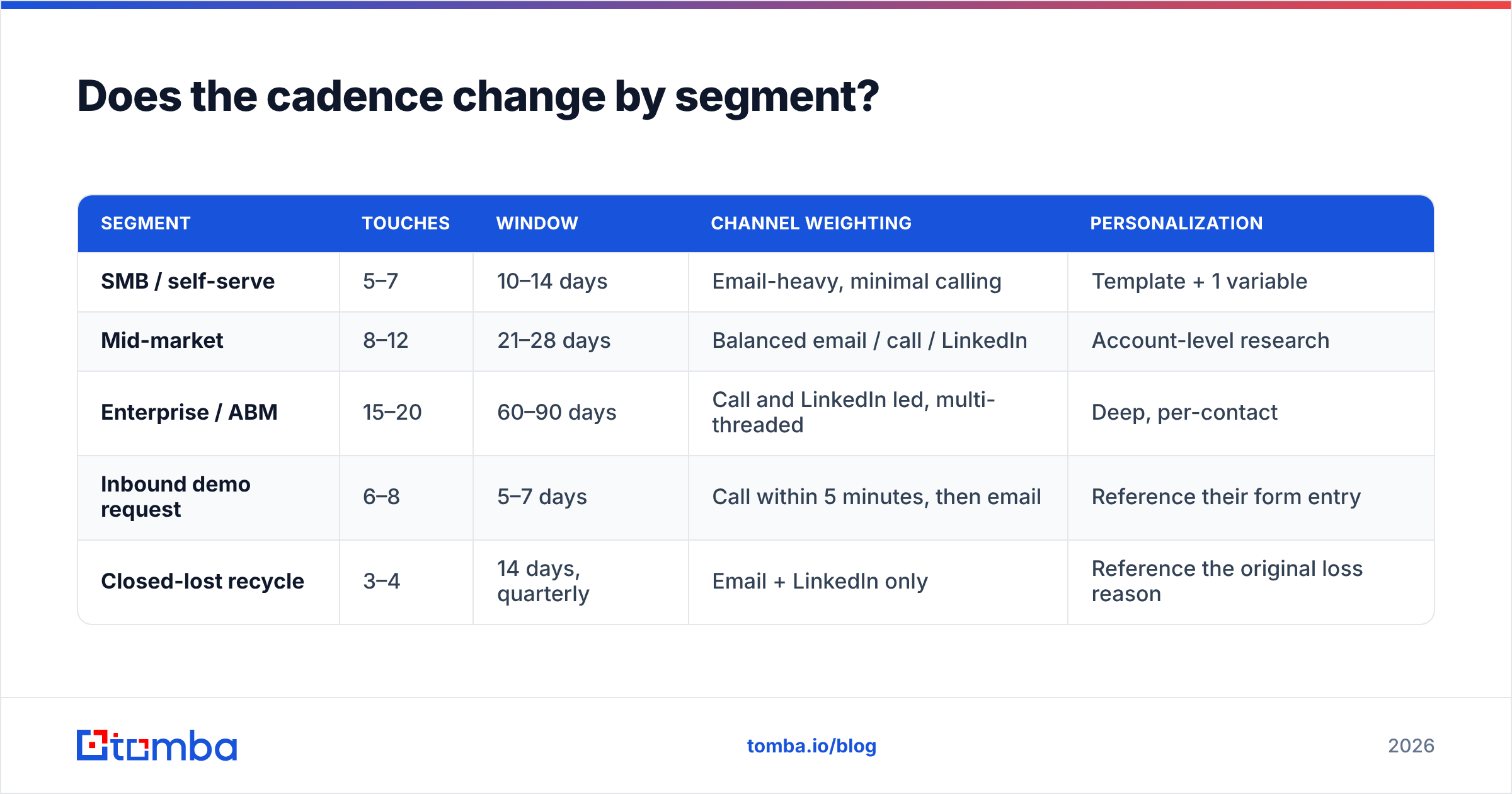
Yes, and running one cadence across all segments is the most common structural error in outbound.
| Segment | Touches | Window | Channel weighting | Personalization |
|---|---|---|---|---|
| SMB / self-serve | 5–7 | 10–14 days | Email-heavy, minimal calling | Template + 1 variable |
| Mid-market | 8–12 | 21–28 days | Balanced email / call / LinkedIn | Account-level research |
| Enterprise / ABM | 15–20 | 60–90 days | Call and LinkedIn led, multi-threaded | Deep, per-contact |
| Inbound demo request | 6–8 | 5–7 days | Call within 5 minutes, then email | Reference their form entry |
| Closed-lost recycle | 3–4 | 14 days, quarterly | Email + LinkedIn only | Reference the original loss reason |
Two segment-specific notes. Inbound leads decay by the minute — speed-to-lead matters more than cadence design there, and analyst coverage of sales practice from firms like Gartner has been consistent on this for years. Enterprise, by contrast, is about multi-threading: five touches across three stakeholders beats fifteen touches to one champion who has no budget authority.
Why do most follow-up cadences fail?#
Rarely because the copy is bad. Usually because of one of these:
- Bad data at touch one. If 12% of your list bounces, your domain reputation drops before the cadence gets to its highest-converting touches. Run every list through an email verifier before the first send, and pay attention to catch-all domains — a catch-all verifier is the difference between "accepts everything" and "actually deliverable."
- No exit rules. Sequences that keep firing after a reply are the fastest way to lose a deal you already won.
- Same-channel repetition. Eight emails is not a cadence, it is a volume strategy with a nicer name.
- No new information per touch. "Following up on my last email" is a touch that costs you goodwill and buys nothing.
- Ignoring the reply-rate-to-complaint-rate ratio. If your unsubscribes and spam complaints climb while replies stay flat, the cadence is too long for the relevance you are delivering. Watch sender reputation as a leading indicator, not a lagging one.
- Measuring the wrong touch. Teams optimize touch one because it is easiest to A/B test, then never look at whether touches five through ten exist at all.
How do you measure whether the cadence works?#
Track reply rate by touch number, not just in aggregate. That single view tells you where to cut and where to extend.
Four metrics worth a dashboard:
- Cumulative positive reply rate by touch — if it flattens at touch six, your touches seven through twelve are pure cost.
- Completion rate — what percentage of enrolled prospects actually receive every scheduled touch. In most teams this is under 40%, and it is the cheapest fix available.
- Channel contribution — which channel produced the touch immediately preceding each booked meeting.
- Bounce and complaint rate per campaign — your early-warning system for email deliverability problems.
Completion rate deserves special attention. Most cadence "underperformance" is not a design problem at all — it is reps manually skipping touches four onward because those touches feel awkward. Automate the schedule, hold the line, and measure again in 30 days before you rewrite a single email.
Where should you start?#
Build the schedule second. Build the list first.
A ten-touch cadence against 200 verified, correctly-matched contacts beats a perfect cadence against 1,000 guessed addresses, every time — because bounces on touch one poison the deliverability that touches four through ten depend on. Get the contact right, verify it, then run the rhythm.
Start with Tomba Email Finder to source and confirm the addresses behind your target account list — search by domain, by name, or in bulk, with confidence scoring on every result so you know what is safe to enroll. The free tier gives you 25 searches a month to test the workflow, and paid plans start at $49/mo on Tomba pricing when you are ready to load the whole territory. Fix the data, then let the cadence do its job.
Related guides#
Ready to find emails that actually work?
Join 150,000+ professionals who stopped guessing and started sending. Free credits on signup — no credit card required.
Get the Tomba newsletter
Practical outbound tactics and product updates — once every two weeks.
About the author