Follow Up Call After Email: The 2026 Playbook That Books Meetings
Most reps send the email, then wait. The reps who call 20 minutes later book 2-3x more meetings. Here's the exact timing, script, and sequence structure that makes the email-then-call combo work in 2026.
TL;DR
- The highest-converting follow up call after email happens inside a 30-minute window after the prospect opens or clicks — not on "day 7" of a rigid cadence.
- Email-then-call sequences beat email-only sequences by roughly 2-3x on meetings booked, because the email supplies the context the call needs in its first eight seconds.
- Reference the email explicitly. "I sent you a note about X ten minutes ago" converts far better than a cold-sounding opener that pretends the email never happened.
- Bad phone numbers kill this play faster than bad scripts. If your connect rate is under 15%, fix the data before you rewrite the talk track.
- Three touches — email, call, voicemail-plus-follow-up-email — inside 48 hours outperform eight emails spread over three weeks.
Why does a follow up call after email work at all?#
Because the email does the introducing, and the call does the closing. Think of it like knocking on a door after mailing a postcard: the person on the other side already has a rough idea of who you are, so you skip the ten seconds of "who is this and why are you calling" that kills most cold calls.
Cold calling alone has a brutal problem — you spend the first eight seconds proving you're not a scam. Email alone has the opposite problem — you're perfectly credible and completely ignorable. Stack them and each one covers the other's weakness. The email gives you a legitimate reason to call ("I sent you a note this morning"), and the call gives your email a second life in a crowded inbox.
Sales orgs that formalize this are usually running what HubSpot and most modern sequence tools call a multi-channel cadence. The mechanic is simple. The execution is where teams lose the plot.
What is the right timing for a follow-up call?#
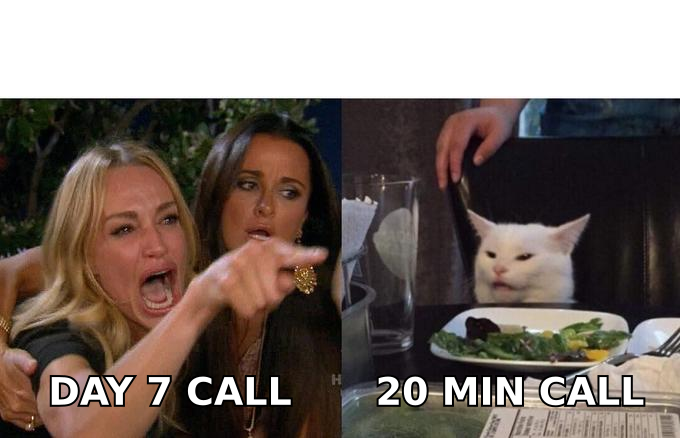
The single biggest lever is speed after signal. If you have open or click tracking, the call should go out inside 30 minutes of the open. The prospect's context window is still warm — they literally read your name minutes ago.
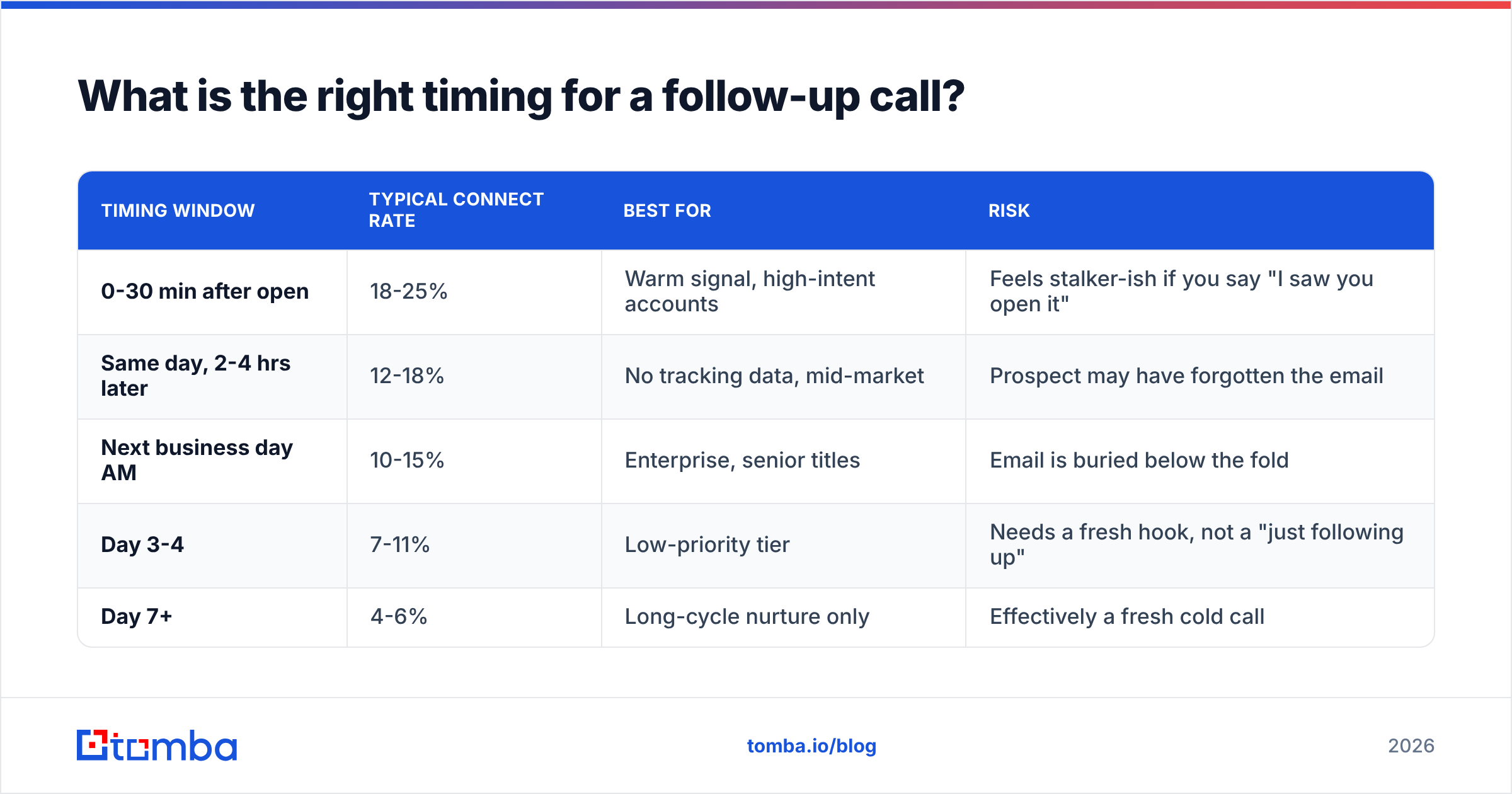
Here's how the timing windows actually break down in practice:
| Timing window | Typical connect rate | Best for | Risk |
|---|---|---|---|
| 0-30 min after open | 18-25% | Warm signal, high-intent accounts | Feels stalker-ish if you say "I saw you open it" |
| Same day, 2-4 hrs later | 12-18% | No tracking data, mid-market | Prospect may have forgotten the email |
| Next business day AM | 10-15% | Enterprise, senior titles | Email is buried below the fold |
| Day 3-4 | 7-11% | Low-priority tier | Needs a fresh hook, not a "just following up" |
| Day 7+ | 4-6% | Long-cycle nurture only | Effectively a fresh cold call |
Two rules that matter more than the table:
- Never say "I noticed you opened my email." It's accurate and it's creepy. Say "I sent you a quick note this morning about [specific thing]" instead. Same information, none of the surveillance vibe.
- Call before 10am or after 4pm local time. Gatekeepers and back-to-back meetings own the middle of the day. Executives answer their own phones at the edges.
How do you structure the call itself?#
Eight seconds. That's what you get before the prospect decides whether this is a conversation or an interruption. Structure the opener so the email does the heavy lifting.
- Name the email, not yourself. "Hi Sarah — I sent you a note about your Q3 hiring backlog this morning, do you have thirty seconds?" You've just proven you're not a random dialer.
- Give the one-line reason. Not your pitch. The specific, observable trigger that made you reach out — a job posting, a funding round, a tech-stack change, a competitor they just churned from.
- Ask a diagnostic question, not a demo question. "How are you handling X right now?" outperforms "would you be open to a 15-minute demo?" by a wide margin because it invites a real answer.
- Handle the "send me info" deflection. "Happy to — the deck's only useful if I know which of these three problems you actually have. Which one's closest?"
- Close on a specific slot. "Thursday 2pm or Friday 10am?" beats "when works for you?" every time.
- Log the outcome the same minute. Untracked calls make your next sequence a guess.
The voicemail deserves its own note. Leave one, keep it under 20 seconds, and reference the email again: "Sarah, it's Mark from Tomba — I sent you an email this morning with the subject line 'Q3 hiring backlog.' Worth a look. I'll follow up Thursday." Then actually follow up Thursday. The consistency is the credibility.
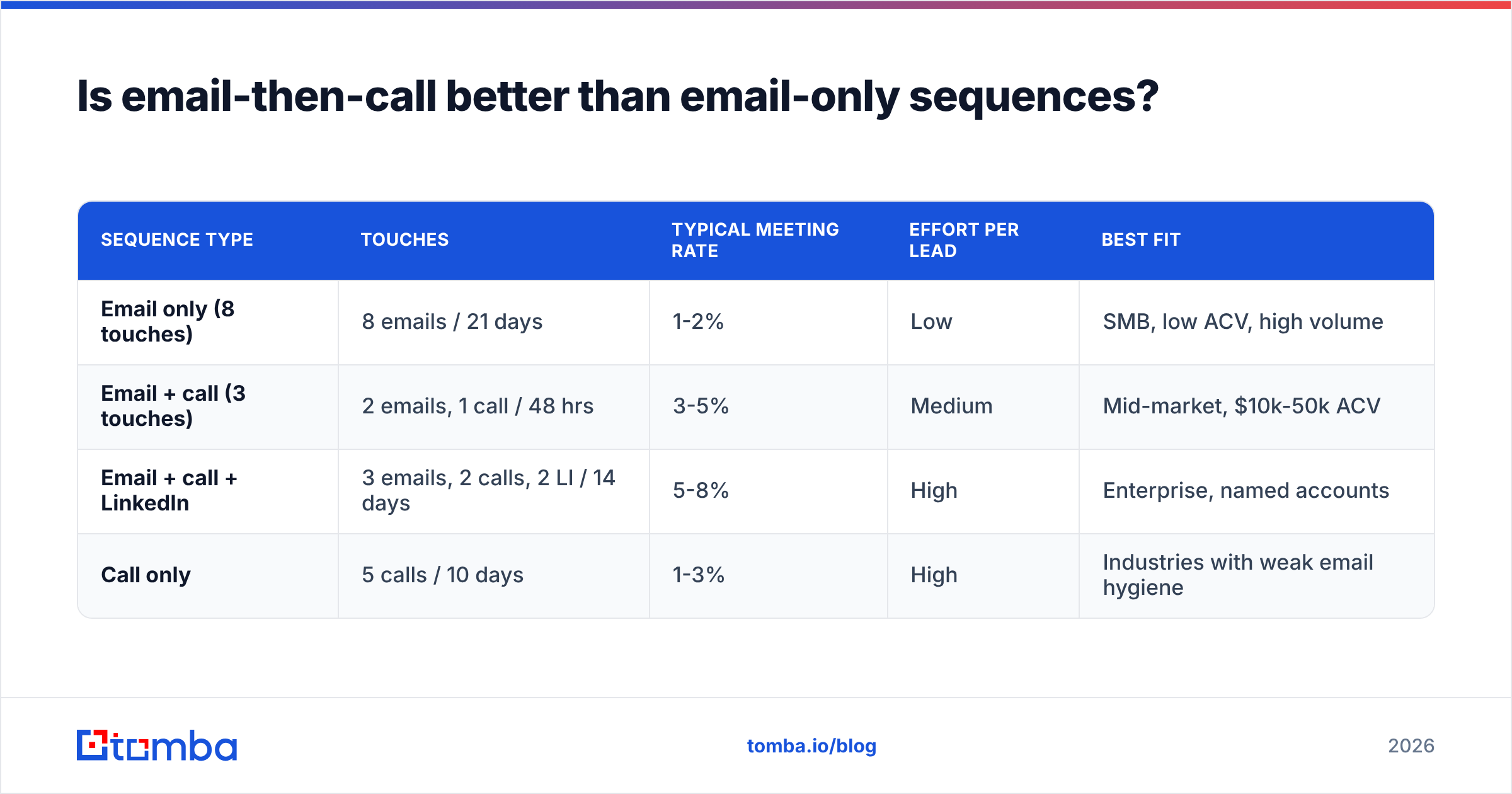
Is email-then-call better than email-only sequences?#
For anything above a $5k ACV, yes — and it's not close. Email-only sequences degrade fast: each additional email in a chain gets a lower reply rate than the one before it, and by touch five you're mostly generating unsubscribes.
| Sequence type | Touches | Typical meeting rate | Effort per lead | Best fit |
|---|---|---|---|---|
| Email only (8 touches) | 8 emails / 21 days | 1-2% | Low | SMB, low ACV, high volume |
| Email + call (3 touches) | 2 emails, 1 call / 48 hrs | 3-5% | Medium | Mid-market, $10k-50k ACV |
| Email + call + LinkedIn | 3 emails, 2 calls, 2 LI / 14 days | 5-8% | High | Enterprise, named accounts |
| Call only | 5 calls / 10 days | 1-3% | High | Industries with weak email hygiene |
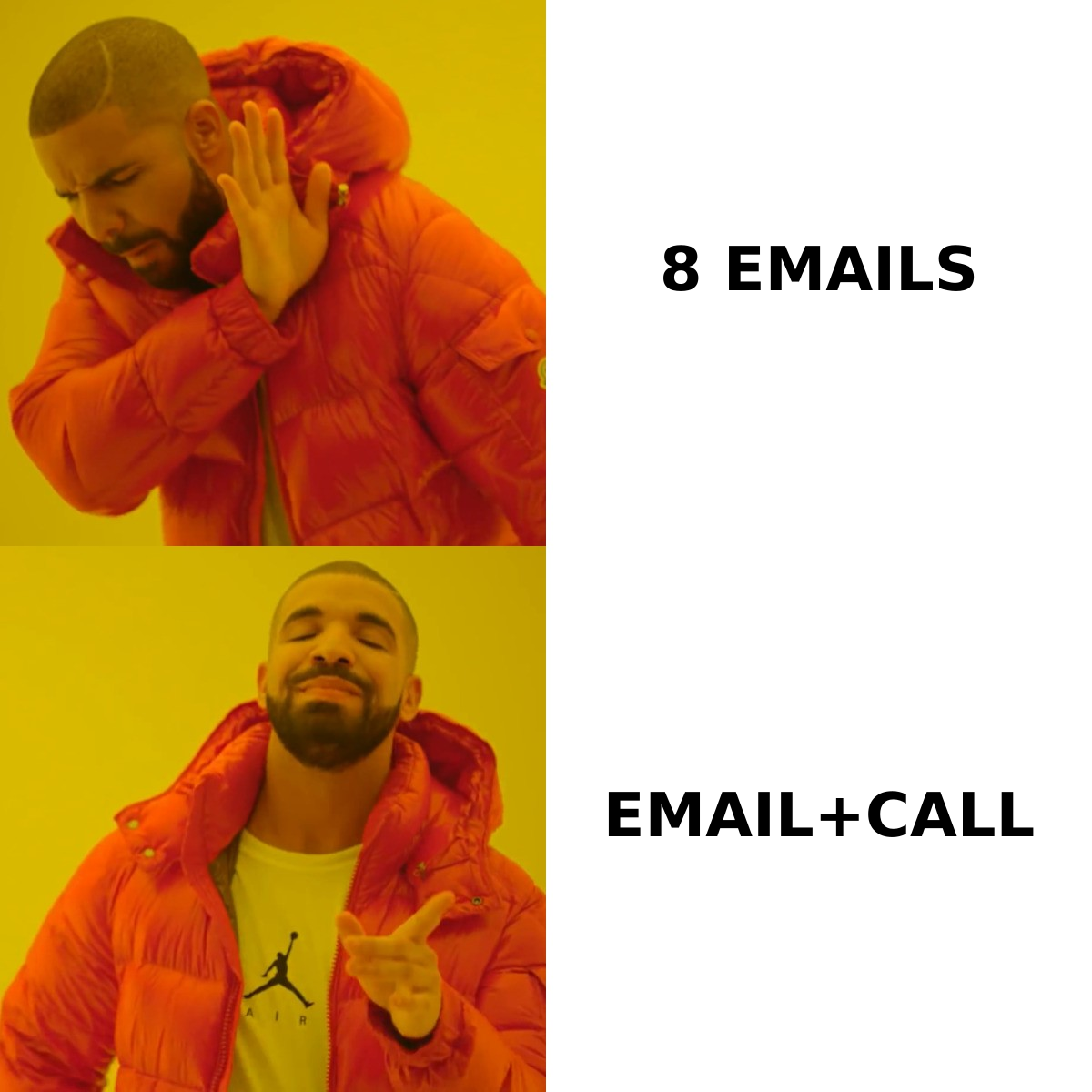
The pattern is consistent: fewer, better-orchestrated touches across two channels beat more touches on one channel. Adding a LinkedIn outreach step on top pushes it further, but only if the LinkedIn message references the same thread — three disconnected messages from three channels read as three different spam attempts.
What kills a follow-up call before you dial?#
Bad data. Overwhelmingly, bad data.
You can have a perfect script and a perfect trigger and still connect on 6% of dials because the direct line in your CRM is a switchboard from 2019, or the mobile belongs to someone who left the company eighteen months ago. Before you spend another quarter rewriting talk tracks, audit the inputs:
- Is the email address real? If the email bounced, the call has no reference point. Run the list through an email verifier before the sequence starts, not after the bounce report comes back.
- Is the number a direct line or a main switchboard? Switchboard numbers turn a warm follow-up into a gatekeeper negotiation. Source direct dials and mobiles where you can — a dedicated phone finder is the cheap fix here.
- Is the title still current? Calling a VP who was promoted to CRO reads as sloppy. Enrichment refreshes on a 90-day cycle catch most of this.
- Is the number in a callable time zone? A 7am call in Berlin from a US-based rep is a delete-and-block event.
A quick sanity check: if your connect rate sits below 15% on direct dials, the problem is almost never the opener. Fix the phone data, and the same script starts working.
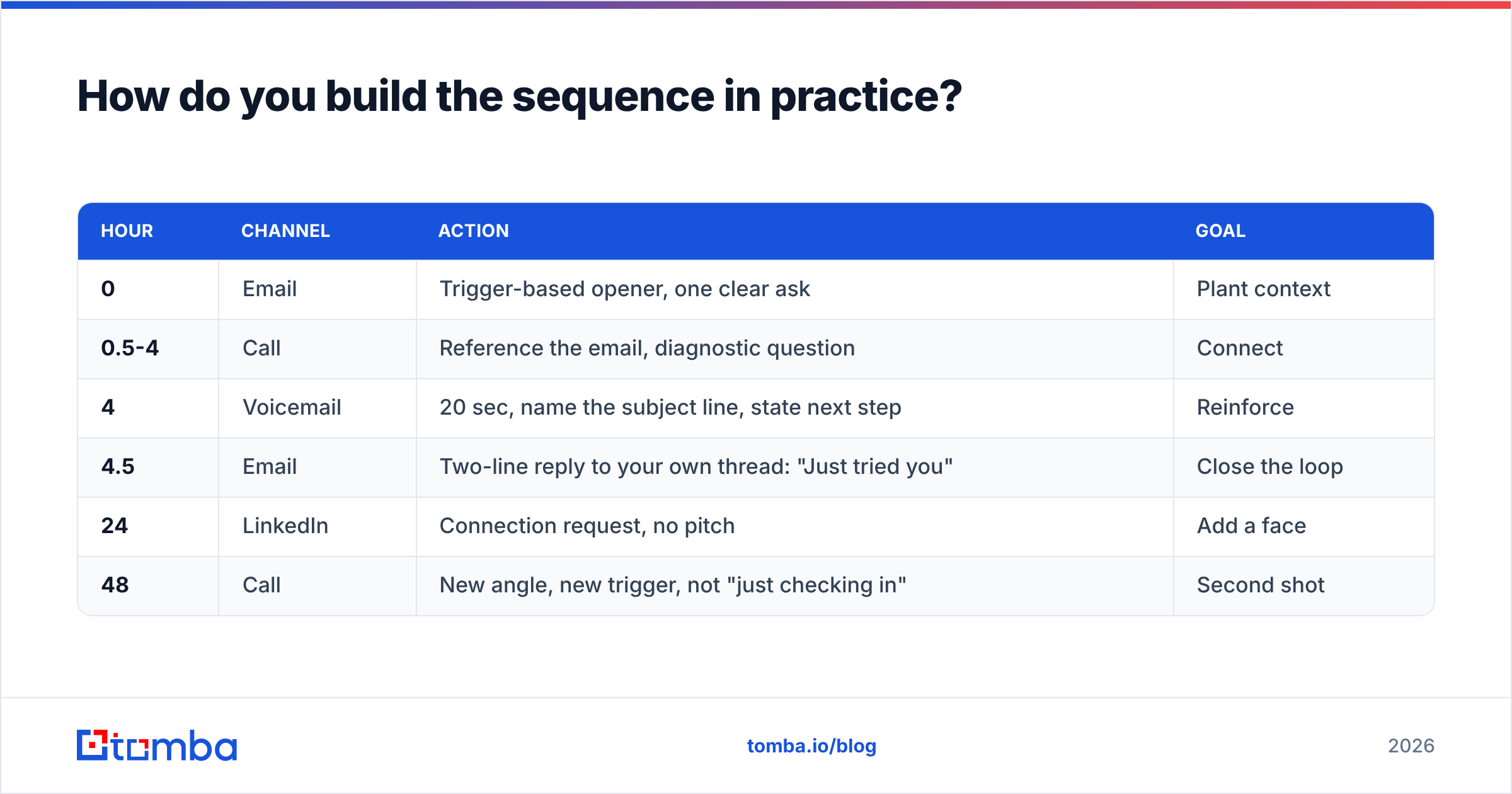
How do you build the sequence in practice?#
Here's a 48-hour structure that holds up across most B2B segments. Adapt the intervals, keep the logic.
| Hour | Channel | Action | Goal |
|---|---|---|---|
| 0 | Trigger-based opener, one clear ask | Plant context | |
| 0.5-4 | Call | Reference the email, diagnostic question | Connect |
| 4 | Voicemail | 20 sec, name the subject line, state next step | Reinforce |
| 4.5 | Two-line reply to your own thread: "Just tried you" | Close the loop | |
| 24 | Connection request, no pitch | Add a face | |
| 48 | Call | New angle, new trigger, not "just checking in" | Second shot |
Three details that make or break this:
Reply to your own thread, don't start a new one. The follow-up email after the call belongs in the original thread. It keeps the context stacked and it looks like a conversation rather than a campaign.
Vary the hook on touch two. "Just following up" is the most-ignored phrase in B2B. Bring a new data point — a competitor announcement, a relevant customer story, a specific number.
Cap it at six touches, then move to nurture. Past six, you're not persistent, you're a problem. Move the contact to a quarterly check-in and spend the energy on a fresh account.
For teams building these lists at scale, the enrichment step matters as much as the sequencing. Pulling verified work emails from a domain via domain search, then layering direct dials on top, gives you a list where both channels actually work. If you're pulling from LinkedIn instead, the LinkedIn finder route gets you from profile to verified email without a scraping headache.
What should you say when they answer but they're busy?#
This is the most common outcome, and most reps blow it. The prospect answers, sounds rushed, and says "now's not a good time."
The wrong response is to pitch faster. The right response is to take the exit and set the return:
"Totally fair — I'll be quick. I sent you a note this morning about [trigger]. If it's relevant, I'd take fifteen minutes Thursday. If it's not, tell me now and I'll stop bothering you."
That last clause does two jobs. It gives them permission to say no, which people find disarming, and it filters your pipeline honestly. A clean "no" on the second touch is worth more than four weeks of hopeful sequencing.
If they say "email me the details," send them inside five minutes while your name is still in their short-term memory — and put a specific meeting slot in the email, not a Calendly link buried in a signature. According to research summarized across sales platforms like Salesforce, speed-to-response after any inbound signal is one of the strongest predictors of conversion, and a live call counts as a signal.
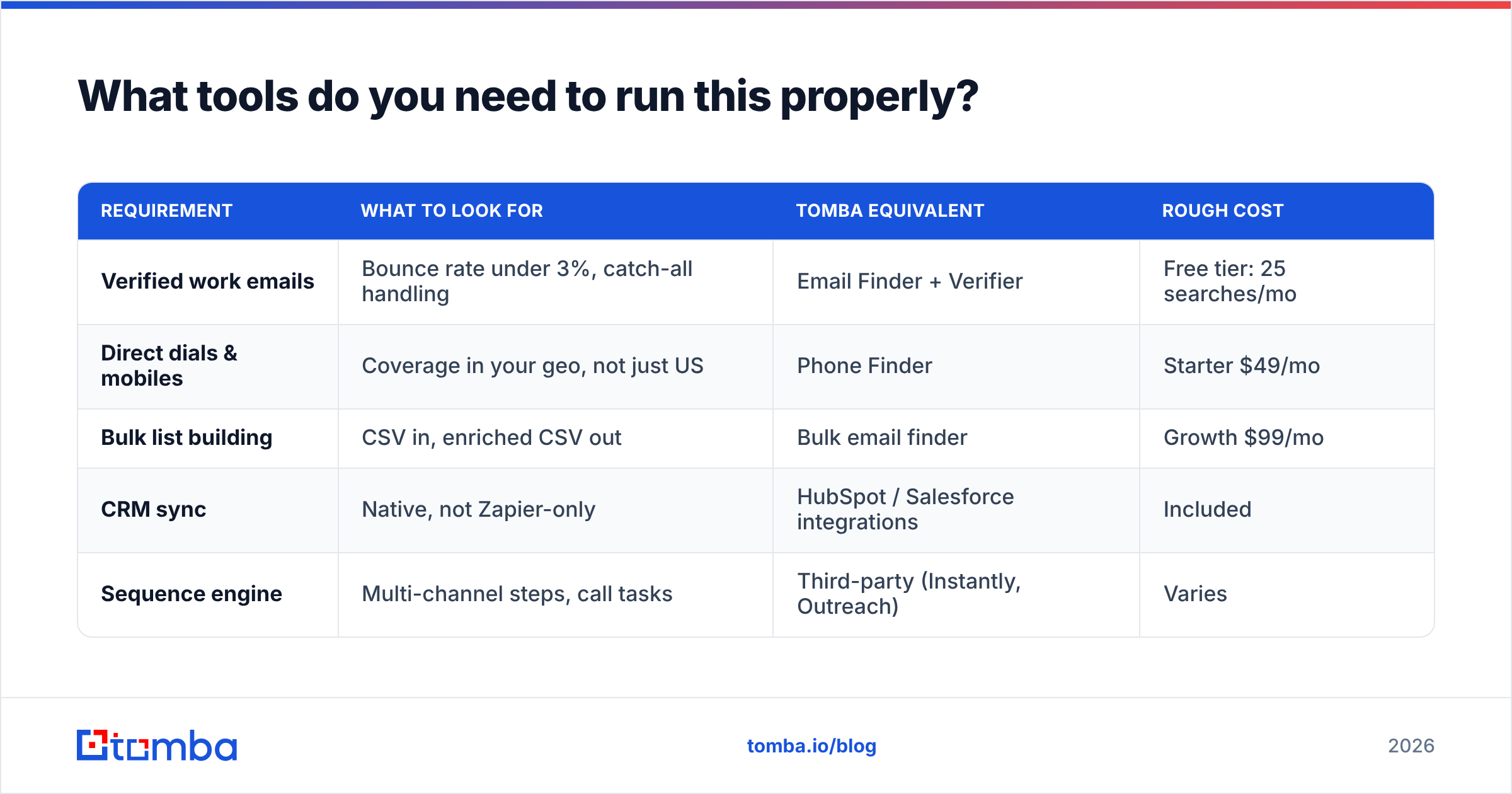
What tools do you need to run this properly?#
You need three things: verified emails, direct dials, and a place to track the sequence. Most teams overbuy on the third and underinvest in the first two.
| Requirement | What to look for | Tomba equivalent | Rough cost |
|---|---|---|---|
| Verified work emails | Bounce rate under 3%, catch-all handling | Email Finder + Verifier | Free tier: 25 searches/mo |
| Direct dials & mobiles | Coverage in your geo, not just US | Phone Finder | Starter $49/mo |
| Bulk list building | CSV in, enriched CSV out | Bulk email finder | Growth $99/mo |
| CRM sync | Native, not Zapier-only | HubSpot / Salesforce integrations | Included |
| Sequence engine | Multi-channel steps, call tasks | Third-party (Instantly, Outreach) | Varies |
A note on stacking: you do not need an all-in-one platform. A focused data provider plus your existing sequencer usually costs less and produces cleaner data than a bundled suite where the contact database is an afterthought. Peer tools like BookYourData take a database-first approach that works well for teams who want pre-built lists, while a search-and-verify approach fits teams building lists account-by-account. Check reviews on G2 for your specific segment before committing to an annual contract.
If you want the full breakdown, Tomba pricing runs Free (25 searches/mo), Starter at $49/mo, Growth at $99/mo, and Pro at $249/mo, with Enterprise custom. Most two-to-five-rep teams running this play land on Growth.
How do you measure whether it's working?#
Track four numbers, weekly, per rep:
- Connect rate — live conversations divided by dials. Below 15% on direct dials means a data problem. Above 25% means your list is unusually good; scale it.
- Email-to-call lift — meeting rate for contacts who got the call versus those who only got emails. If the lift is under 1.5x, your call opener isn't referencing the email clearly enough.
- Time-to-call after send — median minutes between email send and first dial. Anything above four hours means your workflow is broken, not your reps.
- Meetings held, not booked — no-show rate above 30% means you're booking out of politeness, not interest. Tighten the qualification question on the call.
Review these together, not in isolation. A rising connect rate with a falling meeting rate usually means you've improved your data and degraded your talk track — a good problem, but a real one.
Where do you start tomorrow?#
Pick twenty accounts. Send the email at 8am. Call at 8:30. Leave a voicemail that names the subject line. Reply to your own thread at 9. Log everything. Do it for a week before you change anything, then look at connect rate and meeting rate side by side.
The play is not complicated. It fails on execution details — timing that drifts, phone numbers that don't ring, openers that pretend the email never happened.
The prerequisite for all of it is contact data you can trust. If the email bounces, there's no thread to reference; if the dial hits a dead switchboard, there's no conversation to have. Start there: use the Tomba Email Finder to build a verified list by domain, name, or company, then layer direct dials on top so the follow-up call after email lands on a real phone, held by a real person, who actually read your note thirty minutes ago. Free tier gives you 25 searches a month to test the workflow before you commit to a plan.
Related guides#
Ready to find emails that actually work?
Join 150,000+ professionals who stopped guessing and started sending. Free credits on signup — no credit card required.
Get the Tomba newsletter
Practical outbound tactics and product updates — once every two weeks.
About the author