Follow Up Call Script: 7 Templates That Book Meetings in 2026
Most follow-up calls die because the rep opens with "just checking in." Here are 7 tested follow up call scripts, the timing windows that work, and how to keep your dial list clean.
TL;DR
- A follow up call script is not a reminder — it's a second pitch with new information. If you have nothing new to say, you don't have a reason to dial.
- "Just checking in" converts worse than almost any other opener. Replace it with a reference point, a reason, and a single closed question.
- Most closed-won deals need 5–8 touches. Reps who stop at 2 leave roughly half their pipeline unworked.
- Timing beats volume: call back within 24 hours of a demo, 48–72 hours of a proposal, and 5–7 business days after a no-answer.
- Bad phone numbers waste more call time than bad scripts. Validate the number before you burn a dial slot on it.
What is a follow up call script?#
A follow up call script is a written structure for the second, third, or fifth conversation with a prospect who already knows who you are. It's different from a cold call script in one critical way: you're not earning permission to talk, you're earning permission to move forward.
Think of it like a second date. On a first date you explain who you are. On a second date, repeating your résumé is a red flag — the other person expects you to build on what you already discussed. Follow-up calls work the same way. Every call after the first must reference something specific from the last one and add something new.
The structural difference matters more than the wording:
- Reference — name the last touchpoint precisely ("the pricing sheet I sent Tuesday", not "our previous conversation").
- Reason — state the new information that justifies this call today.
- Relevance — connect that information to a problem the prospect actually named.
- Request — one closed question with a binary or date-based answer.
- Retreat path — a graceful exit that keeps the door open if the answer is no.
Skip step 2 and you've written a "just checking in" call, which is the phone equivalent of a blank email.
Why do most follow-up calls fail?#
Three reasons, in order of how much damage they do.
No new information. The rep dials because the CRM task turned red, not because anything changed. The prospect hears "checking in," recognizes it as a status request rather than value, and gives the fastest possible answer to end the call: "still reviewing."
Wrong timing. A proposal follow-up placed 10 days after send lands after the prospect's internal discussion already happened. A demo follow-up placed 5 days later lands after the enthusiasm has decayed. The window is narrower than most reps think.
Too many questions. Reps who open with three questions get vague answers to all three. One closed question — "Does Thursday at 2 or Friday at 10 work better?" — gets a real answer or a real objection. Both are useful.
There's a fourth, quieter killer: dialing numbers that were never going to connect. If a quarter of your list has a wrong direct dial or a switchboard number attributed to a director, your connect rate collapses regardless of script quality. Run the list through a phone validator before a calling block and you recover dial slots you didn't know you were losing.
How many follow-up calls should you actually make?#
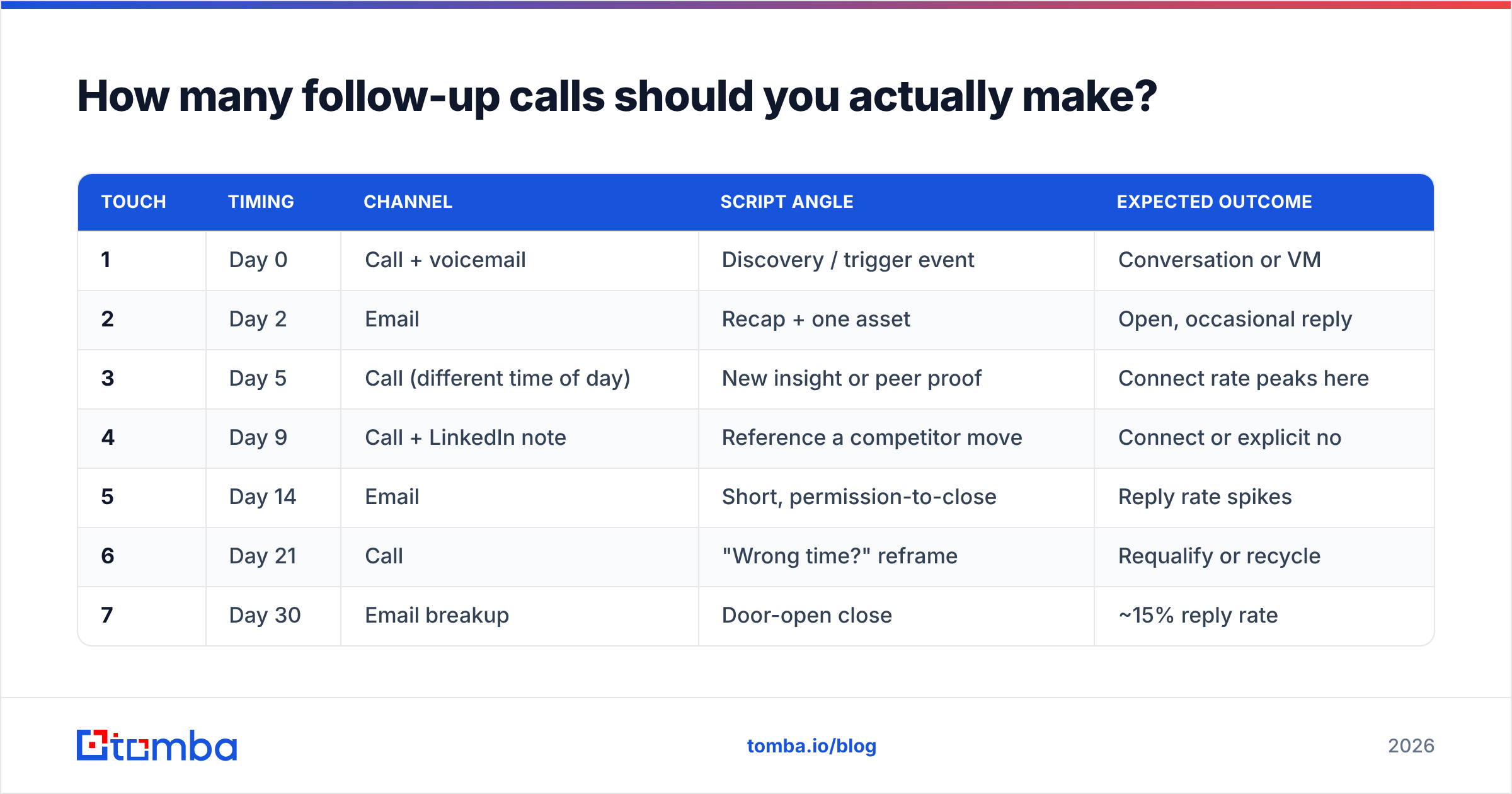
Sales research has consistently pointed to the same range: most closed deals require somewhere between five and eight meaningful touches, and a majority of reps stop at two or three. HubSpot's sales research has repeatedly documented this gap between what reps do and what closes.
Here's a realistic cadence framework you can drop into a sequence:
| Touch | Timing | Channel | Script angle | Expected outcome |
|---|---|---|---|---|
| 1 | Day 0 | Call + voicemail | Discovery / trigger event | Conversation or VM |
| 2 | Day 2 | Recap + one asset | Open, occasional reply | |
| 3 | Day 5 | Call (different time of day) | New insight or peer proof | Connect rate peaks here |
| 4 | Day 9 | Call + LinkedIn note | Reference a competitor move | Connect or explicit no |
| 5 | Day 14 | Short, permission-to-close | Reply rate spikes | |
| 6 | Day 21 | Call | "Wrong time?" reframe | Requalify or recycle |
| 7 | Day 30 | Email breakup | Door-open close | ~15% reply rate |
Two rules make this cadence work. First, vary the time of day — a prospect who never answers at 9am may answer reliably at 4:45pm. Second, never repeat an angle. If touch 3 used peer proof, touch 4 cannot.
What are the best follow up call script templates?#
1. The post-demo follow up call script (within 24 hours)#
"Hi [Name], it's [You] from [Company]. I'm calling about the demo yesterday — specifically the part where you mentioned [specific objection or concern]. I pulled the numbers on that after we hung up, and the answer is [concrete answer]. Does that change how you'd position this internally, or is there another blocker I should be solving first?"
Why it works: you're not asking what they thought. You're delivering on a specific unresolved item, which proves you listened and gives them a reason to keep talking.
2. The proposal follow up call script (48–72 hours after send)#
"Hi [Name], [You] from [Company]. You've had the proposal since Tuesday. I'm not calling to ask if you've read it — I'm calling because I want to know which line item is going to get pushed back on internally, so I can give you the counter-argument before that meeting instead of after it."
Why it works: it reframes you as an ally in their internal sale rather than a vendor chasing a signature. Prospects tell you the real objection because you've made it safe to.
3. The no-answer follow up call script (5–7 business days later)#
"Hi [Name], [You] again. Last time I called about [topic]. Since then, [new development — a competitor announcement, a regulation, a product release]. That's the only reason I'm calling back. If it isn't relevant, tell me and I'll close the file — no hard feelings."
Why it works: the explicit exit ramp lowers the pressure, and the "close the file" line generates honest answers instead of polite avoidance.
4. The gone-quiet follow up call script#
"Hi [Name], it's [You]. Three weeks ago this was a priority, and now it's gone quiet. In my experience that means one of three things: budget moved, priorities shifted, or I dropped the ball somewhere. Which one is it?"
Why it works: the three-option structure is easier to answer than an open question, and naming your own possible failure disarms the defensiveness.
5. The inbound-lead follow up call script (within 5 minutes)#
"Hi [Name], [You] from [Company] — you just downloaded [asset]. I'm calling while it's fresh. Most people who grab that one are trying to solve [problem]. Is that what's going on for you, or something else?"
Why it works: speed. Response-time studies from InsideSales/XANT research and similar vendors have consistently found that contacting an inbound lead within the first five minutes dramatically outperforms contacting them an hour later.
6. The referral follow up call script#
"Hi [Name], [Referrer] suggested I call you. She mentioned you're dealing with [problem] on the [team] side. I told her I'd take two minutes of your time and no more — is now workable, or should I call back after [likely busy period]?"
Why it works: borrowed trust plus an explicit time cap. Naming a specific busy period shows you understand their role.
7. The post-no-show follow up call script#
"Hi [Name], we had 2pm on the calendar and I know how those days go. I'm not chasing you — I'm calling to ask whether this is still worth your time. If yes, I'll send two new slots. If not, say the word and I'll stop."
Why it works: no guilt, no passive aggression, and a genuine either/or. No-shows convert far better when the follow-up removes the awkwardness instead of amplifying it.
Should you leave a voicemail or just call back?#
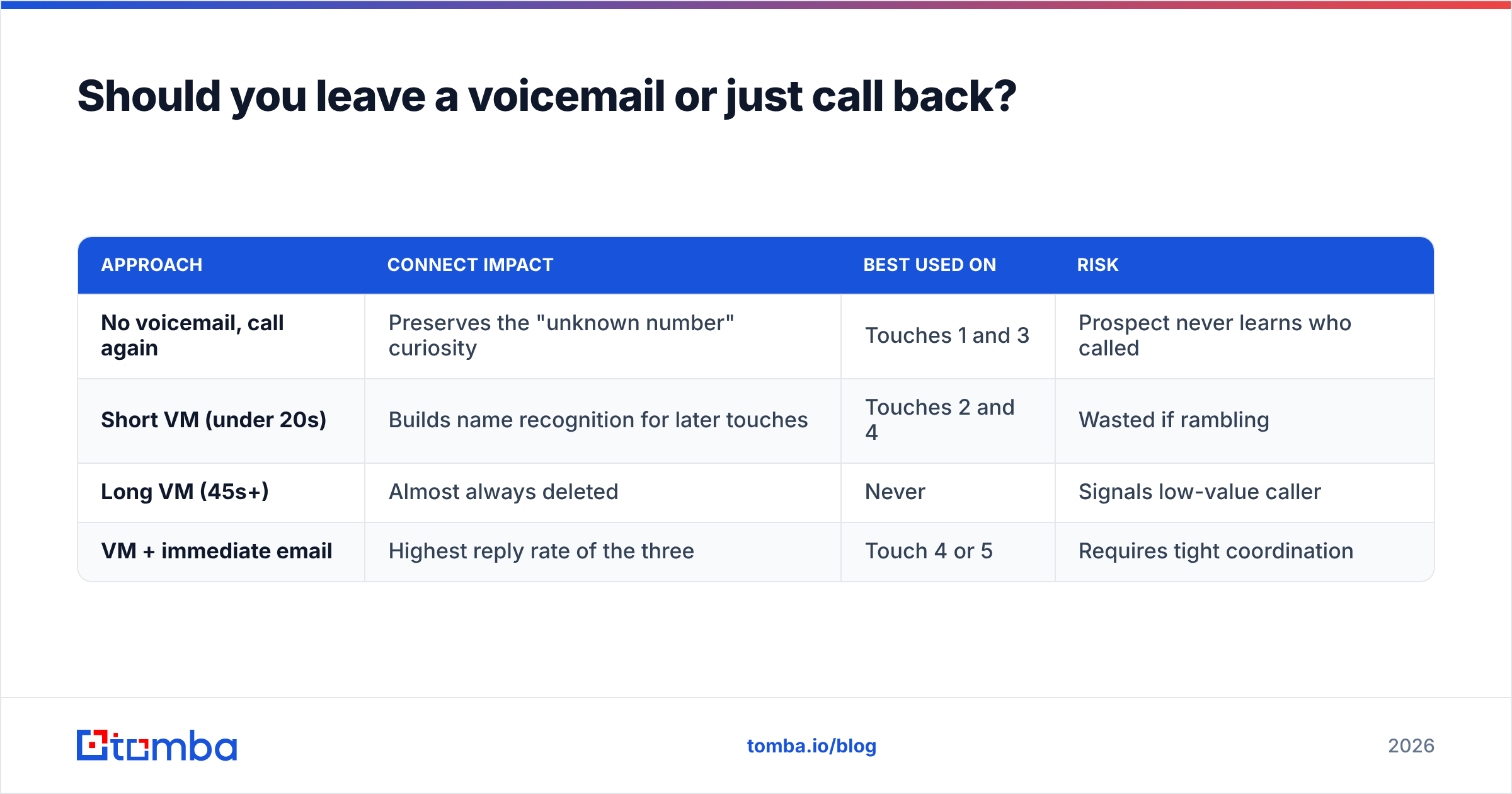
Leave one — but only on specific touches, and only if it's under 20 seconds.
| Approach | Connect impact | Best used on | Risk |
|---|---|---|---|
| No voicemail, call again | Preserves the "unknown number" curiosity | Touches 1 and 3 | Prospect never learns who called |
| Short VM (under 20s) | Builds name recognition for later touches | Touches 2 and 4 | Wasted if rambling |
| Long VM (45s+) | Almost always deleted | Never | Signals low-value caller |
| VM + immediate email | Highest reply rate of the three | Touch 4 or 5 | Requires tight coordination |
The best-performing voicemail formula is brutally short: name, company, one specific reason, callback number, hang up. "Hi [Name], [You] at [Company]. Calling about the [specific thing]. [Number]. Thanks." Anything longer and the prospect stops listening before your number.
Pair the voicemail with an email sent within two minutes, subject line "Left you a voicemail." The combination gets replies that neither channel gets alone.
How do you keep the dial list from wasting your calls?#
Script quality is downstream of data quality. A perfect follow up call script dialed against a switchboard number or an ex-employee's direct line produces nothing.
Three checks before every calling block:
- Verify the number is a direct dial, not a main line. Main-line numbers force you through a gatekeeper on every attempt, which destroys your dials-per-connect ratio.
- Confirm the contact still holds the role. B2B contact data decays fast — people change jobs constantly, and a number that worked in Q1 may route to a replacement by Q3.
- Have a second channel ready. If the phone fails twice, you need a verified email address to keep the sequence alive rather than dropping the account.
That third point is where most call-only sequences break. A phone finder gets you the direct dial, but pairing it with a verified email means a dead number doesn't kill the opportunity — you switch channels and keep the cadence intact. Run addresses through an email verifier before they enter the sequence so the fallback channel is actually reliable.
For teams working a named account list, enriching the whole list at once beats one-off lookups. Data enrichment fills in the direct dials, titles, and verified emails across an entire CSV so your calling block starts with a clean list rather than a hopeful one.
What should you never say on a follow-up call?#
Some phrases are so worn that prospects have a reflexive response ready before you finish the sentence.
- "Just checking in." Signals you have nothing. Replace with a specific reference plus new information.
- "Did you get my email?" They did, or they didn't, and either answer is useless. Lead with the content of the email instead.
- "I wanted to touch base." Vague, corporate, and about your needs. State the reason.
- "Is now a bad time?" Invites a no. Ask "Do you have 90 seconds or should I call back at 4?"
- "I'll keep this brief" followed by four minutes. Say it, then honor it.
- "Any updates on your end?" Puts the work on them. Bring the update yourself.
- "Circling back." Same as checking in, with a worse metaphor.
Swap each for a version that carries information. The rule of thumb: if the sentence would make sense in a call to any prospect in your pipeline, it's too generic to be worth saying.
How do you measure whether your follow up call script works?#
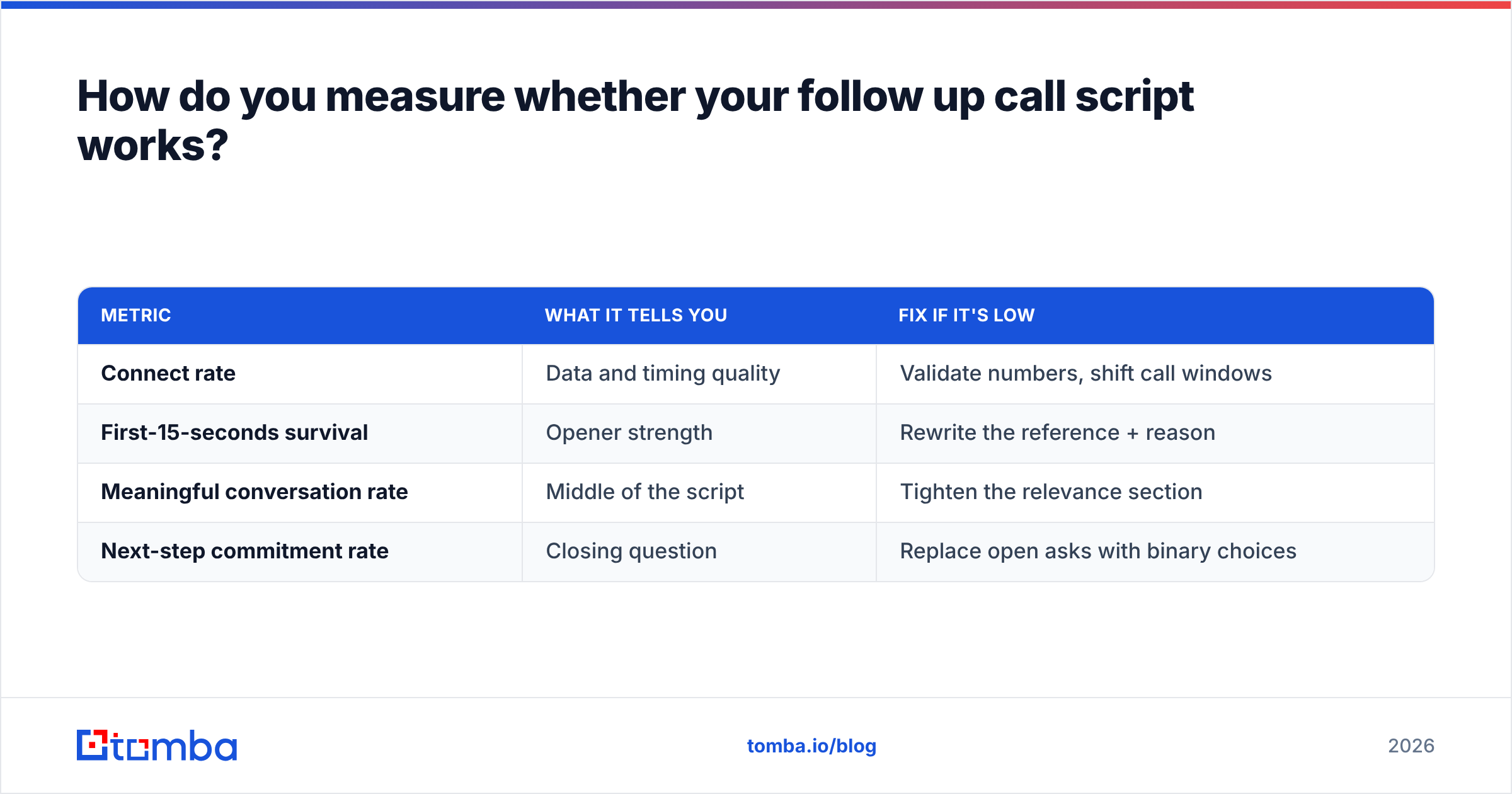
Track four numbers per script variant, not one:
| Metric | What it tells you | Fix if it's low |
|---|---|---|
| Connect rate | Data and timing quality | Validate numbers, shift call windows |
| First-15-seconds survival | Opener strength | Rewrite the reference + reason |
| Meaningful conversation rate | Middle of the script | Tighten the relevance section |
| Next-step commitment rate | Closing question | Replace open asks with binary choices |
If connect rate is fine but 15-second survival is poor, your opener is the problem — not the offer. If conversations happen but no next step gets booked, your closing question is too open.
Run one variable at a time. Change the opener for two weeks, hold everything else constant, and compare. Reps who change three things at once learn nothing.
Also watch your response rate on the email touches that surround the calls. Call-only sequences underperform mixed-channel ones on nearly every dataset, and email replies frequently tell you when to dial.
How do call scripts differ by deal stage?#
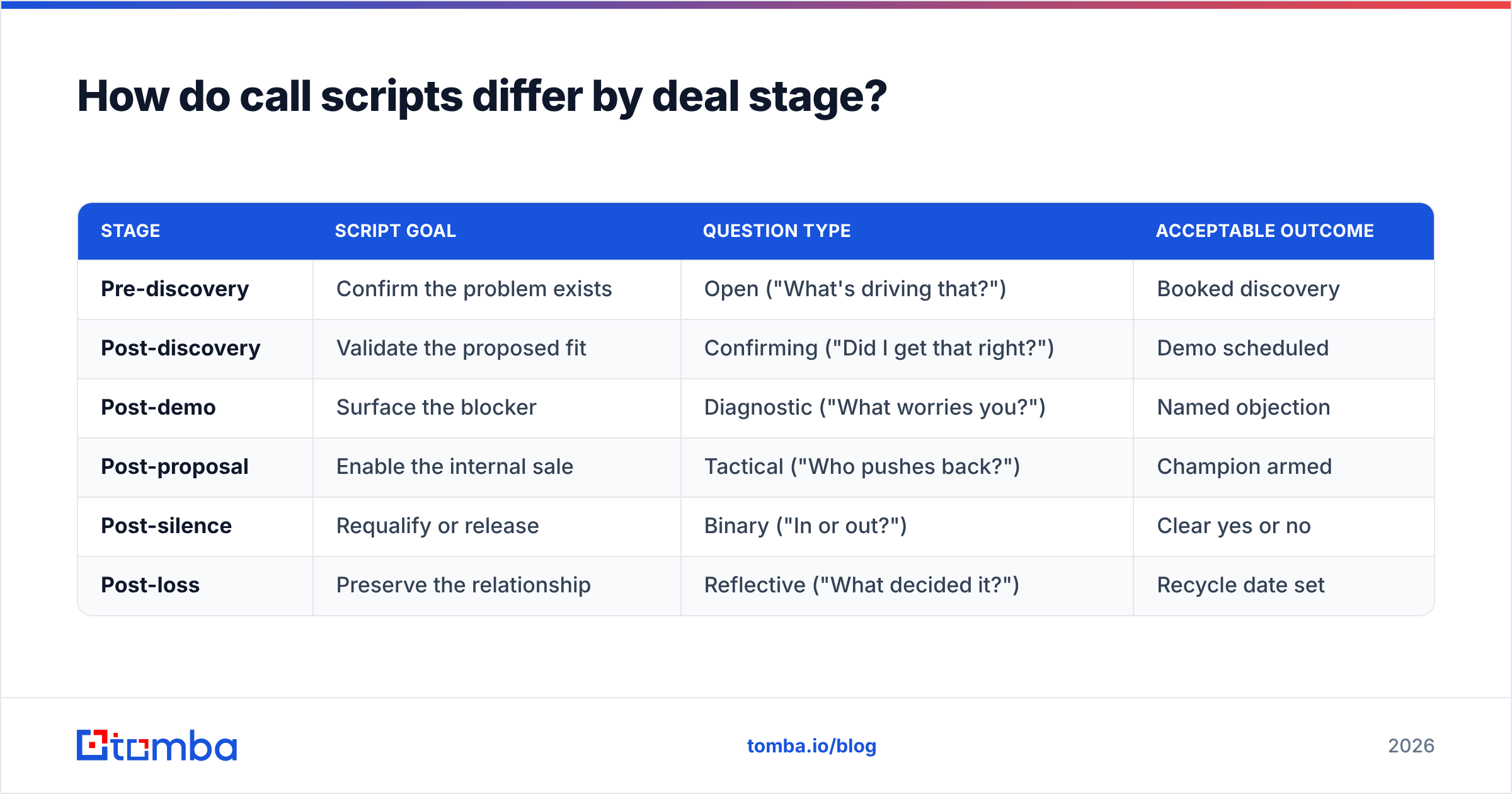
| Stage | Script goal | Question type | Acceptable outcome |
|---|---|---|---|
| Pre-discovery | Confirm the problem exists | Open ("What's driving that?") | Booked discovery |
| Post-discovery | Validate the proposed fit | Confirming ("Did I get that right?") | Demo scheduled |
| Post-demo | Surface the blocker | Diagnostic ("What worries you?") | Named objection |
| Post-proposal | Enable the internal sale | Tactical ("Who pushes back?") | Champion armed |
| Post-silence | Requalify or release | Binary ("In or out?") | Clear yes or no |
| Post-loss | Preserve the relationship | Reflective ("What decided it?") | Recycle date set |
The mistake reps make is running a post-discovery script at the post-proposal stage — asking exploratory questions when the prospect expects you to be driving toward a decision. Match the script to the stage or you'll sound like you weren't paying attention.
Ready to stop dialing dead numbers?#
The best follow up call script in the world can't rescue a bad list. Before your next calling block, spend ten minutes on the data: confirm the direct dials, verify the backup email addresses, and drop the contacts who've changed roles.
Tomba's Email Finder gives you verified contact data for the accounts you're already working — direct emails, company patterns, and enrichment that keeps your sequence alive when the phone doesn't connect. The free tier includes 25 searches per month so you can test it against your current list before committing; paid plans start at $49/month. Check Tomba pricing for the full breakdown.
Clean data plus a script with an actual reason to call is the entire game. Everything else is dialing.
Related guides#
Ready to find emails that actually work?
Join 150,000+ professionals who stopped guessing and started sending. Free credits on signup — no credit card required.
Get the Tomba newsletter
Practical outbound tactics and product updates — once every two weeks.
About the author