Follow Up Campaign Strategy: The 2026 Playbook That Books Meetings
Most replies never come from the first email. Here is how to build a follow up campaign with the right length, cadence, and copy — plus the data hygiene that keeps it out of spam.
TL;DR
- A follow up campaign is a planned, multi-touch sequence sent to the same contact after an initial message — not a pile of "just bumping this" replies.
- Four to six touches over 18–24 business days is the range most B2B teams land on. One-and-done outreach leaves the majority of achievable replies on the table.
- Each touch needs its own reason to exist: new angle, new proof, new question. Repeating the first email in a smaller font is why sequences die.
- Bad data kills follow up campaigns faster than bad copy. Every bounce in touch one poisons the domain reputation that touch five depends on.
- Reply rate per step, not aggregate open rate, is the metric that tells you where to cut and where to add.
What is a follow up campaign?#
A follow up campaign is a pre-planned series of messages sent to the same prospect over a defined window, where each message has a distinct job. The first email opens the conversation. Everything after it works a different angle on the same problem until the prospect replies, opts out, or the sequence ends.
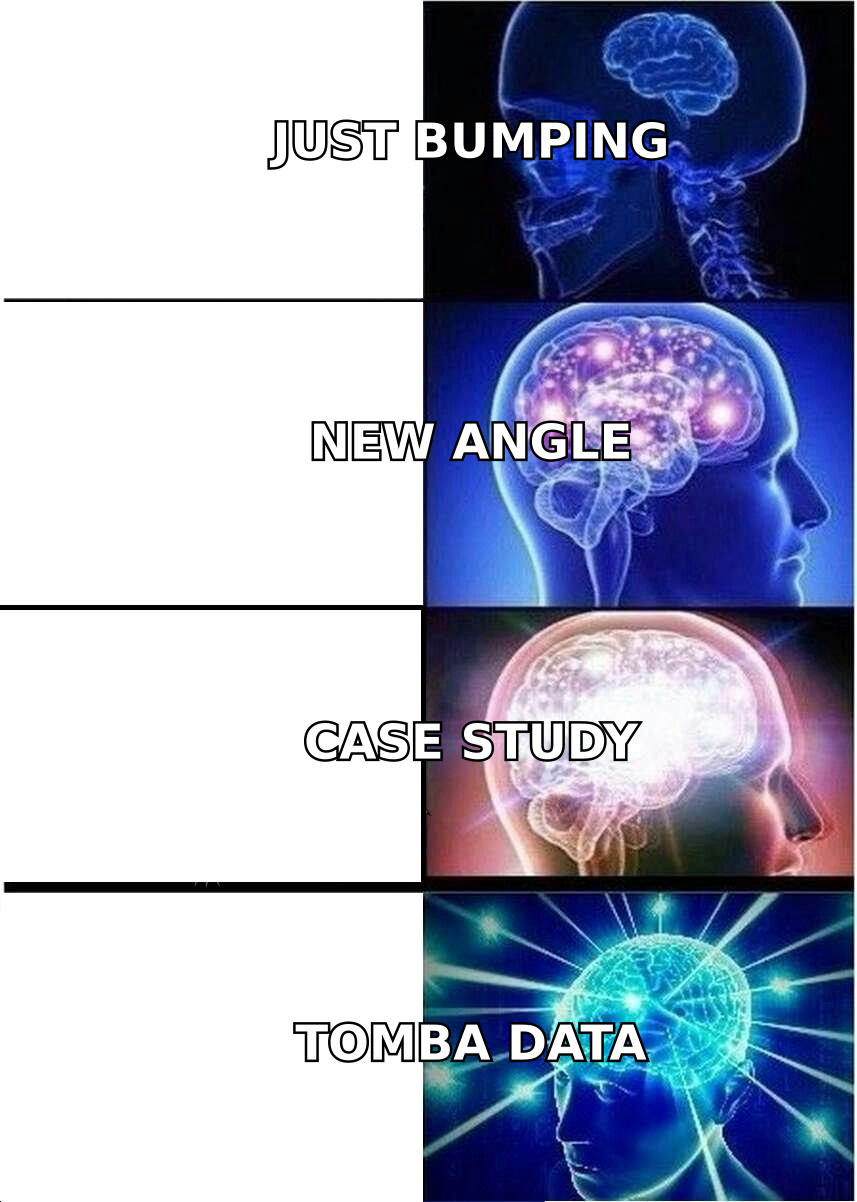
That definition matters because most teams do not run follow up campaigns. They run one email and then improvise. Improvised follow-ups look like this: "Just bumping this to the top of your inbox." "Any thoughts?" "Following up on my last note." Those are not touches. They are reminders that you want something, sent to someone who has not yet been given a reason to care.
The structural difference is planning. In a real campaign you decide, before the first send, how many touches there will be, what each one says, how far apart they sit, and what triggers an exit. The sequence is a designed object you can test and improve. An improvised follow-up is a mood.
Why do follow-ups outperform the first email?#
Because the first email arrives at a random moment in someone's week and the odds that moment is a good one are low.
Your prospect is not evaluating your offer when your email lands. They are in a QBR, or on PTO, or shipping something. A follow up campaign is a probability machine: each additional touch buys another draw at the moment when the recipient has thirty free seconds and a live version of the problem you solve. Sales teams that measure per-step reply rates consistently find that touches two through four contribute more total replies than touch one does — not because the copy is better, but because there are more chances to catch a good moment.
There is a second reason, less obvious: recognition. By the third message, your sender name is familiar. Familiarity does not mean trust, but it does mean the email gets read instead of pattern-matched to spam in half a second. HubSpot's sales research library has documented the same pattern across large outreach datasets — persistence compounds, but only when the persistence carries new information.
The failure mode is treating persistence itself as the strategy. Five identical nudges do not multiply your odds. They multiply your unsubscribes.
How many touches should a follow up campaign have?#
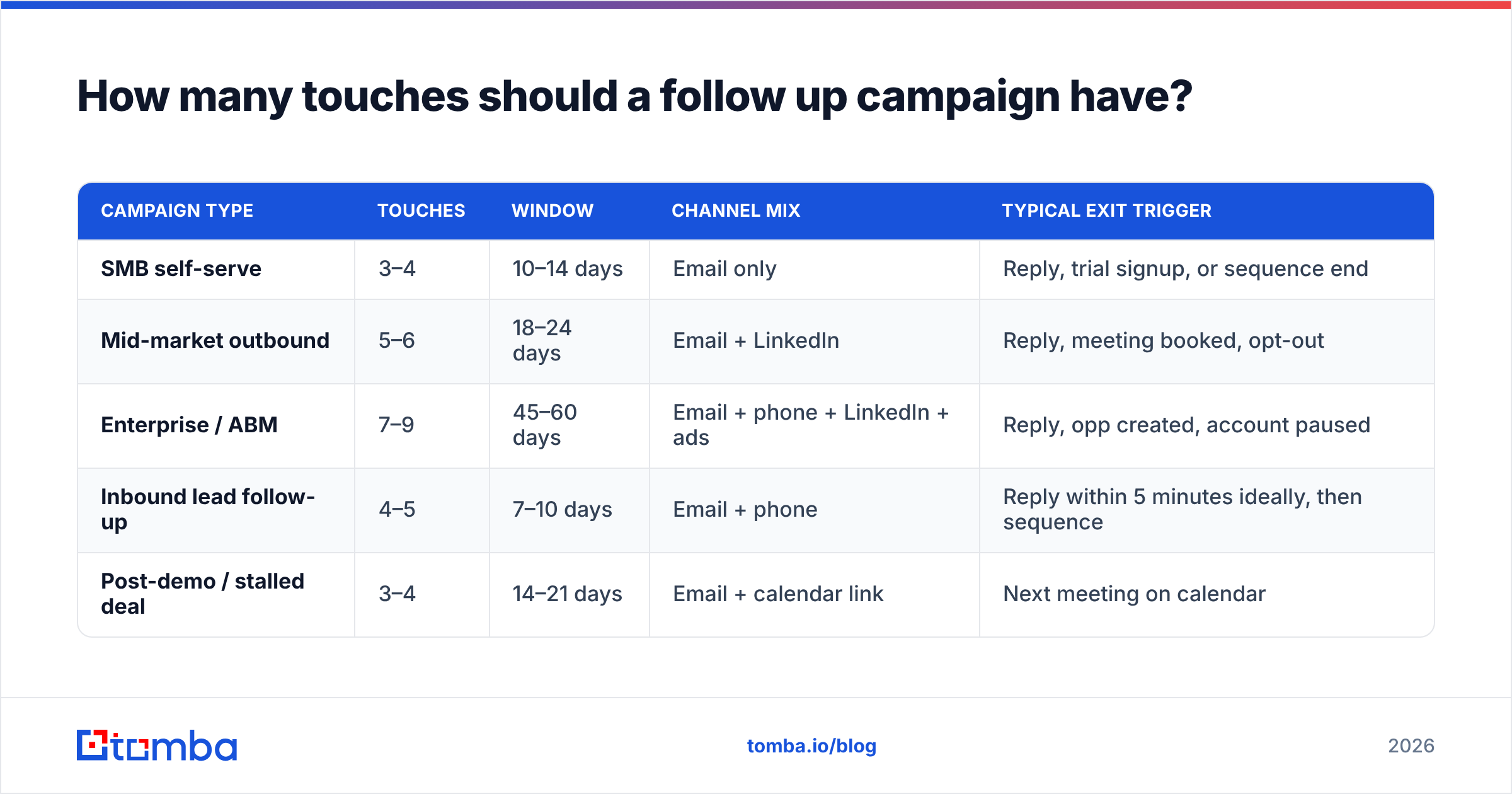
Four to six for most B2B motions. Here is how the ranges break down by deal type:
| Campaign type | Touches | Window | Channel mix | Typical exit trigger |
|---|---|---|---|---|
| SMB self-serve | 3–4 | 10–14 days | Email only | Reply, trial signup, or sequence end |
| Mid-market outbound | 5–6 | 18–24 days | Email + LinkedIn | Reply, meeting booked, opt-out |
| Enterprise / ABM | 7–9 | 45–60 days | Email + phone + LinkedIn + ads | Reply, opp created, account paused |
| Inbound lead follow-up | 4–5 | 7–10 days | Email + phone | Reply within 5 minutes ideally, then sequence |
| Post-demo / stalled deal | 3–4 | 14–21 days | Email + calendar link | Next meeting on calendar |
Two rules govern the numbers. First, longer sequences suit longer sales cycles — an enterprise ABM play can justify nine touches across two months because the deal is worth six figures and the buying committee has eleven people. A $49/month product cannot. Second, more touches means more strain on your sending infrastructure, so sequence length and deliverability budget are the same decision.
If you are starting from scratch, build four touches, measure per-step reply rate, and only extend when step four is still producing replies above your floor. Adding a fifth touch to a sequence where step three already flatlined just adds spam complaints.
What should each touch in the sequence actually say?#
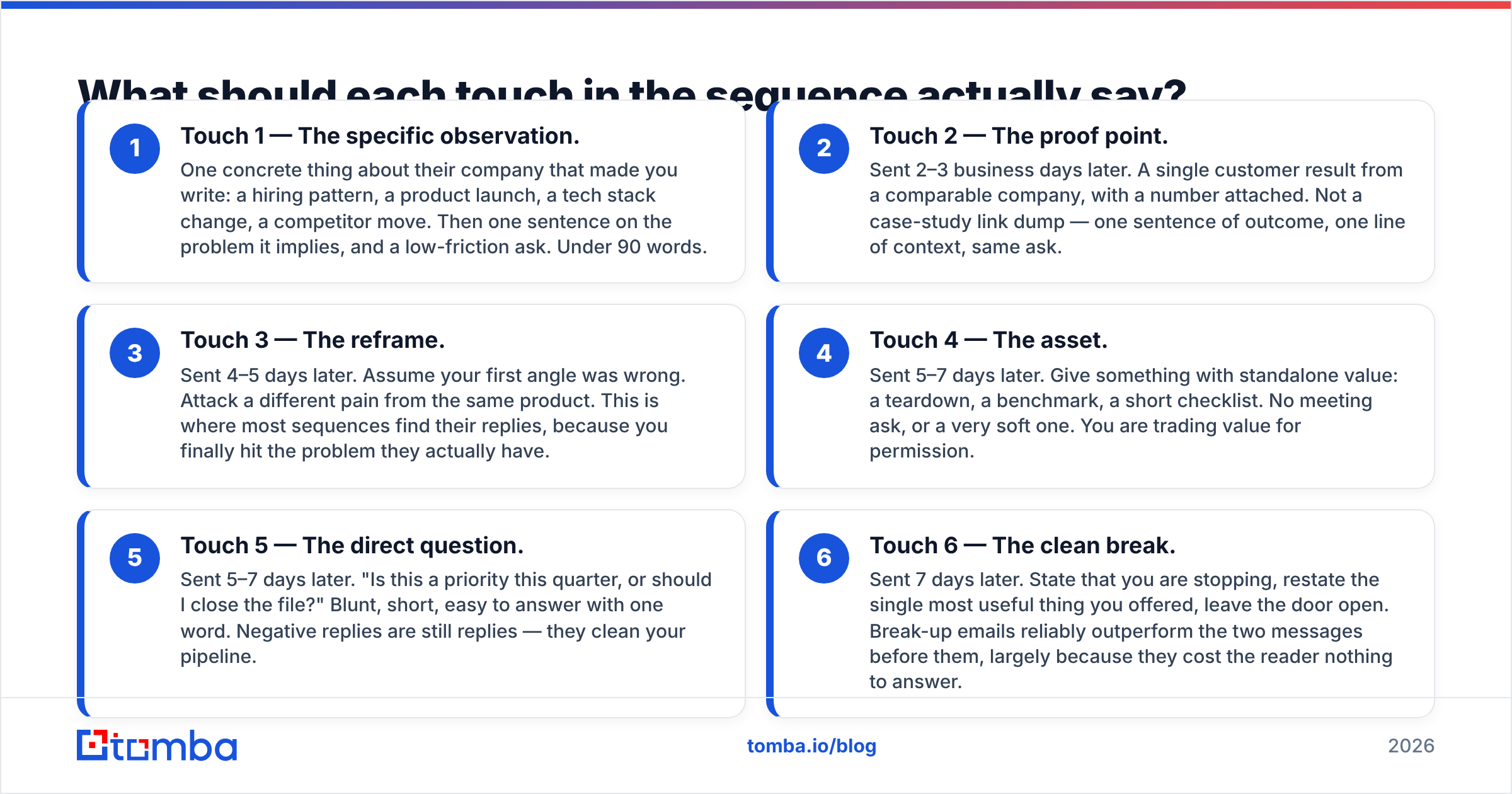
Each message needs a distinct job. Use this as the skeleton and rewrite it in your own voice:
- Touch 1 — The specific observation. One concrete thing about their company that made you write: a hiring pattern, a product launch, a tech stack change, a competitor move. Then one sentence on the problem it implies, and a low-friction ask. Under 90 words.
- Touch 2 — The proof point. Sent 2–3 business days later. A single customer result from a comparable company, with a number attached. Not a case-study link dump — one sentence of outcome, one line of context, same ask.
- Touch 3 — The reframe. Sent 4–5 days later. Assume your first angle was wrong. Attack a different pain from the same product. This is where most sequences find their replies, because you finally hit the problem they actually have.
- Touch 4 — The asset. Sent 5–7 days later. Give something with standalone value: a teardown, a benchmark, a short checklist. No meeting ask, or a very soft one. You are trading value for permission.
- Touch 5 — The direct question. Sent 5–7 days later. "Is this a priority this quarter, or should I close the file?" Blunt, short, easy to answer with one word. Negative replies are still replies — they clean your pipeline.
- Touch 6 — The clean break. Sent 7 days later. State that you are stopping, restate the single most useful thing you offered, leave the door open. Break-up emails reliably outperform the two messages before them, largely because they cost the reader nothing to answer.
Notice that none of these six reference "my previous email." Every touch stands alone. If a prospect reads message four having ignored one through three, it still makes sense. That is the test: forward any single email from your sequence to a colleague with no context. If it reads as a fragment, rewrite it.
Keep the writing tight. If you need a starting point, Tomba's cold email templates library covers the standard sequence shapes, and the subject line tester will flag the spam-adjacent phrasing that quietly caps your open rate.
How is a follow up campaign different from a drip or a nurture?#
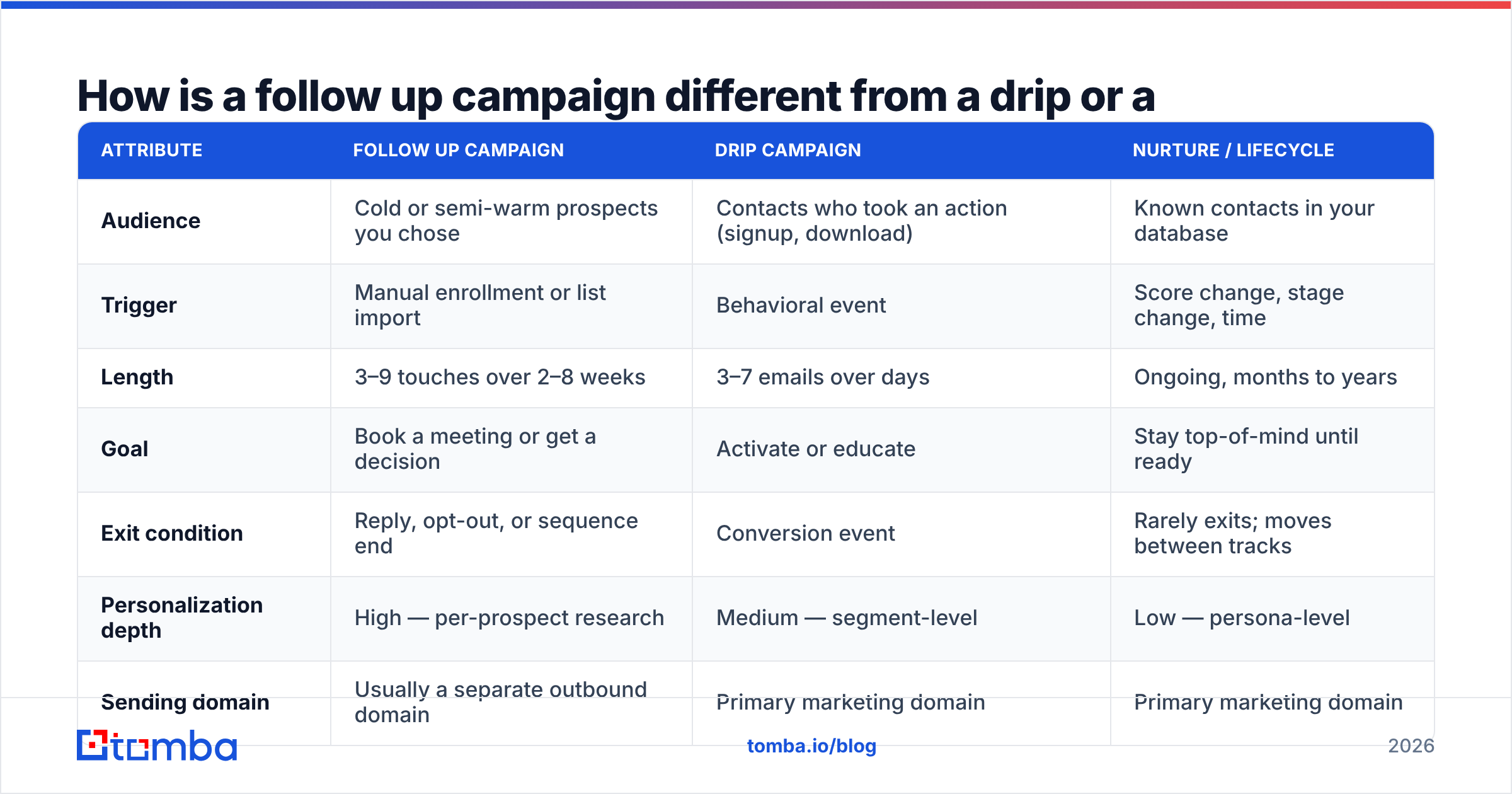
These three get used interchangeably and they are not the same thing. The differences change your tooling and your metrics.
| Attribute | Follow up campaign | Drip campaign | Nurture / lifecycle |
|---|---|---|---|
| Audience | Cold or semi-warm prospects you chose | Contacts who took an action (signup, download) | Known contacts in your database |
| Trigger | Manual enrollment or list import | Behavioral event | Score change, stage change, time |
| Length | 3–9 touches over 2–8 weeks | 3–7 emails over days | Ongoing, months to years |
| Goal | Book a meeting or get a decision | Activate or educate | Stay top-of-mind until ready |
| Exit condition | Reply, opt-out, or sequence end | Conversion event | Rarely exits; moves between tracks |
| Personalization depth | High — per-prospect research | Medium — segment-level | Low — persona-level |
| Sending domain | Usually a separate outbound domain | Primary marketing domain | Primary marketing domain |
| Primary metric | Reply rate per step | Click-through and activation | Pipeline influenced |
The practical consequence: never run a follow up campaign from your marketing automation platform on your primary domain. Cold outbound generates complaints that a nurture list does not, and those complaints attach to whatever domain sent them. Separate domain, separate warmed inboxes, separate reporting. The sales engagement category on G2 is where the sequencing tools live; your ESP is not one of them.
What actually breaks a follow up campaign?#
Data, almost always before copy. A sequence is a compounding system, and every step inherits the reputation damage from the step before it.
Run the numbers on a 1,000-contact campaign with a 12% bounce rate on touch one. That is 120 hard bounces on day one, which is roughly six times the threshold where mailbox providers start throttling you. By touch three, your inbox placement has degraded enough that the copy improvements you spent a week on are invisible — the emails are landing in spam, where nobody grades your subject lines.
The fix order is unglamorous and non-negotiable:
- Verify before you send, not after. Run the full list through an email verifier and drop anything that is not deliverable. Target under 2% bounce.
- Handle catch-all domains explicitly. A large share of enterprise domains accept everything at the SMTP layer. A catch-all verifier tells you which of those addresses are real rather than letting you guess.
- Warm the sending domain for 3–4 weeks before the first campaign, and keep volume per inbox conservative — 30–50 cold sends a day is the range most teams settle on.
- Authenticate everything. SPF, DKIM, and DMARC are table stakes now that Google and Yahoo enforce bulk-sender requirements. Check your records with an SPF checker before you launch, not after replies stop.
- Suppress aggressively. Opt-outs, competitors, existing customers, and anyone already in another sequence. Overlapping campaigns to the same contact is the fastest route to a complaint.
How do you measure a follow up campaign?#
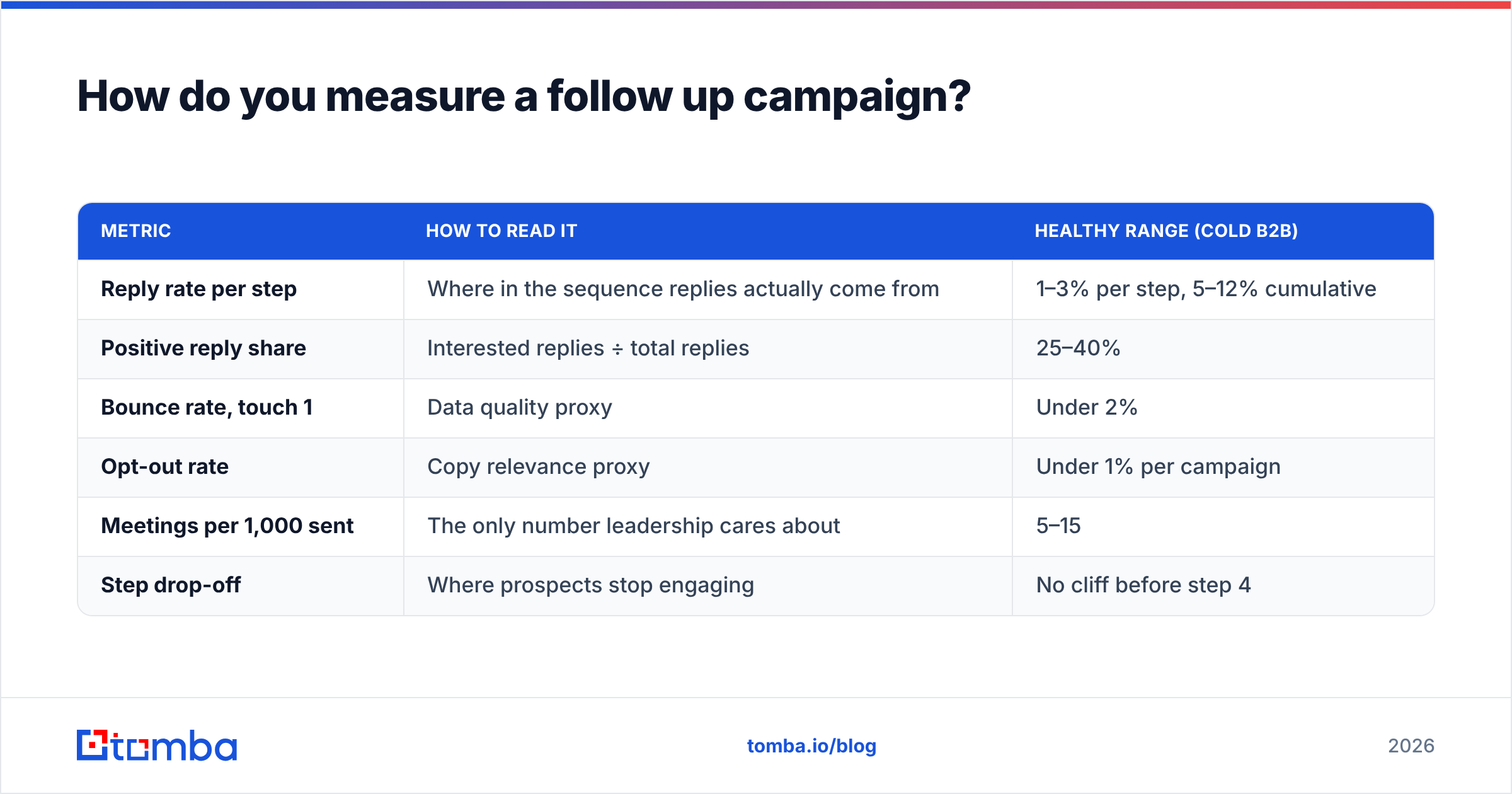
Stop looking at aggregate open rate. Since Apple Mail Privacy Protection, open data is inflated by machine opens and tells you almost nothing about a cold list. Measure these instead:
| Metric | How to read it | Healthy range (cold B2B) |
|---|---|---|
| Reply rate per step | Where in the sequence replies actually come from | 1–3% per step, 5–12% cumulative |
| Positive reply share | Interested replies ÷ total replies | 25–40% |
| Bounce rate, touch 1 | Data quality proxy | Under 2% |
| Opt-out rate | Copy relevance proxy | Under 1% per campaign |
| Meetings per 1,000 sent | The only number leadership cares about | 5–15 |
| Step drop-off | Where prospects stop engaging | No cliff before step 4 |
Per-step reply rate is the one that drives decisions. If step five produces a third as many replies as step three, cut it and reinvest the sending capacity in a new list. If your break-up email outperforms steps four and five combined — which happens often — that is a signal your middle touches lack a reason to exist, not that break-up emails are magic.
Segment everything by persona and company size before you conclude anything. A sequence that fails against VPs of Engineering may perform well against Heads of RevOps, and the aggregate number hides both facts. Salesforce's sales resources cover the reporting structures for this if your CRM is where the analysis lives.
What tooling does a follow up campaign need?#
Four layers, and you can mix vendors freely at each one:
- List building. Where the contacts come from — a B2B database, a scraper, or a data provider. Purchased-list vendors like BookYourData are a reasonable option when you need volume in a specific geography and are willing to verify on arrival.
- Enrichment and email discovery. Turning a name and company into a verified, deliverable address. Tomba's email finder and domain search handle this at row level or in bulk; the Tomba API covers it programmatically when your enrichment runs inside a workflow rather than a spreadsheet.
- Sending and sequencing. The engine that schedules touches, handles reply detection, rotates inboxes, and enforces sending limits.
- Reporting. CRM sync so per-step reply data lands next to opportunity data and you can tie sequences to pipeline instead of to vanity metrics.
Most teams over-invest in layer three and under-invest in layer two. The sequencing tool is largely commoditized — they all schedule emails competently. The differentiator is whether the addresses you feed it are real and whether the enrichment data supports personalization beyond {{first_name}}.
What are the most common follow up campaign mistakes?#
- Reply-chaining every touch. Threading all six messages means the prospect sees the same ignored email six times. Break the thread at least once mid-sequence with a fresh subject.
- Sending all touches at 9:00 a.m. Tuesday. Vary send times across the sequence. If your first four emails all arrive in the morning rush and get buried, try one at 2:00 p.m.
- Ending too early on high-value accounts. A four-touch sequence for a $200k ACV account is not persistence, it is a rounding error.
- Personalizing the first line and nothing else. A researched opener attached to a generic pitch reads worse than no personalization, because it signals automation with extra steps.
- No exit for negative replies. If someone says "not now, ask me in Q3," they should leave the sequence immediately and re-enter later. Continuing to send after a soft no is how you convert a future customer into a spam complaint.
- Never rewriting the middle. Touches three and four rot fastest because they were written last and tested least. Rebuild them quarterly.
Where should you start?#
Build one four-touch sequence for one tightly defined persona. Verify the list before it goes out. Measure reply rate per step for two weeks. Cut whatever step underperforms and write a replacement with a genuinely different angle. Repeat. That loop beats any template pack you can download, because it is tuned to your market rather than to someone else's.
The part you cannot skip is the data underneath it. A follow up campaign amplifies whatever list quality you started with — good data compounds into deliverability and replies, bad data compounds into throttling and silence. Start with the Tomba Email Finder to build a verified contact list from domains, names, or companies before your first touch goes out. The free tier includes 25 searches a month, and paid plans start at $49/month on Tomba pricing if you need bulk volume, API access, or catch-all resolution for enterprise domains. Get the addresses right first; the sequence has a chance after that.
Related guides#
Ready to find emails that actually work?
Join 150,000+ professionals who stopped guessing and started sending. Free credits on signup — no credit card required.
Get the Tomba newsletter
Practical outbound tactics and product updates — once every two weeks.
About the author