12 Follow Up Campaign Examples That Actually Get Replies
Most deals die in the gap between email one and email four. Here are 12 follow up campaign examples with real copy, real cadences, and the timing rules that decide whether anyone answers.
TL;DR
- Roughly half of all replies to an outbound sequence arrive after the first email, so a campaign that stops at one or two touches is leaving most of its pipeline on the table.
- The best follow up campaign examples share four traits: a new reason to write, a shrinking ask, spaced-out timing, and a clean exit.
- Different scenarios need different cadences. A demo no-show deserves a same-day nudge; a proposal in limbo needs a 3-day rhythm; a cold prospect needs 5 to 7 touches over 3 to 4 weeks.
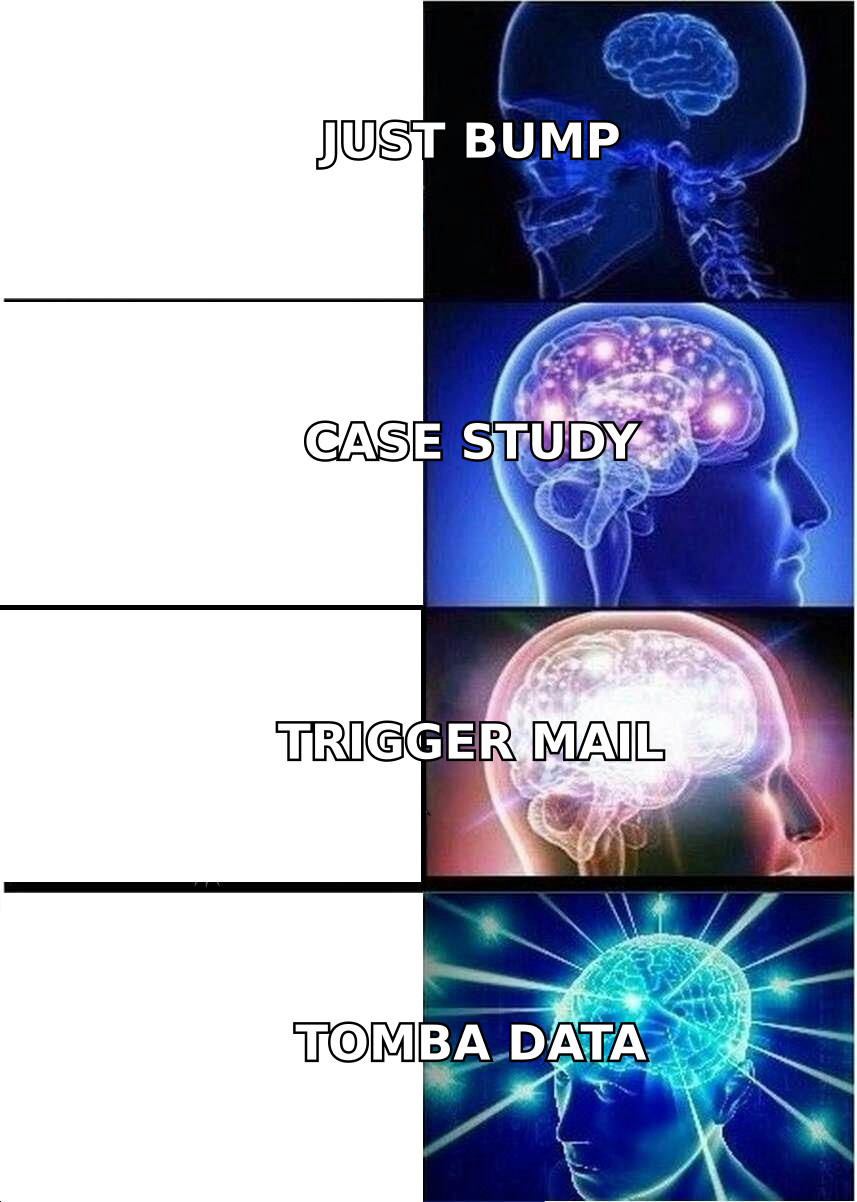
- "Just bumping this" is the single most common failure mode. Every follow-up should carry information the previous one didn't.
- Bad data makes good sequences look bad. Verify addresses before you blame the copy.
What is a follow up campaign, exactly?#
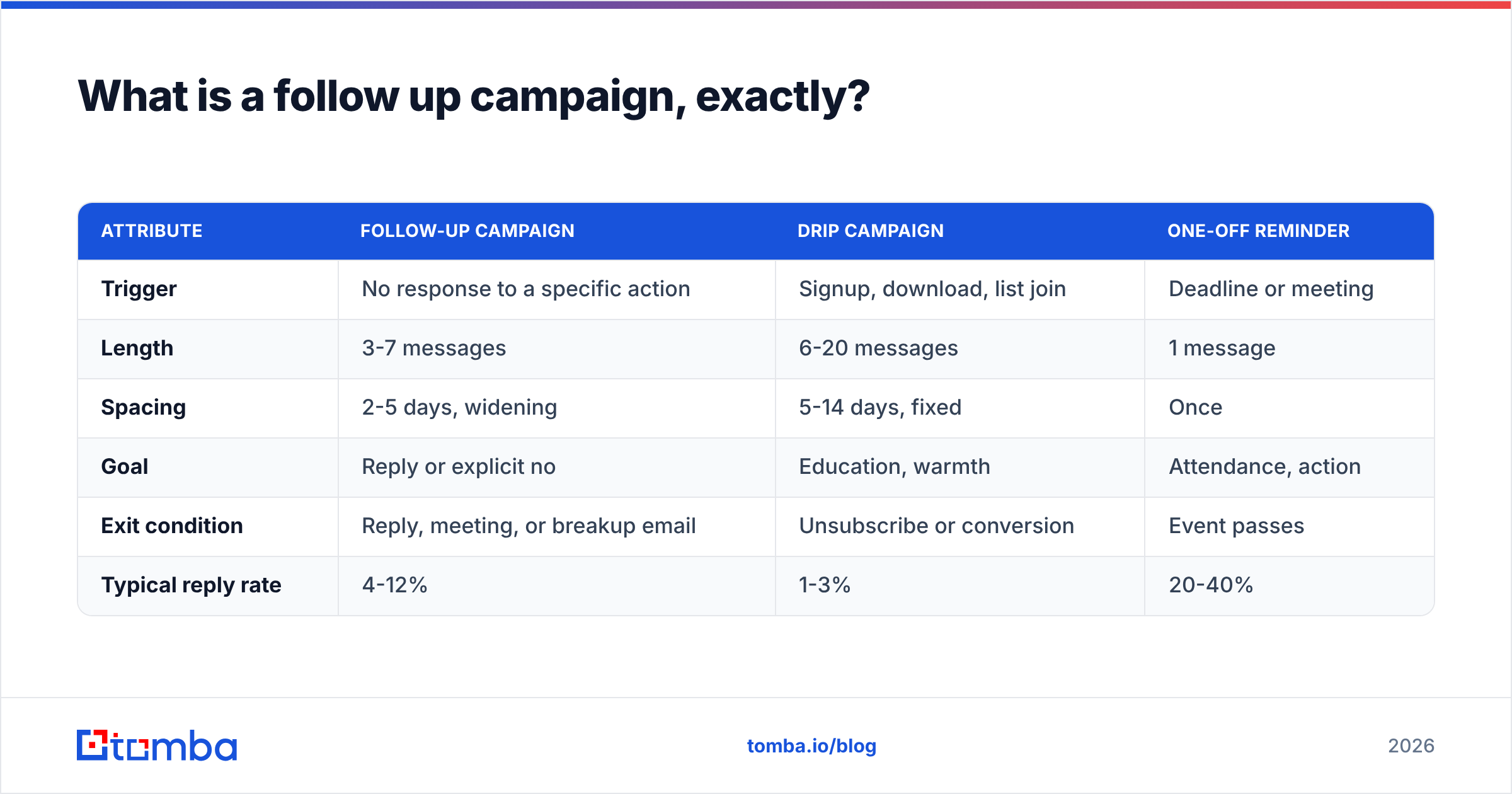
A follow up campaign is a pre-planned series of messages sent after an initial touch, where each message has its own angle, its own timing, and its own exit condition. It is not the same as a drip campaign (time-based nurture content) and not the same as a reminder (a single one-off nudge).
The distinction matters because it changes how you write. A drip assumes the reader is passively interested. A follow-up assumes the reader saw something and did nothing, which means your job is to remove whatever friction caused the silence, not to repeat yourself louder.
Here is the practical difference across the three formats:
| Attribute | Follow-up campaign | Drip campaign | One-off reminder |
|---|---|---|---|
| Trigger | No response to a specific action | Signup, download, list join | Deadline or meeting |
| Length | 3-7 messages | 6-20 messages | 1 message |
| Spacing | 2-5 days, widening | 5-14 days, fixed | Once |
| Goal | Reply or explicit no | Education, warmth | Attendance, action |
| Exit condition | Reply, meeting, or breakup email | Unsubscribe or conversion | Event passes |
| Typical reply rate | 4-12% | 1-3% | 20-40% |
Why do most follow up campaigns fail?#
They fail for reasons that have nothing to do with persistence.
- No new information. Emails two through five restate email one. There is nothing for the reader to react to, so they don't.
- The ask never shrinks. If a 30-minute demo was too much on Monday, it is still too much on Thursday. Successful sequences step down: demo, then 10-minute call, then a single yes/no question, then a resource with no ask at all.
- Bunched timing. Four emails in six days reads as desperation and trains spam filters. Widening gaps (day 3, day 7, day 12, day 20) read as professional.
- No channel variety. Five emails to someone who never opens email is five wasted touches. Mixing in a LinkedIn view, a phone call, or a comment on their post changes the odds.
- Dirty lists. Bounces from unverified addresses drag down sender reputation, which quietly suppresses delivery for the contacts who would have replied.
What do great follow up campaign examples have in common?#
Before the examples themselves, the pattern. Every sequence below follows the same skeleton:
- A distinct angle per touch. Value, social proof, objection handling, resource, breakup. Never repeat an angle inside one campaign.
- A shrinking commitment. Each message asks for less time or less certainty than the last.
- Subject-line continuity. Keep the same thread for touches 1-3 so context travels with the message, then break to a fresh subject for touch 4+ to reset the visual.
- A written exit. The final message says plainly that you'll stop. It routinely outperforms every earlier touch, because it costs the reader nothing to answer.
- A logged outcome. Reply, hard no, or silence. All three are useful; only silence is ambiguous, and that's what the next campaign is for.
What are the best follow up campaign examples by scenario?#
1. Cold outbound, no response (5 touches, 18 days)#
- Day 1 — Value. One-sentence observation about their company, one-sentence relevance, one question.
- Day 4 — Proof. "We did this for [similar company], here's the number." No re-pitch.
- Day 8 — Objection pre-empt. "Most people in your seat tell me they already have a tool for this. The difference is X."
- Day 13 — Resource. Send a teardown, benchmark, or template with no ask.
- Day 18 — Breakup. "I'll close the loop on my end. If this becomes relevant in Q3, reply 'later' and I'll follow up then."
2. Inbound lead that went cold (3 touches, 7 days)#
Speed is the whole game here. Touch one within five minutes of the form fill, touch two next morning with a different channel, touch three on day 7 with a specific use case tied to what they downloaded.
3. Demo no-show (3 touches, 4 days)#
Touch 1 (same day, +15 min): "Looks like we got our wires crossed. Here's my calendar." Assume good faith, never guilt. Touch 2 (day 2): Send a 3-minute Loom of the exact thing they signed up to see. Touch 3 (day 4): "Should I close this out?" Binary question, one line.
4. Proposal sent, silence (4 touches, 12 days)#
- Day 3: "Anything in the scope section you'd change?"
- Day 6: Forward a reference customer in their industry.
- Day 9: Address the unstated blocker directly. Usually procurement, timing, or an internal champion who left.
- Day 12: "Do you want me to hold the pricing through month-end, or should we revisit next quarter?"
5. Trial signed up, never activated (4 touches, 14 days)#
Tie every message to a single activation event, not to the product as a whole. "You created an account but haven't run a search yet. Here's a 40-second video of the first one."
6. Post-conference contact (3 touches, 10 days)#
Reference the specific conversation in the first line. If you can't, you don't have a warm lead, you have a scanned badge. Treat it as cold outbound instead.
7. Champion went quiet after a good call (3 touches, 9 days)#
Assume they got pulled into a fire, not that they lost interest. Offer to write the internal summary for them: "Want me to draft the one-pager you'd forward to your VP?"
8. Renewal at risk (4 touches, 30 days)#
Start 60 days out. Lead with usage data, not with the invoice. The last touch should come from a different sender (CSM or founder) to break the pattern.
9. Closed-lost re-engagement (3 touches, 21 days)#
Trigger on a real change: new funding, a leadership hire, a competitor announcement. "You passed last year because of X. X changed."
10. Referral request after a win (2 touches, 10 days)#
Send it at the moment of measured success, not at renewal. Name the exact person you'd like to meet so the ask requires zero thinking.
11. Event or webinar registrant no-show (2 touches, 3 days)#
Recording plus a timestamped highlight, then a single question about the topic they registered for.
12. Multi-threading a stalled account (4 touches, 14 days)#
Same account, different people. Each message acknowledges the thread openly: "I've been working with Sarah on this and wanted to loop you in as the technical owner."
How should you time follow-ups?#
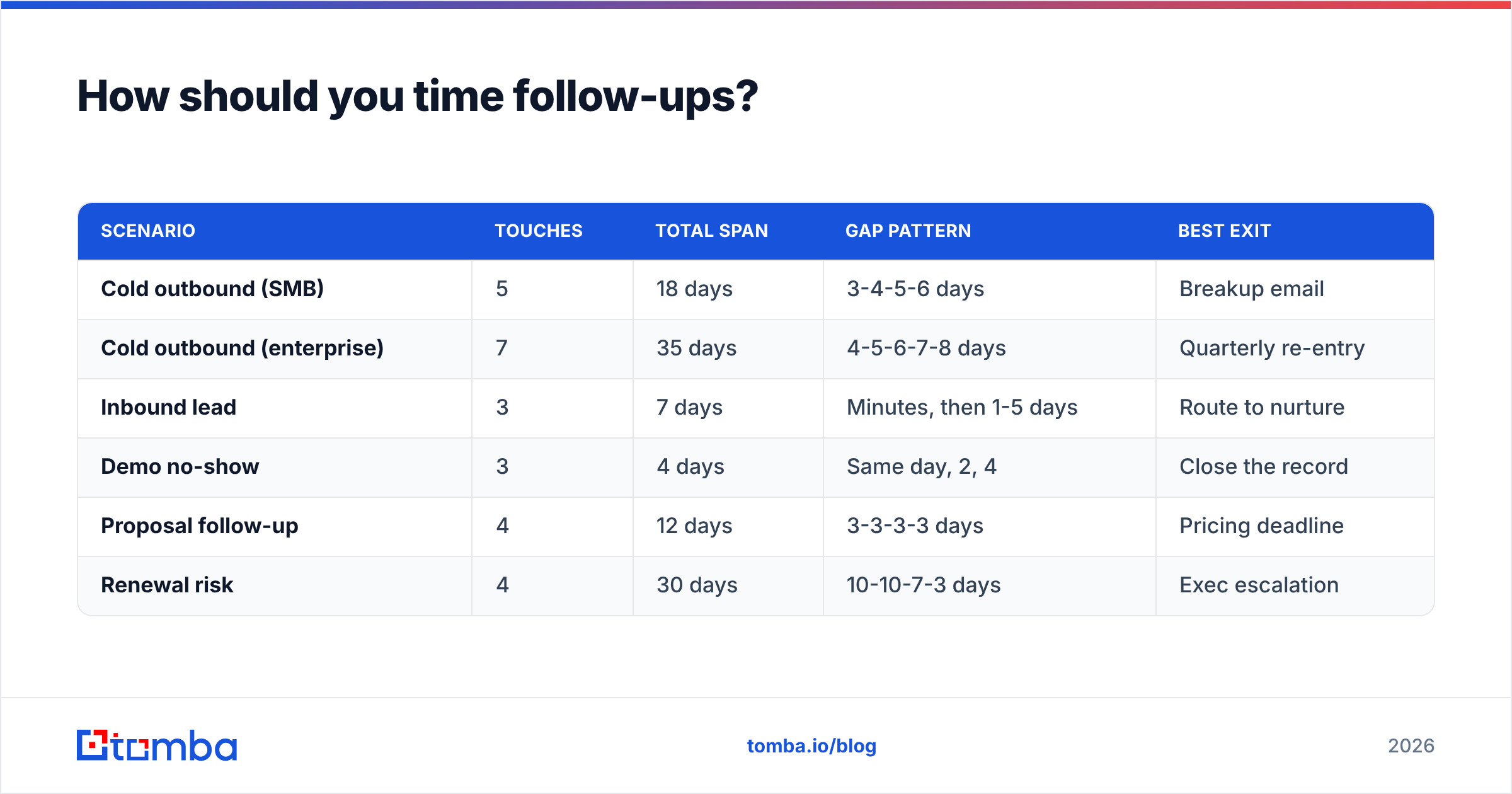
Timing is the variable most teams get wrong, and it's the cheapest one to fix. Use widening intervals, and match total campaign length to deal size.
| Scenario | Touches | Total span | Gap pattern | Best exit |
|---|---|---|---|---|
| Cold outbound (SMB) | 5 | 18 days | 3-4-5-6 days | Breakup email |
| Cold outbound (enterprise) | 7 | 35 days | 4-5-6-7-8 days | Quarterly re-entry |
| Inbound lead | 3 | 7 days | Minutes, then 1-5 days | Route to nurture |
| Demo no-show | 3 | 4 days | Same day, 2, 4 | Close the record |
| Proposal follow-up | 4 | 12 days | 3-3-3-3 days | Pricing deadline |
| Renewal risk | 4 | 30 days | 10-10-7-3 days | Exec escalation |
Two rules that hold across all of them. First, never send two emails to the same person on the same day. Second, if a contact has opened four times and replied zero times, switch channels rather than sending a fifth email. HubSpot's sales blog has published repeatedly on this pattern, and the sales-engagement category on G2 is full of tools built specifically to enforce that channel-switch logic.
What does a follow-up email actually look like?#
Short. Here is touch three of the cold outbound sequence, written the way it should be:
Subject: Re: [Company] hiring 4 AEs
Hi Dana,
Most RevOps leads tell me they already have a data vendor, so I'll be specific about the difference: our match rate on sub-200-employee accounts is what changes, not the total record count.
If your AEs are burning an hour a day on manual lookups, that's the number worth testing.
Worth 10 minutes, or is this the wrong quarter?
Ben
Word count: 62. One angle, one number, one question, an easy out. If you want a starting library rather than a blank page, the cold email templates collection covers the standard sequence shapes, and a subject line generator helps when you need to break the thread on touch four.
How do you measure a follow-up campaign?#
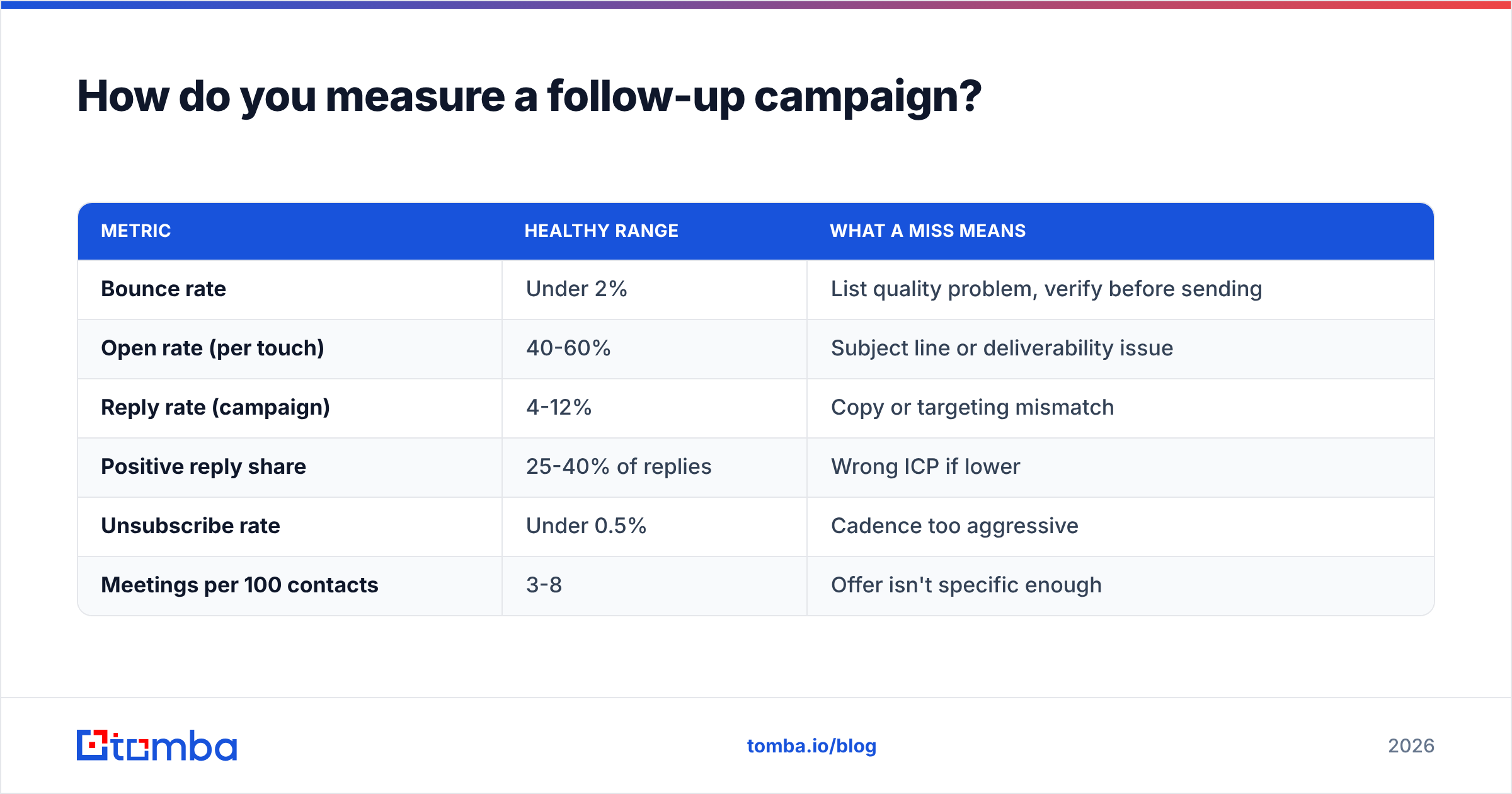
Track per-touch, not per-campaign. Campaign-level averages hide the fact that touch four is carrying the whole sequence, or that touch two is where everyone unsubscribes.
| Metric | Healthy range | What a miss means |
|---|---|---|
| Bounce rate | Under 2% | List quality problem, verify before sending |
| Open rate (per touch) | 40-60% | Subject line or deliverability issue |
| Reply rate (campaign) | 4-12% | Copy or targeting mismatch |
| Positive reply share | 25-40% of replies | Wrong ICP if lower |
| Unsubscribe rate | Under 0.5% | Cadence too aggressive |
| Meetings per 100 contacts | 3-8 | Offer isn't specific enough |
If your bounce rate is above 2%, stop optimizing copy. Nothing else you measure is trustworthy until the list is clean. Run addresses through an email verifier before the sequence starts, and re-verify any list older than 90 days, since B2B contact data decays at roughly 2-3% per month through job changes alone. Improving your response rate is usually a data problem first and a writing problem second.
What are the compliance limits on follow-ups?#
Three practical constraints, none of them optional:
- Working unsubscribe in every message, including plain-text-looking outbound. The CAN-SPAM Act requires honoring opt-outs within 10 business days, and mailbox providers treat a missing opt-out as a spam signal regardless of the law.
- Real physical address in the footer.
- Legitimate interest documented if you're emailing EU contacts under GDPR. In practice that means a written note on why this specific role at this specific company is relevant to your product.
A sequence that ignores these doesn't just carry legal risk; it degrades the sending domain that every future campaign depends on.
Which follow-up mistakes cost the most?#
- Sending the breakup email too early. It works because it comes after real effort. On touch two it just looks like a gimmick.
- Automating the personalization token but not the research. "I saw your work at {{company}}" fools nobody.
- Running all sequences from one domain. Split outbound onto a separate sending domain so a bad campaign never touches your corporate mail.
- Never retiring a sequence. If a cadence has run 500 contacts and sits under 2% replies, it's not a copy tweak away from working. Rebuild the targeting.
- Treating silence as a no. Silence is usually a timing problem. Log it, set a 90-day re-entry, and move on.
Start with contacts worth following up#
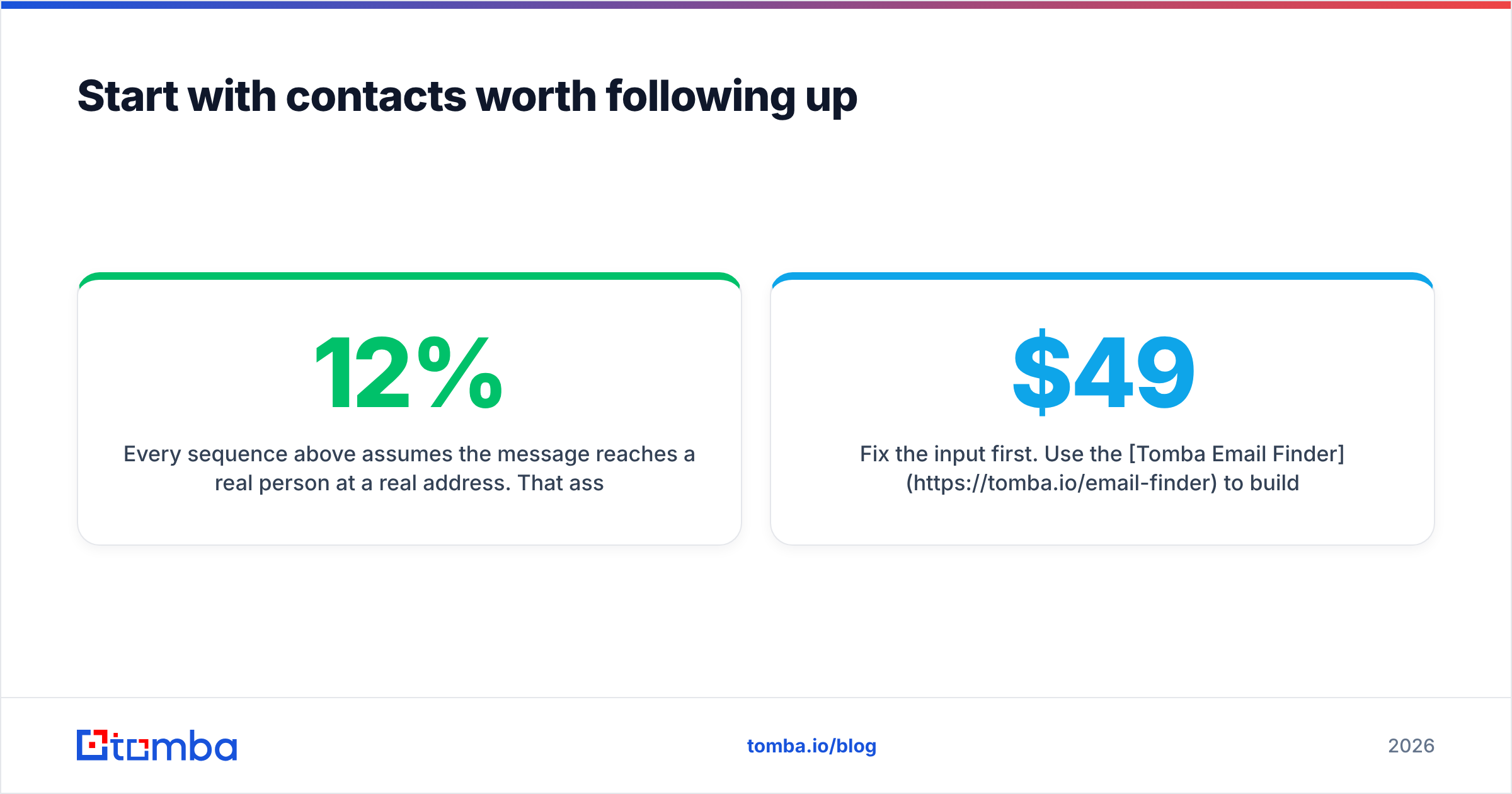
Every sequence above assumes the message reaches a real person at a real address. That assumption is where most campaigns quietly break: the copy gets blamed for a reply rate that was actually capped by a 12% bounce rate on a scraped list.
Fix the input first. Use the Tomba Email Finder to build the list from a domain, a name, or a company, then verify before the first touch goes out. The free tier gives you 25 searches a month to test the workflow, and paid plans start at $49/mo on Starter with $99/mo Growth and $249/mo Pro above it. Full Tomba pricing is public, and the API and bulk tools handle the volume once a sequence proves itself.
Good follow-up campaigns are mostly arithmetic: more touches, better spaced, on addresses that actually deliver. Get the data right and the copy has a chance to matter.
Related guides#
Ready to find emails that actually work?
Join 150,000+ professionals who stopped guessing and started sending. Free credits on signup — no credit card required.
Get the Tomba newsletter
Practical outbound tactics and product updates — once every two weeks.
About the author