Follow Up Cold Email No Response: The 2026 Sequence Guide
Most cold email replies come from follow-ups, not the first send. Here are the exact intervals, angles, and templates that get answers after silence — plus when to stop.
TL;DR
- Between 40% and 60% of replies to a cold sequence arrive after the first email, so a one-and-done send is leaving most of your pipeline on the table.
- The highest-yield cadence for a 4–6 step sequence is roughly day 0, +3, +7, +14, +25 — spaced widely enough to look human, tight enough to stay in memory.
- Every follow-up needs a new reason to exist. "Just bumping this" is the single most ignored sentence in B2B email.
- Silence is ambiguous: it can mean bad timing, wrong person, bad address, or a spam folder. Verify the address before you blame the copy.
- Stop at 5–6 touches, close the loop politely, and recycle the contact into a 90-day re-entry list instead of burning it.
Why do you get no response to a cold email?#
Because "no response" is not one problem — it's five, and they need different fixes.
Founders tend to read silence as rejection. It rarely is. Rejection requires a human to have read your email and decided against it. Most of the time, that step never happened. Here's the actual decision tree behind a silent inbox:
- The email never arrived. Wrong address, a bounce you never saw, or a catch-all domain that swallowed it. Between 20% and 30% of B2B contact data decays every year as people change jobs.
- It arrived in spam or Promotions. Your copy was never evaluated because it was never rendered. This is an authentication and reputation problem, not a persuasion problem.
- It arrived, got scanned, and lost. The average knowledge worker gets over 100 emails a day. Yours was seen at 4:47pm between two meetings and buried by 5:10pm.
- It was read and mentally filed as "maybe later." This is the single largest bucket, and the one follow-ups exist to convert.
- It was read and rejected. Real, but the smallest slice — and these people usually tell you.
Buckets 1 and 2 are infrastructure. Buckets 3 and 4 are cadence. Bucket 5 is the only genuine "no." If you rewrite your subject line to fix a bucket-1 problem, you'll rewrite forever and nothing will change.
How many follow-up emails should you send after no response?#
Send four to six touches total, including the initial email. Then stop.
The data across every major sequencing vendor points the same direction: reply rate climbs steeply through touch three, keeps climbing more gently through touch five or six, then flattens while complaint rate rises. HubSpot's own sales research has repeatedly landed on the same rough shape, and the sequencing tools built around it default to 4–7 steps for a reason.
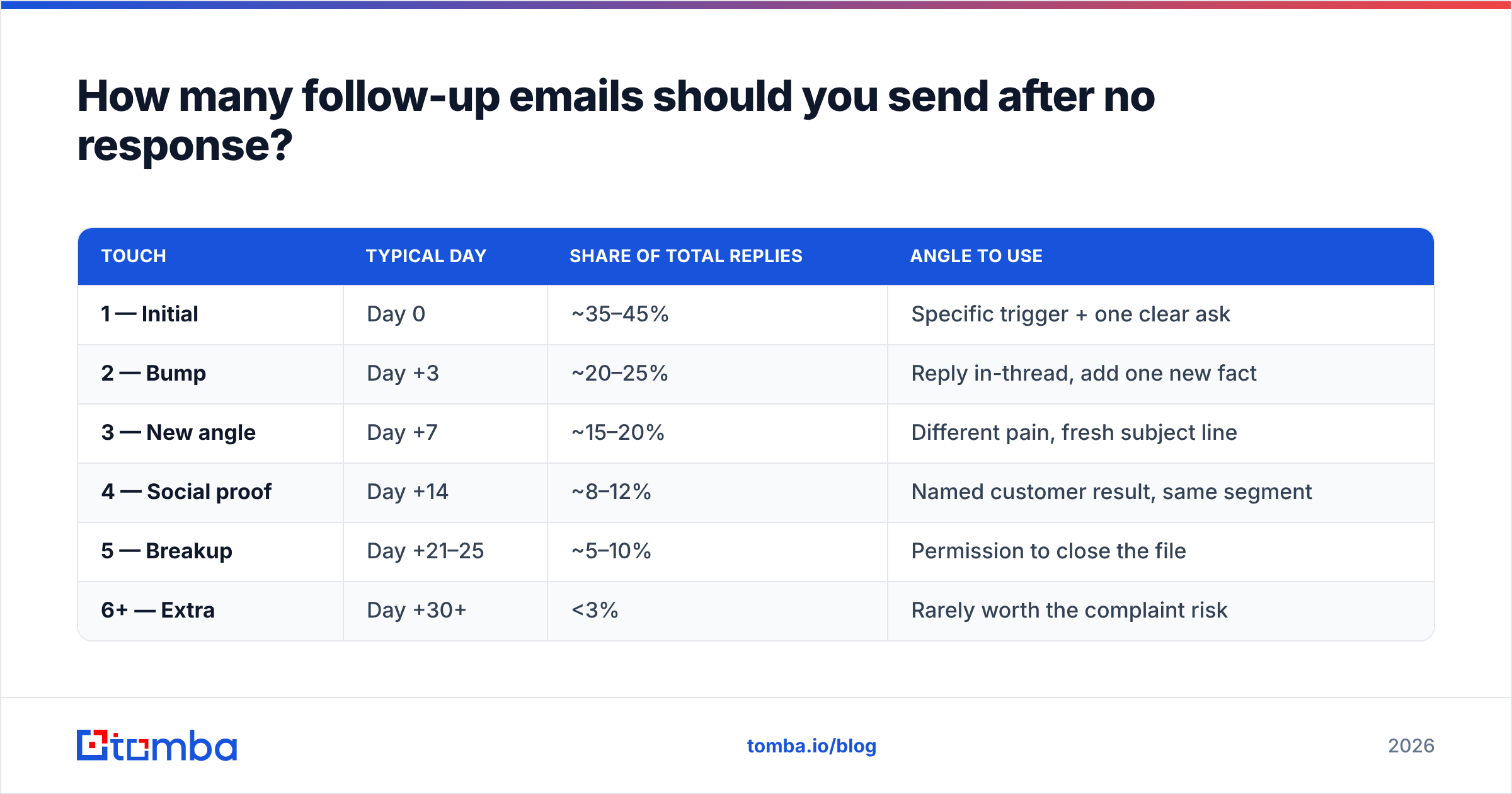
Here's what incremental yield typically looks like on a well-targeted list:
| Touch | Typical day | Share of total replies | Angle to use |
|---|---|---|---|
| 1 — Initial | Day 0 | ~35–45% | Specific trigger + one clear ask |
| 2 — Bump | Day +3 | ~20–25% | Reply in-thread, add one new fact |
| 3 — New angle | Day +7 | ~15–20% | Different pain, fresh subject line |
| 4 — Social proof | Day +14 | ~8–12% | Named customer result, same segment |
| 5 — Breakup | Day +21–25 | ~5–10% | Permission to close the file |
| 6+ — Extra | Day +30+ | <3% | Rarely worth the complaint risk |
Two things stand out. First, more than half of your replies come after email one — which is the whole argument for sequencing. Second, the marginal return past touch five is small enough that it's usually dominated by the reputation cost of chasing people who've made themselves clear.
What is the best follow-up interval after no response?#
Wait three days after the first email, then widen the gaps.
The two failure modes are opposite and equally common. Sending on consecutive days reads as desperation and triggers unsubscribes. Waiting three weeks means the prospect has zero memory of email one, so your follow-up is just a new cold email with worse framing.
A cadence that survives both:
- Day 0 — Initial send. Tuesday through Thursday, 7–9am in the prospect's timezone.
- Day 3 — First bump. Same thread, same subject. Short. Adds one thing email one didn't say.
- Day 7 — New angle. Fresh thread, new subject line. Different problem, different proof point.
- Day 14 — Proof. A named customer in their segment with a number attached.
- Day 21–25 — Breakup. "Assuming this isn't a priority — want me to close the file?"
Skip weekends and national holidays in the prospect's country, not yours. If your sequence tool lets you set send windows, cap sends at three per hour per mailbox to keep volume patterns human-looking.
What should each follow-up email actually say?#
Every follow-up must carry new information. If you strip the pleasantries and nothing is left, don't send it.
The rule to internalize: a follow-up is not a reminder, it's a second attempt at relevance. "Just circling back" fails because it contains zero new data — it asks the prospect to re-evaluate the exact same pitch they already ignored, with the added implication that they owe you a reply.
Five angles that carry real new information:
- The new-fact bump. "Forgot to mention — the two teams we onboarded last month were both on Snowflake, same as you. Migration took 4 days." One sentence, one fact, in-thread.
- The angle switch. Email one pitched cost savings. Email three pitches hiring relief. Same product, different job-to-be-done, new subject line so it doesn't read as repetition.
- The trigger reference. They posted, shipped, hired, raised, or got mentioned. Reference it specifically and connect it to your offer in one line.
- The named proof. "Loom's SDR team cut list-building from 6 hours to 40 minutes a week." Real company, real number, same segment as the prospect.
- The breakup. "I'll stop here — if this becomes relevant in Q3, reply 'later' and I'll ping you then." Counterintuitively, this often out-replies touches 2 through 4 combined, because it costs the prospect nothing and closes an open loop.
Keep every follow-up under 75 words. Touch two should be under 40. The longer the sequence runs, the shorter each message gets.
Should you reply in-thread or start a new email?#
Do both — in-thread for touches two and four, new thread for touches three and five.
In-thread replies preserve context and let the prospect scroll to see what you originally asked. That's an advantage when your first email was good and simply got buried. The downside: if your first email was filtered or ignored on the merits, a reply to it inherits the same fate. Gmail collapses the thread and the prospect sees one unread item, not two.
New threads with fresh subject lines get evaluated on their own. That's what you want when you're switching angles. It's also what you want if you suspect touch one landed in Promotions.
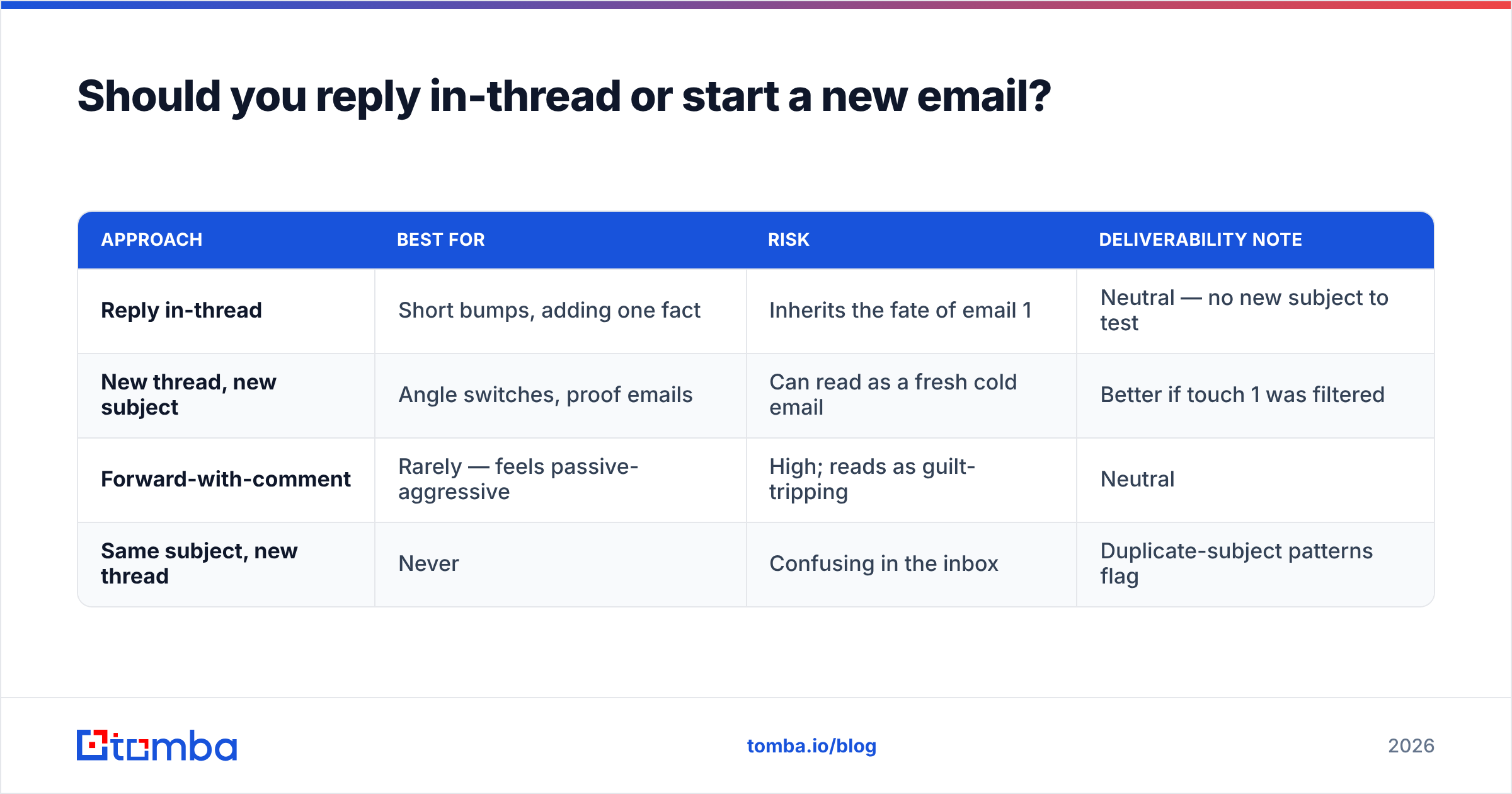
| Approach | Best for | Risk | Deliverability note |
|---|---|---|---|
| Reply in-thread | Short bumps, adding one fact | Inherits the fate of email 1 | Neutral — no new subject to test |
| New thread, new subject | Angle switches, proof emails | Can read as a fresh cold email | Better if touch 1 was filtered |
| Forward-with-comment | Rarely — feels passive-aggressive | High; reads as guilt-tripping | Neutral |
| Same subject, new thread | Never | Confusing in the inbox | Duplicate-subject patterns flag |
Are your follow-ups failing, or is your data failing?#
Before you rewrite a single subject line, check whether your emails are physically reaching human beings.
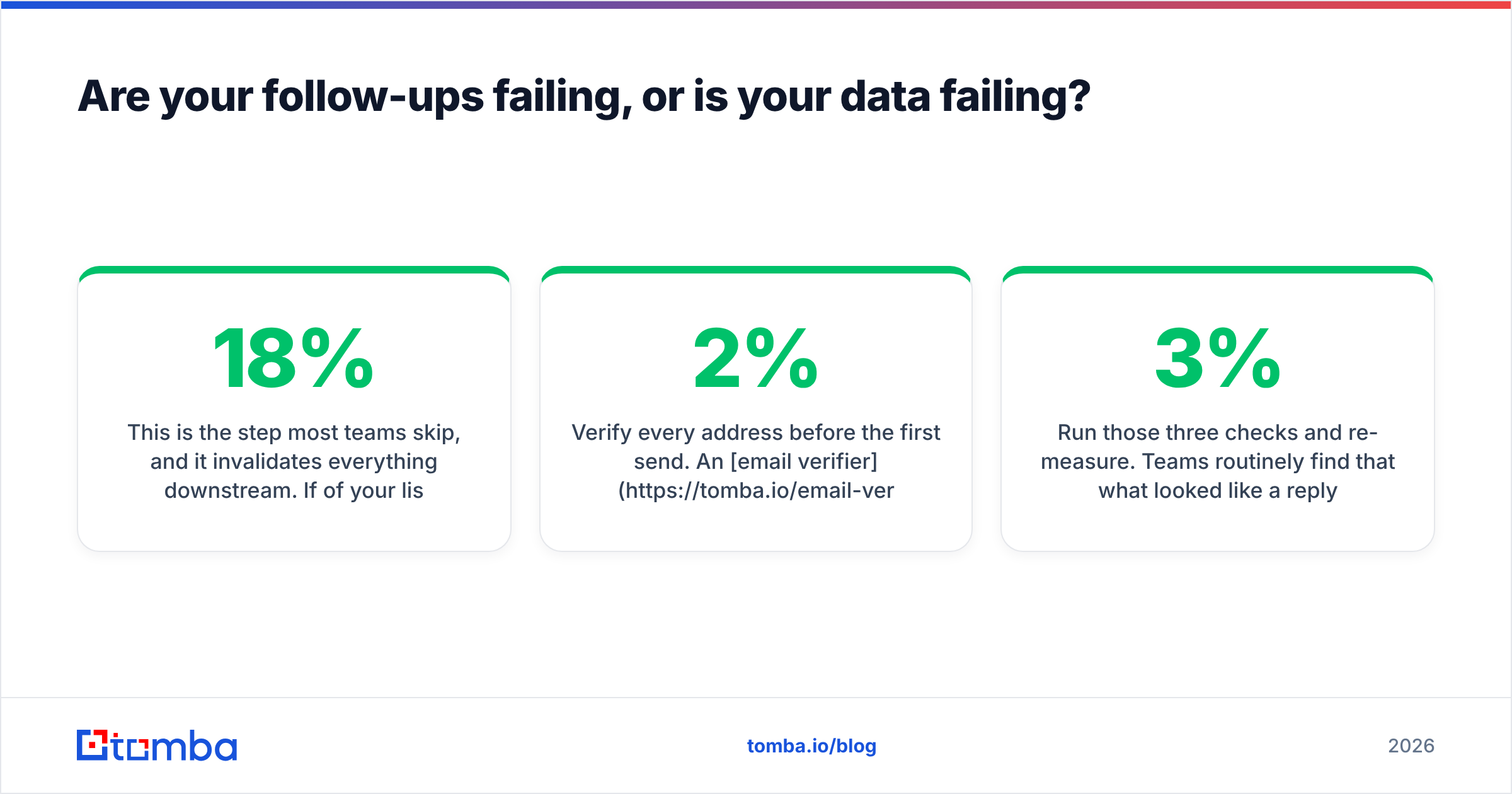
This is the step most teams skip, and it invalidates everything downstream. If 18% of your list is invalid, your "reply rate" is measured against a denominator that includes addresses no one owns. You'll conclude your copy is broken and rewrite a sequence that was actually fine.
Three checks, in order:
- Verify every address before the first send. An email verifier catches syntax errors, dead mailboxes, and role accounts. Keep your bounce rate under 2% — above 3%, mailbox providers start throttling you.
- Handle catch-all domains explicitly. Catch-all servers accept everything, so a standard verification returns "unknown." A dedicated catch-all verifier uses pattern confidence and secondary signals to separate real mailboxes from black holes. Treat unresolvable catch-alls as a lower-priority segment, not a delete.
- Audit authentication. Check your SPF record, DKIM signing, and DMARC policy. Since Google and Yahoo tightened bulk-sender requirements, unauthenticated cold mail from a new domain has a poor chance of reaching a primary inbox at all. Google's own sender guidelines spell out the thresholds.
Run those three checks and re-measure. Teams routinely find that what looked like a 3% reply rate on a "bad sequence" was a 6% reply rate on a list where a third of the addresses never existed.
How do you write a breakup email that actually gets replies?#
Give the prospect an exit, not a guilt trip.
The breakup email works because it inverts the pressure. Every previous touch asked for something. This one offers to stop asking. That release is what triggers the reply — often a "sorry, been swamped, let's talk next month," which is exactly the outcome you wanted.
What works:
Subject: Closing the file
Hi Dana — I've sent a few notes about cutting your SDR list-building time and haven't heard back, which usually means it's not a priority right now.
I'll close this out. If it becomes relevant later, reply "later" and I'll check back in Q4.
Either way, good luck with the Series B push.
What doesn't work: fake deadlines ("this offer expires Friday"), passive aggression ("I guess you're not interested in growing revenue"), or the guilt-trip forward with "Did you see this?" on top. Buyers have seen all three a thousand times and they read as low-status.
One more rule: mean it. If you say you're closing the file, actually stop the sequence. Sending touch six after a breakup email destroys the credibility that made the breakup work.
When should you stop following up entirely?#
Stop at touch five or six, or immediately on any of these signals.
- An explicit no. Suppress permanently. One "no thanks" ignored costs you more in reputation than any deal is worth.
- A hard bounce. Remove and mark the record. Never re-send to a bounced address.
- An out-of-office with a departure date. Update the record, find the replacement, restart cleanly with the new contact.
- A spam complaint. Suppress the domain, not just the person, and audit what else you sent to that company.
- Five or six touches with total silence. Move them to a 90-day re-entry list.
The re-entry list is the underrated asset here. People change roles, budgets reset, and a prospect who was mid-migration in March may be shopping in September. Re-entering with "we spoke in the spring — different situation now?" performs meaningfully better than a genuinely cold first touch, because the name is faintly familiar.
How do you scale follow-ups without sounding automated?#
Automate the sending, not the thinking.
The trap in every sequencing tool is the merge-tag illusion: {{first_name}} and {{company}} feel personalized to the sender and read as mail-merge to the recipient. Everybody gets those. What survives is a specific detail that could only apply to one person.
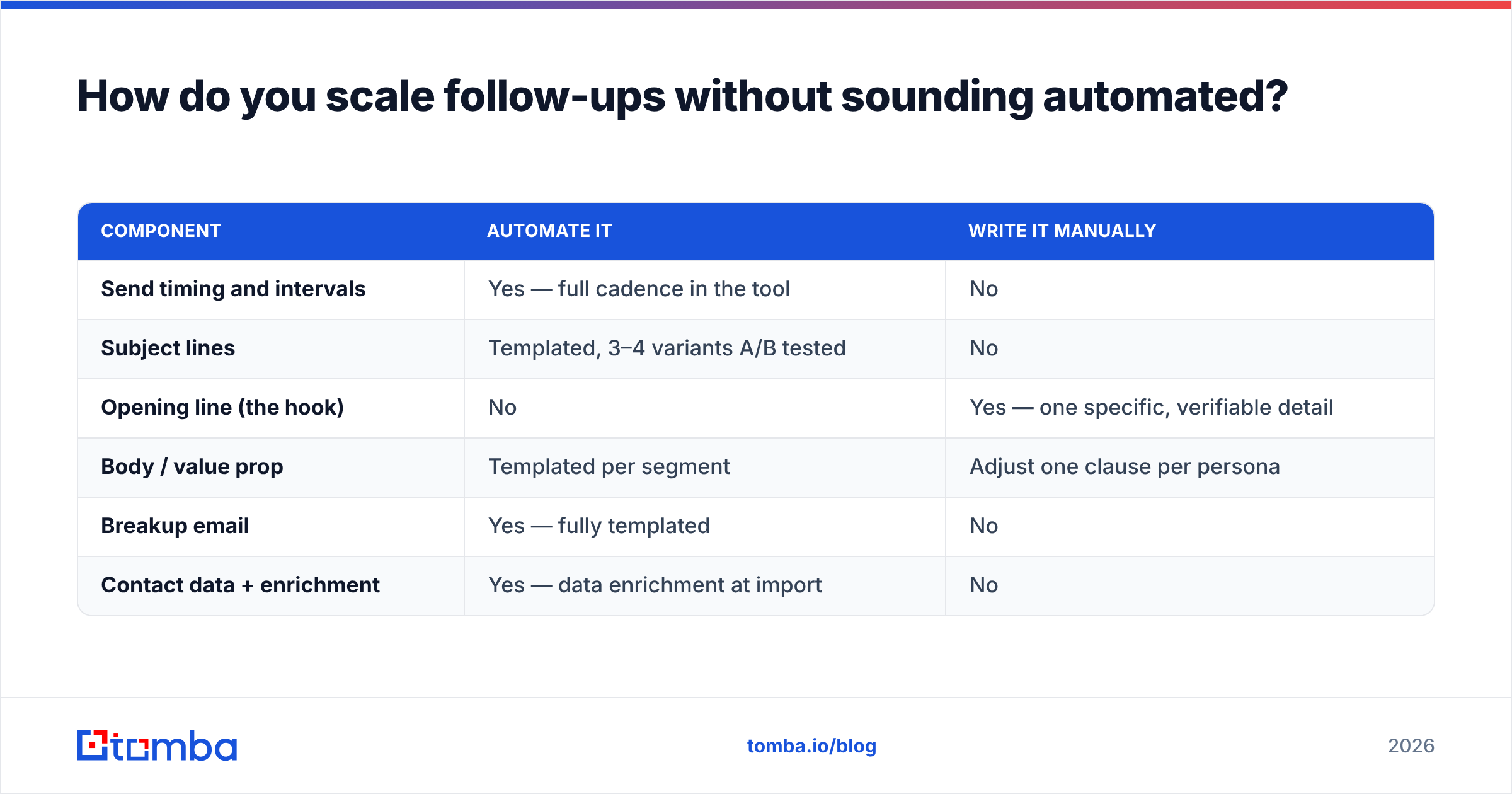
A workable split for a rep sending 200 emails a week:
| Component | Automate it | Write it manually |
|---|---|---|
| Send timing and intervals | Yes — full cadence in the tool | No |
| Subject lines | Templated, 3–4 variants A/B tested | No |
| Opening line (the hook) | No | Yes — one specific, verifiable detail |
| Body / value prop | Templated per segment | Adjust one clause per persona |
| Breakup email | Yes — fully templated | No |
| Contact data + enrichment | Yes — data enrichment at import | No |
That means roughly one manually written sentence per prospect, which is about 90 seconds of work. Everything else is infrastructure. Reps who try to hand-write full emails at volume burn out by Wednesday; reps who automate the hook produce sequences that read like a bot wrote them. The hook is the part that has to be yours.
Feed the whole thing from clean data. Pull contacts by company with domain search, enrich them, verify them, then load into your sequencer. If you're running this at list scale, a bulk email finder is faster than one-off lookups and keeps your verification status attached to each record.
What metrics tell you the follow-up sequence is working?#
Track reply rate by touch number, not just sequence-level averages.
Sequence-level reply rate hides everything useful. If your overall rate is 4%, you don't know whether touch one is carrying it and touches 2–5 are dead weight, or the reverse. Break it out:
- Bounce rate — under 2%. Above that, your data pipeline is broken and nothing else matters.
- Open rate by touch — falling opens across touches suggests deliverability decay or subject fatigue. Note that open tracking has gotten noisy since Apple Mail Privacy Protection; treat it directionally.
- Reply rate by touch — if touch three outperforms touch one, your first email's angle is wrong. Swap them.
- Positive reply share — replies that aren't "unsubscribe." This is the number that correlates with pipeline.
- Meetings booked per 1,000 sent — the only metric your CFO cares about. Benchmarks vary wildly by segment; measure your own trend, not someone else's average.
- Unsubscribe and complaint rate — under 0.1% complaints. Rising complaints mean you're over-touching or under-targeting.
Peer-review platforms like G2 are useful for seeing which sequencers surface per-touch analytics natively; several still only report at the sequence level, which forces you into spreadsheet exports.
Putting it together#
Follow-ups aren't a persistence contest. They're a relevance contest run over five attempts, on a list that's actually deliverable, with an honest exit at the end.
Fix the data first — verify addresses, resolve catch-alls, authenticate your domain. Then build a 4–6 touch cadence at day 0, +3, +7, +14, +25, where every message carries one new fact. Close with a real breakup email, honor it, and recycle silent contacts into a 90-day re-entry list instead of grinding them down.
Ready to stop guessing whether your emails are even landing? Start with the Tomba Email Finder to build verified, deliverable prospect lists by domain, name, or company — then layer your sequence on top of data you can trust. The free tier includes 25 searches a month, and paid plans start at $49/mo on Tomba pricing when you're ready to scale past manual lookups.
Related guides#
Ready to find emails that actually work?
Join 150,000+ professionals who stopped guessing and started sending. Free credits on signup — no credit card required.
Get the Tomba newsletter
Practical outbound tactics and product updates — once every two weeks.
About the author