How to Write a Follow Up Email That Actually Gets Replies
Most B2B deals die in the follow-up, not the first touch. Here's the timing, cadence, and copy structure that separates follow-up emails that get replies from the ones that get archived.
TL;DR
- Between 40% and 60% of replies in a typical B2B sequence arrive after the first email — the follow up email is where the pipeline actually lives, not the opener.
- Three to five follow-ups over 14–21 business days is the practical sweet spot for cold outbound. Two is leaving money on the table; nine is torching your domain.
- Every follow-up needs a new reason to exist. "Just bumping this" adds zero information and trains people to ignore your thread.
- Reply-first, not open-first: opens are unreliable post-MPP, so build your cadence rules on replies, bounces, and clicks.
- Bad data ruins good cadence. A five-touch sequence to an unverified list multiplies bounces by five and takes your sender reputation with it.
What is a follow up email, and why does it decide the deal?#
A follow up email is any message you send after an initial contact that has not been answered — a cold outreach bump, a post-demo recap, a proposal nudge, or a re-engagement after a stalled thread.
Think of it like knocking on a door. The first knock is easy to miss: the person is on a call, in a meeting, or watching your email slide under 200 others. The second and third knock are what actually get someone to the door. Sending one email and concluding "they're not interested" is like knocking once and deciding nobody lives there.
The mechanics behind this are boring and consistent. Buyers are not evaluating you on email one. They are triaging. Your first email arrives in a context where the buyer has no problem you solve this week. Your fourth email arrives three weeks later, potentially the same week their board asked about pipeline coverage. Timing is not something you control — frequency is how you buy more chances at good timing.
Three structural facts worth internalizing:
- Reply distribution is long-tailed. Emails 2–4 routinely produce as many replies combined as email 1. Cutting the sequence at two touches removes the fat middle of that distribution.
- Recall compounds. Even ignored emails build passive brand familiarity. The fourth email is read by someone who has seen your name three times, which changes how it lands.
- Follow-ups are cheap; first touches are not. You already paid the research and data cost to reach this contact. Every additional touch amortizes that cost.

How many follow up emails should you actually send?#
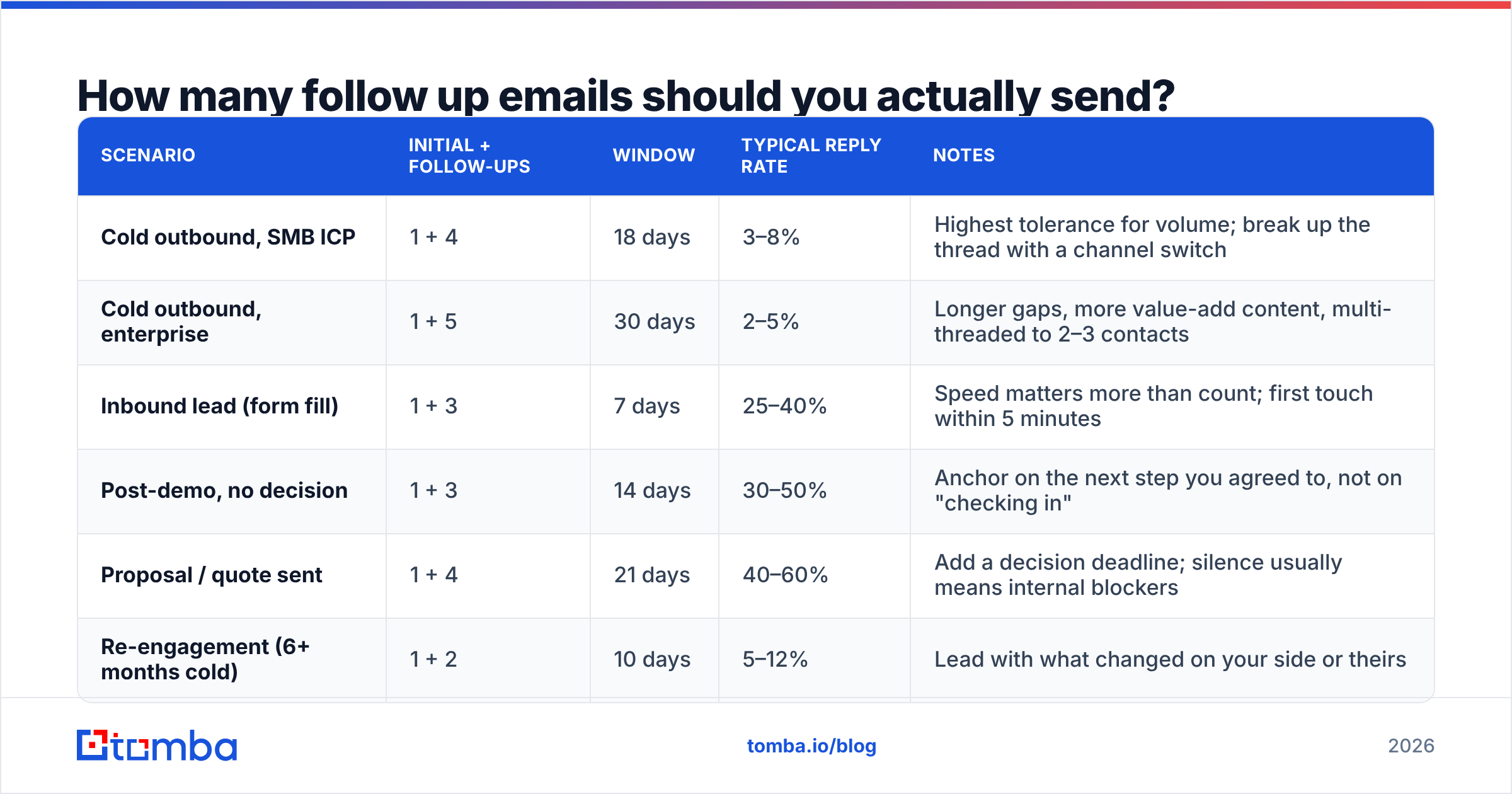
Three to five total follow-ups after the initial email, spread across 14 to 21 business days, covers most B2B outbound scenarios. Fewer and you under-harvest; more and reply rate per send collapses while spam complaints climb.
The right number is not universal, though. It scales with deal size and relationship warmth:
| Scenario | Initial + follow-ups | Window | Typical reply rate | Notes |
|---|---|---|---|---|
| Cold outbound, SMB ICP | 1 + 4 | 18 days | 3–8% | Highest tolerance for volume; break up the thread with a channel switch |
| Cold outbound, enterprise | 1 + 5 | 30 days | 2–5% | Longer gaps, more value-add content, multi-threaded to 2–3 contacts |
| Inbound lead (form fill) | 1 + 3 | 7 days | 25–40% | Speed matters more than count; first touch within 5 minutes |
| Post-demo, no decision | 1 + 3 | 14 days | 30–50% | Anchor on the next step you agreed to, not on "checking in" |
| Proposal / quote sent | 1 + 4 | 21 days | 40–60% | Add a decision deadline; silence usually means internal blockers |
| Re-engagement (6+ months cold) | 1 + 2 | 10 days | 5–12% | Lead with what changed on your side or theirs |
Two rules survive every scenario. First, spacing should expand, not stay flat: day 3, day 6, day 11, day 18 beats four emails every four days, because the widening gap mirrors how buying attention actually returns. Second, the last email should genuinely be the last one. A "breakup" email you don't honor is a credibility problem.
Why do most follow up emails get ignored?#
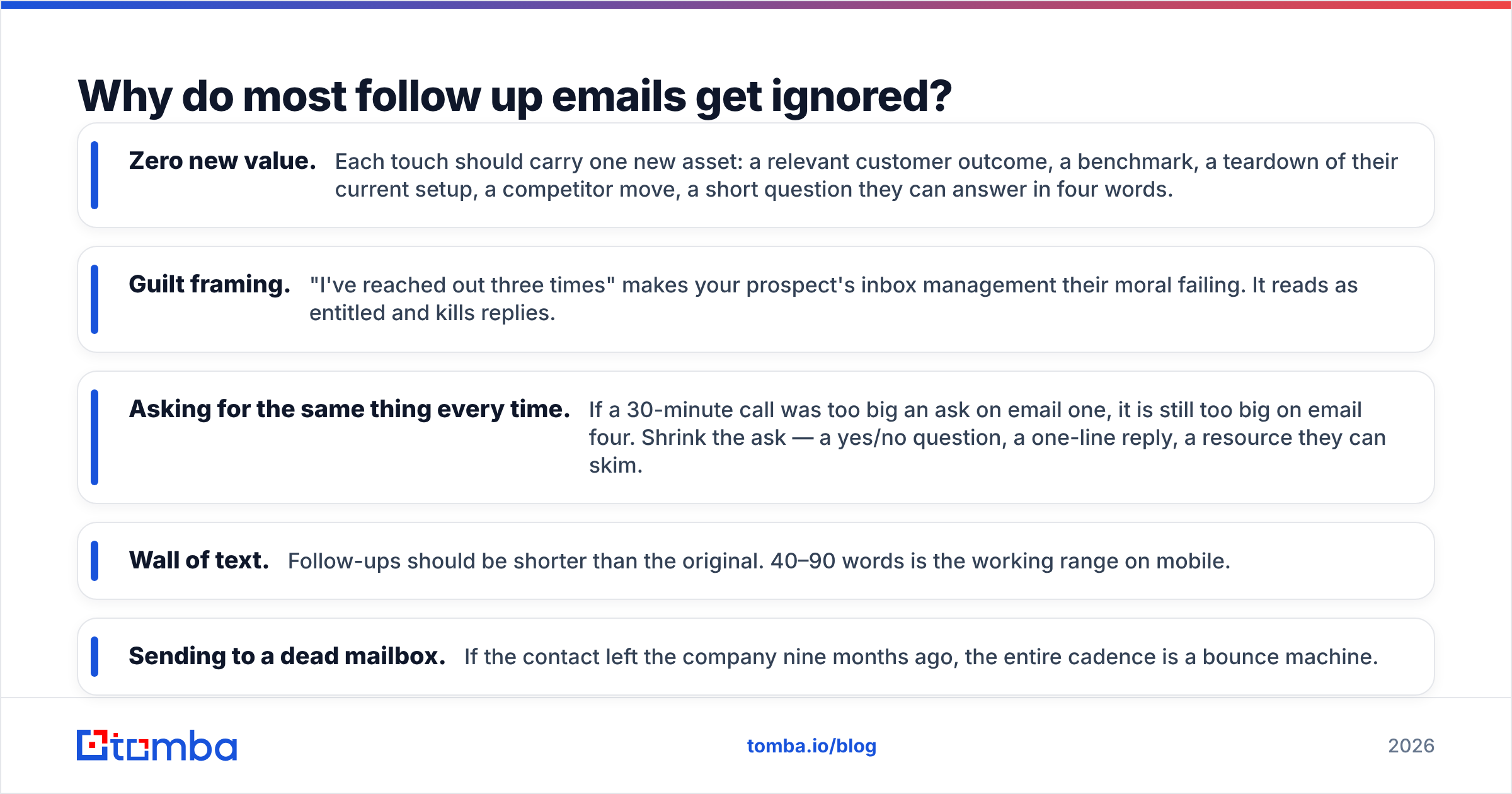
Because they contain no new information. "Just following up," "circling back," and "bumping this to the top of your inbox" are all the same sentence: I want something and I have nothing to offer. The recipient learns after two of these that your thread is safe to archive.
The failure modes, in rough order of how much damage they do:
- Zero new value. Each touch should carry one new asset: a relevant customer outcome, a benchmark, a teardown of their current setup, a competitor move, a short question they can answer in four words.
- Guilt framing. "I've reached out three times" makes your prospect's inbox management their moral failing. It reads as entitled and kills replies.
- Asking for the same thing every time. If a 30-minute call was too big an ask on email one, it is still too big on email four. Shrink the ask — a yes/no question, a one-line reply, a resource they can skim.
- Wall of text. Follow-ups should be shorter than the original. 40–90 words is the working range on mobile.
- Sending to a dead mailbox. If the contact left the company nine months ago, the entire cadence is a bounce machine.
That last one is where most teams silently bleed. Sequences amplify data quality in both directions: a 92%-valid list produces a clean, high-deliverability cadence, while a 70%-valid list turns five touches into five bounce events per bad record. Run your list through an email verifier before the sequence starts, not after the first bounce report arrives.
What structure makes a follow up email work?#
Four blocks, in this order, under 90 words total:
- A one-line context anchor. Reference the original thread or the trigger event so they can place you in two seconds. "Following my note on your Q3 hiring page" beats "Following up on my last email."
- The new information. One sentence. A stat, an outcome, a change on their side, a question. This is the entire reason the email exists.
- A shrunken ask. Make replying cheaper than ignoring. "Worth a look, or is this off-base?" outperforms "Do you have 30 minutes Thursday?"
- A clean exit. No PS stacking, no five signature links, no "looking forward to hearing from you soon."
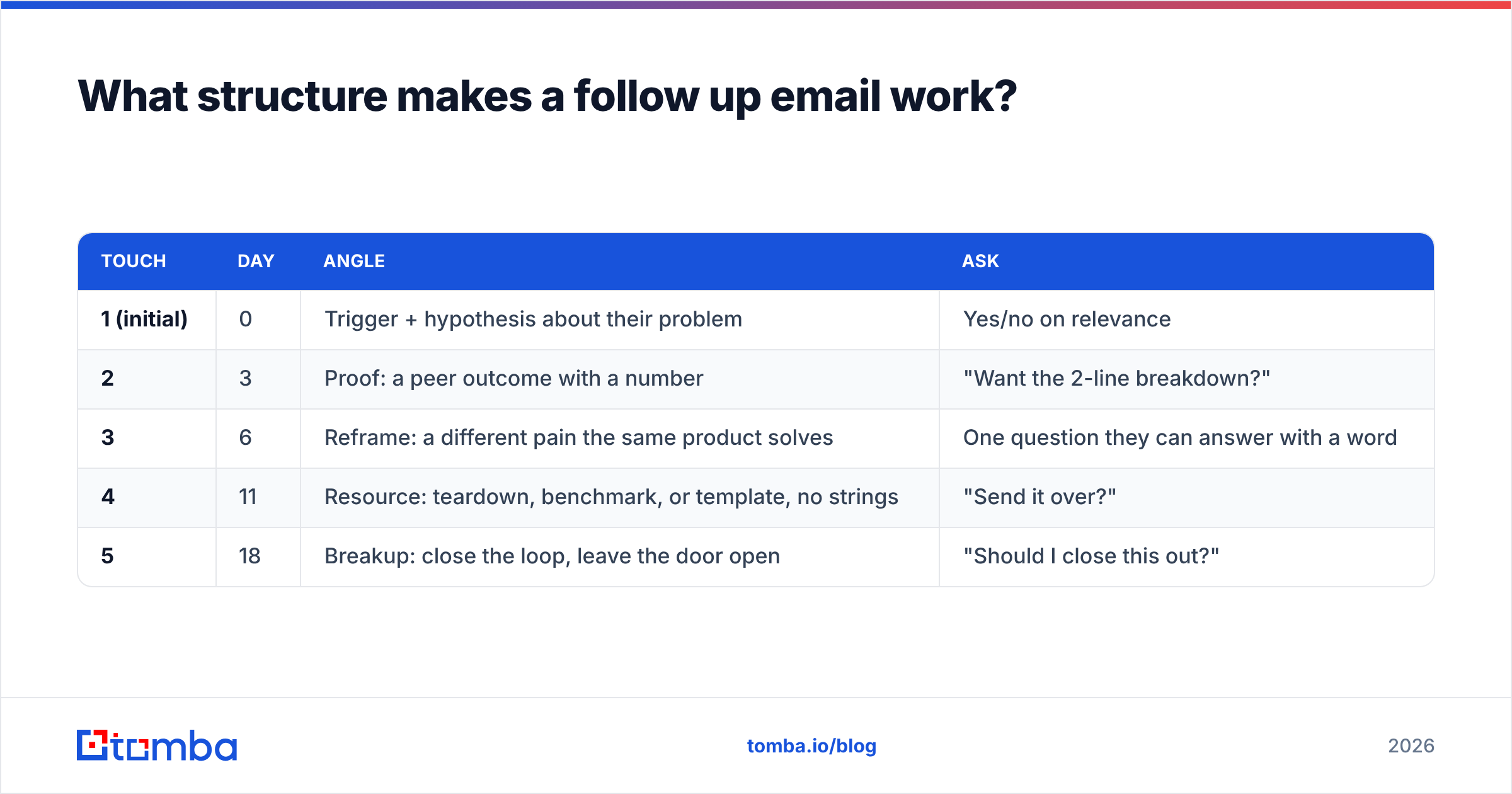
Here is what that looks like in practice across a sequence:
| Touch | Day | Angle | Ask |
|---|---|---|---|
| 1 (initial) | 0 | Trigger + hypothesis about their problem | Yes/no on relevance |
| 2 | 3 | Proof: a peer outcome with a number | "Want the 2-line breakdown?" |
| 3 | 6 | Reframe: a different pain the same product solves | One question they can answer with a word |
| 4 | 11 | Resource: teardown, benchmark, or template, no strings | "Send it over?" |
| 5 | 18 | Breakup: close the loop, leave the door open | "Should I close this out?" |
The reframe on touch 3 matters more than people expect. Your first angle is a guess. If it didn't land, repeating it louder won't fix it — changing the hypothesis will. Sales teams that treat the sequence as five variations on one pitch see far worse response rates than teams that treat it as three distinct hypotheses tested in order.
Should you follow up in the same thread or start a new one?#
Same thread for touches 2 and 3, new thread for touch 4 onward. Threading keeps context for someone who half-remembers you; a fresh subject line gives you a second chance at the preview pane when the old thread has visually died in their inbox.
A few tactical notes:
- Don't quote the entire previous email. It doubles the visual weight and signals "automated sequence."
- New subject lines should not be clever. Plain, specific, lowercase-ish lines outperform curiosity-bait in B2B. Test them before you send — a subject line tester catches spam-trigger phrasing and length problems in seconds.
- Never send a follow-up from a different domain mid-sequence. It breaks threading, confuses recipients, and looks like spoofing to filters.
How does follow-up frequency affect deliverability?#
Directly and unforgivingly. Volume per mailbox, bounce rate, and complaint rate are the three signals mailbox providers weigh hardest, and a sequence multiplies all three.
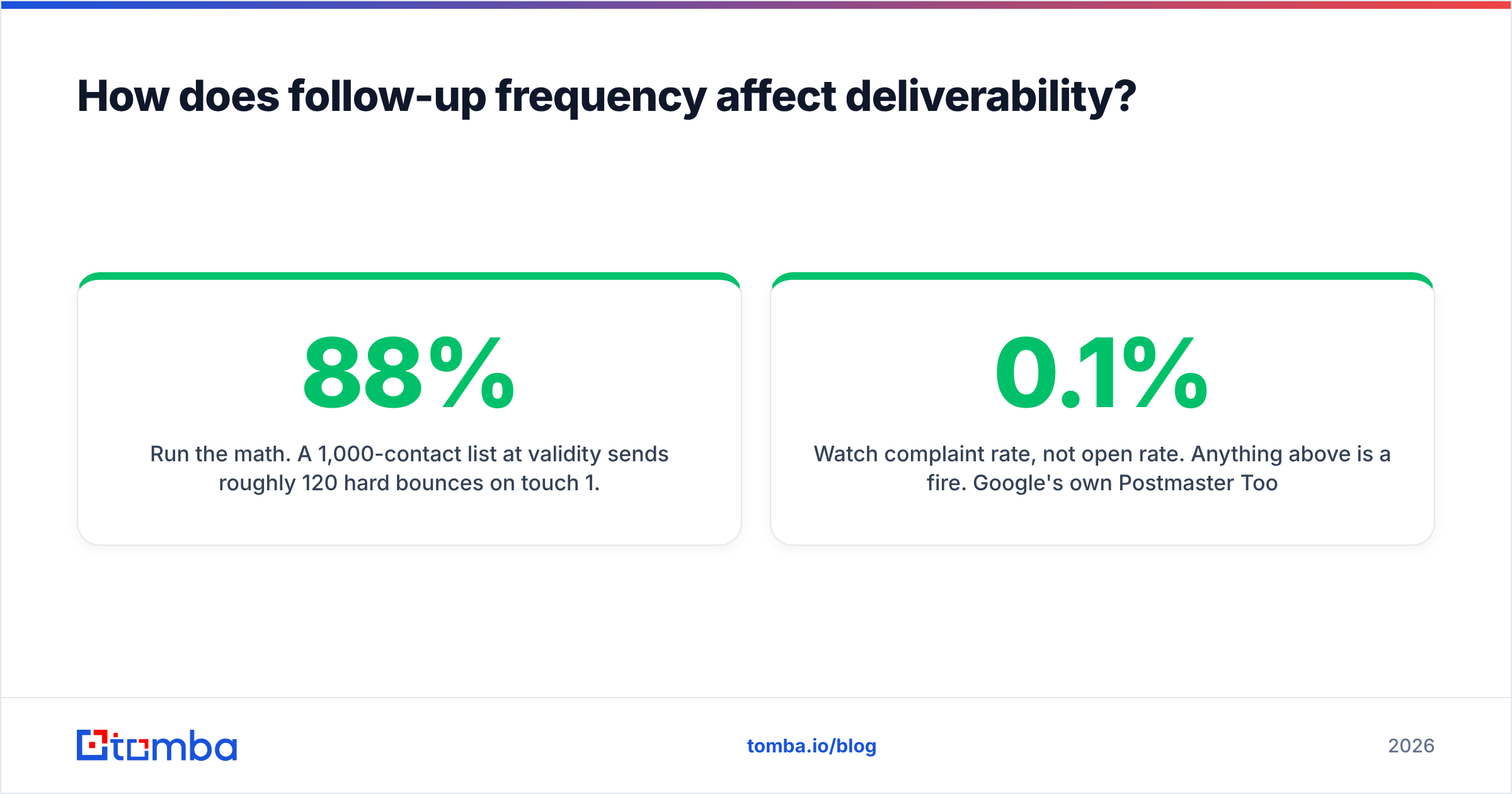
Run the math. A 1,000-contact list at 88% validity sends roughly 120 hard bounces on touch 1. If your tooling doesn't suppress those contacts, touches 2–5 send another 480 bounces into the void. You've now produced 600 bounce events against a domain that likely has no established sending history. Google and Microsoft respond to that pattern by routing you to spam — not just for that campaign, but for the domain.
Practical guardrails:
- Cap per-mailbox volume at 30–50 cold sends/day on a warmed domain, and split across multiple sending mailboxes rather than pushing one harder.
- Suppress on hard bounce immediately, and on soft bounce after two.
- Suppress on reply, click-to-unsubscribe, and out-of-office (pause, don't kill, for OOO — resume after the return date).
- Verify before, not after. Pre-send verification is 10x cheaper than reputation repair. Tomba's catch-all verifier handles the tricky case where a domain accepts everything and standard SMTP checks return an unhelpful "maybe."
- Watch complaint rate, not open rate. Anything above 0.1% is a fire. Google's own Postmaster Tools dashboard is the source of truth here, and it's free.

Apple Mail Privacy Protection and similar features have made open rates functionally decorative for a large slice of B2B recipients. If your cadence branches on "opened but didn't reply," you're branching on noise. Build the logic on replies, clicks, and bounces instead. HubSpot and most modern sequencers now expose reply-based branching natively; use it.
What separates a good follow up email from a great one?#
Specificity that could not have been copy-pasted to anyone else. That's the whole answer, and it's why data quality and copy quality are the same problem.
Compare:
"Hi Sarah — just checking in on my last note about improving your outbound efficiency. Do you have 15 minutes this week?"
versus:
"Sarah — you posted two SDR roles last month. The teams we work with usually hit the same wall at that headcount: reps spend 40% of the day on list building. One question — is that where your time is going, or somewhere else?"
The second one required knowing something. It took 90 seconds of research. It earns a reply rate several multiples higher because it proves a human looked.
Scaling that without scaling headcount is the actual job. Three things make it tractable:
- Trigger-based sequencing. Hiring posts, funding rounds, tech-stack changes, and leadership hires all give you a legitimate, timely reason to write. Peer-review platforms like G2 are useful for seeing which tools a segment is actively evaluating.
- Enriched contact records. Title, seniority, department, and company size let you template intelligently rather than generically. Data enrichment closes the gap between a raw email address and a personalized first line.
- Ruthless suppression. The fastest way to raise reply rate is to stop emailing people who were never going to reply.
When should you stop following up?#
Stop after the breakup email — and mean it. Then move the contact to a nurture track and revisit in 90 days, or when a trigger fires.
Signals it's time to stop earlier:
- Explicit no. Obvious, but respect it immediately and suppress permanently. It's also a legal requirement under CAN-SPAM and GDPR.
- Role change or departure. Re-route to the new owner instead of pushing the sequence.
- Repeated soft bounces or full mailbox. The message isn't landing; more sends won't fix that.
- Three touches with zero engagement of any kind on a low-ACV deal. The expected value of touches 4–5 doesn't justify the deliverability cost at that price point.
And one signal it's time to keep going: an out-of-office reply. That's a confirmed live mailbox and a known return date. Pause the sequence, resume two days after they're back, and reference nothing about the OOO.
Put it together#
Follow-up is not persistence theater. It's a structured test: three hypotheses about why this person might care, spread across 14–21 days, each one shorter and cheaper to answer than the last, sent to addresses you've confirmed exist.
The copy work is the fun part. The unglamorous part — making sure the 1,000 addresses in your sequence are real, current, and correctly formatted — is what determines whether the copy ever gets seen. Start there. Use the Tomba Email Finder to build a verified, deduplicated contact list by domain, name, or company before you write a single follow-up, so your five touches land in five inboxes instead of five bounce logs. The free tier gives you 25 searches a month to test the accuracy on your own ICP; paid plans start at $49/mo when you're ready to run real volume — full Tomba pricing is public, no sales call required.
Related guides#
Ready to find emails that actually work?
Join 150,000+ professionals who stopped guessing and started sending. Free credits on signup — no credit card required.
Get the Tomba newsletter
Practical outbound tactics and product updates — once every two weeks.
About the author