Follow Up Email After a Meeting: Templates That Get Replies
Most meetings die in the 48 hours after they end. Here is the timing, structure, and eight copy-paste templates that turn a good conversation into a booked next step.
TL;DR
- Send the follow up email after a meeting within 24 hours. After 48 hours, recall of what you actually agreed on collapses and your note becomes admin instead of momentum.
- The structure that works is four blocks: thank + anchor, recap of decisions, explicit owner-and-date next step, one attachment or resource. Nothing else.
- Subject lines that reference a specific thing said in the room beat "Great meeting you!" every time.
- A recap email is not a nudge email. Different jobs, different templates — mixing them is why threads die.
- If you're following up with people who weren't in the room (procurement, security, the actual budget holder), you need their address before you can write anything. That's a data problem, not a copy problem.
Why does the follow up email after a meeting matter more than the meeting?#
Because the meeting is where alignment feels real and the email is where it becomes real.
Think of a meeting like a verbal handshake at a noisy conference. Everyone nods. Everyone leaves. Two days later, three people remember three different versions of what was agreed. The follow up email is the written record that decides which version survives — and, more usefully, it's the only artifact that gets forwarded to the people who weren't in the room.
That forwarding behaviour is the whole game in B2B. Your buyer champion rarely has unilateral authority. Your recap email is what they paste into Slack when their VP asks "what did that vendor actually say?" If the recap is vague, the internal pitch is vague. If it's crisp, you've just written your champion's sales deck for them.
There's a second, less romantic reason: silence is the default outcome of every meeting. Not rejection — silence. People leave with genuine intent and then get swallowed by their week. The follow up isn't there to persuade. It's there to put a dated, owned action back into their calendar before their attention decays.
What should a follow up email after a meeting actually contain?#
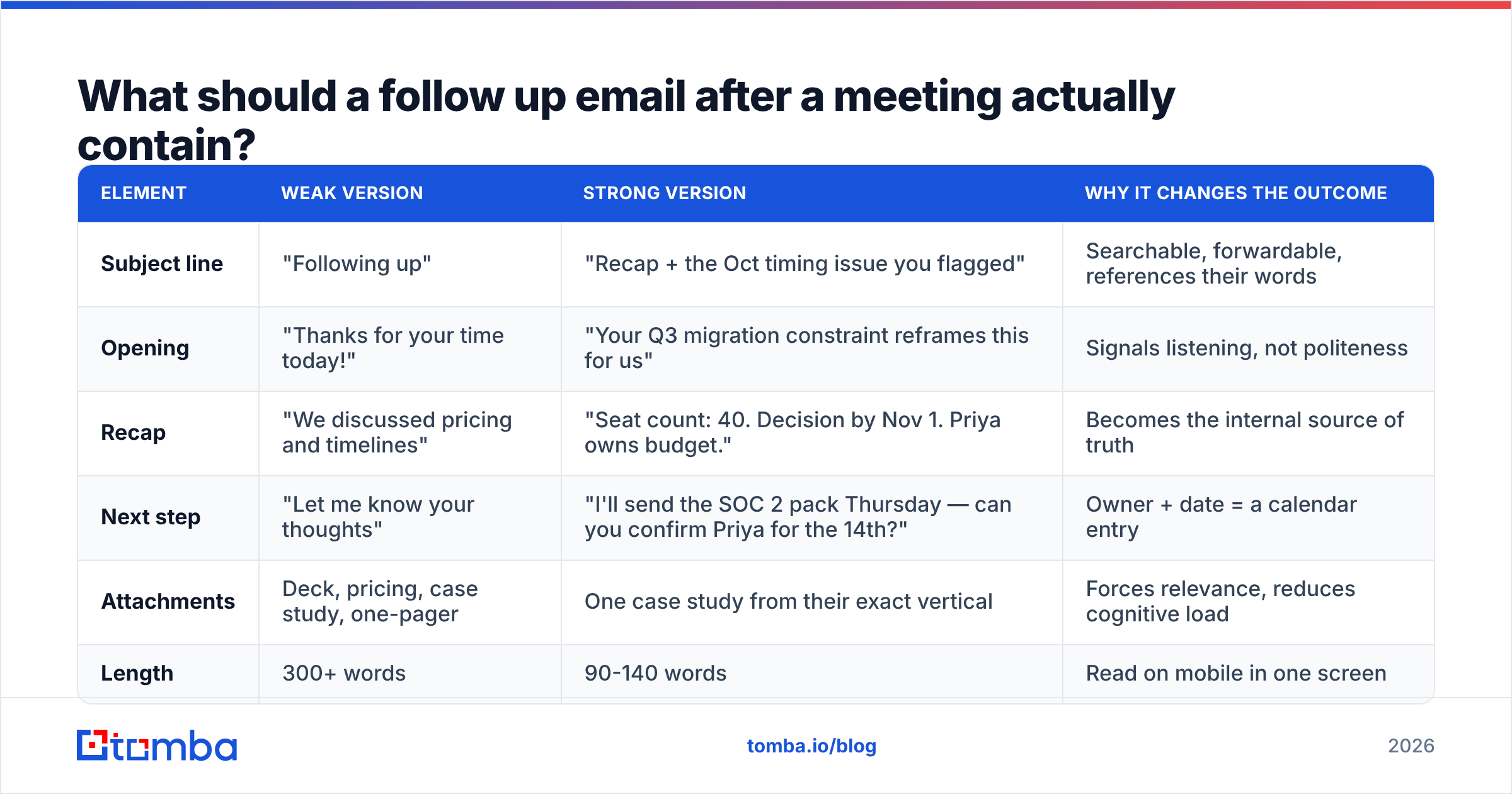
Four blocks, in this order. Anything more and you're writing a memo nobody reads.
- The anchor line. One sentence referencing something specific from the conversation — not "thanks for your time," but "your point about the Q3 migration blocking any new tooling until October was the useful part for me." This proves you listened and it makes the email un-templated in the reader's mind.
- The recap. Three to five bullets max, stated as decisions and constraints, not as narrative. "Budget sits with Priya, not IT" is a decision. "We discussed budget" is noise.
- The next step with an owner and a date. This is the block most people fumble. "Let me know your thoughts" has no owner and no date, so it has no future. "I'll send the security questionnaire by Thursday; you'll confirm whether Priya can join the 14th" has both.
- One resource. A single link, doc, or case study that maps to the objection they actually raised. One. Attaching four things signals you didn't know which one mattered.
What to leave out: your company boilerplate, a second CTA, a paragraph about how excited you are, and any sentence beginning "As discussed" that isn't followed by a concrete noun.
| Element | Weak version | Strong version | Why it changes the outcome |
|---|---|---|---|
| Subject line | "Following up" | "Recap + the Oct timing issue you flagged" | Searchable, forwardable, references their words |
| Opening | "Thanks for your time today!" | "Your Q3 migration constraint reframes this for us" | Signals listening, not politeness |
| Recap | "We discussed pricing and timelines" | "Seat count: 40. Decision by Nov 1. Priya owns budget." | Becomes the internal source of truth |
| Next step | "Let me know your thoughts" | "I'll send the SOC 2 pack Thursday — can you confirm Priya for the 14th?" | Owner + date = a calendar entry |
| Attachments | Deck, pricing, case study, one-pager | One case study from their exact vertical | Forces relevance, reduces cognitive load |
| Length | 300+ words | 90-140 words | Read on mobile in one screen |
When should you send it — and how long should you wait?#
Send the recap within 24 hours, ideally the same working day. Then follow a decaying cadence.
The timing logic is simple: your email should arrive while the meeting is still emotionally warm but after the person has left back-to-back calls. For a morning meeting, late afternoon the same day. For an afternoon meeting, first thing the next morning — it lands at the top of an inbox being triaged rather than in the middle of a 4pm pile.
After the recap, most reps make one of two errors. Either they go silent for two weeks and let the thread die, or they "bump" every 48 hours until the prospect quietly archives them. Neither works. Use spacing that widens:
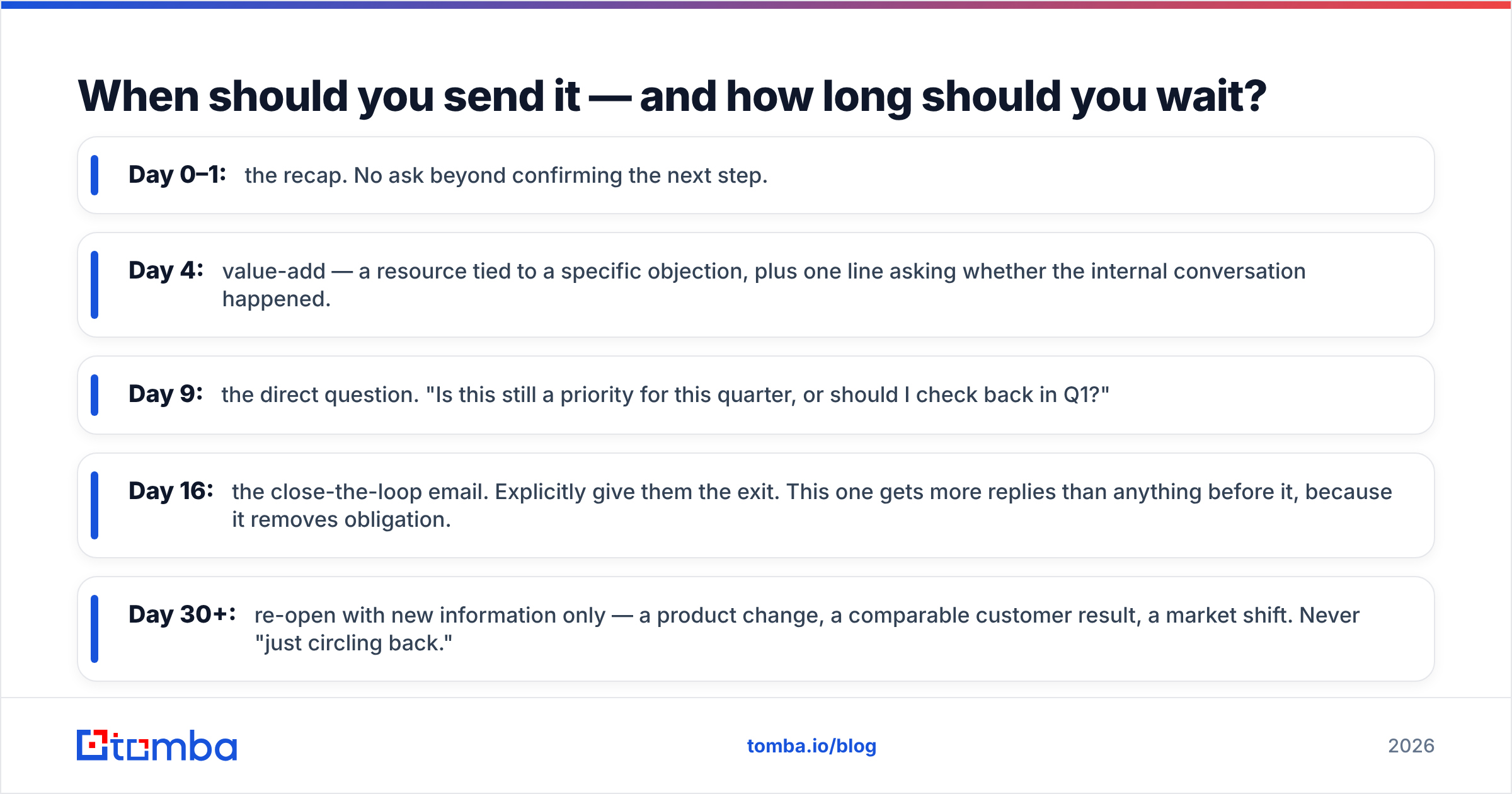
- Day 0–1: the recap. No ask beyond confirming the next step.
- Day 4: value-add — a resource tied to a specific objection, plus one line asking whether the internal conversation happened.
- Day 9: the direct question. "Is this still a priority for this quarter, or should I check back in Q1?"
- Day 16: the close-the-loop email. Explicitly give them the exit. This one gets more replies than anything before it, because it removes obligation.
- Day 30+: re-open with new information only — a product change, a comparable customer result, a market shift. Never "just circling back."
What's the difference between a recap email and a nudge email?#
They do different jobs and should never share a template.
A recap is an artifact. Its reader might be someone who wasn't in the meeting. It's written in the third person about decisions, it's dense, and its CTA is confirmation. Its success metric is whether it gets forwarded.
A nudge is a prompt. Its reader is exactly one person who already knows the context. It's short, personal, and its CTA is a decision. Its success metric is a reply — any reply, including "no."
Mixing them produces the most common failure mode in B2B follow-up: a 400-word email that re-explains everything the reader already knows and buries a soft question at the bottom. The recipient scans, sees no clear action, and defers. Deferral compounds. Two deferrals and you're in the archive.
If you want a broader library to adapt from, our cold email templates collection separates these two shapes explicitly, and HubSpot's sales blog is a decent second source for cadence benchmarks.
What are the templates I can copy right now?#
Eight, covering the situations that actually recur. Swap the bracketed parts. Keep the brevity.
1. Discovery call recap
Subject: Recap — 40 seats, Nov 1 decision, Priya on budget
[Name], the useful part for me was the October migration freeze — that changes what I'd even recommend.
What I noted:
• 40 seats in scope, EMEA first
• Decision target Nov 1, live by Jan
• Budget sits with Priya, not IT
Next: I'll send the security pack Thursday. Can you confirm whether Priya can join on the 14th?
One thing worth reading: [single relevant link]
2. Demo follow-up
Subject: The reporting view you asked about
You asked whether the dashboard can split by region without a custom build. It can — screenshot attached, took me 90 seconds to set up on our side.
The open question from the call was whether your data team needs API access on day one. Want me to loop in our solutions engineer for 20 minutes, or is that a Q1 problem?
3. After a meeting where nothing was decided
Subject: Honest question about timing
[Name], we covered a lot but didn't land on a next step, which usually means the timing isn't right rather than the fit.
Is this a "not now, revisit in January" or a "keep sending me things"? Either is a fine answer and I'll act on it.
4. Following up with a new stakeholder
Subject: Context from [Champion]'s call last Tuesday
[New name] — [Champion] suggested I send you the short version rather than make you sit through a repeat.
The problem we discussed: [one line]. What it would take: [one line]. What I need from you: 15 minutes, or a "no thanks" so I stop filling [Champion]'s inbox.
5. Post-conference or event meeting
Subject: The [specific booth conversation topic], continued
We spoke at [event] about [very specific thing]. You said [their exact phrasing]. That stuck with me because [one line of genuine reaction].
Worth a proper 20 minutes next week, or should I send the written version instead?
6. After a pricing conversation
Subject: Numbers, in writing
As promised: [tier] at [price], [X] included, overage at [rate]. No hidden onboarding fee.
The comparison you asked for against [alternative] is in the attached one-pager — I've kept it factual, including where they're stronger.
Are you presenting this internally, or do you want me on the call?
7. Breakup / close-the-loop
Subject: Closing this out
[Name], I've sent three notes since we spoke and haven't heard back — which I read as priorities shifting, not disinterest.
I'll stop here. If [problem] comes back onto the roadmap, reply to this thread and I'll pick it straight up.
8. Re-open after 30+ days
Subject: [Specific thing that changed]
When we spoke in [month], the blocker was [X]. That's now [changed thing].
Not asking for a meeting yet — just worth knowing. Reply "send it" and I'll write up the two-paragraph version.
How do you follow up with people who weren't in the meeting?#
This is where most follow-up sequences quietly break, and it's not a copywriting problem.
Your champion says "I'll take this to Priya in finance and Marcus in security." Two weeks pass. Your champion goes on leave. You have no way to reach Priya or Marcus, so the deal stalls on one person's availability. Single-threaded deals are the most common cause of "we lost to no-decision."
The fix is to build a multi-threaded contact map during or immediately after the meeting, not when the deal is already stuck. That means:
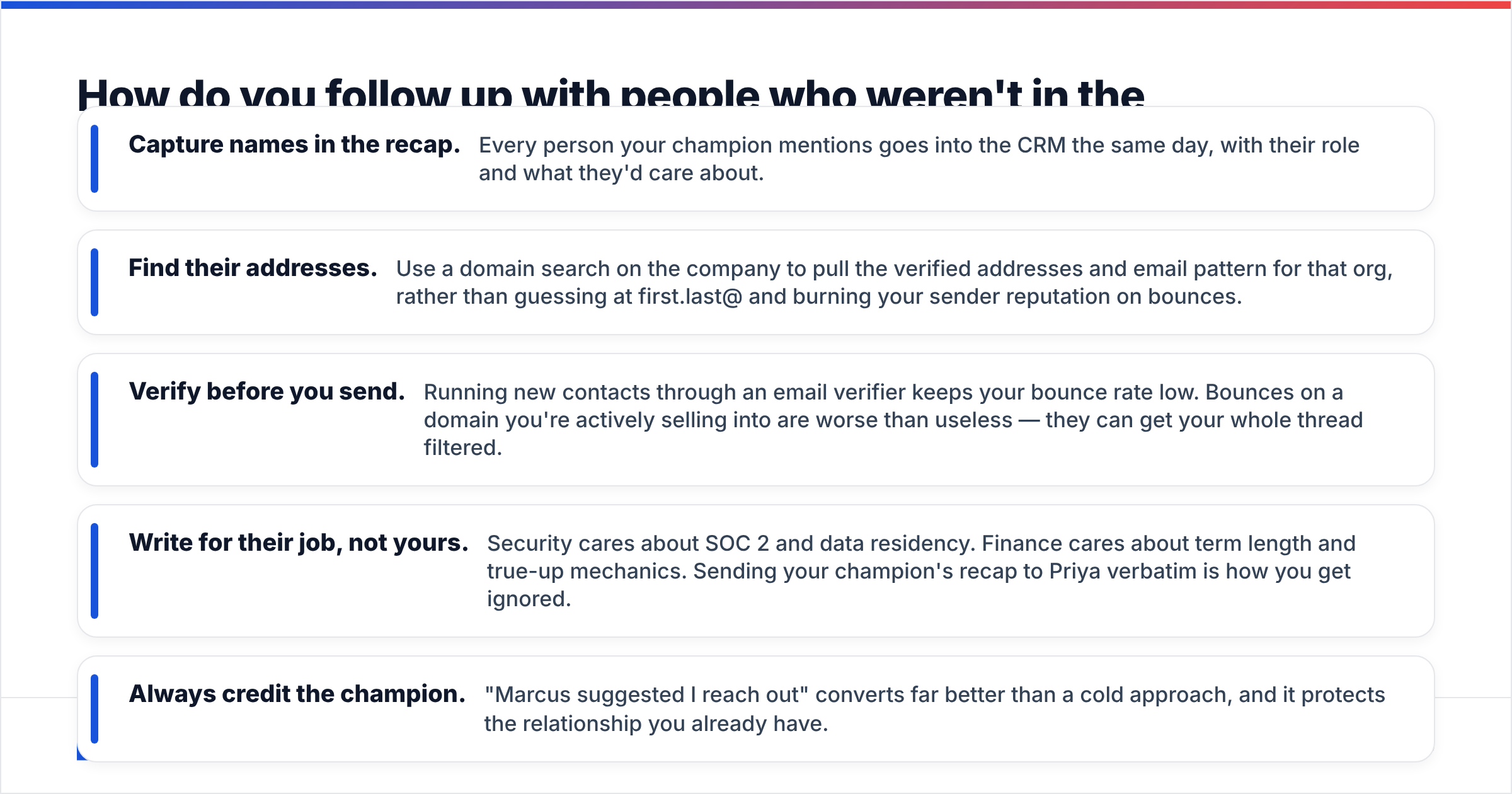
- Capture names in the recap. Every person your champion mentions goes into the CRM the same day, with their role and what they'd care about.
- Find their addresses. Use a domain search on the company to pull the verified addresses and email pattern for that org, rather than guessing at first.last@ and burning your sender reputation on bounces.
- Verify before you send. Running new contacts through an email verifier keeps your bounce rate low. Bounces on a domain you're actively selling into are worse than useless — they can get your whole thread filtered.
- Write for their job, not yours. Security cares about SOC 2 and data residency. Finance cares about term length and true-up mechanics. Sending your champion's recap to Priya verbatim is how you get ignored.
- Always credit the champion. "Marcus suggested I reach out" converts far better than a cold approach, and it protects the relationship you already have.
Gartner's research on B2B buying consistently puts the average buying group in the high single digits. If your follow-up strategy addresses one of those people, you're running at roughly a tenth of the coverage the deal needs. Improving your response rate is usually less about better sentences and more about writing to more of the right inboxes.
What mistakes kill follow-up emails most often?#
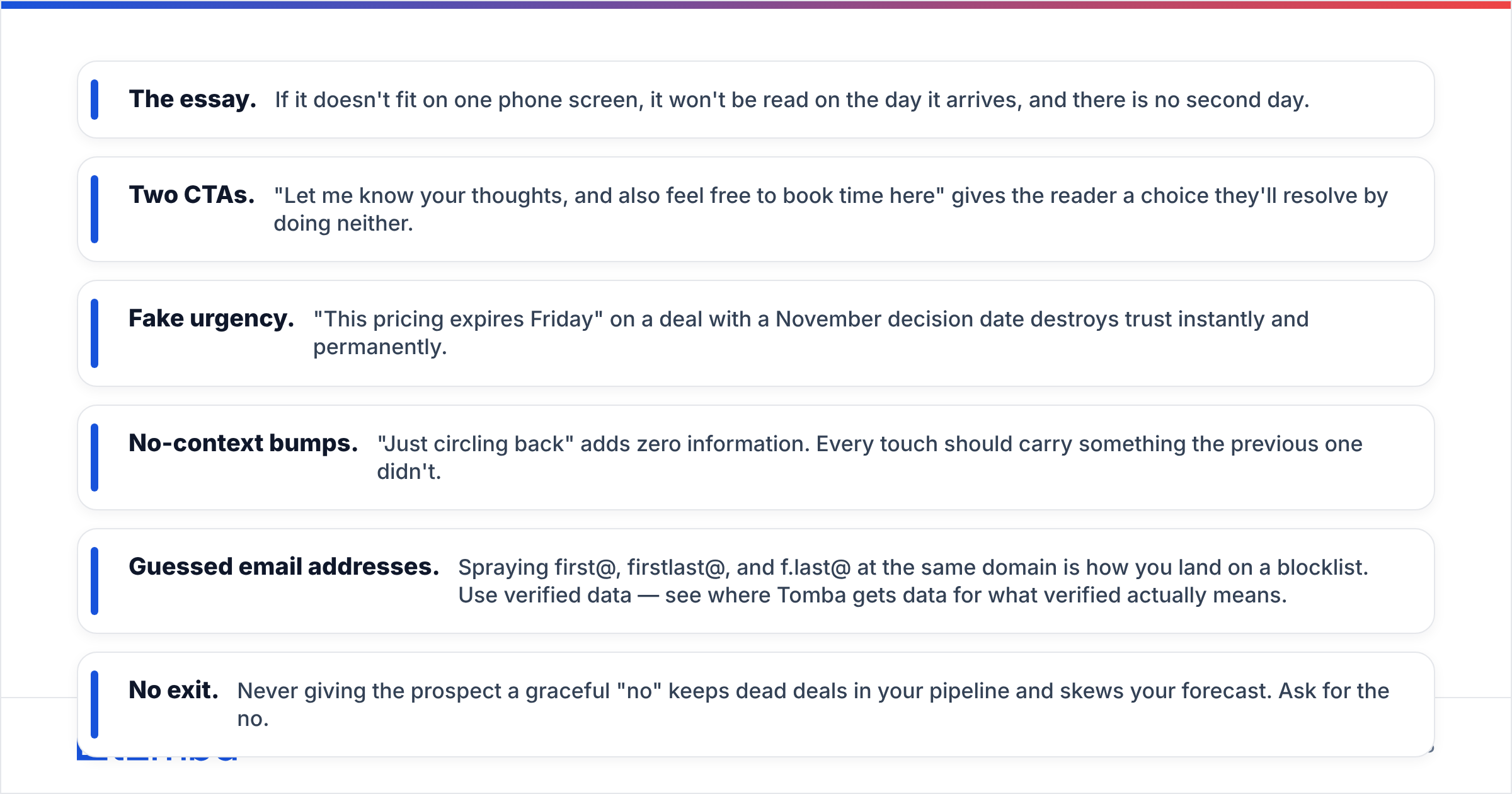
- The essay. If it doesn't fit on one phone screen, it won't be read on the day it arrives, and there is no second day.
- Two CTAs. "Let me know your thoughts, and also feel free to book time here" gives the reader a choice they'll resolve by doing neither.
- Fake urgency. "This pricing expires Friday" on a deal with a November decision date destroys trust instantly and permanently.
- No-context bumps. "Just circling back" adds zero information. Every touch should carry something the previous one didn't.
- Guessed email addresses. Spraying first@, firstlast@, and f.last@ at the same domain is how you land on a blocklist. Use verified data — see where Tomba gets data for what verified actually means.
- No exit. Never giving the prospect a graceful "no" keeps dead deals in your pipeline and skews your forecast. Ask for the no.
- Delegating tone to AI without editing. Generated recaps are fine as a first draft and terrible as a final one — they smooth out exactly the specific details that make a recap credible.
Where should you store and track all this?#
In your CRM, on the same day, with the next step as a dated task — not in your head and not in a starred email.
The mechanical version: after every meeting, spend six minutes. Two on the recap email, two on logging decisions and stakeholder names into your CRM, two on creating the dated follow-up task. Six minutes per meeting is roughly 30 minutes a week for a rep running ten meetings, and it's the difference between a pipeline you can forecast and a list of hopeful conversations.
Tools help at the margins — sales engagement platforms in the G2 category will automate cadence spacing and reply detection for you. But automation multiplies whatever process you already have. Automating a vague follow-up just produces vague follow-ups faster.
Ready to follow up with everyone who matters, not just the person who showed up?#
The best-written follow up email after a meeting still fails if it only reaches one inbox. Multi-threading is the highest-leverage change most reps can make to their follow-up game, and it starts with knowing how to reach the finance lead, the security reviewer, and the exec sponsor your champion mentioned in passing.
Use the Tomba Email Finder to turn a name and a company domain into a verified, deliverable address in seconds — so the stakeholder map you built in the meeting turns into an actual sequence instead of a note you never acted on. The free tier gives you 25 searches a month to test it against your last five meetings; paid plans start at $49/mo on Starter, with Growth at $99/mo. Full Tomba pricing is public if you want to check the numbers before you sign up.
Related guides#
Ready to find emails that actually work?
Join 150,000+ professionals who stopped guessing and started sending. Free credits on signup — no credit card required.
Get the Tomba newsletter
Practical outbound tactics and product updates — once every two weeks.
About the author