Follow Up Email After a Week: Timing, Templates, Data
Waiting a week before you follow up is the most common cadence in B2B sales — and the least examined. Here is what the timing data, the templates, and the deliverability math actually say.
TL;DR
- A follow up email after a week is the safest default gap in B2B outreach: long enough to survive a busy inbox week, short enough that the recipient still remembers your first message.
- Most replies to a sequence do not come from the first email. Follow-ups two through four routinely carry a large share of total responses, so skipping them wastes the sending you already paid for.
- One week is right for cold prospects and post-demo silence. It is too slow for inbound leads (hours), and too fast for closed-lost re-engagement (30–90 days).
- The single biggest cause of "no reply after a week" is not bad copy — it is a wrong or unverified address that bounced or landed in spam.
- Reply to your own thread, add one new piece of value, and ask exactly one question. Never send "just bumping this to the top of your inbox" alone.
What is a follow up email after a week?#
A follow up email after a week is a second (or third, or fourth) message sent roughly seven days after your previous one, usually in the same thread, to a prospect who did not respond. It is the most-used interval in B2B outreach for a boring but valid reason: a business week is the natural unit of attention. Someone who ignored you on Tuesday has, by the following Tuesday, cleared their backlog, finished the fire drill, and returned to normal triage.
Think of it like knocking on an office door. Knock twice in ten seconds and you are a nuisance. Knock once, walk away, come back next week, and you are persistent. The gap is what converts annoyance into professionalism.
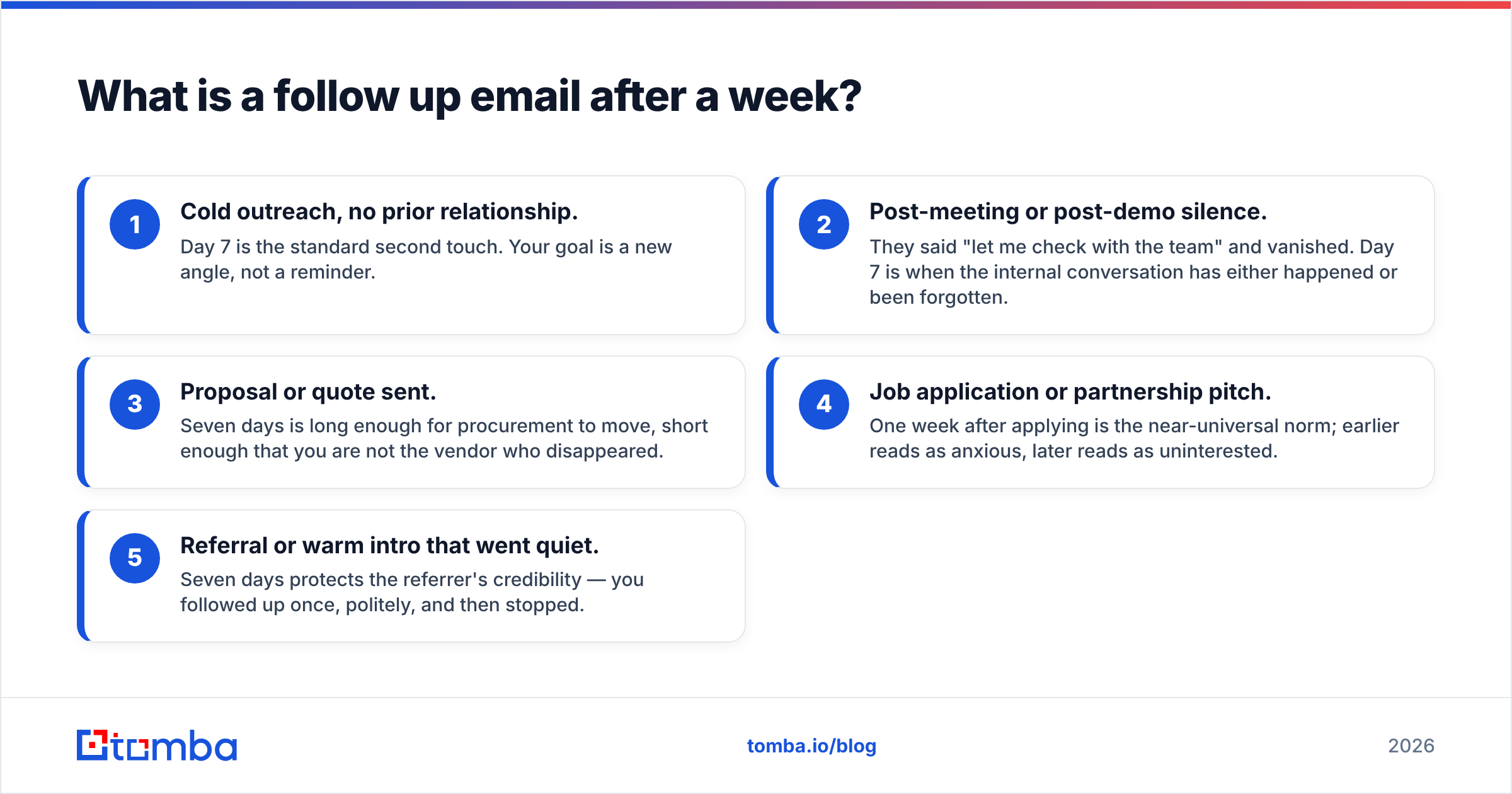
There are four situations where the seven-day gap is the correct call, and knowing which one you are in changes the copy completely:
- Cold outreach, no prior relationship. Day 7 is the standard second touch. Your goal is a new angle, not a reminder.
- Post-meeting or post-demo silence. They said "let me check with the team" and vanished. Day 7 is when the internal conversation has either happened or been forgotten.
- Proposal or quote sent. Seven days is long enough for procurement to move, short enough that you are not the vendor who disappeared.
- Job application or partnership pitch. One week after applying is the near-universal norm; earlier reads as anxious, later reads as uninterested.
- Referral or warm intro that went quiet. Seven days protects the referrer's credibility — you followed up once, politely, and then stopped.

Is a week actually the optimal delay?#
The honest answer: a week is a very good default, not a universal optimum. The data across sales-engagement platforms consistently points to three findings that matter more than the exact number of days.
First, volume of touches beats precision of timing. Sequences with four to seven touches outperform single-email campaigns by a wide margin, regardless of whether the gaps are five, seven, or nine days. Second, the first follow-up carries disproportionate weight — it typically produces the largest single lift in total replies of any message after the opener. Third, gaps under three days depress reply rates and increase spam complaints, because the recipient experiences two unread messages from a stranger as pressure rather than persistence.
Here is how the common intervals compare in practice:
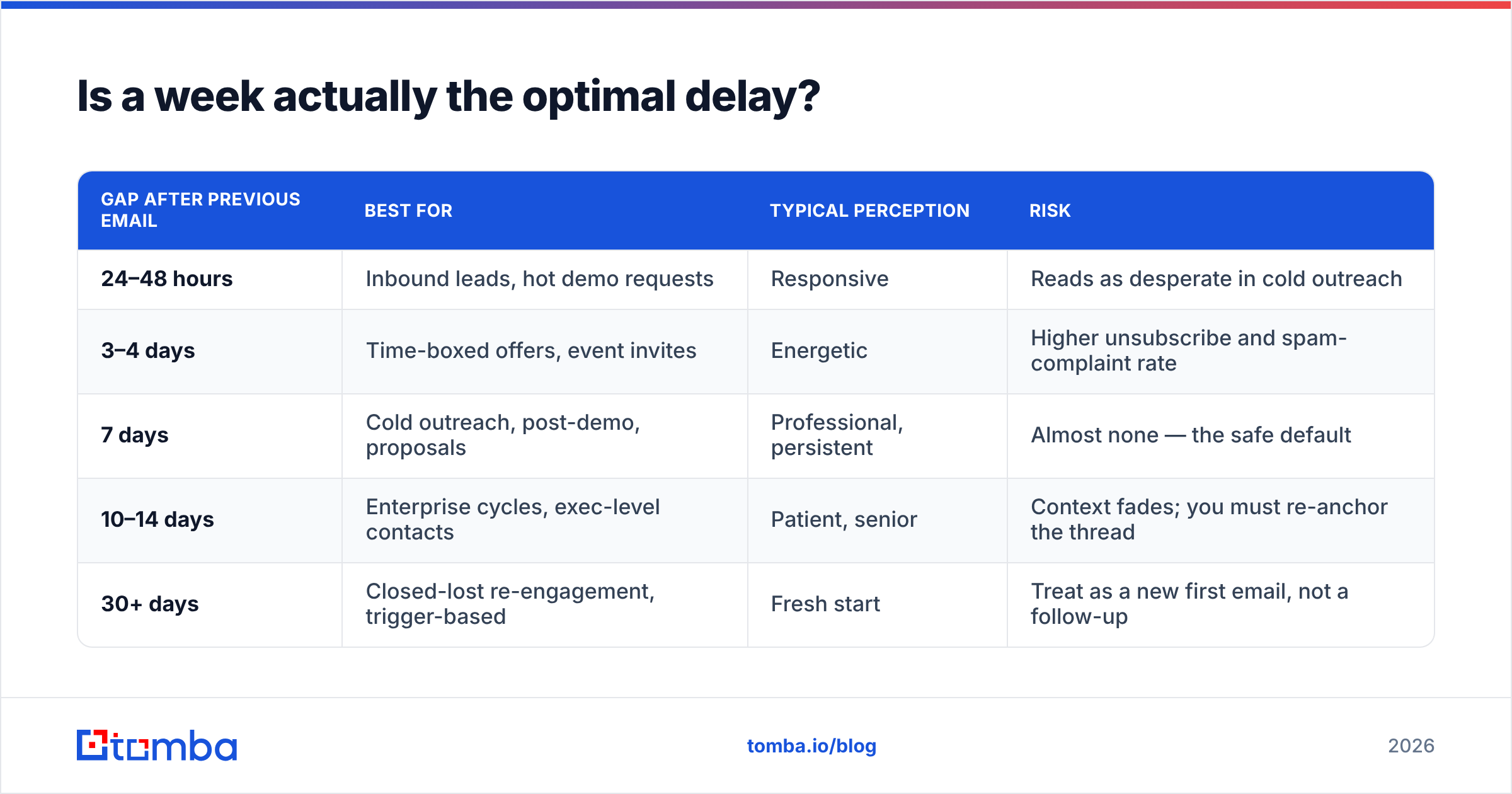
| Gap after previous email | Best for | Typical perception | Risk |
|---|---|---|---|
| 24–48 hours | Inbound leads, hot demo requests | Responsive | Reads as desperate in cold outreach |
| 3–4 days | Time-boxed offers, event invites | Energetic | Higher unsubscribe and spam-complaint rate |
| 7 days | Cold outreach, post-demo, proposals | Professional, persistent | Almost none — the safe default |
| 10–14 days | Enterprise cycles, exec-level contacts | Patient, senior | Context fades; you must re-anchor the thread |
| 30+ days | Closed-lost re-engagement, trigger-based | Fresh start | Treat as a new first email, not a follow-up |
The practical takeaway: if you have no data of your own, use seven days between touches one and two, then widen the gaps (7, 7, 10, 14) as the sequence progresses. Widening signals that you respect their silence instead of escalating against it.
Why did nobody reply in the first place?#
Before you rewrite your copy, rule out the mechanical failures. In most underperforming sequences, roughly a third of "no replies" are not rejections at all — the message never reached a human.
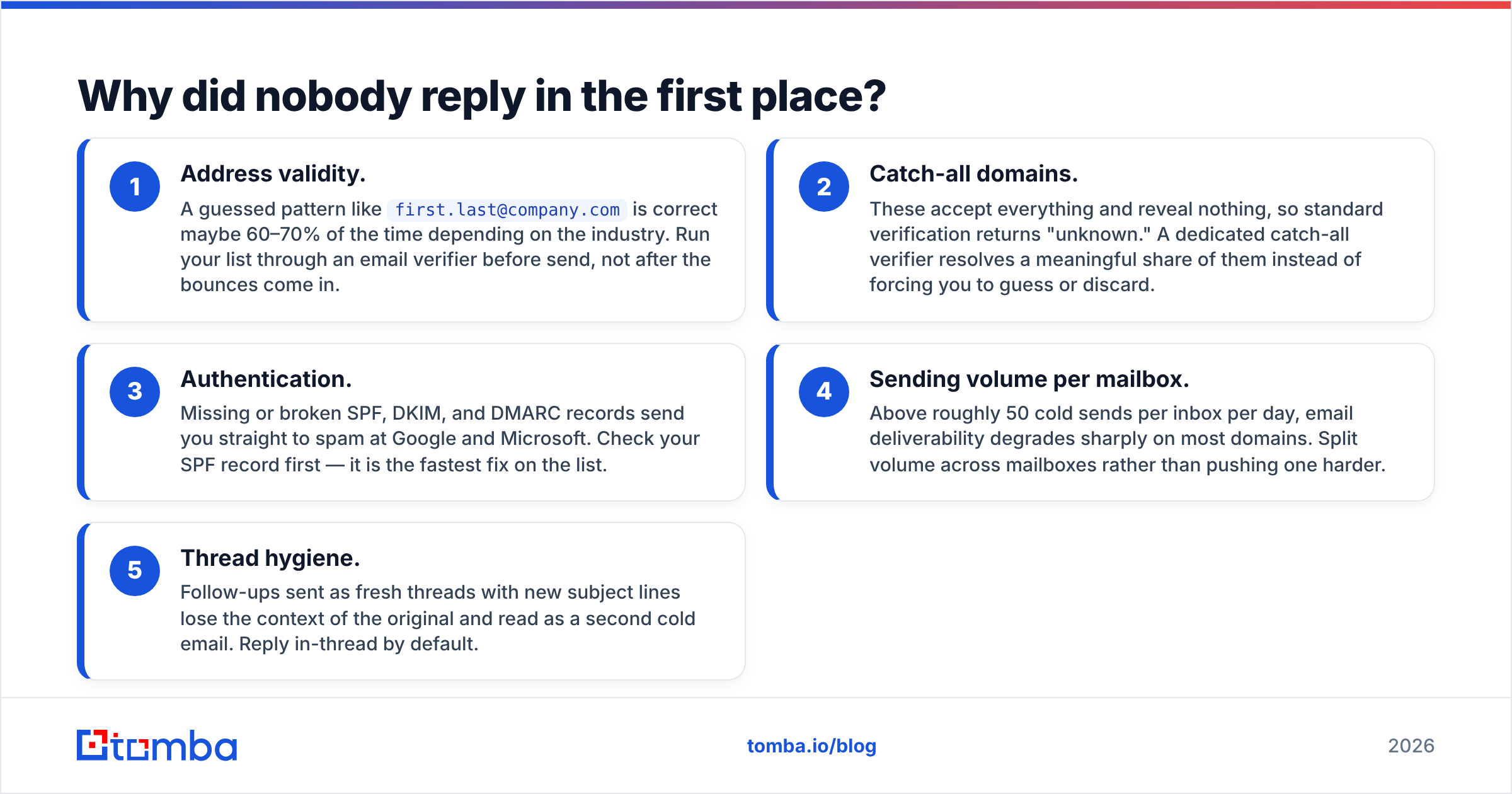
Run this checklist against every campaign before you blame the words:
- Address validity. A guessed pattern like
first.last@company.comis correct maybe 60–70% of the time depending on the industry. Run your list through an email verifier before send, not after the bounces come in. - Catch-all domains. These accept everything and reveal nothing, so standard verification returns "unknown." A dedicated catch-all verifier resolves a meaningful share of them instead of forcing you to guess or discard.
- Authentication. Missing or broken SPF, DKIM, and DMARC records send you straight to spam at Google and Microsoft. Check your SPF record first — it is the fastest fix on the list.
- Sending volume per mailbox. Above roughly 50 cold sends per inbox per day, email deliverability degrades sharply on most domains. Split volume across mailboxes rather than pushing one harder.
- Thread hygiene. Follow-ups sent as fresh threads with new subject lines lose the context of the original and read as a second cold email. Reply in-thread by default.
Only after those five are clean does copy become the variable worth testing. Sending a beautifully written seventh-day follow-up to an address that hard-bounced on day zero is a very expensive way to feel productive.
What should the week-later email actually say?#
The rule: add, do not remind. Every follow-up must carry something the previous one did not. "Just checking in" fails because it transfers the entire cognitive load back to the recipient — they have to reconstruct who you are, what you wanted, and why it mattered, all before deciding to reply.
Four structures that work, in rough order of how often they land:
1. The new-angle follow-up (cold, touch two)
Subject: (reply in original thread)
Hi Dana — following up on last week's note.
Since I wrote, [Competitor] published their Q3 numbers showing [specific, verifiable fact]. That is the exact pattern I see at companies running [their setup].
Worth 15 minutes to compare notes, or should I close the loop here?
2. The one-question follow-up (post-demo)
Hi Marcus — you mentioned needing to run the pricing past Priya before deciding.
One question so I do not chase you unnecessarily: is this a "not now" or a "not this quarter"? Either answer is genuinely useful.
3. The value-drop follow-up (no ask at all)
Hi Elena — no ask here. We put together a two-page teardown of how three companies in your segment cut their lead-response time. Attached in case it is useful.
If the timing is wrong, ignore this entirely.
4. The polite close (touch four or five)
Hi Sam — I have reached out a few times and do not want to keep cluttering your inbox.
I will assume this is not a priority and stop here. If that changes, reply to this thread any time and I will pick it straight back up.
The polite close is the most underrated email in B2B. It regularly outperforms every message before it, because it removes pressure and gives the recipient a costless way to re-open the conversation. If you need help drafting variants, the cold email templates library and the subject line generator are both free starting points.

How many follow-ups should you send after the first week?#
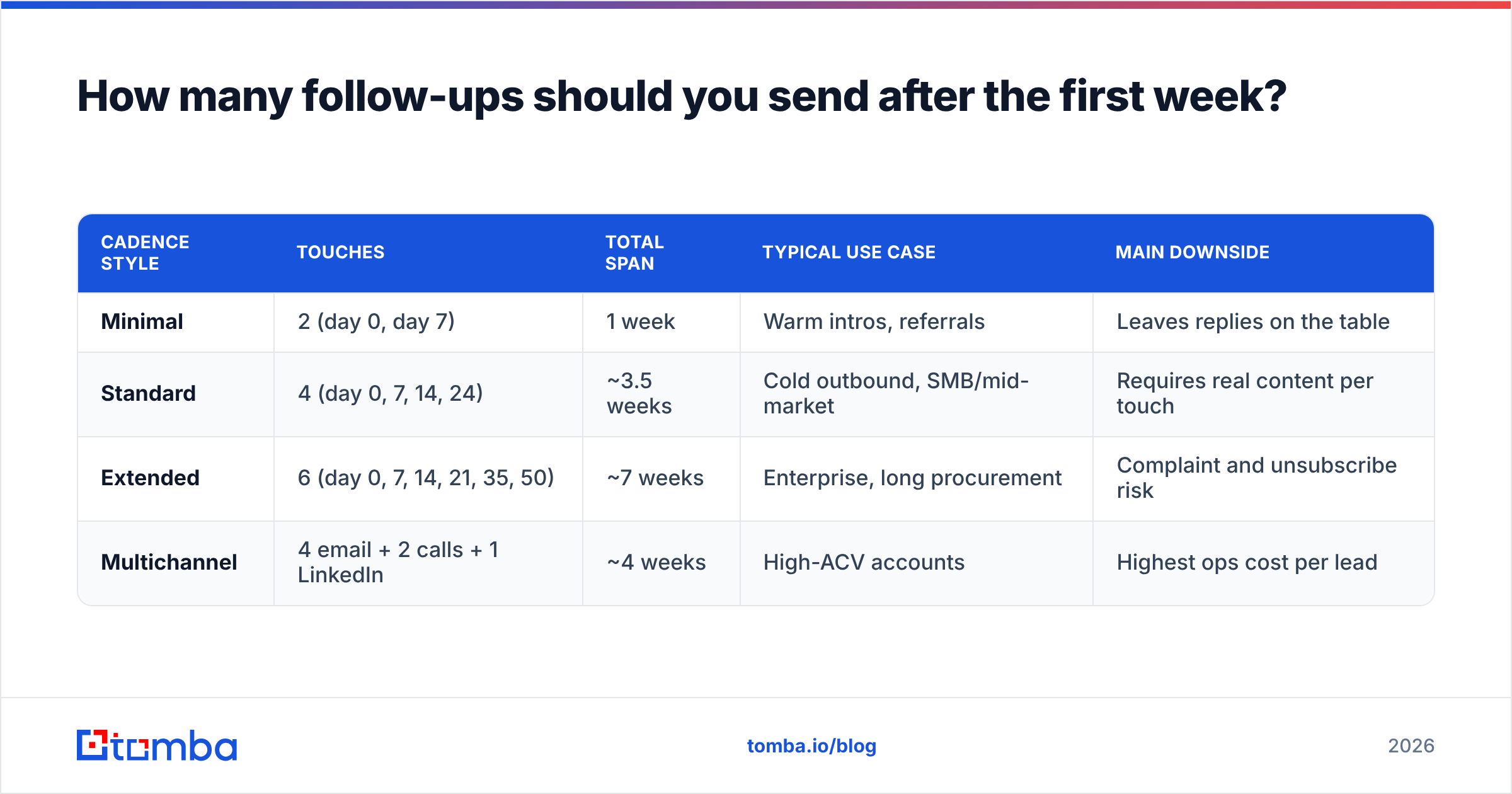
Between three and five total touches, spread over three to four weeks, is the range where most B2B teams find their ceiling. Beyond touch six, incremental replies drop sharply while unsubscribes and complaints keep climbing — a trade that damages sender reputation for every future campaign.
Here is how three common cadence philosophies compare:
| Cadence style | Touches | Total span | Typical use case | Main downside |
|---|---|---|---|---|
| Minimal | 2 (day 0, day 7) | 1 week | Warm intros, referrals | Leaves replies on the table |
| Standard | 4 (day 0, 7, 14, 24) | ~3.5 weeks | Cold outbound, SMB/mid-market | Requires real content per touch |
| Extended | 6 (day 0, 7, 14, 21, 35, 50) | ~7 weeks | Enterprise, long procurement | Complaint and unsubscribe risk |
| Multichannel | 4 email + 2 calls + 1 LinkedIn | ~4 weeks | High-ACV accounts | Highest ops cost per lead |
Multichannel wins on response rate but only if the channels reinforce each other. A LinkedIn note referencing the email you sent Tuesday works. A generic connection request does not. Pair a verified email with a mobile number from a phone finder and you can run the call and email touches against the same person instead of two half-identified contacts.
What mistakes ruin a week-later follow-up?#
- Bumping without content. "Bumping this up" and "any thoughts?" are the two lowest-yield follow-ups in B2B. They are pure demand, zero supply.
- Guilt-tripping. "I noticed you opened my email three times" is creepy, and with modern privacy proxies inflating open counts, it is frequently also wrong.
- Restarting the thread. New subject line, new thread, same pitch — now they have two cold emails from you instead of a conversation.
- Escalating urgency you do not have. Fake deadlines get called out and burn the account permanently.
- Copying five people onto the reply. Adding the prospect's boss to force movement destroys trust faster than any other single tactic.
- Sending Friday at 4pm. It will be buried by Monday's triage. Tuesday through Thursday mornings in the recipient's timezone remain the safest windows.
Does better data beat better timing?#
Yes — and it is not close. Timing optimizations move reply rates by fractions of a percentage point. Contact-data quality moves them by multiples, because a wrong address has a zero percent reply rate no matter how good your day-7 copy is.
The sequence that works: find the address, verify it, enrich the record with role and company context so your follow-up can actually reference something specific, then write. Teams that reverse this order — write first, source later — end up with elegant emails aimed at generic role inboxes.
For an independent view of how vendors in this space differ on accuracy and pricing, G2's sales-intelligence category is a reasonable neutral starting point, and HubSpot's sales blog publishes regular benchmark surveys on follow-up cadence. For the mechanics of why authentication affects whether your second email lands at all, Google's bulk-sender guidelines are the source document most other guides are paraphrasing.
FAQ: quick answers on week-later follow-ups#
Should I change the subject line? No, for touch two and three — reply in the original thread so context travels with the message. Consider a fresh subject only at touch four or later, when you are genuinely changing the angle.
Is a week too long for a job application? No. One week after applying is the standard. Two weeks is acceptable for large organizations with slow HR cycles.
What if they read but never reply? Treat open data as noise. Privacy proxies pre-fetch images and inflate open counts. Behave as if you have no idea whether they saw it.
How do I end the sequence cleanly? Send the polite close, then move the contact to a 90-day re-engagement list tied to a trigger — funding round, new hire in the buying role, tech-stack change.
Start with an address that actually exists#
The best follow-up email after a week is the one that reaches a real inbox on a domain that trusts your sender reputation. Everything else — the angle, the question, the polite close — is downstream of that.
Use the Tomba Email Finder to source verified professional addresses by name and domain, then verify the whole list in bulk before your sequence starts. The free tier covers 25 searches a month so you can test your day-7 cadence against clean data before committing budget; paid plans start at $49/mo on Starter, with Growth at $99/mo — full details on Tomba pricing. Fix the data layer first, and your follow-up copy finally gets a fair test.
Related guides#
Ready to find emails that actually work?
Join 150,000+ professionals who stopped guessing and started sending. Free credits on signup — no credit card required.
Get the Tomba newsletter
Practical outbound tactics and product updates — once every two weeks.
About the author