Follow Up Email After Business Meeting: 12 Templates (2026)
The meeting went well. Then nothing happened. Here is the timing, structure, and 12 copy-paste templates that turn a good business meeting into a booked next step — plus the mistakes that quietly kill deals.
TL;DR
- Send your follow up email after a business meeting within 24 hours — the recap is worth more while everyone still remembers what was agreed.
- The structure that works is fixed: context line, recap of what they said, decisions, owned action items, one specific next step with a date.
- One clear ask beats three soft ones. "Does Thursday 10am work for a 20-minute review?" outperforms "Let me know your thoughts" every time.
- Different meeting types need different follow-ups. A discovery call, a pricing conversation, a conference intro, and a stalled renewal are four different emails.
- Silence is not a no. A three-touch follow-up sequence over 14 days recovers a meaningful share of deals that would otherwise die after meeting one.
What is a follow up email after a business meeting, and why does it decide the deal?#
A follow up email after a business meeting is the written record that turns a conversation into a commitment. Think of it like the receipt at a restaurant: the meal happened either way, but the receipt is what makes it real, itemized, and disputable. Without it, everyone remembers a slightly different version of what was agreed — and the version that gets remembered is usually the one that requires the least work from the buyer.
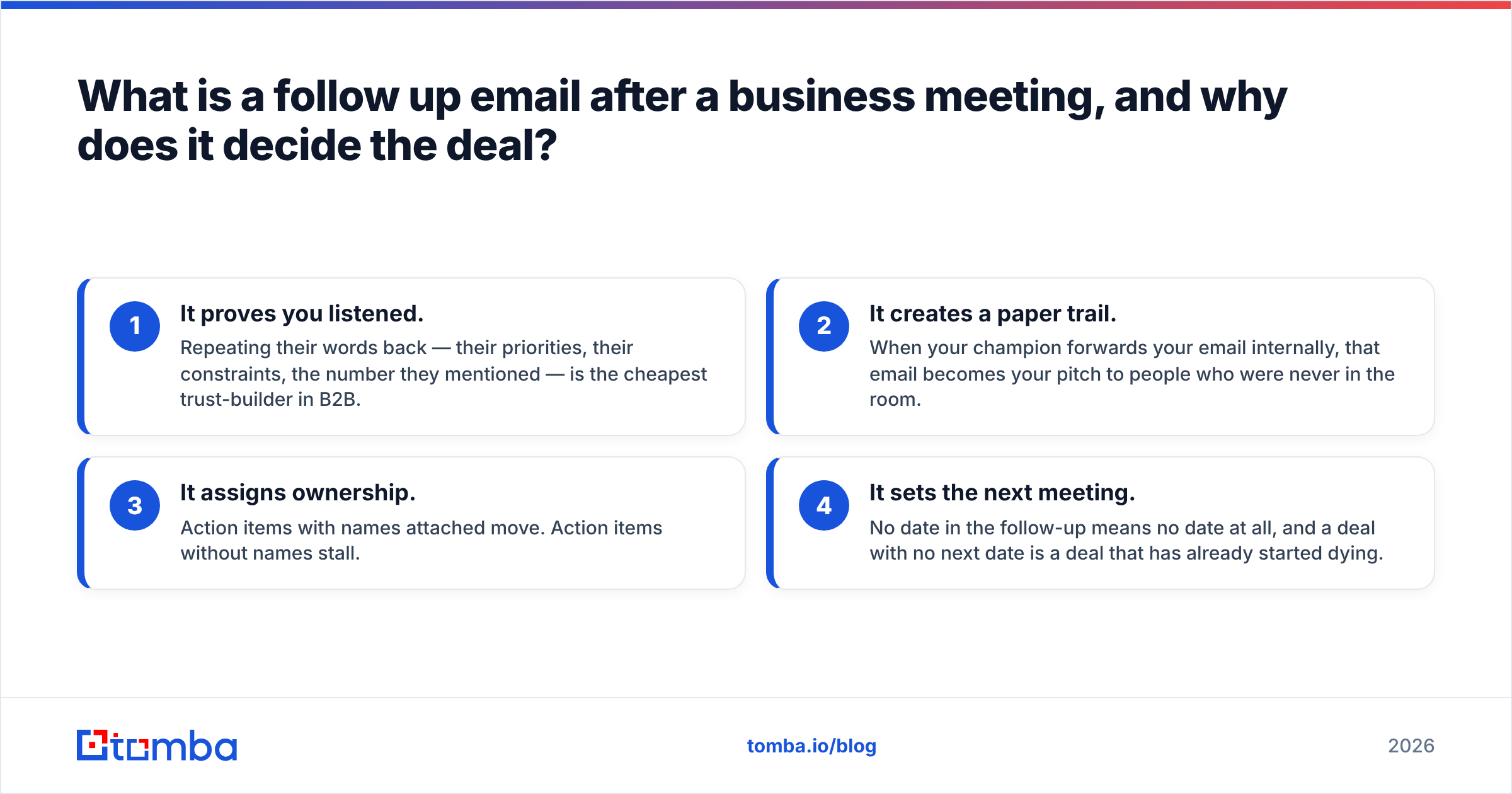
In practice, the follow-up does four jobs at once:
- It proves you listened. Repeating their words back — their priorities, their constraints, the number they mentioned — is the cheapest trust-builder in B2B.
- It creates a paper trail. When your champion forwards your email internally, that email becomes your pitch to people who were never in the room.
- It assigns ownership. Action items with names attached move. Action items without names stall.
- It sets the next meeting. No date in the follow-up means no date at all, and a deal with no next date is a deal that has already started dying.
The uncomfortable truth is that most reps write this email as a courtesy note. "Great speaking with you today, let me know if you have any questions." That email does nothing. It transfers all the effort to the buyer, offers no new information, and gives them nothing to forward.
When should you send the follow up email after a business meeting?#
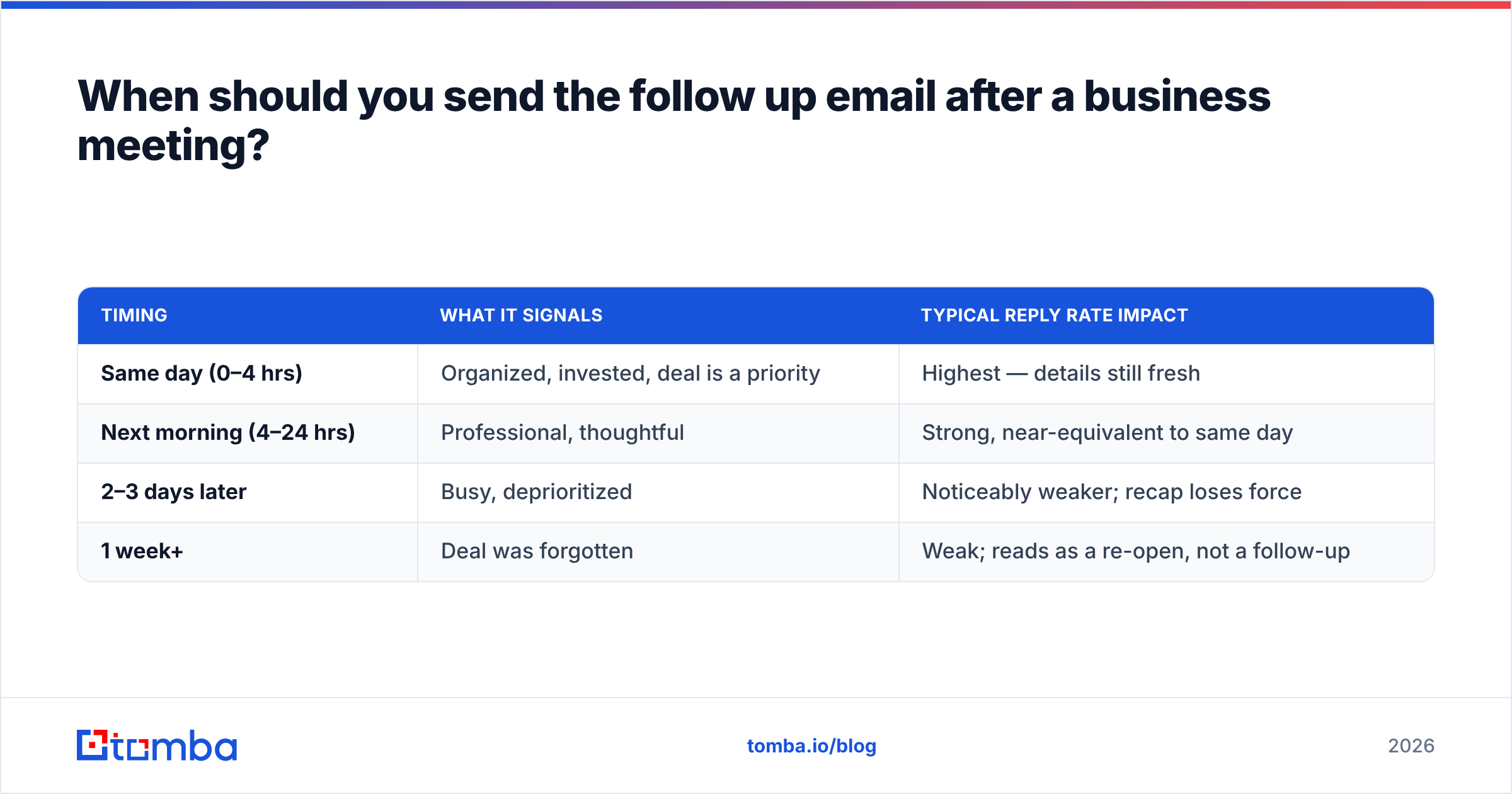
Within 24 hours, and ideally within four. Recall decay is brutal. The details that made your meeting persuasive — the specific workflow they complained about, the exact metric their VP cares about — are sharp on the same afternoon and blurry by Friday.
There's a second reason for speed that has nothing to do with memory: internal politics. Your contact will likely be asked "how did that call go?" by someone. If your recap is already in their inbox, they answer with your framing. If it isn't, they answer with a shrug.
| Timing | What it signals | Typical reply rate impact |
|---|---|---|
| Same day (0–4 hrs) | Organized, invested, deal is a priority | Highest — details still fresh |
| Next morning (4–24 hrs) | Professional, thoughtful | Strong, near-equivalent to same day |
| 2–3 days later | Busy, deprioritized | Noticeably weaker; recap loses force |
| 1 week+ | Deal was forgotten | Weak; reads as a re-open, not a follow-up |
One nuance: if your meeting ran long and you promised deliverables (a proposal, a security doc, a reference call), do not wait until the deliverable is ready. Send the recap immediately with a stated delivery date for the attachment. Two short emails beat one late one.
What structure actually works in a post-meeting follow-up?#
Use the same five-block skeleton every time. It's boring on purpose — boring structures are skimmable, and skimmable emails get forwarded.
- Anchor line (1 sentence). Name the meeting and the date so it's searchable later. "Following up on our Tuesday call about consolidating your outbound stack."
- Their words, not yours (2–3 sentences). Reflect back the problem as they described it. This is the block that earns the read.
- Decisions made (bulleted). What was actually agreed, in short bullets. Keep it to what's genuinely settled — inflating agreement is how deals blow up in week three.
- Action items with owners and dates (bulleted). Yours first, theirs second. Always take the heavier half.
- One next step with a proposed time. Not "let me know." A date, a duration, and a purpose.
Then stop. Two hundred words is plenty. The most common failure mode in follow-up writing is adding a paragraph of product benefits nobody asked for — it converts a trusted recap back into a sales email.
A subject line rule that holds up well: reuse the language from the meeting, not from your marketing site. "Recap + next steps: Q3 pipeline coverage" beats "Following up." If you want to pressure-test variants before sending, run them through a subject line tester rather than guessing.
Which follow-up type matches which meeting?#
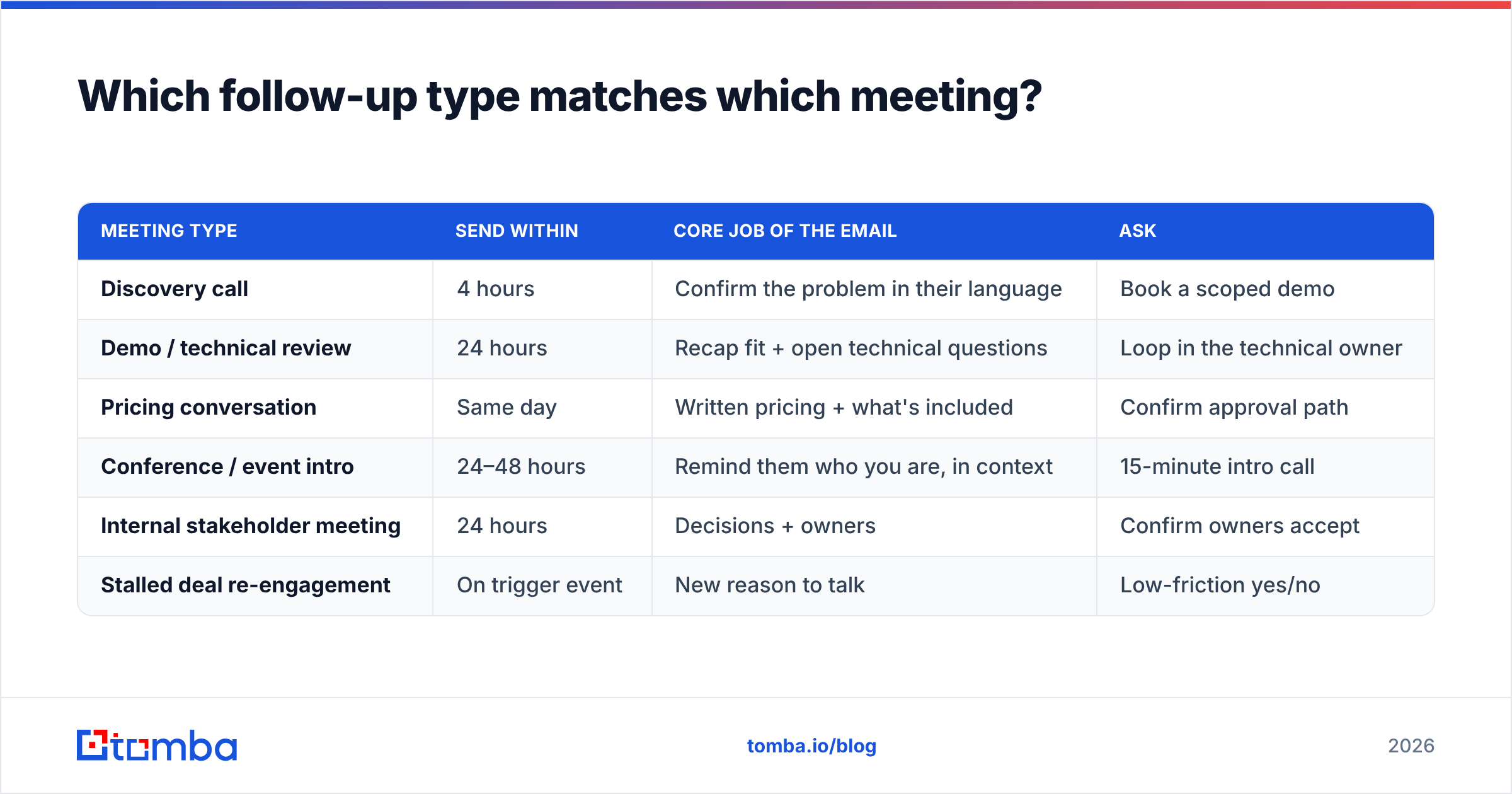
Not every meeting deserves the same email. Sending a formal recap after a two-minute conference handshake reads as tone-deaf; sending a one-liner after a 90-minute technical evaluation reads as careless. Match the weight of the email to the weight of the meeting.
| Meeting type | Send within | Core job of the email | Ask |
|---|---|---|---|
| Discovery call | 4 hours | Confirm the problem in their language | Book a scoped demo |
| Demo / technical review | 24 hours | Recap fit + open technical questions | Loop in the technical owner |
| Pricing conversation | Same day | Written pricing + what's included | Confirm approval path |
| Conference / event intro | 24–48 hours | Remind them who you are, in context | 15-minute intro call |
| Internal stakeholder meeting | 24 hours | Decisions + owners | Confirm owners accept |
| Stalled deal re-engagement | On trigger event | New reason to talk | Low-friction yes/no |
What do the templates actually look like?#
Twelve variants, trimmed to the parts that matter. Adapt the specifics — generic templates sent verbatim are obvious.
1. Discovery call recap
Subject: Recap: manual list-building at [Company]
Hi [Name] — good call this morning. What I heard: your two SDRs spend roughly a day a week building lists by hand, and the bigger cost is the 18% bounce rate that's putting your domain reputation at risk.
Agreed next step: I'll pull a sample of 50 verified contacts in your ICP so you can judge match rate against your own data. I'll have it Thursday.
Does Friday at 10:00 ET work for a 20-minute review of the sample?
2. Demo follow-up with open questions Recap the two or three features that mapped to their stated problems — not the full tour — then list the questions you couldn't answer, with the date you'll answer them.
3. Pricing follow-up Put the number in writing. Ambiguity after a pricing call reads as a negotiating tactic. Include what's in scope, what isn't, and contract length.
4. Multi-stakeholder recap Address the room, not just your champion. Add a one-line "who owns what" table so the forward does your selling for you.
5. Conference introduction Lead with the moment, not the company. "You mentioned your team is switching off Salesloft next quarter" beats "It was great meeting you at SaaStr."
6. Post-meeting with no clear next step Be honest about it: "We didn't land on a next step, so here's my proposal — a 15-minute call after your board meeting on the 12th."
7. Deliverable promised Short. Recap in three lines, state the deliverable date, and set a review slot in advance of it.
8. Introduction request Make the forward one click. Write the forwardable paragraph for them, below your signature.
9. Renewal / QBR follow-up Lead with outcomes delivered, then the risk you're mitigating. Do not lead with the renewal date.
10. Objection surfaced in the meeting Name the objection in the subject line. Buyers respect it and it stops the issue from festering in a channel you can't see.
11. Champion went quiet Change the medium and the ask. A yes/no question or a two-line "should I close this out?" note is usually what unlocks a reply.
12. Post-mortem after a loss Ask one question, offer one thing of value, and set a calendar reminder for two quarters out. Lost deals convert at a surprisingly decent rate on the rebound.
If you want a starting library to fork from rather than writing all twelve from scratch, the cold email templates collection covers most of these shapes.
How many follow-ups should you send before you stop?#
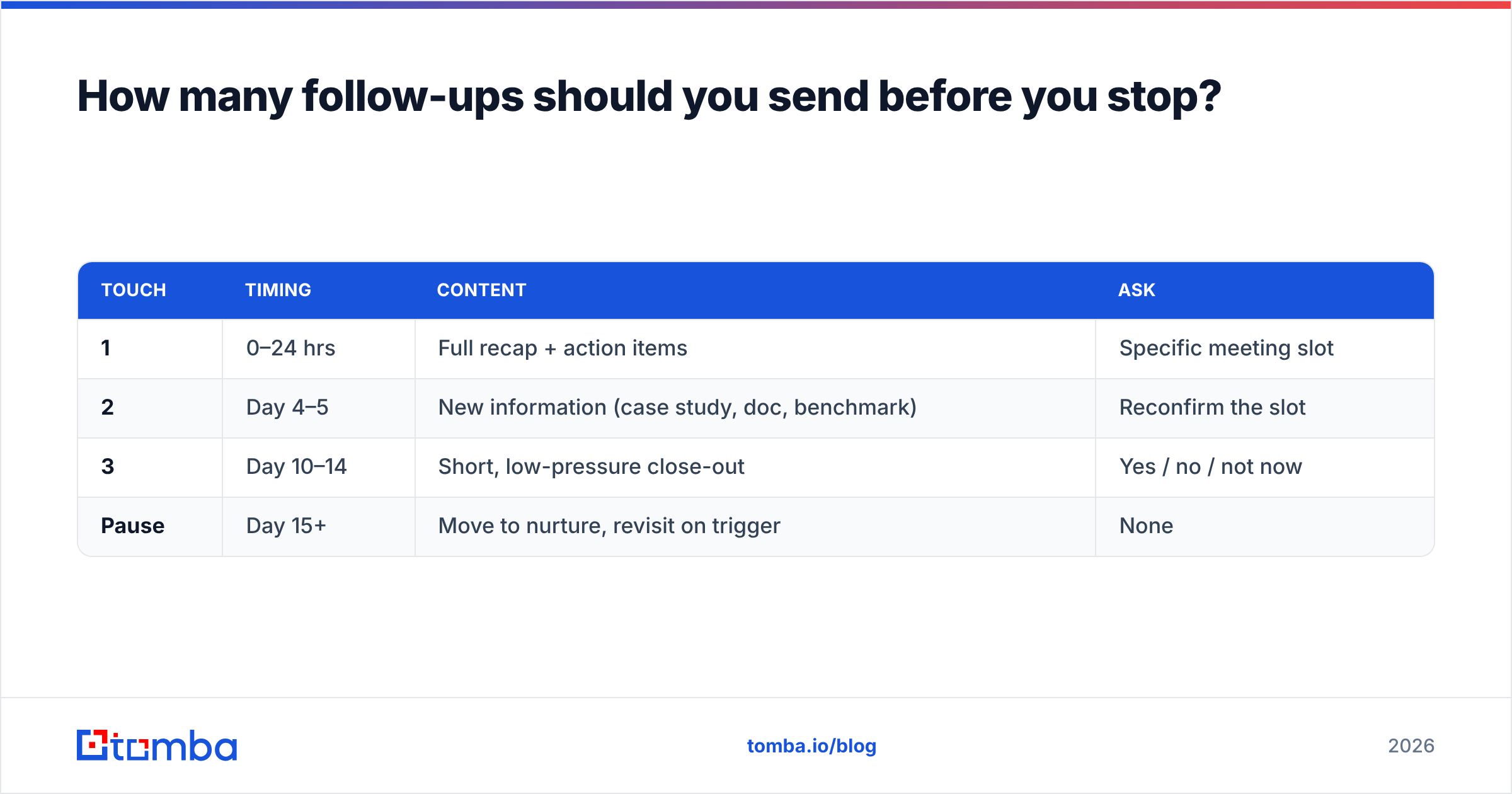
Three touches over 14 days, then a pause — not seven touches over seven days. The goal after a real meeting is different from cold outreach: you already have permission, so pressure damages more than it helps.
| Touch | Timing | Content | Ask |
|---|---|---|---|
| 1 | 0–24 hrs | Full recap + action items | Specific meeting slot |
| 2 | Day 4–5 | New information (case study, doc, benchmark) | Reconfirm the slot |
| 3 | Day 10–14 | Short, low-pressure close-out | Yes / no / not now |
| Pause | Day 15+ | Move to nurture, revisit on trigger | None |
Two practical notes. First, vary the value in touch two — resending the same recap with "just bumping this" trains people to ignore you. Second, track response rate by touch number, not overall; if touch three does all the work, your first email is underperforming and needs rewriting, not repeating.
What quietly kills post-meeting follow-ups?#
- Writing to yourself. Recaps that summarize what you said instead of what they said. If the email would be equally valid for three other prospects, delete it and start again.
- The soft ask. "Let me know your thoughts" has no verb the buyer can act on. Every follow-up needs exactly one clear, dated request.
- Attaching before recapping. A deck opens the door to "let me review this internally" — the phrase that precedes most stalled deals.
- CC'ing the room without a reason. Adding four people to a thread changes the dynamic. Do it deliberately, and say why in the first line.
- Bad addresses. More post-meeting follow-ups than you'd expect bounce because you typed the address from a business card, a badge scan, or a half-remembered spelling. A bounced recap looks identical to being ignored — you'll never know the difference unless you check. Run new contacts through an email verifier before the first send.
- Forgetting the people who weren't in the room. The economic buyer often never attends the first meeting. Gartner's sales research has consistently found B2B buying groups of six to ten people; your recap is frequently the only artifact those people ever see.
How do you scale this without sounding automated?#
Systematize the skeleton, personalize the middle. The anchor line, the action-item block, and the closing ask can be templated permanently — they're structural, and nobody has ever detected a "templated" bulleted list. The recap paragraph is the only part that must be written fresh, and it should take four minutes if your meeting notes are decent.
Three things make that four minutes possible:
- Notes taken during the meeting, in their words. Copy phrases verbatim. Paraphrasing is where personalization dies.
- Contact data that's already correct. When someone new is looped in mid-thread, you need their address in seconds, not after a LinkedIn detour. A domain search on the company returns the likely pattern and the named contacts.
- Enrichment on the record, not on the rep. Titles, seniority, and department pulled automatically into your CRM mean your recap can address the right person by the right role. Data enrichment handles this in the background so nobody is guessing whether the new CC is a decision-maker or an intern.
For the writing itself, plenty of teams get value from published frameworks — HubSpot's sales blog and Salesforce's sales resources both maintain solid, regularly-updated libraries. Use them for structure, not for copy; verbatim template use is detectable and increasingly common in the same inboxes you're writing to.
What should you do next?#
Pick your three highest-value meetings from the past month and check whether each got a recap with a dated next step. If any didn't, that's your first re-engagement email today — and it's warmer than any cold sequence you could build.
Then fix the input. The best-written follow up email after a business meeting is worthless if it lands on a bad address or misses the two stakeholders who never joined the call. Use the Tomba Email Finder to get verified addresses for everyone in the buying group — by name, by company, or across a whole domain — so your recap reaches the people who actually approve the deal. The free tier includes 25 searches a month, and paid plans start at $49/mo on the Starter tier; full Tomba pricing is public if you want to size it against your team's volume.
Related guides#
Ready to find emails that actually work?
Join 150,000+ professionals who stopped guessing and started sending. Free credits on signup — no credit card required.
Get the Tomba newsletter
Practical outbound tactics and product updates — once every two weeks.
About the author