Follow Up Email After Call With Client: 2026 Playbook
Most post-call follow-ups die because they summarize instead of advancing the deal. Here are the timing rules, structures, and 7 templates that actually get replies.
TL;DR
- Send the follow up email after call with client within 24 hours — reply rates fall off a cliff after 48, and after 72 hours you are re-selling from scratch.
- A recap is not a follow-up. Every post-call email needs four parts: a specific callback to what they said, a confirmed decision, one clear next step with a date, and one attachment or link that reduces their work.
- Subject lines that reference the call ("Pricing model we discussed — 2 options") beat generic ones ("Following up") by a wide margin because they survive inbox triage.
- Different call types need different structures. A discovery call follow-up and a post-demo follow-up should not look the same.
- Keep the thread alive with a documented cadence: day 0, day 3, day 8, day 15, then a breakup. Silence is not a "no" until you have asked four times.
Why do most follow-up emails after a client call fail?#
Because they are written for the sender, not the buyer.
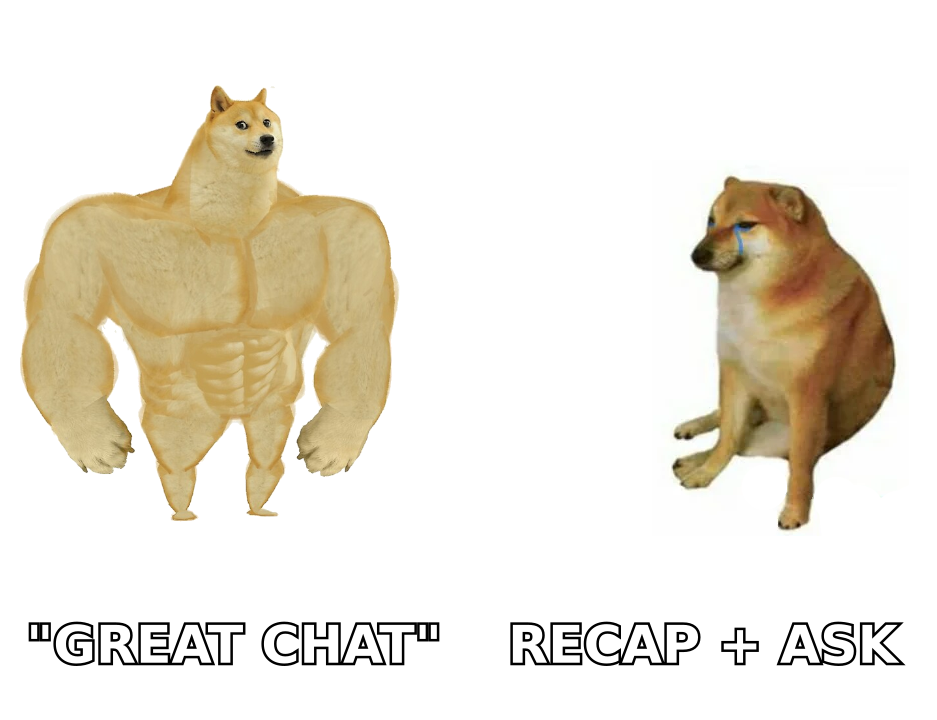
The typical post-call email looks like this: "Hi Sarah, great speaking with you today! I've attached our deck. Let me know if you have any questions." That email does three things wrong at once. It proves nothing was heard on the call, it hands the buyer homework instead of doing work for them, and it ends with a question so passive that ignoring it costs nothing.
The buyer's inbox is the real competitor. Your prospect finished your call, walked into two more meetings, and cleared 40 emails before yours surfaced. Your message has roughly four seconds to prove it is not a template. The only way to win that is specificity — names, numbers, and phrases the buyer actually used.
There is also a compounding effect. A vague follow-up forces the next call to re-establish context, which burns the first ten minutes of a 30-minute meeting. Over a six-touch cycle that is an hour of pipeline time lost to your own sloppiness.
What should a follow up email after call with client always include?#
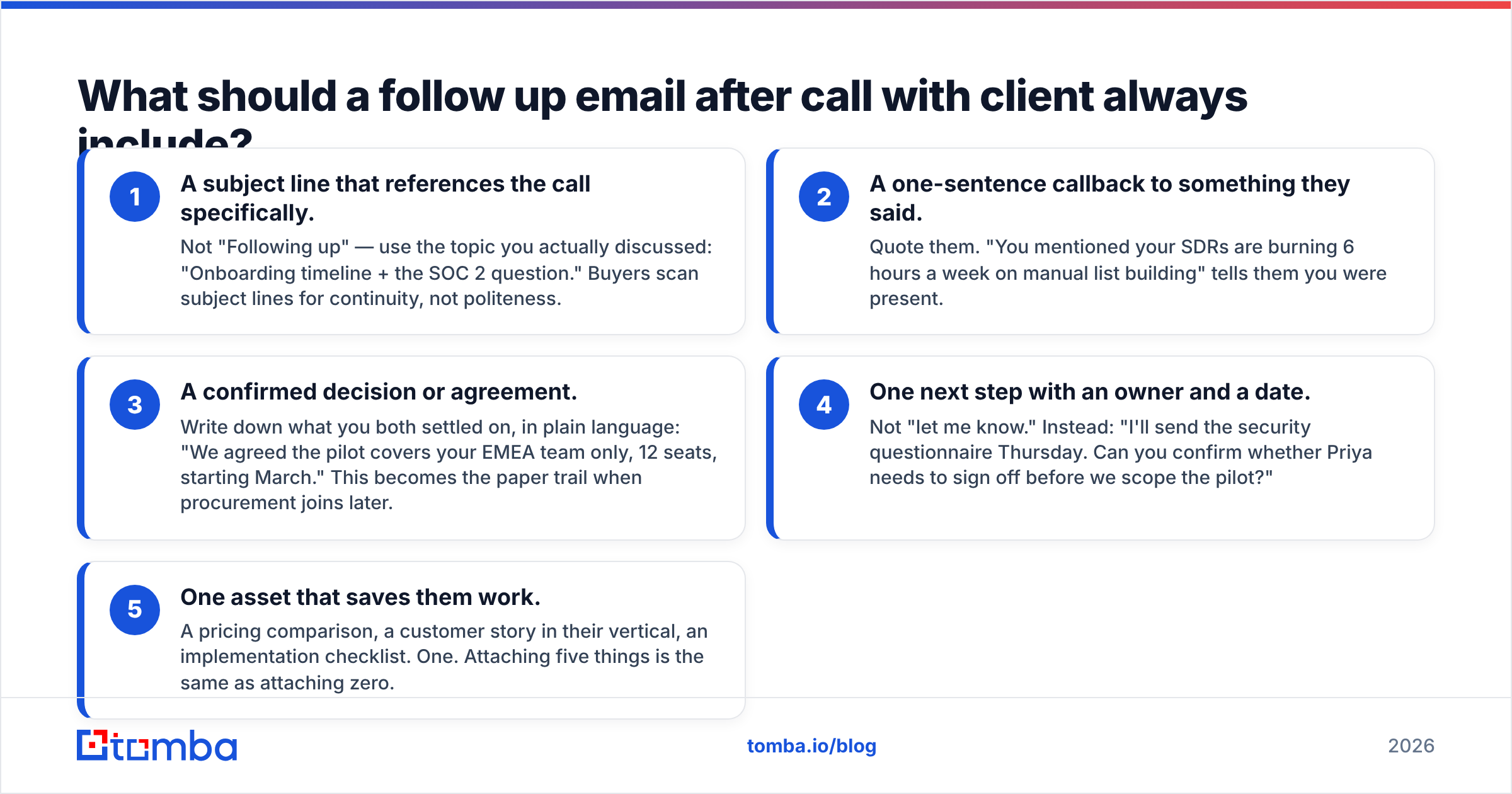
Five components. Drop one and the email loses its job.
- A subject line that references the call specifically. Not "Following up" — use the topic you actually discussed: "Onboarding timeline + the SOC 2 question." Buyers scan subject lines for continuity, not politeness.
- A one-sentence callback to something they said. Quote them. "You mentioned your SDRs are burning 6 hours a week on manual list building" tells them you were present.
- A confirmed decision or agreement. Write down what you both settled on, in plain language: "We agreed the pilot covers your EMEA team only, 12 seats, starting March." This becomes the paper trail when procurement joins later.
- One next step with an owner and a date. Not "let me know." Instead: "I'll send the security questionnaire Thursday. Can you confirm whether Priya needs to sign off before we scope the pilot?"
- One asset that saves them work. A pricing comparison, a customer story in their vertical, an implementation checklist. One. Attaching five things is the same as attaching zero.
Everything else — pleasantries, company boilerplate, a signature with six social icons — is friction. Cut it.
How fast should you send it?#
Within 24 hours, and ideally within four.
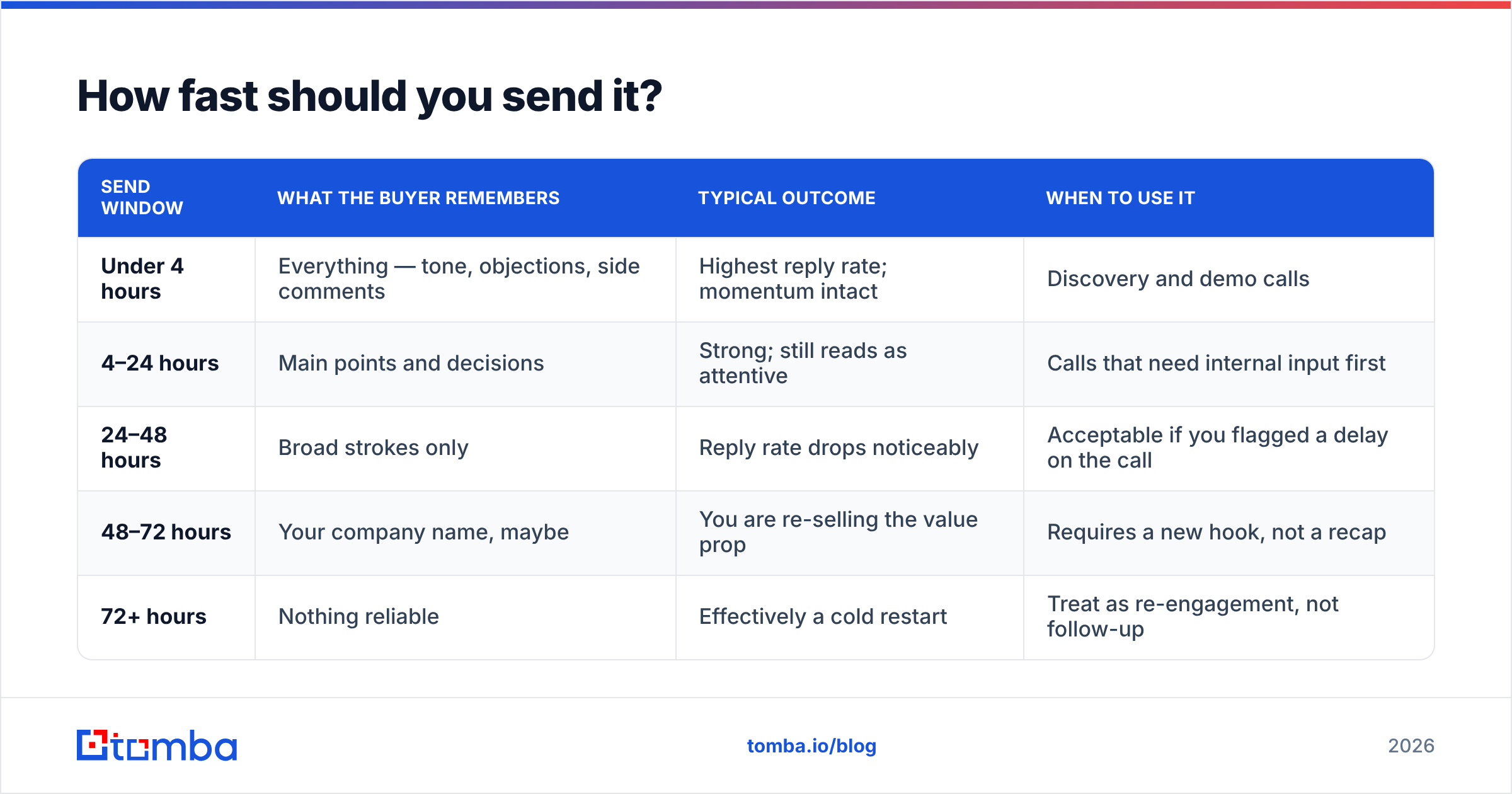
Here is how the windows actually behave in B2B cycles:
| Send window | What the buyer remembers | Typical outcome | When to use it |
|---|---|---|---|
| Under 4 hours | Everything — tone, objections, side comments | Highest reply rate; momentum intact | Discovery and demo calls |
| 4–24 hours | Main points and decisions | Strong; still reads as attentive | Calls that need internal input first |
| 24–48 hours | Broad strokes only | Reply rate drops noticeably | Acceptable if you flagged a delay on the call |
| 48–72 hours | Your company name, maybe | You are re-selling the value prop | Requires a new hook, not a recap |
| 72+ hours | Nothing reliable | Effectively a cold restart | Treat as re-engagement, not follow-up |
One nuance: fast does not mean instant-and-empty. If you promised a custom ROI estimate, sending a hollow email in 20 minutes and the real thing four days later is worse than one complete email at hour 20. Send a two-line holding note if you need time — "Working the numbers with our solutions team, you'll have them Wednesday AM" — then deliver.
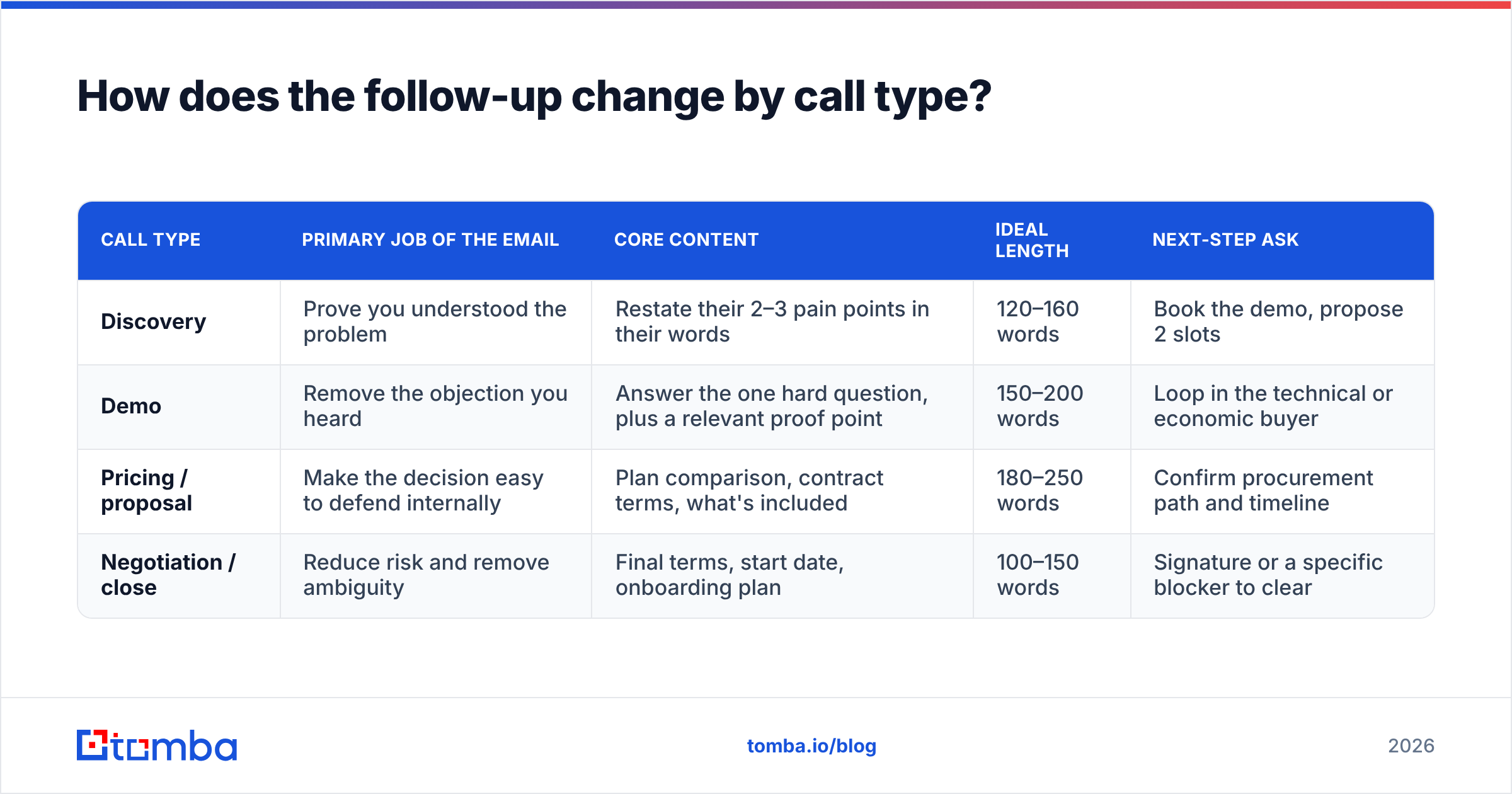
How does the follow-up change by call type?#
Four call types, four different jobs. Match the structure to the stage.
| Call type | Primary job of the email | Core content | Ideal length | Next-step ask |
|---|---|---|---|---|
| Discovery | Prove you understood the problem | Restate their 2–3 pain points in their words | 120–160 words | Book the demo, propose 2 slots |
| Demo | Remove the objection you heard | Answer the one hard question, plus a relevant proof point | 150–200 words | Loop in the technical or economic buyer |
| Pricing / proposal | Make the decision easy to defend internally | Plan comparison, contract terms, what's included | 180–250 words | Confirm procurement path and timeline |
| Negotiation / close | Reduce risk and remove ambiguity | Final terms, start date, onboarding plan | 100–150 words | Signature or a specific blocker to clear |
The discovery follow-up is the one most reps get wrong. They treat it as a demo pitch. Its only job is to show you listened well enough to be worth another 30 minutes.
What do good post-call follow-up templates look like?#
Seven templates below. Replace the bracketed fields with real specifics — a template that stays generic is worse than no template, because buyers can smell fill-in-the-blank copy instantly. If you want more starting points, Tomba's library of cold email templates covers the earlier stages of the sequence.
1. After a discovery call
Subject: [Their pain point] — 2 things worth checking
Hi [Name],
Thanks for walking me through how [team] handles [process] today. The part that stuck with me: [exact thing they said, e.g. "your reps rebuild the same account list every quarter"].
Two things I want to show you next time, both under 15 minutes:
- How [customer in their industry] cut that rebuild to [outcome]
- What the [integration/workflow] looks like inside [their tool]
Does Tuesday 10:00 or Thursday 14:00 work? I'll send an agenda beforehand.
[Your name]
2. After a demo
Subject: The [specific] question from today — answered
Hi [Name],
You asked whether [specific objection, e.g. "the data refreshes before our quarterly planning cycle"]. Short answer: yes — [one-sentence explanation]. Details in the attached one-pager, page 2.
You mentioned [Colleague] owns [area]. Worth a 20-minute session with them before you decide? I can keep it technical and skip the overview.
[Your name]
3. After a pricing conversation
Subject: [Company] pricing — the 2 options we discussed
Hi [Name],
Here are the two paths, side by side, so you have something to forward internally:
Option A — [tier], [seats], [$X/mo], includes [key feature]
Option B — [tier], [seats], [$Y/mo], adds [differentiator], better if [condition they mentioned]
Based on the [volume/headcount] you described, Option [X] is the honest fit. Happy to be wrong if [variable] changes.
What's the approval path from here?
4. When they went quiet after a good call
Subject: Still worth doing?
Hi [Name],
We talked on [date] about [goal]. I have not heard back, which usually means one of three things: priorities shifted, budget moved, or my last email got buried.
Which one is it? Any of them is fine — I'd just rather know than keep guessing.
5. After a call where a competitor came up
Subject: [Competitor] vs us — the honest version
Hi [Name],
You mentioned you're also looking at [Competitor]. They're genuinely strong at [real strength] — if [condition], go with them.
Where we differ is [specific, provable difference]. Attached is a comparison I built from public pricing pages, not marketing copy. Check the [row] line specifically.
6. After a call with a new stakeholder joining
Subject: Context for [New Stakeholder] before Thursday
Hi [Name],
So [New Stakeholder] doesn't start from zero, here's a three-line summary:
- Problem: [restated in their words]
- What we proposed: [one line]
- Open question: [the actual blocker]
Anything I should add or soften before I send it their way?
7. The breakup email
Subject: Closing the loop on [project]
Hi [Name],
I've sent four notes since our [month] call without a reply, so I'll assume the timing isn't right and stop filling your inbox.
If [trigger event, e.g. "you revisit the data vendor question in Q3"], reply to this thread and I'll pick it straight back up. The [asset] I sent is yours to keep either way.
How do you make sure the email actually reaches them?#
Two failure modes: wrong address, and the right address landing in spam.
Wrong address is more common than people admit on post-call follow-ups. You met three people on a Zoom call, you have first names and a company, and the calendar invite only shows the organizer. Guessing firstname.lastname@company.com is a coin flip — patterns vary by company, and a bounce on a warm thread is an unforced error. Run the name and domain through an email finder or use domain search to pull the confirmed pattern for that company before you send. For a list of attendees after a webinar or group call, bulk verify is faster than checking one at a time.
The deliverability side matters too. A follow-up on an existing thread usually inherits engagement signals from the earlier reply, which helps, but three habits protect you:
- Reply in the existing thread when the call was booked over email. Thread continuity is a positive signal to filters and to the human.
- Skip tracking pixels on high-value threads. Some corporate gateways flag them, and the intel is rarely worth a spam-folder risk on a live deal.
- Keep attachments small or link instead. A 14 MB deck triggers gateway scanning; a link to a hosted doc does not, and you get view analytics as a bonus.
If your replies to warm threads are quietly disappearing, check your sender reputation before blaming the copy. Google's Postmaster Tools and Microsoft's SNDS give you the domain-level view that no email tool can guess at.
What cadence should you use when they don't reply?#
Four touches, then a documented close. Spread them out and change the angle each time.
- Day 0 — the recap-plus-next-step email described above.
- Day 3 — add value, don't ask again. Send the case study, benchmark, or article that speaks to their exact problem. No "just checking in."
- Day 8 — change the channel. LinkedIn message, or a call to the direct line. LinkedIn outreach paired with email consistently outperforms email alone.
- Day 15 — go up or sideways. Loop in a peer or the exec you know is involved, with a one-paragraph summary and a direct question.
- Day 22 — the breakup email. Template 7 above. It closes the loop and, surprisingly often, produces the reply that four polite nudges could not.
Between touches, log everything in the CRM. HubSpot's research on sales follow-up has been consistent for years on this point: most closed deals require five or more touches after the first conversation, and most reps stop at two. The gap between those two numbers is where quota lives.
One rule that saves relationships: never send a follow-up that only serves you. If the email has nothing in it beyond "any update?", either add something useful or skip that touch entirely.
What should you never do in a post-call follow-up?#
- Never write "just circling back." It signals the email has no new content, and buyers have learned to skip past it.
- Never recap for more than four lines. They were on the call. You are confirming, not transcribing.
- Never bury the ask. One question, in its own paragraph, near the end. Two questions halve your reply rate.
- Never attach the full deck by default. Send the two slides that matter to the objection you actually heard.
- Never apologize for following up. "Sorry to bother you" frames your product as a nuisance. Follow up because there is a reason to.
- Never guess an email address on a live deal. A bounce on a warm thread reads as unprofessional and can kill momentum you spent a call earning. Use an email verifier first.
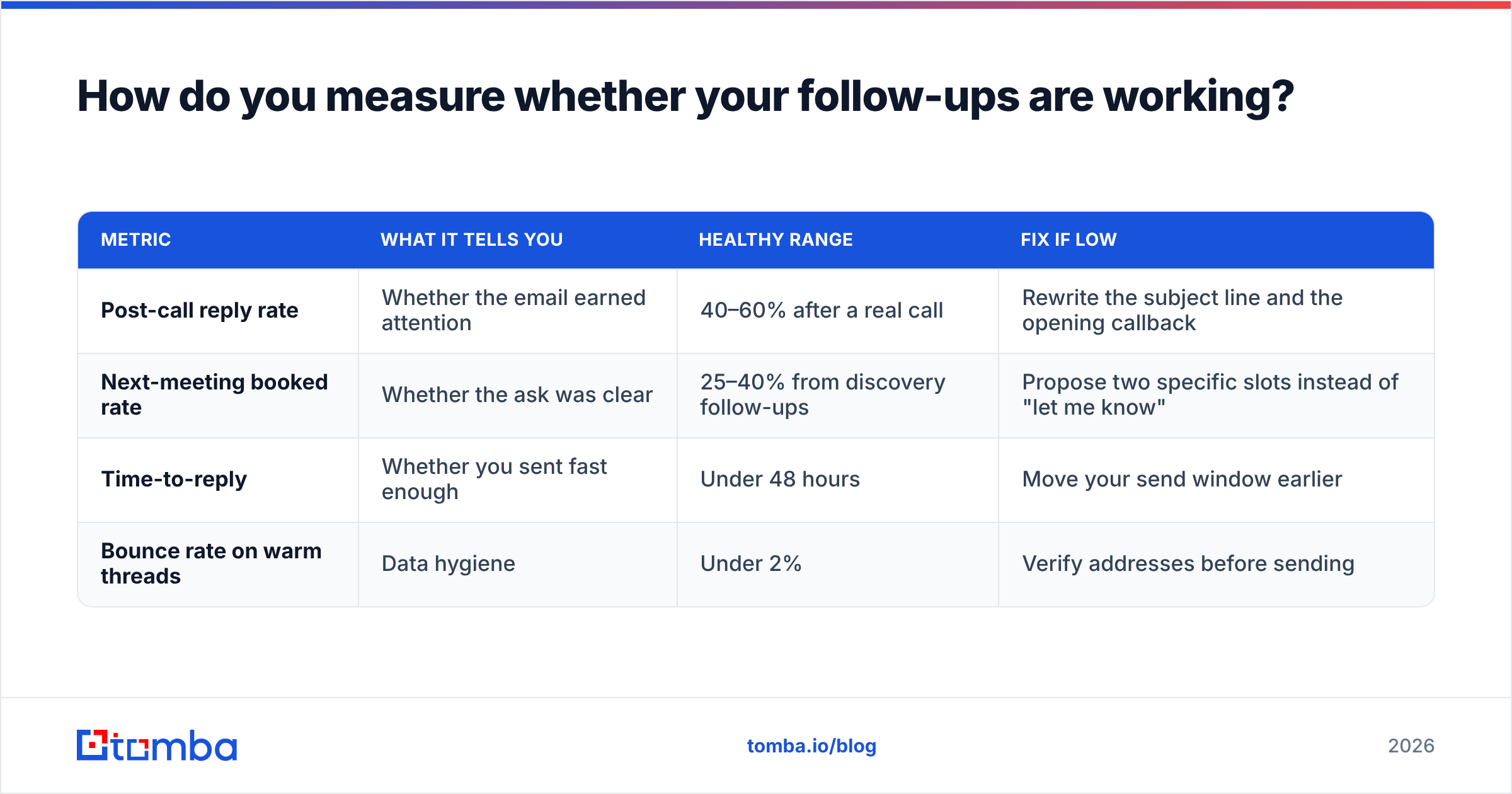
How do you measure whether your follow-ups are working?#
Track three numbers, not ten.
| Metric | What it tells you | Healthy range | Fix if low |
|---|---|---|---|
| Post-call reply rate | Whether the email earned attention | 40–60% after a real call | Rewrite the subject line and the opening callback |
| Next-meeting booked rate | Whether the ask was clear | 25–40% from discovery follow-ups | Propose two specific slots instead of "let me know" |
| Time-to-reply | Whether you sent fast enough | Under 48 hours | Move your send window earlier |
| Bounce rate on warm threads | Data hygiene | Under 2% | Verify addresses before sending |
If your post-call reply rate is under 25%, the problem is almost never cadence — it is that the first email said nothing the buyer could not have written themselves. Compare your last ten follow-ups against the five-component checklist above. Most will be missing components 2 and 4.
Also watch your overall response rate trend by call type. If discovery follow-ups reply at 55% and demo follow-ups reply at 18%, the problem is in the demo, not the email — you are leaving the room with unresolved objections and papering over them afterward.
Get the address right before you hit send#
The best follow-up email in the world does nothing if it lands in a bounce log. Before you send the recap to the three people who joined that call, confirm you have their real, current addresses — not a guessed pattern.
Tomba Email Finder resolves names and company domains to verified professional addresses, with a free tier at 25 searches a month and paid plans starting at $49/mo on the Starter tier. See full Tomba pricing if you're running volume across a team. Get the address right, send within 24 hours, and give the buyer one clear next step — that combination does more for pipeline than any subject-line trick.
Related guides#
Ready to find emails that actually work?
Join 150,000+ professionals who stopped guessing and started sending. Free credits on signup — no credit card required.
Get the Tomba newsletter
Practical outbound tactics and product updates — once every two weeks.
About the author