Follow Up Email After Cold Call: Templates That Get Replies
Most cold calls die because the follow-up email never lands. Here are the timing rules, 7 templates, and the send-window data that turn a 42-second call into a booked meeting.
TL;DR
- The follow up email after cold call is not a formality — it is where the meeting actually gets booked. Send it within 5 to 15 minutes of hanging up, while your name is still in short-term memory.
- Reference something only the two of you heard on the call. A generic "great speaking with you" email is indistinguishable from cold spam and gets treated as such.
- Subject lines that repeat the call ("Our 2:15 call — the pricing question") beat clever ones. You are not earning attention; you are reclaiming it.
- Voicemail-only and no-answer calls still deserve an email, but a different one. Same-sequence, different premise.
- Getting the right address matters more than the copy. A perfect follow-up to
j.smith@when the pattern isjsmith@bounces, and bounces hurt your domain.
Why does the follow up email after cold call matter more than the call?#
Because the call was an interruption and the email is an invitation.
Think of a cold call like flagging someone down on a crowded street. You got 40 seconds of half-attention while they were walking somewhere else. The follow-up email is the business card you hand over — it is the artifact they read later, at their desk, when they actually have the bandwidth to consider you.
The numbers back this up in a boring way. Most call-to-meeting conversions in B2B do not happen on the call itself. They happen when the prospect re-reads the follow-up, forwards it to a colleague, or replies three days later with "actually, send me times." That means your email is doing the persuading, not your voice.
Two practical consequences:
- The email must survive being read out of context. The prospect may open it 48 hours later with zero memory of the call. Reintroduce yourself in six words.
- The email must be forwardable. If your champion sends it to a VP, the VP needs to understand the value without having been on the call. Write for the second reader.
Sorry — corrected below.
When should you send a follow up email after a cold call?#
Within 5 to 15 minutes for a connected call. Same day, before end of business, at the absolute latest.
The reason is memory decay, not urgency theater. A prospect who spoke with you at 10:04 can recall your name, your company, and roughly what you sell at 10:15. By 4 p.m. they remember "some vendor called." By tomorrow they remember nothing, and your email reads as cold outreach with a false premise — which is worse than plain cold outreach, because it feels manipulative.
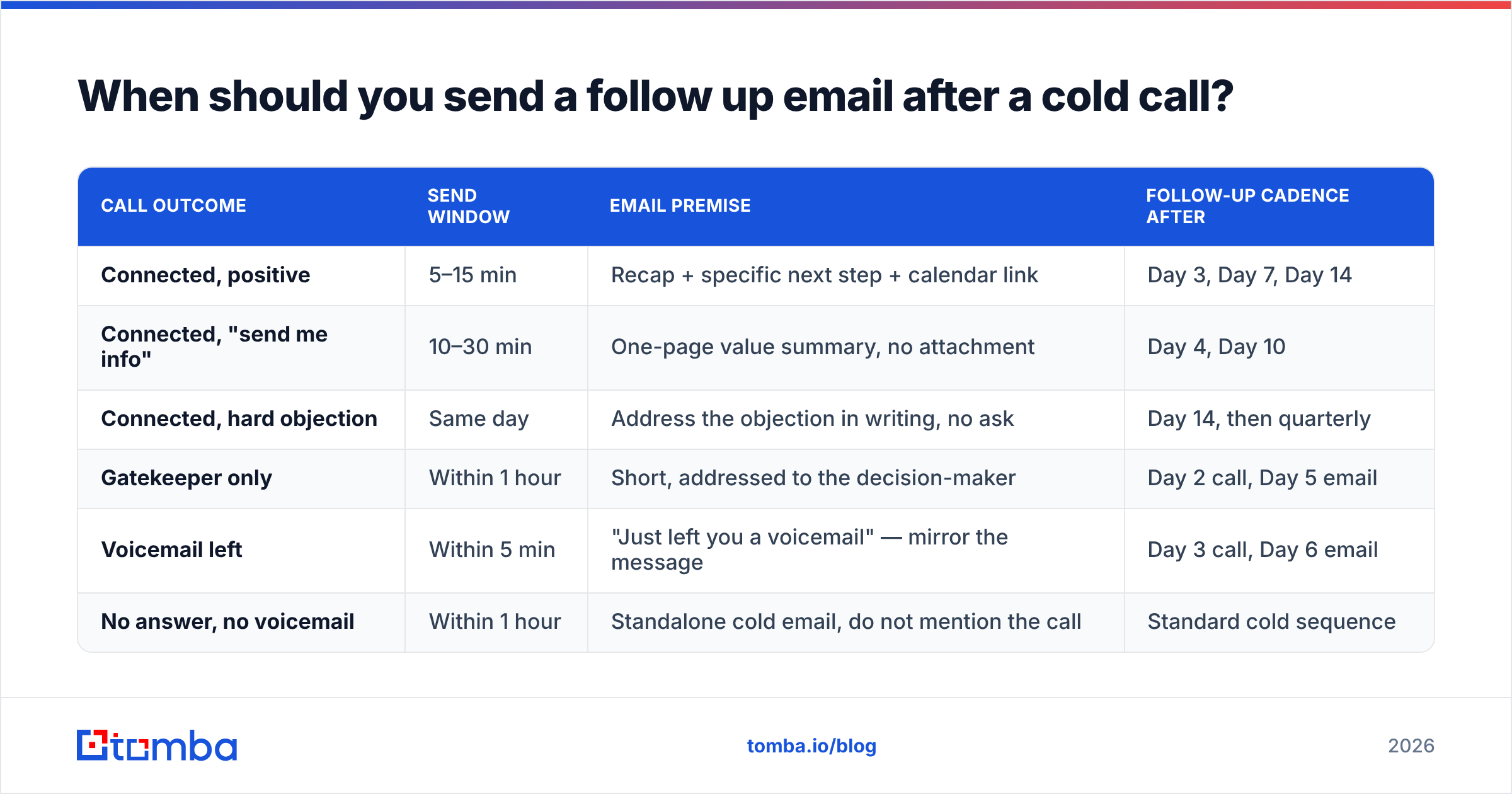
Different call outcomes have different clocks:
| Call outcome | Send window | Email premise | Follow-up cadence after |
|---|---|---|---|
| Connected, positive | 5–15 min | Recap + specific next step + calendar link | Day 3, Day 7, Day 14 |
| Connected, "send me info" | 10–30 min | One-page value summary, no attachment | Day 4, Day 10 |
| Connected, hard objection | Same day | Address the objection in writing, no ask | Day 14, then quarterly |
| Gatekeeper only | Within 1 hour | Short, addressed to the decision-maker | Day 2 call, Day 5 email |
| Voicemail left | Within 5 min | "Just left you a voicemail" — mirror the message | Day 3 call, Day 6 email |
| No answer, no voicemail | Within 1 hour | Standalone cold email, do not mention the call | Standard cold sequence |
That last row trips people up. If you did not leave a voicemail and they did not pick up, referencing "my call earlier" is a lie the prospect can verify in their call log. Skip it.
What are the five parts of a follow up email that gets replies?#
Every high-performing post-call email has the same skeleton. Change the words, keep the bones.
- The re-anchor (one line). "Ben from Tomba — we spoke at 2:15 about your team's bounce rate on outbound." Time, topic, name. This is the single highest-leverage sentence in the email.
- The specific echo (one to two lines). Repeat something they said, in their words. "You mentioned your SDRs are burning half a day a week cleaning lists." This proves you listened and cannot be faked by a template.
- The relevance bridge (two to three lines). Connect their stated problem to one outcome — not your feature list. One outcome. If you list three, you list zero.
- The single ask. One question, answerable in one word or one click. "Does Thursday 11 a.m. work, or is next week better?" Never "let me know your thoughts."
- The exit ramp. A no-friction out: "If this isn't a priority this quarter, say the word and I'll stop." Counterintuitively, this raises reply rates because it makes replying safe.
Total length: 90 to 130 words. If your follow-up is longer than the average Slack message, it will be read the way people read terms of service.
What should the subject line be?#
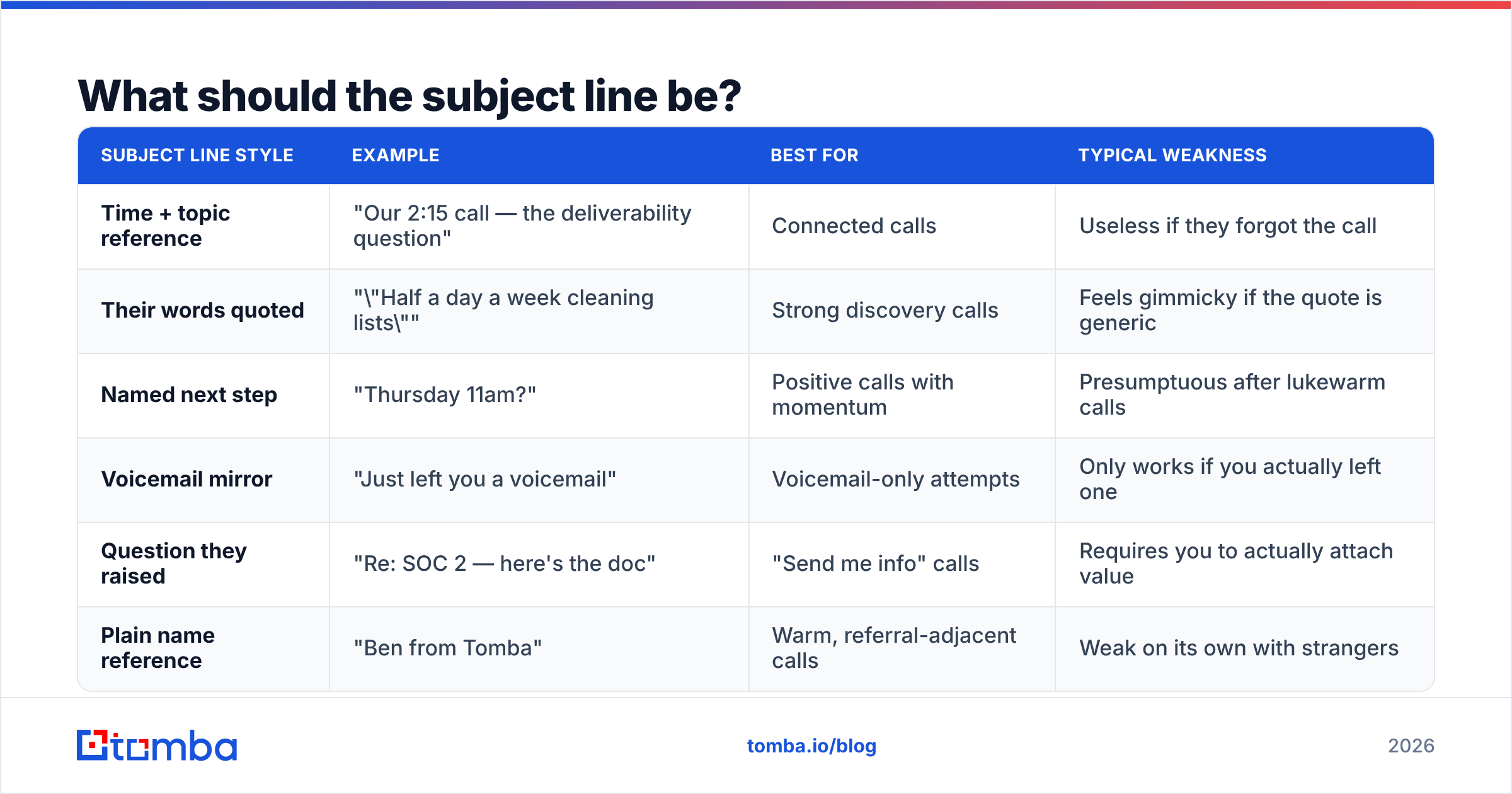
Boring and referential. Your subject line is not competing for attention in a cold inbox — it is competing with the prospect's own memory.
Ranked by what tends to work after a live call:
| Subject line style | Example | Best for | Typical weakness |
|---|---|---|---|
| Time + topic reference | "Our 2:15 call — the deliverability question" | Connected calls | Useless if they forgot the call |
| Their words quoted | ""Half a day a week cleaning lists"" | Strong discovery calls | Feels gimmicky if the quote is generic |
| Named next step | "Thursday 11am?" | Positive calls with momentum | Presumptuous after lukewarm calls |
| Voicemail mirror | "Just left you a voicemail" | Voicemail-only attempts | Only works if you actually left one |
| Question they raised | "Re: SOC 2 — here's the doc" | "Send me info" calls | Requires you to actually attach value |
| Plain name reference | "Ben from Tomba" | Warm, referral-adjacent calls | Weak on its own with strangers |
What consistently underperforms: "Following up," "Touching base," "Quick question," and anything with an emoji. Those are pattern-matched to spam by both humans and filters. If you want to sanity-check a line before you send at volume, run it through a subject line tester and a spam checker — a follow-up that lands in Promotions after a great call is a self-inflicted wound.
What are seven templates you can steal?#
Use these as scaffolding, not scripts. The bracketed parts are where the deal is actually won.
1. Connected + positive
Subject: Our 2:15 call — the list-cleaning problem
[Name] — Ben from Tomba, we spoke a few minutes ago.
You said your two SDRs lose about half a day each week scrubbing bad addresses before a send. That's roughly 50 rep-hours a quarter going into data hygiene instead of conversations.
The teams we work with hand that step to an API and get it back to under an hour a week.
Worth 20 minutes Thursday at 11? If the timing's wrong, tell me and I'll circle back next quarter.
2. "Just send me information"
Subject: The one-pager you asked for
[Name] — as promised, short version, no deck.
What you're solving: [their exact phrase]. What changes: [one measurable outcome]. What it costs: [range or link].
If it's a fit, reply with a day and I'll send an invite. If not, no follow-up from me.
Do not attach a PDF here. Attachments to first-time senders trip filters and rarely get opened. Put the content in the body or behind one link.
3. Hard objection ("we already use X")
Subject: Re: you're already on [Competitor]
[Name] — fair, and I won't try to unseat something that works.
One thing worth knowing: most teams on [Competitor] run into [specific, honest limitation] around [specific scale]. When that shows up, I'm easy to find.
Nothing needed from you today.
No ask. This email exists to be searchable in their inbox six months from now.
4. Voicemail follow-up
Subject: Just left you a voicemail
[Name] — same message in writing so you don't have to listen.
I work with [similar-company type] on [specific problem]. [One-sentence reason you called them specifically — a trigger, a hire, a launch.]
Worth a 15-minute call this week? Reply "no" and I'll close the loop.
5. Gatekeeper redirect
Subject: [Decision-maker name] — passed along by [Gatekeeper name]
[Name] — I spoke with [Gatekeeper] this morning and she suggested I reach you directly about [topic].
[One line of relevance.]
Are you the right person for this, or should I be talking to someone else on your team?
The "am I even talking to the right person" ask is the highest-reply question in B2B email. People love correcting you.
6. Ghosted after a good call
Subject: Closing the file on this
[Name] — we had a good conversation on [date] and then I lost you, which usually means priorities moved.
I'll assume this isn't the quarter for it and stop reaching out. If that's wrong, one line back and I'll pick it up.
7. The re-open, 90 days later
Subject: You said Q3 — it's Q3
[Name] — back in [month] you told me to check in when [budget cycle / hiring / launch] landed. It's landed.
Still the same problem? Same 20 minutes if so.
Does any of this work if the email address is wrong?#
No. And this is where most post-call sequences quietly fail.
Here is the scenario that repeats across every SDR team: rep has a great call, hangs up, realizes the prospect said their email "too fast," and guesses. firstname.lastname@, f.lastname@, firstinitiallastname@ — three plausible patterns, one correct. The guess bounces. The rep never knows, because a hard bounce lands in a notification folder nobody reads, and the prospect is marked "no response" instead of "never received it."
Two compounding costs:
- The obvious one: a meeting you earned on the phone never gets booked.
- The expensive one: repeated hard bounces degrade your sender reputation, which drags down inbox placement for every other email your domain sends. One sloppy guess taxes the whole team.
The fix is mechanical. Before the call, resolve the address. After the call, verify it. A domain search surfaces the company's actual email pattern in seconds, and an email verifier confirms the specific mailbox accepts mail before you send anything that matters. For teams running dials at volume, pushing this into the dialer workflow through the Tomba API removes the guess entirely.
Two habits worth building:
- Confirm on the call. "Is it b.rebia@company.com?" — say the address out loud, spelled the way you have it. Ninety percent of the time you are right and you have just verified it for free.
- Never send to an unverified address inside an automated sequence. One-off manual sends can absorb a bounce. Sequences cannot.
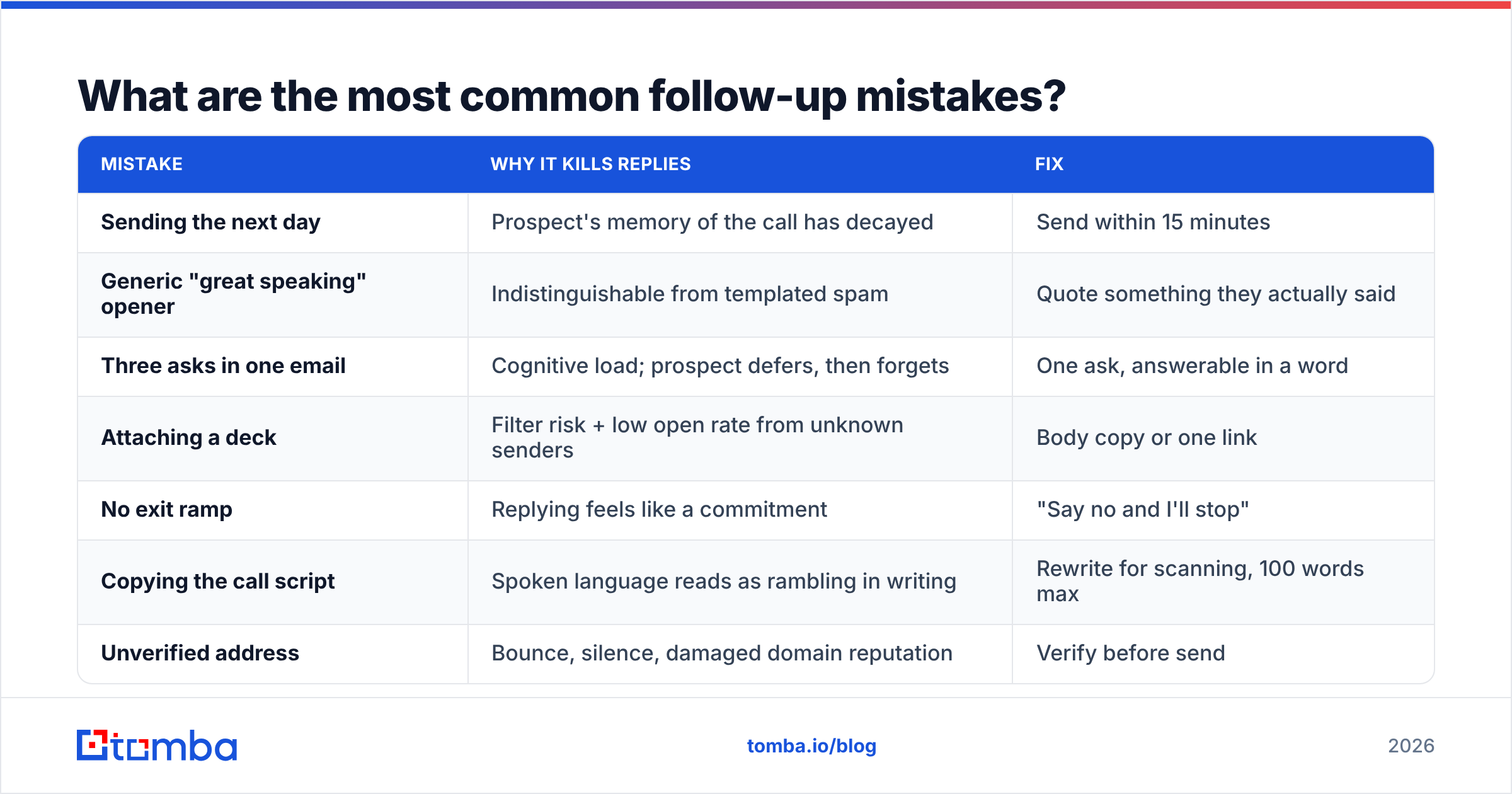
What are the most common follow-up mistakes?#
| Mistake | Why it kills replies | Fix |
|---|---|---|
| Sending the next day | Prospect's memory of the call has decayed | Send within 15 minutes |
| Generic "great speaking" opener | Indistinguishable from templated spam | Quote something they actually said |
| Three asks in one email | Cognitive load; prospect defers, then forgets | One ask, answerable in a word |
| Attaching a deck | Filter risk + low open rate from unknown senders | Body copy or one link |
| No exit ramp | Replying feels like a commitment | "Say no and I'll stop" |
| Copying the call script | Spoken language reads as rambling in writing | Rewrite for scanning, 100 words max |
| Unverified address | Bounce, silence, damaged domain reputation | Verify before send |
| Same email to every outcome | Voicemail and live-call prospects need different premises | Branch by call outcome |
One more that deserves its own line: do not send five follow-ups in six days. After a single cold call you have earned roughly three touches over two weeks. Beyond that you are training the prospect to ignore your name, and eventually to hit "report spam" — which does far more damage to your email deliverability than a lost deal does to your quota.
How should you sequence calls and emails together?#
Treat the call and the email as one motion, not two channels.
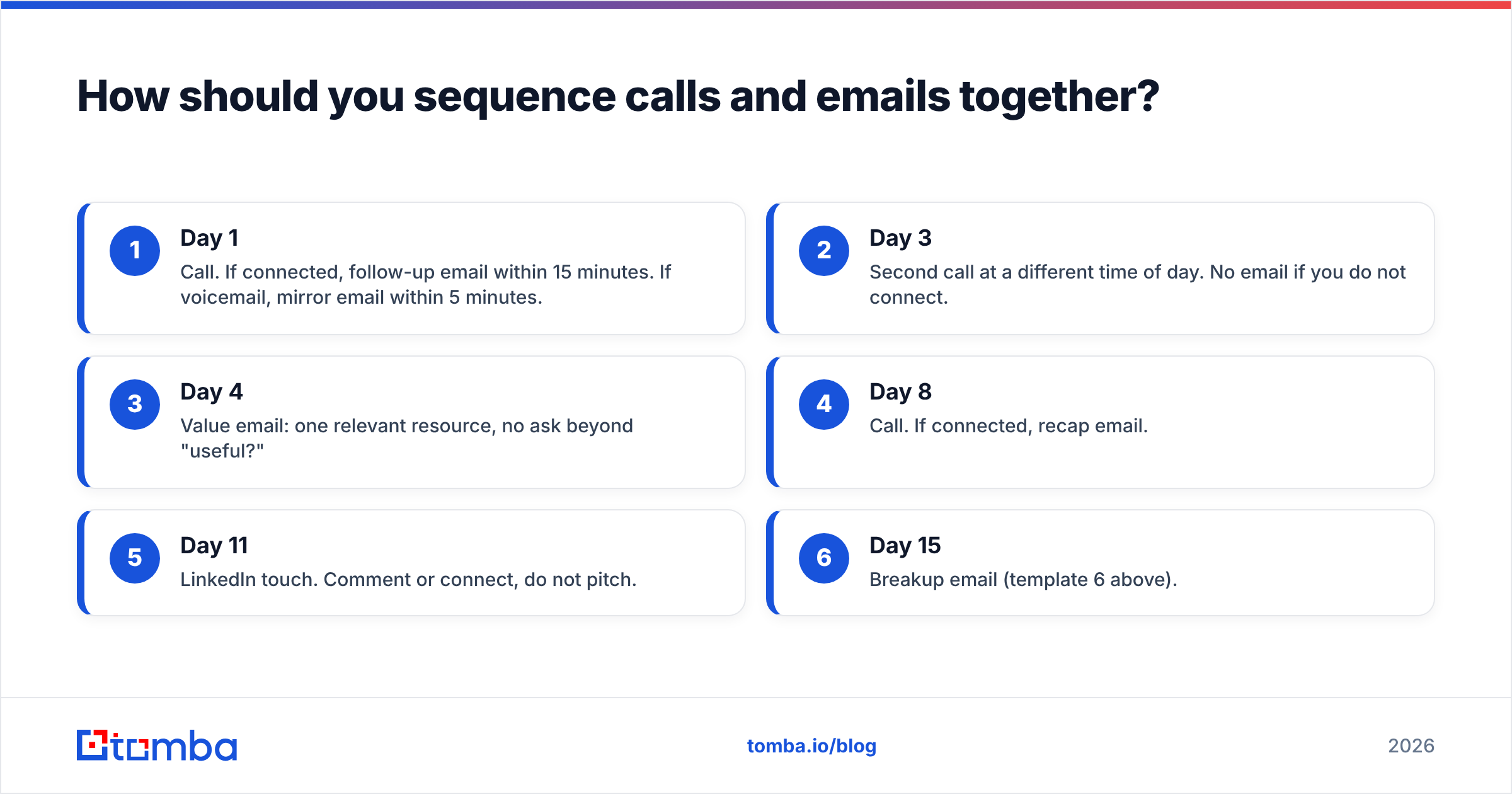
A cadence that holds up across most B2B segments:
- Day 1 — Call. If connected, follow-up email within 15 minutes. If voicemail, mirror email within 5 minutes.
- Day 3 — Second call at a different time of day. No email if you do not connect.
- Day 4 — Value email: one relevant resource, no ask beyond "useful?"
- Day 8 — Call. If connected, recap email.
- Day 11 — LinkedIn touch. Comment or connect, do not pitch.
- Day 15 — Breakup email (template 6 above).
Notice what is missing: back-to-back emails. Every email is separated by a call or a channel switch, which keeps you from becoming inbox noise. Research from vendors like HubSpot and buyer-behavior work published on G2 consistently points the same direction — multi-channel sequences outperform email-only ones, and the gap widens for senior titles.
Also notice the total: six touches over 15 days, then stop. Put non-responders into a quarterly nurture list rather than grinding the same cadence again. If you want the reasoning behind cadence design in more depth, the Salesforce sales resources are a reasonable neutral starting point.
How do you know your follow-ups are actually working?#
Track three numbers, not ten:
- Call-to-email-sent rate. What percentage of connected calls get a follow-up within an hour? If it is below 80%, your problem is process, not copy.
- Reply rate on post-call emails. Should meaningfully exceed your cold-email reply rate. If it does not, your emails are not actually referencing the call.
- Bounce rate on post-call sends. Should be under 2%. Above that, you have an address-quality problem masquerading as a messaging problem.
The third one is the diagnostic most teams never run, and it is the cheapest to fix.
Where should you start?#
Pick one thing: send the next post-call email within 15 minutes, and quote one sentence the prospect actually said. That single change tends to move reply rates more than any subject-line experiment.
Then remove the guesswork from the address. The Tomba Email Finder resolves verified professional addresses by name and domain, so the follow-up you earned on the phone actually reaches an inbox instead of a bounce log. The free tier covers 25 searches a month if you want to test it against your current list; paid Tomba plans start at $49/mo when you are ready to run it across a full dialing team.
Related guides#
Ready to find emails that actually work?
Join 150,000+ professionals who stopped guessing and started sending. Free credits on signup — no credit card required.
Get the Tomba newsletter
Practical outbound tactics and product updates — once every two weeks.
About the author