Follow Up Email After Demo: Templates That Close Deals
Most demos die in the 48 hours after the call. Here are the follow-up email sequences, timing windows, and templates that actually move deals from 'great demo' to signed.
TL;DR
- Send the first follow up email after demo within 4 hours — reply rates drop sharply after 24 hours, and by day three you are competing with everything else in the buyer's inbox.
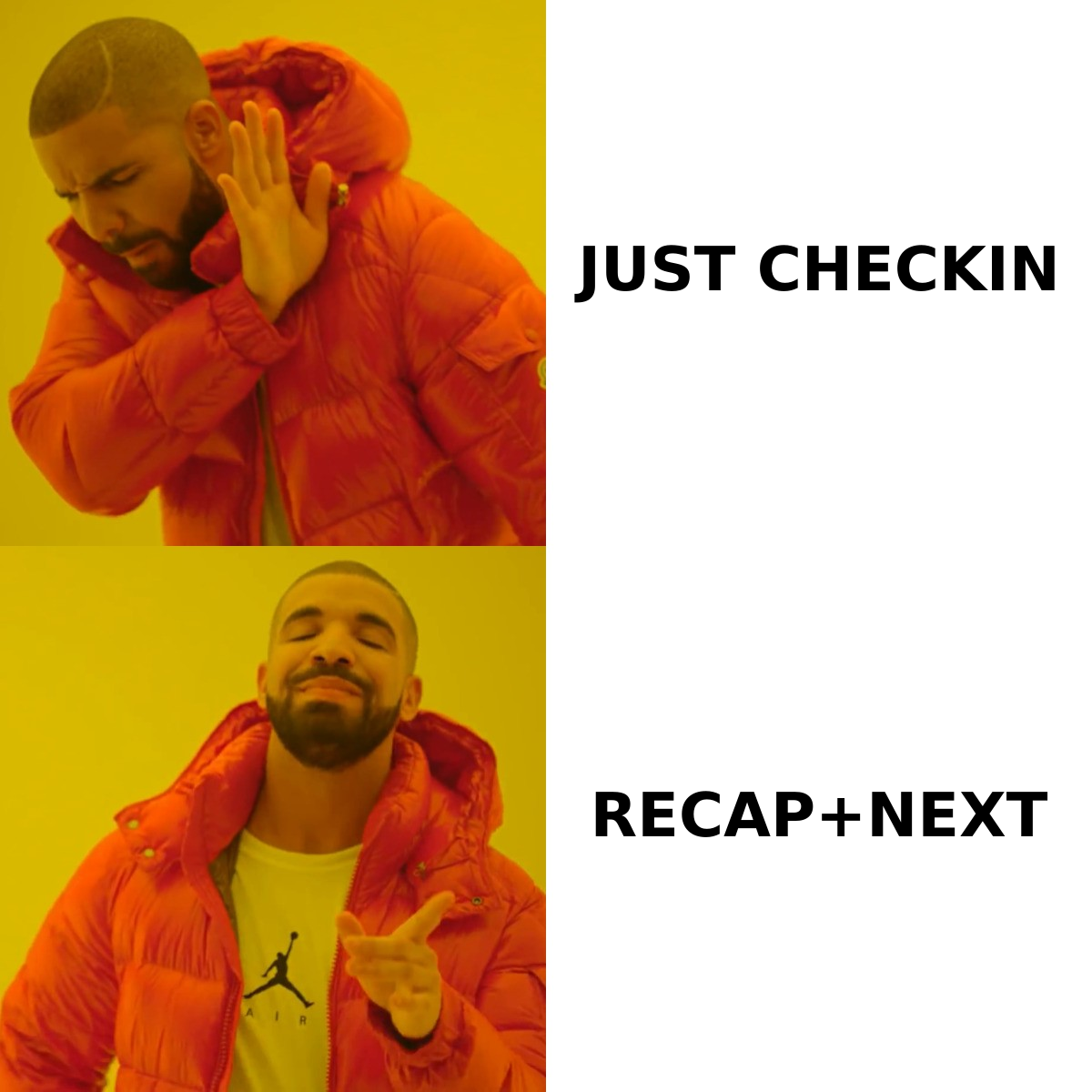
- The recap-plus-next-step structure beats "just checking in" every time: what you heard, what you showed, what happens next, one question.
- Plan a 4-touch sequence over 14 days, not one email and hope. Each touch needs a new reason to exist — a resource, a peer example, a deadline, or a clean break-up.
- Multi-thread. If you only have the champion's email, the deal dies when they go on holiday. Pull the finance and security contacts before you need them.
- Track replies, not opens. Opens are noise in 2026; a reply or calendar event is the only signal that matters.
Why do most demo follow-ups fail?#
Because they ask the buyer to do the work.
A typical post-demo email says "great chatting today, let me know your thoughts." That sentence hands the buyer an open-ended homework assignment at the exact moment their attention is scattering back to the eleven other things they were doing before your call. Nothing in it is easier to act on than to ignore.
The second failure mode is delay. Your demo lives in the buyer's short-term memory for roughly a day. Internal champions often have to relay what they saw to a manager within that window, and if your recap has not landed yet, they relay their own fuzzy version instead. You lose control of the narrative before the deal even reaches the decision-maker.
The third failure mode is single-threading. You demoed to one person, you email one person, and that person's calendar becomes the ceiling on your deal velocity. Gartner's B2B buying research has consistently put the average enterprise buying group at six to ten stakeholders — you cannot win a ten-person decision by emailing one of them. Read their B2B buying journey research for the full picture.
What should a follow up email after demo actually contain?#
Five parts, in this order. Nothing else.
- A one-line thank-you with a specific detail. Not "thanks for your time." Reference something only someone on that call would know — a metric they quoted, a workflow they complained about, the integration they asked about twice.
- A recap of the problem in their words. Mirror their language back. If they said "our SDRs waste an hour a day cleaning lists," write that phrase, not "data hygiene inefficiencies." This is the part your champion forwards internally.
- What you showed and why it matters to them. Two or three bullets, each tied to a problem from part two. Resist listing features you demoed that they did not react to.
- One clear next step with a proposed time. "Does Thursday 2pm work for a 20-minute technical review with your security lead?" beats "let me know how you'd like to proceed." Give a date, a duration, and a purpose.
- One question that is easy to answer. A yes/no or a pick-one. This lowers the cost of replying to almost zero.
Attachments and links go below the signature, not inside the body. Every link above the fold competes with your call to action.
How fast should you send it?#
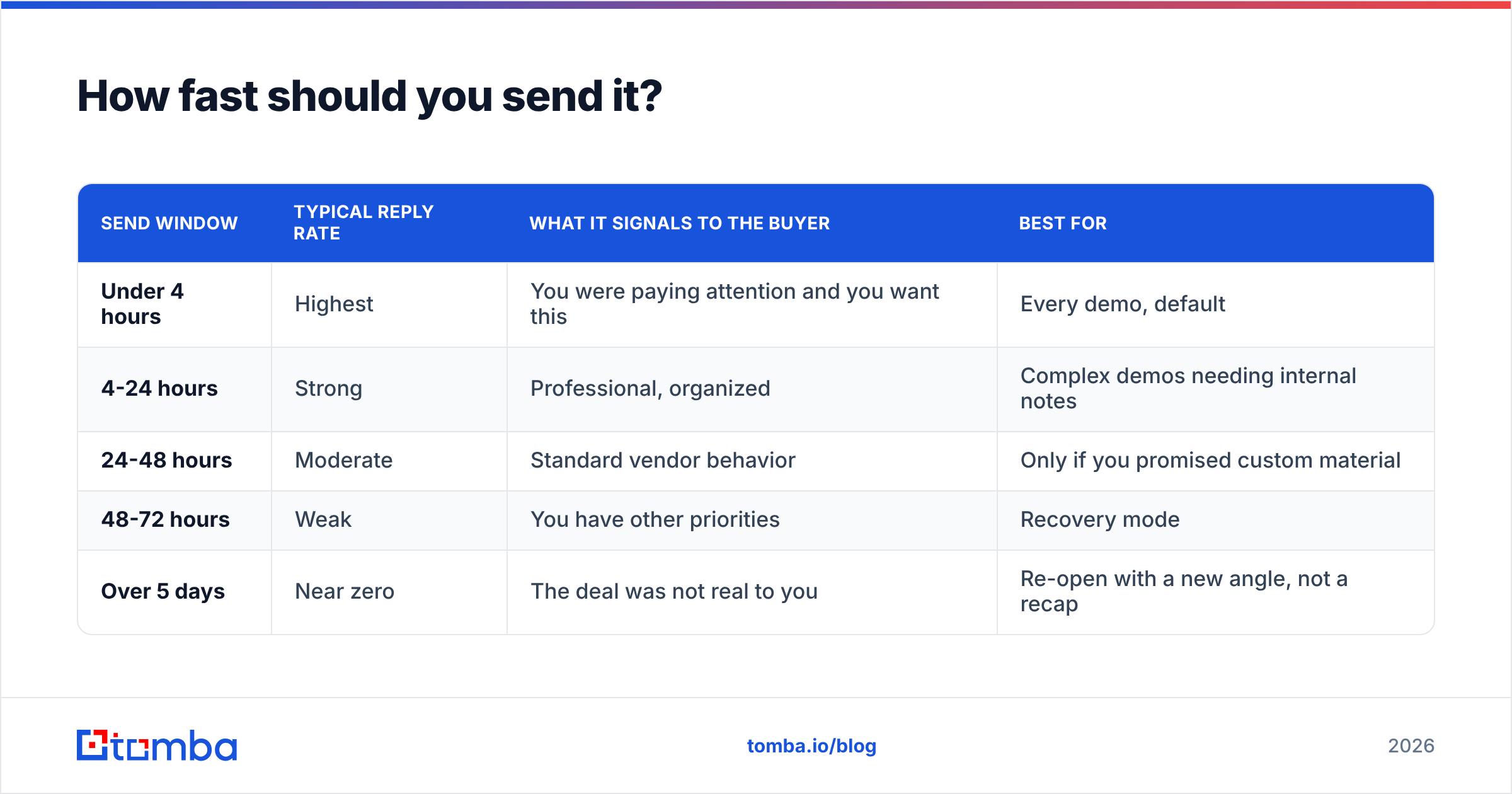
Fast. The table below reflects what most inside-sales teams observe when they instrument their post-demo timing — treat the reply-rate column as directional, not gospel, but the ordering holds everywhere.
| Send window | Typical reply rate | What it signals to the buyer | Best for |
|---|---|---|---|
| Under 4 hours | Highest | You were paying attention and you want this | Every demo, default |
| 4-24 hours | Strong | Professional, organized | Complex demos needing internal notes |
| 24-48 hours | Moderate | Standard vendor behavior | Only if you promised custom material |
| 48-72 hours | Weak | You have other priorities | Recovery mode |
| Over 5 days | Near zero | The deal was not real to you | Re-open with a new angle, not a recap |
The practical rule: write the recap during the last five minutes of the call, while the buyer is still talking. Fill in the gaps immediately after and send before your next meeting. If you wait until end of day, you will be writing from memory, and memory produces generic emails.
What does a 4-touch post-demo sequence look like?#
One email is not a follow-up strategy. Here is a cadence that respects the buyer's inbox while keeping the deal warm for two weeks.
Touch 1 — Same day, within 4 hours. The recap email described above. Subject line: "Recap + next step: [their problem] " or "[Company] x [Your company] — what we covered." Keep it under 150 words.
Touch 2 — Day 3. Deliver value, not pressure. Send the one asset that maps to their biggest objection: a security overview, a migration guide, a customer story from their industry. No ask beyond "worth a look before Thursday?"
Touch 3 — Day 7. Introduce urgency that is real. Pricing that expires, an implementation slot, a quarter-end onboarding window. If nothing real exists, use a peer-pressure angle instead: "two teams in [their vertical] started last month, here's what their first 30 days looked like."
Touch 4 — Day 12-14. The break-up. "I'll assume the timing isn't right and stop cluttering your inbox. If that changes, reply with a single word and I'll pick it back up." Break-up emails routinely outperform touches two and three because they remove pressure and trigger loss aversion at the same time.
Between touches, work other channels. A LinkedIn comment on the champion's post or a short voicemail changes the medium without adding inbox load. HubSpot's ongoing sales statistics research is a useful sanity check on how many touches typical deals actually need.
Which follow-up template fits which demo outcome?#
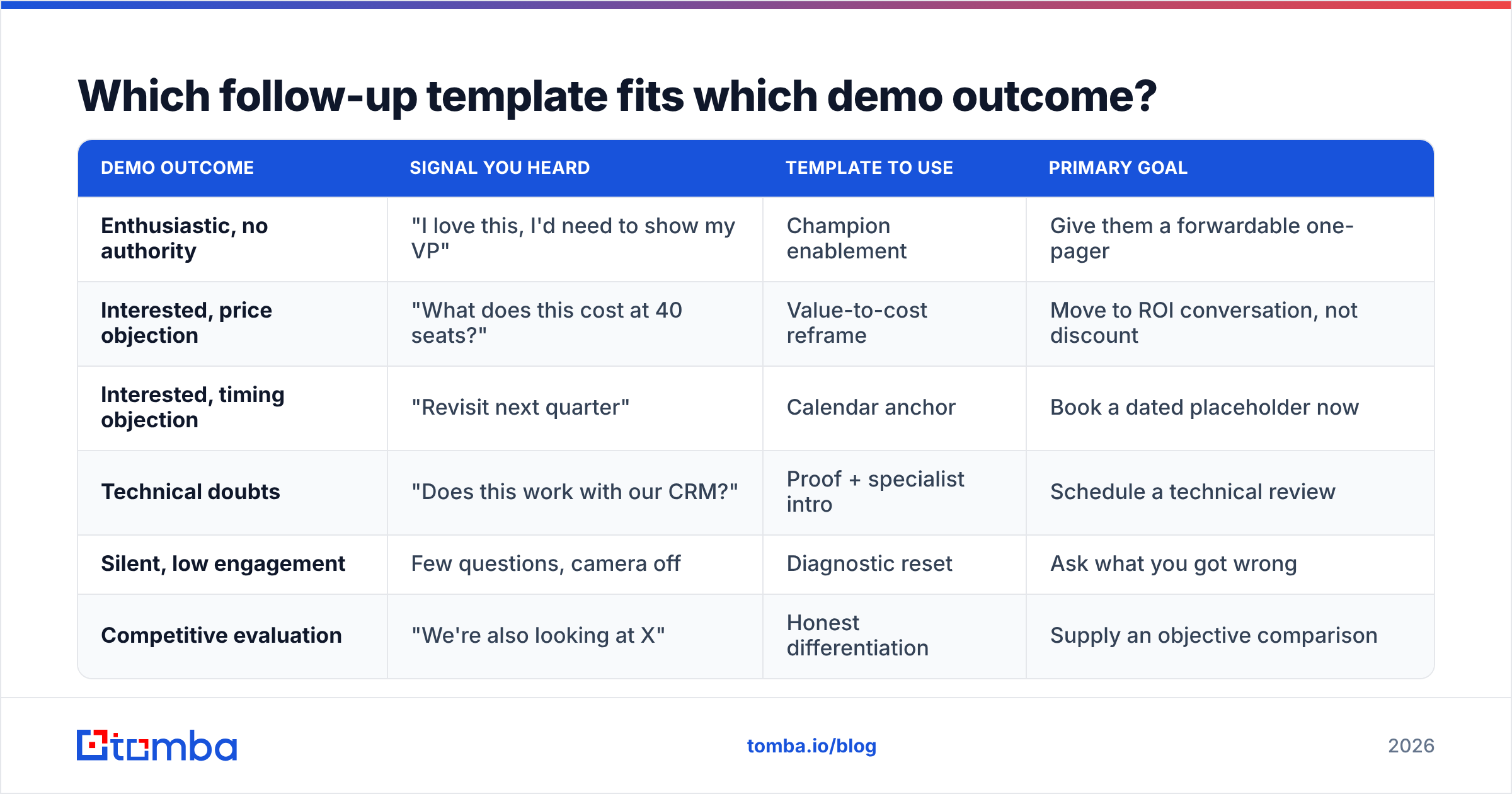
Not every demo ends the same way, and one template cannot cover all of them. Match the email to the exit state of the call.
| Demo outcome | Signal you heard | Template to use | Primary goal |
|---|---|---|---|
| Enthusiastic, no authority | "I love this, I'd need to show my VP" | Champion enablement | Give them a forwardable one-pager |
| Interested, price objection | "What does this cost at 40 seats?" | Value-to-cost reframe | Move to ROI conversation, not discount |
| Interested, timing objection | "Revisit next quarter" | Calendar anchor | Book a dated placeholder now |
| Technical doubts | "Does this work with our CRM?" | Proof + specialist intro | Schedule a technical review |
| Silent, low engagement | Few questions, camera off | Diagnostic reset | Ask what you got wrong |
| Competitive evaluation | "We're also looking at X" | Honest differentiation | Supply an objective comparison |
The champion enablement template deserves special attention because it is the most common outcome and the most commonly botched. Your champion is about to pitch you internally, badly, without you in the room. Your job is to write the email they can forward without editing. That means: no "per our conversation," no pricing they cannot defend, one paragraph of context, three bullets of outcome, and one line about what happens next.
What subject lines get demo follow-ups opened?#
Specificity beats cleverness. The buyer already knows who you are — you were on camera with them hours ago — so the subject line's job is to signal content, not to intrigue.
- Recap + next step for [Company] — plain, forwardable, scannable in a thread list.
- The [integration] question you asked — answers something they raised, so it reads as owed to them.
- [Their metric] — what the numbers looked like for [peer company] — leads with their business, not your product.
- Quick one before Thursday — works for touch two if a real date exists.
- Closing your file? — the break-up subject; short, slightly uncomfortable, extremely high open rate.
Avoid "Following up," "Touching base," and "Just checking in." They carry zero information and buyers have trained themselves to skip them. If you want to pressure-test variants before sending, run them through a subject line tester rather than guessing.
How do you multi-thread after a demo without going around your champion?#
Carefully, and with the champion's blessing where possible. The mechanics:
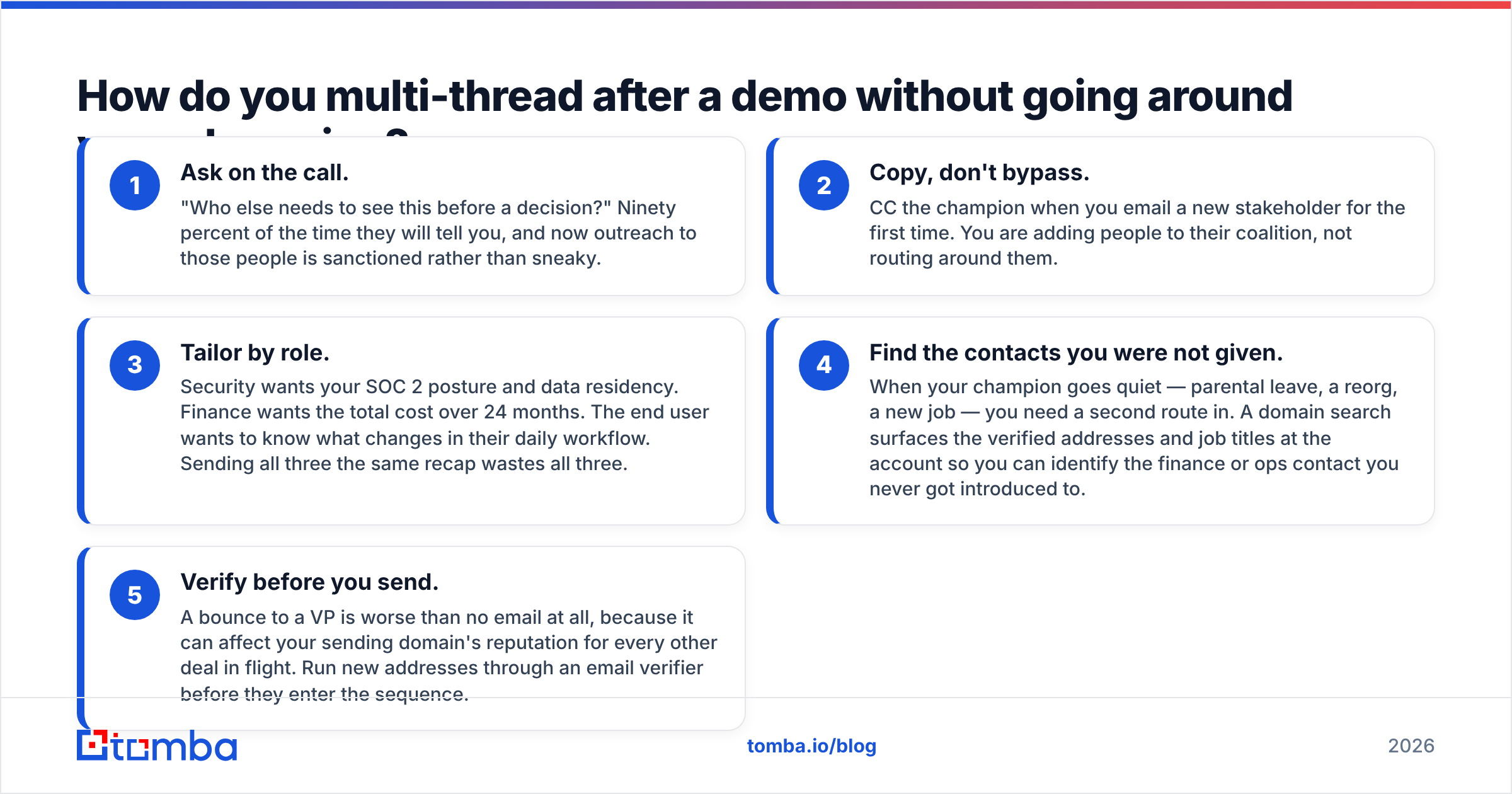
- Ask on the call. "Who else needs to see this before a decision?" Ninety percent of the time they will tell you, and now outreach to those people is sanctioned rather than sneaky.
- Copy, don't bypass. CC the champion when you email a new stakeholder for the first time. You are adding people to their coalition, not routing around them.
- Tailor by role. Security wants your SOC 2 posture and data residency. Finance wants the total cost over 24 months. The end user wants to know what changes in their daily workflow. Sending all three the same recap wastes all three.
- Find the contacts you were not given. When your champion goes quiet — parental leave, a reorg, a new job — you need a second route in. A domain search surfaces the verified addresses and job titles at the account so you can identify the finance or ops contact you never got introduced to.
- Verify before you send. A bounce to a VP is worse than no email at all, because it can affect your sending domain's reputation for every other deal in flight. Run new addresses through an email verifier before they enter the sequence.
The point of multi-threading is not volume. It is insurance. Deals with three or more engaged contacts survive champion turnover; deals with one do not.
What should you measure on post-demo follow-ups?#
Reply rate, meeting-booked rate, and demo-to-opportunity conversion. That's it.
Open rates became close to meaningless once Apple Mail Privacy Protection started pre-fetching images at scale, and in 2026 a meaningful share of your "opens" are machines. Building a follow-up strategy on open data means optimizing for bots. Track what a human had to do: reply, click a scheduling link, accept a calendar invite, forward internally (you'll see this as a new person appearing on the thread).
Benchmarks worth holding yourself to:
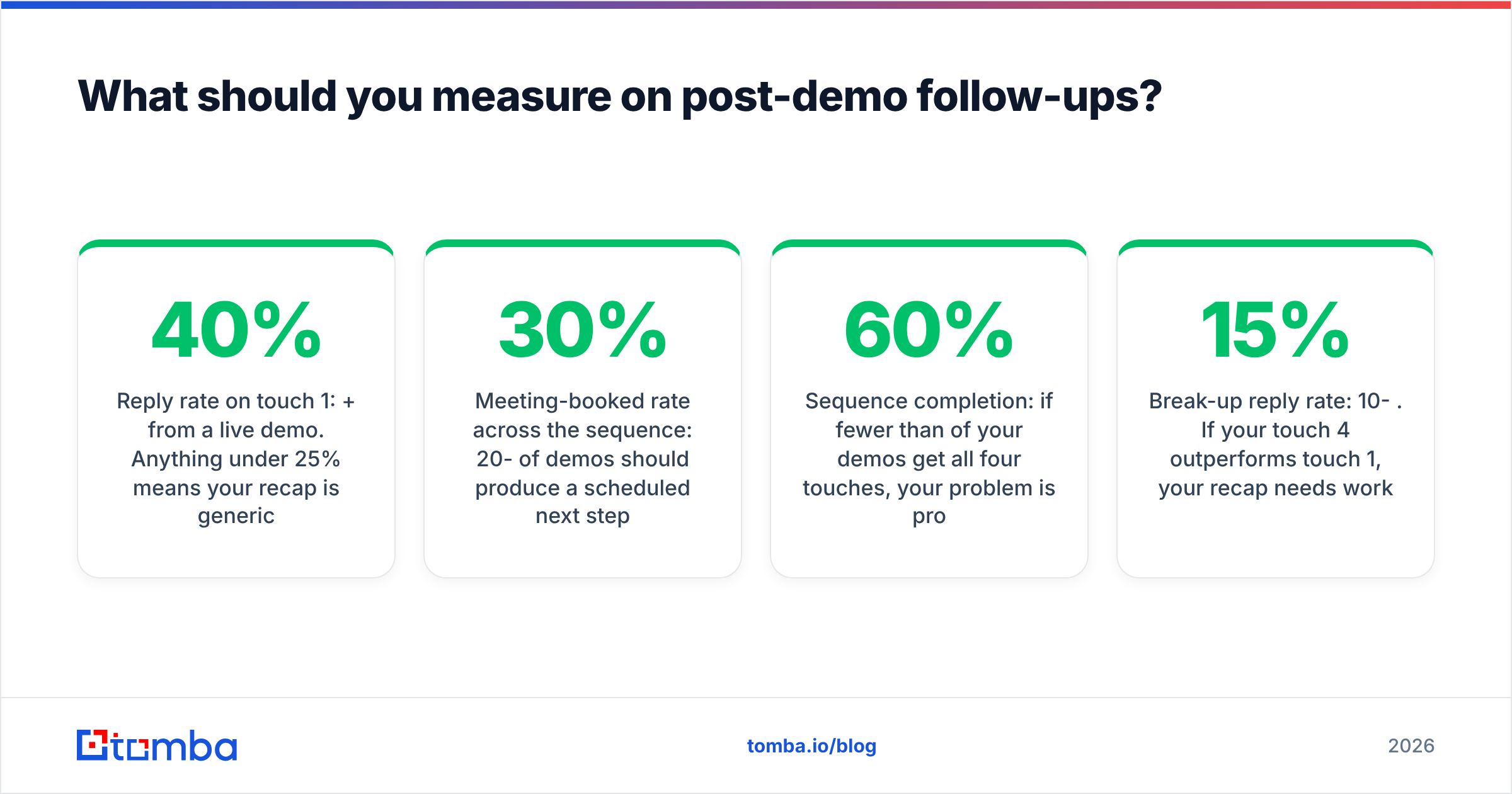
- Reply rate on touch 1: 40%+ from a live demo. Anything under 25% means your recap is generic or your demo did not land.
- Meeting-booked rate across the sequence: 20-30% of demos should produce a scheduled next step.
- Sequence completion: if fewer than 60% of your demos get all four touches, your problem is process discipline, not copy.
- Break-up reply rate: 10-15%. If your touch 4 outperforms touch 1, your recap needs work.
Segment these by demo source. Inbound demos follow up very differently from outbound-sourced ones, and averaging them together hides both. And keep the underlying contact data clean — measurement built on stale addresses tells you your copy failed when the truth is your email never arrived. G2's sales engagement category is a reasonable place to compare tooling if you want automated tracking of these metrics rather than a spreadsheet.
What are the most common post-demo mistakes?#
- Recapping features instead of outcomes. The buyer does not remember your feature names. They remember the problem they described.
- Attaching a 40-slide deck. Nobody opens it. Send a link to a two-page summary instead, and put the deck below the fold.
- Asking for "thoughts." Thoughts require effort. Questions require a click.
- Discounting in touch two. You have not established value yet, so a discount just resets the buyer's price anchor downward.
- Going dark after touch two. Most reps stop right before the point where deals actually convert.
- One-line emails with no context. "Any update?" tells the buyer you have nothing new to say, which tells them the deal matters less to you than it does to them.
- Emailing an unverified address. You'll spend a week wondering why your champion went quiet when the message never reached them at all.
Ready to keep every post-demo deal alive?#
The best follow-up sequence in the world fails against a bad address or a single point of contact. Before your next demo, map the account: who else touches this decision, what their titles are, and how to reach them if your champion disappears. Tomba Email Finder gives you verified work emails by name or domain so you can multi-thread with confidence instead of guessing at formats. Start free with 25 searches a month, or move to the $49/mo Starter plan when your pipeline outgrows it — full Tomba pricing is public, no sales call required.
Write the recap during the call. Send it within four hours. Multi-thread before you need to. That sequence closes more demos than any subject-line trick ever will.
Related guides#
Ready to find emails that actually work?
Join 150,000+ professionals who stopped guessing and started sending. Free credits on signup — no credit card required.
Get the Tomba newsletter
Practical outbound tactics and product updates — once every two weeks.
About the author