Follow Up Email After First Meeting: Templates That Work
Most first meetings die in the 48 hours after they end. Here are the timing rules, structures, and copy-paste templates that turn a good conversation into a booked next step.
TL;DR
- Send the follow up email after first meeting within 24 hours — ideally the same afternoon, while your name still maps to a face in their inbox.
- Four parts, in this order: specific reference, restated problem in their words, one piece of value, one unambiguous next step. Nothing else.
- The single biggest killer is a vague close. "Let me know your thoughts" converts far worse than "Does Thursday at 2pm ET work for 20 minutes?"
- Plan for 3–5 touches, not one. Most deals that stall after a first meeting stall because the seller sent one email and called it a follow-up sequence.
- Segment your template by meeting type — discovery, demo, networking, conference, and internal-champion meetings need different structures.
Why does the follow up email after first meeting matter so much?#
Because the meeting is not the conversion event. The follow-up is.
Think of a first meeting like a good first date. The dinner itself doesn't determine anything — what determines it is whether someone texts the next morning, and whether that text references something real from the night before or reads like it could have been sent to anyone. Same mechanics, same 24-hour window, same fatal move of waiting three days to "seem busy."
In B2B terms: a first meeting creates a temporary spike in attention and context. Your prospect has just spent 30 minutes thinking about the problem you solve. That spike decays fast. Internal priorities, three other vendor calls, and 200 unread emails flatten it within about 48 hours. Every hour you wait, you're asking them to reload context they've already dumped.
There's also an accountability function. A written recap is the only artifact that survives the meeting. Your champion forwards it. Their VP skims it. Procurement finds it six weeks later. If your recap is three sentences of "great speaking with you," you have handed your champion nothing to sell with internally.
What should a follow up email after first meeting actually contain?#
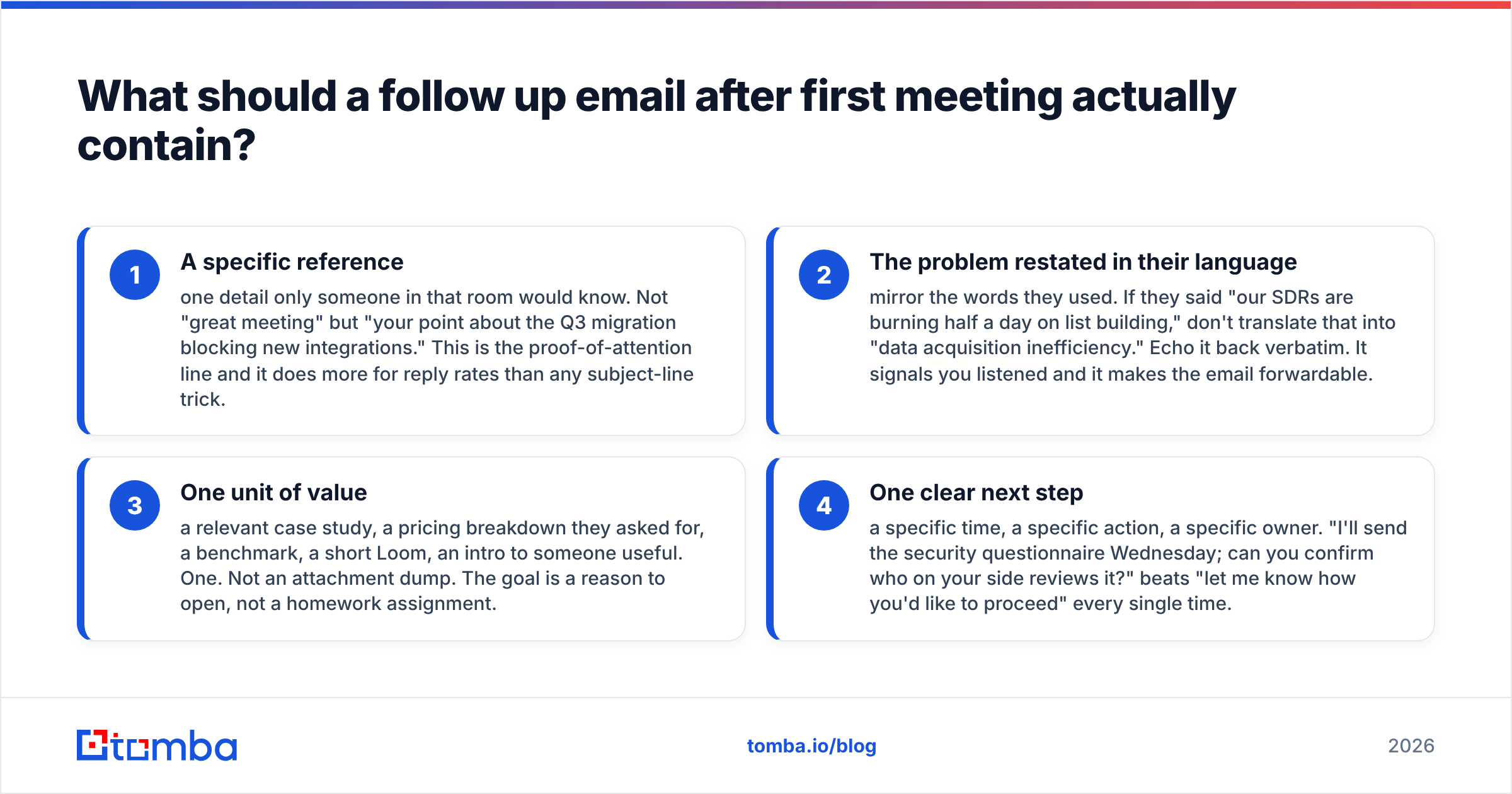
Four components. In this order. No exceptions.
- A specific reference — one detail only someone in that room would know. Not "great meeting" but "your point about the Q3 migration blocking new integrations." This is the proof-of-attention line and it does more for reply rates than any subject-line trick.
- The problem restated in their language — mirror the words they used. If they said "our SDRs are burning half a day on list building," don't translate that into "data acquisition inefficiency." Echo it back verbatim. It signals you listened and it makes the email forwardable.
- One unit of value — a relevant case study, a pricing breakdown they asked for, a benchmark, a short Loom, an intro to someone useful. One. Not an attachment dump. The goal is a reason to open, not a homework assignment.
- One clear next step — a specific time, a specific action, a specific owner. "I'll send the security questionnaire Wednesday; can you confirm who on your side reviews it?" beats "let me know how you'd like to proceed" every single time.
What does not belong: a company boilerplate paragraph, three attachments, a signature block with six social icons, an apology for taking their time, or the phrase "just following up."
Keep it to 120–180 words. Anything longer gets the read-later treatment, and read-later means never.
How does the follow-up change by meeting type?#
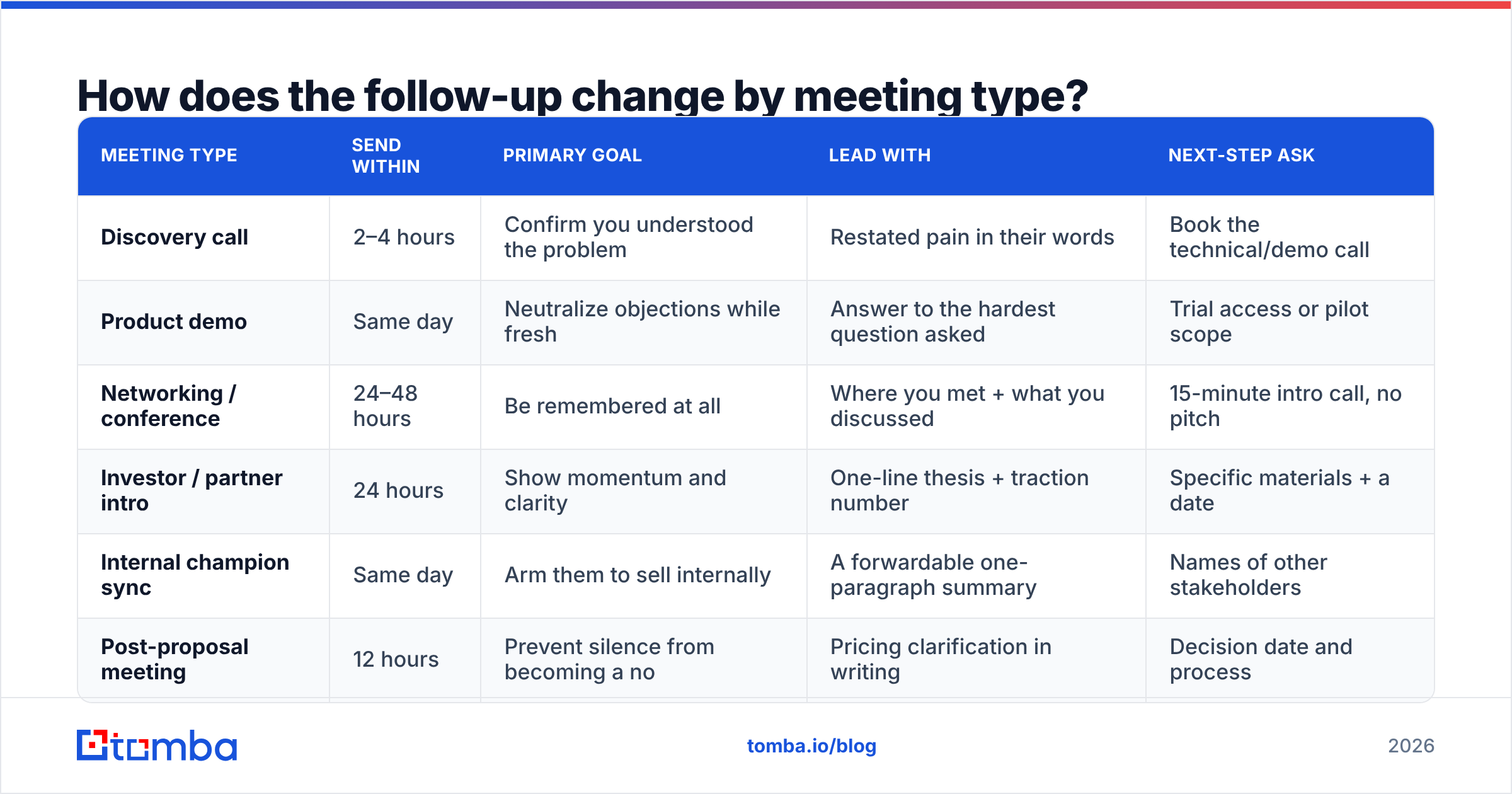
The four components stay constant; the weighting shifts. A discovery-call recap is mostly problem restatement. A conference follow-up is mostly the specific reference, because they met 40 people that day and have no idea who you are.
| Meeting type | Send within | Primary goal | Lead with | Next-step ask |
|---|---|---|---|---|
| Discovery call | 2–4 hours | Confirm you understood the problem | Restated pain in their words | Book the technical/demo call |
| Product demo | Same day | Neutralize objections while fresh | Answer to the hardest question asked | Trial access or pilot scope |
| Networking / conference | 24–48 hours | Be remembered at all | Where you met + what you discussed | 15-minute intro call, no pitch |
| Investor / partner intro | 24 hours | Show momentum and clarity | One-line thesis + traction number | Specific materials + a date |
| Internal champion sync | Same day | Arm them to sell internally | A forwardable one-paragraph summary | Names of other stakeholders |
| Post-proposal meeting | 12 hours | Prevent silence from becoming a no | Pricing clarification in writing | Decision date and process |
Notice the send windows tighten as intent rises. A demo attendee is warm and comparing you against two other vendors this week — same-day or you lose the comparison. A conference contact is cold and overwhelmed; 24–48 hours is fine and arguably better, since day-of emails get buried under everyone else's day-of emails.
When exactly should you send it?#
Same business day, and preferably within four hours of the meeting ending. If the meeting runs late in their timezone, schedule for 7–8am their next morning rather than firing at 9pm.
A few timing rules that hold up in practice:
- Never wait for "the perfect send." A good email in two hours beats a great email in two days. The information asymmetry — them remembering you — decays faster than your copy improves.
- Avoid Friday 4pm. It gets buried by Monday morning triage. If your meeting is Friday afternoon, send Friday evening with a Monday-morning ask, or schedule for Monday 7:30am.
- Match their reply cadence. If they replied to your original outreach at 6am, they are an early-morning inbox person. Send accordingly.
- Use their calendar language. If they said "let's reconnect after the board meeting on the 14th," your follow-up should say "I'll follow up on the 15th" and then you actually follow up on the 15th. That one act of precision separates you from 90% of vendors.
The follow-up isn't a single email either. Plan a sequence of 3–5 touches spaced roughly day 0, day 3, day 7, day 14, day 30 — each one carrying a new reason to exist, not a bump. HubSpot's sales research consistently shows that the majority of closed deals require multiple post-meeting touches, and most reps stop after one or two. HubSpot's sales statistics roundup is a reasonable place to check the current numbers.
What do the actual templates look like?#
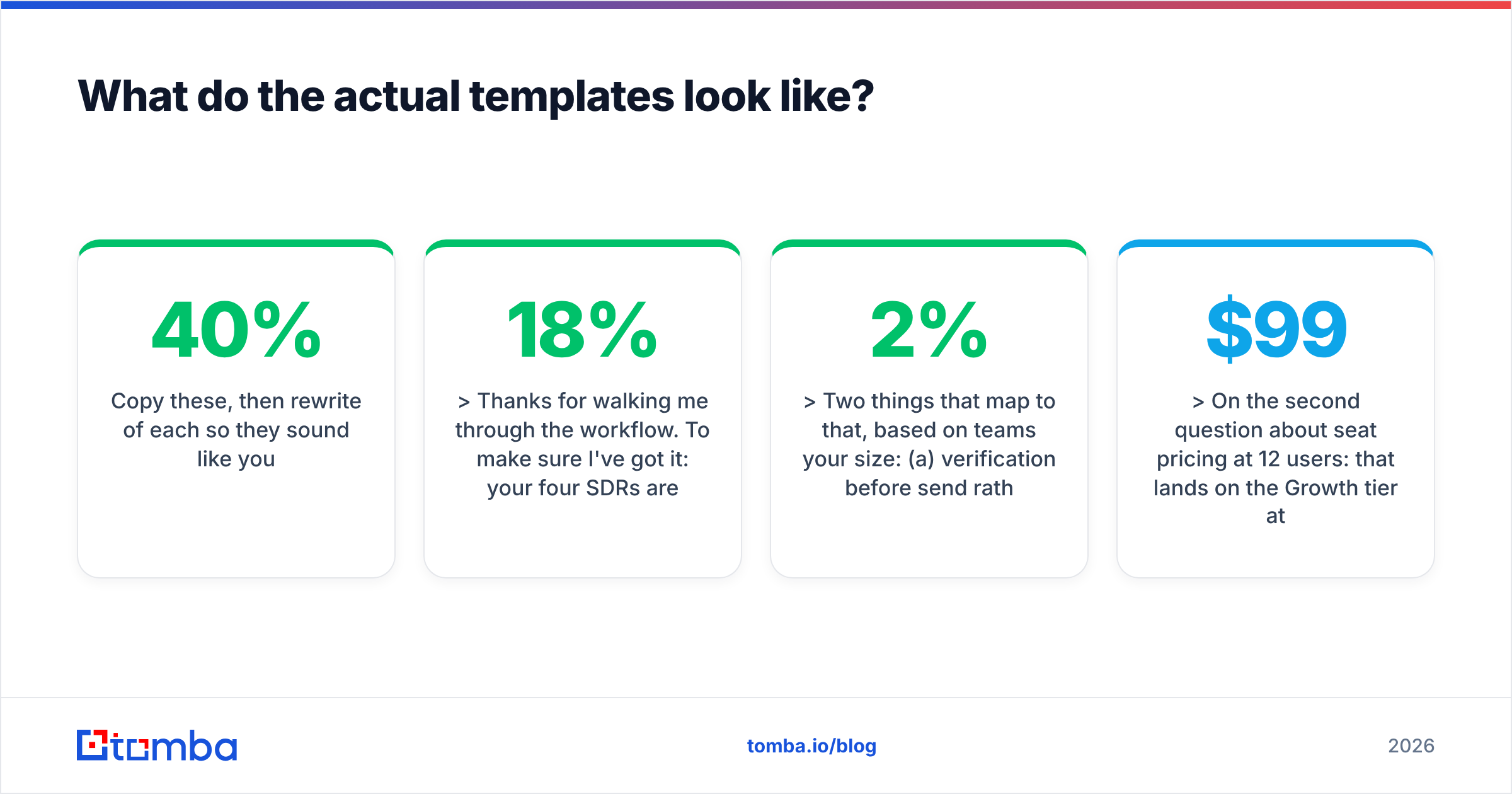
Copy these, then rewrite 40% of each so they sound like you.
1. Discovery call recap
Subject: Recap — SDR list-building time, and the two fixes
Hi Dana,
Thanks for walking me through the workflow. To make sure I've got it: your four SDRs are each spending roughly half a day per week assembling lists, and the bigger cost is that ~18% of what they build bounces, which is now affecting domain reputation.
Two things that map to that, based on teams your size: (a) verification before send rather than after, and (b) pulling contacts by domain instead of by name so coverage isn't dependent on knowing who to look for. I've attached a one-pager on how a similar team cut bounce rate to under 2%.
Next step — worth 30 minutes with Marco from your ops side to look at the actual list build? I have Tuesday 10am or Wednesday 2pm ET.
— Sam
2. Post-demo follow-up
Subject: The Salesforce sync question, answered
Hi Priya,
You asked whether records sync bidirectionally or one-way. It's bidirectional, and field mapping is configurable per object — I've included a screenshot of the mapping screen so you can see it rather than take my word for it.
On the second question about seat pricing at 12 users: that lands on the Growth tier at $99/mo, not the enterprise quote you were shown elsewhere.
Can we get 20 minutes with your RevOps lead Thursday to scope a two-week pilot? I'll bring the sandbox pre-loaded with your domain list.
— Sam
3. Conference / networking follow-up
Subject: The attribution rant, continued (SaaStr, Tuesday)
Hi Lena,
We talked outside the Salesforce booth about how last-touch attribution makes outbound look worthless. You said your CFO won't fund SDRs because of it.
I saved you the Forrester piece I mentioned — it's the cleanest argument I've seen for multi-touch on B2B pipeline.
No pitch: if you're up for 15 minutes in the next two weeks, I'd like to hear how you're planning to make the case. Here's my calendar.
— Sam
4. When they've gone quiet (day 14)
Subject: Should I close the file?
Hi Dana,
Haven't heard back since the 3rd, which usually means one of three things: priorities shifted, budget moved, or I dropped the ball on something you needed.
If it's the first two, tell me and I'll set a reminder for Q4 and stop cluttering your inbox. If it's the third, say the word and I'll fix it today.
— Sam
That fourth one works because it's the only email in the sequence that makes it easier to say no than to ignore. Give people a clean exit and a surprising number take the other door instead. If you want more starting points, the cold email templates library covers adjacent sequences, and the subject line generator is useful when your recap subject keeps coming out as "Following up."
What are the mistakes that kill follow-up reply rates?#
- The "just checking in" email. It carries zero new information and puts the entire cognitive burden on the recipient. Every touch after the first must add something: a relevant article, a customer story, a changed price, a new integration, a question you forgot to ask.
- Multiple asks in one email. "Let me know your thoughts, and also whether you want the deck, and if Thursday works, and who else should be on the call." Four asks equals zero replies. One ask.
- Emailing the wrong or unverified address. You'd be surprised how often a follow-up "goes unanswered" because it never arrived — typo'd address from a business card, a role-based alias, or a contact who left. Run new contacts through an email verifier before you build a whole sequence on top of a bad address, and use a proper email finder rather than guessing at firstname.lastname patterns.
- Ignoring the people who weren't in the room. Deals stall in the gap between your champion and the people who actually sign. Ask in the recap who else should see this, then find them — domain search pulls the rest of the buying committee at a company in one query.
- Sending from a domain with no reputation. If your recap lands in spam, none of the copy matters. Check your SPF record and monitor email deliverability before you blame the template.
- Over-formatting. Bold every third word and add three bullet levels and it starts to look like a marketing blast. Plain text, short paragraphs, one link.
- No calendar link and no proposed time. Give both: two specific slots plus a link for people who hate being given options.
How do you follow up at scale without sounding automated?#
The honest answer: you template the structure, never the specifics.
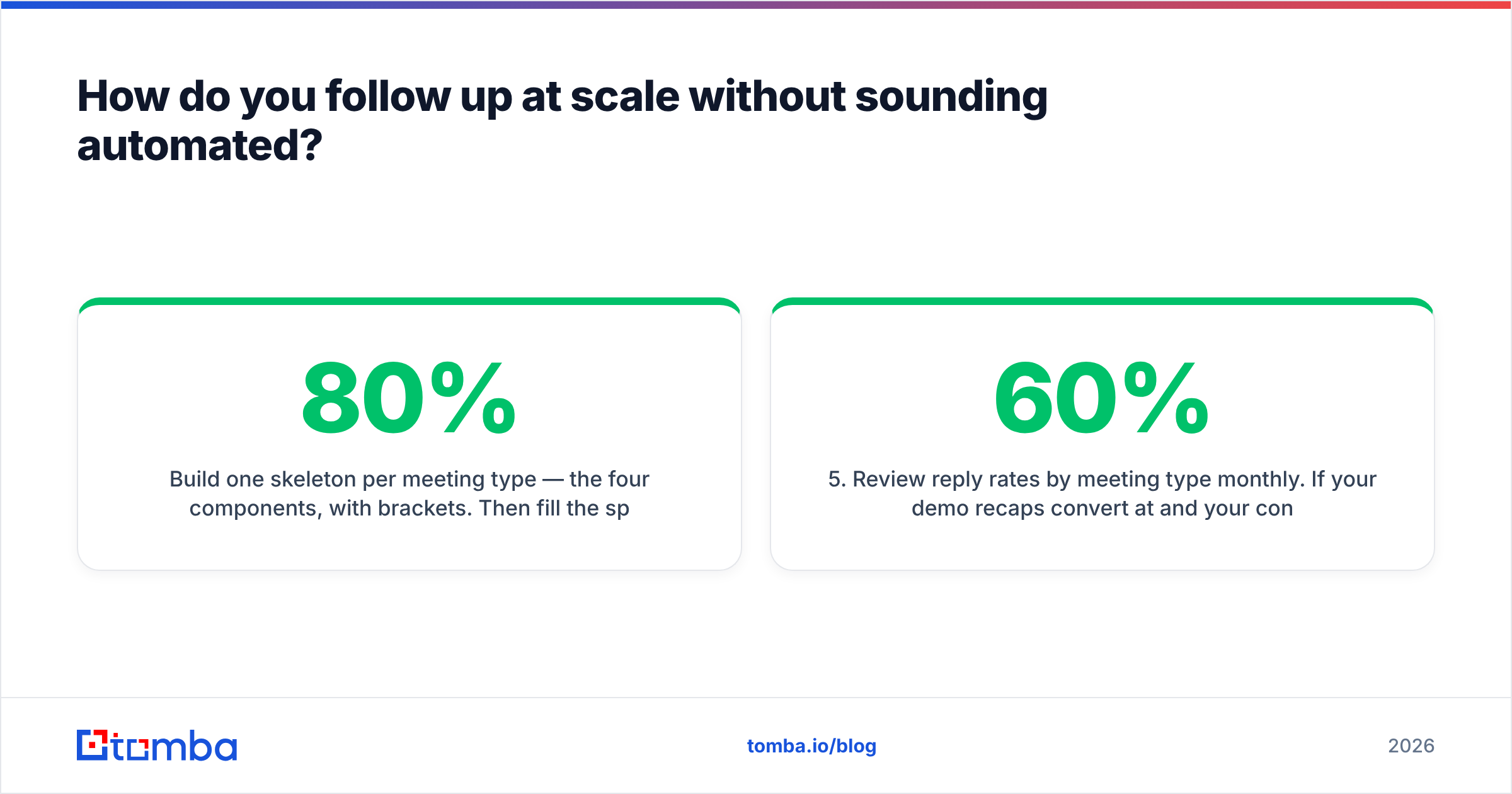
Build one skeleton per meeting type — the four components, with brackets. Then fill the specific-reference line and the problem-restatement line by hand, from your notes, every single time. Those two lines are 30 seconds of work and they carry 80% of the email's credibility. Everything else — the value asset, the signature, the calendar link — can be automated safely.
A workable operating rhythm:
- Take notes in the meeting with the recap in mind. Write down one quotable phrase they used and one number they mentioned. That's your first two lines already written.
- Draft inside a 10-minute post-meeting block. Put it on your calendar as part of the meeting itself, so the meeting is 40 minutes, not 30.
- Log the next touch date immediately in your CRM with the reason for the touch, not just a date. "Day 7 — send the Gartner MQ excerpt" is actionable; "day 7 follow up" is not.
- Enrich the record before touch three. By the third email you should know more about the account than you did at the meeting — funding, headcount changes, new hires in the buying center. Contact enrichment turns a name and an email into that context.
- Review reply rates by meeting type monthly. If your demo recaps convert at 60% and your conference follow-ups at 8%, the problem is the conference template, not your effort level.
For benchmarking your own numbers against peers, G2's sales software category reviews are a reasonable proxy for what teams actually experience with sequencing tools, and Gartner's B2B buying research is worth reading for why buyers go quiet — it's usually internal consensus-building, not disinterest.
Which tool should you use to run this?#
For the writing itself, nothing beats your own notes and ten focused minutes. Tools don't fix a vague ask.
Where tooling genuinely helps is upstream and downstream: making sure the address is real before you invest five touches in it, finding the three other stakeholders your champion mentioned, and keeping the whole buying committee's contact data current as people move.
That's the job Tomba's Email Finder is built for. Feed it the name and company of the CFO your champion said you'd need to convince, get a verified address back, and run your follow-up sequence against a contact that actually exists. The free tier covers 25 searches a month if you just want to test it on your current pipeline; paid plans start at $49/mo and scale to team volume — see Tomba pricing for the tiers.
Write the recap within four hours. One ask. One new thing every touch. That's the whole discipline.
Related guides#
Ready to find emails that actually work?
Join 150,000+ professionals who stopped guessing and started sending. Free credits on signup — no credit card required.
Get the Tomba newsletter
Practical outbound tactics and product updates — once every two weeks.
About the author