Follow Up Email After Meeting With Client: 2026 Playbook
Most post-meeting emails die because they recap instead of advance. Here are the timing rules, structure, and 7 copy-paste templates that actually move deals forward.
TL;DR
- Send within 2–24 hours. After 48 hours, your meeting is competing with everything else that happened that week, and reply rates fall off a cliff.
- A recap is not a follow-up. Every post-meeting email needs one dated, named next step — not "let me know your thoughts."
- Structure beats eloquence: subject that references the meeting, one-line context, 3-bullet decision summary, one ask, one date.
- Multi-threading is the highest-leverage move most reps skip. If you met one person and the deal needs four, your follow-up is already failing.
- The 7 templates below cover discovery, demo, pricing pushback, stakeholder intro, post-negotiation, ghosting, and closed-lost revival.
Why do most follow up emails after client meetings fail?#
Because they're written as receipts, not as moves.
The typical follow-up reads: "Great speaking with you today! As discussed, here's a recap of what we covered. Let me know if you have any questions." That email asks the client to do the work of figuring out what happens next. Busy buyers don't. They archive it, feel vaguely positive about you, and go back to their actual job.
A follow up email after meeting with client contacts has exactly three jobs:
- Prove you were listening. Reflect back their specific words — the metric they mentioned, the internal deadline, the person who "always pushes back on new tools."
- Reduce their internal selling burden. They have to explain this to someone. Give them the paragraph they'll paste into Slack.
- Advance the calendar. Not "next steps" as a heading — an actual proposed date with an actual named attendee.
Everything else is decoration. HubSpot's research on sales follow-up behavior has consistently shown that deals stall in the gap between meetings, not during them. The email is the bridge, and most reps build half of one.
When should you send a follow up email after a meeting?#
Fast, but not so fast that it looks automated.
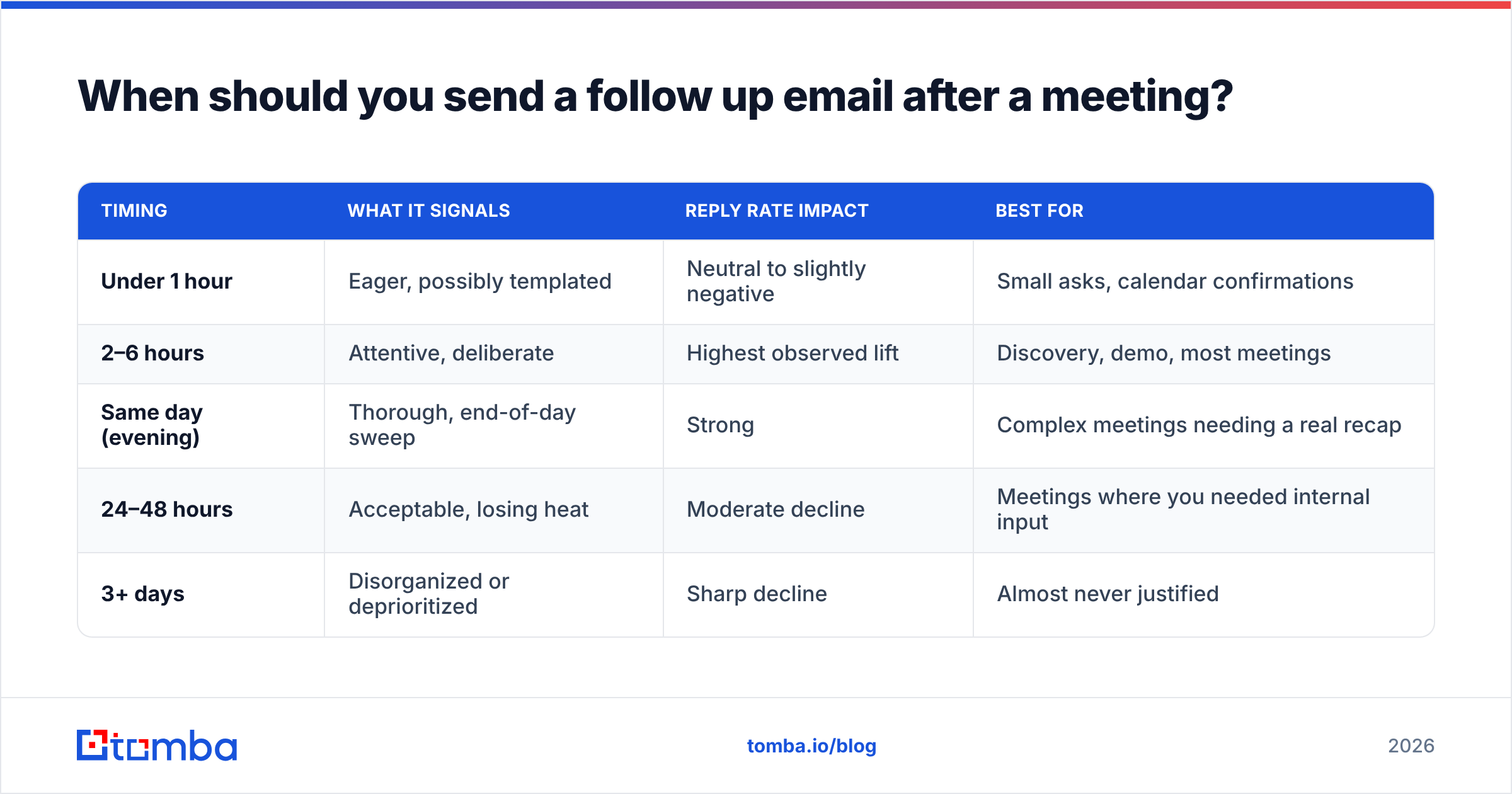
| Timing | What it signals | Reply rate impact | Best for |
|---|---|---|---|
| Under 1 hour | Eager, possibly templated | Neutral to slightly negative | Small asks, calendar confirmations |
| 2–6 hours | Attentive, deliberate | Highest observed lift | Discovery, demo, most meetings |
| Same day (evening) | Thorough, end-of-day sweep | Strong | Complex meetings needing a real recap |
| 24–48 hours | Acceptable, losing heat | Moderate decline | Meetings where you needed internal input |
| 3+ days | Disorganized or deprioritized | Sharp decline | Almost never justified |
The 2–6 hour window works because it's long enough to look considered and short enough that the client still remembers the nuance of what they said. If you need to attach a proposal or pull a number, send a two-line holding email inside that window and follow with the full document the next morning.
One exception: if the meeting ended with an emotional beat — a strong objection, a tense pricing moment — wait until the next morning. Sending into unresolved friction rarely lands well.
What structure should the email follow?#
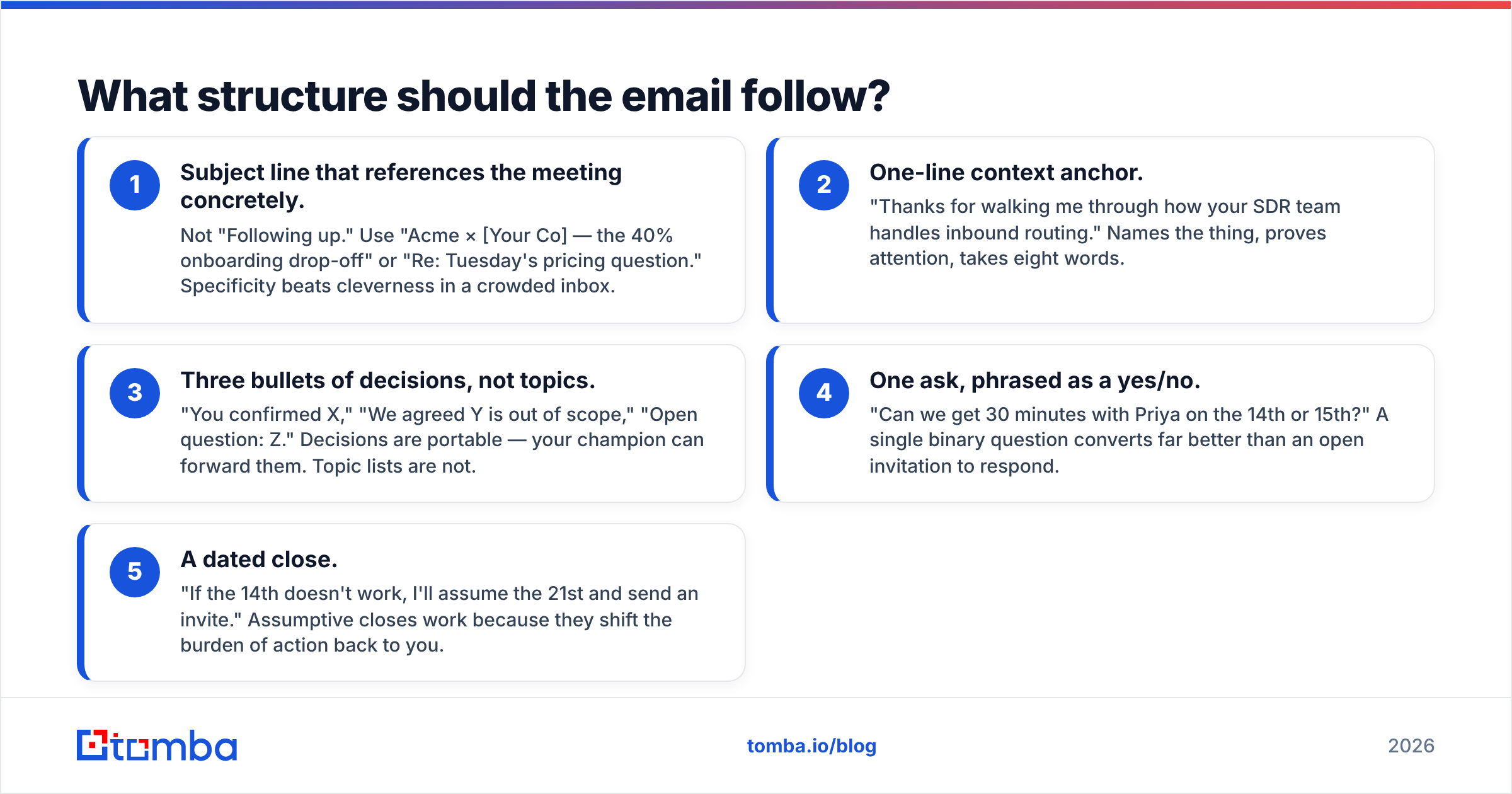
Use the same five-part skeleton every time. Consistency is what lets you write these in four minutes instead of twenty.
- Subject line that references the meeting concretely. Not "Following up." Use "Acme × [Your Co] — the 40% onboarding drop-off" or "Re: Tuesday's pricing question." Specificity beats cleverness in a crowded inbox.
- One-line context anchor. "Thanks for walking me through how your SDR team handles inbound routing." Names the thing, proves attention, takes eight words.
- Three bullets of decisions, not topics. "You confirmed X," "We agreed Y is out of scope," "Open question: Z." Decisions are portable — your champion can forward them. Topic lists are not.
- One ask, phrased as a yes/no. "Can we get 30 minutes with Priya on the 14th or 15th?" A single binary question converts far better than an open invitation to respond.
- A dated close. "If the 14th doesn't work, I'll assume the 21st and send an invite." Assumptive closes work because they shift the burden of action back to you.
Keep the whole thing under 150 words. If you need more, the extra belongs in an attachment or a linked doc, not in the body.
Which templates actually work in 2026?#
Seven situations cover roughly 90% of post-meeting follow-ups. Adapt the specifics; keep the bones.
1. After discovery#
Subject: Acme — the 11-day quote turnaround
Hi Dana,
Thanks for the detail on how quotes move between sales and finance right now.
Three things I took away:
- The 11-day average turnaround is the bottleneck, not lead volume
- Anything touching the ERP needs Marcus's sign-off
- Q1 budget is already allocated; Q2 is the realistic window
Next: can I get 30 minutes with you and Marcus on the 14th to map what an integration would actually touch? If that's tight, the 21st works too.
— Sam
2. After a demo#
Lead with the one feature they reacted to, not a feature list. "You paused on the bulk verification screen — here's a two-minute clip of it running against a 5,000-row list." Attach or link the specific artifact, then ask for the next meeting.
3. After pricing pushback#
Don't defend the number in writing. Reframe against the cost of the status quo, then offer a structural option: annual vs. monthly, phased rollout, reduced seat count for a pilot. Give two paths and ask which one they'd rather take to their CFO.
4. Stakeholder introduction request#
Hi Dana — you mentioned security review is usually the long pole. Rather than wait, can you point me to whoever runs that? I'll send them our SOC 2 report and DPA directly so it's not sitting in your queue.
This works because you're removing work from your champion, not adding it.
5. After negotiation#
Restate the agreed terms in plain language, flag anything still open, and give a date by which the quote expires. Ambiguity after a negotiation call is how deals slip two quarters.
6. The polite nudge (no reply in 5 days)#
Three sentences maximum. Add something new — a customer story in their vertical, a relevant benchmark — and re-ask the same binary question. Never write "just bumping this to the top of your inbox."
7. Closed-lost revival#
Wait 90 days. Reference what changed on your side or theirs. "You passed last spring because we didn't support multi-region data residency. We shipped it in March — worth a 15-minute look?"
How do you follow up when you only met one person?#
You expand the thread. Gartner's research on B2B buying groups puts the typical enterprise purchase decision in the hands of six to ten people. If your follow-up only reaches one of them, you've delegated internal selling to someone who has no training in selling your product.
Three practical moves:
- Ask for names in the meeting, then find their contacts before you send. A quick domain search surfaces the pattern for a company's addresses so you can reach the security lead or the finance approver directly instead of waiting for an intro that never comes.
- CC intentionally, not defensively. Adding a second stakeholder to the thread is fine when your champion suggested them. Adding their VP without warning is not.
- Verify before you send. A bounce to a senior stakeholder is worse than no email at all, because it lands in your champion's inbox as a failure. Run new addresses through an email verifier first — it takes seconds and protects your domain reputation.
If you're building the map manually every time, a bulk email finder will resolve a list of names against a company domain in one pass, which is the difference between multi-threading being a habit and being an aspiration.
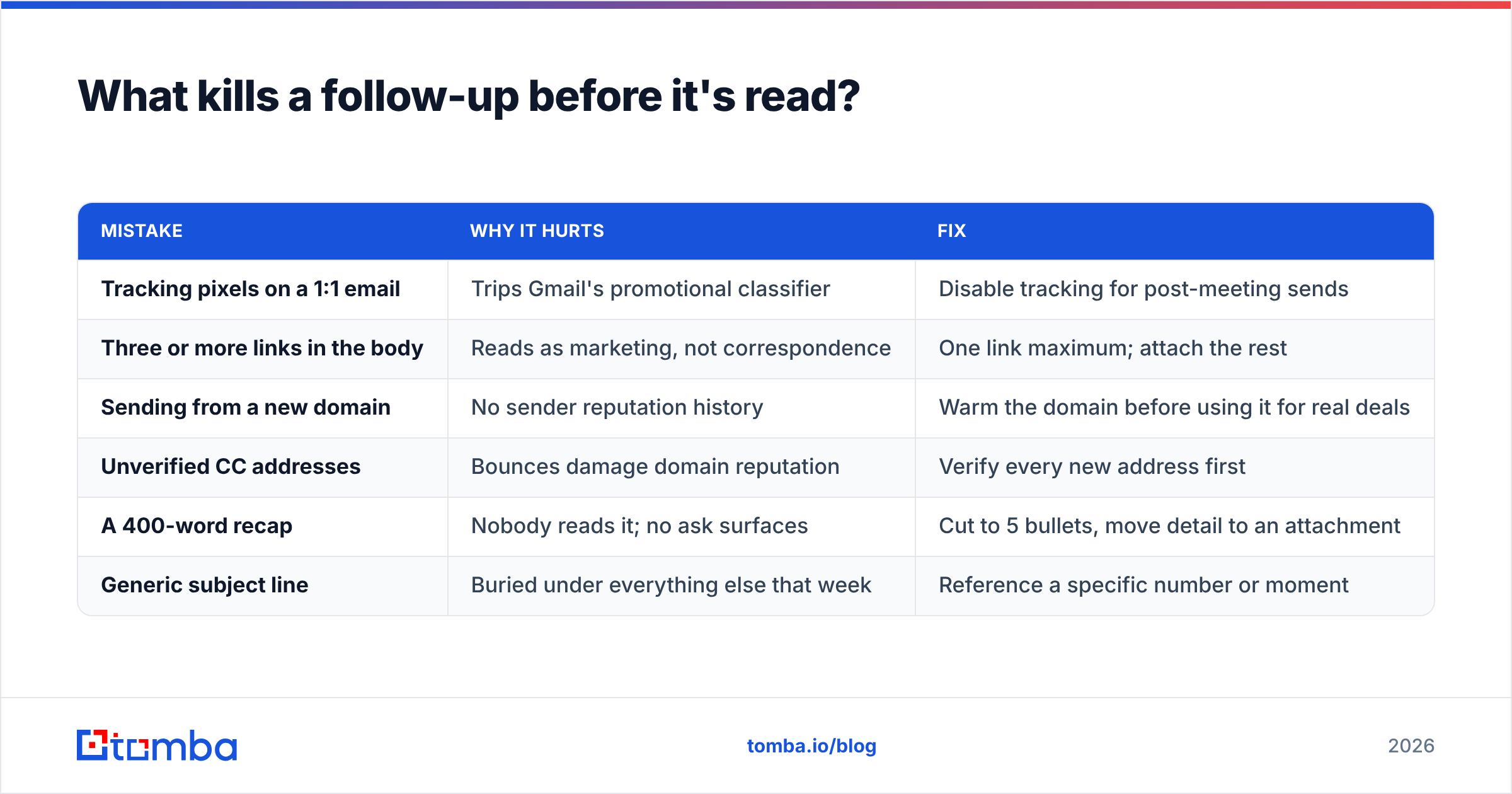
What kills a follow-up before it's read?#
Deliverability, mostly. A perfectly written email that lands in Promotions or Spam is a perfectly wasted afternoon.
| Mistake | Why it hurts | Fix |
|---|---|---|
| Tracking pixels on a 1:1 email | Trips Gmail's promotional classifier | Disable tracking for post-meeting sends |
| Three or more links in the body | Reads as marketing, not correspondence | One link maximum; attach the rest |
| Sending from a new domain | No sender reputation history | Warm the domain before using it for real deals |
| Unverified CC addresses | Bounces damage domain reputation | Verify every new address first |
| A 400-word recap | Nobody reads it; no ask surfaces | Cut to 5 bullets, move detail to an attachment |
| Generic subject line | Buried under everything else that week | Reference a specific number or moment |
Also: send from your normal mail client, not your sequencer. A follow up email after meeting with client contacts is correspondence, not a campaign. The formatting differences — plain text, no unsubscribe footer, a real signature — matter more than most reps assume. If you want to sanity-check a draft before sending, a spam checker will flag the obvious triggers.
How should you handle follow-up cadence over time?#
Follow-ups compound only if each one adds something. Four touches with new information beat ten touches that repeat "checking in."
A cadence that holds up in practice:
- Day 0: Full recap + dated ask
- Day 4: Short nudge with one new asset (case study, benchmark, short clip)
- Day 10: Multi-thread — reach a second stakeholder with a different angle
- Day 21: Value-only touch, no ask. An article, a relevant hire they made, a competitor move.
- Day 45: Explicit close-the-loop email. "Should I stop following up on this?" gets replies at a surprisingly high rate because it's honest and easy to answer.
After day 45, move them to a quarterly nurture list rather than continuing. Persistence past that point damages the relationship without improving the response rate.
What should you measure?#
Track three things per rep, not fifteen:
- Time-to-follow-up — median hours between meeting end and email sent. Target: under 6.
- Meeting-to-next-meeting conversion — what percentage of meetings produce a scheduled follow-on within 14 days. This is the single number that predicts pipeline health.
- Stakeholders per opportunity — how many distinct contacts are on the thread. If it's stuck at 1, your team has a multi-threading problem, not a follow-up problem.
Reply rate is a vanity metric here. A polite "not right now" and a booked meeting both count as replies; only one advances the deal.
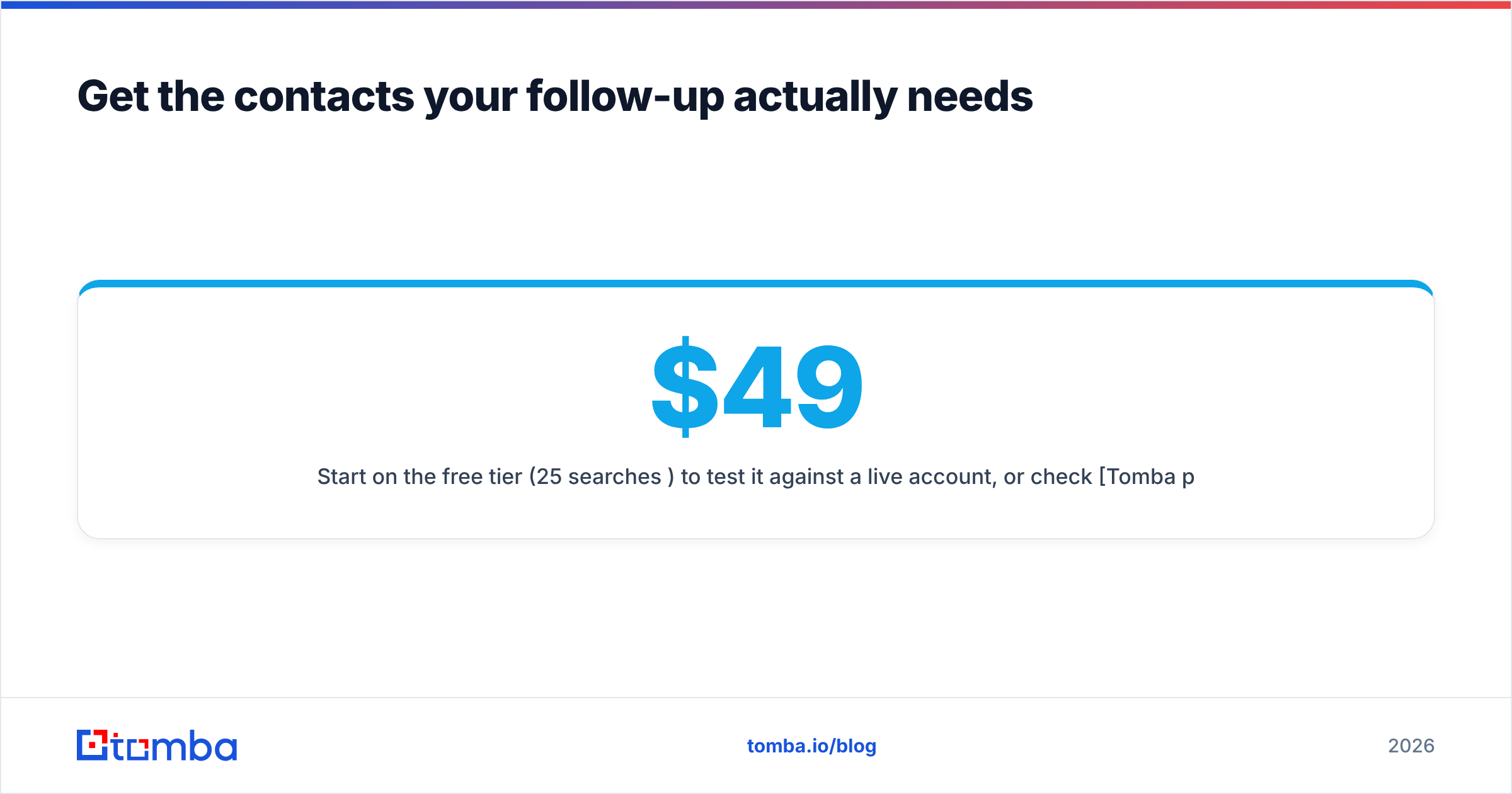
Get the contacts your follow-up actually needs#
The best-written follow up email after meeting with client stakeholders still fails if it reaches one person in a six-person buying group. Tomba's email finder resolves the names you heard in the meeting into verified, deliverable addresses — by domain, by full name, or in bulk from a CSV — so multi-threading takes a minute instead of an afternoon.
Start on the free tier (25 searches per month) to test it against a live account, or check Tomba pricing — Starter runs $49/mo, Growth $99/mo, Pro $249/mo — when follow-up volume outgrows manual lookup. You can also compare vendor options on G2 before committing.
Write the email in four minutes. Send it to everyone who needs to read it. That's the whole game.
Related guides#
Ready to find emails that actually work?
Join 150,000+ professionals who stopped guessing and started sending. Free credits on signup — no credit card required.
Get the Tomba newsletter
Practical outbound tactics and product updates — once every two weeks.
About the author