Follow Up Email After Negotiation: Templates That Close Deals
Most deals stall in the silence after the negotiation call. Here are the follow-up email structures, timing windows, and templates that keep momentum alive without sounding desperate.
TL;DR
- The follow up email after negotiation is not a courtesy note — it is the written record the buying committee will actually argue over. Send it within 24 hours, while the call is still fresh.
- Recap emails that restate terms, price, and open items outperform "just checking in" emails because they give your champion something forwardable.
- Timing beats volume: 24 hours, then 3 business days, then 7, then a breakup at day 14–21. Four touches, each with a different job.
- Every follow-up needs one explicit next step with a date. "Let me know your thoughts" is where deals go to die.
- If your email bounces because you only ever had the champion's address, the whole sequence fails — verified contact data for the economic buyer is part of the negotiation stack.
Why Does the Follow Up Email After Negotiation Decide the Deal?#
Because the negotiation you remember and the negotiation your buyer remembers are two different meetings.
You walked off the call thinking you'd agreed to a 12-month term at 15% off with onboarding included. Your champion walked off thinking they'd floated 20% and you'd "look into it." Three days later they present your deal to a CFO who was never on the call, using their memory as the source of truth. Whichever version is written down first becomes the version that's real.
That's the actual job of the follow up email after negotiation: it converts a conversation into a document. Everything else — the pleasantries, the enthusiasm, the "great speaking with you" — is packaging.
There's a second reason this email matters disproportionately. B2B deals now involve an average buying group of 6–10 people, according to Gartner's research on the B2B buying journey. You spoke to two of them. Your email is the only artifact the other four to eight will see. Write it for them, not for the person who was on the call.
What Should a Post-Negotiation Follow Up Email Contain?#
Six components, in this order. Skip any of them and the email loses its ability to function as a document.
- A one-line context anchor. "Following our call today on the Q4 rollout pricing." Not "It was great chatting!" The recipient may be reading this in a forwarded thread three levels deep.
- The agreed terms, itemized. Price, term length, seat count, start date, what's included. Use a bulleted list or small table so it survives being pasted into Slack.
- The open items, named with owners. "You're confirming seat count with Priya; I'm checking whether the sandbox environment is included at this tier." Ambiguity here is what creates the 3-week stall.
- The concession ledger. State what you moved on and what you got for it. "We can hold the 15% at a 12-month commitment" reads very differently from "we can do 15%."
- One next step with a date and a time. "Can you confirm by Thursday the 27th so we can hold the Q4 implementation slot?"
- A forwardable summary block. Two to four sentences your champion can copy-paste into an internal email without editing.
The last one is the piece almost nobody writes. Your champion is not going to reformat your email for their VP. Make it zero-effort.
Which Follow Up Structure Works Best for Each Scenario?#
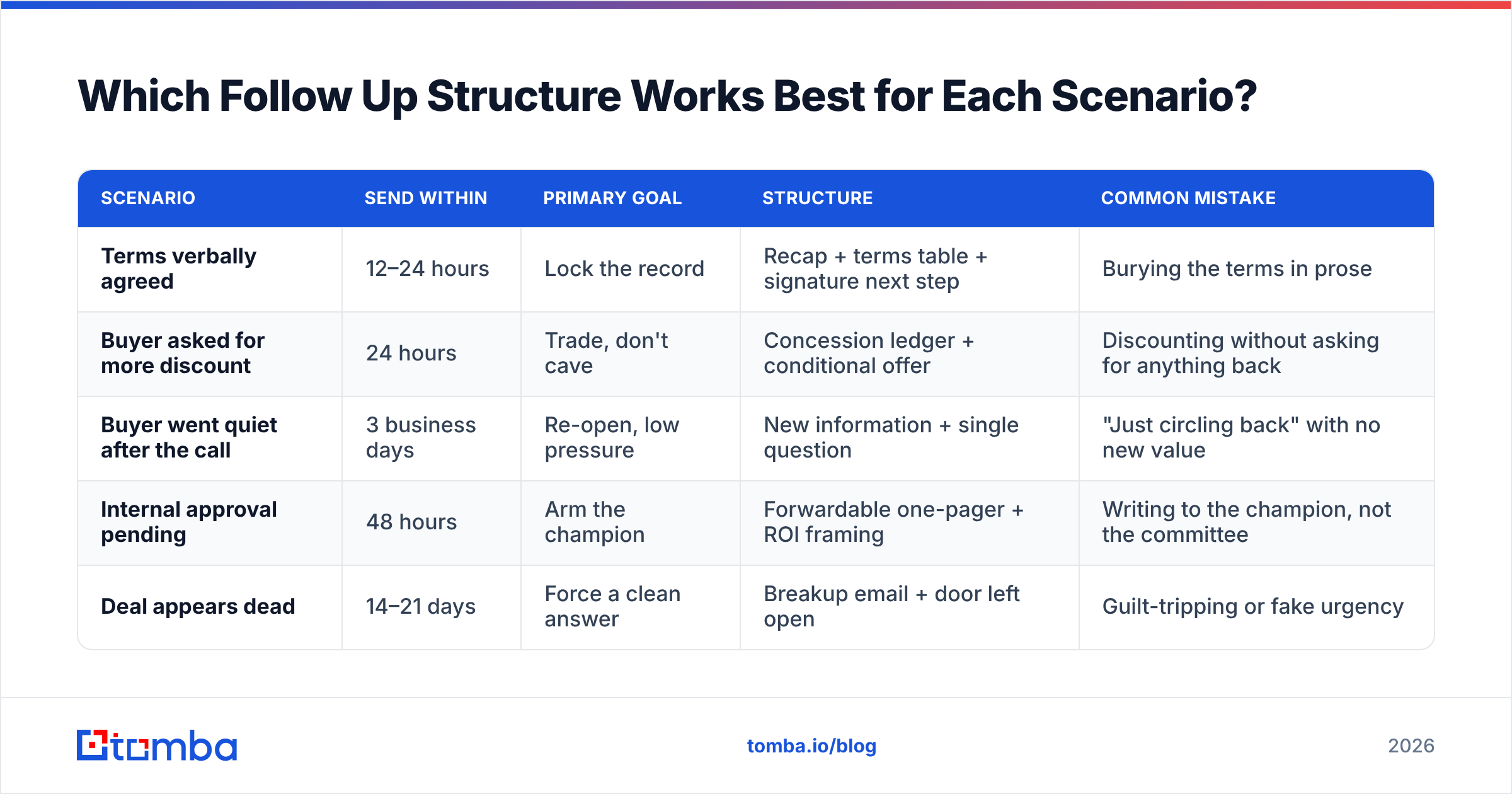
Not every post-negotiation moment calls for the same email. The four common outcomes need four different structures.
| Scenario | Send within | Primary goal | Structure | Common mistake |
|---|---|---|---|---|
| Terms verbally agreed | 12–24 hours | Lock the record | Recap + terms table + signature next step | Burying the terms in prose |
| Buyer asked for more discount | 24 hours | Trade, don't cave | Concession ledger + conditional offer | Discounting without asking for anything back |
| Buyer went quiet after the call | 3 business days | Re-open, low pressure | New information + single question | "Just circling back" with no new value |
| Internal approval pending | 48 hours | Arm the champion | Forwardable one-pager + ROI framing | Writing to the champion, not the committee |
| Deal appears dead | 14–21 days | Force a clean answer | Breakup email + door left open | Guilt-tripping or fake urgency |
The second row is where most reps lose margin. When a buyer pushes for another 5% after you've already conceded, the follow-up email is your leverage moment — in writing, unemotional, with a clear trade attached. "I can get to 20% if we move from 12 to 24 months" is a negotiation. "Let me see what I can do" is a surrender you've now put in writing.
What Does the 24-Hour Recap Email Look Like?#
Here's the template. Everything in brackets is a swap.
Subject: Recap — [Company] pricing + next steps (decision by [date])
Hi [Name],
Following up on today's call so we have everything in one place.
What we agreed:
- Plan: [Growth tier], [45] seats
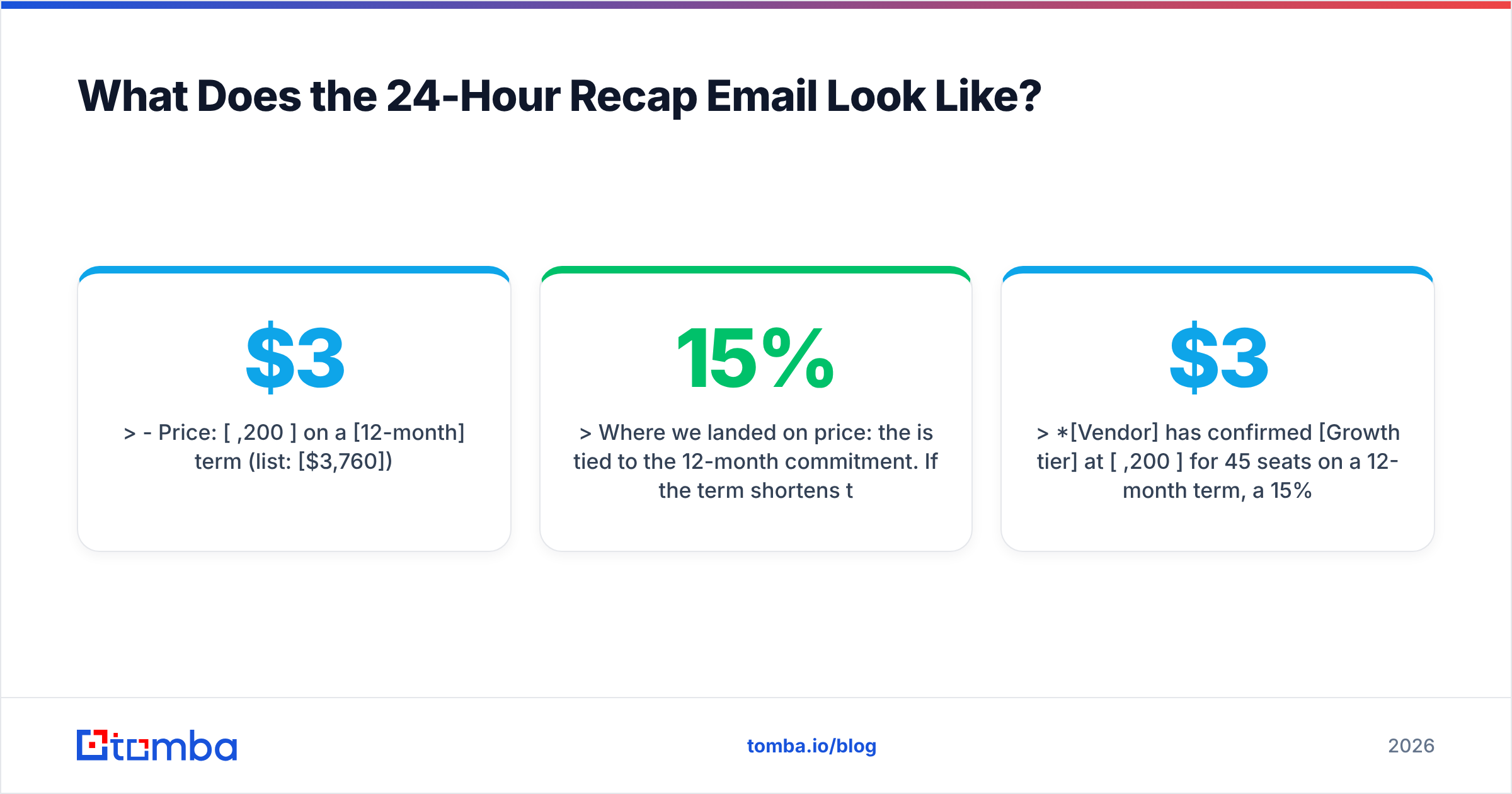
- Price: [$3,200/mo] on a [12-month] term (list: [$3,760])
- Start date: [October 1]
- Included: onboarding, dedicated Slack channel, quarterly review
Still open:
- [You] — confirm final seat count with [Priya] by [Thursday]
- [Me] — confirm sandbox access is included at this tier (answer by tomorrow)
Where we landed on price: the 15% is tied to the 12-month commitment. If the term shortens to 6 months, list pricing applies.
Next step: if you can confirm seat count by Thursday the 27th, I'll have paper to you Friday and we hold your October 1 start.
Here's a summary you can forward internally:
[Vendor] has confirmed [Growth tier] at [$3,200/mo] for 45 seats on a 12-month term, a 15% reduction from list. Onboarding and quarterly reviews are included. Implementation starts October 1 if we confirm by September 27.
[Your name]
Notice what's missing: no "I hope this email finds you well," no three-paragraph enthusiasm preamble, no "please don't hesitate to reach out." The email is scannable in fifteen seconds and forwardable in one click.
If you want more starting points beyond this structure, our library of cold email templates covers the earlier stages of the same sequence.
How Long Should You Wait Between Follow-Ups?#
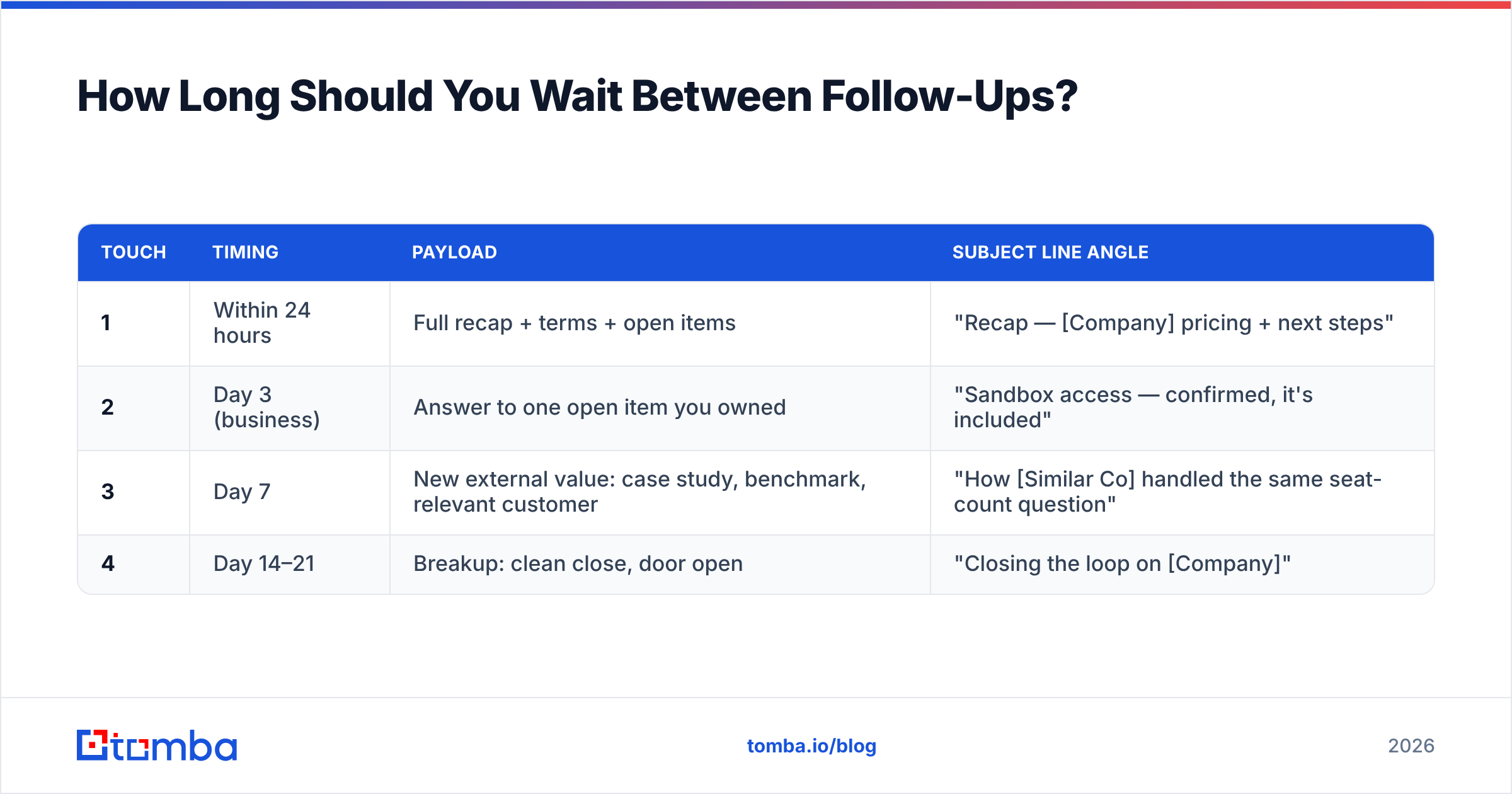
The cadence that works is front-loaded and then decays. Four touches over three weeks, each carrying a different payload.
| Touch | Timing | Payload | Subject line angle |
|---|---|---|---|
| 1 | Within 24 hours | Full recap + terms + open items | "Recap — [Company] pricing + next steps" |
| 2 | Day 3 (business) | Answer to one open item you owned | "Sandbox access — confirmed, it's included" |
| 3 | Day 7 | New external value: case study, benchmark, relevant customer | "How [Similar Co] handled the same seat-count question" |
| 4 | Day 14–21 | Breakup: clean close, door open | "Closing the loop on [Company]" |
Two rules make this cadence work rather than annoy.
Each touch must carry something new. Touch 2 exists because you promised to check something and now have the answer — that's a legitimate reason to appear in the inbox, and it demonstrates you do what you say. Touch 3 must bring information from outside the deal. If you have nothing new, don't send; wait until you do.
Never send "just checking in." It has no payload, it asks the buyer to do the work of remembering, and it signals you have nothing better to say. If your only reason for emailing is that time has passed, that's not a reason.
Response rates on post-negotiation follow-ups behave differently from cold outreach — you have an existing relationship, so the ceiling is much higher, but the floor for irrelevance is also much lower. A generic nudge to a warm prospect damages more than a generic cold email ever could. If you're tracking this properly, watch your response rate per touch number, not just in aggregate.
Is Email Still the Right Channel After a Negotiation Call?#
Mostly yes, with two exceptions.
Email wins for anything that needs to be a record. Terms, pricing, concessions, timelines — put them in email, always, even if you also say them on a call. Written terms are what survive a champion changing jobs mid-cycle, which happens in a meaningful share of long enterprise deals.
The exceptions:
- When the deal has gone quiet for 10+ days after two emails. A phone call breaks a silence that email cannot. The email cadence has already told them everything; what you need now is a human reaction.
- When your champion has explicitly moved the conversation elsewhere — Slack Connect, WhatsApp, a shared channel. Follow them there for speed, but still send the recap by email so it exists in a searchable, forwardable place.
There's a third case that's really a data problem, not a channel problem. Sometimes the deal stalls because the person who can say yes was never in the thread. You've been emailing the manager who ran the evaluation while the VP of Ops holds the budget. No cadence fixes that — you need the second contact.
That's where a domain search earns its keep mid-deal: pull the org's email pattern and the other decision-makers on the account, then loop the right person in with your champion's blessing rather than going around them. Pair it with a phone finder lookup when you need the call that email can't replace.
How Do You Keep Follow-Ups From Bouncing or Landing in Spam?#
Post-negotiation emails have a hidden failure mode: they never arrive, and you interpret silence as rejection.
Three things cause this.
Stale addresses. Contact data decays roughly 2–3% per month through job changes and restructuring, per aggregate estimates cited across vendor research on G2. Over a six-month enterprise cycle, that's a real chance the address you captured at discovery is dead by the time you're negotiating. Running your key contacts through an email verifier before a critical send costs seconds and prevents a silent failure.
Thread hygiene. Long forwarded threads with quoted history and multiple attachments trip spam filters more often than clean replies. Start a fresh thread for the recap email with a clean subject line, and reference the prior thread rather than nesting inside it.
Domain reputation from your cold outbound. If your team blasts cold sequences from the same domain you use for live deals, a reputation hit on the cold side lands on your negotiation emails too. Keep them separated by subdomain. The basics of email deliverability apply here even though this isn't cold email.
One more practical note: if a recap email to a decision-maker goes unanswered for 72 hours and you've never emailed that person before, verify the address before you assume disinterest. It's the cheapest diagnostic in the deal.
What Are the Most Common Post-Negotiation Email Mistakes?#
Ranked by how much damage they do.
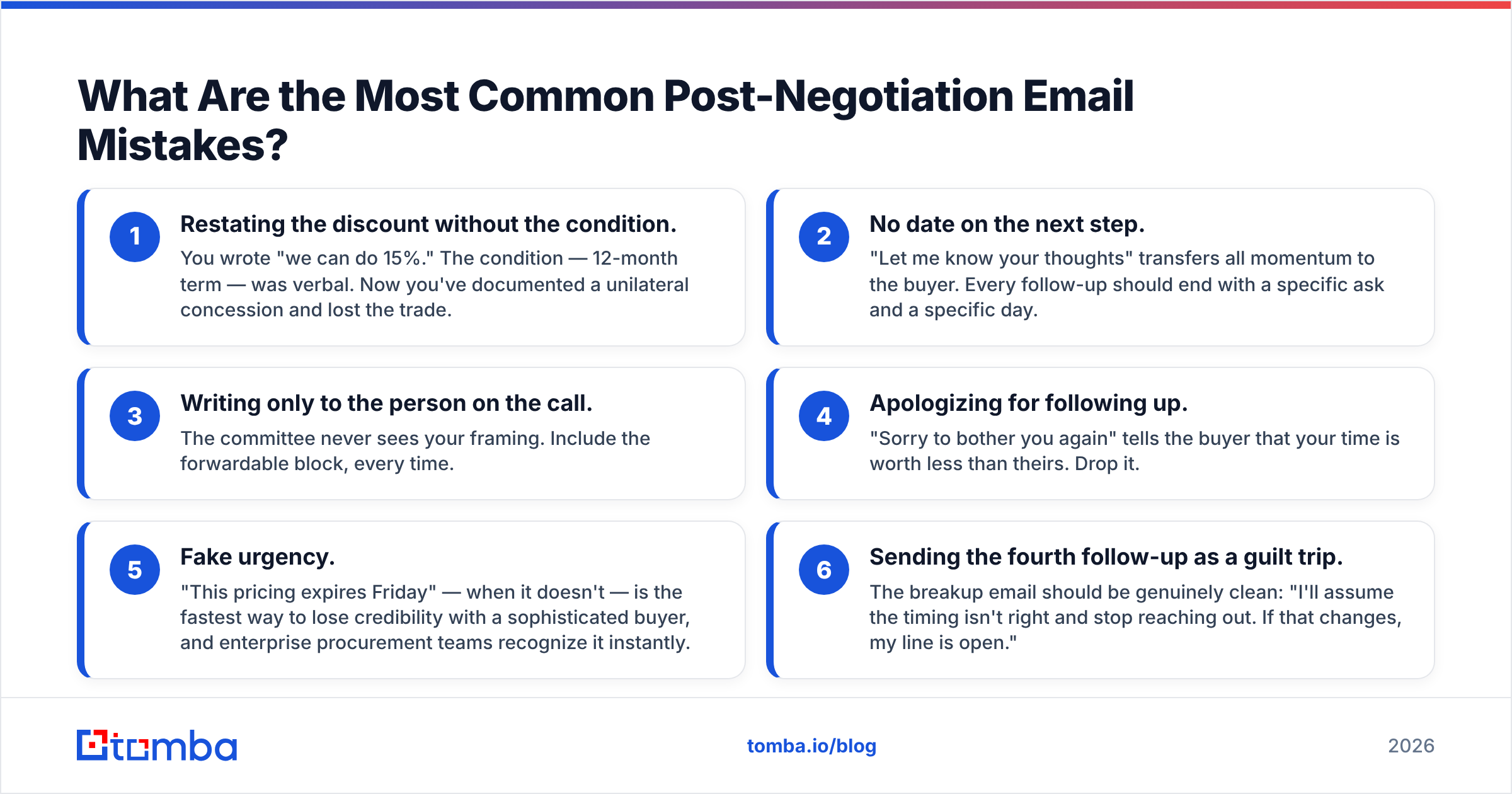
- Restating the discount without the condition. You wrote "we can do 15%." The condition — 12-month term — was verbal. Now you've documented a unilateral concession and lost the trade.
- No date on the next step. "Let me know your thoughts" transfers all momentum to the buyer. Every follow-up should end with a specific ask and a specific day.
- Writing only to the person on the call. The committee never sees your framing. Include the forwardable block, every time.
- Apologizing for following up. "Sorry to bother you again" tells the buyer that your time is worth less than theirs. Drop it.
- Fake urgency. "This pricing expires Friday" — when it doesn't — is the fastest way to lose credibility with a sophisticated buyer, and enterprise procurement teams recognize it instantly.
- Sending the fourth follow-up as a guilt trip. The breakup email should be genuinely clean: "I'll assume the timing isn't right and stop reaching out. If that changes, my line is open."
The breakup email deserves a note. Done well, it has one of the highest reply rates in the entire cadence, because it removes the social cost of saying no. Buyers who've been avoiding you will often reply to it with the actual reason for the delay — which is information you can act on. Written as a guilt trip, it converts a dormant deal into a dead one.
How Do You Find the Decision-Maker You Weren't Introduced To?#
This is the follow-up problem nobody writes templates for. Your champion is enthusiastic, responsive, and completely unable to sign anything. The person who can sign has never heard of you.
The sequence that works:
- Ask first. "Who else needs to sign off, and would it help if I put together a one-pager for them?" This is the low-risk move and it works more often than reps expect.
- If they deflect, find the person anyway — not to email around your champion, but so you know who you're writing the forwardable block for. Titles and org structure change how you frame ROI.
- Get a verified address before you need it. When your champion finally says "can you send this to our COO directly," you don't want to spend two days guessing at the format. Tools like Tomba Email Finder resolve a name plus domain into a verified address in seconds, and a reverse email lookup works in the other direction when someone new appears on the thread with no signature block.
- Loop them in with your champion, never around them. "Happy to send the summary to [COO] directly if that's easier — or you're welcome to forward it, whichever works better internally."
Step 4 is not optional. Going around a champion is the single fastest way to turn an advocate into an opponent.
What Should You Track to Know If Your Follow-Ups Work?#
Four metrics, in order of usefulness.
- Reply rate by touch number. If touch 1 gets 60% and touch 2 gets 8%, your touch-2 payload is weak — it's probably a "checking in" email in disguise.
- Days from negotiation call to signed paper. This is what the recap email is actually optimizing. If it's not shrinking, your recaps aren't clear enough.
- Percentage of deals where the recap gets forwarded. Ask your champions directly, or watch for new names appearing on the thread. Forwarding is the strongest signal your email is doing its job.
- Bounce rate on decision-maker sends. Should be near zero. If it isn't, your contact data — not your copy — is the bottleneck.
Nothing here requires a new tool. A spreadsheet and honest logging beats an unmeasured "I follow up a lot."
Ready to Stop Losing Deals to Silence?#
The follow up email after negotiation is a document, a leverage point, and a forwarding tool all at once — and none of it works if the address is wrong or the decision-maker is missing from the thread.
Tomba Email Finder gets you verified, current addresses for the people who actually approve the deal, so your recap lands where it needs to land. Start on the free tier with 25 searches a month, or move to Starter at $49/mo when you're running full pipelines. See Tomba pricing for the full breakdown, and check the Tomba API if you want verification running automatically before every critical send.
Write the recap. Put a date on the next step. Make sure it arrives.
Related guides#
Ready to find emails that actually work?
Join 150,000+ professionals who stopped guessing and started sending. Free credits on signup — no credit card required.
Get the Tomba newsletter
Practical outbound tactics and product updates — once every two weeks.
About the author