Follow Up Email After Presentation: Templates That Close
Most deals stall in the 48 hours after a great presentation. Here are the follow-up email structures, timing windows, and templates that actually move stakeholders from nodding to signing.
TL;DR
- Send your follow-up within 24 hours. Response rates drop sharply after 48 hours because the meeting is no longer top of mind for the people who did not speak up in the room.
- The recap is not the point. The point is a documented next step with a date, an owner, and a decision the buyer has to make.
- Write one email to the champion and a separate, shorter one to the economic buyer who half-watched from a laptop. Same deal, different jobs.
- A follow-up sequence of 4-6 touches over three weeks outperforms a single "just checking in" note by a wide margin.
- If you only have one contact from the room, enrich the attendee list before you send. Missing the actual decision-maker is the most expensive follow-up mistake there is.
You nailed the presentation. Heads nodded. Someone said "this is exactly what we've been looking for." Then nothing happened for eleven days.
That is not a presentation problem. That is a follow-up problem. The presentation created interest; the follow-up email after presentation is the artifact that survives inside the buyer's organization, gets forwarded to people who never saw your deck, and either creates a next meeting or dies in an inbox.
This guide covers the timing, structure, templates, and multi-stakeholder mechanics that turn a good meeting into a moving deal.
Why does the follow-up email matter more than the presentation?#
Because the presentation happens once, to the people who showed up, and then it stops existing. Your follow-up email is the version of your pitch that gets forwarded.
Think of it like a job interview. The interview is where you perform. The thank-you note is where you control the summary that the hiring committee reads before they vote. B2B buying works the same way — Gartner research on B2B buying consistently finds that buying groups now include six to ten stakeholders, and most of them were not in your meeting.
Three things your follow-up must do that the presentation could not:
- Reach the absent decision-makers. The CFO who approves budget usually skips the first demo. Your email is their entire impression of you.
- Fix what got misheard. In a 45-minute call, at least one objection was half-answered. Written follow-up is your chance to answer it properly, without interruption.
- Create an artifact the champion can defend. Your champion has to sell you internally when you are not in the room. Give them ammunition, not a thank-you card.
When should you send a follow-up email after a presentation?#
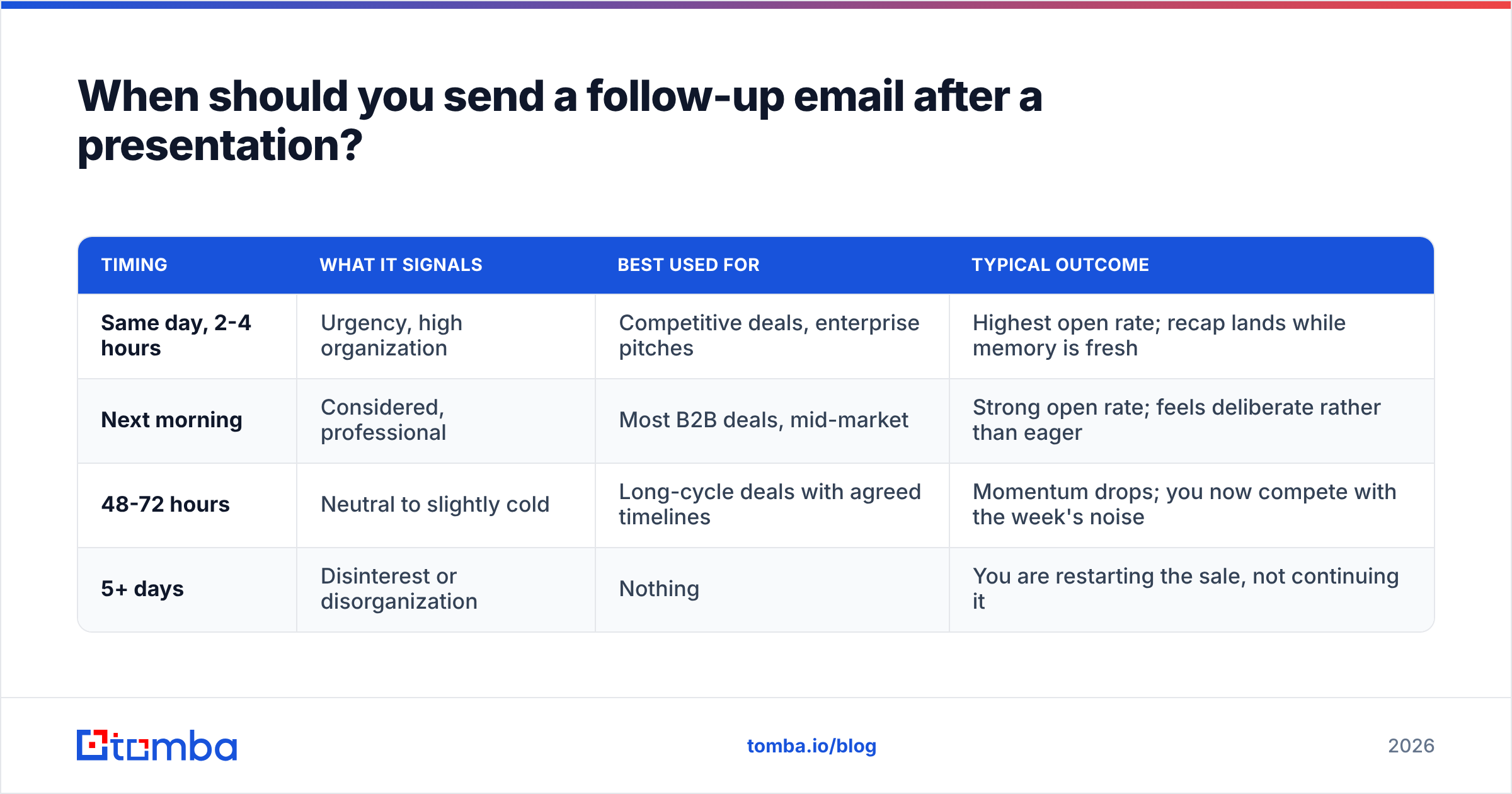
Within 24 hours, and ideally within four. Here is what the timing windows actually do:
| Timing | What it signals | Best used for | Typical outcome |
|---|---|---|---|
| Same day, 2-4 hours | Urgency, high organization | Competitive deals, enterprise pitches | Highest open rate; recap lands while memory is fresh |
| Next morning | Considered, professional | Most B2B deals, mid-market | Strong open rate; feels deliberate rather than eager |
| 48-72 hours | Neutral to slightly cold | Long-cycle deals with agreed timelines | Momentum drops; you now compete with the week's noise |
| 5+ days | Disinterest or disorganization | Nothing | You are restarting the sale, not continuing it |
The same-day send has one requirement: it must contain something the buyer did not already have. A recap sent two hours after the call, containing only what you just said out loud, reads as filler. Attach the pricing sheet they asked for, the security doc, the customer reference. Speed plus substance beats speed alone.
For multi-stakeholder deals, stagger your sends. Champion gets the detailed email same day. The economic buyer gets a three-line version the next morning, so it lands on top of their inbox rather than buried in yesterday's pile.
What should a follow-up email after a presentation include?#
Six components, in this order. Skip any of them and the email stops working.
- A subject line that references the meeting specifically — "Warehouse routing pilot — next steps" beats "Great meeting today." The specific one survives a search three weeks later.
- One sentence of thanks, maximum — gratitude is table stakes, not content. Two sentences of thanks reads as junior.
- A three-bullet recap of what they said, not what you said — "You mentioned onboarding takes six weeks and that's the number your COO is measured on." This proves you listened and lets forwarded readers understand the context.
- The answer to the objection you fumbled — every presentation has one. Address it head-on with a link, a number, or a customer name.
- One clear next step with a date and an owner — "I've held Thursday 2pm and Friday 10am. Which works for a technical review with your data team?" Not "let me know your thoughts."
- An attachment or link they explicitly asked for — this is the reason they open your next email too.
Notice what is missing: your company boilerplate, your feature list, and a second call to action. One ask per email. Two asks means zero decisions.
What do the best follow-up email templates look like?#
Below are templates for the five situations that cover roughly 90% of post-presentation scenarios. Adapt the specifics; keep the structure.
Template 1 — The 24-hour recap (send to your champion)
Subject: Warehouse routing pilot — next steps
Hi Dana,
Thanks for the time yesterday. Three things I took away:
- Onboarding currently runs six weeks and that timeline is what your COO tracks.
- Your team rejected the last vendor because reporting couldn't split by depot.
- Budget sits with Marcus, and the approval window closes end of Q3.
On depot-level reporting — I under-explained this. Here's a two-minute walkthrough showing the depot filter in a live account: [link]. Northwind runs 14 depots on the same setup.
Next step: a 30-minute technical review with your data team. I've held Thursday 2pm and Friday 10am. Which one should I lock?
Ben
Template 2 — The absent executive (send to the economic buyer)
Subject: 3-line summary from yesterday's session with Dana's team
Hi Marcus,
Dana asked me to loop you in. Short version:
Your team is losing roughly 90 hours a month to manual depot routing. We showed a setup that cuts that to under 15. Northwind hit the same numbers in seven weeks.
No deck needed. If it's useful, I can give you 15 minutes on the ROI math and the security review — or you can just take Dana's read on it.
Ben
Template 3 — The silence-breaker (day 7, no reply)
Subject: Re: Warehouse routing pilot — next steps
Hi Dana,
Guessing the depot review slipped behind something more urgent. Two options:
- I hold the Q3 pricing for two more weeks while your side clears space.
- We park this until October and I stop filling your inbox.
Either is genuinely fine — just tell me which.
Ben
Template 4 — The new-information nudge (day 12)
Subject: The depot reporting question, answered properly
Hi Dana,
We shipped depot-level export last Tuesday — the exact gap your team flagged. Screenshot attached.
Worth 20 minutes to show your data lead? Same two slots as before, or send me a time.
Ben
Template 5 — The close-the-loop email (day 21)
Subject: Closing your file?
Hi Dana,
I haven't heard back, which usually means priorities shifted. I'm going to close this out on my side so I stop chasing you.
If routing comes back onto the roadmap, reply to this thread and I'll pick it straight back up — no re-discovery, no new deck.
Ben
Template 5 gets replies more often than templates 3 and 4 combined. Removing pressure is itself a pressure release, and buyers respond to it.
How many follow-ups should you send before giving up?#
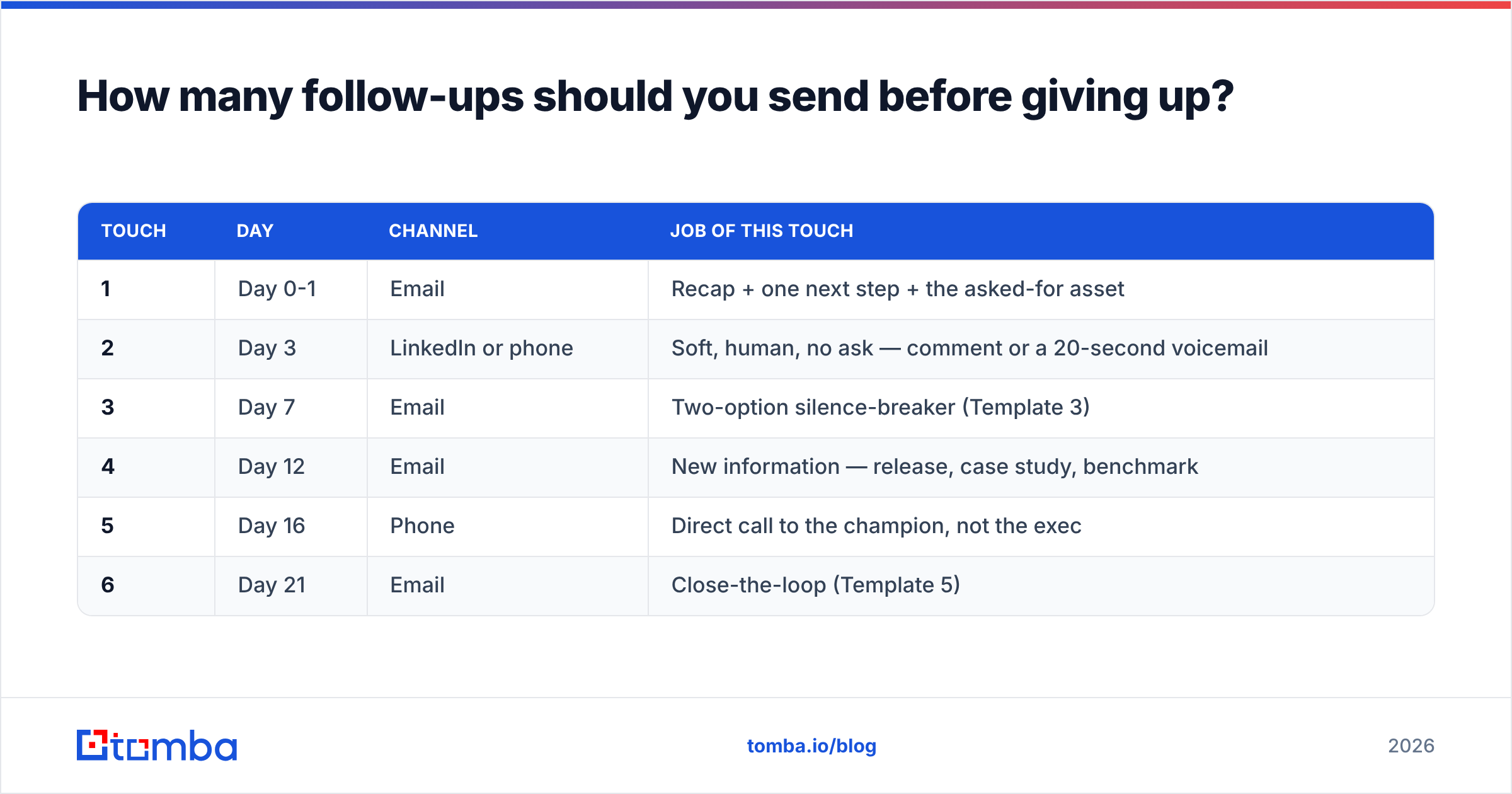
Four to six touches across three weeks, mixing channels. A single follow-up is under-selling; ten is harassment.
| Touch | Day | Channel | Job of this touch |
|---|---|---|---|
| 1 | Day 0-1 | Recap + one next step + the asked-for asset | |
| 2 | Day 3 | LinkedIn or phone | Soft, human, no ask — comment or a 20-second voicemail |
| 3 | Day 7 | Two-option silence-breaker (Template 3) | |
| 4 | Day 12 | New information — release, case study, benchmark | |
| 5 | Day 16 | Phone | Direct call to the champion, not the exec |
| 6 | Day 21 | Close-the-loop (Template 5) |
Two rules make this sequence work. First, every touch after the recap must carry something new — a number, a release note, a customer story. "Just following up" is not a touch, it is a nag. Second, vary the channel. Email-only sequences hit inbox fatigue by touch three, which is why blending in LinkedIn outreach and a phone call meaningfully lifts total reply rate.
If you are running this sequence at volume, the practical bottleneck is contact data — specifically phone numbers for touch five and verified addresses for the stakeholders who never emailed you. A phone finder and a bulk email finder turn a manual scramble into a batch job.
How do you follow up with people who weren't in the room?#
You find them, verify them, and write to them differently. This is the highest-leverage and most-skipped part of post-presentation follow-up.
After the meeting, your champion mentions three names: the CFO who owns budget, the IT director who runs security review, and a regional manager whose team would actually use the product. You have zero email addresses for any of them.
The workflow that fixes this:
- Map the buying group first. Write down every name mentioned in the call, plus their role in the decision — economic buyer, technical gatekeeper, end user, blocker. Four names is typical for mid-market, eight or more for enterprise.
- Find the addresses. Run the company domain through a domain search to pull the org's verified contacts and the email pattern, then use a email finder for the specific names your champion gave you.
- Verify before sending. A bounce to a CFO on a live deal is a credibility event, not a metrics event. Run every new address through an email verifier first.
- Write role-specific, not role-generic. The CFO email leads with payback period. The IT email leads with SOC 2 and SSO. The end-user email leads with what stops being annoying on Monday.
- Always tell your champion. Copy them, or tell them first. Going around a champion is the fastest way to lose one.
One caution on multithreading: do not send four near-identical emails to four people at the same company on the same morning. They compare notes, and matching boilerplate reads as automation. Stagger by a day and change the lead paragraph substantively.
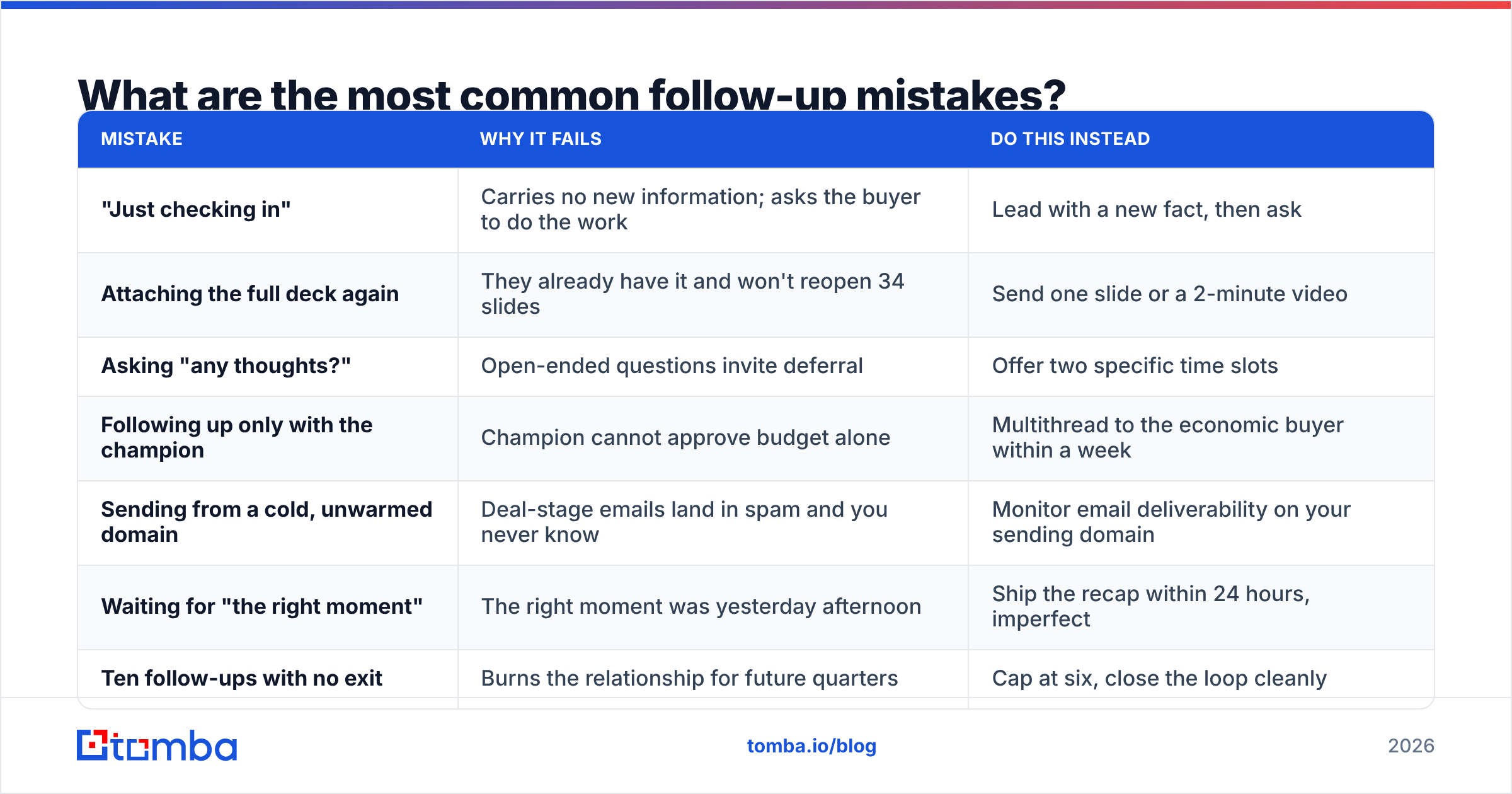
What are the most common follow-up mistakes?#
| Mistake | Why it fails | Do this instead |
|---|---|---|
| "Just checking in" | Carries no new information; asks the buyer to do the work | Lead with a new fact, then ask |
| Attaching the full deck again | They already have it and won't reopen 34 slides | Send one slide or a 2-minute video |
| Asking "any thoughts?" | Open-ended questions invite deferral | Offer two specific time slots |
| Following up only with the champion | Champion cannot approve budget alone | Multithread to the economic buyer within a week |
| Sending from a cold, unwarmed domain | Deal-stage emails land in spam and you never know | Monitor email deliverability on your sending domain |
| Waiting for "the right moment" | The right moment was yesterday afternoon | Ship the recap within 24 hours, imperfect |
| Ten follow-ups with no exit | Burns the relationship for future quarters | Cap at six, close the loop cleanly |
The deliverability one surprises people. A follow-up email after presentation feels like a warm, one-to-one message — but if your domain sends 400 cold emails a day from the same address, your reply-worthy follow-up inherits that reputation. HubSpot's sales email research and vendor deliverability guides both make the same point: sending infrastructure and message quality are separate problems, and the first one silently eats the second.
Should you use AI to write follow-up emails?#
Yes for the first draft, no for the send button.
AI is good at structure and bad at specifics. It will produce a competent recap skeleton in four seconds. It cannot know that the COO winced when you said "migration," or that the champion's real fear is looking foolish in front of their new VP. Those details are the entire reason a follow-up works.
A workable split:
- Let AI handle: subject-line variants, tightening a rambling paragraph, generating the three-line executive version of a long email, translating a technical answer into business language.
- Keep human: the specific quotes from the meeting, the named objection, the next-step ask, and anything that references a person's stated concern.
Practical test: if your follow-up could be sent, unedited, to a different prospect in the same industry, it is too generic to work. Every good post-presentation email contains at least two sentences that would make no sense to anyone else.
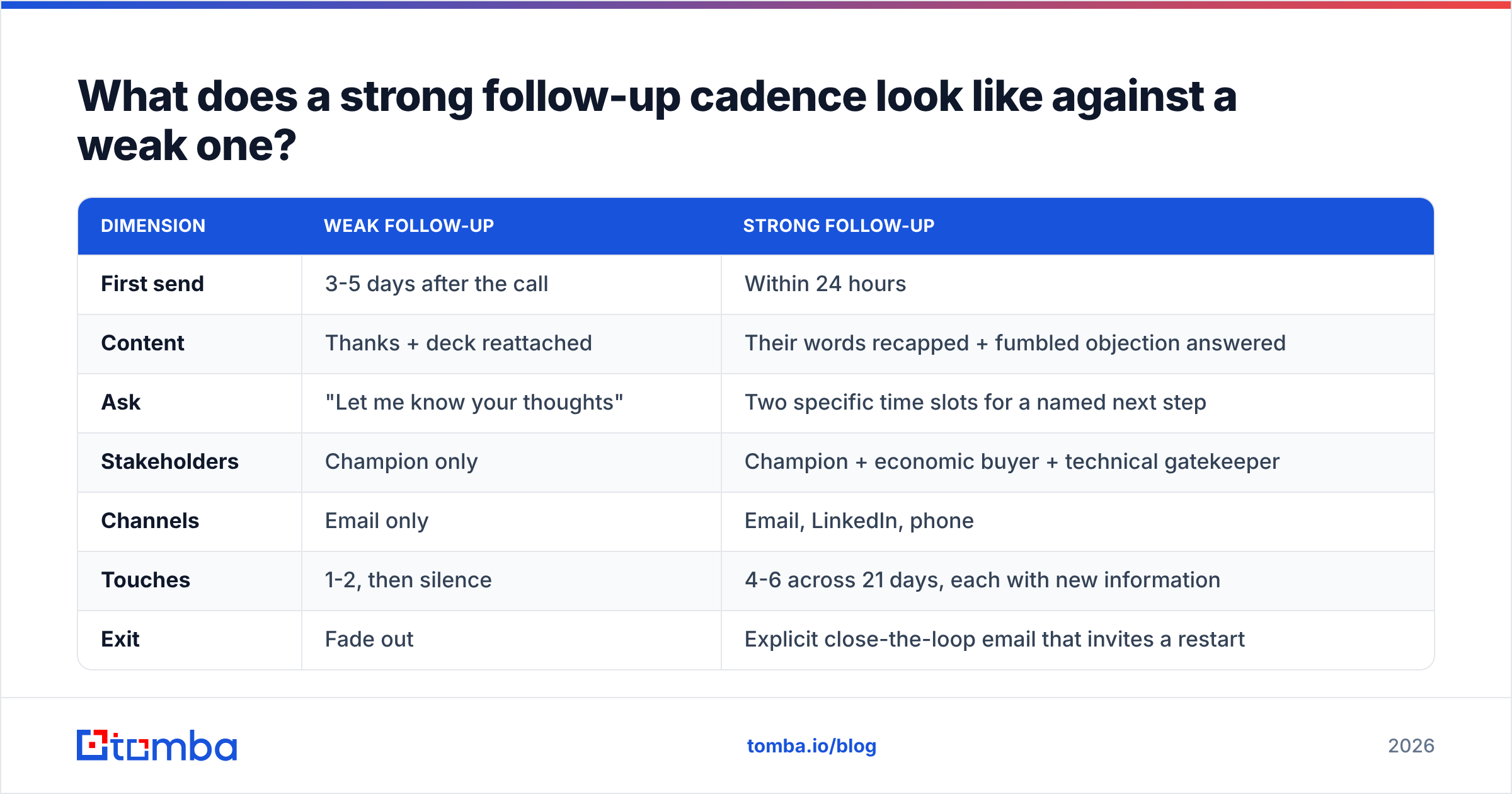
What does a strong follow-up cadence look like against a weak one?#
| Dimension | Weak follow-up | Strong follow-up |
|---|---|---|
| First send | 3-5 days after the call | Within 24 hours |
| Content | Thanks + deck reattached | Their words recapped + fumbled objection answered |
| Ask | "Let me know your thoughts" | Two specific time slots for a named next step |
| Stakeholders | Champion only | Champion + economic buyer + technical gatekeeper |
| Channels | Email only | Email, LinkedIn, phone |
| Touches | 1-2, then silence | 4-6 across 21 days, each with new information |
| Exit | Fade out | Explicit close-the-loop email that invites a restart |
| Data hygiene | Guessed addresses, occasional bounces | Verified addresses before every new-stakeholder send |
The gap between these two columns is not talent. It is process, and process is copyable.
How do you make follow-up repeatable across a team?#
Build three assets and stop relying on memory.
A snippet library. Five templates, stored where reps actually work — CRM, inbox plugin, or a shared doc. Pair it with a set of cold email templates so reps are editing, not composing from blank.
A stakeholder checklist in the CRM. After every presentation, the rep logs every name mentioned and their role. This single field does more for multithreading than any training session, and it feeds directly into your enrichment workflow — push the names through data enrichment to fill titles, emails, and LinkedIn profiles without manual research.
A cadence that fires automatically. Whatever sequencing tool you use, the six-touch structure above should be a template a rep applies in one click, then personalizes. Reps skip follow-ups because starting them is friction, not because they disagree with the strategy. Tools like G2's sales engagement category list dozens of options; the specific tool matters far less than whether the cadence exists at all.
One measurement note: track reply rate per touch, not just overall. Most teams discover that touch four — the new-information email — dramatically outperforms touch three, which tells you to invest in having something new to say rather than in following up more often.
Getting the contact data your follow-up depends on#
Every tactic here assumes you can reach the right person. That assumption breaks constantly. Your champion forwards your email into a black hole, the CFO's address is not on the website, and the technical gatekeeper joined the call as "iPhone (3)."
The Tomba Email Finder closes that gap: search by name and company domain, get a verified professional address with a confidence score, and push it straight into your sequence. Free tier covers 25 searches a month if you just want to test it against a couple of open deals; paid plans start at $49/mo for Starter and $99/mo on Growth when multithreading becomes a weekly habit rather than an occasional scramble — full Tomba pricing is public.
Write the recap within 24 hours. Name the next step. Find the three people who were not in the room. That is the whole discipline.
Related guides#
Ready to find emails that actually work?
Join 150,000+ professionals who stopped guessing and started sending. Free credits on signup — no credit card required.
Get the Tomba newsletter
Practical outbound tactics and product updates — once every two weeks.
About the author