Follow Up Email After Quote: Templates and Timing That Close
Most quotes die in silence, not rejection. Here are the follow-up sequences, timing windows, and templates that actually get a decision after you send pricing.
TL;DR
- Silence after a quote is almost never rejection — it's usually an internal delay, a missing approver, or a budget cycle you can't see.
- Send the first follow up email after quote 48–72 hours after delivery, then run a 5-touch sequence over 21 days. Most closed deals in B2B need 3–5 post-quote touches.
- Every touch must add something new: a risk answer, a comparable customer, a timeline consequence. "Just checking in" is the single lowest-performing opener in quote follow-up.
- Multithread by touch 3. If your only contact is the person who requested the quote, you're one PTO week away from a dead deal.
- Verify the decision-maker's address before you assume you're being ignored — a meaningful share of "no replies" are bounces or wrong-inbox sends.
Why do most quotes go silent instead of getting a no?#
Because a "no" costs your buyer something and silence costs them nothing.
Think of it like sending a contractor's estimate for a kitchen remodel. The homeowner didn't hate the number. They just haven't talked to their spouse, don't know if the money clears before the holidays, and replying "we're thinking about it" feels like an invitation to be chased. So they say nothing.
B2B quotes work the same way. When a deal stalls after pricing, the real causes are usually mundane:
- The requester isn't the approver. They asked for a quote to complete a comparison exercise for someone else. That someone else hasn't seen it.
- The budget window moved. Quarter-end shifted, a hiring freeze landed, a bigger project ate the line item.
- An unanswered objection is sitting there. Implementation time, migration risk, contract length — something they didn't want to argue about on a call.
- You're one of three quotes. They're waiting on the slowest competitor before deciding anything.
- The email never landed. Wrong address, spam folder, or a role alias nobody monitors.
Only the last one is a technical problem. The other four are all solved by follow-up that supplies new information instead of new pressure.
What is the right timing for a follow up email after quote?#
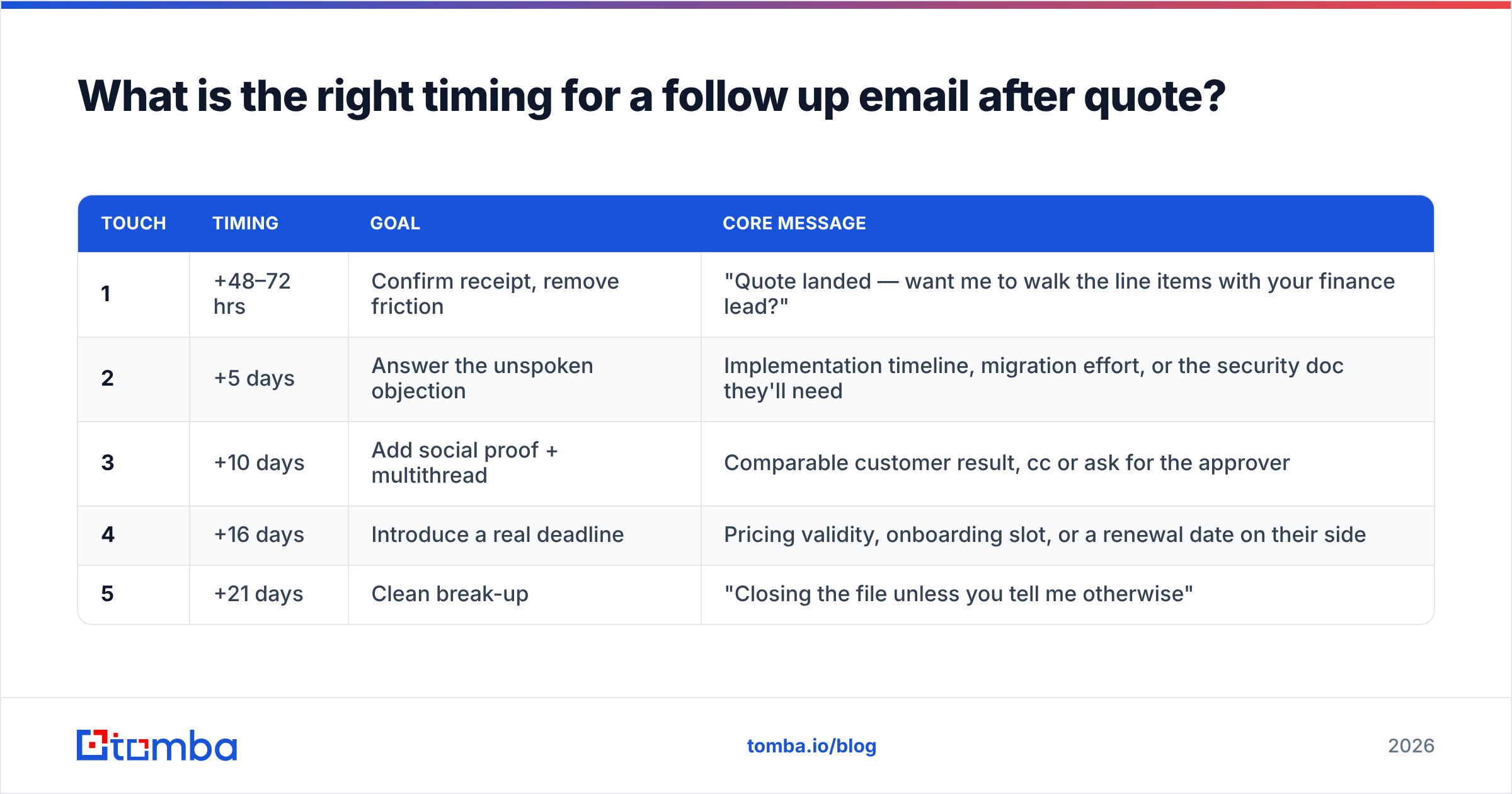
48 to 72 hours for the first touch, then widening gaps across roughly three weeks.
Same-day follow-up reads as anxious. A week of silence reads as indifference. The window in between is where you look organized without looking desperate.
Here's a cadence that works for mid-market deals with a 30–90 day cycle:
| Touch | Timing | Goal | Core message |
|---|---|---|---|
| 1 | +48–72 hrs | Confirm receipt, remove friction | "Quote landed — want me to walk the line items with your finance lead?" |
| 2 | +5 days | Answer the unspoken objection | Implementation timeline, migration effort, or the security doc they'll need |
| 3 | +10 days | Add social proof + multithread | Comparable customer result, cc or ask for the approver |
| 4 | +16 days | Introduce a real deadline | Pricing validity, onboarding slot, or a renewal date on their side |
| 5 | +21 days | Clean break-up | "Closing the file unless you tell me otherwise" |
Two adjustments matter more than the exact days:
- Transactional deals compress. Under $5K with a single approver? Run the same five touches in 10 days, not 21.
- Enterprise deals stretch. Six-figure quotes with procurement involved often need 45–60 days and a parallel LinkedIn or phone track. A phone finder matters more here than a sixth email.
What should each follow-up actually say?#
Every touch answers a different question in the buyer's head. Write to the question, not to the calendar.
Touch 1 — "Did this arrive and is it readable?"
Subject: Quote — line 3 question
Hi Dana,
Sent the quote Tuesday. One thing I should have flagged: line 3 (onboarding) is a one-time fee, not recurring — a few people have read it the other way.
If it's useful, I can jump on 15 minutes with whoever owns the budget and walk the numbers. Otherwise, happy to answer by email.
— Ben
Why it works: it gives a real reason to email, corrects a genuine misreading, and offers a low-cost next step. It never says "just checking in."
Touch 2 — "What's the risk if we say yes?"
Subject: The migration question you didn't ask
Hi Dana,
Most teams at your size ask the same thing after the quote: how much of this lands on their ops person. Short answer — about four hours across two weeks, and we do the field mapping.
Attaching the two-page implementation outline so you can forward it internally without needing me on a call.
— Ben
Touch 3 — "Has anyone like us done this?"
Proof beats adjectives. Name a company in their segment, give a number, keep it to two sentences. Then multithread: "Should I send this to Marcus as well, or would you rather forward it?" That question is polite, gives them control, and surfaces the real approver.
Touch 4 — "Is there a cost to waiting?"
Deadlines only work when they're true. Real ones: quoted pricing expires on a stated date, the Q1 onboarding cohort fills, their current contract auto-renews on the 30th. Fake urgency ("my manager needs an answer today") burns trust and is easy to spot.
Touch 5 — The break-up.
Subject: Closing the file?
Hi Dana,
Haven't heard back, which usually means this slid down the priority list — completely fair. I'll close the file on my side unless you'd like me to keep it open.
If timing is the issue, tell me a month and I'll circle back then instead of pinging you.
— Ben
Break-ups generate replies because they remove the obligation to negotiate. You're offering an exit, and a surprising number of buyers respond with "no, wait."
If you'd rather not write these from scratch each time, start from a cold email templates library and rewrite the specifics — the structure transfers, the details never should.
Should you follow up by email, phone, or LinkedIn?#
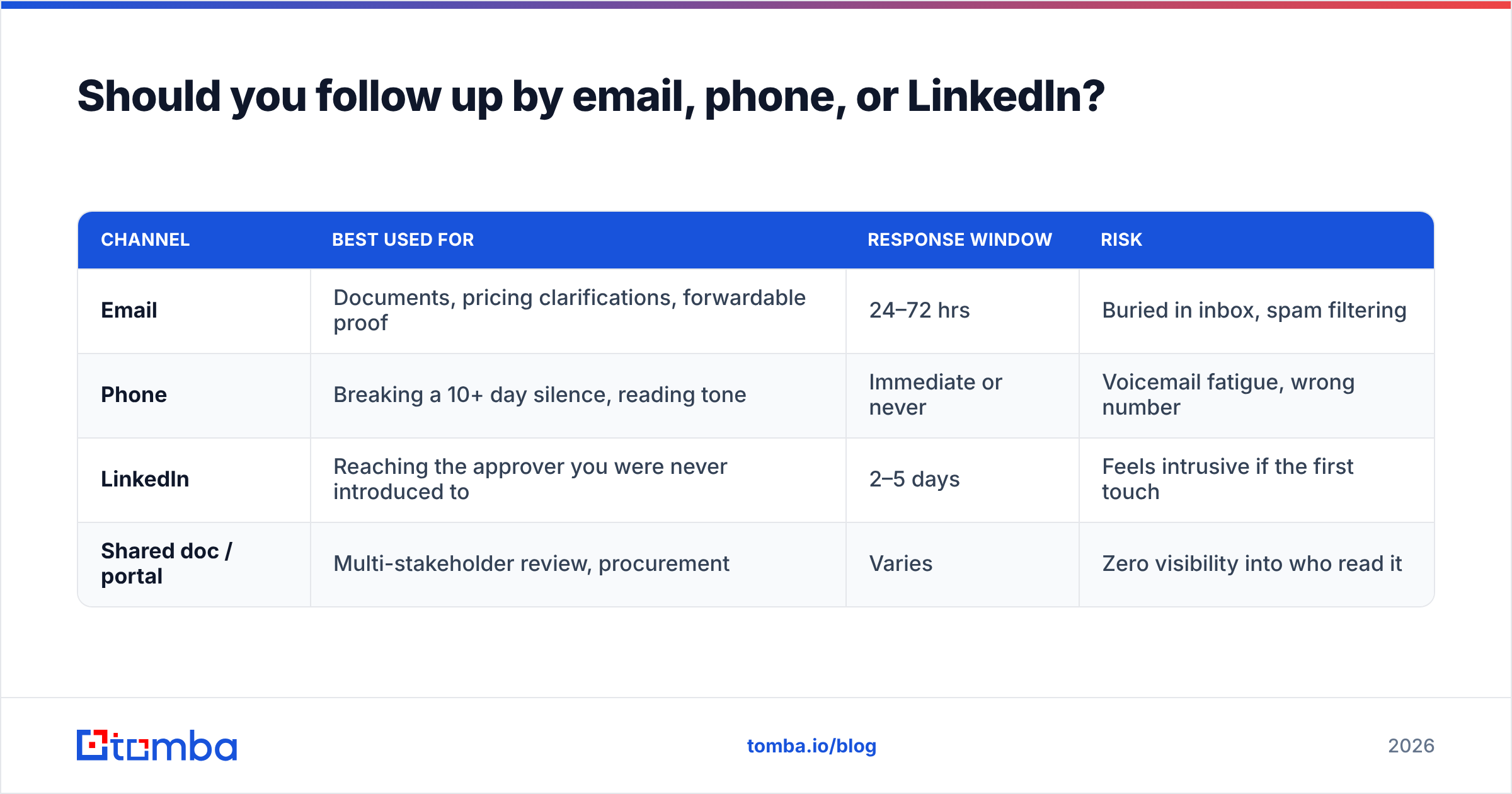
Use all three, but assign them different jobs.
| Channel | Best used for | Response window | Risk |
|---|---|---|---|
| Documents, pricing clarifications, forwardable proof | 24–72 hrs | Buried in inbox, spam filtering | |
| Phone | Breaking a 10+ day silence, reading tone | Immediate or never | Voicemail fatigue, wrong number |
| Reaching the approver you were never introduced to | 2–5 days | Feels intrusive if the first touch | |
| Shared doc / portal | Multi-stakeholder review, procurement | Varies | Zero visibility into who read it |
The practical rule: email carries the substance, phone breaks stalemates, LinkedIn opens doors to people who never got the quote. Research from HubSpot's sales data has consistently shown multi-touch, multi-channel sequences outperform single-channel persistence — and the effect is strongest late in a deal, exactly where quote follow-up lives.
One caveat on LinkedIn: connection requests with a pitch attached get ignored. Send the request bare, then message after acceptance. If you need the approver's direct email instead, a LinkedIn email extractor gets you to the inbox without waiting on connection approval.
How do you know your follow-up is even being delivered?#
Check this before you conclude you're being ghosted.
A meaningful share of "no response" cases are delivery failures, not decisions. The address was typed from a business card. The contact changed companies. The quote went to info@ instead of a human. Or your domain's sender reputation has degraded enough that quote emails — often heavy with attachments and pricing language — land in Promotions or spam.
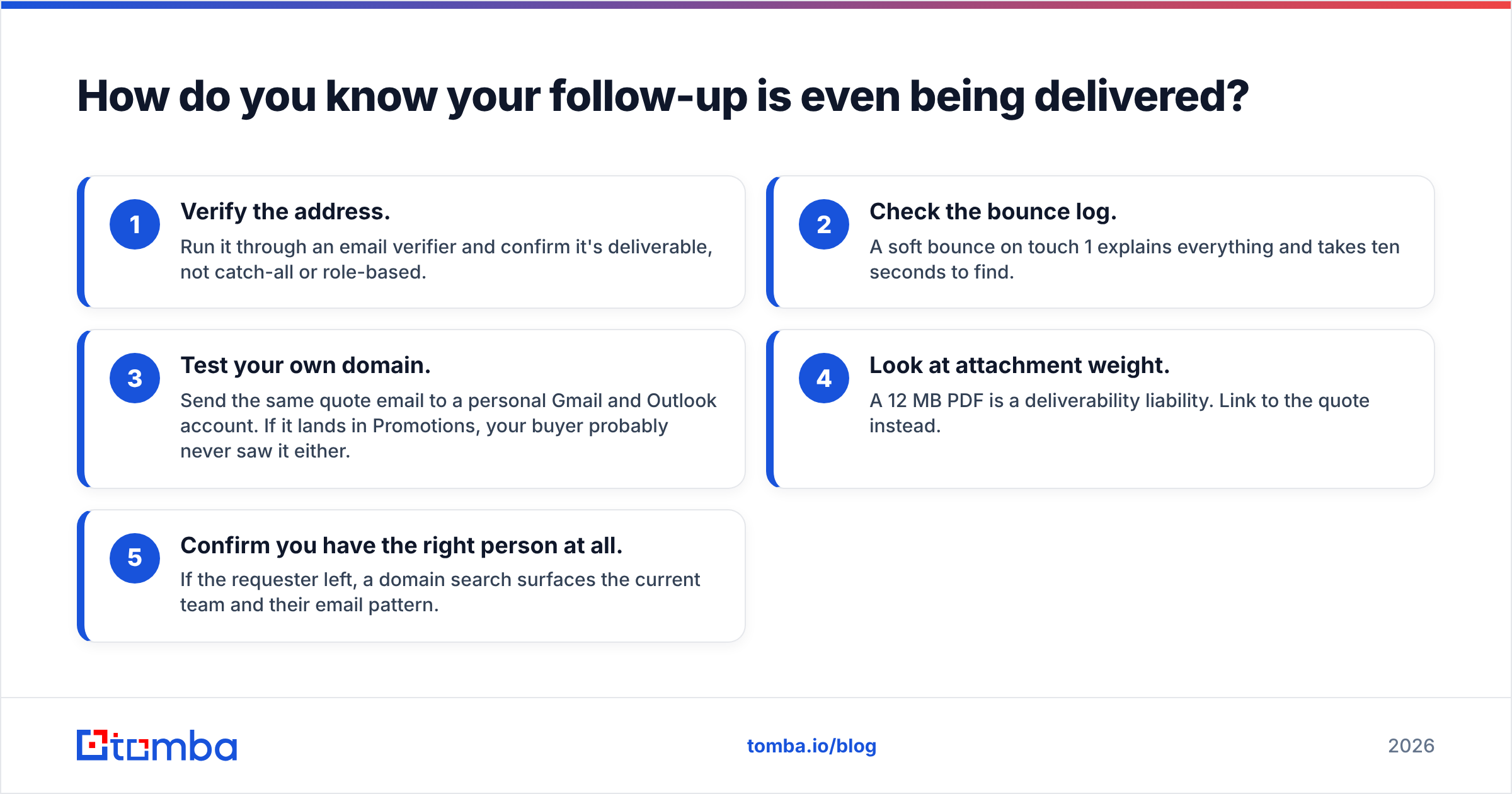
Run this checklist before touch 3:
- Verify the address. Run it through an email verifier and confirm it's deliverable, not catch-all or role-based.
- Check the bounce log. A soft bounce on touch 1 explains everything and takes ten seconds to find.
- Test your own domain. Send the same quote email to a personal Gmail and Outlook account. If it lands in Promotions, your buyer probably never saw it either.
- Look at attachment weight. A 12 MB PDF is a deliverability liability. Link to the quote instead.
- Confirm you have the right person at all. If the requester left, a domain search surfaces the current team and their email pattern.
That last one comes up more than most reps expect. Contact turnover in B2B buying committees runs high enough that a 60-day deal can lose its champion mid-cycle.
What separates a follow-up that closes from one that annoys?#
One test: could the buyer forward your email to their boss without editing it?
If yes, you wrote something useful. If no, you wrote a status request dressed as an email.
Follow-ups that close:
- Lead with new information. A revised figure, a customer story, a compliance doc, an answer to a question they didn't ask out loud.
- Make forwarding easy. Short paragraphs, one attachment or link, no inside jokes, no "as per my last email."
- Ask a question with a low-cost answer. "Is this still a Q3 priority, or should I check back in January?" is answerable in five words.
- Name the silence without guilt-tripping. "You've probably got bigger fires" beats "I haven't heard from you."
- Keep the subject line specific. "Quote follow-up" is invisible. "Line 3 question" gets opened.
Follow-ups that annoy:
- "Just circling back" with no new content. This is the most-sent and least-effective quote follow-up in existence.
- Guilt framing. "I've reached out three times" makes their non-response your grievance.
- Reply-all escalation without warning. Copying their VP on touch 2 to force a reply reliably destroys the relationship.
- Discount panic. Cutting price on touch 2 tells them the original number was fiction and teaches them to wait you out.
- Daily pings. Frequency reads as desperation, and desperation reads as a weak product.
The discount point deserves emphasis. If you drop 20% because someone didn't reply for a week, you've just trained every future buyer to stay silent. Hold price until you've heard an actual objection — then trade concessions for something: longer term, faster start, a case study, a referral.
How do you build a repeatable post-quote system?#
Turn the sequence into infrastructure so it survives a busy week.
1. Log the quote as a pipeline stage, not a task. "Quote sent" should be its own sales pipeline stage with an SLA — no deal sits there past 21 days without a documented next step or a closed-lost reason.
2. Pre-write the five touches at quote time. Draft them while the context is fresh, schedule them, then override individual sends when something changes. Writing touch 4 on the fly at 6 p.m. on a Friday is how "just checking in" gets sent.
3. Capture the second and third contacts before you need them. When the quote goes out, find one peer and one senior stakeholder at the account. Enrich them, verify their emails, park them in the record. Then multithreading on touch 3 is a two-minute action rather than a research project.
4. Track reply rate by touch number, not just overall. If touch 1 gets 30% replies and touches 2–5 get 3%, your content is the problem, not your persistence.
5. Set a real recycle date. "Not now" deals are the highest-quality pipeline you own. Book a calendar reminder for the month they named and reference the original quote when you return.
6. Audit your list hygiene quarterly. Stale contacts inflate your non-response rate and quietly damage email deliverability, which then hurts the follow-ups that would have worked.
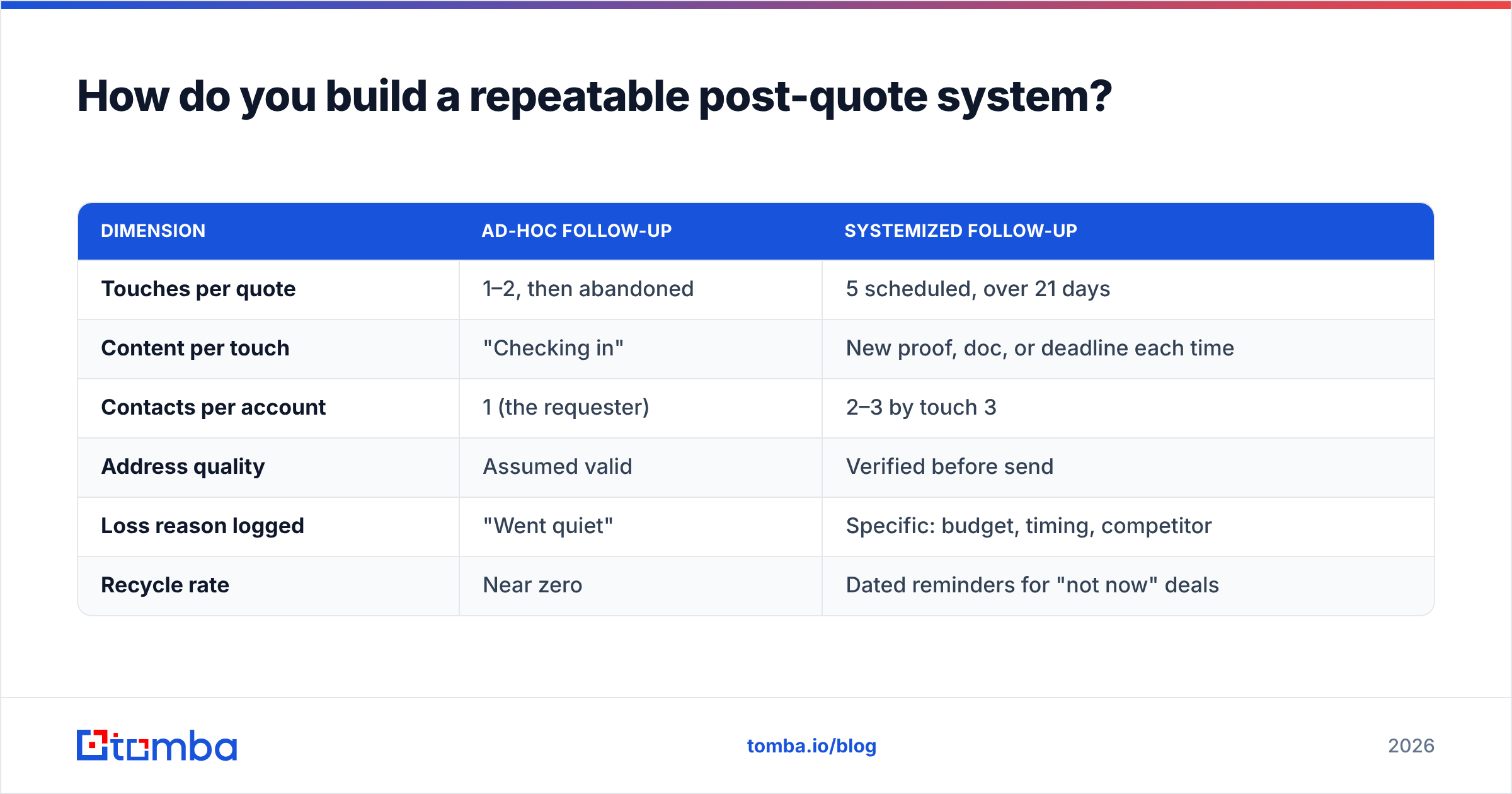
Compare the two operating models side by side:
| Dimension | Ad-hoc follow-up | Systemized follow-up |
|---|---|---|
| Touches per quote | 1–2, then abandoned | 5 scheduled, over 21 days |
| Content per touch | "Checking in" | New proof, doc, or deadline each time |
| Contacts per account | 1 (the requester) | 2–3 by touch 3 |
| Address quality | Assumed valid | Verified before send |
| Loss reason logged | "Went quiet" | Specific: budget, timing, competitor |
| Recycle rate | Near zero | Dated reminders for "not now" deals |
The second column isn't more work per deal — it's the same work, moved to a moment when you have time to do it well.
What tools help most after the quote goes out?#
Fewer than vendors would like you to believe. You need three things: accurate contact data for the people you weren't introduced to, confidence that your emails are landing, and a place to schedule the sequence.
Your CRM or sequencer handles scheduling. Deliverability is a domain-configuration problem — check your SPF record, DKIM, and DMARC once, properly. Where most teams actually lose deals is contact data: the approver whose email they never had, the champion who changed jobs, the finance lead who should have been on the thread from day one.
Independent review sites like G2 are useful for shortlisting sequencer tools, but treat category leaderboards as a starting point rather than an answer — post-quote follow-up performance depends far more on your content and cadence than on which sequencer sends the mail. Peers like BookYourData approach the data side from a prebuilt-list angle, which suits teams who want volume up front rather than lookups per account; both models work, and the right one depends on whether your follow-up is account-specific or list-driven.
Whichever route you take, verify before you send. A follow-up sequence aimed at an address that stopped existing three months ago produces exactly the silence you're trying to fix.
Where should you start this week?#
Pull every quote you've sent in the last 45 days that hasn't received a response. For each one, do three things: verify the recipient's email is still deliverable, identify one additional stakeholder at that account, and send a single touch that contains information you have never sent them before. Not a check-in. A fact.
That exercise typically resurrects one or two deals per rep, and it costs an afternoon.
For the contact-data half of that work, the Tomba Email Finder locates the approver, the finance lead, or the replacement champion by name and domain, and verifies deliverability before you send. The free tier covers 25 searches a month, which is enough to run this audit on a stalled pipeline; paid plans start at $49/mo on Starter and $99/mo on Growth if you need it as a standing part of your workflow. Full Tomba pricing is public — no quote required, which feels like the right note to end on.
Related guides#
Ready to find emails that actually work?
Join 150,000+ professionals who stopped guessing and started sending. Free credits on signup — no credit card required.
Get the Tomba newsletter
Practical outbound tactics and product updates — once every two weeks.
About the author