Follow Up Email After Sending Proposal: 2026 Playbook
Most proposals die in silence, not rejection. Here is the exact follow-up cadence, timing, and templates that pull a decision out of a quiet buyer without sounding desperate.
TL;DR
- Silence after a proposal usually means internal delay, not rejection. Treat it as a process problem, not a rejection problem.
- Send touch one within 48–72 hours, then space touches at 3, 7, 14, and 30 days. Five touches over roughly a month closes more than three touches over ten days.
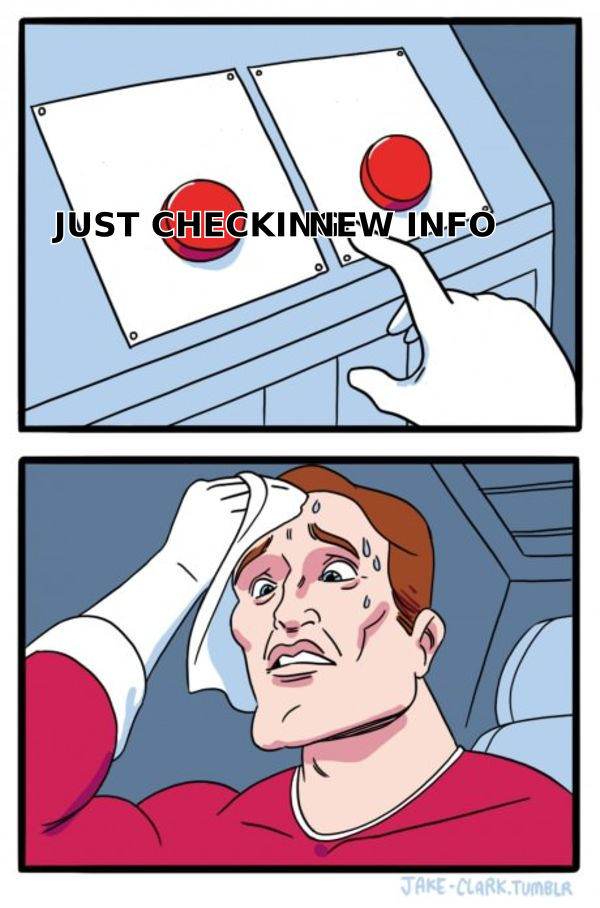
- Every follow-up must carry new information — a case study, a pricing option, a deadline, a risk you spotted. "Just checking in" is the single lowest-response opener in B2B.
- Multi-thread. If your only contact goes dark, you have a single point of failure. Get the CFO, the technical evaluator, and the champion's manager on the thread.
- Verify the addresses you're following up to. A proposal that bounced on send looks identical to a proposal that got ignored, and you'll never know which one happened.
Why does your follow up email after sending proposal get ignored?#
Because your buyer isn't avoiding you — they're stuck. Between the moment they read your proposal and the moment they can say yes, there is usually a procurement review, a security questionnaire, a budget holder who has never heard of you, and two competing priorities from a different department.
The rep's mental model is "they read it and decided against me." The reality is closer to "they read it, liked it, forwarded it to legal, and legal has a 12-day queue." Those two situations look identical from your inbox. They demand completely different follow-ups.
There's a second, less comfortable reason: your follow-up added nothing. When the entire body of your message is a restatement that you sent a proposal, you've asked the buyer to do work — remember, retrieve, decide — while giving them nothing to work with. A follow-up that carries a new artifact (a revised timeline, a reference customer in their vertical, an answer to an objection they haven't raised yet) gives the champion something to forward internally. That's the actual job of the message: arm the person who wants to buy from you.
The third reason is unglamorous. Some follow-ups never arrive. Role changes, typo'd addresses, aggressive spam filtering on a domain that has never received mail from you — all of it produces silence that reads exactly like disinterest. Running the contact through an email verifier before you build a five-touch sequence on top of a dead address costs a few seconds and saves a month of shadowboxing.
What is the right timing for a proposal follow-up?#
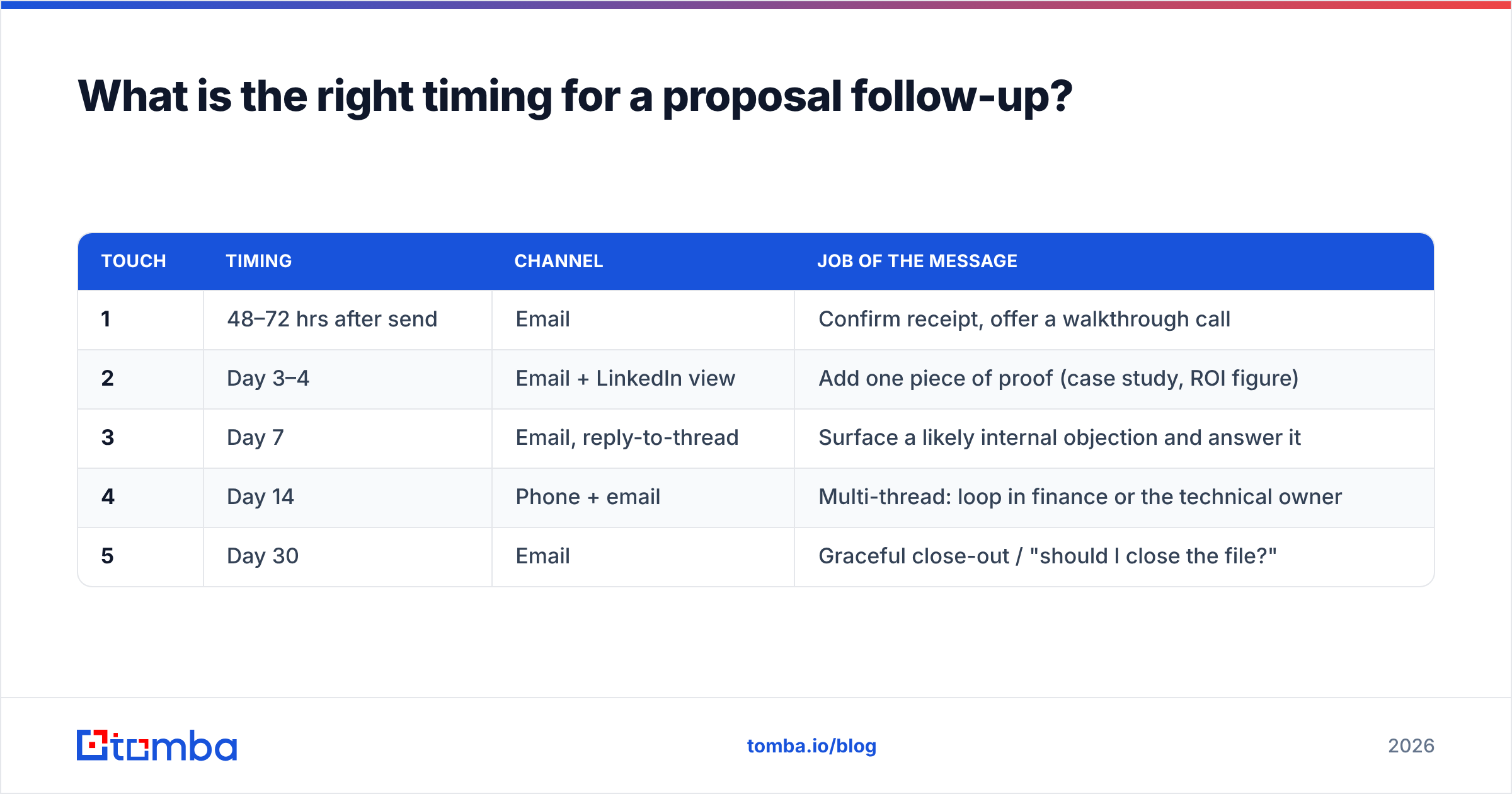
Fast on the first touch, patient after that. The most common failure pattern is the reverse: reps wait a week to send touch one, then panic-send three messages in four days once they get nervous.
Here's a cadence that holds up across most B2B deal sizes:
| Touch | Timing | Channel | Job of the message |
|---|---|---|---|
| 1 | 48–72 hrs after send | Confirm receipt, offer a walkthrough call | |
| 2 | Day 3–4 | Email + LinkedIn view | Add one piece of proof (case study, ROI figure) |
| 3 | Day 7 | Email, reply-to-thread | Surface a likely internal objection and answer it |
| 4 | Day 14 | Phone + email | Multi-thread: loop in finance or the technical owner |
| 5 | Day 30 | Graceful close-out / "should I close the file?" |
Two rules make this cadence work. First, touches 1 through 3 stay in the same email thread — replying keeps the proposal one scroll away and preserves context for anyone the champion forwards it to. Touch 4 and 5 can break out into fresh subject lines because by then the old thread is buried.
Second, adjust for deal size. A $5k proposal that hasn't moved in 21 days is dead; a $250k enterprise proposal at day 21 is routine. Scale the cadence to the buying committee's size, not to your quota anxiety.
Should you follow up on the proposal deadline you set?#
Yes, and this is where most reps leave money on the table. If your proposal carried an expiry date or a pricing validity window, that date is the strongest non-pushy reason to email that exists. It's not you applying pressure — it's a fact of the document. Send a heads-up 5 days before, and a final note on the day itself. Buyers who were genuinely stalled will surface. Buyers who were never going to buy will finally tell you.
What are the five proposal follow-up templates that actually get replies?#
Each of these does a different job. Don't send them in isolation — send them in the sequence above.
1. The 48-hour receipt confirmation. Short, low-friction, gives a reason to reply.
Subject: (reply to original thread)
Hi [Name] — wanted to make sure the proposal landed cleanly, some firewalls eat the attachment. Happy to walk through the implementation timeline on a 15-minute call if it's easier than reading 9 pages. Otherwise I'll assume you're reviewing and check back Thursday.
2. The proof drop. No ask. Pure value. This one gets forwarded internally more than any other.
Subject: The [Competitor Customer] number I mentioned
Hi [Name] — I pulled the actual figures from [Similar Company], who had the same 3-region rollout problem. They went from 14 days to 4 days per region in the first quarter. One-page summary attached in case it's useful for your internal write-up.
3. The objection pre-empt. You name the thing they're worried about before they have to.
Subject: On the migration risk
Hi [Name] — thinking about your side of this: the piece I'd be nervous about is the mid-quarter migration. Here's how we've handled it for two customers on the same stack, plus what it would cost to phase it instead. Does that change the internal conversation at all?
4. The multi-thread. Sent to a second stakeholder, not your champion.
Subject: Proposal for [Company] — finance summary
Hi [Name] — [Champion] has our full proposal; I put together a one-page cost breakdown that's probably more useful for your side of the review. Worth 10 minutes to talk through the payment structure?
5. The graceful close-out. The highest-response follow-up in most sequences, because it's genuinely final.
Subject: Closing the file?
Hi [Name] — I haven't heard back, which usually means priorities shifted. Totally fine. Should I close this out and circle back next quarter, or is it still live on your end? Either answer is helpful.
That last one works because it removes the social cost of saying no. You'd be surprised how often the reply is "no, don't close it — we're just waiting on legal."
Is email or phone better for proposal follow-up?#
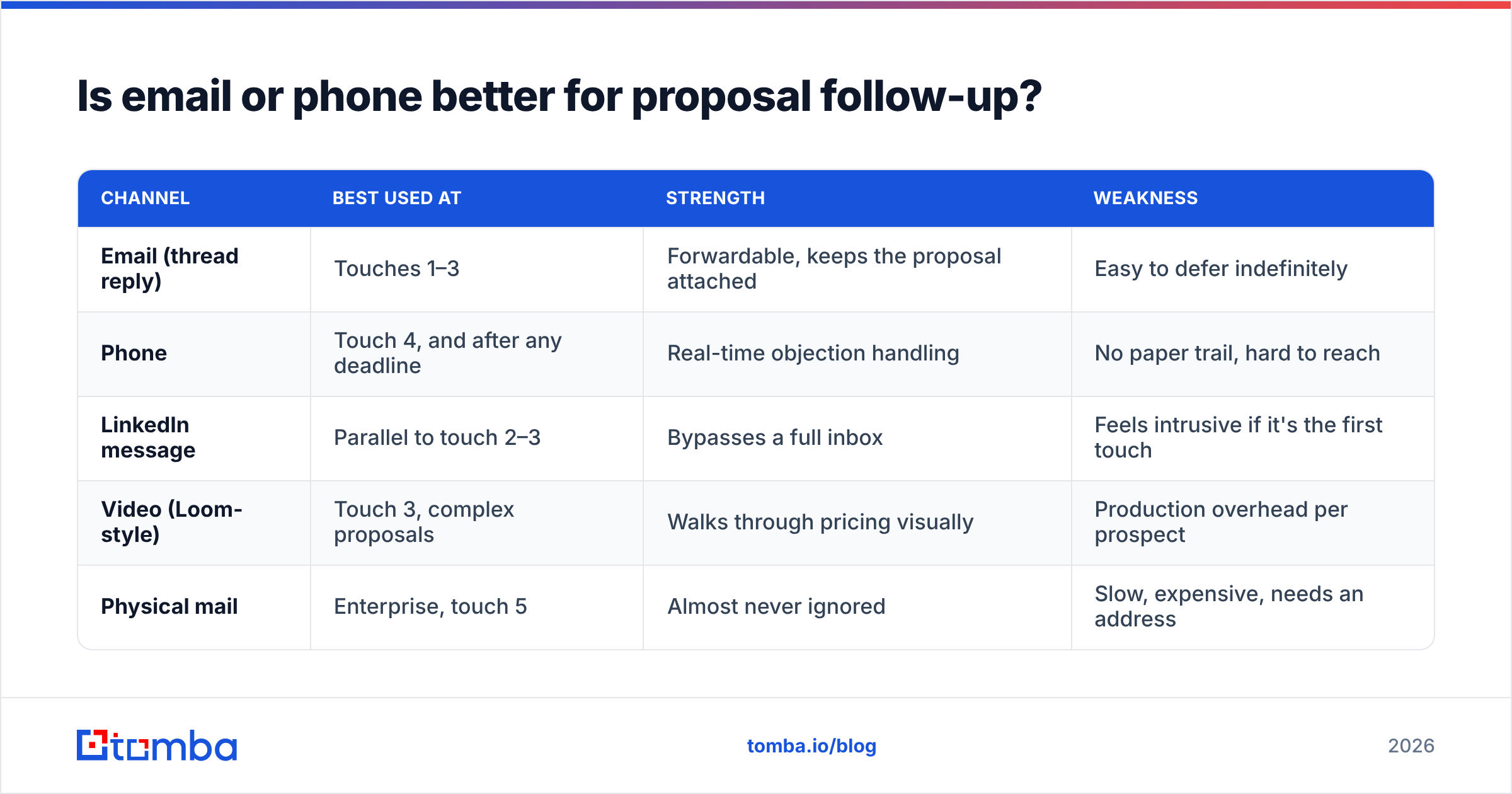
Neither alone. The data across sales-engagement platforms consistently shows multi-channel sequences outperforming single-channel ones, and post-proposal is the stage where a phone call has the highest leverage because the buyer already knows who you are.
| Channel | Best used at | Strength | Weakness |
|---|---|---|---|
| Email (thread reply) | Touches 1–3 | Forwardable, keeps the proposal attached | Easy to defer indefinitely |
| Phone | Touch 4, and after any deadline | Real-time objection handling | No paper trail, hard to reach |
| LinkedIn message | Parallel to touch 2–3 | Bypasses a full inbox | Feels intrusive if it's the first touch |
| Video (Loom-style) | Touch 3, complex proposals | Walks through pricing visually | Production overhead per prospect |
| Physical mail | Enterprise, touch 5 | Almost never ignored | Slow, expensive, needs an address |
The practical rule: email carries the artifact, phone carries the urgency. If you've sent three emails with no reply, the fourth email is not the answer. Pick up the phone — and if you don't have a direct line, a phone finder will usually get you a mobile faster than another round of gatekeeper roulette.
For a deeper breakdown of what moves reply numbers generally, HubSpot's sales research is a reasonable ongoing reference, and G2's sales engagement category shows how vendors are positioning multi-channel cadences in 2026.
How many times should you follow up before giving up?#
Five touches over 30 days, then a quarterly re-entry. That's the answer for most mid-market B2B deals.
Reps under-follow-up far more often than they over-follow-up. The typical rep sends two messages after a proposal and moves on. The deals that close on touch four and five are simply never harvested. On the other side, the rep who sends nine messages in twelve days isn't persistent — they're training the buyer to filter them.
Here's the distinction that matters:
- Persistence with new information — each touch adds an artifact, a stakeholder, or an answer. Buyers read these.
- Persistence with the same information — each touch restates that you're waiting. Buyers filter these.
- Escalating urgency you didn't earn — fake deadlines, "final notice" framing on a $12k deal. This burns the relationship and the referral.
- Silent abandonment — you stop at touch two and never re-enter. This is the most expensive of the four, and the most common.
- Structured re-entry — closed-out deals get a calendar reminder at 90 days with a genuine trigger (funding round, new hire, product launch). This is where a lot of pipeline quietly comes from.
When you do close the file, close it properly. A one-line note saying you're marking it dormant and will check back in Q1 is not a defeat — it's a scheduled re-open with the buyer's implicit permission.
What makes a proposal follow-up subject line work?#
Specificity beats cleverness, and thread continuity beats both.
For touches 1 through 3, don't write a new subject line at all — hit reply. The original subject already contains the deal context, and a fresh subject line orphans the proposal attachment. When you do need a new one at touch 4 or 5, three patterns hold up:
- Reference a concrete artifact: "The migration timeline you asked about"
- Name the stakeholder problem: "For [Name] — finance summary of the [Company] proposal"
- Permission-to-close: "Closing the file?" / "Bad timing?"
What consistently underperforms: "Following up," "Checking in," "Touching base," and anything with an exclamation mark. If you want to pressure-test variants before sending, run them through a subject line tester rather than guessing.
One deliverability note that gets missed: if your follow-ups start landing in spam mid-sequence, your reply rate collapses and you'll misread it as disinterest. Post-proposal emails go to warm contacts, so this is rarer than in cold outbound, but a domain with a broken SPF record or a shaky sender reputation will still get throttled. Worth checking once rather than never.
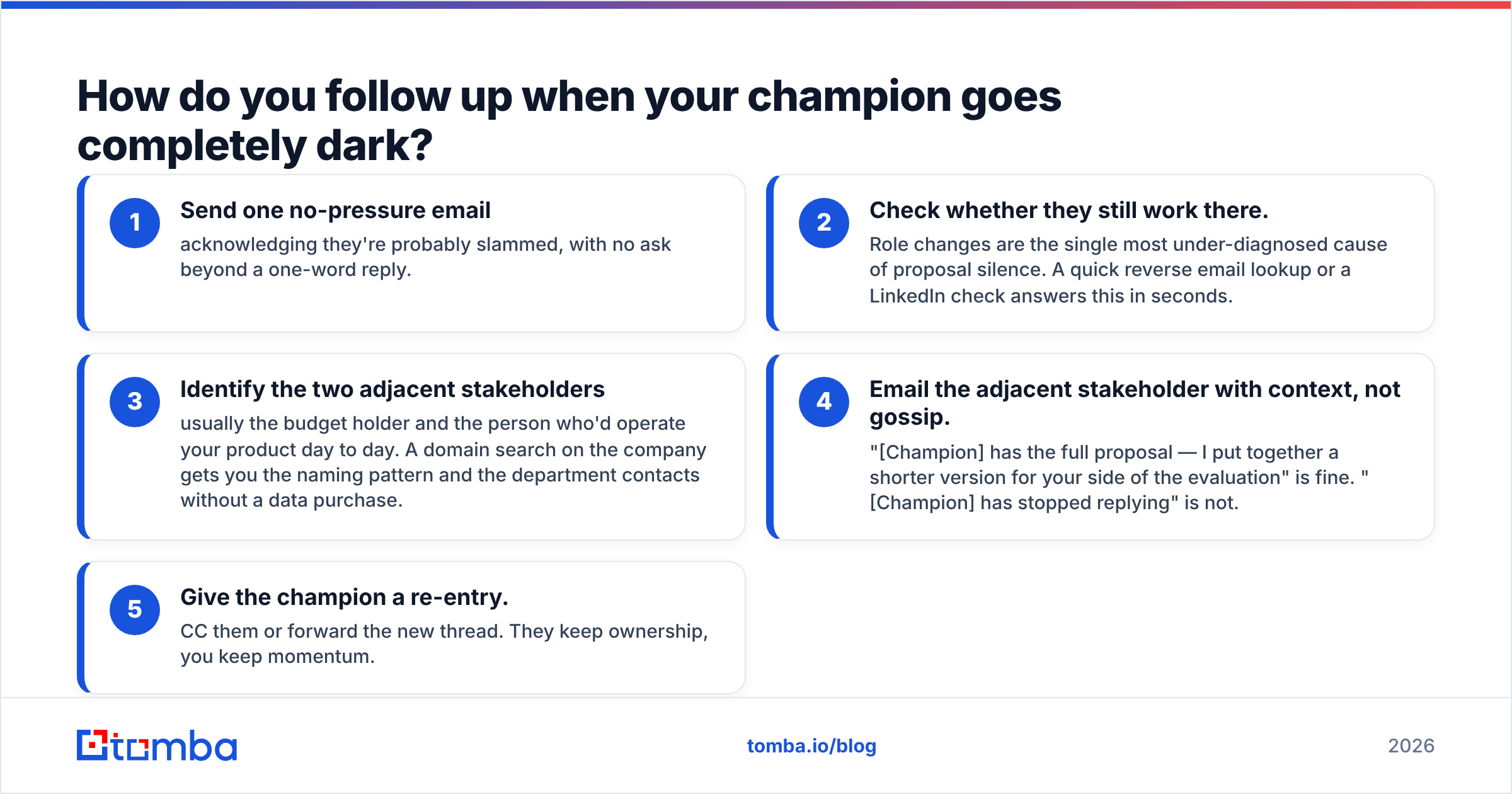
How do you follow up when your champion goes completely dark?#
Assume they've been pulled onto something else, then route around them without embarrassing them.
Champions go quiet for boring reasons: reorg, parental leave, a competing project, a bad quarter. The mistake is to keep emailing the same person harder. The move is to widen the thread while giving your champion an easy way back in.
Practical sequence when a champion disappears:
- Send one no-pressure email acknowledging they're probably slammed, with no ask beyond a one-word reply.
- Check whether they still work there. Role changes are the single most under-diagnosed cause of proposal silence. A quick reverse email lookup or a LinkedIn check answers this in seconds.
- Identify the two adjacent stakeholders — usually the budget holder and the person who'd operate your product day to day. A domain search on the company gets you the naming pattern and the department contacts without a data purchase.
- Email the adjacent stakeholder with context, not gossip. "[Champion] has the full proposal — I put together a shorter version for your side of the evaluation" is fine. "[Champion] has stopped replying" is not.
- Give the champion a re-entry. CC them or forward the new thread. They keep ownership, you keep momentum.
If you're doing this across many deals rather than one, pushing the enriched contacts straight into your CRM via a HubSpot integration beats maintaining a side spreadsheet nobody updates.
What should you track to know if your follow-ups are working?#
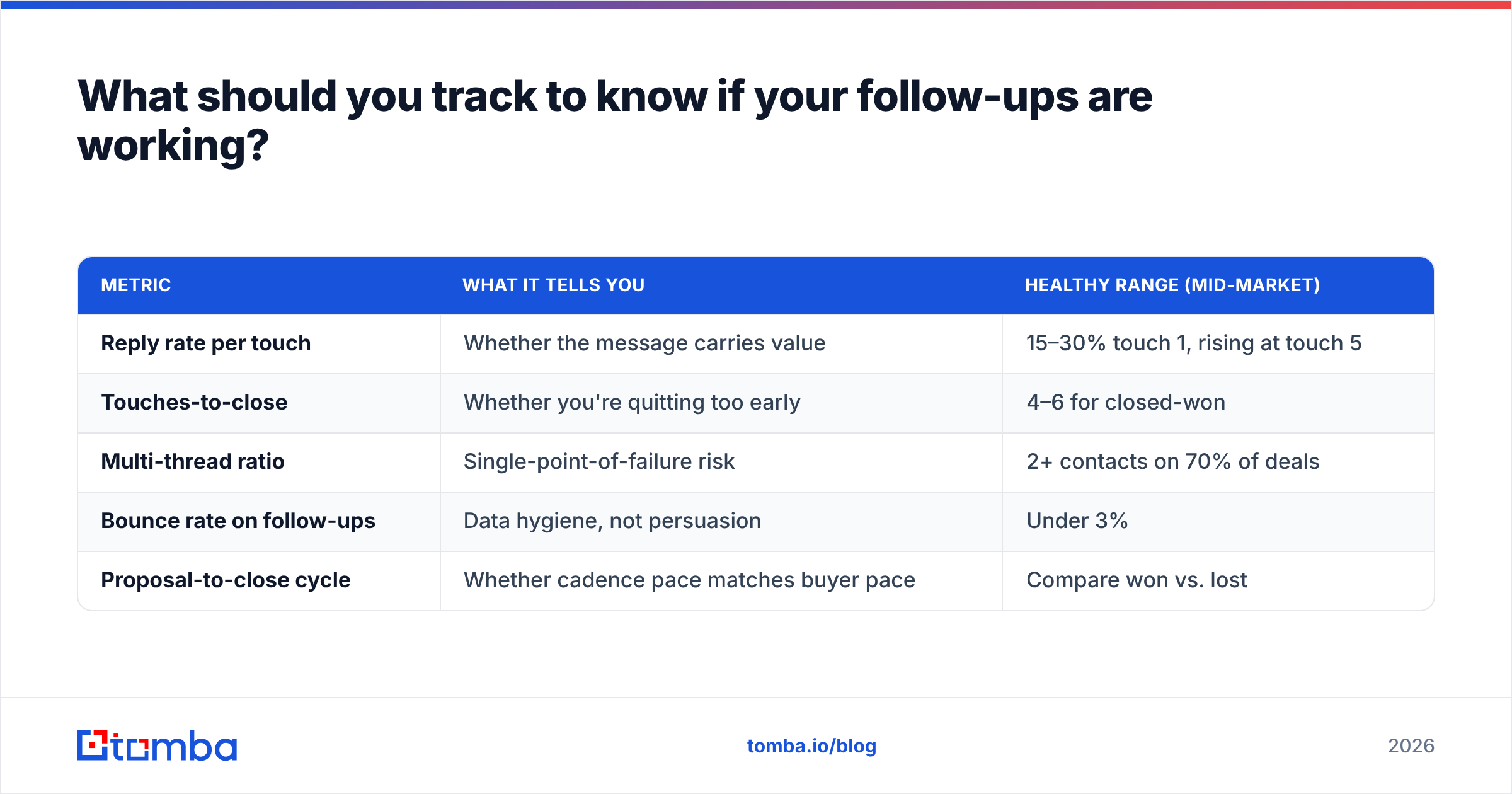
Track four things, and ignore open rates.
| Metric | What it tells you | Healthy range (mid-market) |
|---|---|---|
| Reply rate per touch | Whether the message carries value | 15–30% touch 1, rising at touch 5 |
| Touches-to-close | Whether you're quitting too early | 4–6 for closed-won |
| Multi-thread ratio | Single-point-of-failure risk | 2+ contacts on 70% of deals |
| Bounce rate on follow-ups | Data hygiene, not persuasion | Under 3% |
| Proposal-to-close cycle | Whether cadence pace matches buyer pace | Compare won vs. lost |
Open rates have been unreliable since privacy-protection features started pre-fetching images, and post-proposal is exactly the segment where corporate mail security inflates them most. Reply rate is the only signal worth optimising against.
The bounce-rate line matters more than it looks. If 8% of your follow-ups bounce, roughly one in twelve "unresponsive" prospects never received the message. That's not a persistence problem — it's a data problem wearing a persistence costume. Bulk-checking your active pipeline contacts once a quarter with a bulk verify pass is cheap insurance against phantom silence.
Make sure your follow-ups actually reach a human#
The best proposal follow-up sequence in the world does nothing if it's aimed at an address that stopped working three months ago — or at a champion who left the company two weeks after your call.
Tomba's email finder gets you verified, current addresses for the stakeholders around your deal: the budget holder your champion keeps mentioning, the technical evaluator who never got looped in, the replacement for the contact who quit. Free tier gives you 25 searches a month to test it against your live pipeline; Starter is $49/mo and Growth $99/mo when you're running follow-up sequences at volume — full Tomba pricing is public, no demo call required.
Fix the data layer first. Then the cadence above will tell you something true about your deals instead of something true about your bounce rate.
Related guides#
Ready to find emails that actually work?
Join 150,000+ professionals who stopped guessing and started sending. Free credits on signup — no credit card required.
Get the Tomba newsletter
Practical outbound tactics and product updates — once every two weeks.
About the author