Follow Up Email Best Practices: The 2026 Playbook That Works
Most replies come from follow-ups, not first emails. Here is the cadence, timing, and copy structure that still works in 2026 — plus the mistakes that get you filtered.
TL;DR
- Between 40% and 60% of B2B replies arrive after the first email, so a sequence without follow-ups leaves most of your pipeline unopened.
- Four to six touches over 18–25 days is the range that keeps reply rates climbing without triggering spam complaints. Past touch seven, the curve flattens hard.
- Every follow-up needs a new reason to exist — a fresh angle, proof point, or question. "Just bumping this" is the single most ignored line in B2B email.
- Timing beats volume: 3 days after email one, then 4, then 6, then 7+ works better than daily pestering or a 30-day silence.
- None of this matters if the address is wrong. Bounces from stale contacts destroy sender reputation faster than any copy mistake.
Why do follow up emails matter more than the first email?#
Because the first email is a coin flip on timing, and follow-ups are how you get more flips.
Think of it like knocking on a neighbor's door. One knock at 2pm on a Tuesday tells you almost nothing about whether they're home — it tells you whether they were near the door at 2pm on a Tuesday. Knock three times across a week at different hours and you learn something real.
The same holds in a B2B inbox. Your prospect got 120 emails that day, was in back-to-back calls, and archived everything below the fold. Their non-reply is not a rejection. It's noise.
Aggregate data from outbound platforms consistently puts the share of replies arriving on touch two or later somewhere between 40% and 60%. The exact number varies by industry and list quality, but the direction never flips: sequences with follow-ups outperform single sends, and the gap is not small.
The uncomfortable corollary is that most teams are leaving that on the table. They write one thoughtful email, get silence, and conclude the offer is wrong. Usually the offer was fine and the sequence was one email long.
What does a good follow-up cadence look like in 2026?#
Increasing gaps, four to six touches, roughly three weeks total.
The logic behind increasing gaps: early on, your first email is still fresh in the prospect's memory, so a quick nudge lands in context. Later, you're re-introducing yourself, which needs breathing room to avoid reading as desperate.
Here's the cadence that holds up across most B2B motions:
- Day 0 — The opener. Specific, short, one ask. Reference something real about their company.
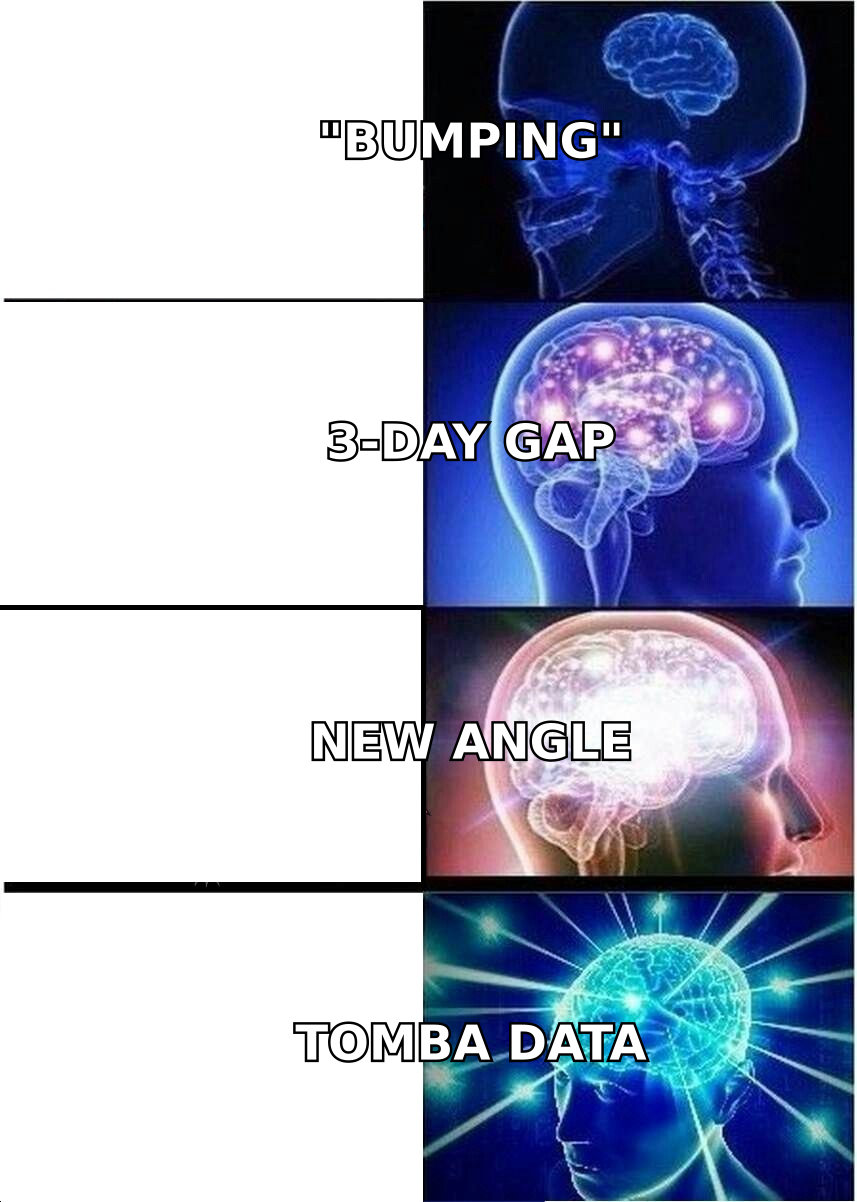
- Day 3 — The reframe. Same problem, different angle. Don't re-explain; re-position.
- Day 7 — The proof. A customer result, a benchmark, a short case detail. Concrete numbers.
- Day 13 — The low-friction ask. Downgrade the ask from "30-minute call" to "worth a look?" or "should I send the one-pager?"
- Day 20 — The breakup. Explicit close-out. Highest single-touch reply rate in most sequences.
- Day 45+ — The re-entry (optional). New trigger only: funding round, new hire, product launch.
Two things to notice. First, the gaps widen — 3, 4, 6, 7. Second, every step has a job. If you can't state in one sentence why touch four exists, delete it.
How many follow-ups is too many?#
Between six and eight, depending on deal size — and the ceiling is reputation, not etiquette.
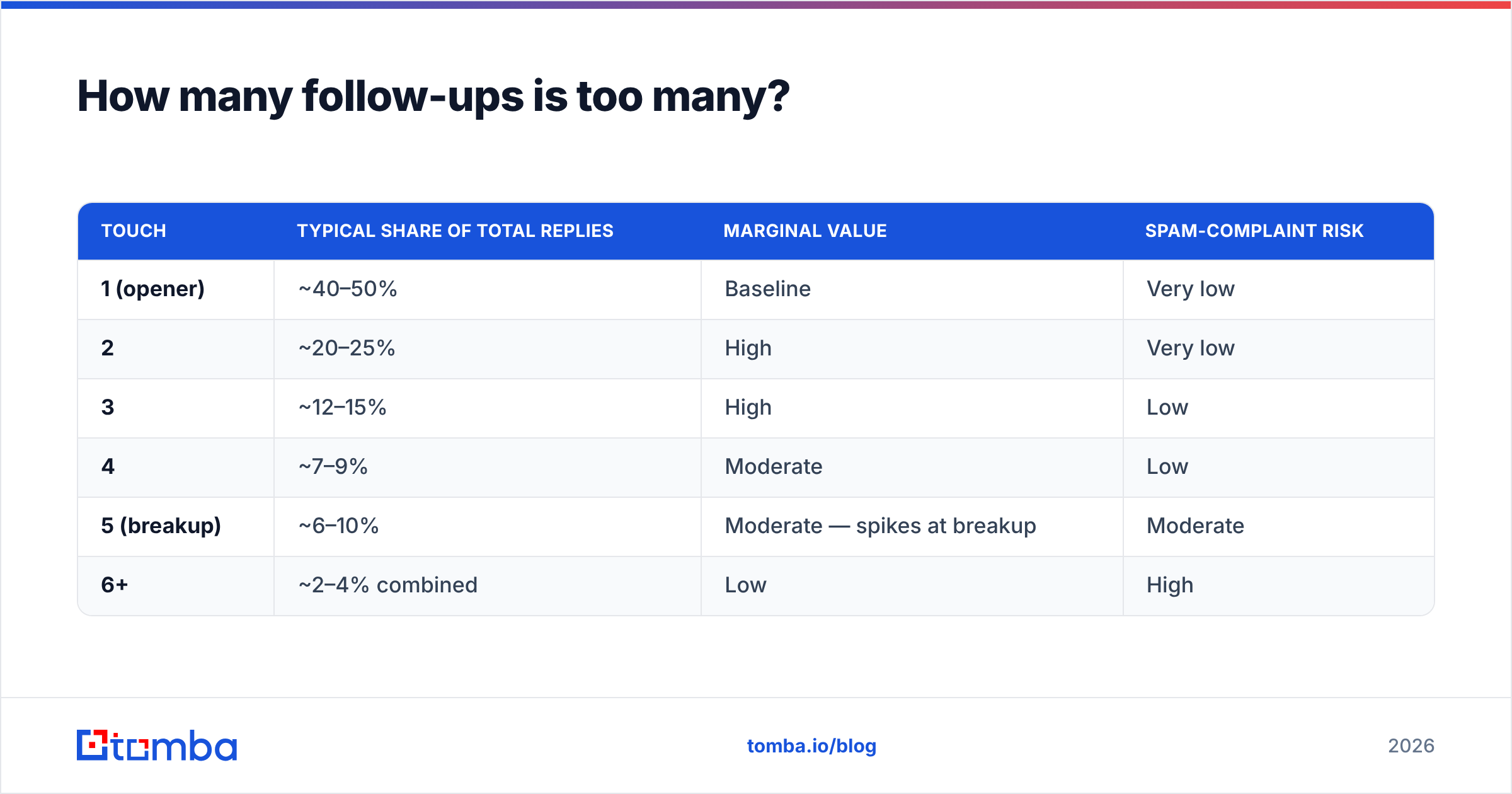
Reply-rate lift per touch decays fast. Touch two adds a lot. Touch three adds a solid amount. By touch six you're picking up scraps, and by touch eight you're mostly collecting spam complaints from people who were never going to buy.
| Touch | Typical share of total replies | Marginal value | Spam-complaint risk |
|---|---|---|---|
| 1 (opener) | ~40–50% | Baseline | Very low |
| 2 | ~20–25% | High | Very low |
| 3 | ~12–15% | High | Low |
| 4 | ~7–9% | Moderate | Low |
| 5 (breakup) | ~6–10% | Moderate — spikes at breakup | Moderate |
| 6+ | ~2–4% combined | Low | High |
The practical rule: for deals under $10k ACV, stop at four. For enterprise deals with committee buying, six is defensible because the cost of a lost deal dwarfs the cost of one more email. Above eight touches in a single sequence, you're not persistent — you're a deliverability liability.
Complaint rate is the number that should govern this. Google and Yahoo's bulk sender requirements pushed the tolerated spam-complaint threshold to 0.3%, and both providers have been explicit that sustained rates above it degrade inbox placement. Sequence length is one of the biggest drivers of that number. Protecting your email deliverability is worth more than the marginal reply on touch nine.
What should each follow-up actually say?#
Give it a new reason to exist. That's the whole rule.
The most common follow-up in B2B — "Hi {{FirstName}}, just bumping this to the top of your inbox" — fails because it adds zero information. You've asked the prospect to spend attention and given them nothing in return. It reads as an obligation transfer.
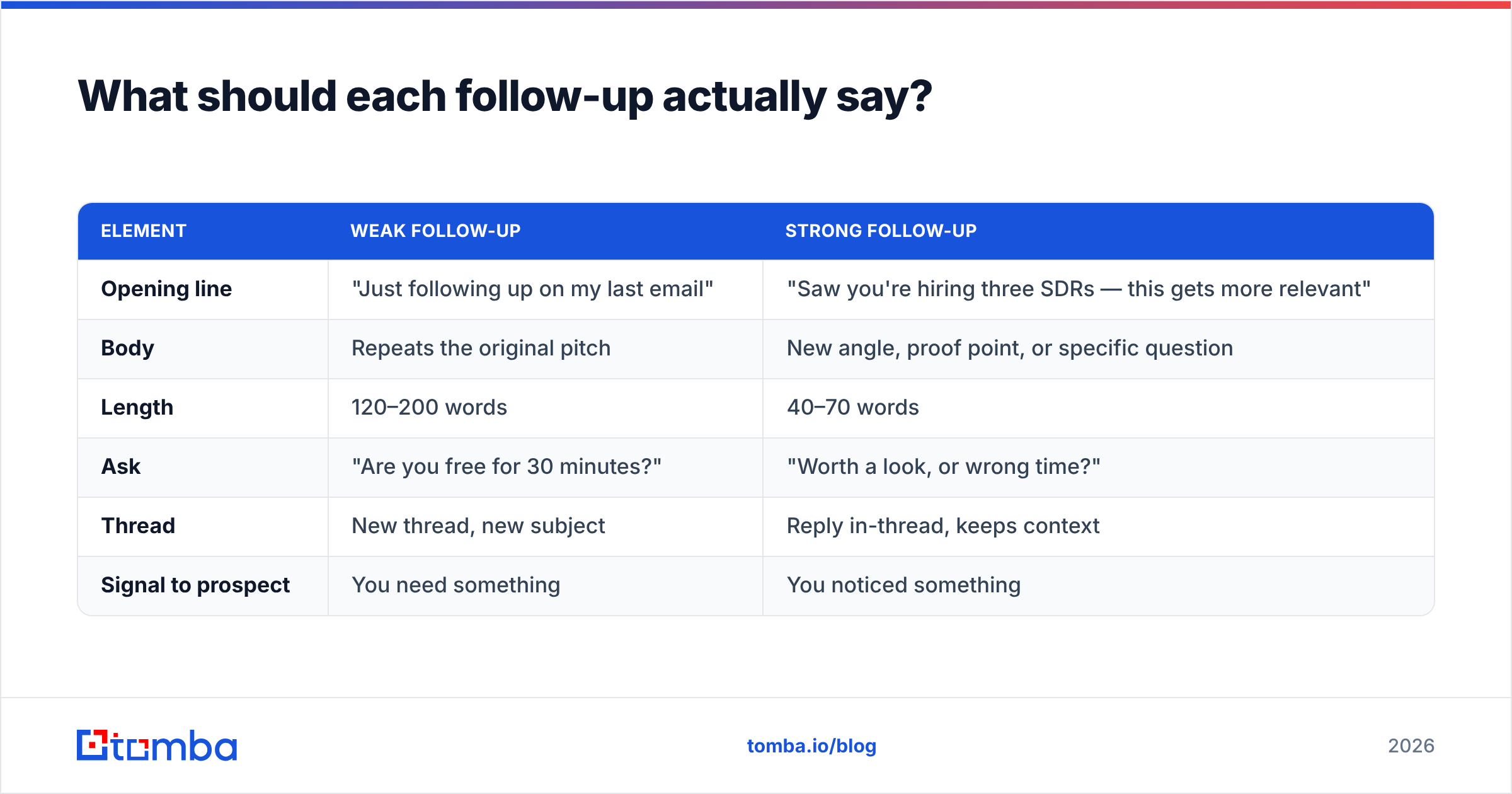
Compare the two structures:
| Element | Weak follow-up | Strong follow-up |
|---|---|---|
| Opening line | "Just following up on my last email" | "Saw you're hiring three SDRs — this gets more relevant" |
| Body | Repeats the original pitch | New angle, proof point, or specific question |
| Length | 120–200 words | 40–70 words |
| Ask | "Are you free for 30 minutes?" | "Worth a look, or wrong time?" |
| Thread | New thread, new subject | Reply in-thread, keeps context |
| Signal to prospect | You need something | You noticed something |
Four angles that reliably carry a follow-up:
- The trigger angle. Something changed at their company. New funding, new exec, a job posting, a product launch. This is the strongest opener available because it's provably about them.
- The proof angle. One customer, one number, one sentence. "Cutting bounce rate from 11% to 2% took a mid-market SaaS team about a week." Not a case study link — a fact.
- The subtraction angle. Reduce the ask. If "book a call" got silence, try "want me to send the two-paragraph version?" Lower cost, higher yes rate.
- The permission-to-close angle. The breakup email. "I'll assume this isn't a priority and close the loop — happy to revisit next quarter." It works because it removes obligation, and people reply to say "actually, wait."
One structural note: reply in the same thread rather than starting fresh. It preserves context, keeps the prospect from re-reading your pitch cold, and avoids the appearance of a new campaign. If you need fresh copy ideas, a subject line generator is useful for the rare cases where a new thread is justified.
When should you send follow-up emails?#
Weekday mornings in the recipient's timezone, and stop obsessing past that.
Send-time optimization is the most over-studied, least impactful variable in outbound. Tuesday through Thursday, 7–10am local, is a reasonable default and roughly where most published benchmarks cluster. But the delta between a good send time and a mediocre one is a few percentage points. The delta between a relevant follow-up and a lazy one is an order of magnitude.
What actually matters about timing:
- Timezone accuracy. Sending at 9am your time to a prospect eight hours ahead means landing at 5pm — buried by morning. Enrich your contacts with location data so this is automatic, not manual.
- Avoiding Mondays and Fridays for the opener. Monday inboxes are triage-mode; Friday afternoons are gone.
- Spacing consistency. Erratic gaps (day 1, day 2, day 19) read as disorganized. The prospect notices.
- Volume pacing per mailbox. Under 50 sends per mailbox per day on a warmed domain. Above that, your follow-ups start landing in spam regardless of copy quality.
That last one is where most sequences quietly die. A perfectly written five-touch cadence delivered to the promotions tab is a five-touch cadence with a zero percent reply rate. Run a spam checker against your templates before the sequence goes live, and confirm your authentication records are clean.
How does data quality affect follow-up performance?#
More than the copy does. A follow-up to a dead address is a bounce that damages every future send.
Here's the mechanic most teams miss: bounces compound across a sequence. If you send five touches to a list with a 12% invalid rate, you don't bounce once per bad contact — you may bounce repeatedly, depending on how your sending platform handles hard-bounce suppression. Mailbox providers read that pattern as a sender who doesn't manage their list, and your sender reputation takes the hit for weeks.
There's also a silent version of this. Catch-all domains accept everything at the SMTP layer and discard invalid mail after the fact. Your bounce report looks clean, your open rate is mysteriously terrible, and you spend a month A/B testing subject lines to fix a data problem. Running catch-all domains through a dedicated catch-all verifier separates the deliverable from the black hole.
The hygiene checklist before any sequence launches:
- Verify every address — not just the ones that look odd. Use an email verifier pass on the full list.
- Deduplicate across campaigns. Two reps following up with the same person is worse than no follow-up.
- Suppress prior non-responders from the last 90 days unless you have a new trigger.
- Check role accounts. info@, sales@, and support@ inflate your list and depress your reply rate.
- Confirm the person still works there. Job-change rates in B2B run high enough that a six-month-old list is materially stale.
What tools help you run follow-up sequences well?#
Three categories, and most teams over-buy in one and under-buy in another.
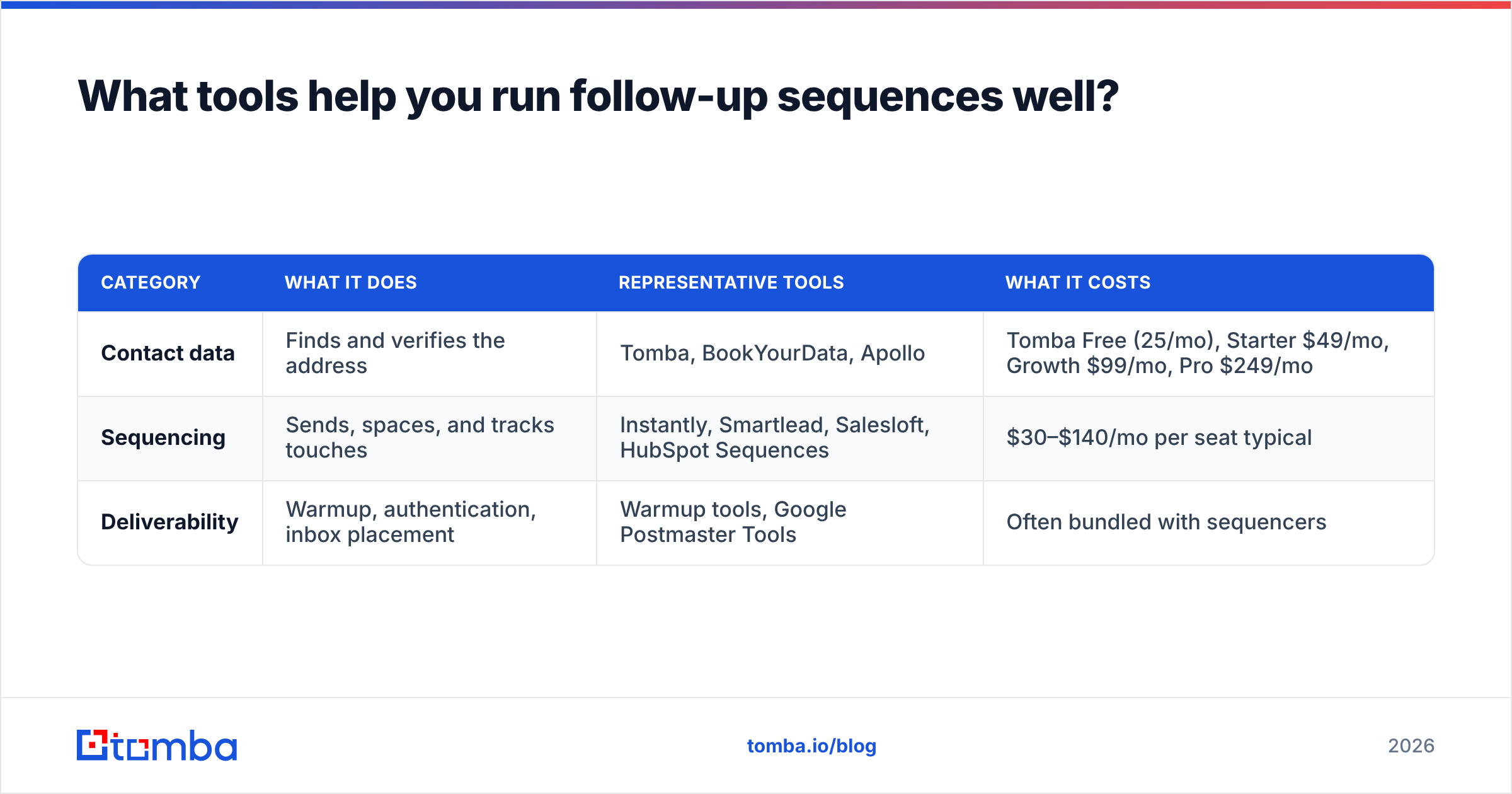
| Category | What it does | Representative tools | What it costs |
|---|---|---|---|
| Contact data | Finds and verifies the address | Tomba, BookYourData, Apollo | Tomba Free (25/mo), Starter $49/mo, Growth $99/mo, Pro $249/mo |
| Sequencing | Sends, spaces, and tracks touches | Instantly, Smartlead, Salesloft, HubSpot Sequences | $30–$140/mo per seat typical |
| Deliverability | Warmup, authentication, inbox placement | Warmup tools, Google Postmaster Tools | Often bundled with sequencers |
The over-buying happens on sequencers — teams pay for enterprise orchestration when a five-touch cadence needs a spreadsheet and a scheduler. The under-buying happens on data. A $30/mo sequencer running on a list you scraped for free will underperform a basic sequencer running on verified contacts, every time.
For sourcing, both Tomba and BookYourData are reasonable starting points depending on how you like to buy — Tomba is search-and-verify by domain or name with a usable free tier, BookYourData leans toward pre-built list purchase with pay-as-you-go credits. Check current Tomba pricing against your monthly contact volume; the Starter tier at $49/mo covers most solo and small-team outbound. For sequencing, HubSpot's sequences documentation is a solid reference on cadence mechanics even if you use a different tool, and G2's sales engagement category gives you honest side-by-side reviews without the vendor gloss.
If your follow-ups need to reference something specific — the author of a post the prospect published, a phone number for a multi-channel touch — pulling that from an author finder or phone finder beats manual research at scale.
What are the most common follow-up mistakes?#
The list is short and every item is fixable this week.
- Guilt-tripping. "I've reached out three times now" makes the prospect's non-reply their problem. It isn't. Never reference how many times you've emailed.
- The fake urgency. "Prices go up Friday" on a product where they don't. Prospects who've been in B2B for more than a year read this instantly and disqualify you.
- Re-pitching the same thing louder. If the value prop didn't land in email one, repeating it in email three won't help. Change the angle.
- Attachments in early touches. They tank deliverability and nobody opens an attachment from a stranger. Link or paste inline.
- The 400-word follow-up. Follow-ups should be shorter than the opener, not longer. Forty to seventy words.
- No exit. Every sequence needs a breakup email. Without it you either stop silently (wasting the highest-converting touch) or keep going forever (destroying your domain).
One more that's less obvious: sending follow-ups from a domain you also use for transactional or customer mail. If a cold sequence tanks your reputation, it takes your invoices and password resets with it. Use a separate sending domain for outbound. Always.
How do you measure whether your follow-ups are working?#
Track reply rate by touch number, not just campaign-level averages.
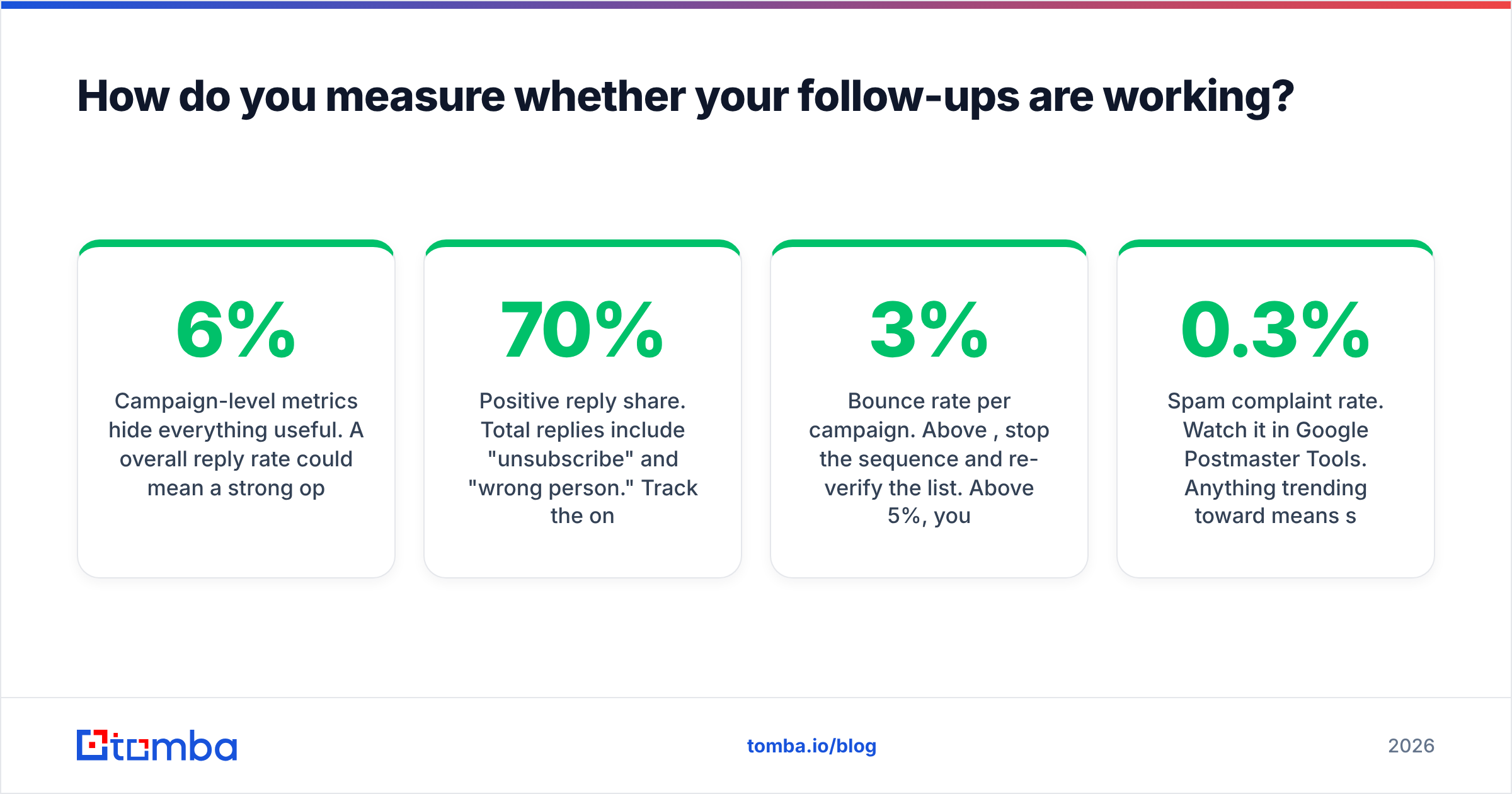
Campaign-level metrics hide everything useful. A 6% overall reply rate could mean a strong opener and dead follow-ups, or a weak opener rescued by touch three. Those two situations need opposite fixes.
The four numbers worth a dashboard:
- Reply rate per touch. If touch three underperforms touch four, your third email is the problem — rewrite it, don't delete the sequence.
- Positive reply share. Total replies include "unsubscribe" and "wrong person." Track the ones that advance a deal separately. Your response rate means nothing if 70% of it is negative.
- Bounce rate per campaign. Above 3%, stop the sequence and re-verify the list. Above 5%, you have a data-sourcing problem, not a hygiene problem.
- Spam complaint rate. Watch it in Google Postmaster Tools. Anything trending toward 0.3% means shorten the sequence or tighten targeting.
Review these weekly, change one variable at a time, and give each change at least 200 sends before you judge it. Most teams change three things at once and learn nothing.
Getting started#
Follow-ups are the highest-leverage, lowest-effort improvement available in outbound — but only on top of contact data that's actually correct. Every touch you send to a dead address is a small withdrawal from your sender reputation, and the balance runs out faster than most teams expect.
Start with the list. Tomba Email Finder finds professional addresses by domain, name, or company and verifies them before they enter your sequence, so your four-touch cadence lands in four inboxes instead of bouncing twice. The free tier gives you 25 searches a month to test it against contacts you already know, and Starter runs $49/mo when you're ready to scale the volume. Fix the data, then fix the copy — in that order.
Related guides#
Ready to find emails that actually work?
Join 150,000+ professionals who stopped guessing and started sending. Free credits on signup — no credit card required.
Get the Tomba newsletter
Practical outbound tactics and product updates — once every two weeks.
About the author