Follow Up Email Business Proposal: Templates That Close Deals
Most proposals die in silence, not rejection. Here is the follow-up cadence, timing data, and seven templates that turn a sent proposal into a signed one.
TL;DR
- Proposals rarely die from a "no" — they die from silence. Internal reprioritisation, budget freezes, and a champion who went quiet kill more deals than price does.
- A follow up email business proposal sequence should run 5–7 touches over 30 days, each one carrying new information instead of "just checking in."
- Timing beats cleverness: the first follow-up goes 48–72 hours after send, not 24 hours and not two weeks.
- Multi-thread early. If only one contact has your proposal, your deal has a single point of failure.
- Track opens on the proposal document, not just the email, so your follow-up references what they actually read.
Why do business proposals go silent?#
Because your proposal landed in someone's week, not in a vacuum.
Think of it like handing a detailed renovation quote to a homeowner who is also dealing with a leaking roof, a school run, and a mother-in-law visiting Sunday. Your quote is good. It is also number nine on a list of eight things. Nothing about that is personal, and treating it as personal is exactly what ruins the follow-up.
Technically, three things usually cause the silence:
- The proposal reached one person, not the buying committee. Gartner's B2B buying research has consistently found that a typical complex purchase involves 6–10 decision-makers. Your champion has to sell internally, and they're worse at selling your product than you are. See Gartner's buying-group research for the underlying data.
- The proposal answered "what" but not "why now." Without a compelling event, "later" is always the cheapest decision.
- Your follow-up gave them nothing new to react to. "Just bumping this up" is a request for labour with no payment attached.
The fix is not more persistence. It is better payload per touch.
What does a good follow-up cadence look like?#
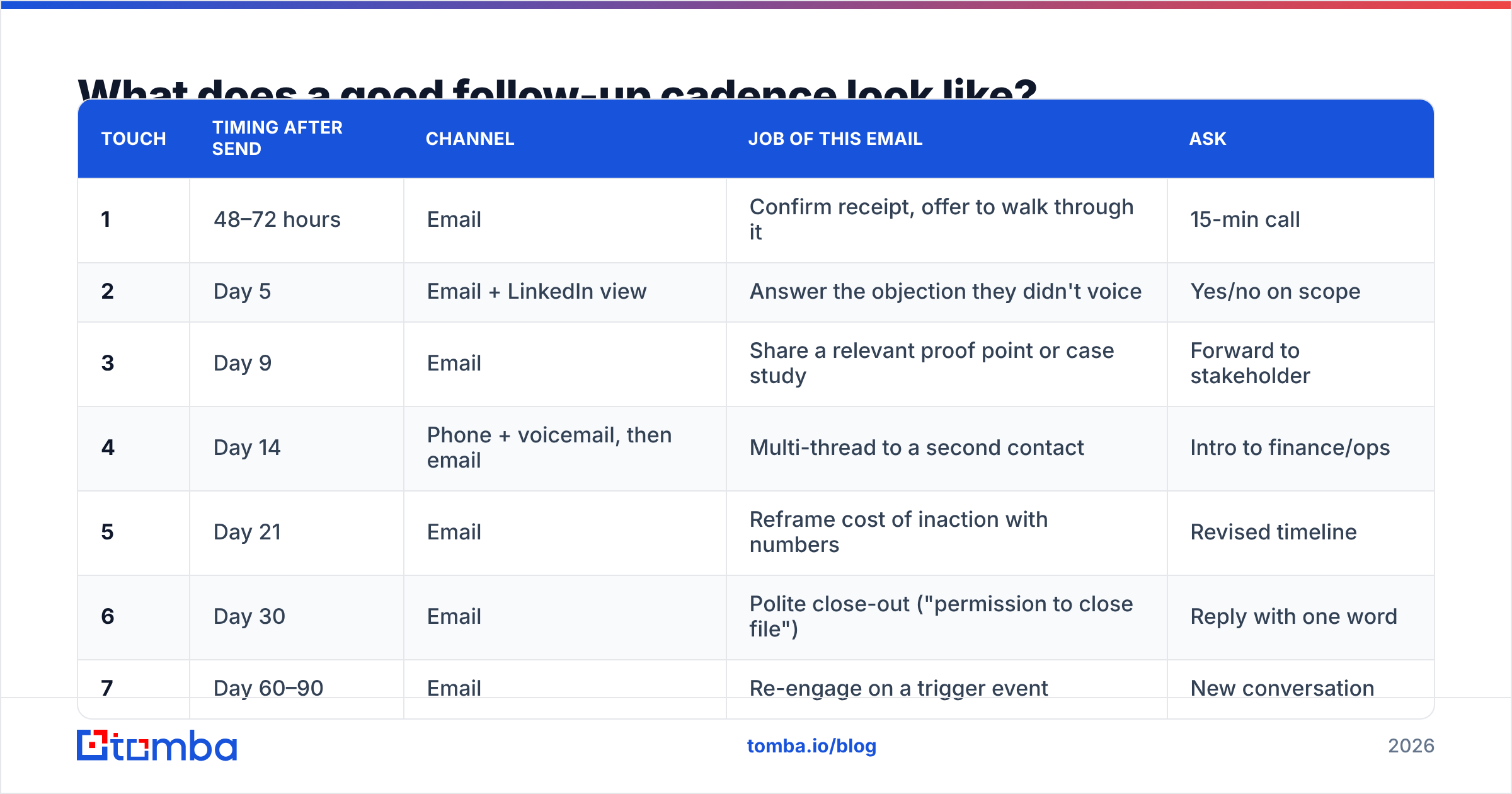
Here is the structure that consistently outperforms ad-hoc nudging. Each touch has a distinct job — none of them repeat the previous one.
| Touch | Timing after send | Channel | Job of this email | Ask |
|---|---|---|---|---|
| 1 | 48–72 hours | Confirm receipt, offer to walk through it | 15-min call | |
| 2 | Day 5 | Email + LinkedIn view | Answer the objection they didn't voice | Yes/no on scope |
| 3 | Day 9 | Share a relevant proof point or case study | Forward to stakeholder | |
| 4 | Day 14 | Phone + voicemail, then email | Multi-thread to a second contact | Intro to finance/ops |
| 5 | Day 21 | Reframe cost of inaction with numbers | Revised timeline | |
| 6 | Day 30 | Polite close-out ("permission to close file") | Reply with one word | |
| 7 | Day 60–90 | Re-engage on a trigger event | New conversation |
Two rules make this work.
Rule one: never send two touches with the same ask. If touch one asks for a call and touch two asks for a call, touch two is noise. Vary the ask by size — a call is expensive, a yes/no reply is cheap, a forward is cheap and useful.
Rule two: escalate the channel, not the tone. Moving from email to phone to a second contact is escalation. Getting passive-aggressive is not.
What should each follow-up email actually say?#
Use these as skeletons, not scripts. Every one is short on purpose — proposal follow-ups over 120 words get skimmed.
Touch 1 — the 48-hour confirm (send 2 days after the proposal)
Subject: The Acme proposal — one thing to flag
Hi Dana,
Sent the proposal Tuesday. One thing I want to flag before you read too far: the implementation timeline on page 4 assumes your Salesforce migration finishes in Q2. If that slips, we'd restructure phase one and the number changes.
Worth 15 minutes to confirm? Tuesday or Thursday afternoon both work.
— Sam
Why it works: it is not a check-in, it is a correction. You are giving them a reason to open the document.
Touch 2 — the unvoiced objection (day 5)
Subject: The bit of the proposal people usually push back on
Hi Dana,
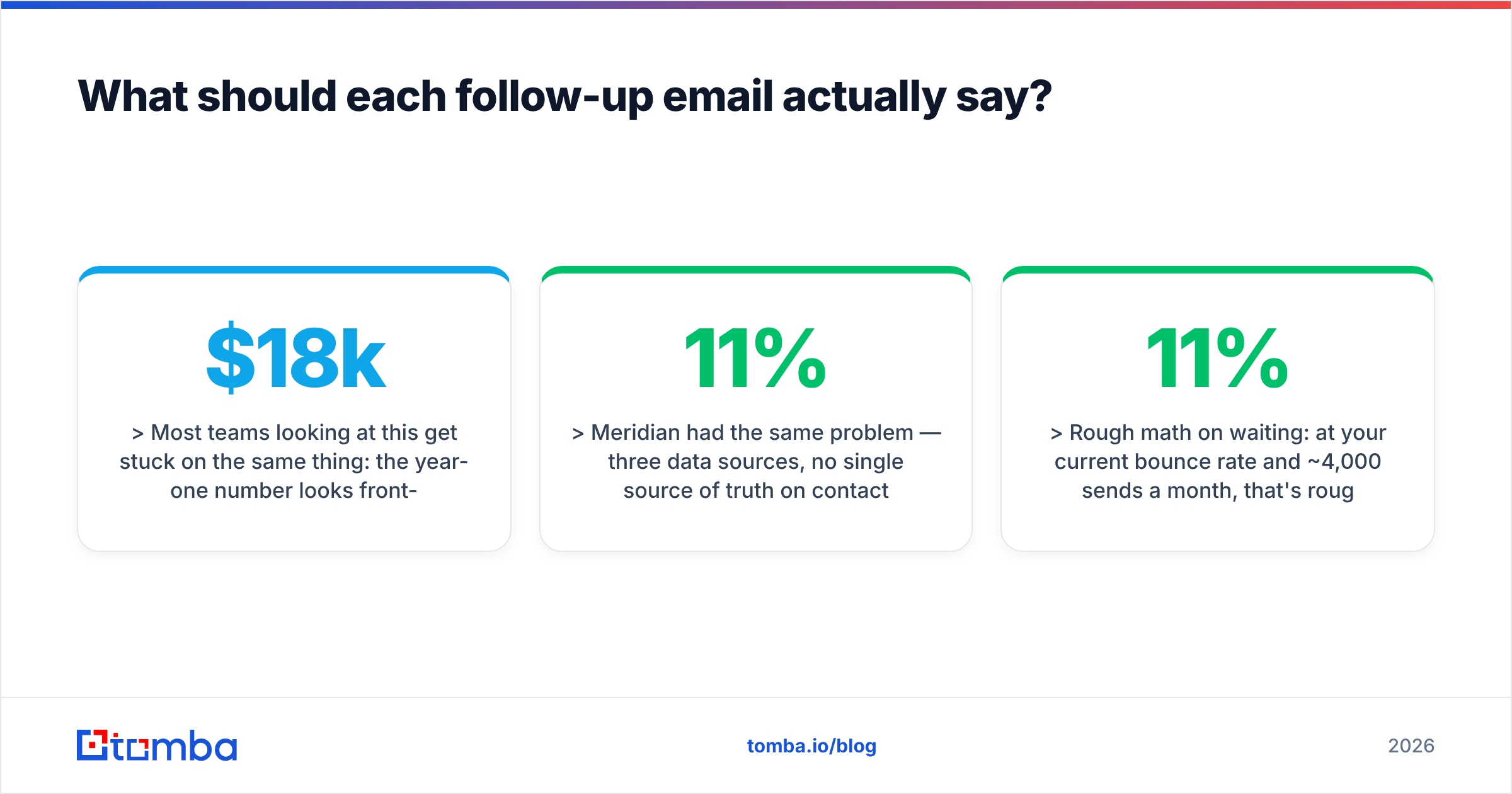
Most teams looking at this get stuck on the same thing: the $18k year-one number looks front-loaded next to your current tooling spend.
Two ways we've handled that — quarterly billing, or a scoped pilot on one region first. Neither changes the outcome, both change the cash flow.
Which one is closer to what your finance team would want to see?
— Sam
Why it works: it names the objection before they have to. Naming it costs you nothing and buys enormous credibility.
Touch 3 — the proof point (day 9)
Subject: Similar setup to yours (Meridian, 40-person sales team)
Hi Dana,
Meridian had the same problem — three data sources, no single source of truth on contact accuracy. They ran the pilot version of what's in section 2 and cut their bounce rate from 11% to under 3% in six weeks.
Two-page write-up here if it's useful for your internal case: [link]
Happy to send a version you can forward without my logo on it.
— Sam
That last line does more work than the case study. Champions need ammunition, not marketing.
Touch 4 — the multi-thread (day 14)
Subject: Should I be talking to someone in ops too?
Hi Dana,
Guessing this needs a nod from whoever owns the ops budget. Rather than keep pinging you, is there someone I should loop in directly? Happy to run a 20-minute version of the walkthrough for them so you're not stuck relaying it.
If it's easier, I can send you a two-paragraph summary to forward.
— Sam
If you don't know who that second contact is, find them before you send this. A domain search on the company's website will surface the org's email pattern and named contacts in operations, finance, or IT, and running those through an email verifier before you send stops a bounce from wrecking your sender reputation on an account you've already invested in.
Touch 5 — the cost of inaction (day 21)
Subject: What the delay is costing (rough math)
Hi Dana,
Rough math on waiting: at your current 11% bounce rate and ~4,000 sends a month, that's roughly 440 wasted contacts monthly. At your stated $180 cost-per-qualified-lead, the delay runs about $6k a month in burned pipeline.
Not a pressure tactic — just the number I'd want if I were on your side of this.
Still worth doing, or has the priority shifted?
— Sam
Touch 6 — the close-out (day 30)
Subject: Closing the file?
Hi Dana,
I'll assume the timing isn't right and stop following up. No hard feelings at all — I'd rather be useful than annoying.
Reply "later" and I'll check back in Q1. Reply "no" and I'll close it out cleanly.
— Sam
This email has the highest reply rate of any in the sequence. It works because it removes the obligation, which is exactly what was creating the avoidance.
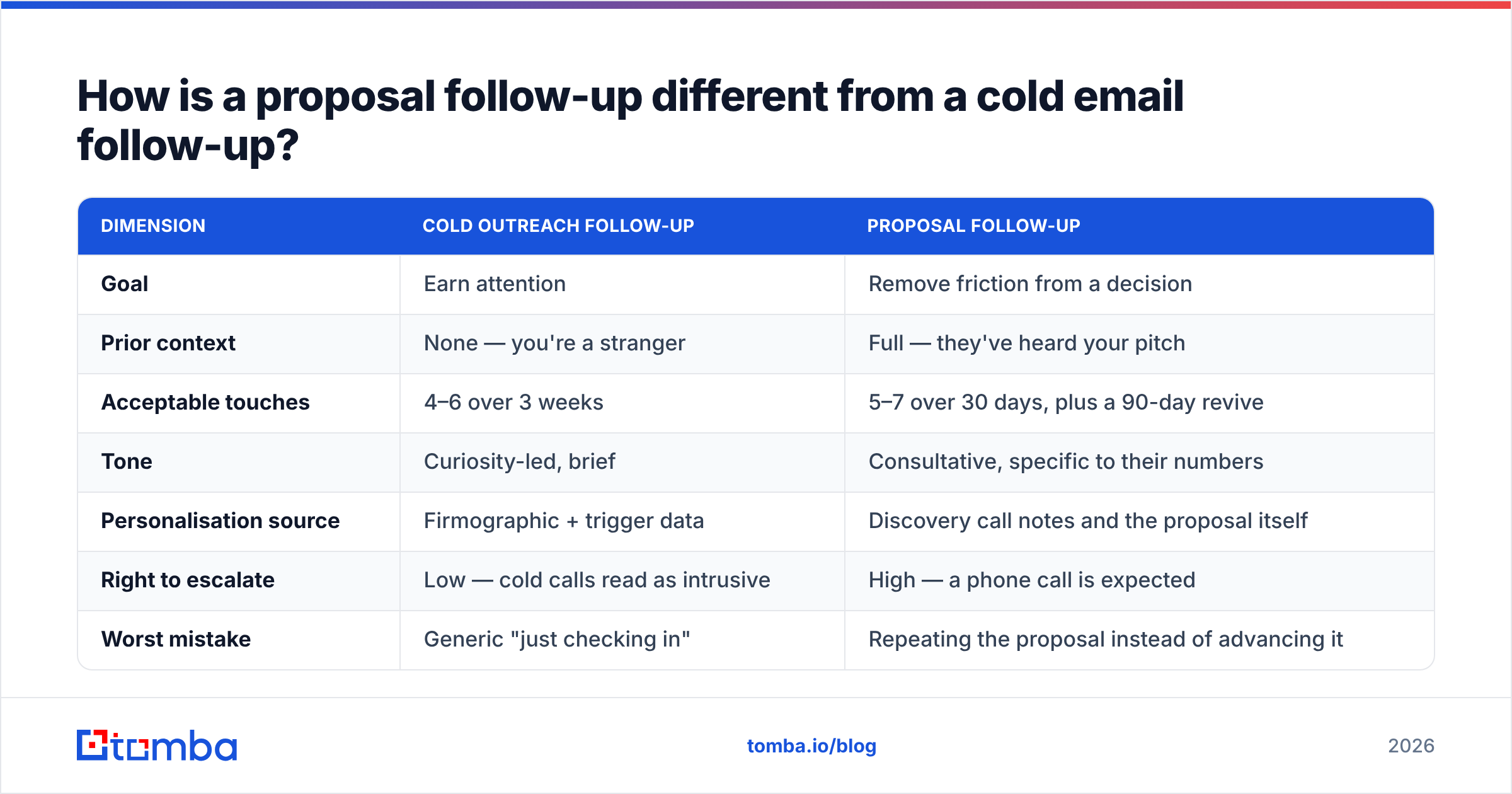
How is a proposal follow-up different from a cold email follow-up?#
They are not the same job, and using cold-email tactics on a warm proposal is a common own-goal.
| Dimension | Cold outreach follow-up | Proposal follow-up |
|---|---|---|
| Goal | Earn attention | Remove friction from a decision |
| Prior context | None — you're a stranger | Full — they've heard your pitch |
| Acceptable touches | 4–6 over 3 weeks | 5–7 over 30 days, plus a 90-day revive |
| Tone | Curiosity-led, brief | Consultative, specific to their numbers |
| Personalisation source | Firmographic + trigger data | Discovery call notes and the proposal itself |
| Right to escalate | Low — cold calls read as intrusive | High — a phone call is expected |
| Worst mistake | Generic "just checking in" | Repeating the proposal instead of advancing it |
| Ideal length | 50–80 words | 60–120 words |
The single biggest difference: in cold outreach you're competing for attention against everything in the inbox. In proposal follow-up you're competing against the buyer's own internal inertia. That means your job shifts from being interesting to being easy to say yes to.
Practically, that means shrinking the ask. "Do you want to move forward?" is a large, scary question. "Can you confirm the Q2 timeline is still accurate?" is a small one — and a reply to a small question reopens the thread.
When is the best time to send a proposal follow-up?#
The honest answer: cadence matters far more than the hour of day, but the hour is not nothing.
- First follow-up: 48–72 hours. Twenty-four hours reads as anxious. A week reads as disinterested. Two to three days is long enough that they've had a chance to read it, short enough that the conversation is still warm.
- Tuesday through Thursday, 8–10am local time remains the most reliable window in most B2B datasets, including HubSpot's send-time research. Monday is triage day, Friday is deferral day.
- Never send the close-out email on a Friday afternoon. You will get the "no" purely because it's the cheapest thing to do at 4:45pm.
- Match their reply pattern. If your contact has replied twice at 7:12am, that's your window. Stop guessing, read the thread.
One caveat on timing tools: scheduling every email for the same minute of the same weekday makes your sending pattern look automated to filters and to humans. Vary it by 20–40 minutes.
What kills a follow-up sequence?#
Five failure modes, in rough order of frequency.
- "Just checking in." It transfers work to the buyer and adds zero information. If you cannot state what is new in this email, do not send this email.
- Sending to a single contact. If your champion changes jobs — and in B2B roughly one in five does within a year — your deal leaves with them. Multi-thread by touch four at the latest.
- Bouncing on the second contact. You found a name on LinkedIn, guessed the email format, and hit a hard bounce on a domain where you already have an active thread. Guessing formats is a solved problem — use a find email addresses lookup or an email permutator and verify before sending.
- Re-attaching the same PDF. Sending the identical document again signals you have nothing to add. Send a one-page summary, a revised option, or a stakeholder-specific version.
- Giving up at touch three. Most reps stop between touch two and three. Most positive replies to proposal sequences arrive at touch four or later. The gap between those two facts is where quota lives.
There's a sixth, subtler one: following up without ever revisiting the proposal itself. If your buyer's situation changed — new budget cycle, new headcount, a competitor's announcement — the right move is a revised proposal, not a fifth nudge on a stale one.
How do you build the contact data behind a multi-threaded follow-up?#
Multi-threading is the highest-leverage change you can make, and it is fundamentally a data problem before it's a writing problem.
The workflow that scales:
- Map the buying group before the proposal goes out. Pull the company's contact roster and identify who owns budget, who owns implementation, and who owns the pain. You want these names in your CRM before you need them, not on day 14 in a panic.
- Verify every address at the point of use. A contact enrichment pass on the account fills in titles, seniority, and LinkedIn profiles so your second-contact email doesn't open with a wrong-role assumption.
- Watch for catch-all domains. Many enterprises accept everything at the SMTP layer, which means a "valid" result is meaningless without deeper checks. A dedicated catch-all verifier separates real mailboxes from black holes — important when the address in question is the CFO you get one shot at.
- Keep a phone fallback. By touch four, email-only is a liability. Having a direct dial turns a stalled thread into a two-minute conversation.
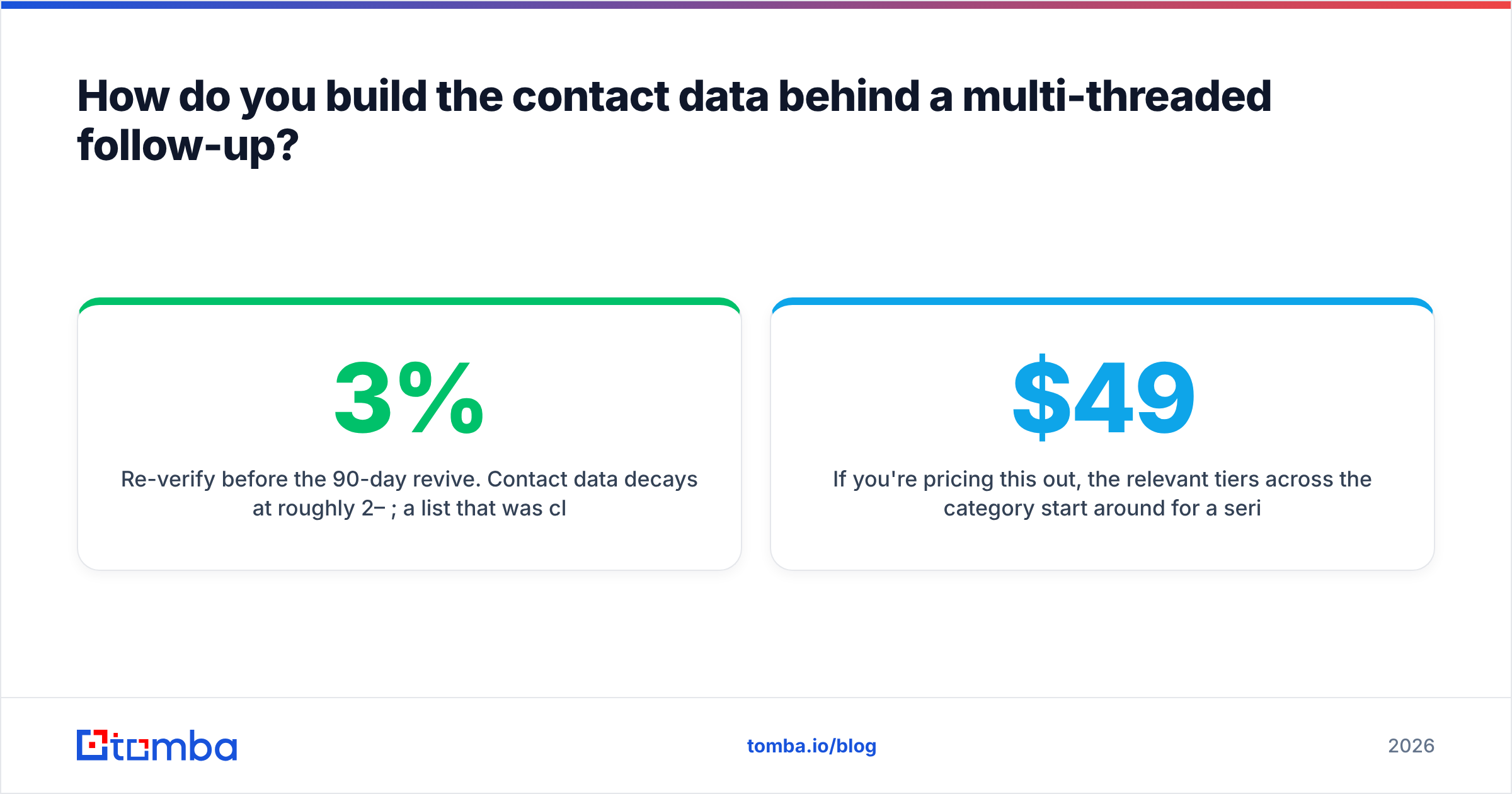
- Re-verify before the 90-day revive. Contact data decays at roughly 2–3% per month; a list that was clean in March is measurably stale by July.
If you're pricing this out, the relevant tiers across the category start around $49/mo for a serious volume of lookups — Tomba's Starter plan sits at that level with Growth at $99/mo, and peers like BookYourData take a pay-as-you-go approach that suits teams with lumpy, project-based needs rather than steady monthly usage. Full Tomba pricing is public if you want to compare line by line.
What should you measure?#
Reply rate is the headline number, but it hides the interesting failure.
Track these four:
- Reply rate by touch number. If touch four outperforms touch two, your sequence is too short — extend it. If everything after touch three is dead, your later emails have no new payload.
- Positive reply rate vs. total reply rate. "Not now" is a reply. Separate it, or you'll optimise for volume of noise.
- Multi-thread rate. What percentage of proposals have two or more engaged contacts by day 14? Under 40% is a structural problem.
- Proposal open rate. Not the email open — the document. If they never opened the PDF, your follow-up should be about access and format, not about the price.
The one metric people over-index on is send-time open rate. It correlates with almost nothing that matters once the relationship is warm, and chasing it distracts from the two things that do move outcomes: how many stakeholders you reach, and whether each email carries new information.
Ready to stop losing proposals to silence?#
Every template above assumes one thing: that you can actually reach the second, third, and fourth person in the buying group when your champion goes quiet. That is where most sequences quietly break.
Tomba's Email Finder gives you verified, role-mapped contacts on the accounts already in your pipeline — so when touch four says "should I loop in ops," you already know exactly who ops is and that the address will land. Start free with 25 searches a month, and scale to Starter at $49/mo when multi-threading becomes standard practice instead of a scramble.
The proposal you sent last week is probably still winnable. It just needs a better next email.
Related guides#
Ready to find emails that actually work?
Join 150,000+ professionals who stopped guessing and started sending. Free credits on signup — no credit card required.
Get the Tomba newsletter
Practical outbound tactics and product updates — once every two weeks.
About the author